

The breast implant lawsuit is one of the largest medical device legal battles heading into 2026. Thousands of women have filed claims against manufacturers like Allergan and Johnson and Johnson. These lawsuits allege that certain implants caused cancer, autoimmune disorders, and a range of debilitating symptoms now called breast implant illness.
If you have breast implants and you are dealing with unexplained health problems, you may be entitled to compensation. Estimated settlement amounts range from $50,000 to over $500,000 depending on the type of injury and the manufacturer involved.
This article breaks down every major development for 2026. You will learn which companies are being sued, what conditions qualify, how much money is at stake, and exactly how to file a claim before deadlines pass.
Here is one number that puts it in perspective: the FDA has received more than 150,000 adverse event reports related to breast implants since its reporting system began.
Breast Implant Lawsuit Update 2026
The breast implant lawsuit is entering a critical phase in 2026, with several cases approaching trial dates and settlement talks gaining momentum. Courts are pushing for resolution after years of pretrial motions and discovery battles.
The Allergan textured breast implant MDL (MDL No. 2921) in the U.S. District Court for the District of New Jersey remains the largest consolidated case. Bellwether trials, which serve as test cases for the broader litigation, are expected to produce verdicts that could shape settlement negotiations for thousands of pending claims.
Johnson and Johnson faces its own wave of lawsuits through its subsidiary Mentor Worldwide. These cases center on both textured and smooth implants linked to various health complications.
| 2026 Milestone | Expected Timeframe |
|---|---|
| Allergan bellwether trials | Mid-2026 |
| Mentor implant case rulings | Q2 to Q3 2026 |
| New filings deadline (varies by state) | Ongoing through 2026 |
| Potential global settlement talks | Late 2026 |
The FDA continues to monitor breast implant safety and has required manufacturers to conduct post-market studies. Results from those studies could influence both pending and future lawsuits.
New plaintiffs are still joining the litigation. If you have not filed yet, 2026 may be one of the last windows to do so in certain states due to statute of limitations deadlines.
Breast Implant Lawsuit Settlement Amounts
Settlement amounts in breast implant lawsuits vary widely based on the type of injury, medical costs, and the specific manufacturer being sued. No global settlement has been finalized as of early 2026, but individual cases and early verdicts give a picture of what claimants might expect.
Women diagnosed with BIA-ALCL, a rare cancer linked to textured implants, tend to have the strongest claims. These cases often involve the highest payouts because the harm is severe and well documented.
Autoimmune and breast implant illness claims carry lower projected payouts. That is because the science connecting implants to systemic symptoms is still evolving, making these cases harder to prove in court.
| Injury Type | Estimated Settlement Range |
|---|---|
| BIA-ALCL (cancer) | $200,000 to $750,000+ |
| Autoimmune disorders | $75,000 to $300,000 |
| Breast implant illness (systemic) | $50,000 to $200,000 |
| Implant rupture with complications | $40,000 to $150,000 |
| Capsular contracture (severe) | $30,000 to $100,000 |
These numbers come from analysis of prior medical device settlements and attorney projections. Think of it like a car accident claim: the more severe the damage and the clearer the fault, the higher the compensation.
Your actual payout depends on your medical records, out-of-pocket costs, lost wages, and the strength of evidence tying your condition to the implant.
Who Qualifies for the Breast Implant Lawsuit
You may qualify for the breast implant lawsuit if you received breast implants and later developed serious health complications. The key question is whether your specific implant and condition match the claims being made in active litigation.
You likely qualify if:
- You received Allergan Biocell textured breast implants
- You were diagnosed with BIA-ALCL after implant surgery
- You developed autoimmune symptoms after receiving silicone implants
- You needed explant surgery due to implant failure or illness
- You experienced capsular contracture requiring additional procedures
You may still qualify if:
- You have Mentor or Sientra brand implants linked to complications
- You developed chronic fatigue, joint pain, brain fog, or other systemic symptoms after implantation
- Your implants ruptured and caused silicone migration
There is no requirement that your implants were part of a formal recall. Many lawsuits involve implants that were never officially recalled but still caused harm.
Your state’s statute of limitations determines how long you have to file. In most states, you have two to three years from the date you discovered (or should have discovered) your injury.
Key Takeaway: Breast implant lawsuits in 2026 are approaching trial, with cancer-related claims valued at $200,000 to $750,000+ and eligibility extending to anyone harmed by implants from major manufacturers.
Breast Implant Cancer Lawsuit
The breast implant cancer lawsuit primarily involves BIA-ALCL, a type of non-Hodgkin lymphoma that develops in the scar tissue around breast implants. The World Health Organization formally recognized this cancer’s connection to breast implants, giving plaintiffs strong scientific backing.
Most cancer cases target textured implants. The rough surface of these devices appears to trigger an immune response that, in some patients, leads to cancerous cell growth.
As of 2026, hundreds of BIA-ALCL cases have been confirmed worldwide. The FDA has documented over 700 cases in the United States alone, with at least 36 deaths attributed to the disease.
Plaintiffs in cancer lawsuits argue that manufacturers knew about the risk or should have known based on available data. They claim companies failed to warn patients and doctors.
Treatment for BIA-ALCL typically requires implant removal and sometimes chemotherapy or radiation. The physical, emotional, and financial toll is significant, which is why these claims carry the highest settlement projections.
If you were diagnosed with any form of lymphoma after receiving breast implants, you should have your case evaluated immediately. The connection between implants and cancer is now well established enough that courts are taking these claims very seriously.
Allergan Breast Implant Lawsuit
The Allergan breast implant lawsuit is the largest and most advanced of all breast implant litigation in the United States. Allergan, now owned by AbbVie, manufactured the Biocell textured breast implant that was linked to BIA-ALCL and voluntarily recalled in July 2019.
That recall came after the FDA requested it based on mounting evidence of cancer risk. By the time Allergan pulled its textured implants from the market, thousands of women had already been implanted with the devices.
The consolidated MDL in New Jersey includes claims from women across the country. The cases allege that Allergan:
- Knew about BIA-ALCL risks for years before the recall
- Failed to adequately warn surgeons and patients
- Prioritized profits over patient safety
- Continued selling textured implants even as reports of cancer increased
Quick Facts: Allergan Lawsuit
| Detail | Information |
|---|---|
| Product | Biocell textured breast implants |
| Recall date | July 24, 2019 |
| Court | U.S. District Court, District of New Jersey |
| MDL Number | 2921 |
| Parent company | AbbVie (acquired Allergan in 2020) |
| Key allegation | Failure to warn about BIA-ALCL risk |
Early motions to dismiss were denied, which means the cases are moving forward. That is a strong signal for plaintiffs.
AbbVie has substantial financial resources. If settlement talks advance in 2026, the company has the capacity to fund a large-scale resolution.
Johnson and Johnson Breast Implant Lawsuit
The Johnson and Johnson breast implant lawsuit involves Mentor Worldwide, a J&J subsidiary that manufactures both textured and smooth breast implants. While Allergan gets more headlines, J&J’s exposure in this litigation is substantial.
Mentor’s MemoryGel and MemoryShape implants have been named in lawsuits alleging rupture, silicone leakage, capsular contracture, and autoimmune reactions. Some plaintiffs have also filed BIA-ALCL claims against Mentor’s textured products.
J&J has faced scrutiny before in medical device litigation. The company’s track record with products like talcum powder and pelvic mesh gives plaintiffs’ attorneys a playbook for proving corporate negligence.
What makes the J&J cases different from Allergan is the range of products involved. Mentor sells both textured and smooth implants, so the lawsuit covers a broader patient population.
| Manufacturer | Products at Issue | Primary Allegations |
|---|---|---|
| Johnson and Johnson (Mentor) | MemoryGel, MemoryShape, textured and smooth | Rupture, silicone leak, autoimmune, BIA-ALCL |
| Allergan (AbbVie) | Biocell textured | BIA-ALCL, failure to warn |
J&J has historically preferred to fight cases in court rather than settle early. But the sheer volume of claims and growing scientific evidence could push toward settlement discussions in 2026.
If you have Mentor brand implants and have experienced any complications, you are not excluded from filing just because Mentor products were not part of the 2019 recall.
Key Takeaway: Allergan’s Biocell recall created the largest breast implant MDL, but Johnson and Johnson’s Mentor subsidiary faces growing legal pressure in 2026 across multiple implant types.
Breast Implant Lawsuit and Autoimmune Disease
Breast implant lawsuits involving autoimmune disease claim that silicone implants triggered the body’s immune system to attack its own tissues. Women report developing conditions like lupus, rheumatoid arthritis, scleroderma, and Sjogren’s syndrome after receiving implants.
The science here is more contested than in cancer cases. Manufacturers have long argued that implants do not cause autoimmune disease. But a growing body of peer-reviewed research shows a statistical correlation between silicone implants and autoimmune diagnoses.
A 2019 study published in the Annals of Surgery analyzed over 99,000 women and found that breast implant recipients had a significantly higher rate of autoimmune disorders compared to the general population.
Autoimmune conditions linked to breast implants include:
- Rheumatoid arthritis
- Lupus (systemic lupus erythematosus)
- Scleroderma
- Sjogren’s syndrome
- Hashimoto’s thyroiditis
- Mixed connective tissue disease
Proving causation is the biggest hurdle in autoimmune cases. You need medical records showing the onset of symptoms after implantation and expert testimony linking the two.
Think of it this way: if you were perfectly healthy before your implant surgery and then developed an autoimmune condition within a few years, that timeline itself becomes evidence. Your attorney will pair that with expert medical opinions to build your case.
These claims may not reach cancer-level settlements. But they are real, they are growing in number, and courts are allowing them to proceed.
BIA-ALCL Lawsuit
BIA-ALCL stands for Breast Implant-Associated Anaplastic Large Cell Lymphoma. It is a rare cancer of the immune system, not breast cancer. This distinction matters because it changes how the disease is diagnosed, treated, and litigated.
BIA-ALCL typically presents as swelling or fluid buildup around the implant, sometimes years after surgery. Many women initially mistake it for a routine complication. By the time cancer is suspected, the disease may have progressed.
The FDA identified the first cases of BIA-ALCL in 2011 and has been tracking it ever since. The agency now maintains a database with confirmed cases and is requiring manufacturers to study long-term outcomes.
BIA-ALCL by the numbers:
| Statistic | Data |
|---|---|
| Confirmed U.S. cases (FDA) | 700+ |
| Deaths reported (FDA) | 36+ |
| Most linked implant type | Textured surface |
| Primary manufacturer | Allergan (Biocell) |
| Average time to diagnosis | 7 to 10 years post-implant |
Lawsuits allege that manufacturers had early warning signs and failed to act. Internal documents in some cases suggest companies were aware of the cancer link before public disclosure.
If you have been diagnosed with BIA-ALCL, your claim is among the strongest in this litigation. The causal connection is well supported by the FDA, the WHO, and independent medical research.
Treatment typically involves removing the implant and surrounding scar tissue (capsulectomy). Some patients need chemotherapy. All of those costs factor into your potential compensation.
Breast Implant Illness Lawsuit
Breast implant illness, often called BII, refers to a collection of systemic symptoms that some women develop after receiving breast implants. It is not a formal medical diagnosis, but it is a recognized condition among medical professionals and within the legal system.
Symptoms of BII can include chronic fatigue, brain fog, joint and muscle pain, hair loss, skin rashes, difficulty concentrating, and persistent anxiety or depression. These symptoms often appear gradually and worsen over time.
Common BII symptoms reported in lawsuits:
- Chronic fatigue that does not improve with rest
- Joint pain and muscle aches
- Brain fog and memory problems
- Hair loss
- Skin rashes and dryness
- Gastrointestinal issues
- Sleep disturbances
The challenge with BII cases is that no single test confirms the diagnosis. Many women go years seeing specialists who cannot find a cause for their symptoms. When they have their implants removed, symptoms often improve or disappear entirely.
That pattern of symptom relief after explant surgery is powerful evidence in a lawsuit. It shows a direct connection between the implant and the illness, even without a specific blood test or imaging finding.
BII lawsuits are typically valued lower than cancer claims. But they represent a huge share of the total filings. If thousands of BII claimants band together, the collective pressure on manufacturers is enormous.
Courts are increasingly willing to let these cases move forward, especially when plaintiffs have documented symptom timelines and post-explant improvement.
Key Takeaway: Autoimmune, BIA-ALCL, and breast implant illness claims each require different types of evidence, but all three are actively moving through courts in 2026.
Textured Breast Implant Lawsuit
The textured breast implant lawsuit targets devices with a rough, sandpaper-like surface that was designed to help the implant stay in place and reduce capsular contracture. Ironically, that same texture appears to be the primary driver of BIA-ALCL cancer risk.
Allergan’s Biocell line was the most heavily textured product on the market. It was also the implant most frequently linked to BIA-ALCL, which is why it was recalled in 2019. But other manufacturers, including Mentor and Sientra, also sold textured implants.
The surface texture creates more surface area for bacteria to colonize. Some researchers believe this chronic bacterial irritation triggers the immune response that eventually leads to lymphoma.
Not all textured implants carry the same risk. Macro-textured implants like Biocell have a much higher association with BIA-ALCL than micro-textured or nano-textured surfaces. This distinction affects which lawsuits have the strongest foundation.
If you are unsure whether your implants are textured, your surgical records will specify the product type and model number. Your plastic surgeon’s office should have this on file.
Textured vs. Smooth Implant Comparison:
| Feature | Textured Implants | Smooth Implants |
|---|---|---|
| Surface | Rough, granular | Slick, even |
| BIA-ALCL risk | Higher (especially macro-textured) | Very low |
| Capsular contracture rate | Lower (original purpose) | Slightly higher |
| Recall status (Allergan) | Recalled July 2019 | Not recalled |
| Lawsuit activity | Very high | Moderate |
Breast Implant Class Action Lawsuit
There is no single class action lawsuit for breast implants in the traditional sense. Instead, most breast implant cases are consolidated as multidistrict litigation (MDL), which is different from a class action.
In a class action, one verdict or settlement applies to everyone in the class. In an MDL, each plaintiff retains their individual case. The cases are grouped together for efficiency during pretrial proceedings like discovery and motions, but each person’s claim is evaluated on its own facts.
This matters to you because your compensation in an MDL depends on your specific injuries and evidence. You are not just a number in a group.
Class Action vs. MDL:
| Feature | Class Action | MDL (Multidistrict Litigation) |
|---|---|---|
| Individual claim evaluation | No | Yes |
| Shared pretrial proceedings | Yes | Yes |
| Same payout for all members | Usually | No |
| Control over your case | Limited | More control |
| Common in breast implant cases | No | Yes |
The Allergan MDL (No. 2921) is the primary consolidated litigation. Cases from across the country are funneled into this MDL for pretrial work.
Some state-level lawsuits are also proceeding separately. Depending on your state and your specific situation, your attorney may recommend filing in state court rather than joining the federal MDL.
Understanding this distinction helps you make a more informed decision about how to pursue your claim.
Breast Implant Recall Lawsuit
The largest breast implant recall in history occurred on July 24, 2019, when Allergan voluntarily recalled its Biocell textured breast implants worldwide. The FDA requested this recall after identifying a clear link between Biocell implants and BIA-ALCL.
A recall lawsuit is based on the argument that the product was defective and should have been pulled from the market much sooner. Plaintiffs say Allergan had data showing the risk years before the recall and chose to keep selling the product.
The recall covered all Biocell textured breast implants and tissue expanders. It did not include Allergan’s smooth surface implants, which remain on the market.
Key recall facts:
- Allergan recalled Biocell implants at the FDA’s request
- The recall was global, affecting patients in dozens of countries
- Allergan did not offer to pay for removal surgery for asymptomatic patients
- Many women were left to decide on their own whether to have their implants removed
- The recall strengthened existing lawsuits and prompted thousands of new filings
If you received Allergan Biocell implants and have not had them removed, you still have legal options. Even if you have not been diagnosed with cancer, you may be able to file a claim based on the need for medical monitoring or the cost of preventive removal.
Recalls are like a manufacturer admitting there is a problem. In court, the recall itself becomes evidence of a defective product.
Key Takeaway: The 2019 Allergan Biocell recall is the backbone of the largest breast implant MDL, and most cases are handled as individual claims within the MDL structure, not as a traditional class action.
Mentor Breast Implant Lawsuit
Mentor Worldwide, a subsidiary of Johnson and Johnson, is the second-largest breast implant manufacturer facing litigation in 2026. Mentor produces both the MemoryGel (smooth round) and MemoryShape (textured anatomical) implant lines.
Lawsuits against Mentor allege that the company’s implants caused rupture, silicone gel bleeding (where silicone seeps through the shell even without a full rupture), capsular contracture, autoimmune reactions, and in some cases, BIA-ALCL.
Unlike Allergan, Mentor has not issued a voluntary recall of its textured implants. This does not mean the products are safe. It means Mentor has taken a different legal and regulatory approach.
Some plaintiffs argue that Mentor’s failure to recall its textured products is itself evidence of negligence. They point to the FDA’s findings on BIA-ALCL risk across all textured implants, not just Allergan’s.
Mentor Implant Lawsuit Details:
| Detail | Information |
|---|---|
| Parent company | Johnson and Johnson |
| Products at issue | MemoryGel, MemoryShape |
| Key allegations | Rupture, silicone migration, autoimmune, BIA-ALCL |
| Recall issued | No (as of 2026) |
| Court status | Active litigation, individual and consolidated cases |
If you have Mentor implants and are experiencing complications, don’t assume you have no case. The absence of a recall does not shield the manufacturer from liability.
Your medical records, the specific implant model, and the timeline of your symptoms will determine the strength of your claim.
Breast Implant Lawsuit Payout
Breast implant lawsuit payouts are determined by several factors, including the severity of your injury, the type of implant, your medical expenses, and whether a settlement or jury verdict resolves your case. No two payouts are identical.
Jury verdicts tend to be higher than settlements. But verdicts also carry risk because a jury could find in favor of the manufacturer. Settlements provide guaranteed money but usually at a lower amount.
Factors that increase your payout:
- A cancer diagnosis (BIA-ALCL) directly linked to your implant
- Extensive medical treatment, including surgery and chemotherapy
- Lost wages and inability to work
- Emotional distress and diminished quality of life
- Strong documentation of your medical history
Factors that may reduce your payout:
- Pre-existing autoimmune conditions
- Long gaps between implant and symptom onset without medical records
- Implant types with less established risk profiles
- States with caps on certain types of damages
Think of payout determination like grading a test. Every piece of evidence adds points. The more you can prove, the higher your score.
| Payout Factor | Impact on Amount |
|---|---|
| Cancer diagnosis | Highest |
| Autoimmune diagnosis | Moderate to high |
| BII symptoms only | Moderate |
| Implant rupture alone | Lower |
| Strong medical documentation | Increases all categories |
Early settlement offers from manufacturers are almost always below what your case is worth. Most attorneys recommend waiting for a stronger negotiating position before accepting anything.
Breast Implant Lawsuit Eligibility
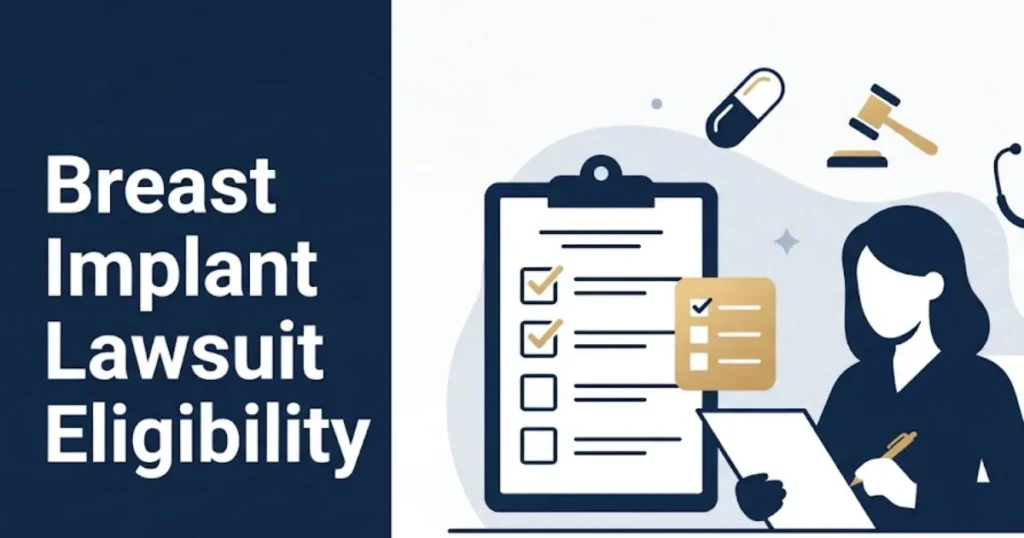
Eligibility for the breast implant lawsuit depends on three main factors: what type of implant you have, what health problems you have experienced, and whether you are within your state’s filing deadline. Meeting all three criteria puts you in the strongest position.
You are most likely eligible if you meet these conditions:
- You received breast implants from Allergan, Mentor, or Sientra
- You developed health complications after implantation
- Your state’s statute of limitations has not expired
- You can provide medical records linking your implant to your condition
Eligibility varies by claim type:
| Claim Type | Implant Requirement | Health Requirement | Evidence Needed |
|---|---|---|---|
| BIA-ALCL | Textured (usually) | Cancer diagnosis | Pathology report, medical records |
| Autoimmune | Silicone (any surface) | Autoimmune diagnosis | Diagnosis records, expert opinion |
| BII | Any type | Systemic symptoms | Symptom documentation, explant records |
| Rupture | Any type | Confirmed rupture | Imaging, surgical records |
You do not need to have had your implants removed to file. You do not need to have been part of the recall. You do not need to have a cancer diagnosis.
Even women with smooth implants may qualify if they can demonstrate complications. The lawsuit is not limited to one manufacturer or one product.
Key Takeaway: You may be eligible even without a recall, a cancer diagnosis, or a specific implant brand; the key is linking your health problems to your implant with medical records.
How to File a Breast Implant Lawsuit
Filing a breast implant lawsuit starts with gathering your medical records and contacting an attorney who handles medical device litigation. Most law firms handling these cases offer free consultations and work on a contingency fee basis, meaning you pay nothing upfront.
Step-by-step filing process:
- Collect your records. Get your surgical records showing the implant brand, model, and lot number. Pull together all medical records documenting your symptoms and treatments.
- Contact an attorney. Look for a law firm with experience in breast implant or medical device lawsuits. During the consultation, they will review your case for free.
- Case evaluation. Your attorney will determine whether your claim is strong enough to file. They will assess your implant type, health condition, medical evidence, and state deadline.
- Filing the complaint. If your case moves forward, your attorney files a formal complaint in the appropriate court. This could be the federal MDL in New Jersey or a state court near you.
- Discovery and pretrial. Your case enters the pretrial phase where both sides exchange evidence. This is where depositions, expert reports, and document requests happen.
- Settlement or trial. Most cases settle before trial. But if the manufacturer won’t offer a fair amount, your case can go to a jury.
| Filing Step | Typical Timeline |
|---|---|
| Initial consultation | 1 to 2 weeks |
| Records collection | 2 to 8 weeks |
| Complaint filing | 1 to 4 weeks after evaluation |
| Discovery phase | 6 to 18 months |
| Settlement or trial | 1 to 3 years total |
The most important thing is to act before your state’s filing deadline. Once the statute of limitations expires, you lose your right to sue. Period.
Don’t wait until you feel sick enough. If you already have symptoms and the right implant, the time to act is now.
Frequently Asked Questions
How much money can I get from a breast implant lawsuit in 2026?
Most estimates place breast implant settlements between $50,000 and $750,000 depending on injury type.
Cancer-related claims like BIA-ALCL sit at the higher end of that range.
Autoimmune and BII claims typically fall between $50,000 and $300,000.
What is the deadline to file a breast implant lawsuit?
The deadline depends on your state’s statute of limitations, which is usually two to three years from when you discovered your injury.
Some states use a “discovery rule” that starts the clock when you learned (or should have learned) about the implant connection.
Talk to an attorney immediately to confirm your specific deadline.
Can I sue for autoimmune disease caused by breast implants?
Yes, autoimmune disease claims are actively being filed and accepted by courts.
You will need a documented autoimmune diagnosis and medical records showing symptom onset after implantation.
Expert medical testimony linking your condition to your implants strengthens the claim significantly.
What is the Allergan breast implant recall about?
Allergan recalled all Biocell textured breast implants in July 2019 due to their link to BIA-ALCL cancer.
The FDA requested the recall after identifying a disproportionate number of cancer cases involving Biocell’s macro-textured surface.
The recall covered implants and tissue expanders but did not include Allergan’s smooth products.
Do I qualify for the breast implant lawsuit if my implants have not been recalled?
Yes, you can still qualify even if your specific implants were never recalled.
Lawsuits cover complications from implants made by Allergan, Mentor, Sientra, and other manufacturers regardless of recall status.
The key factor is whether your implants caused documented health problems.
The breast implant lawsuit in 2026 is moving faster than ever. Whether your case involves cancer, autoimmune disease, or breast implant illness, the window to file is open but it will not stay that way forever.
Get your medical records together now. Reach out to an attorney who handles breast implant cases. The sooner you start, the stronger your position will be when settlements are finalized.
Your health problems deserve answers. They may also deserve compensation.







