

The transvaginal mesh lawsuit remains active in 2026, with some women still filing new claims and others collecting settlement payments from resolved cases. Over 100,000 lawsuits have been filed against mesh manufacturers since this litigation began over a decade ago.
Billions of dollars have been paid out. But the story is not over.
If you had a mesh implant and suffered complications, this article covers what you need to know right now. You will find updated settlement figures, eligibility details, filing steps, manufacturer breakdowns, and key deadlines.
One fact that surprises many people: some states still allow new claims even in 2026. The window has not closed everywhere.
Transvaginal Mesh Lawsuit Update 2026
The transvaginal mesh lawsuit update for 2026 shows that while the massive federal MDL cases have largely concluded, individual lawsuits and state court cases continue moving forward. Several manufacturers are still resolving remaining claims, and a small number of new filings are being accepted in certain jurisdictions.
Most of the federal litigation was centralized in the U.S. District Court for the Southern District of West Virginia under Judge Joseph R. Goodwin. By late 2024, the majority of MDL cases had been settled or dismissed. But that does not mean the legal fight ended.
State court cases in California, New Jersey, Pennsylvania, and Florida remain active. Some of these involve women who discovered their injuries later or who faced delays in diagnosis.
In 2026, the focus has shifted from mass bellwether trials to individual case resolutions. Women with severe injuries, particularly those requiring multiple revision surgeries, are seeing higher valuations on their claims.
| Update Detail | 2026 Status |
|---|---|
| Federal MDL Cases | Mostly resolved |
| State Court Cases | Still active in several states |
| New Filings | Limited but possible |
| Settlement Payments | Ongoing for resolved claims |
| Average Resolution Time | 12 to 36 months for new cases |
Manufacturers like Boston Scientific and Endo International are still processing final payouts. Women who settled in 2023 or 2024 may still be waiting for checks to arrive.
Transvaginal Mesh Settlement Amounts in 2026
Settlement amounts for transvaginal mesh cases in 2026 range from roughly $60,000 to over $400,000 per claimant, depending on the severity of complications. Some exceptional cases with catastrophic injuries have settled for more than $1 million.
These numbers reflect a wide range because every case is different. A woman who needed one revision surgery will receive less than someone who had five surgeries and permanent nerve damage.
The manufacturers that have paid the most include Boston Scientific (over $1.6 billion in total settlements), C.R. Bard (approximately $4 billion through parent company Becton Dickinson), and Johnson & Johnson’s Ethicon division (over $700 million).
| Injury Severity | Estimated Settlement Range |
|---|---|
| Mild complications, no surgery | $30,000 to $75,000 |
| Moderate complications, one revision surgery | $75,000 to $200,000 |
| Severe complications, multiple surgeries | $200,000 to $500,000 |
| Catastrophic injury, permanent disability | $500,000 to $1.5 million+ |
These are estimates based on past verdicts and settlement data. Your actual payout depends on medical records, the specific mesh product used, and the strength of your evidence.
Jury verdicts in bellwether trials have occasionally exceeded $100 million, though those amounts are typically reduced on appeal. The largest known verdict was $302 million against Boston Scientific in a single case.
Who Qualifies for a Transvaginal Mesh Lawsuit
You may qualify for a transvaginal mesh lawsuit if you had a surgical mesh device implanted for pelvic organ prolapse or stress urinary incontinence and later experienced medical complications. The implant itself is the qualifying factor, not the condition it was meant to treat.
Qualification generally requires three things. First, you had a transvaginal mesh product implanted. Second, you experienced at least one documented complication. Third, your complication is linked to the mesh product rather than the underlying condition.
- Mesh erosion through vaginal tissue
- Chronic pelvic or groin pain lasting months or years
- Painful intercourse (dyspareunia)
- Urinary problems including infections or incontinence worsening
- Mesh contraction or shrinkage
- Organ perforation (bladder or bowel)
- Need for revision or removal surgery
Women who had their mesh implanted at any point may still qualify, though the statute of limitations varies by state. Some states use a “discovery rule,” meaning the clock starts when you first learned of the mesh-related injury, not when the implant occurred.
Quick Fact: Even if your surgery was 10 or 15 years ago, you could still have a valid claim if your complications were diagnosed recently.
Key Takeaway: The transvaginal mesh lawsuit is still active in 2026 with settlements ranging from $60,000 to over $1 million, and women with documented mesh complications may still qualify to file claims.
What Is the Transvaginal Mesh Lawsuit About
The transvaginal mesh lawsuit is a massive wave of product liability litigation against companies that manufactured and sold defective surgical mesh implants used in women’s pelvic floor repair procedures. These devices caused severe medical complications in thousands of women.
Starting in the mid-2000s, doctors implanted polypropylene mesh through the vagina to treat pelvic organ prolapse and stress urinary incontinence. The procedure was marketed as a quick, minimally invasive fix.
But the mesh often did not stay in place. It eroded through tissue, contracted, caused infections, and triggered chronic pain that ruined women’s daily lives. Many women needed multiple surgeries just to remove the mesh, and some could never have it fully taken out.
The lawsuits allege that manufacturers knew about these risks and failed to warn patients and doctors. Some companies pushed their products through the FDA’s 510(k) clearance process, which allowed them to skip full clinical trials by claiming their mesh was similar to already-approved devices.
Think of it like this: a company selling a new car that skips crash testing by claiming it is “basically the same” as an older model. That is essentially what happened with many mesh products.
The litigation grew into one of the largest mass torts in U.S. history, with more cases than asbestos litigation at its peak.
Transvaginal Mesh Complications That Support a Lawsuit
The most common complications supporting a transvaginal mesh lawsuit include mesh erosion, chronic pain, infection, and the need for revision surgery. These complications must be documented in medical records to build a viable claim.
Mesh erosion is the single most reported problem. The polypropylene mesh cuts through vaginal wall tissue, exposing sharp edges. This causes bleeding, discharge, and extreme discomfort.
Chronic pelvic pain is another major issue. Many women report pain that never goes away, even years after implantation. Some describe it as a constant burning or pulling sensation deep in the pelvis.
| Complication | How It Affects the Body | Lawsuit Relevance |
|---|---|---|
| Mesh erosion | Mesh protrudes through vaginal tissue | Most commonly cited in claims |
| Chronic pelvic pain | Ongoing pain in pelvis, hips, or groin | Strong basis for damages |
| Dyspareunia | Painful sexual intercourse | Affects quality of life claims |
| Urinary dysfunction | Worsened incontinence or retention | Proves device failure |
| Infection | Recurring UTIs or surgical site infections | Documented medical costs |
| Organ perforation | Mesh penetrates bladder or bowel | Supports severe injury claims |
| Mesh contraction | Mesh shrinks and pulls tissue | Requires additional surgery |
Autoimmune responses are a newer area of concern. Some women report developing autoimmune symptoms after mesh implantation, though the scientific link is still being studied.
The more severe your complications, the higher your case is typically valued. Women who needed mesh removal surgery generally have stronger claims.
How to File a Transvaginal Mesh Lawsuit
To file a transvaginal mesh lawsuit in 2026, you need to contact an attorney experienced in medical device litigation, gather your medical records, and have your case evaluated for eligibility. Most mesh attorneys work on a contingency fee basis, meaning you pay nothing upfront.
Here is the typical process, step by step:
- Step 1: Contact a law firm that handles transvaginal mesh cases. Many offer free case evaluations.
- Step 2: Sign a retainer agreement. The firm only gets paid if you win.
- Step 3: Your attorney requests your medical records, including implant details and surgical reports.
- Step 4: Medical experts review your records to confirm the mesh caused your complications.
- Step 5: Your attorney files the lawsuit in the appropriate court (federal or state).
- Step 6: The discovery phase begins. Both sides exchange evidence.
- Step 7: Your case either settles or goes to trial.
One thing many women do not realize: you do not need to remember the exact brand of mesh that was implanted. Your attorney can obtain that information from your surgical records and hospital billing codes.
Quick Fact: Most mesh attorneys charge a contingency fee of 33% to 40% of the settlement amount. If you recover nothing, you owe nothing.
The process from filing to resolution typically takes 12 to 36 months in 2026, depending on court schedules and whether the manufacturer is willing to negotiate.
Key Takeaway: Filing a transvaginal mesh lawsuit involves gathering medical records and working with a contingency-fee attorney, and the process typically takes one to three years from start to finish.
Vaginal Mesh Lawsuit Payout Per Person
The vaginal mesh lawsuit payout per person has historically averaged between $100,000 and $250,000 for moderate injury claims, though individual results vary widely based on the specifics of each case.
Payouts are not one-size-fits-all. Several factors determine your individual number.
The type of complication matters most. A woman with mesh erosion who needed one corrective surgery might receive $80,000. A woman who had three revision surgeries, suffers from permanent pain, and can no longer work might receive $400,000 or more.
| Factor | How It Affects Payout |
|---|---|
| Number of surgeries | More surgeries equals higher payout |
| Duration of pain | Chronic ongoing pain increases value |
| Lost wages | Proven income loss adds to damages |
| Emotional distress | Documented mental health impact adds value |
| Medical expenses | Out-of-pocket costs are factored in |
| Mesh product used | Some products have worse track records |
Think of it like car insurance claims. A fender bender pays out differently than a totaled vehicle with injuries. The same logic applies here.
Some women received their settlements in a lump sum. Others had structured payments. If you are part of a group settlement, your share is calculated based on a points system tied to injury severity.
Quick Fact: The total combined payouts across all mesh manufacturers have exceeded $8 billion as of early 2026.
Which Transvaginal Mesh Manufacturers Have Been Sued
The major transvaginal mesh manufacturers that have been sued include Boston Scientific, C.R. Bard, Johnson & Johnson (Ethicon), Coloplast, Cook Medical, American Medical Systems (AMS), and Endo International. These companies produced the vast majority of mesh products implanted in the U.S.
Each manufacturer faced its own set of lawsuits, and some have paid significantly more than others.
| Manufacturer | Key Products | Estimated Total Settlements |
|---|---|---|
| Boston Scientific | Obtryx, Pinnacle, Solyx | Over $1.6 billion |
| C.R. Bard (Becton Dickinson) | Avaulta, Pelvilace | Approximately $4 billion |
| Johnson & Johnson (Ethicon) | Prolift, TVT, Gynecare | Over $700 million |
| Coloplast | Aris, Restorelle | Over $400 million |
| American Medical Systems (AMS) | Apogee, Perigee, Elevate | Over $1.6 billion |
| Endo International | Various via AMS acquisition | Included in AMS totals |
| Cook Medical | Various sling products | Undisclosed settlements |
C.R. Bard faced some of the harshest jury verdicts. In one bellwether trial, a jury awarded $68 million to a single plaintiff.
Boston Scientific fought many cases aggressively but eventually entered into large-scale settlement programs. Their total liability has continued climbing even through 2025 and into 2026.
Some manufacturers no longer exist as independent companies. AMS was acquired by Endo International, which itself filed for bankruptcy in 2022, complicating remaining claims against that entity.
Transvaginal Mesh MDL Status in 2026
The transvaginal mesh MDL (multidistrict litigation) proceedings are effectively concluded in 2026, with nearly all federal cases having been settled, tried, or dismissed. The MDL was one of the largest in U.S. legal history.
At its peak, seven separate MDLs were running simultaneously in the Southern District of West Virginia, each targeting a different manufacturer. Judge Joseph R. Goodwin oversaw all of them.
- MDL 2325: C.R. Bard
- MDL 2326: Ethicon (Johnson & Johnson)
- MDL 2327: American Medical Systems
- MDL 2387: Boston Scientific
- MDL 2440: Coloplast
- MDL 2511: Cook Medical
- MDL 2503: Neomedic
By 2024, the combined MDL docket had processed over 100,000 individual cases. That number is staggering when you consider that each case represented a real woman with a real injury.
In 2026, the remaining federal cases are being remanded to their original district courts for final resolution. No new cases are being added to the MDL dockets.
However, state court litigation continues separately. Women filing in state courts in 2026 bypass the MDL entirely and proceed through their local court systems.
Quick Fact: The transvaginal mesh MDLs collectively represented the largest number of pending federal cases in the United States for several consecutive years.
Key Takeaway: The federal MDL proceedings for transvaginal mesh are effectively over, but state court cases continue, and women in certain states can still file individual lawsuits in 2026.
Is This a Transvaginal Mesh Class Action Lawsuit
The transvaginal mesh litigation is not a class action lawsuit. It is a mass tort, which means each woman files her own individual case rather than being grouped into a single class action with identical claims.
This distinction matters a lot. In a class action, everyone gets the same payout regardless of how badly they were hurt. In a mass tort, your settlement is based on your specific injuries, medical history, and damages.
That is good news for women with severe complications. Their cases are valued individually, which typically results in higher compensation than a class action would provide.
| Feature | Class Action | Mass Tort (Mesh Lawsuits) |
|---|---|---|
| Individual case evaluation | No | Yes |
| Payout based on personal injury | No, equal split | Yes, individual valuation |
| You have your own attorney | Not always | Yes |
| You control your case | Limited | More control |
| Settlement amounts | Usually smaller per person | Usually larger per person |
Some people confuse the terms because both involve large numbers of plaintiffs suing the same defendant. But the legal mechanics are very different.
In the mesh litigation, your attorney files a complaint on your behalf alone. Your medical records, your surgical history, and your specific complications determine your claim value.
You are not just a name on a list. You are a plaintiff with your own case.
Is It Too Late to File a Mesh Lawsuit
It is not necessarily too late to file a transvaginal mesh lawsuit in 2026, but your ability to file depends heavily on your state’s statute of limitations and when you first discovered your mesh-related injury. Time is running short in many jurisdictions.
The key legal concept here is the discovery rule. In most states, the statute of limitations does not start running from the date of your mesh surgery. Instead, it starts from the date you knew or should have known that your complications were caused by the mesh.
If a doctor just told you in 2025 that your chronic pain is caused by mesh erosion, your clock may have just started.
- States with 2-year statutes from discovery: Many states fall into this category.
- States with 3-year statutes from discovery: Including some states like Connecticut and Maine.
- States with longer windows: A few states offer more generous deadlines.
Quick Fact: Some states also have a “statute of repose,” which is a hard outer deadline regardless of when you discovered the injury. This can range from 6 to 15 years after the original surgery.
If you think you might have a claim, do not wait. Every month that passes narrows your options. Even if the MDL is closed, individual lawsuits in state court remain viable for eligible women.
Transvaginal Mesh Lawsuit Statute of Limitations
The statute of limitations for a transvaginal mesh lawsuit varies by state but typically ranges from 2 to 6 years from the date of injury discovery. This deadline determines the absolute last day you can legally file your claim.
Understanding this timeline is critical. Miss the deadline and your case is permanently barred, no matter how serious your injuries.
| State | Statute of Limitations | Discovery Rule Applied |
|---|---|---|
| California | 2 years | Yes |
| Texas | 2 years | Yes |
| New York | 3 years | Yes |
| Florida | 4 years (recently changed) | Yes |
| Pennsylvania | 2 years | Yes |
| Ohio | 2 years | Yes |
| Illinois | 2 years | Yes |
| New Jersey | 2 years | Yes |
The discovery rule works in your favor. If your mesh was implanted in 2012 but you only learned in 2024 that your symptoms were mesh-related, your 2-year window starts in 2024, not 2012.
But proving the discovery date can be complicated. Your medical records need to show when a doctor first attributed your symptoms to the mesh. Vague complaints about pelvic pain without a mesh diagnosis may not trigger the discovery rule.
Quick Fact: Some attorneys can argue for tolling, which pauses the statute of limitations under certain circumstances like mental incapacity or fraudulent concealment by the manufacturer.
Key Takeaway: The statute of limitations varies by state and is tied to when you discovered your mesh injury, not when the surgery happened, so women who were recently diagnosed may still have time to file.
What Evidence Do You Need for a Transvaginal Mesh Lawsuit
The primary evidence needed for a transvaginal mesh lawsuit includes your surgical records, pathology reports, medical records documenting complications, and the specific mesh product identification. Without these records, building a strong case becomes extremely difficult.
Your attorney will need to establish a clear chain: the mesh was implanted, it caused a problem, and that problem harmed you.
Here is what you should gather or have your attorney request:
- Operative report from your original mesh implant surgery
- Product identification (manufacturer and model of mesh used)
- Post-surgical medical records showing complications
- Imaging results (MRIs, CT scans, ultrasounds showing mesh position)
- Records of any revision or removal surgery
- Pain management records and medication history
- Employment records showing lost wages or reduced work capacity
- Mental health records documenting emotional distress
The operative report is the most important single document. It identifies exactly which mesh product was placed and how the surgery was performed.
If you cannot find your records, do not panic. Hospitals are required to maintain records for a minimum period, and your attorney can subpoena them.
Expert medical witnesses will review your records and provide opinions linking your injuries to the mesh device. This expert testimony is often what makes or breaks a case.
Transvaginal Mesh Revision Surgery Lawsuit Claims
Women who required revision surgery to repair or remove transvaginal mesh have some of the strongest lawsuit claims, with these cases often valued at $200,000 to $500,000 or more. Revision surgery is powerful evidence that the original device failed.
Revision surgery is not simple. Mesh often grows into tissue, making full removal nearly impossible. Surgeons sometimes have to cut away portions of the vaginal wall or bladder to extract embedded mesh fragments.
Some women have undergone three, four, or even five separate surgeries to address mesh complications. Each additional procedure adds to the claim value.
| Revision Surgery Factor | Impact on Claim Value |
|---|---|
| Number of revision surgeries | Each surgery increases value |
| Partial vs. full mesh removal | Full removal attempts valued higher |
| Organ damage during removal | Significantly increases damages |
| Ongoing pain after removal | Proves permanent injury |
| Need for future surgeries | Projected costs added to claim |
The cost of a single mesh removal surgery can exceed $30,000 to $50,000. When you add hospital stays, anesthesia, follow-up care, and lost work time, the financial impact is massive.
Women who still have mesh in their bodies because doctors determined removal was too risky also have strong claims. Living with a known defective device inside your body is itself a compensable harm.
Quick Fact: Studies show that up to 15% of women who received transvaginal mesh implants eventually needed some form of revision surgery.
Transvaginal Mesh FDA Recall History
The FDA never issued a full recall of all transvaginal mesh products, but it effectively banned the sale of mesh for pelvic organ prolapse repair in April 2019 by ordering manufacturers to stop selling and distributing these devices. Mesh for stress urinary incontinence (sling procedures) remains on the market.
The regulatory timeline tells an important story about how slow the system moved while women were being harmed.
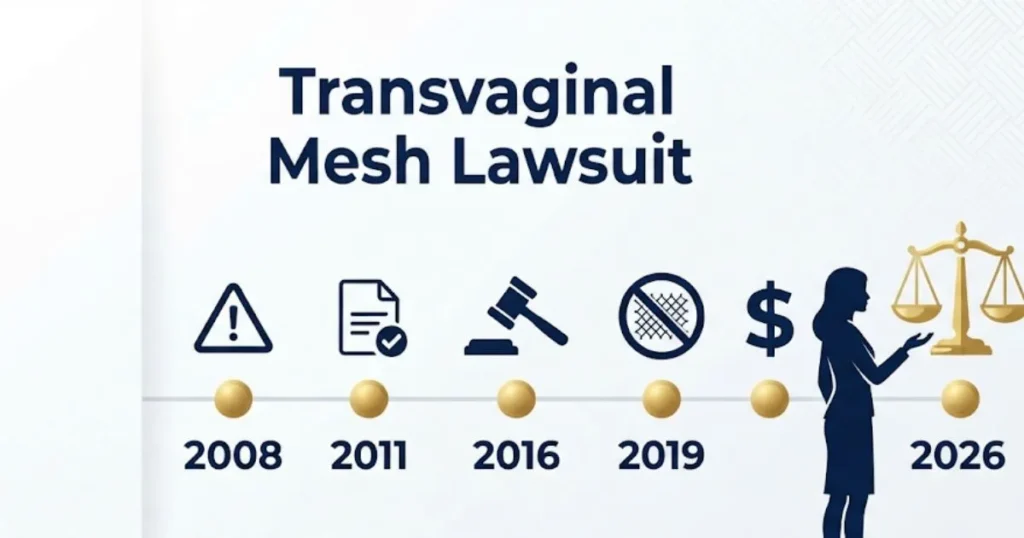
- 2008: FDA issues first public health notification about mesh complications
- 2011: FDA issues updated safety communication, states serious complications are “not rare”
- 2014: FDA proposes reclassifying mesh from Class II to Class III (highest risk)
- 2016: FDA finalizes reclassification, requires manufacturers to submit premarket approval applications
- 2019: FDA orders manufacturers to stop selling mesh for pelvic organ prolapse repair
- 2019 to present: Mesh for SUI sling procedures remains available
| Year | FDA Action |
|---|---|
| 2008 | First public health notification |
| 2011 | Safety communication: complications “not rare” |
| 2014 | Proposed reclassification to Class III |
| 2016 | Reclassification finalized |
| 2019 | Sales ban for POP repair mesh |
The gap between the first warning in 2008 and the sales ban in 2019 is 11 years. During that time, hundreds of thousands of women received mesh implants.
Many lawsuits argue that the FDA’s own warnings prove the manufacturers knew their products were dangerous. The 2011 statement that complications are “not rare” has been used extensively in court proceedings.
Quick Fact: Several mesh products originally received FDA clearance through the 510(k) pathway, which does not require clinical trials. This regulatory shortcut is central to many plaintiffs’ arguments.
Key Takeaway: The FDA effectively banned transvaginal mesh for prolapse repair in 2019 after years of safety warnings, and this regulatory history has been a powerful tool for plaintiffs in mesh lawsuits.
Transvaginal Mesh Lawsuit Timeline
The transvaginal mesh lawsuit timeline spans from the mid-2000s to 2026 and beyond, making it one of the longest-running mass tort litigations in American legal history. Here is how the major events unfolded.
| Year | Major Event |
|---|---|
| 2005 to 2008 | Early individual lawsuits filed as complications emerge |
| 2008 | FDA issues first safety warning about mesh |
| 2010 | First MDLs created in Southern District of West Virginia |
| 2011 | FDA warns that complications are “not rare” |
| 2013 | First bellwether trials begin; large verdicts awarded |
| 2014 | Number of pending cases exceeds 70,000 |
| 2016 | FDA reclassifies mesh to Class III |
| 2017 to 2019 | Major settlement programs launched by manufacturers |
| 2019 | FDA bans mesh for prolapse repair |
| 2020 to 2023 | Bulk of settlements processed and paid |
| 2024 | Most MDL dockets winding down |
| 2025 to 2026 | Remaining state court cases and late-filed claims continue |
The bellwether trials were pivotal. These are test cases selected to gauge how juries respond to the evidence. When juries awarded massive verdicts, manufacturers became much more willing to settle.
In 2013, a jury awarded $11.1 million against C.R. Bard in one of the first bellwether trials. That verdict sent shockwaves through the industry.
By 2014, mesh lawsuits outnumbered every other type of federal litigation. The sheer volume forced the courts to develop new case management strategies.
The 2026 landscape looks very different. The flood has become a trickle, but the cases still moving through the system are often the most complex and highest-value ones.
Latest Transvaginal Mesh Lawsuit Update
The latest transvaginal mesh lawsuit update as of 2026 shows that the litigation has entered its final phase, with remaining cases being individually resolved through settlements or trials in state courts across the country.
Several key developments define the current state of play.
Boston Scientific continues processing payouts from its settlement fund. Women who accepted settlement offers in 2024 and 2025 are receiving payments on a rolling basis. Some claimants report wait times of 6 to 12 months between accepting a settlement and receiving the check.
Endo International’s bankruptcy has complicated claims against its subsidiary, American Medical Systems. Women with AMS mesh products may receive reduced payouts through the bankruptcy estate. The final distribution plan is still being worked out in bankruptcy court.
- Remaining state court cases are moving through discovery and trial preparation
- Some states have seen a small uptick in new filings from women recently diagnosed
- Attorneys report that manufacturers are more willing to settle remaining cases quickly
- Medical expert testimony standards have tightened, requiring stronger documentation
Quick Fact: Legal analysts estimate that fewer than 5,000 mesh cases remain active in U.S. courts as of early 2026, down from a peak of over 100,000.
For women who have not yet filed, the message from the legal community is clear: act now. The window is closing, and the infrastructure of law firms handling these cases is shrinking as the litigation winds down.
Key Takeaway: The transvaginal mesh litigation is in its final phase in 2026 with fewer than 5,000 active cases remaining, and women who have not filed should act quickly before statutes of limitations expire.
Frequently Asked Questions
How much money can I get from a transvaginal mesh lawsuit in 2026?
Most women receive between $100,000 and $250,000 for moderate mesh injury claims.
Severe cases involving multiple surgeries or permanent disability have settled for $400,000 to over $1 million.
Your payout depends on the severity of your complications, your medical records, and the manufacturer involved.
Can I still file a transvaginal mesh lawsuit in 2026?
Yes, you can still file in many states if you are within the statute of limitations.
The discovery rule in most states starts the clock when you learned your injury was caused by mesh.
Contact an attorney for a free case evaluation to confirm your eligibility based on your state’s deadlines.
What complications qualify for a transvaginal mesh lawsuit?
Mesh erosion, chronic pelvic pain, painful intercourse, recurring infections, organ perforation, and the need for revision surgery all qualify.
These complications must be documented in your medical records.
The stronger your medical evidence, the higher your case is likely to be valued.
How long does a transvaginal mesh lawsuit take to settle?
Most individual mesh cases take 12 to 36 months from filing to settlement.
Cases that go to trial can take longer, sometimes 3 to 5 years.
The timeline depends on court schedules, the complexity of your injuries, and whether the manufacturer is willing to negotiate.
Which mesh manufacturers have paid the largest settlements?
C.R. Bard (through Becton Dickinson) has paid approximately $4 billion in total mesh settlements.
Boston Scientific and American Medical Systems have each paid over $1.6 billion.
Johnson & Johnson’s Ethicon division has paid over $700 million in mesh-related settlements and verdicts.
The transvaginal mesh lawsuit is still producing results for women who were harmed by defective surgical implants. Billions have been paid, and more payments are being processed.
If you experienced mesh complications, 2026 may be your last realistic chance to file a claim in many states. Check your state’s statute of limitations and reach out to a qualified attorney.
Do not let the deadline pass you by. Your injuries deserve compensation, and the legal system still has a path open for you.







