

If you had hernia mesh implanted and suffered complications, you likely qualify for a hernia mesh lawsuit in 2026. Thousands of people across the country have filed claims against manufacturers like C.R. Bard, Ethicon, and Atrium Medical. These cases allege the companies sold defective polypropylene mesh products that caused serious injuries.
Right now, more than 20,000 hernia mesh lawsuits sit in federal multidistrict litigation. Settlement talks have gained real momentum heading into 2026. Some individual cases have already resulted in jury verdicts exceeding $1 million.
This guide breaks down exactly who qualifies, which mesh brands are involved, what settlement payouts look like, and how to file before your deadline runs out. You’ll get specific dates, dollar figures, and a step-by-step checklist. No vague answers here.
The window to file is shrinking in many states. If you’re wondering whether your situation counts, the answer is probably closer than you think.
Do I Qualify for a Hernia Mesh Lawsuit?
You likely qualify for a hernia mesh lawsuit if you received a mesh implant during hernia repair surgery and later experienced complications. The key factor is whether your mesh product has been linked to known defects. If it has, and you suffered harm, you have grounds for a claim.
Three basic conditions need to line up for qualification:
- You had hernia mesh surgically implanted
- The mesh was manufactured by a defendant company (such as C.R. Bard, Ethicon, or Atrium Medical)
- You experienced medical complications linked to the mesh
It doesn’t matter whether your surgery happened in 2010 or 2022. What matters is that you can connect your health problems to the defective product.
| Qualification Factor | What You Need |
|---|---|
| Mesh Implant | Proof of hernia repair surgery using mesh |
| Manufacturer | Product made by a company named in litigation |
| Complications | Documented medical issues after implantation |
| Timing | Filed within your state’s statute of limitations |
Most people who had mesh-related complications don’t realize they qualify. Pain, infections, and repeat surgeries aren’t just bad luck. They’re often the result of a product that never should have been on the market.
If you had a hernia mesh implant and something went wrong, the odds are strong that you meet the basic criteria.
Hernia Mesh Lawsuit Eligibility Requirements
The eligibility requirements for a hernia mesh lawsuit center on three things: the product, the injury, and the timing. You don’t need to prove the manufacturer acted with evil intent. You just need to show the product was defective and caused you harm.

Here’s what attorneys and courts typically look for:
- Product identification: Your medical records should confirm which mesh brand was used. Hospital operative reports usually contain this information.
- Documented complications: You need medical records showing treatment for mesh-related problems. This includes ER visits, imaging, prescriptions, or surgical notes.
- Statute of limitations compliance: Your claim must fall within the legal filing window for your state. This varies widely, from one year to six years depending on where you live.
You do not need to have filed an FDA complaint. You do not need to have had the mesh removed. You do not even need to know the exact brand of mesh, as a lawyer can help track that down through your surgical records.
Quick Fact: Some people qualify even if their original surgery seemed successful at first. Many mesh complications don’t show up for months or years after implantation.
The eligibility bar is lower than most people expect. If you have medical records and a timeline of complications, you’re likely in the qualifying range.
Hernia Mesh Complications That Qualify for a Lawsuit
The complications that qualify for a hernia mesh lawsuit include chronic pain, infection, mesh migration, bowel obstruction, and mesh erosion into surrounding tissue. These are not minor side effects. They are serious medical events that often require additional surgery to fix.
Here is a breakdown of the most common qualifying complications:
| Complication | Description |
|---|---|
| Chronic Pain | Persistent pain at the mesh site lasting months or years |
| Mesh Migration | The mesh shifts from its original position inside the body |
| Mesh Erosion | The mesh wears through surrounding tissue or organs |
| Bowel Obstruction | Mesh adheres to intestines and blocks normal function |
| Infection | Bacterial infection at or around the mesh site |
| Fistula Formation | Abnormal tunnel forms between organs due to mesh damage |
| Hernia Recurrence | The hernia returns because the mesh failed to hold |
| Mesh Contraction | The mesh shrinks and pulls on surrounding tissue |
| Autoimmune Response | Body rejects the mesh material, triggering systemic symptoms |
Some patients experience just one of these. Others deal with several at the same time. Both situations qualify.
The severity of your complication affects your potential payout, but it does not affect your eligibility. Even chronic pain alone, without revision surgery, can support a valid claim.
Think of it like a car recall. If the defective part caused any level of damage to your vehicle, you have a claim. The same logic applies here, but the “vehicle” is your body.
Hernia Mesh Lawsuit Qualification Checklist
A hernia mesh lawsuit qualification checklist helps you quickly assess whether your case fits the criteria. Run through this list and check each item that applies to your situation.
Your Qualification Checklist:
- You had a hernia repair surgery that used mesh
- The surgery was performed within the last 15 years
- You experienced one or more complications listed in current litigation
- You received medical treatment for those complications
- You have access to surgical records (or can request them)
- You have not already settled a claim for this specific mesh product
- Your state’s statute of limitations has not expired
If you can check at least four of these boxes, your case is worth a serious look. If you check all seven, you’re in a strong position.
Key point: You don’t need to check every single box right now. Attorneys working on these cases often help obtain missing medical records and identify the specific mesh product used in your surgery.
Many qualified claimants hesitate because they think their case isn’t strong enough. But the manufacturers are facing liability for products they knowingly sold with defect risks. Your individual experience adds to that picture.
Don’t disqualify yourself before a professional reviews your situation. The checklist is a starting point, not a final verdict.
Key Takeaway: You qualify for a hernia mesh lawsuit if you had mesh implanted, experienced documented complications, and fall within your state’s filing window. Most people with mesh problems meet these criteria.
Which Hernia Mesh Brands Are in the Lawsuit?
The hernia mesh brands named in lawsuits include products from C.R. Bard (now owned by Becton Dickinson), Ethicon (a Johnson & Johnson subsidiary), Atrium Medical, Medtronic, and Covidien. These companies manufactured some of the most widely used mesh products in the United States.
Here are the specific products most frequently cited in court filings:
| Manufacturer | Product Names |
|---|---|
| C.R. Bard / Becton Dickinson | Ventralex, 3DMax, PerFix Plug, Ventralight ST |
| Ethicon / Johnson & Johnson | Physiomesh (recalled 2016), Prolene Hernia System, Proceed |
| Atrium Medical | C-QUR mesh line |
| Medtronic | Various polypropylene mesh products |
| Covidien | Parietex, Symbotex |
| W.L. Gore | GORE-TEX Dualmesh (fewer cases) |
Ethicon’s Physiomesh was voluntarily recalled from the market in May 2016 after studies showed higher-than-expected rates of reoperation and recurrence. That recall strengthened thousands of claims.
C.R. Bard faces the largest share of lawsuits. Their products used polypropylene material that has been linked to degradation, contraction, and inflammatory responses inside the body.
If you’re unsure which brand was used in your surgery, your hospital’s operative report will list the product. Your surgeon’s office can also provide this information. Identifying the brand is a critical first step because it connects your case to the right pool of litigation.
Not all mesh products are created equal. Some brands have far worse track records than others. That difference matters when it comes to your claim’s strength.
Hernia Mesh Lawsuit Settlement Amounts in 2026
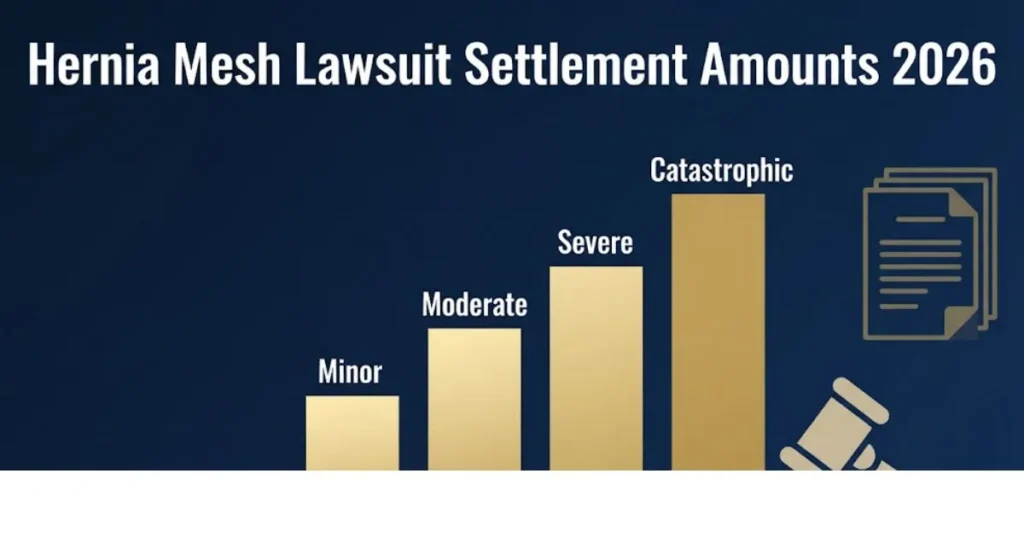
Hernia mesh lawsuit settlement amounts in 2026 are expected to range from $50,000 to over $1 million per case, depending on injury severity and case specifics. The wide range reflects the difference between cases involving minor complications and those requiring multiple revision surgeries.
Here’s how settlement tiers are typically structured in mesh litigation:
| Settlement Tier | Typical Injury Profile | Estimated Range |
|---|---|---|
| Tier 1 (Lower) | Chronic pain, no revision surgery | $50,000 to $150,000 |
| Tier 2 (Mid) | Single revision surgery, infection | $150,000 to $400,000 |
| Tier 3 (Higher) | Multiple surgeries, bowel resection | $400,000 to $750,000 |
| Tier 4 (Highest) | Permanent disability, organ damage | $750,000 to $1,500,000+ |
Several bellwether trials have already produced significant verdicts. In one Rhode Island case, a jury awarded over $4.8 million against C.R. Bard. A separate case resulted in a $1.2 million verdict for a patient who suffered mesh erosion.
These verdicts set the tone for settlement negotiations. When juries hand down big numbers, manufacturers become more willing to settle remaining cases at reasonable figures.
Quick Fact: Becton Dickinson (parent of C.R. Bard) has already set aside billions in reserves for mesh-related liabilities. That signals they expect to pay.
Your individual settlement depends on factors like medical expenses, lost income, pain and suffering, and the strength of your documentation. Cases with detailed medical records and clear causation tend to settle higher.
How Much Is a Hernia Mesh Lawsuit Worth?
A hernia mesh lawsuit is worth anywhere from $50,000 to over $1 million, with the exact value driven by your specific injuries, medical costs, and personal impact. No two cases are identical, so the value depends entirely on what you went through.
Several factors determine your case’s worth:
- Medical expenses: Every surgery, hospital stay, prescription, and doctor visit adds to the total. Revision surgeries alone can cost $30,000 to $100,000 or more.
- Lost wages: Time off work for surgeries, recovery, and ongoing treatment counts as economic damage.
- Pain and suffering: Chronic pain, emotional distress, and reduced quality of life carry significant value in these cases.
- Future medical needs: If you’ll need ongoing care or additional procedures, those projected costs increase your claim.
Think of your case like a house appraisal. The base value comes from tangible costs (medical bills, lost income). But the full value includes less measurable factors like how the injury changed your daily life.
Bold stat: The average hernia mesh settlement for cases involving revision surgery is estimated between $200,000 and $400,000 based on verdicts and settlements reported through 2025.
One thing worth understanding: most settlements are confidential. The numbers reported publicly tend to be jury verdicts, which run higher than negotiated settlements. Still, those verdicts push settlement values upward for everyone.
Hernia Mesh Lawsuit Payout per Person
The hernia mesh lawsuit payout per person varies based on a tiered system that groups cases by injury severity. You won’t receive a flat amount. Instead, your payout depends on where your case falls on the severity scale.
Here’s a realistic breakdown of per-person payouts based on current litigation patterns:
| Case Category | Per-Person Payout Estimate |
|---|---|
| Minor complications, no surgery | $25,000 to $75,000 |
| Moderate pain, one revision surgery | $100,000 to $300,000 |
| Severe complications, multiple surgeries | $300,000 to $700,000 |
| Catastrophic injury, permanent damage | $700,000 to $1,500,000+ |
Attorney fees typically take 33% to 40% of your settlement. That means on a $300,000 settlement, you’d take home roughly $180,000 to $200,000 after fees and costs.
The timeline for receiving your payout matters too. Mass tort settlements usually don’t arrive as a single lump sum. They roll out in phases over months. Some claimants receive initial payments quickly, with the remainder following after administrative review.
Quick Fact: Unlike class action lawsuits where everyone gets the same small check, hernia mesh cases are individual claims. Your payout is based on your injuries, not split equally among thousands of people.
That distinction makes a real difference. Your case stands on its own merit. Stronger documentation and more severe injuries translate directly to higher compensation.
Key Takeaway: Hernia mesh lawsuit payouts in 2026 range from $50,000 to over $1 million per person, with most revision surgery cases settling between $200,000 and $400,000 before attorney fees.
How to File a Hernia Mesh Lawsuit
To file a hernia mesh lawsuit, you need to gather your medical records, identify your mesh product, and retain an attorney experienced in medical device litigation. The process is straightforward, and most attorneys handle these cases on contingency, meaning you pay nothing upfront.
Step-by-step filing process:
- Collect your medical records. Request your operative report from the hospital where your hernia surgery was performed. This document identifies the mesh product used.
- Document your complications. Gather records from every doctor visit, ER trip, imaging test, and surgery related to your mesh problems.
- Contact a mass tort attorney. Look for firms with specific experience in hernia mesh litigation. They’ll evaluate your case at no cost.
- Sign a retainer agreement. Once you choose a lawyer, you’ll sign an agreement. Contingency fee arrangements mean the attorney only gets paid if you receive compensation.
- File the complaint. Your attorney drafts and files the legal complaint in the appropriate court. Most federal cases join the MDL in the Southern District of Ohio.
- Enter the litigation process. After filing, your case enters discovery, where both sides exchange evidence.
| Filing Step | What You Do | What Your Attorney Does |
|---|---|---|
| Records Collection | Request surgical reports | Reviews and organizes evidence |
| Case Evaluation | Share your medical history | Determines claim strength |
| Filing | Sign paperwork | Submits complaint to court |
| Litigation | Respond to requests | Handles all legal proceedings |
The entire process from initial contact to filing usually takes two to four weeks. After that, your attorney handles everything while you wait for resolution.
Hernia Mesh Lawsuit Filing Deadline in 2026
The hernia mesh lawsuit filing deadline in 2026 depends on your state’s statute of limitations and when you discovered (or should have discovered) your mesh-related injury. There is no single national deadline. Each state sets its own rules.
Most states use a “discovery rule” for medical device cases. This means the clock starts ticking when you first learned or reasonably should have learned that your mesh caused your problems. That’s different from when the mesh was actually implanted.
Here’s what that looks like in practice:
| Scenario | When the Clock Starts |
|---|---|
| Mesh implanted 2015, pain started 2023 | Clock starts in 2023 |
| Mesh implanted 2018, revision surgery 2024 | Clock starts in 2024 |
| Mesh implanted 2012, complications 2020 but didn’t connect to mesh until 2025 | May start in 2025 |
Bold stat: In states with a two-year statute of limitations, patients who discovered complications in 2024 must file by 2026 or lose their right to sue.
Some states also have an outer limit called a “statute of repose.” This sets an absolute deadline regardless of when you discovered the injury. In those states, the window could close even if your complications appeared recently.
The safest approach is to file as soon as you suspect mesh problems. Waiting risks missing a deadline that could permanently bar your claim. Time is not on your side here.
Hernia Mesh Lawsuit Statute of Limitations by State
The hernia mesh lawsuit statute of limitations varies by state, ranging from one year to six years depending on where you live. This is one of the most important factors in your case because missing the deadline means losing your right to file permanently.
Here is a reference table for selected states:
| State | Statute of Limitations | Discovery Rule? |
|---|---|---|
| California | 2 years | Yes |
| Texas | 2 years | Yes |
| Florida | 2 years | Yes |
| New York | 3 years | Yes |
| Pennsylvania | 2 years | Yes |
| Ohio | 2 years | Yes |
| Illinois | 2 years | Yes |
| Georgia | 2 years | Yes |
| Tennessee | 1 year | Yes |
| Kentucky | 1 year | Yes |
| Louisiana | 1 year | Yes |
| Michigan | 3 years | Yes |
| New Jersey | 2 years | Yes |
| Virginia | 2 years | Limited |
| Massachusetts | 3 years | Yes |
Tennessee, Kentucky, and Louisiana stand out with just a one-year window. If you live in one of those states and recently discovered complications, every month matters.
The discovery rule is your best friend in these cases. It prevents the clock from running out before you even know something is wrong. But you have to act quickly once you do know.
One common mistake: people assume the deadline runs from their original surgery date. That’s almost never how it works in mesh cases. The discovery date is what counts.
If you’re even close to a deadline, contact an attorney immediately. Courts enforce these cutoffs strictly, and extensions are rare.
Key Takeaway: Filing deadlines vary dramatically by state, from one year to six years from the date of injury discovery. Check your state’s statute of limitations immediately and don’t wait to start the process.
Hernia Mesh MDL Update for 2026
The hernia mesh MDL (multidistrict litigation) update for 2026 shows continued activity in MDL 2846, which consolidates thousands of federal hernia mesh claims in the U.S. District Court for the Southern District of Ohio under Judge Edmund A. Sargus Jr.
As of early 2025, over 20,000 pending cases remained in the C.R. Bard hernia mesh MDL alone. Separate MDLs exist for Ethicon Physiomesh and Atrium C-QUR products.
Here’s where things stand heading into 2026:
| MDL | Court | Judge | Approximate Pending Cases |
|---|---|---|---|
| Bard Hernia Mesh (MDL 2846) | S.D. Ohio | Judge Sargus | 20,000+ |
| Ethicon Physiomesh (MDL 2782) | N.D. Georgia | Judge Totenberg | 3,000+ |
| Atrium C-QUR Mesh (MDL 2753) | D. New Hampshire | Judge Barbadoro | 3,500+ |
Several bellwether trials have already concluded in the Bard MDL. These test cases help both sides gauge how juries respond to the evidence. Plaintiffs have secured multiple favorable verdicts, which puts pressure on manufacturers to settle.
Quick Fact: Bellwether verdicts in the Bard MDL have ranged from $250,000 to over $4.8 million in plaintiff awards.
Settlement discussions are ongoing, though no global settlement has been announced for the Bard MDL as of early 2025. Many legal analysts expect movement toward structured settlements in 2026 as the volume of pending cases makes continued individual litigation impractical for defendants.
Keep watching for announcements from the court. When a global settlement framework is finalized, it typically sets the terms for thousands of remaining cases at once.
Hernia Mesh Lawsuit Timeline and Case Status
The hernia mesh lawsuit timeline spans over a decade, starting with early individual filings and evolving into massive federal MDLs. Understanding where the litigation stands helps you gauge when payouts might arrive.
Here’s a condensed timeline of major events:
| Year | Event |
|---|---|
| 2011-2014 | Early individual lawsuits filed against mesh manufacturers |
| 2014 | Bard MDL 2846 established in S.D. Ohio |
| 2016 | Ethicon voluntarily recalls Physiomesh from market |
| 2017-2019 | Bellwether cases selected and prepared |
| 2020-2022 | First bellwether trials produce plaintiff verdicts |
| 2023-2024 | Settlement negotiations intensify, more cases filed |
| 2025 | Over 26,000 total cases pending across all mesh MDLs |
| 2026 (expected) | Potential global settlement framework; continued trials |
The Bard MDL is the furthest along in the litigation process. Multiple bellwether trials have already been completed, giving both sides real data on jury behavior.
It’s like watching a long negotiation at a car dealership. The bellwether trials are the test drives. Once enough results come in, both sides have the information they need to agree on a price.
Bold stat: From initial filing to resolution, individual hernia mesh cases typically take three to five years. Cases filed in 2024 or 2025 could see resolution between 2027 and 2029 if no global settlement accelerates the process.
Filing sooner puts you earlier in the resolution queue. Waiting only delays your potential payout.
What Happens After Filing a Hernia Mesh Lawsuit?
After filing a hernia mesh lawsuit, your case enters a structured legal process that includes discovery, case evaluation, and either settlement negotiation or trial. Most claimants don’t have to appear in court personally. Your attorney handles the procedural work.
Here’s what the post-filing process typically looks like:
| Phase | What Happens | Estimated Duration |
|---|---|---|
| Case Filing | Complaint submitted to court | 2 to 4 weeks |
| Discovery | Both sides exchange evidence and medical records | 6 to 18 months |
| Case Evaluation | Your case is categorized by injury severity | 1 to 3 months |
| Settlement Negotiation | Attorneys negotiate payout based on case tier | Ongoing |
| Resolution | Settlement finalized or case goes to trial | Varies |
During discovery, the defendant’s attorneys may request your complete medical history. Your lawyer will handle objections and protect irrelevant personal information.
You might be asked to attend an independent medical examination (IME). This is where a doctor chosen by the defense evaluates your condition. It’s standard procedure and shouldn’t cause concern.
What you’ll need to do personally:
- Respond to your attorney’s requests for information
- Provide updated medical records if you receive new treatment
- Attend an IME if requested
- Review and approve any settlement offer before it’s accepted
The most important thing to understand: your case moves at the pace of the overall litigation. If a global settlement is reached, your individual resolution could speed up significantly. Without one, expect a longer timeline.
Key Takeaway: After filing, your case enters discovery and evaluation phases that can take one to two years. Most of the work falls on your attorney. Your main job is staying responsive and keeping your medical records updated.
Hernia Mesh Revision Surgery Lawsuit
A hernia mesh revision surgery lawsuit is one of the strongest types of claims in this litigation. If you required surgery to remove, replace, or repair defective hernia mesh, your case automatically falls into a higher compensation tier.
Revision surgery proves two things at once. First, it confirms that the mesh failed. Second, it documents significant medical harm that required invasive treatment.
Here’s why revision surgery cases are valued higher:
- Additional medical costs: Revision surgeries can cost $30,000 to $100,000+ depending on complexity
- Extended recovery: Patients often miss weeks or months of work after a second surgery
- Increased pain and suffering: Going through another surgery takes a physical and emotional toll
- Risk of further complications: Each additional surgery increases the chance of adhesions, infection, and other problems
| Revision Surgery Detail | Impact on Case Value |
|---|---|
| Single mesh removal | Moderate increase |
| Mesh removal plus bowel repair | Significant increase |
| Multiple revision surgeries | Highest tier placement |
| Permanent colostomy or organ damage | Maximum compensation range |
Some patients have undergone three or four surgeries related to a single mesh implant. Each procedure adds to the case’s value.
If you had revision surgery, your medical records from that procedure become the centerpiece of your claim. The operative notes will describe exactly what the surgeon found, and that description often reads like a product failure report.
Signs of Hernia Mesh Failure
The signs of hernia mesh failure include chronic pain at the surgical site, swelling, fever, nausea, bowel changes, and a noticeable bulge returning where the original hernia was repaired. These symptoms can appear weeks, months, or even years after implantation.
Here are the warning signs to watch for:
- Persistent pain: Pain at the mesh site that doesn’t improve over time or gets worse
- Swelling or tenderness: Unexplained swelling near the surgical area
- Fever or chills: Signs of infection around the implant
- Nausea or vomiting: Could indicate bowel obstruction from mesh adhesion
- Difficulty urinating: Mesh migration near the bladder can cause urinary problems
- Returning bulge: A visible bulge suggests the mesh has failed and the hernia is recurring
- Feeling the mesh: Being able to feel the mesh through your skin, especially if it seems to have shifted
Quick Fact: According to FDA reports, polypropylene mesh can degrade over time inside the body. This degradation releases particles that trigger inflammatory responses and can cause the mesh to shrink, harden, or erode into nearby tissue.
Not every discomfort after hernia surgery means your mesh failed. Some post-surgical pain is normal and resolves within weeks. But if symptoms persist beyond three months or new symptoms appear, that’s a red flag.
If you recognize these signs, document everything. Write down when symptoms started, how they’ve changed, and what treatments you’ve tried. See your doctor and request imaging to check the mesh’s position. This documentation becomes evidence if you file a claim.
Your body is telling you something. Don’t ignore it.
Frequently Asked Questions About Hernia Mesh Lawsuits
Do I qualify for a hernia mesh lawsuit if my surgery was years ago?
Yes, you can qualify even if your surgery was five, ten, or fifteen years ago.
The statute of limitations typically starts from when you discovered your mesh-related complications, not from your original surgery date.
As long as you’re within your state’s filing window from the discovery date, your claim is valid.
How much money can I get from a hernia mesh lawsuit?
Most hernia mesh settlements range from $50,000 to over $1 million per person.
Your payout depends on the severity of your complications, whether you had revision surgery, and your documented medical costs.
Cases involving multiple surgeries or permanent injuries fall in the highest compensation tiers.
What is the deadline to file a hernia mesh lawsuit in 2026?
The deadline depends on your state’s statute of limitations, which ranges from one to six years.
The clock usually starts when you first discovered or should have discovered that your mesh caused your problems.
States like Tennessee, Kentucky, and Louisiana have just a one-year window, so acting quickly is essential.
Which hernia mesh brands have been recalled or sued?
The most prominent brands in litigation include C.R. Bard (Ventralex, 3DMax), Ethicon (Physiomesh, Prolene), and Atrium Medical (C-QUR).
Ethicon’s Physiomesh was voluntarily recalled in 2016 due to higher-than-expected complication rates.
Products from Medtronic, Covidien, and W.L. Gore are also named in some lawsuits.
Can I file a hernia mesh lawsuit if I had revision surgery?
Absolutely, and revision surgery cases are among the strongest claims in this litigation.
The fact that you needed additional surgery to fix or remove the mesh is powerful evidence of product failure.
Revision surgery cases typically qualify for the highest settlement tiers, ranging from $200,000 to over $1 million.
The hernia mesh lawsuit is one of the largest medical device litigations in American history. If your mesh caused complications, the law may entitle you to significant compensation.
Don’t let a filing deadline pass you by. Gather your surgical records, check your state’s statute of limitations, and get your case evaluated now. The manufacturers already know their products caused harm. The question is whether you’ll hold them accountable before time runs out.
Your next step is simple: find out where you stand and take action in 2026.







