

Belviq lawsuit mass tort marketing is one of the most active legal advertising sectors heading into 2026. Law firms and marketing agencies are spending millions to reach people who took the recalled weight loss drug and later developed cancer.
This guide breaks down how mass tort marketing campaigns for Belviq actually work. You’ll learn about lead generation costs, the best advertising channels, case qualification standards, and how Belviq campaigns compare to Tepezza marketing efforts.
The Belviq litigation has been growing since the FDA pulled the drug in February 2020. An estimated 2 million Americans took Belviq before the recall, and only a fraction have filed claims so far.
That gap between potential claimants and actual filings is exactly why mass tort marketing for this case is still hot in 2026.
Belviq Lawsuit Mass Tort Marketing in 2026
Belviq lawsuit mass tort marketing refers to the advertising and outreach strategies law firms use to find and sign clients who were harmed by the weight loss drug lorcaserin, sold under the brand name Belviq. In 2026, this remains a high-value marketing category because the litigation is still active and many eligible claimants haven’t filed.
The drug was manufactured by Arena Pharmaceuticals and marketed by Eisai Inc. The FDA requested its withdrawal from the market on February 13, 2020, after a clinical trial showed an increased risk of cancer among patients who took the drug.
Since then, lawsuits have been filed across multiple federal courts. Mass tort marketing campaigns target former Belviq users through TV ads, social media, paid search, and direct mail.
| Key Fact | Detail |
|---|---|
| Drug Name | Belviq (lorcaserin) |
| Manufacturer | Arena Pharmaceuticals / Eisai Inc. |
| FDA Recall Date | February 13, 2020 |
| Reason for Recall | Increased cancer risk found in clinical trial |
| Estimated U.S. Users | Approximately 2 million |
| Litigation Status in 2026 | Active; cases still being filed |
The marketing around this lawsuit is competitive. Firms that got in early have already signed thousands of cases, but there’s still a large pool of unrepresented claimants who don’t know they have legal options. That’s the engine driving continued ad spend.
What Is a Belviq Lawsuit Mass Tort Marketing Campaign?
A Belviq lawsuit mass tort marketing campaign is a coordinated effort to identify, reach, and sign potential plaintiffs who used Belviq and developed cancer. These campaigns combine multiple advertising channels to generate leads that are then screened, qualified, and matched with attorneys.
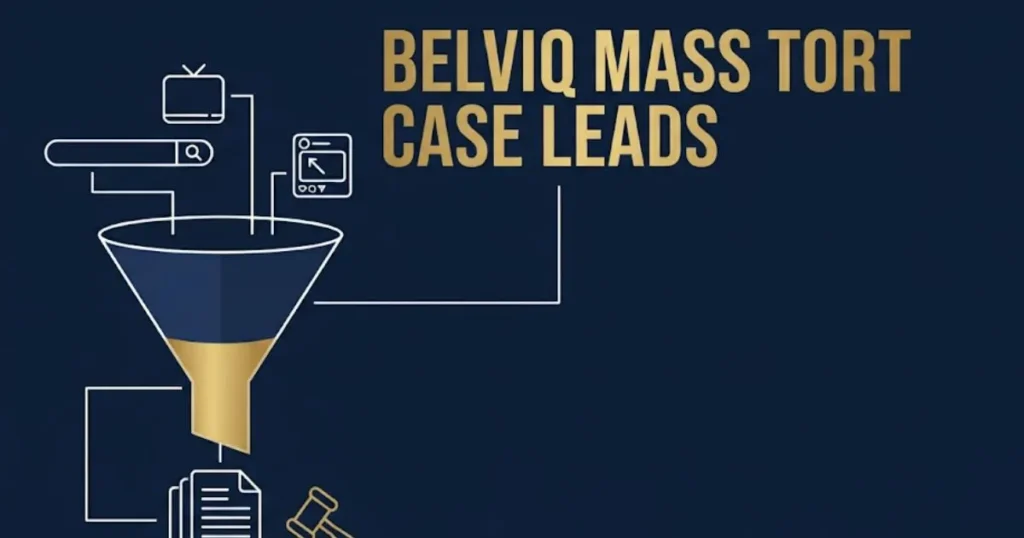
Think of it like a funnel. At the top, ads run across TV, Google, Facebook, and other platforms. People who respond are directed to a landing page or call center.
From there, intake specialists ask screening questions about the person’s Belviq usage history and medical diagnosis. If they meet the qualification criteria, they’re connected with a law firm and sign a retainer agreement.
The entire process, from ad impression to signed client, can happen in as little as 24 to 48 hours when campaigns are well built. But most campaigns operate on a longer timeline because medical records need to be verified.
What a typical campaign includes:
- Paid search ads on Google for Belviq-related keywords
- Social media ads on Facebook, Instagram, and YouTube
- Television commercials during daytime and late-night programming
- Landing pages optimized for conversions
- Call center intake with trained legal specialists
- Medical record review and case screening
- Retainer signing and case file transfer to attorneys
Campaigns in 2026 are more data-driven than ever. Firms track every dollar from ad click to signed retainer to optimize their return on investment.
How to Generate Belviq Lawsuit Mass Tort Case Leads
Belviq lawsuit mass tort case leads come from advertising campaigns that prompt former Belviq users to contact a law firm or intake center. The most reliable lead sources in 2026 are paid search, social media advertising, and television spots.
A “lead” in mass tort marketing is any person who responds to an ad and provides their contact information. Not every lead becomes a signed case. The conversion path looks like this:
| Stage | Description | Typical Rate |
|---|---|---|
| Ad Impression | Person sees the ad | N/A |
| Click or Call | Person responds to the ad | 1% to 3% CTR |
| Lead Capture | Person submits info or calls | 30% to 50% of clicks |
| Screening | Intake specialist qualifies the lead | 20% to 40% of leads |
| Retainer Signed | Person becomes a client | 50% to 70% of qualified leads |
The quality of leads matters more than volume. A firm that generates 1,000 leads but only signs 30 cases is spending far more per acquisition than a firm that generates 200 high-quality leads and signs 60 cases.
In 2026, the best lead generators use pre-qualification forms on their landing pages. These forms ask about drug usage dates, specific cancer diagnosis, and treatment history before a person ever speaks with intake.
That pre-screening step filters out unqualified leads early and saves the firm money on intake staff time.
Key Takeaway: Belviq mass tort marketing in 2026 is a structured process that turns advertising into signed legal cases, and firms that focus on lead quality over quantity will see better returns.
Belviq Cancer Lawsuit Marketing Explained
Belviq cancer lawsuit marketing focuses specifically on reaching people who developed cancer after taking lorcaserin. The cancer connection is the core of every Belviq lawsuit, and marketing messages are built around that link.
The FDA’s own safety review found that 7.7% of patients in the Belviq clinical trial group developed cancer, compared to 7.1% in the placebo group. While that difference seems small in percentage terms, it was statistically significant enough for the FDA to request a full market withdrawal.
The cancers most commonly associated with Belviq include:
- Pancreatic cancer
- Colorectal cancer
- Lung cancer
- Breast cancer
Marketing campaigns for Belviq cancer lawsuits use these specific diagnoses in their ad copy. An ad might read: “Did you take Belviq and later develop pancreatic cancer? You may be entitled to compensation.”
That specificity matters. Ads that name the exact cancer type perform significantly better than generic “were you harmed” messaging. People recognize their own diagnosis and are more likely to respond.
The emotional weight of a cancer diagnosis also shapes the tone of these campaigns. Effective marketing balances urgency with empathy. It says “act now” without sounding exploitative.
Mass Tort Marketing Strategies for Belviq Cases
The most effective mass tort marketing strategies for Belviq in 2026 combine digital and traditional channels with a strong emphasis on data tracking and lead qualification. No single channel works alone.
Here’s what the top-performing firms are doing differently:
Strategy 1: Multi-channel campaigns.
Running ads across Google, Facebook, YouTube, and TV simultaneously creates multiple touchpoints. A person might see a TV ad, then search on Google, then see a retargeting ad on Facebook before finally calling.
Strategy 2: Retargeting.
Most people don’t convert on their first visit. Retargeting ads follow website visitors across the internet, reminding them to take action. This can increase conversion rates by 30% to 50%.
Strategy 3: Content marketing.
Publishing informative articles about Belviq risks, recall history, and lawsuit updates builds trust and attracts organic search traffic. This approach takes longer but produces leads at a much lower cost.
Strategy 4: Geo-targeting.
Belviq prescriptions were more common in certain states. Running heavier ad spend in high-prescription areas like Florida, Texas, and California produces more qualified leads per dollar.
| Strategy | Pros | Cons |
|---|---|---|
| Paid Search | High intent leads | Expensive CPCs |
| Social Media Ads | Wide reach, visual | Lower intent |
| TV Advertising | Massive reach | High production cost |
| Content Marketing | Low cost, long-term | Slow to produce results |
| Retargeting | Lifts conversions | Requires existing traffic |
Combining three or more of these strategies is the sweet spot for firms running Belviq campaigns in 2026.
Belviq Lawsuit Lead Generation That Actually Works
Belviq lawsuit lead generation works best when campaigns target people based on their actual medical and prescription history, not just broad demographics. The firms seeing the highest return on ad spend in 2026 are the ones using precise audience targeting.
Generic ads that say “Were you hurt by a drug?” get clicks but not quality. Specific ads that mention Belviq by name, list the associated cancers, and state the recall year perform two to three times better in terms of conversion.
What separates working lead gen from wasted spend:
- Landing pages that load in under 3 seconds
- Forms that pre-qualify with 4 to 6 screening questions
- Call centers staffed during evenings and weekends
- Follow-up sequences for leads who don’t convert immediately
- Spanish-language ad variants for broader reach
The follow-up piece is often overlooked. Data from mass tort campaigns shows that 40% to 60% of signed cases come from leads who didn’t convert on their first contact. They needed a second call, a text reminder, or an email before they committed.
Firms that rely on one-touch lead gen are leaving money on the table. Building a nurture sequence of 5 to 7 touches over 14 days consistently outperforms single-contact approaches.
Key Takeaway: Effective Belviq lead generation in 2026 depends on precise targeting, fast landing pages, and persistent follow-up sequences that convert hesitant leads over time.
Belviq Mass Tort Advertising in 2026
Belviq mass tort advertising in 2026 is shifting heavily toward digital channels, though television still plays a role for broad awareness. The biggest change from previous years is the emphasis on video content and short-form social ads.
Total mass tort advertising spend across all torts in the United States was estimated at over $2 billion in 2024. Belviq cases represent a smaller but growing slice of that pie as the litigation progresses.
In 2026, the advertising trends for Belviq look like this:
| Channel | 2024 Share | 2026 Projected Share |
|---|---|---|
| Television | 45% | 35% |
| Paid Search (Google) | 25% | 28% |
| Social Media (Facebook, YouTube) | 20% | 27% |
| Programmatic Display | 5% | 5% |
| Other (Radio, Print, Direct Mail) | 5% | 5% |
The decline in TV’s share doesn’t mean firms are spending less on TV. It means digital is growing faster. Google and Facebook are eating into TV’s dominance because they offer better tracking and lower cost per acquisition.
Short-form video ads on YouTube and Instagram Reels are the breakout format in 2026. A 30-second video explaining the Belviq recall and asking viewers to check their eligibility is outperforming static image ads by a wide margin.
The creative approach matters too. Ads that feature real medical information and cite the FDA recall date feel more trustworthy than flashy “you could get millions” messaging.
How to Market Belviq Lawsuit Cases Effectively
Marketing Belviq lawsuit cases effectively in 2026 requires a clear message, the right audience, and a conversion system that doesn’t leak leads. Most campaigns fail not because of bad ads but because of a broken process between the ad and the signed retainer.
Step 1: Define your ideal claimant profile.
Not every Belviq user qualifies. Your marketing should target people who took the drug for a meaningful duration and later received a cancer diagnosis. Knowing this narrows your audience and reduces wasted ad spend.
Step 2: Build a dedicated landing page.
Don’t send Belviq ad traffic to your firm’s homepage. Build a specific page about the Belviq lawsuit. Include the drug name, recall information, qualifying cancer types, and a simple form or phone number.
Step 3: Run ads on at least two channels.
Diversifying your traffic sources protects you from sudden cost spikes on any one platform. If Google CPCs jump 40% overnight, your Facebook and TV campaigns keep leads flowing.
Step 4: Track everything.
Every call, form submission, and retainer should be tracked back to its source. Without tracking, you can’t tell which ads are profitable and which are burning cash.
Step 5: Optimize weekly.
Mass tort campaigns aren’t set-it-and-forget-it. The firms winning in 2026 review performance data weekly and adjust bids, creative, and targeting based on results.
One firm running a Belviq campaign might test 10 different ad headlines in a single week. The winning headline gets more budget. The losers get cut. That kind of discipline separates profitable campaigns from money pits.
Best Digital Marketing Channels for Belviq Lawsuits
The best digital marketing channels for Belviq lawsuits in 2026 are Google Ads, Facebook Ads, and YouTube. Each serves a different purpose in the lead generation funnel.
Google Ads (Paid Search):
This is the highest-intent channel. When someone types “Belviq lawsuit” or “can I sue for Belviq cancer” into Google, they’re actively seeking answers. Paid search ads appear at the top of those results. The cost per click ranges from $25 to $80 depending on competition, but the lead quality is hard to beat.
Facebook Ads:
Facebook reaches people who aren’t actively searching. The advantage is visual storytelling. You can show a 60-second video about the Belviq recall and target users based on age, location, and health interests. CPCs are lower at $5 to $20, but leads require more nurturing before they convert.
YouTube:
YouTube sits between Google and Facebook in terms of intent. Pre-roll video ads that play before health-related content can reach Belviq’s core demographic of adults aged 35 to 65 who were prescribed weight loss medication.
| Channel | Cost Per Click | Lead Intent | Best Use |
|---|---|---|---|
| Google Ads | $25 to $80 | Very High | Capturing active searchers |
| Facebook Ads | $5 to $20 | Medium | Awareness and retargeting |
| YouTube | $8 to $30 | Medium-High | Video education and trust |
| $5 to $15 | Medium | Short-form video ads | |
| Programmatic Display | $2 to $8 | Low | Brand awareness |
A balanced approach using Google for high-intent capture and Facebook or YouTube for awareness and retargeting gives firms the widest reach at the best overall cost per signed case.
Key Takeaway: Google Ads captures the highest-intent Belviq leads, but pairing it with Facebook and YouTube for awareness and retargeting creates a full-funnel campaign that drives more signed cases per dollar.
Belviq Lawsuit TV Advertising Campaigns
Belviq lawsuit TV advertising campaigns still work in 2026, especially for reaching older demographics who spend more time watching linear television. TV remains the single best channel for mass awareness.
The typical Belviq TV spot runs 60 seconds and follows a familiar format. It opens with a question: “Did you or a loved one take Belviq?” It mentions the FDA recall. It lists qualifying cancers. Then it shows a toll-free number.
Average costs for Belviq TV advertising:
- National cable spot: $5,000 to $25,000 per airing
- Local broadcast spot: $500 to $5,000 per airing
- Production cost for a single commercial: $10,000 to $50,000
TV’s strength is volume. A single national spot can generate hundreds of calls in a day. But TV’s weakness is waste. Many callers don’t qualify, and there’s no way to pre-screen viewers before they pick up the phone.
That’s why most firms pair TV with a strong call center operation. The call center handles the flood of incoming calls, screens for eligibility, and passes qualified leads to attorneys.
Some firms in 2026 are shifting TV budgets toward Connected TV (CTV) and streaming platforms. Services like Hulu, Peacock, and Tubi allow ads to be targeted by zip code, age range, and viewing habits. This hybrid approach gives firms TV’s visual impact with digital’s targeting precision.
Cost Per Lead for Belviq Mass Tort Cases
The cost per lead for Belviq mass tort cases in 2026 ranges from $150 to $600 depending on the marketing channel, lead quality, and geographic targeting. Signed case costs run significantly higher, typically between $2,500 and $8,000 per retainer.
These numbers vary widely. A firm running well-optimized Google Ads might achieve a $200 cost per lead, while a firm running broad TV campaigns might pay $500 or more for each lead that comes through.
| Metric | Low End | High End |
|---|---|---|
| Cost Per Lead (all channels) | $150 | $600 |
| Cost Per Qualified Lead | $400 | $1,500 |
| Cost Per Signed Case | $2,500 | $8,000 |
| Average TV Lead Cost | $350 | $600 |
| Average Google Lead Cost | $150 | $400 |
| Average Facebook Lead Cost | $100 | $300 |
Facebook tends to produce the cheapest leads, but those leads often require more follow-up before they convert. Google leads cost more upfront but convert at higher rates. TV sits in the middle on cost but brings in the highest overall volume.
The number that matters most isn’t cost per lead. It’s cost per signed, qualified case. A $100 Facebook lead that never signs is infinitely more expensive than a $500 Google lead that becomes a $50,000 settlement.
Smart firms track all the way through to case resolution and calculate their true return on investment from each channel.
Belviq Mass Tort Case Qualification Criteria
Belviq mass tort case qualification criteria in 2026 require that a claimant took lorcaserin (Belviq or Belviq XR) and was later diagnosed with a qualifying cancer. Not every former user has a viable case.
The standard qualification criteria include:
- Patient took Belviq or Belviq XR for at least 60 to 90 days
- Cancer diagnosis occurred during or after Belviq use
- Cancer diagnosis is one of the types linked to lorcaserin in clinical studies
- Patient has medical records documenting both Belviq use and cancer diagnosis
Qualifying cancer types typically include:
- Pancreatic cancer
- Colorectal cancer
- Lung cancer
- Breast cancer
- Brain cancer (certain types)
- Other cancers identified in the FDA safety review
| Qualification Factor | Requirement |
|---|---|
| Minimum Drug Use | 60 to 90 days |
| Timing of Diagnosis | During or after Belviq use |
| Documentation Needed | Prescription records and cancer diagnosis records |
| Pre-existing Cancer | Usually disqualifying if diagnosed before Belviq use |
| Statute of Limitations | Varies by state; still open in many jurisdictions in 2026 |
Cases are strongest when the cancer diagnosis came within a few years of Belviq use and the patient has clear prescription records. If a person took Belviq for two weeks and was diagnosed with an unrelated skin condition, that’s not a case.
Marketing campaigns that clearly state these criteria in their ads and landing pages attract better leads and waste less of the firm’s intake resources.
Key Takeaway: Belviq case qualification requires documented drug use of at least 60 to 90 days plus a qualifying cancer diagnosis, and marketing campaigns that communicate these criteria upfront generate higher-quality leads.
The Belviq Lawsuit Intake Process Step by Step
The Belviq lawsuit intake process is the system that turns a raw lead into a signed legal client. It typically involves five to seven steps and can take anywhere from 24 hours to several weeks depending on the complexity of the case.
Step-by-step breakdown:
- Initial contact. The lead calls a phone number or submits an online form in response to an ad.
- Screening interview. An intake specialist asks about the person’s Belviq usage, including the dates they took it, the prescribing doctor, and the dosage.
- Medical history review. The specialist asks about any cancer diagnosis, including the type, date of diagnosis, and treatment received.
- Preliminary qualification. Based on the screening answers, the lead is classified as qualified, potentially qualified, or not qualified.
- Medical records request. For qualified leads, the firm requests prescription records and medical records to verify the claim.
- Attorney review. A licensed attorney reviews the case file and determines if it meets the legal threshold for filing.
- Retainer signing. The client signs a retainer agreement, and the case is officially opened.
| Intake Stage | Average Duration |
|---|---|
| Initial Contact | Same day |
| Screening Interview | 10 to 20 minutes |
| Medical History Review | Same call or next day |
| Records Request | 2 to 6 weeks |
| Attorney Review | 1 to 2 weeks |
| Retainer Signing | Same day as approval |
The bottleneck is almost always medical records. Getting records from hospitals and pharmacies takes time. Firms that use electronic records retrieval services can cut this step from six weeks to two weeks.
Speed matters because leads go cold fast. Every day between initial contact and retainer signing increases the chance the person will lose interest or sign with a competing firm.
Tepezza Lawsuit Mass Tort Marketing Comparison
Tepezza lawsuit mass tort marketing operates on similar principles to Belviq but targets a completely different drug, condition, and patient population. Understanding how Tepezza campaigns work provides useful context for anyone running or studying Belviq marketing.
Tepezza (teprotumumab) is a drug used to treat thyroid eye disease. Lawsuits allege that Tepezza caused permanent hearing loss and tinnitus in some patients. The litigation has been growing rapidly, and marketing for Tepezza cases has become one of the most competitive mass tort advertising categories in 2026.
How Tepezza marketing differs from Belviq marketing:
- Target condition: Hearing loss and tinnitus (Tepezza) vs. cancer (Belviq)
- Patient demographics: Tepezza patients tend to be younger and more digitally connected
- Ad messaging: Tepezza ads focus on hearing damage; Belviq ads focus on cancer risk
- Lead volume: Tepezza has a smaller patient pool but higher awareness per capita
| Factor | Belviq Marketing | Tepezza Marketing |
|---|---|---|
| Drug Category | Weight loss | Thyroid eye disease |
| Alleged Harm | Cancer | Hearing loss / tinnitus |
| Estimated U.S. Users | ~2 million | ~100,000 |
| Lead Cost (avg) | $150 to $600 | $200 to $700 |
| Primary Channels | TV, Google, Facebook | Google, Facebook, YouTube |
| Litigation Maturity | More established | Newer, still developing |
Tepezza campaigns often run at a higher cost per lead because the patient population is smaller and more concentrated. Belviq campaigns benefit from a much larger potential claimant pool, which makes broad awareness advertising like TV more cost-effective.
Belviq vs. Tepezza Mass Tort Marketing: Key Differences
The key difference between Belviq and Tepezza mass tort marketing is the size and accessibility of the target audience. Belviq’s estimated user base of 2 million is roughly 20 times larger than Tepezza’s, which fundamentally changes how campaigns are built and budgeted.
With Belviq, TV advertising makes financial sense because the large user base means even a broad, untargeted TV spot will reach some former users. With Tepezza, TV is often too wasteful because the patient population is so small that most viewers have no connection to the drug.
Other key differences:
- Message complexity: Cancer is a universally understood harm. Hearing loss requires more explanation of the connection to the drug.
- Conversion speed: Belviq leads often convert faster because cancer patients have a strong emotional motivation to act.
- Competition level: Belviq marketing is less saturated in 2026 than Tepezza, meaning lower ad costs and less noise.
- Record retrieval: Cancer diagnoses are usually well-documented. Hearing loss sometimes requires audiological testing, which adds a step.
For firms deciding where to allocate their mass tort marketing budget in 2026, Belviq offers a larger addressable market at a lower cost per lead. Tepezza offers potentially higher individual case values but at a higher acquisition cost.
Some firms run both campaigns simultaneously, using shared infrastructure like call centers and intake teams to handle leads from both torts efficiently.
Key Takeaway: Belviq campaigns reach a larger audience at lower cost, while Tepezza campaigns target a smaller group at higher cost, and the best firms run both using shared intake infrastructure.
Belviq Lawsuit Eligibility in 2026
Belviq lawsuit eligibility in 2026 remains open for many former users, though specific deadlines depend on state statutes of limitations and the progression of the litigation. If you took Belviq and developed cancer, you may still be within the filing window.
General eligibility requirements:
- You were prescribed and took Belviq or Belviq XR
- You took the drug for a period of at least 60 days
- You were diagnosed with cancer during or after your Belviq use
- Your cancer diagnosis falls within one of the categories linked to lorcaserin
- You have not previously filed a Belviq lawsuit or settled a Belviq claim
State statutes of limitations for pharmaceutical injury cases typically run 2 to 6 years from the date of discovery of the injury. Because many cancers linked to Belviq are being discovered years after the drug was taken, the discovery clock may have started recently for some claimants.
| State Example | Statute of Limitations | Notes |
|---|---|---|
| California | 2 years from discovery | Discovery rule may extend deadline |
| Texas | 2 years from injury | Strict deadline |
| Florida | 4 years from discovery | Recently updated |
| New York | 3 years from discovery | Standard for personal injury |
| Illinois | 2 years from discovery | Can be tolled in some cases |
These are general guidelines. Individual circumstances vary. The point for marketing purposes is that many former Belviq users still qualify in 2026, which means the addressable market for advertising campaigns has not closed.
Firms should emphasize urgency in their ad copy. Statutes of limitations are real deadlines, and waiting too long can permanently bar a claim.
Belviq Lawsuit Settlement Amounts in 2026
Belviq lawsuit settlement amounts in 2026 have not been officially established through a global settlement, but individual case values are estimated based on comparable pharmaceutical mass tort settlements and the severity of cancer diagnoses involved.
Estimated individual case values in 2026:
| Case Category | Estimated Settlement Range |
|---|---|
| Fatal cancer (death of patient) | $250,000 to $1,000,000+ |
| Serious cancer requiring surgery/chemo | $100,000 to $500,000 |
| Early-stage cancer with successful treatment | $50,000 to $200,000 |
| Non-cancer serious side effects | $10,000 to $50,000 |
These estimates are based on historical mass tort settlements involving similar cancer-causing drugs. The actual amounts will depend on several factors:
- Type and stage of cancer at diagnosis
- Duration of Belviq use
- Strength of the causal link between Belviq and the specific cancer
- Patient age and overall health before taking Belviq
- Economic damages including medical bills and lost income
- Whether the manufacturer settles or cases go to trial
No global settlement has been announced as of early 2026. Cases are still in active litigation. Some bellwether trials may be scheduled for late 2026 or 2027, and those outcomes will heavily influence settlement negotiations.
For marketing purposes, firms should be cautious about quoting specific dollar amounts in ads. Overpromising on settlement amounts can create compliance issues and erode trust with potential clients.
Key Takeaway: Belviq lawsuit settlements in 2026 are projected to range from $50,000 to over $1 million per case depending on cancer severity, but no global settlement has been finalized yet, and bellwether trials will shape final numbers.
Frequently Asked Questions
How much does a Belviq mass tort lead cost in 2026?
The average cost per lead for Belviq mass tort cases ranges from $150 to $600 in 2026.
Google Ads tends to produce leads in the $150 to $400 range, while TV leads average $350 to $600.
The cost per signed case, after qualification and intake, typically runs between $2,500 and $8,000.
Who qualifies for the Belviq lawsuit in 2026?
People who took Belviq or Belviq XR for at least 60 days and were later diagnosed with cancer may qualify.
Qualifying cancers include pancreatic, colorectal, lung, and breast cancer.
Statutes of limitations remain open in many states as of 2026.
What marketing channels work best for Belviq case leads?
Google Ads, Facebook Ads, and television are the three most effective channels for Belviq lead generation in 2026.
Google captures the highest-intent leads at $25 to $80 per click.
Facebook offers lower costs but requires more follow-up to convert leads into signed cases.
How does Belviq mass tort marketing compare to Tepezza?
Belviq has a much larger potential claimant pool of around 2 million users compared to Tepezza’s estimated 100,000.
This makes broad advertising channels like TV more cost-effective for Belviq campaigns.
Tepezza campaigns run at higher cost per lead but may yield higher individual case values.
What are the expected Belviq lawsuit settlement amounts in 2026?
Individual Belviq settlements are estimated at $50,000 to over $1 million depending on cancer type and severity.
No global settlement has been finalized as of early 2026.
Bellwether trial outcomes expected in late 2026 or 2027 will shape the final settlement range.
What to Do Right Now
The Belviq lawsuit is still wide open in 2026. Millions of former users haven’t filed claims yet, and marketing campaigns are actively working to reach them.
If you’re a firm or marketer, the window for efficient lead acquisition is now. Costs will rise as more competitors enter the space and bellwether trials draw closer.
If you’re a former Belviq user, check your eligibility before statutes of limitations close. Your claim has real value, and the clock is ticking.







