

Elmiron lawsuit lawyers are helping thousands of people who suffered eye damage after taking the bladder drug pentosan polysulfate sodium. If you took Elmiron and your vision changed, 2026 could be the year your case finally pays out.
The litigation against Janssen Pharmaceuticals has been building since 2020. Over 2,300 cases are now consolidated in a federal MDL in New Jersey. Bellwether trials have already produced mixed results, and settlement talks are gaining real momentum.
This article covers everything you need to know for 2026. That includes updated settlement projections, who qualifies, filing deadlines, attorney fees, and how to pick the right lawyer.
One fact that stands out: some Elmiron users took the drug for over a decade before anyone warned them about retinal toxicity. The FDA didn’t update the label until 2020.
Elmiron Lawsuit Lawyers
Elmiron lawsuit lawyers are attorneys who represent people harmed by the prescription bladder drug Elmiron, manufactured by Janssen Pharmaceuticals. These lawyers focus on pharmaceutical product liability and mass tort cases involving eye damage.
The right attorney can make a major difference in your outcome. Elmiron cases require knowledge of the drug’s history, the science behind pigmentary maculopathy, and the MDL process in federal court.
Most elmiron lawsuit lawyers work on a contingency fee basis. That means you pay nothing upfront. They only collect a fee if you win or settle your case.
| Feature | What to Know |
|---|---|
| Case Type | Pharmaceutical mass tort |
| Fee Structure | Contingency (no win, no fee) |
| Where Cases Are Filed | MDL 2973, District of New Jersey |
| Number of Pending Cases | Over 2,300 as of early 2025 |
| Key Defendant | Janssen Pharmaceuticals (Johnson & Johnson) |
When you contact an Elmiron lawyer, they’ll typically review your medical records, prescription history, and eye exam results. The initial consultation is almost always free.
Look for lawyers with specific experience in pharmaceutical litigation. General personal injury attorneys may not understand the medical and scientific issues involved in Elmiron claims.
Elmiron Lawsuit Update 2026
The Elmiron lawsuit is expected to see significant developments in 2026, including potential global settlement discussions and additional bellwether trial dates. The litigation is entering a phase where both sides face pressure to resolve cases.
Judge Brian R. Martinotti oversees the MDL in the District of New Jersey. Throughout 2024 and 2025, the court worked through discovery, expert challenges, and initial trial selections.

Several bellwether cases have already gone to trial. These test cases help both sides gauge how juries react to the evidence. Results have been split, with some plaintiff victories and some defense wins.
Key 2026 developments to watch for:
- Additional bellwether trials scheduled for mid-2026
- Possible global settlement framework announcement
- Continued filing of new individual cases
- Expert testimony rulings that could shape remaining claims
Settlement pressure typically builds after bellwether trials produce clear patterns. With several trials behind them, 2026 is shaping up as the year when serious money gets put on the table.
Janssen has shown some willingness to settle individual cases. But a large-scale resolution affecting thousands of plaintiffs hasn’t materialized yet.
Elmiron Settlement Amounts
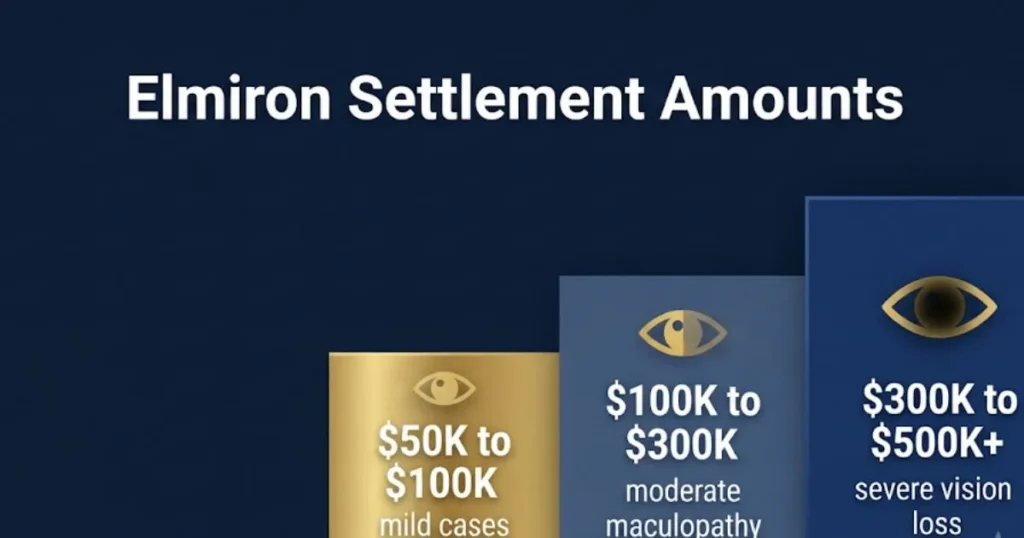
Elmiron settlement amounts are projected to range from $50,000 to over $500,000 per case, depending on the severity of eye damage and the strength of medical evidence. No global settlement has been announced yet as of early 2025.
These estimates come from analyzing early bellwether verdicts, individual settlements, and comparisons with similar pharmaceutical mass torts. Your actual payout depends heavily on your specific injuries and medical records.
| Injury Severity | Projected Settlement Range |
|---|---|
| Mild vision changes (documented) | $50,000 to $100,000 |
| Diagnosed pigmentary maculopathy | $100,000 to $300,000 |
| Severe vision loss or legal blindness | $300,000 to $500,000+ |
| Minimal or undocumented eye issues | May not qualify |
Think of it like car insurance claims. A fender bender pays less than a totaled vehicle. The same logic applies here. More severe, well-documented injuries command higher settlements.
Plaintiffs with long prescription histories and clear ophthalmic diagnoses have the strongest cases. Medical records from before and after Elmiron use are extremely valuable.
Keep in mind that these are estimates. Until Janssen agrees to a settlement program or a jury sets a clear benchmark, all numbers are projections based on available data.
Key Takeaway: Elmiron lawsuits are active and growing in 2026, with settlement projections ranging from $50,000 to over $500,000 depending on injury severity and medical documentation.
Elmiron Lawsuit Payout Per Person
The payout per person in an Elmiron lawsuit depends on individual factors like duration of drug use, type of eye injury, and quality of medical proof. There is no flat per-person payout at this time.
Every Elmiron case gets evaluated on its own merits. Two people who took the drug for the same period might receive very different amounts. The difference comes down to what a doctor diagnosed and how well the records support the claim.
Factors that determine your individual payout:
- How long you took Elmiron
- Whether you have a formal maculopathy diagnosis
- The severity of your vision loss
- Your age at the time of injury
- Whether your eye doctor linked the damage to Elmiron specifically
- Strength of your prescription pharmacy records
Some pharmaceutical mass torts use a point-based scoring system when distributing settlement funds. Higher-scoring claims get larger payouts. The Elmiron litigation could adopt a similar approach.
In the Vioxx settlement, for example, individual payouts ranged from a few thousand to several hundred thousand dollars based on injury severity. Elmiron is following a comparable path.
If your doctor diagnosed you with pigmentary maculopathy after years of Elmiron use, your case is likely in the higher payout tier. If you have only mild symptoms without a formal diagnosis, your case may fall into a lower category.
Elmiron Eye Damage Lawsuit
The Elmiron eye damage lawsuit centers on claims that pentosan polysulfate sodium causes a unique form of retinal damage called pigmentary maculopathy. Plaintiffs allege that Janssen knew about this risk and failed to warn patients or doctors.
Pigmentary maculopathy is a condition where the macula, the part of your eye responsible for sharp central vision, develops dark spots and damage. The pattern of damage in Elmiron users looks different from age-related macular degeneration.
Researchers at Emory University first identified the connection in 2018. Dr. Nieraj Jain and colleagues published findings showing that long-term Elmiron users had a distinct pattern of retinal changes not seen in other populations.
Timeline of key events:
| Year | Event |
|---|---|
| 1996 | FDA approves Elmiron for interstitial cystitis |
| 2018 | Emory researchers publish study linking Elmiron to maculopathy |
| 2019 | Additional studies confirm the retinal damage pattern |
| 2020 | FDA adds eye damage warning to Elmiron label |
| 2020 | First lawsuits filed against Janssen |
| 2021 | MDL 2973 created in New Jersey |
| 2024-2025 | Bellwether trials begin |
For nearly 24 years, the Elmiron label said nothing about eye damage. Thousands of patients took the drug without knowing they might be slowly losing their vision.
That’s the core of every Elmiron eye damage lawsuit. The manufacturer had a duty to investigate and disclose known risks. Plaintiffs say Janssen failed that duty.
Who Qualifies for the Elmiron Lawsuit
You may qualify for the Elmiron lawsuit if you took Elmiron (pentosan polysulfate sodium) and later developed eye problems, particularly pigmentary maculopathy or unexplained vision changes. The longer you took the drug, the stronger your potential case.
Not everyone who took Elmiron will qualify. The litigation focuses specifically on people who experienced measurable eye damage that can be linked to the medication.
Basic eligibility checklist:
- You were prescribed Elmiron for interstitial cystitis or bladder pain
- You took the drug for at least two years (longer use strengthens your case)
- You developed vision problems during or after Elmiron use
- You have medical records showing eye damage, maculopathy, or retinal changes
- Your eye problems were not fully explained by another condition
| Qualifying Factor | Stronger Case | Weaker Case |
|---|---|---|
| Duration of use | 3+ years | Less than 1 year |
| Diagnosis | Confirmed pigmentary maculopathy | Self-reported blurry vision only |
| Medical records | Complete ophthalmology records | No eye exams on file |
| Prescription proof | Pharmacy records available | No records available |
Even if you haven’t been diagnosed with maculopathy specifically, it’s worth getting a comprehensive eye exam. Some people don’t realize their vision has changed because the damage happens gradually.
Talk to an eye doctor who understands Elmiron-related retinal damage. A specialized exam using optical coherence tomography (OCT) and fundus autofluorescence can detect the damage patterns associated with this drug.
Key Takeaway: You may qualify for the Elmiron lawsuit if you took the drug for two or more years and developed documented eye damage, especially pigmentary maculopathy confirmed by an ophthalmologist.
How to File an Elmiron Lawsuit
Filing an Elmiron lawsuit starts with contacting an experienced pharmaceutical litigation attorney who will review your medical and prescription records at no cost. The process is straightforward, and most people can begin with a phone call or online form.
Here’s what the typical filing process looks like, step by step.
Step-by-step filing process:
- Contact an Elmiron attorney for a free case evaluation
- Provide your prescription history and pharmacy records
- Authorize release of your medical records, especially eye exams
- The attorney reviews your records and determines case strength
- If your case qualifies, the attorney files a complaint in the MDL or state court
- Your case enters the litigation process (discovery, depositions, trial or settlement)
You don’t need to have a lawyer already to start the process. Most firms handle the paperwork, medical record requests, and court filings on your behalf.
The complaint itself will name Janssen Pharmaceuticals as the defendant. It will describe your Elmiron use, your eye injuries, and allege that the company failed to adequately warn about the risk of retinal damage.
| Step | What Happens | Your Role |
|---|---|---|
| Initial contact | Free case review | Share basic info |
| Record gathering | Attorney collects medical/pharmacy records | Sign authorization forms |
| Case filing | Complaint filed in MDL 2973 or state court | Review and approve |
| Litigation | Discovery, depositions, expert evaluations | Cooperate with your legal team |
| Resolution | Settlement or trial | Accept or reject offer |
One important note: you do not need to go to court in person for most of this process. The vast majority of cases in pharmaceutical mass torts settle before trial.
Elmiron Lawsuit Deadline 2026
The deadline to file an Elmiron lawsuit varies by state because each state has its own statute of limitations for product liability and personal injury claims. In many states, you have two to three years from the date you discovered (or should have discovered) your injury.
This is where things get tricky. The “discovery rule” applies in most Elmiron cases. That means the clock doesn’t necessarily start when you took the drug. It starts when you learned, or reasonably should have learned, that Elmiron caused your eye damage.
| State Example | Statute of Limitations | Discovery Rule |
|---|---|---|
| New Jersey | 2 years | Yes |
| California | 2 years | Yes |
| Texas | 2 years | Yes |
| New York | 3 years | Yes |
| Florida | 4 years (recently changed) | Yes |
| Pennsylvania | 2 years | Yes |
For 2026 specifically, here’s what matters:
- If you first learned about the Elmiron-eye damage link in 2024, your deadline could fall in 2026 or 2027 depending on your state.
- If you’ve known for years and haven’t filed, you may be running out of time.
- The FDA’s 2020 label change is often used as a benchmark for when the public became aware of the risk.
Do not wait to find out whether your deadline has passed. An attorney can evaluate your situation and tell you within days whether you’re still within the filing window.
Is It Too Late to File an Elmiron Lawsuit
It is not too late to file an Elmiron lawsuit for most people in 2026, but the window is closing. If you recently discovered your eye damage or just learned that Elmiron may have caused it, you likely still have time to file.
The key question is when you became aware of the link between Elmiron and your vision problems. Courts look at the “discovery date,” not necessarily when you stopped taking the drug.
Signs you still have time:
- You were diagnosed with maculopathy or vision changes in 2024 or later
- You only recently learned that Elmiron could cause eye damage
- You haven’t yet seen an eye specialist about potential Elmiron-related injury
- Your state has a longer statute of limitations (3 or 4 years)
Signs you may be running out of time:
- You learned about the Elmiron-eye damage connection in 2021 or 2022
- You live in a state with a 2-year statute of limitations
- You were already contacted by a law firm years ago and didn’t act
Even if you think you might be too late, it’s still worth having a lawyer check. Some states allow exceptions, tolling provisions, or equitable arguments that can extend your filing window.
The worst outcome of calling an attorney is being told your time has passed. The worst outcome of not calling is losing a valid claim worth thousands of dollars.
Key Takeaway: Most people can still file an Elmiron lawsuit in 2026, but deadlines vary by state; the sooner you contact an attorney and check your statute of limitations, the safer your claim will be.
Elmiron Maculopathy Lawsuit
The Elmiron maculopathy lawsuit specifically targets the unique retinal condition caused by long-term use of pentosan polysulfate sodium. Pigmentary maculopathy is the medical diagnosis at the heart of this litigation.
This isn’t ordinary age-related macular degeneration. Elmiron-induced maculopathy shows a distinct pattern of damage that eye specialists can identify on retinal imaging. The pigment changes in the macula look different under OCT and fundus autofluorescence testing.
What pigmentary maculopathy looks like in Elmiron users:
- Dark, patchy deposits in the macular region
- Difficulty reading or seeing fine details
- Trouble adjusting to dim lighting
- Distorted central vision
- Progressive worsening even after stopping the drug
The scary part about this condition is that stopping Elmiron doesn’t always stop the damage. Some patients report continued vision decline months or years after their last dose. That’s what makes these lawsuits so compelling from a damages perspective.
Studies estimate that between 15% and 25% of long-term Elmiron users may develop some degree of maculopathy. “Long-term” generally means three or more years of continuous use.
| Maculopathy Detail | Information |
|---|---|
| Condition | Pigmentary maculopathy |
| Cause Alleged | Pentosan polysulfate sodium (Elmiron) |
| Risk Population | Long-term users (3+ years) |
| Estimated Prevalence | 15% to 25% of long-term users |
| Reversible? | Often not fully reversible |
| Detection Methods | OCT, fundus autofluorescence, visual field testing |
If your eye doctor diagnosed you with this condition and you have a history of Elmiron use, your case is likely strong. The connection between the drug and this specific type of retinal damage is well-established in peer-reviewed medical literature.
Elmiron MDL Update
The Elmiron MDL (Multidistrict Litigation No. 2973) is housed in the U.S. District Court for the District of New Jersey under Judge Brian R. Martinotti. As of early 2025, over 2,300 cases are consolidated in this MDL, with new cases still being added.
An MDL is not a class action. Each case remains individual, but they’re grouped together for pretrial efficiency. Think of it like bundling hundreds of similar packages for shipping. They travel together but get delivered separately.
Current MDL status:
- Pretrial discovery is largely complete for initial case groups
- Expert witnesses have been disclosed by both sides
- Daubert challenges (challenges to expert testimony) have been argued
- Bellwether trial selections have occurred
- Additional case management orders are expected throughout 2026
The MDL process helps avoid conflicting rulings from different judges on the same scientific questions. All the pretrial work happens in New Jersey, and then cases can be remanded to their home courts for trial if they don’t settle.
| MDL Detail | Status |
|---|---|
| MDL Number | 2973 |
| Court | District of New Jersey |
| Presiding Judge | Brian R. Martinotti |
| Total Cases | 2,300+ |
| Phase | Bellwether trials and settlement discussions |
| New Cases Being Accepted | Yes |
Judge Martinotti has pushed both sides toward resolution. Courts managing large pharmaceutical MDLs typically encourage global settlement once bellwether results establish a pattern. That’s where this litigation stands heading into 2026.
Elmiron Bellwether Trial Results
Elmiron bellwether trials have produced mixed results so far, with some plaintiff verdicts and some defense wins. These outcomes give both sides data points for settlement negotiations.
Bellwether trials are test cases selected from the larger MDL pool. They’re designed to show how juries respond to the evidence, the experts, and the legal arguments. Neither side is bound by bellwether results, but they heavily influence settlement values.
Summary of bellwether outcomes:
- Some plaintiffs have won verdicts in the hundreds of thousands of dollars
- The defense has also won cases where the plaintiff’s evidence was weaker
- Jurors have responded strongly to evidence showing Janssen’s failure to warn
- Cases with extensive prescription histories and clear maculopathy diagnoses performed best for plaintiffs
The mixed results actually serve both sides’ interests in different ways. Plaintiffs can point to wins as proof that juries will hold Janssen liable. Janssen can point to defense verdicts as leverage to lower settlement numbers.
In practical terms, mixed bellwether results often accelerate settlement. Neither side wants to gamble on hundreds of individual trials when results are unpredictable. It’s cheaper and faster for everyone to negotiate a global resolution.
What this means for your case in 2026:
- Strong cases (long use, clear diagnosis) are positioned for favorable settlements
- Weaker cases (short use, no diagnosis) face more uncertainty
- Settlement negotiations are informed by these trial outcomes
- The most likely path forward is a settlement grid, not thousands of individual trials
Key Takeaway: Mixed bellwether trial results in the Elmiron MDL are pushing both sides toward settlement negotiations, which could produce a resolution framework in 2026.
Elmiron Class Action Lawsuit
The Elmiron litigation is not technically a class action lawsuit. It’s a mass tort consolidated in a multidistrict litigation. The difference matters because it affects how much money you might receive.
In a class action, one lawsuit represents everyone, and the payout gets split equally among all class members. In a mass tort or MDL, each person has their own individual case. Your compensation is based on your specific injuries.
| Feature | Class Action | Mass Tort (MDL) |
|---|---|---|
| Individual cases | No | Yes |
| Personalized payouts | No | Yes |
| You have your own lawyer | Sometimes | Yes |
| Settlement based on your injuries | Rarely | Yes |
| Your case can go to trial | No | Yes |
This distinction works in your favor as an Elmiron plaintiff. Your settlement isn’t diluted by people with minor or no injuries. If you have severe maculopathy and a strong medical record, your payout reflects that.
People often call the Elmiron litigation a “class action” because that’s the term most people know. But the legal structure is an MDL, which gives individual plaintiffs more control and potentially more money.
Some state-level class actions related to Elmiron may exist for specific consumer protection claims. But the main federal litigation where big money is at stake is the MDL in New Jersey.
Best Lawyers for Elmiron Lawsuit
The best lawyers for an Elmiron lawsuit are firms with direct experience in pharmaceutical mass torts, a track record in MDL litigation, and dedicated resources for handling complex medical evidence. Not every personal injury attorney is qualified.
Choosing the right firm matters more than people realize. A general accident lawyer won’t know how to argue pentosan polysulfate sodium toxicity to a jury. You need someone who has handled drug injury cases before.
What to look for in an Elmiron lawyer:
- Experience with pharmaceutical product liability cases
- Active involvement in the Elmiron MDL (MDL 2973)
- Access to medical experts in ophthalmology and retinal toxicology
- A history of successful mass tort settlements or verdicts
- Clear communication about your case timeline and realistic expectations
- Contingency fee arrangement (no upfront costs)
Red flags to watch for:
- Guarantees of a specific dollar amount before reviewing your case
- Pressure to sign immediately without time to review the agreement
- No verifiable track record in pharmaceutical litigation
- Vague answers about fee structure or case costs
- Firms that seem to be just collecting cases to sell to other lawyers
Some large firms serve as “lead counsel” in the MDL. They help shape litigation strategy, argue motions, and try bellwether cases. If your case is handled by a firm with a leadership role in the MDL, that can be an advantage.
Ask during your consultation whether the firm will handle your case directly or refer it to another attorney. Some firms act as middlemen, which can add a layer between you and your legal team.
Elmiron Attorney Fees
Elmiron attorneys typically work on a contingency fee basis, charging between 33% and 40% of your total settlement or verdict. You pay nothing upfront and owe nothing if your case doesn’t succeed.
This fee structure exists because pharmaceutical cases are expensive to litigate. Your attorney fronts all the costs for medical expert reviews, court filings, depositions, and other expenses. They recoup those costs from your settlement.
| Fee Component | Typical Range |
|---|---|
| Contingency fee percentage | 33% to 40% |
| Case costs (deducted from settlement) | $2,000 to $10,000+ |
| Upfront cost to you | $0 |
| Payment if you lose | $0 |
Here’s a real-world example. If your case settles for $200,000 and your attorney’s fee is 35%, they receive $70,000. Case costs of $5,000 are deducted. You take home $125,000.
Some firms charge on the lower end (33%) while others go up to 40%, especially if the case goes to trial. Get the fee agreement in writing before you sign anything. There should be no surprises.
Questions to ask about fees:
- What percentage do you charge on a settlement vs. a trial verdict?
- Are case costs deducted before or after the attorney fee calculation?
- Do I owe anything if my case doesn’t result in compensation?
- Will any other firms share in the fee?
The contingency model means your attorney has every incentive to maximize your payout. They only get paid when you get paid, and they get paid more when you get more.
Key Takeaway: Elmiron attorneys charge contingency fees of 33% to 40% with no upfront costs, so choosing a firm with a strong track record in pharmaceutical cases directly impacts how much you keep.
Elmiron Vision Damage Claims
Elmiron vision damage claims are based on the allegation that long-term use of pentosan polysulfate sodium causes toxic damage to the retina, leading to progressive and often irreversible vision loss. These claims target the manufacturer’s failure to warn.
The types of vision damage reported in Elmiron lawsuits include a range of symptoms, from mild to severe.
Reported vision damage types:
- Difficulty reading fine print or small text
- Blurred or distorted central vision
- Trouble seeing in low light or adjusting between light conditions
- Dark or missing spots in central vision
- Progressive decline in overall visual sharpness
- In severe cases, near-total loss of central vision approaching legal blindness
What makes these claims legally strong is the growing body of medical evidence. Multiple peer-reviewed studies from research groups at Emory, Kaiser Permanente, and other institutions have confirmed the association between Elmiron and pigmentary maculopathy.
| Evidence Category | Details |
|---|---|
| Published Studies | Multiple peer-reviewed papers since 2018 |
| FDA Action | Label updated in June 2020 to include eye warning |
| Defendant’s Knowledge | Plaintiffs allege Janssen had internal data suggesting risk |
| Distinct Injury Pattern | Pigmentary maculopathy is distinguishable from age-related conditions |
The strength of your vision damage claim depends on documentation. An ophthalmologist’s diagnosis, retinal imaging results, and a clear timeline linking Elmiron use to the onset of symptoms form the backbone of a strong case.
If you haven’t had a specialized eye exam yet, getting one is the single most important thing you can do to support your claim. The right imaging tests can reveal damage that a standard eye exam might miss.
Elmiron Lawsuit Settlement Timeline
The Elmiron lawsuit settlement timeline is expected to stretch through 2026 and possibly into 2027 for a global resolution. Individual settlements have already occurred, but a large-scale program hasn’t been finalized yet.
Pharmaceutical mass torts rarely settle quickly. The typical timeline from the first lawsuit to a global settlement is five to eight years. Elmiron litigation began in 2020, putting us squarely in the window where large settlements historically happen.
| Phase | Estimated Timeline |
|---|---|
| Initial lawsuits filed | 2020 |
| MDL created | 2021 |
| Discovery and expert work | 2021 to 2024 |
| Bellwether trials | 2024 to 2026 |
| Settlement negotiations | 2025 to 2026 |
| Global settlement (projected) | Late 2026 to 2027 |
| Payouts begin (projected) | 2027 to 2028 |
What’s driving the timeline:
- Bellwether trial results need to accumulate before serious negotiations begin
- Both sides are assessing their strengths and weaknesses through trial outcomes
- Janssen/J&J has financial incentive to settle rather than face thousands of individual trials
- Plaintiffs’ attorneys want enough data to negotiate from a position of strength
If you file your case in 2026, you won’t receive a check the same year. Be realistic about timing. But filing now ensures you’re included in any global settlement that gets announced.
Think of it like getting in line at a store. The line is moving, but you have to be in it when the doors open. Filing your claim is getting in line.
Elmiron Side Effects and Legal Options
Elmiron’s most serious side effect is pigmentary maculopathy, a form of retinal damage that can permanently impair vision. Other reported side effects include hair loss, diarrhea, headache, and abdominal pain, but the eye damage is what drives the litigation.
The FDA approved Elmiron in 1996 as the only oral medication specifically for interstitial cystitis. For 24 years, the drug’s label made no mention of eye-related risks.
Reported Elmiron side effects:
- Pigmentary maculopathy (retinal damage)
- Blurred or distorted vision
- Difficulty reading
- Hair loss (alopecia)
- Diarrhea
- Nausea
- Headache
- Abdominal pain
- Bruising or bleeding
Your legal options in 2026:
- File an individual lawsuit through the MDL in New Jersey
- File a state court lawsuit depending on your jurisdiction
- Join existing litigation by retaining an attorney who is already active in MDL 2973
- Pursue a private settlement if Janssen offers one directly to your attorney
| Legal Option | Best For |
|---|---|
| MDL filing | Most plaintiffs with documented eye damage |
| State court filing | Plaintiffs in states with favorable laws or faster timelines |
| Private settlement | Cases with exceptionally strong evidence |
If you’re still taking Elmiron, talk to your prescribing doctor about alternatives before making any medication changes. Your health comes first, but your legal rights run on a clock.
The connection between Elmiron and eye damage is not speculation. It’s backed by peer-reviewed research, FDA acknowledgment, and multiple court proceedings. Your legal options are real and time-sensitive.
Key Takeaway: Elmiron’s retinal side effects are scientifically established, and multiple legal options exist in 2026, but your filing window depends on when you discovered the damage and your state’s statute of limitations.
Frequently Asked Questions
How much money can I get from an Elmiron lawsuit in 2026?
Most Elmiron settlements are projected between $50,000 and $500,000 per person.
Your payout depends on how long you took the drug and how severe your eye damage is.
No global settlement has been finalized yet, so exact amounts remain estimates.
What is the deadline to file an Elmiron lawsuit?
The deadline varies by state and is typically two to three years from when you discovered your injury.
Many states apply the “discovery rule,” meaning the clock starts when you learned Elmiron caused your eye problems.
Contact an attorney immediately to confirm your specific deadline.
Do Elmiron lawsuit lawyers charge upfront fees?
No, Elmiron lawyers work on contingency, meaning you pay $0 upfront.
They only get paid if your case results in a settlement or verdict.
Typical fees range from 33% to 40% of the total recovery.
What eye problems qualify for the Elmiron lawsuit?
The primary qualifying condition is pigmentary maculopathy, a distinct form of retinal damage.
Other qualifying issues include blurred vision, difficulty reading, and progressive central vision loss.
A specialized eye exam with OCT and fundus autofluorescence can confirm whether your damage matches the pattern linked to Elmiron.
How long does an Elmiron lawsuit take to settle?
Most Elmiron cases will take two to four years from filing to payout.
Cases filed in 2026 could see resolution by 2028 or 2029 if a global settlement is reached.
Individual timelines vary based on case complexity and the MDL’s overall progress.
The Elmiron litigation is moving toward a critical phase in 2026. If you took this drug and your vision suffered, this is the time to act.
Check your eligibility by contacting an experienced pharmaceutical litigation attorney. Gather your prescription records and get a specialized eye exam if you haven’t already.
Your deadline is real, and it’s not getting further away. Get your case on file while the settlement window is open.







