

The Mirena hair loss lawsuit is still active in 2026, and thousands of women are filing claims against Bayer for hair loss linked to the Mirena IUD. If your hair started falling out after getting this device, you may be entitled to compensation.
Bayer, the company behind Mirena, faces allegations that it failed to properly warn users about the risk of significant hair loss. The IUD releases levonorgestrel, a synthetic hormone that has been connected to both telogen effluvium and androgenic alopecia.
In this article, you’ll learn who qualifies, how much money you might receive, how to file, and what deadlines you’re working against. One stat worth knowing: the FDA’s adverse event database has logged thousands of hair loss reports tied to Mirena since the device hit the market.
Whether you’re just learning about these lawsuits or ready to take action, this guide breaks down everything for 2026.
Mirena Hair Loss Lawsuit in 2026: What You Need to Know
The Mirena hair loss lawsuit in 2026 refers to ongoing legal claims against Bayer AG by women who experienced significant hair loss after using the Mirena IUD. These cases allege that Bayer knew about the hair loss risk and failed to give adequate warnings.
Mirena was approved by the FDA in 2000. It’s a small, T-shaped intrauterine device that releases levonorgestrel directly into the uterus. Millions of women in the United States have used it.
The hair loss complaints aren’t new. Reports started surfacing years ago. But what’s changed is the volume of cases and the growing body of evidence linking the device’s hormone to alopecia.
| Key Fact | Detail |
|---|---|
| Defendant | Bayer AG / Bayer Healthcare |
| Product | Mirena IUD |
| Active Ingredient | Levonorgestrel |
| Primary Allegation | Failure to warn about hair loss risk |
| Case Type | Product liability / individual tort claims |
| Status in 2026 | Active; new filings still being accepted |
These lawsuits are built on a “failure to warn” legal theory. That means plaintiffs argue Bayer should have told women and their doctors that hair loss was a known side effect. For years, Mirena’s label did not list alopecia as a risk, even though post-market reports showed a clear pattern.
Women across the country are pursuing individual claims. Some experienced mild thinning. Others lost large clumps of hair, visible scalp patches, and permanent damage to their self-image and mental health.
Mirena Lawsuit Update for 2026
As of 2026, Mirena hair loss lawsuits continue to move through state and federal courts. No global settlement has been announced, but individual cases are being resolved and new claims are still being filed.
The earlier Mirena MDL (multidistrict litigation) in the Southern District of New York focused mainly on device migration and organ perforation. That MDL, overseen by Judge Cathy Seibel, wound down after bellwether trials and settlements. Hair loss claims were largely separate from that process.
Now, hair loss cases are being handled individually or in smaller consolidated groups. Several state courts have active dockets. Attorneys across the country are still accepting new clients.

- Bayer has not admitted liability for hair loss
- No class-wide settlement exists as of early 2026
- Individual settlements have reportedly been reached in some cases
- New scientific studies continue to strengthen the link between levonorgestrel and alopecia
The legal landscape for these cases is shifting in favor of plaintiffs. More medical literature now supports the connection between hormonal IUDs and hair loss, which makes it harder for Bayer to argue the link is speculative.
If you’ve been waiting to see how things shake out, 2026 is a critical year. Statute of limitations deadlines are approaching for many women, and waiting too long could mean losing your right to file.
Mirena IUD Lawsuit Settlement Amounts
Mirena IUD lawsuit settlement amounts for hair loss claims are estimated to range from $25,000 to $250,000 per case, depending on the severity of hair loss and the strength of the evidence.
These numbers are based on similar pharmaceutical product liability settlements and early individual resolutions. No official settlement program has been announced by Bayer for hair loss claims specifically.
| Severity Level | Estimated Settlement Range |
|---|---|
| Mild thinning (temporary) | $25,000 to $50,000 |
| Moderate hair loss (lasting 6+ months) | $50,000 to $125,000 |
| Severe or permanent alopecia | $125,000 to $250,000 |
| Cases with documented emotional distress | Higher end of range |
Think of it like car insurance claims. A fender bender pays less than a totaled vehicle. The more damage you can prove, the higher the compensation.
Several factors influence your specific payout:
- How much hair you lost
- Whether your hair grew back after IUD removal
- Medical records documenting the hair loss
- Whether a doctor linked the hair loss to Mirena
- Emotional and psychological impact
- Lost wages or career impact due to hair loss
Settlement values could increase if Bayer faces unfavorable rulings in early cases. Strong bellwether verdicts often push defendants toward larger settlement offers.
Key Takeaway: Settlement amounts in Mirena hair loss cases depend heavily on severity, with documented permanent hair loss commanding the highest compensation.
Mirena Lawsuit Payout Per Person
The estimated Mirena lawsuit payout per person falls between $25,000 and $250,000, though some cases with extreme harm could exceed that range.
Every case is different. Your individual payout depends on your specific medical history, the quality of your evidence, and how your case compares to others in the same litigation track.
Here’s what separates a low payout from a high one:
- Low end ($25,000 to $50,000): You experienced temporary hair thinning that resolved after removing the Mirena. You have some medical records but no dermatologist diagnosis specifically blaming the IUD.
- Mid range ($50,000 to $125,000): You had noticeable hair loss lasting more than six months. A doctor documented the connection to Mirena. You may have needed treatment like minoxidil or PRP therapy.
- High end ($125,000 to $250,000+): You suffered permanent or near-permanent alopecia. You have extensive medical records, dermatologist evaluations, and evidence of emotional distress or career impact.
Payouts won’t happen overnight. Even after a settlement is reached, disbursement can take months. Attorney fees and case costs are deducted before you receive your share.
It’s worth understanding that no amount is guaranteed until your case is formally settled or a jury returns a verdict. But based on comparable pharmaceutical injury cases, these ranges represent realistic expectations for 2026.
Who Qualifies for a Mirena Hair Loss Lawsuit
You may qualify for a Mirena hair loss lawsuit if you used the Mirena IUD and experienced significant hair loss during or after use. The hair loss must be linked to the device, not to another medical condition.
Qualification comes down to a few key questions:
- Did you have a Mirena IUD inserted at any point?
- Did you experience unusual hair loss, thinning, or bald patches while using it or shortly after removal?
- Can a medical professional confirm the hair loss was not caused by another condition like thyroid disease, iron deficiency, or genetic pattern baldness?
| Qualification Factor | What You Need |
|---|---|
| Mirena use | Proof of insertion (medical records) |
| Hair loss timing | Started during or within months of Mirena use |
| Medical documentation | Doctor or dermatologist records noting hair loss |
| Alternative causes ruled out | Blood work or diagnosis excluding other causes |
| Severity | Noticeable thinning, bald patches, or significant shedding |
Women who had their Mirena removed years ago can still qualify. The key is whether your hair loss timeline aligns with your period of Mirena use.
You don’t need to have perfect medical records to start the process. Many attorneys will help you gather and organize your documentation during the intake phase.
Mirena Hair Loss Lawsuit Eligibility Requirements
Mirena hair loss lawsuit eligibility requires three core elements: proof you used Mirena, documented hair loss, and a reasonable medical link between the two.
Let’s break down each requirement:
1. Proof of Mirena Use
You need medical records showing your Mirena was inserted. This could be an OB-GYN visit note, a procedure record, or pharmacy/insurance documentation. If your records are old, your attorney can request them from your provider.
2. Documented Hair Loss
You need evidence that your hair loss actually happened. Dermatologist visit notes are the strongest proof. Photos showing before and after hair density help too. Prescription records for hair loss treatments like minoxidil or spironolactone add weight.
3. Medical Causation
A doctor needs to have at least noted a possible connection between your hair loss and Mirena. Ideally, a dermatologist performed an evaluation and ruled out other common causes.
- Thyroid disorders must be excluded or accounted for
- Iron deficiency anemia should be tested
- Genetic alopecia should be addressed
- Autoimmune conditions like alopecia areata need consideration
Not every woman who lost hair while on Mirena will have a viable case. But if your hair loss was significant and other causes were ruled out, your claim is strong.
Key Takeaway: You qualify if you used Mirena, lost significant hair, and have medical records connecting the hair loss to the device.
Mirena Hair Loss Side Effects Explained
Mirena hair loss is a recognized side effect that occurs when the device’s levonorgestrel hormone disrupts the natural hair growth cycle. Women report everything from mild thinning to large bald patches.
The Mirena IUD releases about 20 micrograms of levonorgestrel per day into the uterus. While this is a localized dose, the hormone does enter the bloodstream in smaller amounts. That systemic exposure is enough to affect hair follicles in some women.
Common hair loss symptoms reported by Mirena users:
- Excessive hair shedding during brushing or showering
- Visible scalp through thinning hair
- Receding hairline at the temples
- Bald patches on the crown or top of the head
- Hair texture changes (finer, weaker strands)
- Slow or incomplete regrowth after shedding
Hair loss typically begins 3 to 6 months after Mirena insertion. This delay makes it tricky. Many women don’t immediately connect their hair loss to the IUD because the timing isn’t obvious.
Some women notice improvement after removing Mirena. Others don’t. In cases where the hormonal disruption triggers androgenic alopecia, the damage can be permanent because the follicles miniaturize and stop producing normal hair.
The emotional toll is significant. Hair loss affects confidence, social interactions, and mental health. Several lawsuits include claims for emotional distress alongside the physical injury.
How Levonorgestrel in Mirena Causes Hair Loss
Levonorgestrel causes hair loss by acting like an androgen in the body, which can shrink hair follicles and push them into a premature resting phase. This is the scientific basis for Mirena hair loss claims.
Here’s how the mechanism works in plain terms. Levonorgestrel is a synthetic progestin. Once it enters your bloodstream, it can bind to androgen receptors in your body. Androgens are the hormones responsible for male-pattern baldness, and they affect women too.
When levonorgestrel activates those receptors in hair follicles, two things can happen:
Telogen Effluvium
This is when your hair follicles prematurely enter the “resting” phase of the growth cycle. Normally, about 10% of your hair is resting at any given time. With telogen effluvium, that number can spike to 30% or higher. The result is dramatic shedding.
Androgenic Alopecia
This is the more serious outcome. The hormone causes hair follicles to miniaturize over time. Each growth cycle produces thinner, shorter, weaker hair until the follicle essentially shuts down. This type of loss can be permanent.
| Hair Loss Type | Mechanism | Reversibility |
|---|---|---|
| Telogen Effluvium | Follicles pushed into resting phase | Usually reversible after IUD removal |
| Androgenic Alopecia | Follicle miniaturization from androgen activity | Often permanent or partially permanent |
The FDA’s FAERS database contains thousands of adverse event reports linking Mirena to alopecia. Published studies in dermatology journals have documented the connection between levonorgestrel-releasing IUDs and hair loss.
This science matters for your lawsuit. It establishes causation, which is the legal bridge between using Mirena and losing your hair.
Key Takeaway: Levonorgestrel in Mirena acts like an androgen that can trigger two types of hair loss, one temporary and one potentially permanent.
How to File a Mirena Hair Loss Lawsuit
To file a Mirena hair loss lawsuit, you need to contact a product liability attorney, provide your medical records, and allow them to evaluate whether your case meets the legal threshold for a claim against Bayer.
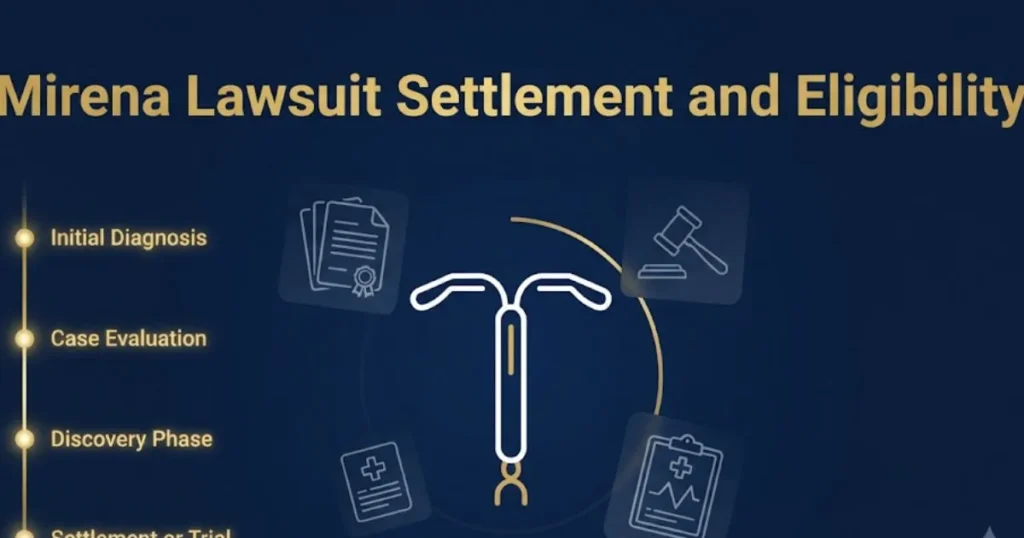
The process is more straightforward than most people expect. Here’s a step-by-step breakdown:
Step 1: Free Case Evaluation
Most attorneys handling Mirena cases offer free consultations. You share your story, your timeline of Mirena use, and your hair loss experience. They tell you if you have a viable claim.
Step 2: Gather Your Records
Your attorney will help you collect medical records showing Mirena insertion, hair loss documentation, and any dermatologist visits. If you’re missing records, the law firm can request them from your healthcare providers.
Step 3: Sign a Retainer Agreement
If your case qualifies, you sign a contingency fee agreement. This means you pay nothing upfront. The attorney only gets paid if you win or settle.
Step 4: Filing the Complaint
Your attorney drafts and files a legal complaint in the appropriate court. The complaint names Bayer as the defendant and outlines your injuries and legal claims.
Step 5: Discovery and Litigation
After filing, both sides exchange evidence. Bayer’s attorneys will review your medical history. Your attorney may hire medical experts to testify about causation.
| Filing Step | What Happens | Your Role |
|---|---|---|
| Consultation | Attorney reviews your case | Share your story and records |
| Record collection | Medical records gathered | Sign release forms |
| Retainer | Fee agreement signed | No money out of pocket |
| Complaint filed | Lawsuit officially begins | Review and approve the filing |
| Discovery | Evidence exchanged | Answer questions, provide documents |
You don’t need to go to court in most cases. The vast majority of product liability claims settle before trial.
What Medical Documentation Do You Need for a Mirena Claim
You need medical records proving you used Mirena and separate records documenting your hair loss to build a strong claim. The more detailed your documentation, the stronger your case.
Think of your medical records as the evidence file in a courtroom drama. Without them, your story is just your word against a billion-dollar company.
Essential documents for your claim:
- OB-GYN records showing Mirena insertion date
- Any records showing Mirena removal date
- Dermatologist visit notes documenting hair loss
- Photos of hair loss progression (dated if possible)
- Blood test results ruling out thyroid issues, iron deficiency, and other causes
- Prescription records for hair loss treatments (minoxidil, spironolactone, biotin supplements, PRP therapy)
- Mental health records if you sought treatment for emotional distress related to hair loss
Helpful but not required:
- Statements from hairstylists or family members who witnessed the hair loss
- Journal entries or notes you kept about shedding patterns
- Social media posts or messages where you discussed the hair loss with friends
| Document Type | Why It Matters | Strength Level |
|---|---|---|
| Mirena insertion record | Proves you used the product | Essential |
| Dermatologist diagnosis | Medical expert confirms hair loss | Very strong |
| Blood work ruling out other causes | Shows Mirena is the likely cause | Strong |
| Before/after photos | Visual proof of damage | Strong |
| Treatment prescriptions | Shows you sought medical help | Moderate |
| Emotional distress records | Supports damages claim | Moderate |
If you don’t have all of these right now, don’t panic. Your attorney can help you reconstruct your medical timeline and request records from providers.
Key Takeaway: Start gathering your Mirena insertion records, dermatologist notes, and any photos of hair loss immediately, even before you contact an attorney.
Mirena Class Action vs Individual Lawsuit
There is no active Mirena hair loss class action in 2026. Most Mirena hair loss cases are filed as individual lawsuits, which typically result in higher compensation per person than class actions.
People often confuse class actions with mass torts, and it matters for your wallet. Here’s the difference:
Class Action: One lawsuit filed on behalf of a large group. Everyone in the class gets the same (usually small) payout. One set of facts applies to everyone. This works well for things like overcharging on a phone bill.
Individual Lawsuit (Mass Tort): Each person files their own case. Your payout is based on YOUR specific injuries. Stronger cases get more money. This is how most pharmaceutical injury cases work.
| Feature | Class Action | Individual Lawsuit |
|---|---|---|
| Filing | One case for all plaintiffs | Separate case per person |
| Payout | Same amount for everyone | Based on individual injuries |
| Typical compensation | Lower (often $50 to $500) | Higher ($25,000 to $250,000+) |
| Your involvement | Minimal | More active |
| Case strength | Averaged across group | Based on your evidence |
Mirena hair loss cases are individual because every woman’s experience is different. Some lost a little hair. Some lost most of it. Some recovered after removal. Some didn’t. A class action can’t account for those differences.
The earlier Mirena MDL handled device migration and perforation claims, not hair loss. That MDL has largely concluded. Hair loss claims are proceeding through individual filings in various courts.
Being an individual plaintiff gives you more control over your case. It also means your settlement reflects your actual harm, not an averaged number shared among thousands.
Mirena IUD Removal and Hair Loss Claims
You can file a Mirena hair loss claim whether or not you’ve had the IUD removed. However, removing the device and documenting what happened to your hair afterward strengthens your case.
Many women report that their hair loss improved after Mirena removal. That improvement actually helps your lawsuit. It creates a clear before-and-after pattern that supports the argument that Mirena caused the problem.
Here’s what the removal timeline typically looks like for hair loss:
- Immediately after removal: Shedding may initially increase as hormones adjust
- 1 to 3 months post-removal: Shedding begins to slow in many cases
- 3 to 6 months post-removal: New hair growth starts for women with telogen effluvium
- 6 to 12 months post-removal: Significant regrowth visible, or lack thereof confirms permanent damage
If your hair did NOT grow back after removal, your case is stronger. Permanent hair loss means permanent damage, and that translates to higher compensation.
Important for your claim: Make sure your removal is documented in your medical records. Ask your doctor to note the reason for removal, especially if hair loss was a factor in your decision.
Some women had their Mirena removed years ago and wonder if they can still file. The answer depends on your state’s statute of limitations. In many states, the clock starts when you discovered (or should have discovered) the connection between Mirena and your hair loss, not when the device was inserted or removed.
Key Takeaway: Removing Mirena and tracking your hair’s response afterward creates powerful evidence for your lawsuit, especially if your hair didn’t grow back.
Mirena IUD Hair Loss Compensation Breakdown
Mirena IUD hair loss compensation covers several categories of damages, including medical costs, emotional suffering, and lost income. Your total compensation is the sum of all applicable damage categories.
Compensation in product liability cases isn’t just one number. It’s built from multiple pieces. Here’s how the math works:
Economic Damages (Quantifiable Costs)
- Dermatologist visits and consultations
- Hair loss treatments (minoxidil, PRP therapy, laser therapy)
- Wigs, hairpieces, and head coverings
- Prescription medications
- Lost wages from missed work
- Future treatment costs
Non-Economic Damages (Quality of Life)
- Emotional distress and anxiety
- Depression related to appearance changes
- Loss of self-confidence
- Impact on relationships and social life
- Pain and suffering
| Damage Category | Examples | Typical Range |
|---|---|---|
| Medical expenses | Doctor visits, treatments, prescriptions | $2,000 to $15,000 |
| Cosmetic costs | Wigs, hairpieces, extensions | $1,000 to $10,000 |
| Lost wages | Missed work, reduced productivity | Varies widely |
| Emotional distress | Anxiety, depression, social withdrawal | $10,000 to $100,000+ |
| Pain and suffering | Overall quality of life impact | $10,000 to $150,000+ |
Keep receipts for everything. Every dollar you spent dealing with hair loss, from the $30 bottle of Rogaine to the $3,000 PRP treatment, counts toward your damages.
Some cases may also include punitive damages if a jury finds that Bayer’s failure to warn was particularly reckless. Punitive damages punish the company and can significantly increase total compensation.
Mirena Lawsuit Timeline for 2026
The Mirena hair loss lawsuit timeline in 2026 involves several phases, and where your case falls depends on when you file and how your individual claim progresses.
Most cases follow a predictable sequence. But timing varies based on the court, the complexity of your case, and whether Bayer chooses to settle or fight.
| Phase | Estimated Timeline | What Happens |
|---|---|---|
| Case evaluation | 1 to 2 weeks | Attorney reviews your claim |
| Filing the complaint | 1 to 3 months after evaluation | Lawsuit formally filed in court |
| Discovery | 6 to 18 months after filing | Both sides exchange evidence |
| Expert reports | During discovery | Medical experts review your case |
| Settlement negotiations | Can happen any time after filing | Bayer may offer to settle |
| Trial (if no settlement) | 2 to 3 years after filing | Jury decides your case |
| Payout after settlement | 3 to 6 months after agreement | Check arrives after deductions |
For 2026 specifically, here’s what matters:
Early 2026: Attorneys are still accepting new cases. If you haven’t filed yet, this is the time to move. Statute of limitations deadlines are closing for women who had their Mirena inserted or removed years ago.
Mid 2026: Cases filed in 2024 and 2025 will be deep in discovery. Settlement discussions may be underway for some of these earlier cases.
Late 2026: We may see the first significant individual settlements or verdicts that establish a benchmark for future payouts.
Don’t expect a fast resolution. Pharmaceutical lawsuits against major companies like Bayer move slowly. But filing early puts you in a stronger position.
Key Takeaway: Filing your Mirena hair loss claim early in 2026 puts you ahead in the timeline and protects you from missing statute of limitations deadlines.
Mirena Hair Loss Lawsuit Statute of Limitations
The statute of limitations for a Mirena hair loss lawsuit varies by state but typically ranges from 2 to 6 years from the date you discovered (or should have discovered) the connection between Mirena and your hair loss.
This is one of the most misunderstood parts of the process. Many women think the clock starts when they got the IUD. That’s not how it works in most states.
Most states use a “discovery rule.” The timer starts when you knew or reasonably should have known that Mirena caused your hair loss. If you didn’t learn about the connection until you read a news article in 2024, your clock may have started in 2024, even if you got Mirena in 2015.
| State Example | Statute of Limitations | Discovery Rule |
|---|---|---|
| California | 2 years | Yes |
| Texas | 2 years | Yes |
| New York | 3 years | Yes |
| Florida | 4 years (as of recent changes) | Yes |
| Illinois | 2 years | Yes |
| Pennsylvania | 2 years | Yes |
Warning: These are general guidelines. Your state may have exceptions, tolling provisions, or different rules for product liability cases. An attorney can tell you your exact deadline.
If you’re reading this in 2026, time may be running short. Women who first experienced hair loss in 2022 or 2023 could already be approaching their filing deadline in states with 2-year statutes.
Don’t gamble with deadlines. Once the statute of limitations expires, your case is gone. No exceptions. No extensions. No second chances.
Mirena Hair Loss Attorney Fees and Costs
Mirena hair loss attorneys work on a contingency fee basis, meaning you pay nothing upfront and they only collect a fee if you win or settle your case. The standard contingency fee is 33% to 40% of your total recovery.
This is the same payment model used in car accident cases, slip-and-fall cases, and most personal injury lawsuits. It exists so that regular people can afford to take on giant corporations like Bayer.
Here’s how the money breaks down:
| Item | Detail |
|---|---|
| Upfront cost to you | $0 |
| Contingency fee | 33% to 40% of recovery |
| Case expenses | Deducted from your share or the total, depending on agreement |
| If you lose | You owe nothing |
Example calculation:
If your case settles for $100,000 and your attorney takes 33%, they receive $33,000. Case expenses (filing fees, expert witness costs, medical record retrieval) might total $5,000. You take home $62,000.
Common case expenses include:
- Court filing fees
- Medical record retrieval costs
- Expert witness fees (doctors, toxicologists)
- Deposition costs
- Administrative and mailing costs
Read your retainer agreement carefully. Some firms deduct expenses from the total recovery before calculating their percentage. Others take their percentage first and then deduct expenses from your share. The difference can mean thousands of dollars.
Don’t let attorney fees scare you away from filing. Without a lawyer, you’re unlikely to recover anything from Bayer. A smaller slice of a real settlement is worth infinitely more than 100% of nothing.
Key Takeaway: You pay zero dollars upfront to hire a Mirena hair loss attorney; they only get paid from your settlement or verdict.
Frequently Asked Questions
Can I still file a Mirena hair loss lawsuit in 2026?
Yes, new Mirena hair loss lawsuits are still being accepted in 2026.
Your ability to file depends on whether your state’s statute of limitations has expired.
Contact an attorney quickly to confirm your deadline.
How much money can I get from a Mirena hair loss lawsuit?
Most estimates place individual payouts between $25,000 and $250,000.
Your amount depends on the severity of your hair loss and the strength of your medical records.
Cases involving permanent alopecia and emotional distress tend to receive higher compensation.
Does Mirena actually cause hair loss?
Yes, Mirena’s active ingredient levonorgestrel has been linked to both telogen effluvium and androgenic alopecia.
The FDA’s adverse event database contains thousands of hair loss reports from Mirena users.
Published dermatology studies support the connection between levonorgestrel and hormonal hair loss.
Do I need a lawyer to file a Mirena hair loss claim?
You technically can file on your own, but it’s not recommended.
Bayer has teams of experienced defense attorneys, and going against them without legal representation puts you at a serious disadvantage.
Most Mirena attorneys charge nothing upfront and work on contingency.
What is the deadline to file a Mirena hair loss lawsuit?
The deadline depends on your state’s statute of limitations, which ranges from 2 to 6 years.
In most states, the clock starts when you discovered the link between Mirena and your hair loss.
If you suspect you’re near the deadline, contact an attorney immediately to protect your rights.
The Mirena hair loss lawsuit in 2026 is real, it’s active, and women are filing claims every day. If you lost hair because of this IUD, you have options.
Start by gathering your medical records. Find your Mirena insertion and removal dates. Collect any dermatologist notes or photos.
Then contact a product liability attorney for a free case review. Time matters here. Don’t let a statute of limitations deadline slip by while you’re still thinking about it.







