

If you took Ozempic and lost your vision, you may have a legal claim worth tens of thousands of dollars or more. The ozempic lawsuit blind wave is one of the fastest growing areas of pharmaceutical litigation heading into 2026.
A landmark 2024 Harvard study found that Ozempic users faced a significantly higher risk of NAION, a condition that can cause sudden, permanent blindness. That study changed the legal picture overnight.
Hundreds of lawsuits have been filed against Novo Nordisk, the company behind Ozempic. Plaintiffs say the drugmaker knew about the blindness risk and failed to warn patients or doctors.
This article breaks down settlement estimates, eligibility rules, filing steps, MDL status, and the science connecting Ozempic to vision loss. Everything is current through 2026.
Ozempic Lawsuit Blind: What You Need to Know in 2026
The ozempic lawsuit blind litigation refers to legal claims filed by people who suffered blindness or serious vision loss after using semaglutide (sold as Ozempic or Wegovy). These lawsuits accuse Novo Nordisk of failing to warn patients about a known risk of permanent eye damage.
The core allegation is straightforward. Novo Nordisk had data suggesting a link between its GLP-1 drugs and a dangerous eye condition called NAION. Despite this, the company did not add adequate warnings to its labeling.
By early 2026, hundreds of individual lawsuits have been filed across federal courts. Many of these cases are being consolidated into multidistrict litigation for more efficient handling.
| Key Fact | Detail |
|---|---|
| Drug Involved | Ozempic (semaglutide) |
| Manufacturer | Novo Nordisk |
| Primary Injury Claimed | Blindness / Vision Loss / NAION |
| Core Legal Theory | Failure to warn |
| Lawsuits Filed (est. 2026) | 500+ individual claims |
| MDL Status | Consolidation under review |
The stakes are enormous for Novo Nordisk. Ozempic generated over $18 billion in global sales in 2024 alone. If courts determine the company hid or downplayed blindness risks, the financial exposure could reach billions in settlement payouts.
What makes these cases particularly strong is the combination of peer-reviewed scientific evidence, FDA adverse event reports, and the severity of the injury itself. Losing your eyesight is catastrophic, and juries tend to award significant damages for permanent disabilities.
Ozempic Blindness Lawsuit Overview
The ozempic blindness lawsuit centers on claims that Novo Nordisk’s blockbuster diabetes and weight loss drug causes a type of sudden vision loss that can be irreversible. Plaintiffs argue the company prioritized profits over patient safety.
These lawsuits fall under product liability law. Specifically, most claims are built on a “failure to warn” theory. That means the plaintiffs don’t necessarily have to prove Ozempic is defective. They need to prove Novo Nordisk didn’t properly disclose the risk.
The typical plaintiff in these cases is someone who was prescribed Ozempic for type 2 diabetes or weight management. After weeks or months of use, they experienced sudden vision loss in one or both eyes. Medical evaluation confirmed NAION or a related optic neuropathy.
Key facts about the litigation:
- Most cases are filed in federal court
- Claims include failure to warn, negligence, and strict liability
- Plaintiffs seek compensatory and punitive damages
- Cases span multiple states and judicial districts
The legal theory is not new. Pharmaceutical companies have paid billions in past settlements for failing to warn about known drug risks. Vioxx, Zantac, and Accutane lawsuits followed similar patterns. The Ozempic blindness litigation fits squarely into this tradition.
What sets this wave apart is the speed. The scientific study linking Ozempic to NAION was published in mid-2024, and lawsuits began filing within weeks. That rapid response suggests strong attorney confidence in the underlying evidence.
Ozempic Blindness Lawsuit Settlement Amounts
Estimated ozempic blindness lawsuit settlement amounts range from $100,000 to $550,000 or more per plaintiff, depending on the severity of vision loss and the strength of individual evidence. No settlements have been finalized yet as of early 2026, but legal analysts have projected these ranges based on comparable pharmaceutical cases.
Settlement values in drug injury cases depend on several factors. The most important ones are the permanence of the injury, the plaintiff’s age, lost income, and how clearly the drug can be linked to the harm.
| Settlement Tier | Estimated Range | Injury Level |
|---|---|---|
| Tier 1 (Highest) | $350,000 to $550,000+ | Total blindness in one or both eyes |
| Tier 2 | $150,000 to $350,000 | Significant permanent vision loss |
| Tier 3 | $100,000 to $150,000 | Partial vision loss with documented NAION |
These numbers are based on prior pharmaceutical mass tort outcomes. For comparison, Elmiron vision loss settlements averaged between $100,000 and $500,000 per plaintiff, and those cases involved similar optic damage claims.
Factors that increase your payout:
- Complete or near-complete blindness
- Young age at time of injury (more years of disability)
- Strong medical records linking Ozempic use to NAION diagnosis
- Documentation showing no prior eye conditions
- High pre-injury income (increases lost earnings claim)
Punitive damages could push individual awards much higher if a jury finds Novo Nordisk acted with reckless disregard for patient safety. In past pharma cases, punitive damages have multiplied compensatory awards by 3x to 10x.
Keep in mind that actual settlement amounts won’t be determined until either bellwether trials produce verdicts or Novo Nordisk agrees to a global settlement. Both scenarios are possible in late 2026 or 2027.
Key Takeaway: Ozempic blindness lawsuits accuse Novo Nordisk of hiding a serious vision loss risk, and estimated settlements range from $100,000 to $550,000 or more based on injury severity.
Who Qualifies for the Ozempic Blindness Lawsuit?
You may qualify for the ozempic blindness lawsuit if you took Ozempic (or Wegovy) and were later diagnosed with NAION, sudden vision loss, or significant optic nerve damage. The diagnosis must be supported by medical records from an eye specialist.
Qualification isn’t automatic. Attorneys and courts look at specific criteria to determine if your case is strong enough to move forward.
Basic eligibility checklist:
- You were prescribed and took Ozempic or Wegovy (semaglutide)
- You developed vision problems while using the drug or shortly after
- A doctor diagnosed you with NAION, optic neuropathy, or permanent vision loss
- Your medical records document the timeline of drug use and symptom onset
- You had no pre-existing condition that fully explains the vision loss
| Eligibility Factor | Required? |
|---|---|
| Prescription for Ozempic/Wegovy | Yes |
| Documented vision loss or NAION diagnosis | Yes |
| Medical records linking timeline | Yes |
| Prior eye disease ruling out other causes | Must be evaluated |
| Minimum duration of drug use | Varies by attorney |
People who used Ozempic for any reason, whether diabetes management or weight loss, can potentially qualify. The drug’s intended purpose doesn’t affect your legal standing.
One thing that strengthens a case significantly is a clean medical history before Ozempic use. If you had perfect vision and no eye problems before starting the drug, then developed NAION within months, that timeline tells a powerful story.
Even if your vision loss is partial, you may still qualify. You don’t have to be completely blind. Any medically documented, permanent reduction in vision tied to Ozempic use could be grounds for a claim.
Can Ozempic Cause Blindness?
Yes, Ozempic can cause blindness according to peer-reviewed research. A major 2024 study found that people taking semaglutide (the active ingredient in Ozempic) had a significantly elevated risk of developing NAION, which can lead to sudden, permanent vision loss.
The connection works like this. NAION happens when blood flow to the optic nerve gets cut off. Think of it like a mini-stroke in your eye. The optic nerve cells die from lack of oxygen, and the damage is usually permanent.
Researchers at Harvard Medical School and Massachusetts Eye and Ear published their findings in JAMA Ophthalmology in July 2024. The study examined over 16,000 patients and found striking results.
Key findings from the study:
- Diabetes patients on Ozempic were 4.28 times more likely to develop NAION
- Overweight/obese patients on Ozempic were 7.64 times more likely to develop NAION
- The risk was statistically significant across all patient subgroups
| Study Detail | Data |
|---|---|
| Published | July 2024 |
| Journal | JAMA Ophthalmology |
| Institution | Harvard / Mass Eye and Ear |
| Patients Analyzed | 16,827 |
| NAION Risk (Diabetes Group) | 4.28x higher |
| NAION Risk (Weight Loss Group) | 7.64x higher |
That 7.64x increase in the weight loss group is particularly alarming. Millions of people take Ozempic primarily for weight management, not diabetes. Many of them were otherwise healthy before starting the drug.
NAION typically strikes without warning. People wake up and notice a dark shadow in their vision, or they suddenly lose sight in one eye during normal activities. There’s no treatment that reverses the damage once it occurs.
The FDA has received hundreds of adverse event reports involving Ozempic and vision problems. While the agency hasn’t issued a formal recall, the growing body of evidence has put Novo Nordisk under intense scrutiny.
Ozempic Blind Lawsuit Update 2026
As of 2026, the ozempic blind lawsuit litigation is moving toward critical milestones. Federal courts are processing hundreds of claims, MDL consolidation efforts are advancing, and legal teams on both sides are gearing up for potential bellwether trials.
The biggest development in early 2026 is the push to consolidate ozempic blindness cases into a single MDL. This would place all federal claims before one judge, streamlining discovery and pre-trial proceedings.
Timeline of key events:
- July 2024: Harvard/JAMA study published linking semaglutide to NAION
- Late 2024: First wave of lawsuits filed in multiple federal courts
- Early 2025: Additional studies and FDA reports reinforce the blindness link
- Mid 2025: Attorneys file motions for MDL consolidation
- Early 2026: MDL panel reviews consolidation request
- Mid to Late 2026: Bellwether trial selection expected if MDL is granted
Novo Nordisk has denied wrongdoing in court filings. The company maintains that its labeling was adequate and that NAION has multiple risk factors unrelated to semaglutide. This defense strategy mirrors what other drug companies have tried in similar cases.
Legal experts say the strength of the Harvard study makes it harder for Novo Nordisk to argue ignorance. The data is published in one of the world’s most respected ophthalmology journals. That carries serious weight in a courtroom.
The number of filed cases is growing weekly. As more attorneys accept clients and more patients connect their vision loss to Ozempic, the litigation’s scope continues to expand. By the end of 2026, case counts could exceed 1,000.
Key Takeaway: The Ozempic blindness litigation is rapidly expanding in 2026, with MDL consolidation and bellwether trial selection expected to shape the path toward potential settlements.
How to File an Ozempic Blindness Lawsuit
To file an ozempic blindness lawsuit, you need to gather your medical records, contact a mass tort attorney, and have your case evaluated for eligibility. The process typically begins with a free case review.
Filing a pharmaceutical lawsuit might sound intimidating, but it’s actually a structured process that attorneys handle for you. Most work on contingency, meaning you pay nothing upfront and they only get paid if you win.
Step-by-step filing process:
- Collect your medical records: Get records from every doctor who treated your vision loss, plus pharmacy records showing your Ozempic prescriptions
- Contact a mass tort attorney: Look for firms experienced in pharmaceutical litigation, not general practice lawyers
- Complete a case evaluation: The attorney reviews your records, timeline, and diagnosis
- Sign a retainer agreement: This formalizes the attorney-client relationship
- Your attorney files the complaint: The lawsuit is filed in the appropriate court
- Discovery and litigation begin: Your case enters the legal process
| Filing Step | What Happens | Your Role |
|---|---|---|
| Case Review | Attorney evaluates your claim | Share medical history |
| Documentation | Records gathered and organized | Sign release forms |
| Filing | Complaint submitted to court | Review and approve |
| Litigation | Discovery, depositions, motions | Respond to requests |
One common concern is the statute of limitations. Each state sets its own deadline for filing personal injury claims. Most states allow 2 to 3 years from the date you discovered (or should have discovered) the injury.
Because the Ozempic-NAION connection only became widely known in 2024, many plaintiffs can argue their “discovery date” is recent. This can extend filing deadlines even if the vision loss happened earlier. Still, don’t wait. Statutes of limitations are strict, and missing yours means losing your right to sue entirely.
Ozempic Vision Loss Lawsuit Explained
The ozempic vision loss lawsuit encompasses all legal claims filed by patients who experienced any degree of permanent vision impairment after taking semaglutide. This includes but isn’t limited to complete blindness. Partial vision loss counts too.
Vision loss from Ozempic takes several forms. Some patients lose central vision in one eye. Others experience a progressive narrowing of their visual field. In the most severe cases, both eyes are affected.
Types of vision loss claimed in lawsuits:
- Complete blindness in one eye
- Complete blindness in both eyes
- Permanent reduction in visual acuity
- Loss of peripheral vision
- Central scotoma (dark spot in center of vision)
The legal claims are the same regardless of how much vision was lost. What changes is the potential compensation. Total blindness cases are worth significantly more than partial vision loss cases because the impact on daily life is greater.
Something that separates these lawsuits from many other drug injury cases is how sudden the damage occurs. NAION doesn’t develop slowly over years. It hits within hours or days. One morning you can see fine. By afternoon, half your visual field is gone.
That sudden onset actually helps plaintiffs. When a side effect develops gradually, drug companies argue other factors could be responsible. But when someone goes from 20/20 vision to legally blind within days of starting a new medication, the connection is hard to dismiss.
Medical experts serving as witnesses in these cases will point to the temporal relationship between drug use and symptom onset. This kind of evidence is highly persuasive to juries.
Ozempic NAION Lawsuit Claims
Ozempic NAION lawsuit claims are the most specific and scientifically supported category within the broader Ozempic blindness litigation. NAION stands for non-arteritic anterior ischemic optic neuropathy, and it is the primary eye condition linked to semaglutide use.
In plain language, NAION is what happens when the blood supply to the front of your optic nerve suddenly fails. The nerve cells don’t get oxygen. They die. And dead nerve cells don’t regenerate.
| NAION Fact | Detail |
|---|---|
| Full Name | Non-arteritic anterior ischemic optic neuropathy |
| What It Affects | Optic nerve (connects eye to brain) |
| Cause | Sudden loss of blood flow to optic nerve |
| Reversible? | No, damage is permanent |
| Typical Onset | Sudden, often noticed upon waking |
| Risk Before Ozempic | Relatively rare (2 to 10 per 100,000 per year) |
Before the semaglutide studies, NAION was considered a fairly rare condition. It mostly affected older adults with diabetes, high blood pressure, or sleep apnea. The Harvard study changed the conversation by showing that Ozempic independently and dramatically increased the risk.
Why NAION-specific claims are strong:
- Clear, measurable diagnosis (confirmed by ophthalmologist examination)
- Established baseline rarity makes clusters of cases suspicious
- Peer-reviewed study provides causation evidence
- No available treatment means all damage is permanent
- Severe impact on quality of life
These claims are particularly powerful because NAION leaves objective medical evidence. An ophthalmologist can measure optic disc swelling, visual field defects, and nerve fiber layer thinning. It’s not a subjective complaint. It shows up on scans and tests.
Key Takeaway: NAION is the specific eye condition driving Ozempic blindness lawsuits, and its objective, measurable nature makes these claims scientifically strong and legally persuasive.
Ozempic Side Effects and Blindness
Blindness is among the most serious ozempic side effects reported to the FDA, alongside gastroparesis (stomach paralysis), pancreatitis, bowel obstruction, and thyroid tumors. Vision loss stands out because it’s sudden, permanent, and profoundly life-altering.
Novo Nordisk’s original labeling for Ozempic listed dozens of potential side effects. The common ones include nausea, vomiting, diarrhea, and constipation. But the label did not specifically warn about NAION or sudden blindness risk in the way plaintiffs say it should have.
Comparison of Ozempic side effects and legal status:
| Side Effect | Severity | On Original Label? | Active Lawsuits? |
|---|---|---|---|
| Nausea/Vomiting | Mild to moderate | Yes | No |
| Gastroparesis | Severe | Inadequately | Yes |
| Pancreatitis | Severe | Partially | Yes |
| Bowel Obstruction | Severe | No | Yes |
| NAION/Blindness | Severe/Permanent | No | Yes |
| Thyroid Tumors | Severe | Yes (boxed warning) | Limited |
The failure-to-warn argument is strongest when a drug company knew or should have known about a risk but didn’t tell patients. For blindness, the argument is that animal studies, early clinical data, and post-market adverse event reports all pointed to a vision risk before the 2024 Harvard study confirmed it.
Ozempic is a GLP-1 receptor agonist. These drugs mimic a natural hormone that regulates blood sugar. But GLP-1 receptors exist throughout the body, including in the nervous system and blood vessels. Activating receptors in those locations could plausibly affect blood flow to sensitive structures like the optic nerve.
The FDA has not added a black box warning for NAION as of early 2026. Some patient advocacy groups and lawmakers have called for one. Whether the agency acts before settlements or trials conclude remains uncertain.
Ozempic Blindness Lawsuit Payout Expectations
Ozempic blindness lawsuit payout expectations are currently estimated between $100,000 and $550,000 per plaintiff based on injury severity, with outlier cases potentially exceeding those ranges. Actual payouts will depend on trial results, settlement negotiations, and individual case strength.
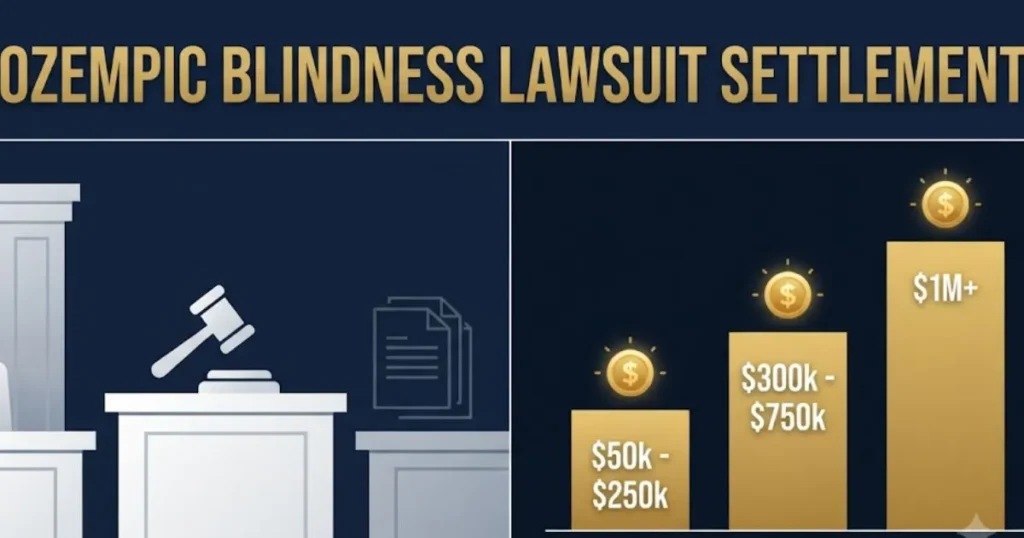
It’s worth understanding how mass tort payouts typically work. Unlike a class action where everyone gets the same check, mass tort cases evaluate each plaintiff individually. Your payout depends on your specific injuries and evidence.
Factors that determine your payout:
- Degree of vision loss (total vs. partial)
- Whether one or both eyes are affected
- Your age and remaining life expectancy
- Lost wages and earning capacity
- Cost of past and future medical care
- Pain and suffering
- Impact on daily activities and independence
| Payout Factor | Higher Payout | Lower Payout |
|---|---|---|
| Vision Loss Severity | Total blindness | Mild partial loss |
| Eyes Affected | Both eyes | One eye |
| Age at Injury | Younger (more years affected) | Older |
| Work Impact | Career-ending | Minimal impact |
| Medical Documentation | Extensive, clear records | Sparse records |
Think of it like car insurance claims. A fender bender gets a small payout. A totaled vehicle with injuries gets a large one. Same principle applies here. The worse your injury and the stronger your documentation, the higher your payout.
Some legal analysts point to the Elmiron litigation as the closest comparison case. Elmiron, a bladder medication, caused a unique form of eye damage. Those settlements landed in the $100,000 to $500,000 range. Ozempic blindness claims involve a similar injury pattern but potentially stronger scientific evidence.
Punitive damages remain a wild card. If evidence emerges that Novo Nordisk deliberately concealed blindness risks, a jury could add substantial punitive damages on top of compensatory awards.
Ozempic Lawsuit Eligibility in 2026
Ozempic lawsuit eligibility in 2026 depends on three main factors: you used semaglutide (Ozempic or Wegovy), you suffered vision loss or NAION, and your medical records connect the two events. Meeting all three makes you a strong candidate.
Eligibility has expanded somewhat since the earliest filings. Initially, only patients with confirmed NAION diagnoses were being accepted. Now, some attorneys are reviewing cases involving other forms of documented permanent vision loss linked to semaglutide.
2026 eligibility criteria:
- Used Ozempic or Wegovy at any point
- Diagnosed with NAION, ischemic optic neuropathy, or significant permanent vision loss
- Have medical records documenting drug use and vision diagnosis
- Filed or can file within your state’s statute of limitations
- No pre-existing condition that fully accounts for the vision loss (such as glaucoma unrelated to semaglutide)
| Eligibility Question | Answer |
|---|---|
| Do I need to be completely blind? | No, partial permanent vision loss may qualify |
| Does it matter if I used Ozempic for diabetes or weight loss? | No, both uses qualify |
| What if I also took other medications? | Your case is evaluated individually |
| Is there an age requirement? | No, any adult who used the drug may qualify |
| Do I need a lawyer? | Strongly recommended for mass tort claims |
An important note for 2026: statutes of limitations vary by state. Most personal injury claims have a 2 to 3 year window. Since the Ozempic-blindness link became publicly known in mid-2024, many states’ clocks may have started then under the “discovery rule.”
If you suspect your vision loss is connected to Ozempic but haven’t been formally diagnosed with NAION, get an eye exam from an ophthalmologist (not just an optometrist). A specialist can run the specific tests needed to document optic nerve damage, which strengthens your legal case.
Key Takeaway: Eligibility for Ozempic blindness lawsuits in 2026 requires documented semaglutide use, a confirmed vision loss diagnosis, and medical records showing the timeline, and even partial vision loss may qualify.
Ozempic Optic Nerve Damage Lawsuit
The ozempic optic nerve damage lawsuit targets Novo Nordisk for injuries to the optic nerve caused by semaglutide. The optic nerve is the cable that carries visual information from your eye to your brain. When it’s damaged, vision loss is typically permanent.
Optic nerve damage is the underlying mechanism behind NAION. But some plaintiffs have experienced optic nerve injuries that don’t fit neatly into the NAION classification. These broader optic neuropathy claims are being included in the litigation.
Types of optic nerve damage in Ozempic lawsuits:
- NAION (most common, sudden onset)
- Optic disc edema (swelling of the nerve head)
- Retrobulbar optic neuropathy (damage behind the eye)
- Progressive optic atrophy (gradual nerve deterioration)
The optic nerve contains about 1.2 million nerve fibers. Once these fibers are damaged, they don’t repair themselves. This biological reality is why Ozempic vision injuries are classified as permanent disabilities in legal claims.
Diagnosing optic nerve damage requires specific tests. Optical coherence tomography (OCT) scans can measure nerve fiber layer thickness. Visual field tests map out exactly which areas of vision are lost. These objective measurements provide strong courtroom evidence.
What makes optic nerve damage claims particularly valuable in litigation is their measurability. Unlike pain or emotional distress, which are subjective, optic nerve damage produces hard data. An OCT scan from before and after Ozempic use can visually demonstrate the harm in a way any juror can understand.
The Ozempic NAION Study That Changed Everything
The ozempic NAION study that reshaped this litigation was published in JAMA Ophthalmology on July 3, 2024, by researchers at Harvard Medical School and Massachusetts Eye and Ear Infirmary. It provided the first large-scale statistical evidence linking semaglutide to NAION.
Before this study, the connection between Ozempic and blindness was based on individual case reports and FDA adverse event filings. Anecdotal evidence, essentially. The Harvard research turned anecdotes into data.
Study design and key findings:
| Study Element | Detail |
|---|---|
| Publication | JAMA Ophthalmology, July 2024 |
| Lead Institution | Massachusetts Eye and Ear / Harvard |
| Study Type | Retrospective matched cohort |
| Total Patients | 16,827 |
| Comparison Groups | Semaglutide users vs. non-GLP-1 users |
| NAION Risk (Diabetes Patients) | 4.28x higher on semaglutide |
| NAION Risk (Overweight Patients) | 7.64x higher on semaglutide |
The 7.64 times increased risk in the overweight/obesity group shocked many in the medical community. These were people using Ozempic primarily for weight loss, not for managing a chronic disease. Many were otherwise healthy.
Why this study carries so much legal weight:
- Published in a top-tier, peer-reviewed journal
- Large sample size (over 16,000 patients)
- Controlled for confounding variables like diabetes, hypertension, and sleep apnea
- Showed a dose-response relationship (higher doses, higher risk)
- Results were statistically significant, not marginal
The study’s lead author, Dr. Joseph Rizzo, is one of the world’s leading neuro-ophthalmologists. His credibility adds another layer of authority to the findings. Expert witnesses citing this study in court will carry significant persuasive power.
Novo Nordisk responded by saying the study had limitations, including its retrospective design and single-center data. While those are fair scientific critiques, they don’t erase the magnitude of the risk increase. A nearly 8x risk elevation demands attention, regardless of study design.
GLP-1 Drugs and Blindness Risk
GLP-1 drugs and blindness risk is a concern that extends beyond just Ozempic. The entire class of GLP-1 receptor agonists, including Wegovy, Mounjaro (tirzepatide), and Rybelsus, may carry similar vision risks based on their shared mechanism of action.
GLP-1 receptor agonists work by mimicking a hormone called glucagon-like peptide-1. This hormone regulates blood sugar, slows digestion, and reduces appetite. Those are the intended effects. But GLP-1 receptors are found throughout the body, including in blood vessels and nerve tissue.
GLP-1 drugs currently on the market:
| Drug Name | Active Ingredient | Manufacturer | Approved Use |
|---|---|---|---|
| Ozempic | Semaglutide | Novo Nordisk | Type 2 diabetes |
| Wegovy | Semaglutide | Novo Nordisk | Weight management |
| Rybelsus | Semaglutide (oral) | Novo Nordisk | Type 2 diabetes |
| Mounjaro | Tirzepatide | Eli Lilly | Diabetes / Weight loss |
| Zepbound | Tirzepatide | Eli Lilly | Weight management |
| Trulicity | Dulaglutide | Eli Lilly | Type 2 diabetes |
The 2024 Harvard study focused on semaglutide specifically. Whether tirzepatide (Mounjaro/Zepbound) carries the same NAION risk hasn’t been established with equal certainty. But the shared receptor mechanism raises logical concerns.
Here’s a simple analogy. If one brand of space heater causes fires because of a specific heating element design, you’d be suspicious of other brands using the same design. GLP-1 drugs share a core mechanism, so the blindness risk could be a class-wide problem.
Some researchers have called for expanded studies covering all GLP-1 receptor agonists, not just semaglutide. Until those studies are completed, patients on any GLP-1 drug should be aware of potential vision risks and report any sudden changes in eyesight immediately.
The legal implications of a class-wide risk are significant. If blindness is linked to the entire GLP-1 drug class, Eli Lilly could face lawsuits similar to those targeting Novo Nordisk. This would dramatically expand the scope and dollar value of the litigation.
Key Takeaway: The blindness risk may not be limited to Ozempic alone; the entire GLP-1 drug class shares a mechanism that could affect optic nerve blood flow, potentially expanding litigation to other manufacturers.
Ozempic Blindness MDL Status
The ozempic blindness MDL status is in a transitional phase as of 2026. Attorneys representing plaintiffs have filed motions with the U.S. Judicial Panel on Multidistrict Litigation (JPML) requesting consolidation of all federal Ozempic blindness cases into a single MDL.
MDL stands for multidistrict litigation. It’s a legal process where similar federal cases from across the country get transferred to one judge for coordinated pre-trial proceedings. It doesn’t merge the cases. Each plaintiff keeps their individual claim. But discovery, expert challenges, and procedural motions are handled together.
Why MDL matters for plaintiffs:
- Reduces redundant legal work across hundreds of cases
- Speeds up the overall litigation timeline
- Creates economies of scale for plaintiffs’ legal teams
- Allows bellwether (test) trials that set the tone for settlements
- Puts pressure on the defendant to negotiate
| MDL Process Step | Expected Timeline |
|---|---|
| MDL Petition Filed | Mid 2025 |
| JPML Hearing | Early to Mid 2026 |
| MDL Transfer Order (if granted) | Mid 2026 |
| Discovery Phase | Late 2026 through 2027 |
| Bellwether Trial Selection | 2027 |
| First Bellwether Trial | Late 2027 or 2028 |
It’s worth noting that Novo Nordisk already faces an MDL for Ozempic gastroparesis claims. The blindness claims could potentially be added to that existing MDL or assigned their own separate one. Legal experts are divided on which approach the JPML will take.
If the JPML grants a separate MDL for blindness claims, it signals that courts view these injuries as distinct and serious enough to warrant their own litigation track. That would be a positive development for plaintiffs.
The judge assigned to an MDL has enormous influence over the case. Their rulings on which expert testimony is admissible, how discovery proceeds, and which cases go to bellwether trial can effectively determine whether settlements happen and how large they are.
Ozempic Eye Problems Lawsuit
The ozempic eye problems lawsuit is a broader category that captures all legal claims involving eye-related injuries from semaglutide. While NAION and blindness are the most prominent, other eye problems linked to Ozempic are being included in litigation.
Not every Ozempic-related eye injury results in total blindness. Some patients experience conditions that seriously impair their vision without meeting the clinical definition of NAION. These cases still have legal merit.
Eye problems reported in Ozempic lawsuits:
- NAION (sudden optic nerve damage)
- Diabetic retinopathy worsening
- Macular edema (fluid buildup in the retina)
- Vitreous hemorrhage (bleeding inside the eye)
- Sudden blurry vision that doesn’t resolve
- Double vision (diplopia)
| Eye Problem | Severity | Reversible? | Lawsuit Viable? |
|---|---|---|---|
| NAION | Severe | No | Yes, strong claims |
| Diabetic Retinopathy Worsening | Moderate to Severe | Sometimes partially | Yes, with documentation |
| Macular Edema | Moderate | Sometimes | Possibly, case-by-case |
| Vitreous Hemorrhage | Moderate to Severe | Sometimes | Possibly, with specialist records |
| Persistent Blurry Vision | Mild to Moderate | Varies | Weaker, but evaluated |
The diabetic retinopathy worsening angle is particularly interesting. Ozempic was supposed to help diabetes patients. But rapid blood sugar reduction, which Ozempic causes, can actually worsen existing retinal disease. Some endocrinologists have warned about this paradox.
For these broader eye problem claims, the legal bar is slightly different than for NAION cases. Attorneys need to demonstrate that the eye condition was either caused by Ozempic or significantly worsened by it. Strong medical records and expert testimony are essential.
If you’ve experienced any persistent eye problem after starting Ozempic, even if it’s not blindness, it’s worth having your case reviewed. The worst that happens is an attorney tells you your claim isn’t strong enough. The best that happens is you get compensated for harm you shouldn’t have suffered.
Frequently Asked Questions
Can I sue Novo Nordisk if Ozempic made me go blind?
Yes, you can sue Novo Nordisk if you developed blindness or NAION after taking Ozempic.
Hundreds of lawsuits have already been filed alleging the company failed to warn about this risk.
You’ll need medical records documenting your Ozempic use and vision loss diagnosis.
How much money can I get from an Ozempic blindness lawsuit?
Estimated settlements range from $100,000 to $550,000 or more depending on injury severity.
Total blindness cases are expected to receive the highest payouts.
No final settlements have been reached yet as of early 2026.
What is the deadline to file an Ozempic blindness claim in 2026?
Deadlines vary by state, but most allow 2 to 3 years from the date you discovered the injury.
Since the Ozempic-NAION link became public in mid-2024, many clocks started then.
File as soon as possible because missing your state’s deadline eliminates your claim permanently.
What is NAION and how is it connected to Ozempic?
NAION is non-arteritic anterior ischemic optic neuropathy, a condition where blood flow to the optic nerve suddenly stops.
A 2024 Harvard study found Ozempic users were up to 7.64 times more likely to develop NAION.
The damage is permanent and there is no treatment to reverse it.
Is there a class action lawsuit for Ozempic vision loss?
Ozempic blindness cases are being handled as mass tort litigation, not a traditional class action.
Each plaintiff files an individual lawsuit but cases may be consolidated into an MDL for efficiency.
This structure allows each person’s payout to reflect their specific injuries rather than a flat amount.
The Ozempic blindness litigation is one of the most significant pharmaceutical lawsuits of 2026. If you took this drug and lost any degree of vision, your window to act is open right now.
Gather your medical records. Get an eye exam from a specialist. Have your case reviewed by a mass tort attorney who handles pharmaceutical claims.
Don’t sit on this. Statutes of limitations are real deadlines with real consequences. The evidence is strong, the cases are moving, and the time to file is now.







