

The Depo-Provera lawsuit is not expected to be fully settled before late 2026 at the earliest. Bellwether trials and pretrial proceedings in the MDL are still unfolding, and those results will shape any global settlement offer from Pfizer.
Thousands of women who received Depo-Provera injections are now filing claims alleging the drug caused meningioma brain tumors. The science backing these claims has grown stronger in recent years, with studies from France and other countries linking long-term use of medroxyprogesterone acetate to a significantly elevated tumor risk.
This guide covers everything you need to know in 2026. You will find the latest case updates, settlement amount estimates, payout breakdowns, eligibility rules, filing steps, and bellwether trial details.
One fact worth knowing right away: a 2024 French government study found that prolonged use of Depo-Provera increased meningioma risk by up to 5.6 times compared to nonusers.
When Will the Depo-Provera Lawsuit Be Settled
The Depo-Provera lawsuit is unlikely to reach a global settlement before late 2026 or early 2027. Settlement talks typically begin after bellwether trial results establish a clear picture of what juries award.
Right now, the litigation is in its pretrial phase within MDL No. 3127. Cases have been consolidated in the Northern District of California under Judge Yvonne Gonzalez Rogers. The court is working through discovery, expert disclosures, and Daubert challenges.
Mass tort cases of this size rarely settle quickly. For comparison, the Zantac MDL took over three years before major rulings shaped outcomes. The 3M earplug litigation took even longer.
| Settlement Milestone | Projected Timing |
|---|---|
| Discovery and Expert Reports | Mid 2025 to early 2026 |
| Bellwether Trial Selection | Late 2025 to mid 2026 |
| First Bellwether Verdicts | Late 2026 to early 2027 |
| Settlement Negotiations | 2027 onward |
| First Payouts to Claimants | 2027 to 2028 (estimated) |
The speed of settlement depends on several factors. If bellwether juries deliver large plaintiff verdicts, Pfizer will face strong pressure to negotiate. If the defense wins early trials, the timeline could stretch.
No one can guarantee a date. But based on the current pace, expect meaningful settlement activity to begin in late 2026 at the earliest.
Depo-Provera Lawsuit Settlement Amounts in 2026
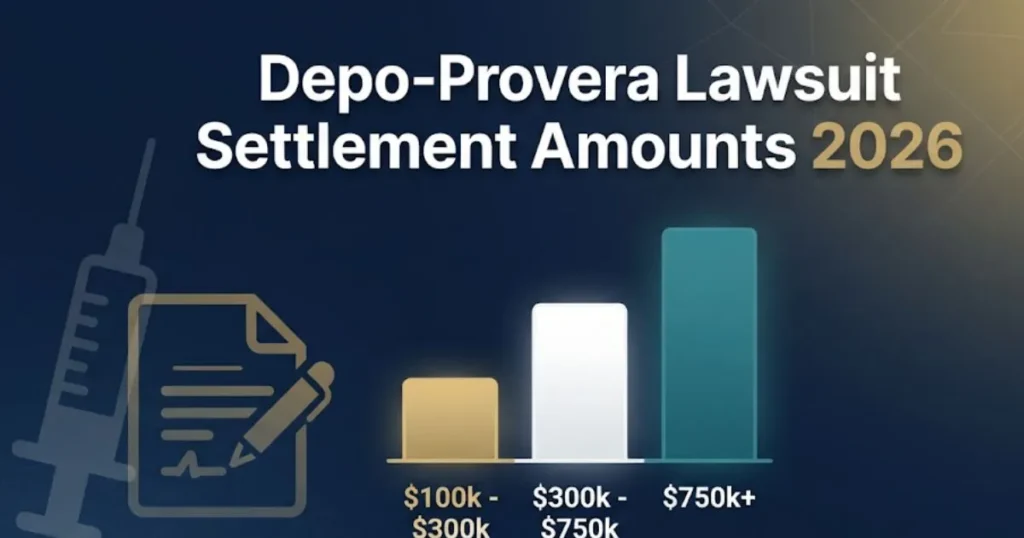
Settlement amounts in the Depo-Provera lawsuit have not been finalized because no global settlement exists yet. However, legal analysts and mass tort attorneys have projected potential ranges based on comparable pharmaceutical cases.
Estimated individual settlement amounts range from $100,000 to over $1 million, depending on case severity. The strongest cases involve women who used Depo-Provera for years and required surgery to remove meningioma tumors.

Cases involving recurrent tumors, permanent neurological damage, or multiple surgeries will likely fall in the highest settlement tiers. Cases with smaller, monitored tumors that did not require surgery will receive lower amounts.
| Case Severity | Estimated Settlement Range |
|---|---|
| Monitored meningioma (no surgery) | $50,000 to $150,000 |
| Single surgery, full recovery | $150,000 to $400,000 |
| Surgery with lasting complications | $400,000 to $750,000 |
| Multiple surgeries or permanent damage | $750,000 to $1,500,000+ |
These figures are estimates based on prior mass tort outcomes. Actual amounts will depend on bellwether verdicts, the strength of individual evidence, and the terms Pfizer agrees to.
The Vioxx litigation is a useful reference point. That case settled for $4.85 billion across roughly 50,000 claims, averaging about $97,000 per claimant. Depo-Provera cases involve brain tumors, which typically command higher individual payouts than cardiovascular injury claims.
Depo-Provera Lawsuit Payout Per Person
The payout per person in the Depo-Provera lawsuit will vary significantly from one claimant to the next. There is no flat payment amount because each case is evaluated individually based on specific medical and usage history.
Several factors determine how much each person receives:
- Duration of Depo-Provera use (longer use strengthens the claim)
- Tumor size and grade (larger or higher-grade tumors get higher payouts)
- Whether surgery was required (and how many surgeries)
- Lasting health effects (vision loss, cognitive problems, seizures)
- Age at diagnosis (younger women with decades of impact ahead may receive more)
- Lost wages and medical expenses (documented financial losses)
A woman who used Depo-Provera for eight years and needed two brain surgeries will receive a much larger payout than someone who used it briefly and has a small, stable tumor being monitored with MRIs.
Attorney fees will also reduce the take-home amount. Most mass tort attorneys work on contingency, typically taking 30% to 40% of the settlement. So a $500,000 gross settlement might result in a net payout of $300,000 to $350,000 after fees and costs.
Think of it like workers’ compensation tiers. The system does not hand everyone the same check. It assigns value based on how much harm you suffered.
Key Takeaway: The Depo-Provera lawsuit is not expected to settle before late 2026, with estimated individual payouts ranging from $50,000 to over $1 million based on the severity of brain tumor injuries and duration of drug use.
Depo-Provera Meningioma Lawsuit Update 2026
As of 2026, the Depo-Provera meningioma litigation continues to grow rapidly. Hundreds of new cases are being filed each month, and the MDL in the Northern District of California is moving through its pretrial phases.
Judge Yvonne Gonzalez Rogers has been managing the consolidated cases. Key pretrial deadlines for expert witness reports and Daubert motions are being set. These motions will determine which scientific experts can testify at trial about the link between Depo-Provera and meningioma.
Several important developments have shaped the case in recent months:
- The number of pending cases in the MDL has grown past 1,000 individual claims
- Plaintiff attorneys have submitted epidemiological evidence from multiple international studies
- Pfizer’s legal team has challenged certain expert methodologies
- The court has issued case management orders setting a pathway toward bellwether trials
The litigation gained momentum after a 2024 French study published with backing from France’s ANSM (National Agency for the Safety of Medicines) found a statistically significant link between prolonged injectable medroxyprogesterone acetate use and intracranial meningioma.
The FDA has also updated Depo-Provera’s label to include meningioma risk information. That label change strengthens plaintiff arguments that Pfizer knew or should have known about the risk earlier.
This case is still in the building phase. But the foundation is getting stronger with each court order.
Who Qualifies for the Depo-Provera Lawsuit
You may qualify for the Depo-Provera lawsuit if you received Depo-Provera injections and were later diagnosed with a meningioma brain tumor. That is the core eligibility test.
More specifically, attorneys are looking for claimants who meet these criteria:
- Received at least one Depo-Provera injection (though longer use strengthens the case)
- Were diagnosed with a meningioma (a tumor growing from the membranes surrounding the brain or spinal cord)
- The meningioma diagnosis came during or after the period of Depo-Provera use
- Have medical records documenting both the injections and the tumor diagnosis
| Eligibility Factor | What You Need |
|---|---|
| Drug used | Depo-Provera (medroxyprogesterone acetate injection) |
| Diagnosis | Meningioma brain tumor (any grade) |
| Timing | Diagnosed during or after Depo-Provera use |
| Documentation | Medical records for injections and tumor |
| Location | U.S. residents (for the current MDL) |
Women who used the drug for one year or longer generally have the strongest claims. But even shorter-term users may qualify if their tumor diagnosis lines up with the drug’s known risk profile.
Family members of women who died from meningioma complications after Depo-Provera use may also file wrongful death claims. These cases carry their own eligibility requirements but are being accepted in the MDL.
Depo-Provera Brain Tumor Lawsuit Explained
The Depo-Provera brain tumor lawsuit is a mass tort action alleging that Pfizer’s injectable contraceptive causes meningioma brain tumors. Plaintiffs claim Pfizer failed to warn patients and doctors about this serious risk.
Meningiomas are tumors that form in the meninges, the protective membranes around the brain and spinal cord. While often classified as benign, these tumors can cause severe symptoms. They press on brain tissue and can require risky surgery to remove.
The core legal argument is straightforward. Pfizer knew or should have known that Depo-Provera’s active ingredient, medroxyprogesterone acetate, could promote meningioma growth. Despite mounting evidence, the company allegedly failed to add adequate warnings to its labeling for decades.
Here is why this matters. Depo-Provera has been used by millions of women worldwide since the FDA approved it in 1992. Many women received injections every three months for years without being told about any brain tumor risk.
The lawsuit centers on two legal theories:
- Failure to warn: Pfizer did not properly alert patients or prescribing doctors about the meningioma risk
- Defective design: The product’s risks outweigh its benefits when safer alternatives exist
This is not a situation where a minor side effect was overlooked. Brain tumors are life-altering. Some women have undergone multiple craniotomies. Others have suffered permanent vision loss, hearing damage, or cognitive decline.
Key Takeaway: The Depo-Provera lawsuit alleges that Pfizer knew its injectable contraceptive could cause meningioma brain tumors but failed to warn millions of women who used the drug for years.
Depo-Provera Lawsuit Against Pfizer
Pfizer is the primary defendant in the Depo-Provera litigation. The company manufactures and markets Depo-Provera through its subsidiary, Pharmacia & Upjohn Company LLC.
Plaintiffs argue that Pfizer had access to scientific data linking medroxyprogesterone acetate to meningioma growth for years before taking any action. Internal documents and published research dating back to the early 2000s raised red flags about progestin hormones and tumor development.
Despite this evidence, Pfizer did not add meningioma warnings to the Depo-Provera label until the FDA required it in 2024. Plaintiffs say that delay was inexcusable.
Pfizer’s defense strategy has focused on several arguments:
- Meningiomas are common tumors that occur in the general population regardless of drug use
- The scientific evidence does not establish direct causation
- The company complied with FDA labeling requirements at all relevant times
- Individual plaintiffs cannot prove their specific tumors were caused by Depo-Provera
Pfizer is one of the largest pharmaceutical companies in the world, with annual revenues exceeding $50 billion. The company has significant resources to mount a prolonged legal defense.
However, Pfizer has a history of settling major product liability cases when the evidence becomes overwhelming. The company paid $2.3 billion in the largest healthcare fraud settlement in U.S. history back in 2009. It also resolved Protonix injury claims and other drug liability cases through negotiated settlements.
The financial pressure on Pfizer will increase if bellwether trials produce large plaintiff verdicts. That is the pattern these cases follow.
Is the Depo-Provera Lawsuit a Class Action
The Depo-Provera lawsuit is not a class action. It is a mass tort consolidated into a multidistrict litigation (MDL). The difference matters because it affects how your case is handled and how much you might receive.
In a class action, one lawsuit represents everyone. All class members get the same outcome, usually a small payment. A mass tort is different. Each plaintiff files an individual case with individual facts. Your payout depends on your specific injuries and evidence.
| Feature | Class Action | Mass Tort (MDL) |
|---|---|---|
| Case type | One lawsuit for all | Individual cases consolidated |
| Payout structure | Same for everyone | Varies by case |
| Typical payout | Small (often under $100) | Large (thousands to millions) |
| Individual evidence | Not required | Required (medical records, etc.) |
| Attorney relationship | One attorney for the class | Your own attorney represents you |
The MDL structure is actually better for Depo-Provera plaintiffs. Because each case is evaluated on its own merits, women with severe injuries can receive significantly more than those with minor cases.
Think of it like this. In a class action, everyone splits one pie equally. In a mass tort, each person gets a slice proportional to how much they were hurt.
The cases are consolidated in the MDL only for pretrial efficiency. Shared discovery, common expert witnesses, and coordinated scheduling save time and money. But each case retains its individual identity.
Depo-Provera MDL Status in 2026
The Depo-Provera MDL, designated as MDL No. 3127, is centralized in the U.S. District Court for the Northern District of California. Judge Yvonne Gonzalez Rogers is presiding over the consolidated proceedings.
The Judicial Panel on Multidistrict Litigation (JPML) created this MDL in 2024 after finding that the growing number of Depo-Provera meningioma cases shared common factual questions. Centralizing them prevents conflicting rulings and speeds up the pretrial process.
As of early 2026, the MDL has progressed through several stages:
- Initial case management orders have been issued
- Plaintiff and defense leadership teams have been appointed
- Discovery is underway, including document production from Pfizer
- Expert witness disclosures are being prepared and challenged
- Bellwether case selection is in progress or approaching
| MDL Detail | Information |
|---|---|
| MDL Number | 3127 |
| Court | Northern District of California |
| Judge | Yvonne Gonzalez Rogers |
| Year Established | 2024 |
| Current Phase | Pretrial discovery and bellwether preparation |
| Number of Pending Cases | 1,000+ and growing |
The MDL will continue to accept new cases as they are filed. There is no cap on the number of claims that can be added. Women who have not yet filed still have time, but statutes of limitation apply and vary by state.
The pace of the MDL depends heavily on how quickly discovery wraps up and when bellwether trials are scheduled. Every month, new case management orders refine the timeline.
Key Takeaway: The Depo-Provera MDL (No. 3127) is progressing through pretrial discovery in the Northern District of California, with over 1,000 cases pending and bellwether trial preparation underway in 2026.
Depo-Provera Bellwether Trials in 2026
Bellwether trials are test cases selected from the MDL to go to trial first. Their outcomes give both sides a realistic preview of what juries think about the evidence, which directly shapes settlement negotiations.
In the Depo-Provera MDL, bellwether case selection is a key step expected to take shape in 2026. The court will choose a small group of representative cases, typically 6 to 20 cases, from which a handful will actually go to trial.
The selection process works like this:
- Each side proposes a pool of cases
- The court narrows the pool based on diversity of facts (different tumor severities, different usage durations, different states)
- A small number are prepared for trial
- Usually 3 to 5 cases actually go before a jury
Bellwether verdicts do not bind other plaintiffs. But they carry enormous practical weight. If juries award large damages, Pfizer faces pressure to settle the remaining cases rather than risk thousands of similar verdicts. If Pfizer wins the early trials, plaintiffs may accept lower settlement amounts.
In the 3M earplug MDL, bellwether verdicts ranged from defense wins to plaintiff awards exceeding $70 million. That wide range eventually pushed both sides toward a $6 billion settlement.
The Depo-Provera bellwether trials could follow a similar pattern. Strong plaintiff verdicts in even one or two cases would significantly accelerate global settlement talks.
Expect the first bellwether trials to be scheduled for late 2026 or early 2027 based on the current pretrial timeline.
Depo-Provera Lawsuit Timeline
The Depo-Provera lawsuit timeline stretches back several years, with key events accelerating in 2024 and 2025. Understanding this timeline helps you see where things stand and what comes next.
| Year | Event |
|---|---|
| 2004 to 2020 | Early studies link progestins to meningioma risk; no major U.S. litigation |
| 2024 (early) | French ANSM study confirms elevated meningioma risk with Depo-Provera |
| 2024 (mid) | FDA updates Depo-Provera labeling to include meningioma warning |
| 2024 (late) | JPML consolidates cases into MDL No. 3127 in Northern District of California |
| 2025 | Discovery phase begins; plaintiff and defense leadership appointed |
| 2025 to 2026 | Expert reports, Daubert hearings, bellwether selection |
| Late 2026 to early 2027 | First bellwether trials expected |
| 2027+ | Settlement negotiations and potential global resolution |
The timeline is not fixed. Courts adjust schedules based on the complexity of discovery, motions practice, and trial readiness. Pfizer has strong incentive to slow things down because delay means paying later. Plaintiffs want speed because their injuries are ongoing.
One thing is clear. The litigation has moved faster than many observers predicted. The combination of strong scientific evidence and FDA action gave plaintiffs early momentum.
For women considering filing, the key takeaway from this timeline is simple: the window is open now. Waiting too long could mean running into statute of limitations problems in your state.
Depo-Provera Settlement Calculator
There is no official Depo-Provera settlement calculator because the case has not yet reached a settlement phase. However, attorneys use internal models to estimate potential values based on case-specific factors.
These estimates rely on a point system that assigns values to different variables. The more severe your situation, the higher your point total, and the larger your potential payout.
Factors that increase your estimated settlement value:
- Longer duration of Depo-Provera use (5+ years scores highest)
- Higher-grade meningioma (Grade II or III vs. Grade I)
- Surgical intervention (especially craniotomy)
- Multiple surgeries or tumor recurrence
- Permanent neurological damage (vision loss, seizures, cognitive decline)
- Younger age at diagnosis (more years of impact)
- Strong medical documentation (clear records of both injections and diagnosis)
| Factor | Low Value Indicator | High Value Indicator |
|---|---|---|
| Duration of use | Under 1 year | 5+ years |
| Tumor grade | Grade I (benign) | Grade II or III |
| Treatment | Monitoring only | Multiple surgeries |
| Lasting effects | Full recovery | Permanent disability |
| Documentation | Partial records | Complete records |
Online settlement calculators from law firm websites should be treated with caution. They are marketing tools designed to capture leads. They cannot account for the specific legal dynamics of your case.
The real “calculator” is the combination of your medical records, your attorney’s assessment, and the eventual bellwether trial outcomes that set the market for case values.
Key Takeaway: No official Depo-Provera settlement calculator exists yet, but attorneys estimate case values using point-based systems that weigh tumor severity, treatment history, and duration of drug use.
How to File a Depo-Provera Lawsuit
Filing a Depo-Provera lawsuit starts with contacting a mass tort attorney who handles pharmaceutical injury cases. Most of these attorneys offer free case evaluations and work on contingency, meaning you pay nothing upfront.
Here is the step-by-step process:
Step 1: Gather your medical records. You need documentation showing your Depo-Provera injections and your meningioma diagnosis. Pharmacy records, clinic visit notes, and imaging reports (MRI or CT scans) are the most important documents.
Step 2: Contact a qualified attorney. Look for law firms with experience in pharmaceutical mass torts. During the initial consultation, the attorney will review your records and determine if you have a viable claim.
Step 3: Sign a retainer agreement. If the attorney accepts your case, you will sign a contingency fee agreement. This means the attorney only gets paid if you receive a settlement or verdict. Typical fees range from 30% to 40% of the recovery.
Step 4: Your attorney files the complaint. The lawyer drafts and files a formal complaint, typically in the MDL court or in a state court depending on the strategy.
Step 5: Your case enters the MDL process. Once filed, your case joins the consolidated pretrial proceedings. Your attorney handles all legal work. You may need to provide additional medical records or answer written questions (interrogatories) during discovery.
| Filing Step | What Happens |
|---|---|
| Step 1 | Gather medical records (injections + diagnosis) |
| Step 2 | Free consultation with mass tort attorney |
| Step 3 | Sign contingency fee agreement |
| Step 4 | Attorney files complaint |
| Step 5 | Case enters MDL for pretrial proceedings |
The entire filing process typically takes 2 to 4 weeks from your first call to a filed complaint. The longer part is the waiting period as the MDL proceeds through pretrial phases.
Depo-Provera Lawsuit Eligibility Requirements
To be eligible for the Depo-Provera lawsuit, you must have received Depo-Provera injections and been diagnosed with a meningioma. Both elements are required.
The specific eligibility requirements break down as follows:
Medical Requirements:
- Documented history of receiving Depo-Provera (medroxyprogesterone acetate) injections
- Diagnosis of meningioma (intracranial or spinal), confirmed by imaging or pathology
- Temporal connection between drug use and tumor development
Legal Requirements:
- You must file within your state’s statute of limitations (typically 2 to 3 years from diagnosis or discovery of the connection to Depo-Provera)
- You must be a U.S. resident or have received treatment in the U.S.
- Your claim must not have been previously settled or dismissed
| Requirement | Details |
|---|---|
| Drug | Depo-Provera injection (any formulation) |
| Diagnosis | Meningioma (Grade I, II, or III) |
| Timing | Tumor diagnosed during or after Depo-Provera use |
| Records | Medical documentation of both injections and tumor |
| Statute of Limitations | Varies by state; typically 2 to 3 years |
Women who used generic versions of medroxyprogesterone acetate (not brand-name Depo-Provera) may also have claims, but these are evaluated separately and may involve different defendants.
Family members of deceased patients can file wrongful death claims. These require proof that the death was related to meningioma caused by Depo-Provera use.
If you are unsure whether you qualify, a mass tort attorney can review your situation at no cost. The consultation is free, and there is no obligation.
Depo-Provera Meningioma Symptoms to Watch For
Meningioma symptoms vary depending on tumor size and location, but they often develop gradually over months or years. Many women do not realize they have a brain tumor until symptoms become impossible to ignore.
The most commonly reported symptoms include:
- Headaches that worsen over time or do not respond to normal treatment
- Vision changes including blurring, double vision, or partial vision loss
- Hearing loss or ringing in the ears
- Seizures in women with no prior seizure history
- Memory problems or difficulty concentrating
- Weakness or numbness in arms or legs
- Balance difficulties or unexplained dizziness
- Personality or behavior changes
- Speech difficulties
| Symptom | Frequency in Meningioma Patients |
|---|---|
| Headaches | Very common |
| Vision changes | Common |
| Seizures | Moderate |
| Cognitive decline | Moderate |
| Motor weakness | Less common |
| Personality changes | Less common |
The tricky part is that many of these symptoms mimic other conditions. Headaches get blamed on stress. Memory issues get attributed to aging. That is why meningiomas often go undiagnosed for years.
If you used Depo-Provera for any significant period and experience persistent neurological symptoms, ask your doctor about getting a brain MRI. Early detection can make a real difference in treatment outcomes and in the strength of a potential legal claim.
Meningiomas are classified into three grades. Grade I tumors are slow-growing and considered benign. Grade II (atypical) tumors grow faster and are more likely to recur. Grade III (anaplastic) tumors are rare, aggressive, and malignant. All three grades qualify for the lawsuit.
Key Takeaway: If you used Depo-Provera and experience persistent headaches, vision problems, seizures, or cognitive changes, request a brain MRI because meningioma symptoms often mimic less serious conditions and go undiagnosed for years.
Depo-Provera Lawsuit Evidence and Studies
The scientific evidence linking Depo-Provera to meningioma has grown substantially in recent years. Multiple studies across different countries have found a statistically significant association between prolonged use of medroxyprogesterone acetate and the development of intracranial meningiomas.
The French ANSM Study (2024): This large-scale study, backed by France’s national drug safety agency, analyzed health records of hundreds of thousands of women. It found that prolonged use of injectable medroxyprogesterone acetate increased meningioma risk by up to 5.6 times. This study became a cornerstone of plaintiff evidence in the MDL.
BMJ Published Research: Studies published in the British Medical Journal and other peer-reviewed journals have documented the biological mechanism. Meningioma cells contain progesterone receptors. When exposed to sustained high levels of synthetic progestin like medroxyprogesterone acetate, these cells can be stimulated to grow.
WHO and FDA Recognition: The World Health Organization classified medroxyprogesterone acetate as a possible factor in meningioma development. The FDA added meningioma risk language to the Depo-Provera label in 2024, which plaintiffs point to as an admission that the risk was real and known.
Key evidence points in the litigation:
- Dose-response relationship: longer use correlates with higher risk
- Biological plausibility: meningioma cells have progesterone receptors
- Temporal association: tumors develop during or shortly after prolonged use
- Consistency across studies conducted in different countries
- Pfizer’s internal documents (under discovery) regarding risk awareness
| Study / Source | Key Finding |
|---|---|
| French ANSM Study (2024) | 5.6x increased meningioma risk with prolonged use |
| BMJ Research | Meningioma cells have progesterone receptors stimulated by progestins |
| FDA Label Update (2024) | Added meningioma risk warning to Depo-Provera label |
| WHO Classification | Recognized medroxyprogesterone acetate as a possible meningioma risk factor |
This body of evidence is significantly stronger than what existed in earlier pharmaceutical mass torts at a comparable stage. Plaintiffs have both epidemiological data and a clear biological mechanism. That combination is powerful in front of a jury.
Pfizer will challenge this evidence through its own experts. But the weight of independent research puts plaintiffs in a strong position heading into bellwether trials.
Frequently Asked Questions
When will the Depo-Provera lawsuit be settled?
The Depo-Provera lawsuit is not expected to settle before late 2026 at the earliest.
Bellwether trials must produce results before meaningful settlement negotiations can begin.
Most legal analysts project global settlement talks will happen in 2027.
How much money will I get from the Depo-Provera lawsuit?
Individual payouts are estimated to range from $50,000 to over $1 million.
Your specific amount depends on tumor severity, number of surgeries, and duration of drug use.
Attorney fees of 30% to 40% will be deducted from your gross settlement.
Do I qualify for the Depo-Provera meningioma lawsuit?
You likely qualify if you received Depo-Provera injections and were diagnosed with a meningioma brain tumor.
Medical records documenting both the injections and the tumor are required.
A mass tort attorney can evaluate your case at no cost during a free consultation.
Is the Depo-Provera lawsuit a class action or mass tort?
The Depo-Provera lawsuit is a mass tort, not a class action.
Each plaintiff files an individual case, and payouts vary based on personal injuries and evidence.
Cases are consolidated in MDL No. 3127 for pretrial efficiency only.
What is the deadline to file a Depo-Provera lawsuit?
The deadline varies by state, with most statutes of limitations running 2 to 3 years from diagnosis or discovery.
New cases are still being accepted into the MDL in 2026.
Filing sooner is strongly recommended to preserve your legal rights and avoid missing your state’s deadline.
The Depo-Provera lawsuit is one of the most significant pharmaceutical mass torts moving through the courts in 2026. The scientific evidence is strong, the number of claimants is growing, and the pretrial process is advancing toward bellwether trials.
If you used Depo-Provera and were diagnosed with a meningioma, now is the time to act. Gather your medical records, contact a mass tort attorney for a free evaluation, and get your claim filed before statute of limitations deadlines close.
This case is moving. Make sure you are part of it.







