

The Texas Tylenol lawsuit gives families a path to seek compensation if prenatal acetaminophen use led to an autism or ADHD diagnosis in their child. Thousands of cases are now moving through federal courts, and Texas families are a significant part of that count.
This lawsuit targets Johnson and Johnson, Kenvue, and major retailers that sold acetaminophen products without adequate warnings about neurodevelopmental risks during pregnancy. Over 1,000 lawsuits were pending in the federal MDL as of late 2025.
In this guide, you will learn exactly who qualifies in Texas, what settlement amounts might look like, how to file your claim, and what deadlines apply for 2026. One key detail many people miss: this lawsuit is not just about Tylenol brand products. Store brand acetaminophen counts too.
If you used any acetaminophen product during pregnancy and your child was later diagnosed with autism or ADHD, this article was written for you.
Texas Tylenol Lawsuit: What You Need to Know
The Texas Tylenol lawsuit refers to legal claims filed by Texas families alleging that acetaminophen use during pregnancy caused or contributed to autism spectrum disorder or ADHD in their children. These cases fall under a broader wave of product liability litigation targeting the makers and sellers of acetaminophen.
The core allegation is straightforward. Drug manufacturers and retailers knew, or should have known, about scientific research linking prenatal acetaminophen exposure to neurodevelopmental harm. They failed to warn consumers.
Johnson and Johnson, through its subsidiary McNeil Consumer Healthcare, is the primary defendant. But major retailers like Walmart, CVS, Walgreens, Target, and Costco are also named for selling store brand versions without warnings.
Texas is one of the top states for Tylenol lawsuit filings. The state’s large population and strong product liability laws make it a key jurisdiction.
| Detail | Info |
|---|---|
| Primary Defendants | Johnson and Johnson, Kenvue, major retailers |
| Core Allegation | Failure to warn about prenatal risks |
| Conditions Involved | Autism spectrum disorder, ADHD |
| Texas Relevance | High volume of filings, strong state laws |
| Federal Court | MDL No. 3043, SDNY |
Families in Texas don’t need to have used name brand Tylenol specifically. Any acetaminophen product purchased at a Texas store or used during a pregnancy while living in Texas may qualify.
Tylenol Lawsuit Texas 2026: Where Things Stand Right Now
As of 2026, the Tylenol lawsuit is at a critical turning point. The federal multidistrict litigation (MDL No. 3043) continues in the U.S. District Court for the Southern District of New York under Judge Denise Cote.
In late 2023, Judge Cote excluded the plaintiffs’ expert witnesses in the first bellwether case, which was a major setback. That ruling questioned whether the scientific evidence was strong enough to link acetaminophen to autism.
Plaintiffs appealed that decision to the Second Circuit Court of Appeals. The appeal has been a focal point heading into 2026. If the appellate court reverses Judge Cote’s ruling, thousands of cases could move forward toward trial or settlement negotiations.
Despite the federal setback, state court cases remain active. Texas families have the option of filing in state courts, where different judges may apply different standards to expert testimony.
- Federal MDL status: Pending appeal on expert testimony exclusion
- State court activity: Cases still being filed and processed in Texas
- Bellwether timeline: Dependent on appeal outcome
- Settlement talks: Not formally underway as of early 2026
The appeal outcome will shape everything. A favorable ruling reopens the door to bellwether trials. An unfavorable one could force plaintiffs to rely on state courts exclusively.
Think of the appeal like a gate. Right now, it is closed at the federal level. State courts offer a side entrance that remains open.
Tylenol Autism Lawsuit in Texas
The Tylenol autism lawsuit in Texas involves families whose children received an autism spectrum disorder diagnosis after the mother used acetaminophen products during pregnancy. These claims argue that the drug disrupted fetal brain development.
Multiple scientific studies support this connection. A 2019 study published in JAMA Pediatrics found that prenatal acetaminophen exposure was associated with a 20% increase in autism risk and a 30% increase in ADHD risk. A 2021 consensus statement in Nature Reviews Endocrinology, signed by 91 scientists and clinicians, called for precautionary action.
Texas families with autistic children face enormous lifetime care costs. According to estimates, the lifetime cost of supporting a person with autism can exceed $2.4 million. That financial burden is central to the damages these lawsuits seek.
| Study / Source | Finding |
|---|---|
| JAMA Pediatrics (2019) | 20% increased autism risk with prenatal use |
| Nature Reviews Endocrinology (2021) | 91 experts called for precautionary warnings |
| Estimated Lifetime Autism Costs | Over $2.4 million per individual |
The connection between acetaminophen and autism is not about occasional use. Most studies focus on sustained or frequent use during pregnancy. But the lawsuits argue that consumers deserved warnings regardless.
For Texas parents, the key question is whether their child’s diagnosis can be connected to maternal acetaminophen use. Medical records and pharmacy receipts become essential proof.
Key Takeaway: The scientific evidence linking prenatal acetaminophen to autism is published, peer reviewed, and backed by dozens of researchers, giving Texas families a foundation for their claims.
Who Qualifies for the Tylenol Lawsuit in Texas
You may qualify for the Tylenol lawsuit in Texas if you used acetaminophen during pregnancy and your child was later diagnosed with autism spectrum disorder or ADHD. Both conditions are covered under the current litigation.
Qualification is not limited to Tylenol brand products. If you used Equate, Kirkland, CVS brand, Walgreens brand, or any generic acetaminophen, you are still eligible. The lawsuits target all manufacturers and sellers.
Here are the general eligibility requirements:
- You took acetaminophen at any point during pregnancy
- Your child has a formal diagnosis of autism or ADHD
- The diagnosis came from a qualified medical professional
- You have some form of documentation (medical records, pharmacy records, or purchase receipts)
- You are filing within the applicable statute of limitations
| Eligibility Factor | Required? |
|---|---|
| Acetaminophen use during pregnancy | Yes |
| Child diagnosed with autism or ADHD | Yes |
| Medical professional diagnosis | Yes |
| Documentation of use or purchase | Strongly recommended |
| Texas residency at time of use | Helpful but not strictly required |
You do not need to prove you used acetaminophen every single day. Even intermittent use during pregnancy can be part of a valid claim.
One common question: what if your child was diagnosed as an adult? Adult diagnoses may still qualify if the condition can be linked to prenatal exposure. However, childhood diagnoses with documented medical histories tend to produce stronger claims.
Texas Tylenol Settlement Amounts
No official Tylenol settlements have been paid out yet as of early 2026. The litigation has not reached the settlement phase because the federal MDL is still dealing with the expert testimony appeal.
That said, legal analysts and mass tort attorneys have offered estimated ranges based on comparable pharmaceutical lawsuits.
| Claim Tier | Estimated Settlement Range | Typical Scenario |
|---|---|---|
| Tier 1 (Severe) | $300,000 to $600,000+ | Severe autism requiring lifetime care |
| Tier 2 (Moderate) | $150,000 to $300,000 | Moderate autism or combined autism/ADHD |
| Tier 3 (Lower) | $50,000 to $150,000 | ADHD diagnosis with documented prenatal use |
These estimates are projections only. Actual payouts will depend on the strength of individual evidence, severity of the diagnosis, and the outcome of bellwether trials or global settlement negotiations.
For context, past pharmaceutical mass torts offer clues. The Zantac litigation, the talcum powder lawsuits, and the opioid settlements all followed a tiered payout structure. Higher documented harm meant higher payouts.
Texas families should understand that settlement money would be distributed after legal fees, which typically run 33% to 40% on a contingency basis. That means a $300,000 settlement might yield roughly $180,000 to $200,000 after fees.
The most important factor affecting your potential payout is the quality and completeness of your documentation. Strong medical records and clear evidence of acetaminophen use during pregnancy will place your claim in a higher tier.
Tylenol Lawsuit Payout per Person in Texas
The Tylenol lawsuit payout per person in Texas will vary based on individual case details. There is no flat payment that every claimant will receive.
Several factors determine how much each person could get:
- Severity of the child’s condition: A child requiring full-time care scores higher
- Age of diagnosis: Earlier diagnoses often indicate more severe presentations
- Medical documentation: Detailed records strengthen the claim
- Proof of acetaminophen use: Pharmacy records, prescriptions, or purchase receipts
- Duration and frequency of use during pregnancy: Longer use may correlate to higher risk
Think of it like car insurance claims. A fender bender and a totaled vehicle are both claims, but the payout is wildly different. The same principle applies here.
| Factor | Impact on Payout |
|---|---|
| Severe autism with high support needs | Higher payout |
| ADHD only diagnosis | Lower payout range |
| Strong pharmacy records | Increases claim value |
| No documentation of use | Weakens claim significantly |
| Lifetime care cost projections | Can increase damages |
Some attorneys have suggested that top-tier Tylenol claims could eventually exceed $500,000 per plaintiff. Lower-tier claims may settle for $50,000 or less. These numbers remain speculative until the first bellwether trials conclude or a global settlement is reached.
Key Takeaway: Individual payouts will be determined by injury severity and evidence quality, with the strongest Texas claims potentially reaching six figures or more.
How to File a Tylenol Lawsuit in Texas
Filing a Tylenol lawsuit in Texas starts with contacting a mass tort attorney who handles acetaminophen litigation. Most attorneys in this space work on contingency, meaning you pay nothing upfront.
Here is the general process step by step:
- Contact a qualified attorney who handles Tylenol or acetaminophen cases
- Provide your medical history including your pregnancy records and your child’s diagnostic records
- Share any evidence of acetaminophen use such as pharmacy records, prescriptions, or even a written account of your usage
- Your attorney evaluates your claim and determines if it meets the filing criteria
- The case is filed either in the federal MDL (SDNY) or in a Texas state court
- Discovery phase begins where evidence is exchanged between parties
- Your case moves toward trial or settlement depending on the litigation’s trajectory
| Filing Step | What Happens |
|---|---|
| Initial Consultation | Attorney reviews your situation |
| Documentation Gathering | Medical and pharmacy records collected |
| Claim Evaluation | Attorney confirms eligibility |
| Filing | Complaint submitted to court |
| Litigation | Case proceeds through MDL or state court |
You do not need to live in Texas currently. If you lived in Texas during your pregnancy and purchased acetaminophen there, that connection may be enough.
One detail people often overlook: you should start gathering records now. Medical records can take weeks to obtain from hospitals and clinics. Pharmacy records from 5 to 10 years ago may require formal requests.
Time is not your friend in this process. The sooner you start, the stronger your position.
Tylenol ADHD Lawsuit in Texas
The Tylenol ADHD lawsuit in Texas covers children diagnosed with attention deficit hyperactivity disorder after their mothers used acetaminophen during pregnancy. ADHD claims are part of the same litigation that covers autism.
ADHD affects roughly 9.8% of children in the United States, according to CDC data. The lawsuits argue that acetaminophen contributed to or caused ADHD in children whose mothers used the drug prenatally.
The JAMA Pediatrics study from 2019 found a 30% increased risk of ADHD among children exposed to acetaminophen in the womb. That percentage is statistically significant in medical research terms.
- ADHD claims are generally valued lower than autism claims
- But ADHD cases with documented learning disabilities or behavioral challenges may tier higher
- Combined ADHD and autism diagnoses can push a claim into a higher settlement bracket
| Condition | Estimated Claim Strength |
|---|---|
| ADHD alone | Moderate |
| ADHD with learning disabilities | Moderate to strong |
| ADHD combined with autism | Strong |
| Severe ADHD requiring medication and therapy | Moderate to strong |
Texas parents whose children take medication for ADHD, attend special education programs, or require behavioral therapy should document those costs. These out-of-pocket expenses strengthen the damages portion of your claim.
The lawsuit does not require you to prove that acetaminophen was the only cause of your child’s ADHD. It needs to be shown that acetaminophen was a contributing factor.
Tylenol Pregnancy Lawsuit in Texas
The Tylenol pregnancy lawsuit in Texas focuses on women who took acetaminophen at any point during pregnancy and whose children later developed neurodevelopmental disorders. Pregnancy is the connecting event in every single one of these claims.
For decades, acetaminophen was considered the safest over-the-counter pain reliever for pregnant women. Doctors routinely recommended it. The FDA did not require pregnancy warnings specific to neurodevelopmental risks.
That is exactly what plaintiffs argue was the problem. Without warnings, millions of pregnant women used acetaminophen believing it was completely safe. Meanwhile, research was accumulating that suggested potential harm to fetal brain development.
- Acetaminophen crosses the placental barrier
- It can reach the developing fetal brain
- Studies suggest it may interfere with hormonal regulation critical for brain development
- The drug may also cause oxidative stress in fetal tissue
| Pregnancy Detail | Relevance to Lawsuit |
|---|---|
| Trimester of use | All trimesters potentially relevant |
| Frequency of use | Higher frequency may strengthen claim |
| Reason for use (headaches, fever, pain) | Documented medical reason helps |
| Doctor’s recommendation to use Tylenol | Shows reliance on perceived safety |
Texas women who took acetaminophen on their doctor’s advice have a particularly compelling angle. They relied on professional medical guidance and manufacturer safety assurances that turned out to be incomplete.
Key Takeaway: The pregnancy connection is the backbone of every Tylenol claim, and Texas mothers who used acetaminophen while pregnant are the primary plaintiffs in this litigation.
Texas Tylenol Lawsuit Eligibility Requirements
Texas Tylenol lawsuit eligibility requires three core elements: acetaminophen use during pregnancy, a child with a qualifying diagnosis, and some form of supporting documentation.
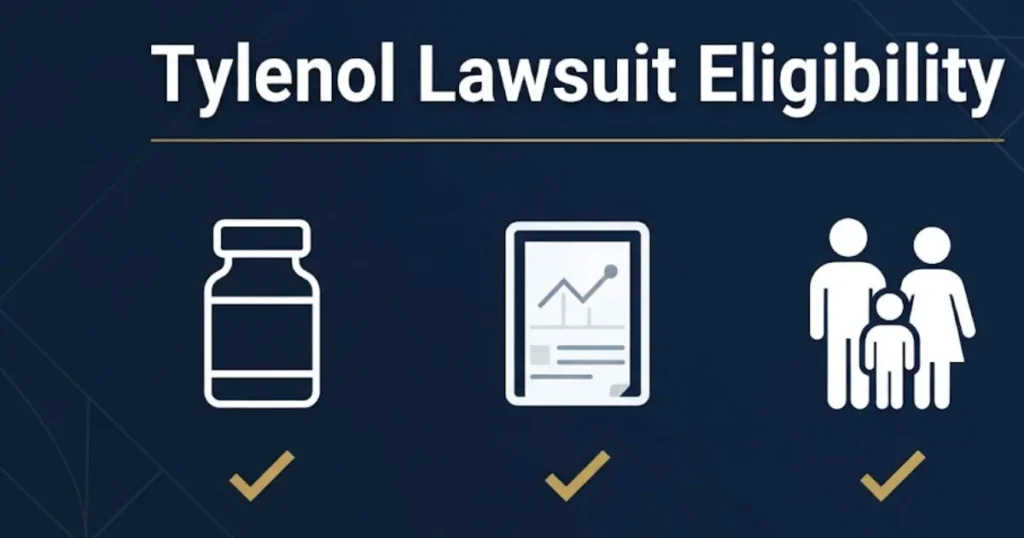
Here is a breakdown of the specific requirements:
Qualifying Diagnoses:
- Autism spectrum disorder (ASD)
- Attention deficit hyperactivity disorder (ADHD)
- Attention deficit disorder (ADD)
- Other neurodevelopmental delays linked to prenatal exposure (case dependent)
Qualifying Products:
- Tylenol (all formulations)
- Generic acetaminophen from any manufacturer
- Store brands: Equate (Walmart), Kirkland (Costco), CVS Health, Walgreens brand, Up and Up (Target)
- Combination products containing acetaminophen (cold medicines, sleep aids)
| Requirement | Details |
|---|---|
| Prenatal acetaminophen use | Any brand, any formulation |
| Child’s diagnosis | ASD, ADHD, ADD, or related condition |
| Diagnosis documentation | Medical records from qualified provider |
| Evidence of product use | Pharmacy records, prescriptions, personal testimony |
| Filing deadline | Within Texas statute of limitations |
People sometimes ask whether fathers can file. The answer depends on the circumstances. If the mother is deceased or incapacitated, the father or legal guardian of the child may file on the child’s behalf. In most cases, the claim is filed by or on behalf of the mother who used the product.
You do not need a receipt from every single purchase. Attorneys can work with partial records, pharmacy database searches, and even personal declarations about your usage patterns.
Texas Statute of Limitations for the Tylenol Lawsuit
The Texas statute of limitations for personal injury claims is generally two years from the date you discover, or reasonably should have discovered, the injury and its cause. This discovery rule is critical for Tylenol cases.
For Tylenol lawsuits, the clock does not necessarily start when your child is born. It starts when you learned, or should have learned, that acetaminophen might have caused your child’s condition.
Because the scientific research linking acetaminophen to autism and ADHD has only gained widespread public attention in recent years, many Texas families may still be within the filing window.
| Statute Detail | Texas Rule |
|---|---|
| General personal injury | 2 years |
| Discovery rule applies? | Yes |
| Clock starts when? | When you knew or should have known about the link |
| Minors exception? | Statute may be tolled until child turns 18 |
| Product liability claims | 2 years from discovery in most cases |
Texas also has special rules for minors. If the injured party is a child, the statute of limitations may be paused (tolled) until the child reaches the age of 18. This could extend the filing window significantly for families with young children.
Do not assume you have unlimited time. Courts interpret “should have known” differently. As media coverage and public awareness grow, the argument that you didn’t know about the acetaminophen link becomes harder to sustain.
If you are even considering filing, 2026 is the time to act. Waiting longer introduces risk.
Is the Tylenol Lawsuit a Class Action in Texas?
The Tylenol lawsuit is not a class action. It is a mass tort, which is a fundamentally different legal structure. This distinction matters for Texas families considering filing.
In a class action, one or a few plaintiffs represent a large group. Everyone in the class gets the same outcome. In a mass tort, each plaintiff files an individual case. Each person’s case is evaluated on its own evidence and merits.
| Feature | Class Action | Mass Tort (Tylenol) |
|---|---|---|
| Individual evaluation | No | Yes |
| Same payout for everyone | Yes | No |
| Personal evidence matters | Minimally | Significantly |
| Settlement varies by person | No | Yes |
| You have your own case | No | Yes |
This is good news for Texas families. It means your payout is based on your specific situation. A family with a severely autistic child and strong documentation will likely receive more than someone with a milder ADHD diagnosis and limited records.
The cases are consolidated in the federal MDL for pretrial efficiency. But each claim remains individual. If settlements occur, they will be negotiated based on injury tiers, not a single lump sum split equally.
Some Texas attorneys may also file in Texas state courts rather than the federal MDL. State court filings give plaintiffs access to Texas-specific judges and juries.
Key Takeaway: Because the Tylenol lawsuit is a mass tort and not a class action, your individual evidence and your child’s specific diagnosis directly determine your potential payout.
Acetaminophen Lawsuit in Texas
The acetaminophen lawsuit in Texas is the same litigation commonly called the Tylenol lawsuit. The term “acetaminophen” covers the generic drug ingredient found in Tylenol and all its store brand equivalents.
This distinction is important. You do not need to have used the Tylenol brand specifically. If you took any product containing acetaminophen during pregnancy, you may have a claim.
Products containing acetaminophen include:
- Tylenol (all varieties: Regular, Extra Strength, PM)
- Equate Acetaminophen (Walmart)
- Kirkland Signature Acetaminophen (Costco)
- CVS Health Acetaminophen
- Walgreens Pain Reliever Acetaminophen
- Up and Up Acetaminophen (Target)
- NyQuil, DayQuil (contain acetaminophen)
- Excedrin (contains acetaminophen)
- Midol (some formulations)
The lawsuits name both the brand manufacturer (Johnson and Johnson, now Kenvue) and the retailers who sold their own store brand versions. Walmart, Costco, and CVS are among the named defendants in various filings.
| Product | Manufacturer / Seller |
|---|---|
| Tylenol | Johnson and Johnson / Kenvue |
| Equate | Walmart |
| Kirkland | Costco |
| CVS Health brand | CVS Pharmacy |
| Up and Up | Target |
Texas consumers purchased millions of units of these products over the years. The state’s high retail volume makes it a significant market in this litigation.
If you remember buying acetaminophen at a Texas store during your pregnancy but don’t remember the exact brand, that is okay. Your attorney can help identify the manufacturer and retailer.
Tylenol MDL and Texas Claims
The Tylenol MDL (multidistrict litigation) is centralized under MDL No. 3043 in the U.S. District Court for the Southern District of New York. Texas claims can be filed directly into this MDL or pursued separately in Texas state courts.
MDL is a federal procedure that consolidates similar cases before one judge for pretrial proceedings. It is not a trial. It is a way to handle thousands of similar cases efficiently without repeating the same motions and discovery in every court across the country.
Judge Denise Cote oversees the Tylenol MDL. Her 2023 ruling excluding plaintiffs’ expert witnesses was a significant blow to the federal cases. The appeal of that decision is the single most important event in this litigation heading into 2026.
- MDL consolidates pretrial work but each case retains individual status
- Texas families can join the MDL or file in Texas state courts
- State court filings bypass the MDL ruling on expert testimony
- Some Texas attorneys prefer state court for strategic reasons
| MDL Detail | Info |
|---|---|
| Case Number | MDL No. 3043 |
| Court | SDNY (Southern District of New York) |
| Judge | Denise Cote |
| Key Ruling | Expert testimony excluded (2023) |
| Appeal Status | Pending at Second Circuit |
| Texas Options | MDL or Texas state court |
Filing in Texas state court means your case is governed by Texas rules of evidence, not federal Daubert standards. Texas follows a modified version of expert testimony rules that some attorneys believe is more favorable to plaintiffs.
This strategic choice between federal and state court is something your attorney will help you evaluate.
Tylenol Lawsuit Update for 2026
The most important Tylenol lawsuit update for 2026 is the pending appeal at the Second Circuit Court of Appeals. This appeal challenges Judge Cote’s decision to exclude plaintiffs’ expert witnesses in the federal MDL.
Here is a timeline of major developments:
| Date | Event |
|---|---|
| October 2022 | MDL No. 3043 established |
| 2023 | Initial bellwether cases selected |
| December 2023 | Judge Cote excludes expert testimony |
| Early 2024 | Plaintiffs file appeal to Second Circuit |
| 2024 to 2025 | Briefing and oral arguments |
| 2026 | Appeal decision expected |
If the Second Circuit reverses Judge Cote’s ruling, the MDL cases will restart with expert witnesses allowed. Bellwether trials could be scheduled, and settlement pressure on defendants would increase dramatically.
If the appeal fails, the federal MDL could effectively end. Plaintiffs would then rely entirely on state court filings across Texas and other states.
Meanwhile, new scientific research continues to emerge. Studies published in 2024 and 2025 have added to the body of evidence linking acetaminophen to neurodevelopmental outcomes. This ongoing research could support future expert testimony motions.
- The appeal decision is expected sometime in 2026
- State court cases in Texas remain active regardless
- No settlement negotiations have formally begun
- New scientific studies continue to strengthen the causal argument
Key Takeaway: The 2026 appeal ruling at the Second Circuit will determine whether the federal Tylenol litigation moves forward toward trials and settlements, or whether Texas families must pursue claims through state courts.
Tylenol Lawsuit Evidence Requirements in Texas
Strong evidence is the backbone of any successful Tylenol claim in Texas. The more documentation you have, the better your chances of qualifying for a higher settlement tier.
Here is what Texas attorneys typically ask for:
Medical Records:
- Prenatal care records showing pregnancy dates
- Records indicating acetaminophen was discussed or recommended
- Child’s diagnostic records (autism or ADHD evaluation)
- Developmental assessments and therapy records
- Prescription history from your OB-GYN or primary care provider
Pharmacy and Purchase Records:
- Pharmacy purchase history (pharmacies keep digital records for years)
- Prescription records if acetaminophen was prescribed
- Credit card or bank statements showing purchases at pharmacies or retailers
Personal Documentation:
- A written declaration describing your acetaminophen use during pregnancy
- Dates of use, approximate frequency, and reason for use
- Names of stores where you purchased the product
| Evidence Type | How to Obtain It |
|---|---|
| Prenatal medical records | Request from OB-GYN or hospital |
| Child’s diagnostic records | Request from pediatrician or specialist |
| Pharmacy records | Contact pharmacy chain directly |
| Purchase receipts | Check bank or credit card statements |
| Personal declaration | Write a detailed account with dates |
Don’t panic if you don’t have every document. Mass tort attorneys are experienced at building cases with partial records. A personal declaration combined with medical records can be sufficient in many cases.
Start gathering records now. Some pharmacies only retain records for 7 to 10 years. Waiting could mean losing access to critical evidence.
Tylenol Lawsuit for Autism and ADHD in Texas
The Tylenol lawsuit for autism and ADHD in Texas covers both diagnoses under the same litigation umbrella. You do not need to file separate lawsuits for each condition.
If your child has been diagnosed with both autism and ADHD, your claim may actually be stronger. Dual diagnoses suggest more significant neurodevelopmental impact, which could place your case in a higher settlement tier.
Here is how the two conditions are treated in the litigation:
| Condition | Claim Strength | Typical Evidence Needed |
|---|---|---|
| Autism spectrum disorder | Strong | Formal ASD diagnosis, developmental records |
| ADHD | Moderate | ADHD diagnosis, school records, medication history |
| Both autism and ADHD | Very strong | All of the above combined |
| Developmental delay only | Case dependent | Detailed medical evaluation required |
The lawsuits do not require you to prove that acetaminophen was the sole cause. The legal standard is whether acetaminophen was a “substantial contributing factor” to the child’s condition. This is a lower bar than proving exclusive causation.
Texas families should know that children diagnosed later in life are not automatically excluded. Some children receive autism or ADHD diagnoses in their teenage years or even as adults. These later diagnoses can still be tied to prenatal acetaminophen exposure.
The key is connecting the dots: prenatal exposure, timing of diagnosis, and documented evidence linking the two. Your attorney will help build that narrative.
Every case is unique. A child with severe autism requiring daily support presents a very different claim than a child with mild ADHD managed by behavioral therapy alone. Both can file, but the expected payout will differ.
Key Takeaway: Texas families with children diagnosed with autism, ADHD, or both should gather all medical and pharmacy records now, as the strength of your documentation directly impacts your claim’s value and settlement tier.
Frequently Asked Questions
Can I Still File a Tylenol Lawsuit in Texas in 2026?
Yes, many Texas families can still file a Tylenol lawsuit in 2026.
The discovery rule means your statute of limitations likely started when you learned about the link between acetaminophen and your child’s condition.
Claims involving minors may have extended deadlines under Texas law.
How Much Money Can I Get from the Texas Tylenol Lawsuit?
No settlements have been finalized yet, but legal analysts estimate payouts ranging from $50,000 to $600,000 per claim.
Your payout depends on the severity of your child’s diagnosis and the strength of your evidence.
Higher-tier claims involve severe autism with lifetime care needs.
Does the Tylenol Lawsuit Cover Store Brand Acetaminophen?
Yes, the lawsuit covers all acetaminophen products, not just Tylenol brand.
Store brands from Walmart, Costco, CVS, Walgreens, and Target are included.
Retailers are named as defendants for selling these products without pregnancy warnings.
What Proof Do I Need for a Texas Tylenol Claim?
You need your prenatal medical records, your child’s diagnosis records, and any evidence of acetaminophen purchases during pregnancy.
Pharmacy records, prescription history, and personal written declarations are all accepted.
Partial documentation can still support a claim when combined with other evidence.
Is the Tylenol Lawsuit a Class Action or Individual Case?
The Tylenol lawsuit is a mass tort, not a class action.
Each plaintiff files an individual case that is evaluated on its own merits.
This means your settlement amount is based on your specific evidence and your child’s diagnosis, not a one-size-fits-all payout.
The Texas Tylenol lawsuit remains active heading into 2026, with the federal appeal decision expected to reshape the entire litigation. Texas families who used acetaminophen during pregnancy and have children with autism or ADHD diagnoses should act now.
Start collecting medical records, pharmacy purchase histories, and your child’s diagnostic documentation. Contact a mass tort attorney who handles acetaminophen cases to evaluate your eligibility.
Your evidence is your leverage in this fight. The stronger your records, the stronger your claim.







