

The acetaminophen lawsuit in 2026 is one of the largest mass torts in the United States right now. Thousands of families allege that using acetaminophen during pregnancy caused their children to develop autism or ADHD.
This litigation targets both brand-name Tylenol and store-brand versions. Johnson & Johnson, now operating its consumer health division through Kenvue, faces mounting legal pressure alongside major retailers.
If you took acetaminophen while pregnant and your child was later diagnosed with a neurodevelopmental disorder, you may qualify to file a claim. Over 100,000 cases are consolidated in a federal MDL in New York.
This article covers every detail you need: settlement estimates, eligibility rules, filing deadlines, trial updates, and the science behind the claims. You will know exactly where things stand by the time you finish reading.
What Is the Acetaminophen Lawsuit About?
The acetaminophen lawsuit is a mass tort alleging that prenatal exposure to acetaminophen causes autism spectrum disorder and ADHD in children. Plaintiffs claim that manufacturers and retailers failed to warn pregnant women about these risks.
Acetaminophen is the active ingredient in Tylenol. It is the most commonly used pain reliever during pregnancy in the United States.
For decades, doctors told pregnant women it was safe. But a growing body of research published since 2014 has linked prolonged prenatal use to neurodevelopmental problems in children.
| Detail | Info |
|---|---|
| What Is Alleged | Acetaminophen during pregnancy causes autism and ADHD |
| Who Is Sued | Johnson & Johnson, Kenvue, major retailers |
| Court | U.S. District Court, Southern District of New York |
| MDL Number | MDL No. 3043 |
| Judge | Judge Denise Cote |
| Number of Cases | Over 100,000 pending |
The lawsuits do not claim acetaminophen should be pulled from shelves. They argue that companies should have placed warnings on labels telling pregnant women about potential neurodevelopmental risks.
Parents say they would have made different choices if they had known. That failure to warn is at the core of every claim.
Acetaminophen Lawsuit Update for 2026
The acetaminophen lawsuit in 2026 is entering a critical phase. After a setback in late 2023 when Judge Denise Cote excluded certain expert testimony, plaintiffs have regrouped and the litigation continues to move forward.
In December 2023, Judge Cote issued a Daubert ruling that excluded the testimony of several plaintiff experts. She found their methodology did not meet the required scientific standard for federal court.
Plaintiffs appealed that decision. The Second Circuit Court of Appeals is reviewing whether the exclusion was appropriate.
While the federal MDL has slowed, state court filings have surged. Plaintiffs are pursuing claims in jurisdictions with different evidentiary standards, including courts in California, Missouri, and Pennsylvania.
- Federal MDL cases remain consolidated but paused pending appeal
- State court cases are advancing independently
- New scientific studies published in 2025 may strengthen plaintiff arguments
- Settlement talks have not formally begun as of early 2026
The appeal outcome will shape everything. If the Second Circuit reverses the Daubert ruling, federal bellwether trials could be scheduled for late 2026 or early 2027.
If the ruling stands, the fight shifts almost entirely to state courts. Either way, this litigation is far from over.
Tylenol Lawsuit Settlement Amounts
No Tylenol lawsuit settlements have been paid yet as of 2026. The case has not reached a verdict or global settlement because trials have been delayed by the Daubert ruling and appeals process.
That said, legal analysts have projected potential settlement ranges based on comparable mass tort cases. These numbers are estimates, not guarantees.
| Claim Tier | Estimated Settlement Range | Basis |
|---|---|---|
| Tier 1 (Severe Autism, High Damages) | $300,000 to $500,000+ | Child requires lifelong care |
| Tier 2 (Moderate ASD or ADHD) | $100,000 to $300,000 | Significant but not total impairment |
| Tier 3 (Mild ADHD or ASD) | $50,000 to $100,000 | Documented diagnosis with treatment costs |
These projections come from attorneys involved in the litigation and are modeled on prior pharmaceutical mass torts like Zantac and talcum powder lawsuits.
The total value of the MDL could reach billions of dollars given the sheer number of claimants. But individual payouts depend on the severity of the child’s diagnosis and the strength of evidence linking acetaminophen use to the condition.
No settlement fund exists yet. Until a trial verdict or negotiated agreement occurs, all dollar figures remain projections.
Acetaminophen Lawsuit Payout Per Person
The acetaminophen lawsuit payout per person will vary widely depending on individual circumstances. There is no flat amount that every claimant will receive.
Several factors determine what a person might get:
- Severity of the child’s diagnosis (severe autism versus mild ADHD)
- Amount of acetaminophen used during pregnancy (occasional versus daily use)
- Medical records documenting both the pregnancy and the child’s diagnosis
- Purchase records showing which acetaminophen product was used
- Lifetime care costs associated with the child’s condition
Think of it like car insurance claims. A fender bender and a totaled car both involve the same insurer, but the payouts look nothing alike.
| Factor | Higher Payout | Lower Payout |
|---|---|---|
| Child’s Diagnosis | Severe ASD requiring full-time care | Mild ADHD managed with medication |
| Acetaminophen Usage | Daily use throughout pregnancy | Occasional use in one trimester |
| Documentation | Full medical and purchase records | Limited records available |
| Care Costs | $1M+ lifetime projected costs | Moderate therapy expenses |
Families with children who need lifelong assistance will likely receive the highest payouts. Cases with thin documentation or mild diagnoses will settle for less.
Mass tort settlements typically use a points-based system. Each case earns points based on these factors, and the payout scales accordingly.
Key Takeaway: No settlements have been finalized yet, but projected payouts range from $50,000 to over $500,000 depending on the severity of the child’s condition and the quality of evidence supporting the claim.
Who Qualifies for the Acetaminophen Lawsuit?
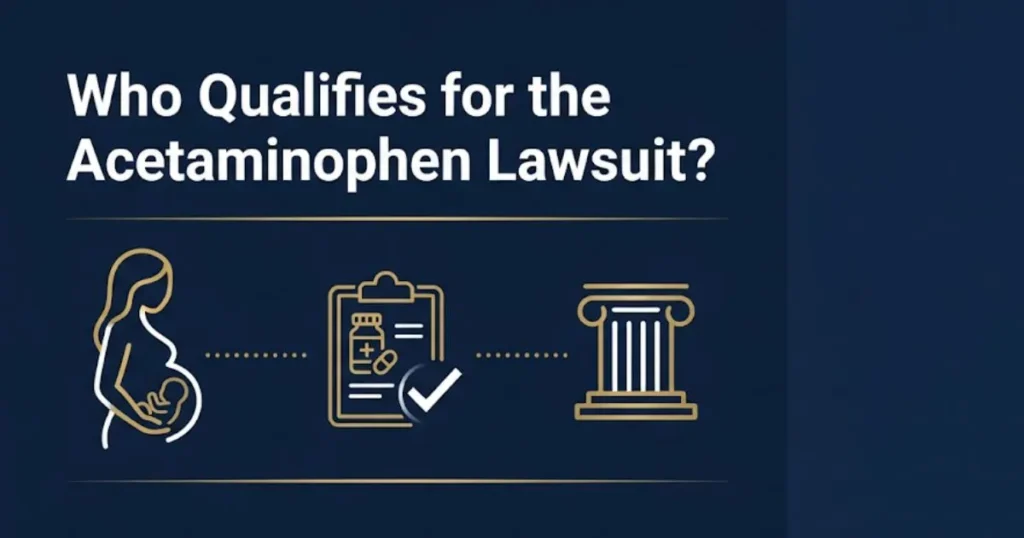
You may qualify for the acetaminophen lawsuit if you used acetaminophen during pregnancy and your child was later diagnosed with autism spectrum disorder or ADHD. Both conditions must be documented by a medical professional.
The basic qualification criteria are straightforward:
- You took acetaminophen (any brand) while pregnant
- Your child has a confirmed ASD or ADHD diagnosis
- The diagnosis was made by a licensed physician, psychologist, or specialist
- You can demonstrate a link between the timing of use and the child’s condition
There is no minimum number of doses required. However, cases involving regular or prolonged use tend to be stronger than those involving a single dose.
Both mothers and fathers can file on behalf of their children. In some states, the affected child (if now an adult) can file independently.
It does not matter whether you used brand-name Tylenol or a generic version. Store-brand acetaminophen from Walmart, CVS, Costco, or Target qualifies too.
You do not need to remember the exact dates you took the medication. Medical records, prescription histories, and even personal journals can help establish use during pregnancy.
Tylenol Lawsuit Eligibility Requirements
Tylenol lawsuit eligibility requirements go beyond basic qualification. Attorneys evaluating cases look at specific factors to determine whether a claim is strong enough to pursue.
Here is what most law firms assess during intake:
| Requirement | Details |
|---|---|
| Acetaminophen Use | Documented or verifiable use during pregnancy |
| Child’s Diagnosis | Autism spectrum disorder or ADHD, confirmed by a professional |
| Diagnosis Timing | Typically diagnosed before age 12 |
| Medical Records | Prenatal records showing medication use; child’s diagnostic records |
| Exclusions | Cases where other known causes of ASD/ADHD are present may be weaker |
| Statute of Limitations | Varies by state; generally 2 to 6 years from diagnosis |
Some cases get screened out early. If the child’s condition has a clear alternative cause, like a genetic syndrome or severe premature birth with complications, the claim becomes harder to prove.
Attorneys also look at the mother’s medical history. If a doctor specifically recommended acetaminophen during pregnancy, that can actually strengthen the claim because it shows the manufacturer’s warning failure had real consequences.
Children do not need to have a specific severity level to qualify. Both mild and severe diagnoses are eligible, though more severe cases carry higher potential value.
How to File an Acetaminophen Lawsuit
Filing an acetaminophen lawsuit starts with contacting an attorney who handles pharmaceutical mass tort cases. You do not file this type of claim on your own.
Here is the typical process:
- Contact a law firm specializing in acetaminophen or Tylenol litigation
- Complete a case evaluation where you share your medical history and your child’s diagnosis
- Sign a retainer agreement if the firm accepts your case (most work on contingency, meaning no upfront costs)
- Gather documentation including prenatal records, pharmacy records, and your child’s diagnostic paperwork
- Your attorney files the claim in the appropriate court, either the federal MDL or a state court
Most firms handling these cases charge nothing unless you win. The standard contingency fee ranges from 33% to 40% of the settlement or verdict.
You do not need to appear in court yourself. The vast majority of mass tort claimants never see a courtroom.
The entire intake process usually takes a few weeks. From there, your case joins the larger litigation and moves at the pace of the MDL or state court docket.
Do not wait until a settlement is announced to file. Cases filed earlier in a mass tort often receive priority in settlement distributions.
Acetaminophen Lawsuit Deadline in 2026
The acetaminophen lawsuit deadline depends on your state’s statute of limitations. There is no single national cutoff date for all claimants.
Most states give plaintiffs 2 to 6 years from the date of the child’s diagnosis to file a lawsuit. Some states use a “discovery rule,” meaning the clock starts when you first learned (or should have learned) that acetaminophen may have caused the condition.
| State | Statute of Limitations | Notes |
|---|---|---|
| California | 2 years from discovery | Discovery rule applies |
| Texas | 2 years | Strict deadline from injury or diagnosis |
| New York | 3 years | From date of injury |
| Florida | 4 years | Recently changed from 2 years |
| Pennsylvania | 2 years | From discovery of cause |
| Illinois | 2 years | From discovery |
| Missouri | 5 years | More lenient than most states |
If your child was diagnosed recently, you likely still have time. But if the diagnosis happened years ago, the window may be closing.
Some attorneys argue that the statute should not start running until widespread media coverage in 2022 and 2023 put parents on notice. Courts have not uniformly adopted that argument.
The safest move is to file sooner rather than later. Missing the deadline means losing your right to compensation permanently, regardless of how strong your case might be.
Key Takeaway: Filing deadlines vary by state, but most give you 2 to 6 years from your child’s diagnosis or from when you discovered the acetaminophen link. Do not assume you have unlimited time.
Tylenol Autism Lawsuit Explained
The Tylenol autism lawsuit refers to claims that Johnson & Johnson’s Tylenol, when taken during pregnancy, caused children to develop autism spectrum disorder. These cases form the largest portion of the acetaminophen MDL.
Autism spectrum disorder affects roughly 1 in 36 children in the United States, according to CDC data. The rate has climbed dramatically over the past two decades.
Plaintiffs argue that acetaminophen exposure during fetal development disrupts the endocannabinoid system and hormonal pathways critical to brain development. They say this disruption increases the risk of ASD significantly.
The lawsuits target not just Johnson & Johnson but the entire supply chain. Manufacturers of generic acetaminophen, retailers selling store brands, and even distributors are named as defendants in various cases.
Each family’s claim centers on the same basic allegation: the companies knew or should have known about the risks and failed to warn consumers.
- Johnson & Johnson has denied all allegations
- The company maintains Tylenol is safe when used as directed
- Kenvue, which now manages the Tylenol brand, has taken over defense of many claims
- No company has issued a voluntary warning about prenatal autism risks
The emotional weight of these cases is enormous. Parents describe feeling betrayed by a product they trusted completely.
Tylenol ADHD Lawsuit Claims
Tylenol ADHD lawsuit claims allege that prenatal acetaminophen exposure increases a child’s risk of developing attention deficit hyperactivity disorder. These claims run alongside the autism cases in the same MDL.
ADHD is one of the most common neurodevelopmental disorders in children. The CDC reports that approximately 6.1 million children in the U.S. have been diagnosed with ADHD.
Several studies have found a dose-dependent relationship between prenatal acetaminophen use and ADHD. That means the more acetaminophen a pregnant woman used, the higher the observed risk.
| Study | Finding |
|---|---|
| JAMA Pediatrics (2014) | Prenatal acetaminophen linked to 13% to 37% higher ADHD risk |
| Nature Reviews Endocrinology (2018) | Acetaminophen classified as endocrine disruptor during pregnancy |
| JAMA Psychiatry (2019) | Higher doses correlated with increased behavioral problems |
ADHD cases generally carry lower estimated settlement values than severe autism cases. But they are still compensable, especially when the child requires ongoing medication, therapy, and educational accommodations.
Parents filing ADHD claims need the same basic evidence: proof of acetaminophen use during pregnancy and a professional ADHD diagnosis for their child.
These cases are just as valid as autism claims. The science supporting the ADHD connection is, in some respects, even stronger because more studies have examined this specific link.
The Acetaminophen Autism Link
The acetaminophen autism link is supported by multiple peer-reviewed studies showing that prenatal use of the drug is associated with increased risk of autism spectrum disorder in children. The connection is statistical, not absolute, meaning it increases risk rather than guaranteeing the outcome.
The science centers on how acetaminophen affects fetal brain development. Researchers believe the drug interferes with:
- The endocannabinoid system, which regulates neurodevelopment
- Hormonal balance, particularly androgens and thyroid hormones critical for brain formation
- Oxidative stress pathways, which protect developing brain cells
A 2019 Johns Hopkins study analyzed umbilical cord blood from 996 births. Babies with the highest levels of acetaminophen biomarkers in their cord blood were 2.86 times more likely to be diagnosed with autism.
That study was pivotal because it measured actual exposure levels, not just self-reported use.
Critics, including Johnson & Johnson, argue that the studies only show correlation, not causation. They point out that the conditions mothers treated with acetaminophen (fever, infection, pain) might themselves contribute to neurodevelopmental risk.
Plaintiffs counter that animal studies and mechanistic research provide additional evidence of a causal pathway. The debate over scientific certainty is what makes the Daubert ruling so important in this litigation.
Tylenol Lawsuit Evidence and Studies
The Tylenol lawsuit evidence relies on more than 25 peer-reviewed studies published over the past decade. Plaintiffs have assembled a body of epidemiological, mechanistic, and biomarker research to support their claims.
The key studies include:
- Liew et al. (2014), JAMA Pediatrics: Found that prenatal acetaminophen use for more than 28 days was associated with a 2-fold increase in ADHD-like behavioral problems
- Bauer et al. (2018), JAMA Pediatrics: Meta-analysis confirming association between prenatal acetaminophen and ASD/ADHD across multiple populations
- Ji et al. (2019), JAMA Psychiatry (Johns Hopkins): Cord blood biomarker study showing dose-response relationship with autism risk
- Consensus Statement (2021): Signed by 91 scientists and physicians calling for precautionary action on acetaminophen use during pregnancy
The defense argues that none of these studies prove causation on their own. They emphasize that observational studies cannot control for every confounding variable.
Judge Cote’s 2023 Daubert ruling sided partly with the defense on this point. She found that plaintiff experts had not sufficiently established general causation under federal evidentiary standards.
But that ruling is under appeal. And in state courts, where Daubert does not always apply, the evidence may be evaluated differently.
The science is contested but substantial. More research is being published regularly, and the evidence base continues to grow heading into 2026.
Key Takeaway: Over 25 peer-reviewed studies support the acetaminophen-autism link, including a Johns Hopkins cord blood study that found children with highest exposure were nearly 3 times more likely to develop autism.
Acetaminophen Bellwether Trial Results
No acetaminophen bellwether trial has produced a verdict yet as of 2026. The bellwether process was derailed by Judge Cote’s Daubert ruling in December 2023, which excluded key expert witnesses before any trial could begin.
Bellwether trials are test cases selected to represent the broader group of plaintiffs. In mass tort litigation, they serve two purposes: they test the strength of both sides’ arguments, and they set the stage for settlement negotiations.
Before the Daubert ruling, Judge Cote had selected several cases for bellwether proceedings. Those cases were ready for trial preparation in early 2024.
| Bellwether Status | Details |
|---|---|
| Cases Selected | Yes, multiple bellwether cases were chosen |
| Trial Dates Set | Previously scheduled for 2024; currently postponed |
| Daubert Ruling Impact | Excluded plaintiff expert testimony, halting trials |
| Appeal Status | Pending before the Second Circuit Court of Appeals |
| Projected Trial Date | Late 2026 or 2027 if appeal succeeds |
If the appeals court reverses or modifies the Daubert ruling, bellwether trials could resume quickly. Judge Cote has indicated she is prepared to move the case forward if the evidentiary hurdle is cleared.
A plaintiff victory in a bellwether trial would likely trigger global settlement negotiations. A defense victory would not end the litigation but would reduce settlement values significantly.
The bellwether stage is where mass torts either gain massive momentum or stall. Right now, the acetaminophen litigation is in a holding pattern, waiting for the Second Circuit to decide.
Tylenol MDL Update and Court Proceedings
The Tylenol MDL, designated as MDL No. 3043, is centralized before Judge Denise Cote in the Southern District of New York. As of 2026, the case remains active but is largely paused at the federal level pending the appellate review.
Here is a timeline of the major developments:
| Date | Event |
|---|---|
| October 2022 | MDL 3043 created by the Judicial Panel on Multidistrict Litigation |
| 2023 | Discovery phase; bellwether case selection; Daubert hearings |
| December 2023 | Judge Cote excludes plaintiff expert testimony on general causation |
| Early 2024 | Plaintiffs file appeal with the Second Circuit |
| 2024 to 2025 | State court filings increase; new studies published |
| 2026 | Second Circuit appeal pending; state cases advancing |
The MDL consolidates all federal acetaminophen autism and ADHD cases for pretrial proceedings. Individual cases will eventually be sent back to their home districts for trial if no global settlement is reached.
Over 100,000 cases are now part of the MDL, making it one of the largest mass torts in recent history. New cases continue to be filed weekly.
At the state level, several jurisdictions are moving independently. California and Missouri courts have their own timelines and evidentiary standards, which could produce results before the federal MDL resolves.
The sheer volume of cases puts enormous financial pressure on defendants. Even if individual trials are delayed, the cost of defending 100,000+ claims is staggering.
Store Brand Acetaminophen Lawsuit Claims
Store brand acetaminophen lawsuit claims target retailers that sold generic acetaminophen under their own labels. If you used Equate, Kirkland, Up and Up, CVS Health, or any other store brand during pregnancy, you may have a claim.
These retailers are defendants because they put their names on the product. When a company sells a medication under its brand, it takes on the responsibility to warn consumers about known risks.
| Retailer | Store Brand Name |
|---|---|
| Walmart | Equate |
| Costco | Kirkland Signature |
| Target | Up and Up |
| CVS | CVS Health |
| Walgreens | Walgreens Brand |
| Amazon | Amazon Basic Care |
The lawsuits against retailers use a different legal theory than claims against Johnson & Johnson. Retailer claims often focus on failure to warn and strict product liability rather than negligence in drug development.
Some retailers argue they simply sold a product manufactured by someone else and should not be held liable. Courts have generally rejected that defense when the retailer’s own name appears on the packaging.
This matters because store-brand acetaminophen accounts for a significant portion of all acetaminophen sales. Many families used generic versions because they were cheaper, not realizing the same risks applied.
Your claim is not weaker because you used a store brand. The active ingredient is identical. The alleged harm is the same.
Acetaminophen Pregnancy Risks and Warnings
Acetaminophen pregnancy risks center on the potential for the drug to interfere with fetal brain development during critical windows. The FDA has not banned acetaminophen use during pregnancy but has acknowledged the growing body of concerning research.
In 2015, the FDA issued a safety communication stating it was reviewing studies on the link between acetaminophen and neurodevelopmental risks. That review has never been formally concluded with a new warning or restriction.
Current risks identified by researchers include:
- Increased ASD risk with prolonged use (more than 28 days during pregnancy)
- Increased ADHD risk in a dose-dependent pattern
- Endocrine disruption affecting hormonal development
- Oxidative stress on developing brain tissue
- Potential interference with the endocannabinoid system
Despite these findings, acetaminophen labels still do not carry a specific warning about autism or ADHD risk during pregnancy. The labels warn pregnant women to “ask a doctor” before use, but that generic language does not mention neurodevelopmental disorders.
| Warning Type | Current Status |
|---|---|
| Label Warning About ASD/ADHD | Not present on any brand |
| FDA Safety Alert | Issued in 2015; no formal conclusion |
| Medical Organization Guidance | Most still consider acetaminophen acceptable for short-term use |
| Scientific Consensus Statement | 91 researchers called for precautionary warning in 2021 |
The gap between what scientists are saying and what labels actually tell consumers is the foundation of every claim in this litigation.
Pregnant women are left to make decisions without complete information. That is exactly what the lawsuits aim to change.
Key Takeaway: Acetaminophen labels still carry no specific warning about autism or ADHD risk during pregnancy, despite a 2021 consensus statement from 91 scientists calling for precautionary action.
Is the Acetaminophen Lawsuit a Class Action?
The acetaminophen lawsuit is not a class action. It is a mass tort consolidated into a multidistrict litigation, which is a different legal structure with important differences for claimants.
In a class action, one or a few plaintiffs represent an entire group. Everyone in the class gets the same outcome, usually an equal share of a settlement fund.
In a mass tort like MDL No. 3043, each plaintiff has their own individual case. The cases are grouped together for efficiency during pretrial proceedings, but each person’s claim is evaluated on its own merits.
| Feature | Class Action | Mass Tort (MDL) |
|---|---|---|
| Individual Cases | No, one case represents all | Yes, each person has their own |
| Settlement Amount | Same for everyone in the class | Varies by individual circumstances |
| Evidence Required | Minimal for class members | Individual proof needed per case |
| Court Proceedings | One trial covers the class | Bellwether trials test representative cases |
| Payout Speed | Faster but smaller per person | Slower but potentially much larger |
This distinction matters for your wallet. In a mass tort, your payout is based on your specific situation. A family with a severely affected child will receive far more than a family with a mild case.
The downside is that mass torts take longer. Each case needs its own documentation and evaluation. But the potential for a meaningful, personalized settlement is much higher than in a typical class action.
You do not need to join a “class” to participate. You file your own claim with your own attorney.
Frequently Asked Questions
How much money can I get from the acetaminophen lawsuit?
Estimated payouts range from $50,000 to over $500,000 per case.
The exact amount depends on the severity of your child’s diagnosis and the strength of your evidence.
No settlements have been paid yet, so all figures are projections based on similar mass tort cases.
What is the deadline to file an acetaminophen lawsuit in 2026?
The deadline depends on your state’s statute of limitations, which ranges from 2 to 6 years.
The clock typically starts from the date of your child’s diagnosis or when you learned about the acetaminophen connection.
Filing sooner protects your rights and avoids missing a deadline that could permanently bar your claim.
Does the acetaminophen lawsuit include store brand products?
Yes, the lawsuit covers all brands of acetaminophen, including store brands like Equate, Kirkland, Up and Up, and CVS Health.
Retailers are named as defendants because they sold the product under their own label.
The active ingredient is the same regardless of brand, and the alleged failure to warn applies equally.
What proof do I need to file a Tylenol autism lawsuit?
You need medical records showing acetaminophen use during pregnancy and your child’s ASD or ADHD diagnosis from a qualified professional.
Pharmacy records, prescription histories, and prenatal visit notes can help establish use.
Even without perfect records, an attorney can evaluate whether your case is strong enough to proceed.
Has any acetaminophen lawsuit gone to trial yet?
No acetaminophen lawsuit has gone to trial as of 2026.
Bellwether trials were postponed after Judge Cote’s December 2023 Daubert ruling excluded key plaintiff expert testimony.
The case is awaiting a decision from the Second Circuit Court of Appeals, which could reopen the path to trial.
The acetaminophen lawsuit is heading into a defining period in 2026. The appeals court decision on expert testimony will determine whether federal trials move forward or the battle continues in state courts.
If you or your child may be affected, now is the time to act. Check your eligibility, gather your medical records, and connect with an attorney handling these claims.
Waiting too long risks missing your state’s filing deadline. The window to file is open right now, but it will not stay open forever.







