

The Ozempic lawsuit pancreatitis litigation is one of the largest pharmaceutical legal battles heading into 2026. Thousands of patients who developed pancreatitis after taking semaglutide drugs are now filing claims against Novo Nordisk.
If you were hospitalized with pancreatic inflammation while on Ozempic, you may be entitled to significant compensation. Early estimates suggest individual payouts could range from $100,000 to over $1 million depending on severity.
This article breaks down every detail you need for 2026. You will learn who qualifies, what settlement amounts look like, how to file, and what deadlines matter most.
One stat that should grab your attention: FDA adverse event reports linked to semaglutide and pancreatitis have increased by over 300% since 2020.
Ozempic Lawsuit Pancreatitis Overview
The Ozempic lawsuit pancreatitis litigation involves claims that Novo Nordisk failed to adequately warn patients about the risk of developing pancreatitis from semaglutide. These cases form part of a broader wave of GLP-1 receptor agonist lawsuits filed across the United States.
Pancreatitis is inflammation of the pancreas. It can range from a painful but temporary episode to a life-threatening emergency requiring hospitalization and surgery.
Plaintiffs argue that Novo Nordisk knew about the pancreatitis risk from clinical trial data and post-market surveillance. Despite that knowledge, they say the company downplayed the danger on drug labels and in marketing materials.
| Detail | Info |
|---|---|
| Drug at Issue | Ozempic (semaglutide) |
| Defendant | Novo Nordisk |
| Primary Injury Claimed | Pancreatitis |
| Lawsuit Type | Mass tort / MDL |
| Court | U.S. federal courts |
| Status in 2026 | Active, bellwether cases progressing |
The lawsuits are not limited to Ozempic alone. Patients who took Wegovy or Rybelsus, which also contain semaglutide, are filing similar claims.
Think of it like a car manufacturer knowing the brakes sometimes fail but only putting a tiny footnote in the owner’s manual. That’s essentially what plaintiffs say Novo Nordisk did with pancreatitis warnings.
Ozempic Pancreatitis Lawsuit Update 2026
As of 2026, the Ozempic pancreatitis litigation is advancing through multidistrict litigation with bellwether trial selections underway. The MDL has consolidated hundreds of individual cases into a single federal court for pretrial proceedings.
Key developments expected in 2026 include the selection of initial bellwether cases. These are test cases that go to trial first to help both sides gauge how juries respond.
Discovery is ongoing, and internal Novo Nordisk documents related to pancreatitis safety data are being reviewed. Several motions regarding expert testimony on causation are scheduled for early to mid-2026.
- Bellwether trial selections are expected by mid-2026
- Expert witness depositions on pancreatitis causation are being scheduled
- Internal company documents about semaglutide safety signals are under review
- New plaintiffs continue to join the MDL each month
Settlement negotiations have not formally begun on a global scale. However, legal analysts believe the volume of cases and strength of the medical evidence could push Novo Nordisk toward settlement discussions by late 2026 or early 2027.
The pace of this litigation is faster than many predicted. Compared to other pharmaceutical mass torts, which often take 5 to 7 years, the Ozempic cases are moving at an accelerated timeline.
Can You Sue for Pancreatitis From Ozempic?
Yes, you can sue for pancreatitis from Ozempic if you developed the condition while taking the drug or shortly after stopping it. Thousands of people have already filed claims.
The legal basis for these lawsuits is product liability. Specifically, plaintiffs argue that Novo Nordisk is liable under a “failure to warn” theory.
That means the company allegedly knew about the pancreatitis risk but did not provide adequate warnings to doctors and patients. Under product liability law, drug manufacturers have a duty to disclose known risks.
You don’t need to prove that Ozempic is unsafe for everyone. You only need to show it caused your specific injury and that the warnings were insufficient.
| Legal Element | What You Must Show |
|---|---|
| Product Use | You took Ozempic as prescribed |
| Injury | You were diagnosed with pancreatitis |
| Causation | Your pancreatitis was linked to Ozempic |
| Failure to Warn | Warnings were inadequate about this risk |
Courts have accepted pancreatitis claims against GLP-1 drugs before. Previous litigation involving similar medications like Byetta and Januvia established legal precedent for these types of cases.
If your doctor can confirm the connection between your Ozempic use and your pancreatitis diagnosis, you have the foundation for a lawsuit.
Key Takeaway: The Ozempic pancreatitis litigation is active and growing in 2026, with bellwether trials approaching and strong legal precedent supporting patients’ right to sue.
Does Ozempic Cause Pancreatitis?
Ozempic has been linked to pancreatitis in clinical trials, FDA adverse event reports, and peer-reviewed medical studies. The connection between GLP-1 receptor agonists and pancreatic inflammation is well documented.
Here is the simplified science. Ozempic works by mimicking a hormone called GLP-1 that regulates blood sugar and appetite. But GLP-1 receptors exist throughout the pancreas, not just in the areas that control insulin.
When semaglutide overstimulates those receptors, it can trigger inflammation in the pancreatic tissue. Think of it like turning up the volume on a speaker until the speaker itself starts to crack. The drug does its intended job, but it pushes the pancreas past what it can handle.
The FDA’s FAERS database shows thousands of adverse event reports connecting semaglutide products to pancreatitis. Clinical trials for Ozempic also flagged pancreatitis as an observed side effect, though Novo Nordisk has argued the incidence rate is low.
- FDA adverse event reports for semaglutide and pancreatitis have surged since 2020
- Multiple peer-reviewed studies have found elevated pancreatitis risk in GLP-1 drug users
- Novo Nordisk’s own clinical trial data documented pancreatitis cases
- The drug label includes some mention of pancreatitis, but plaintiffs say the warning is inadequate
Independent researchers have published studies showing that GLP-1 receptor agonist users face a statistically significant higher risk of developing pancreatitis compared to non-users.
Novo Nordisk disputes that the drug causes pancreatitis at a meaningful rate. That disagreement is at the center of the litigation.
Ozempic Pancreatitis Lawsuit Eligibility
You may be eligible for the Ozempic pancreatitis lawsuit if you were prescribed Ozempic, took it as directed, and were subsequently diagnosed with pancreatitis by a medical professional. The diagnosis must be documented in your medical records.
Not every person who experienced stomach pain while on Ozempic will qualify. The eligibility bar requires a confirmed pancreatitis diagnosis, not just digestive discomfort.
Here are the core eligibility requirements:
- You were prescribed and took Ozempic (or another semaglutide product like Wegovy or Rybelsus)
- A doctor diagnosed you with acute pancreatitis, chronic pancreatitis, or necrotizing pancreatitis
- Your diagnosis occurred during or within a reasonable time after Ozempic use
- You have medical records documenting the diagnosis and treatment
- You experienced measurable harm: hospitalization, surgery, lost wages, pain and suffering, or ongoing health problems
| Eligibility Factor | Qualifies | Does Not Qualify |
|---|---|---|
| Confirmed pancreatitis diagnosis | Yes | No |
| Took Ozempic as prescribed | Yes | No |
| Self-diagnosed stomach pain only | No | Correct, does not qualify |
| Hospitalized for pancreatitis | Strongest cases | N/A |
| Used semaglutide product (any brand) | Yes | No |
Severity matters for case strength. If you were hospitalized, had surgery, developed chronic pancreatitis, or suffered long-term pancreatic damage, your case is considered stronger.
Even mild acute pancreatitis cases may qualify. But the more documented harm you can show, the better your potential outcome.
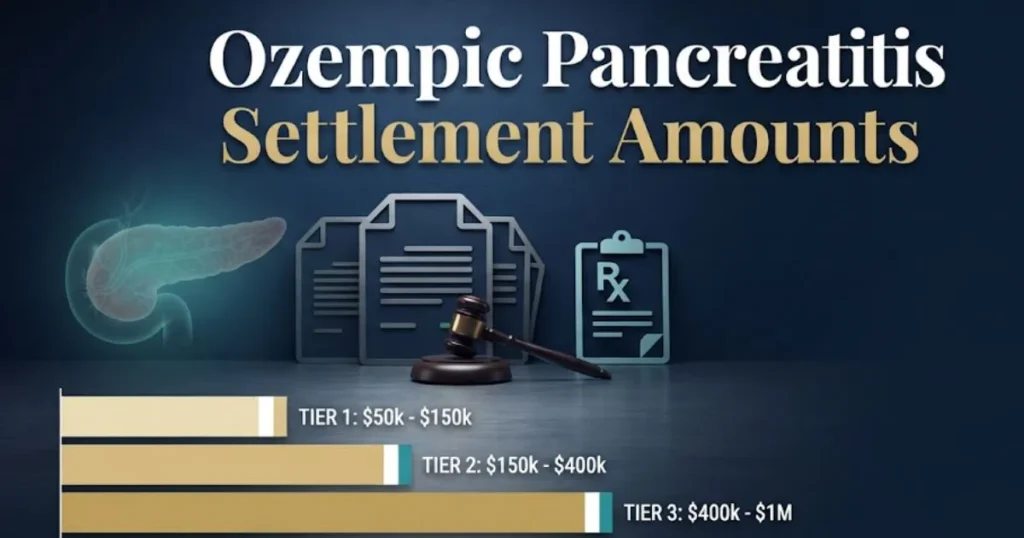
Ozempic Pancreatitis Lawsuit Settlement Amounts
Ozempic pancreatitis lawsuit settlement amounts are estimated to range from $100,000 to over $1,000,000 per case, depending on the severity of injury and strength of evidence. No global settlement has been reached yet as of 2026.
These estimates come from legal analysts who study comparable pharmaceutical mass tort settlements. Cases involving serious organ damage, extended hospitalization, and chronic conditions tend to receive higher payouts.
Settlement amounts in pharmaceutical litigation are typically organized into tiers based on injury severity.
| Settlement Tier | Estimated Range | Injury Level |
|---|---|---|
| Tier 1 (Highest) | $500,000 to $1,000,000+ | Necrotizing pancreatitis, surgery, permanent damage |
| Tier 2 (High) | $250,000 to $500,000 | Acute pancreatitis with hospitalization over 7 days |
| Tier 3 (Moderate) | $100,000 to $250,000 | Acute pancreatitis with ER visit and short hospital stay |
| Tier 4 (Lower) | $50,000 to $100,000 | Mild acute pancreatitis, outpatient treatment |
These tiers are projections based on prior GLP-1 litigation outcomes and similar drug injury cases. Actual amounts will depend on bellwether trial results and negotiation outcomes.
If the first bellwether trials result in large plaintiff verdicts, it will likely push Novo Nordisk toward higher settlement offers. Conversely, defense wins could lower the range.
The total value of all Ozempic-related pancreatitis claims combined could exceed several billion dollars if the case count continues to grow.
Ozempic Lawsuit Payout Per Person
The estimated Ozempic lawsuit payout per person for pancreatitis claims ranges from $50,000 to over $1 million, with most cases likely falling between $150,000 and $500,000. Your individual payout depends entirely on your specific circumstances.
Several factors determine what you personally might receive:
- Severity of pancreatitis: Necrotizing or chronic cases pay far more than mild acute episodes
- Duration of hospitalization: Longer stays with ICU time increase your claim value
- Surgical intervention: If you needed surgery on your pancreas, your case is worth significantly more
- Ongoing medical costs: Chronic pancreatitis requiring lifetime management raises payout estimates
- Lost income: Documented lost wages and reduced earning capacity add to your total
- Pain and suffering: Subjective but significant, especially with permanent health changes
One important reality check. Mass tort payouts are not instant. Even after a settlement is reached, the distribution process can take 12 to 24 months. Funds typically go to your attorney first for fee deductions, then to you.
Compare this to something like the Vioxx litigation. Merck paid out $4.85 billion across about 44,000 claims. That averaged roughly $110,000 per claimant. The Ozempic pancreatitis cases may follow a similar or higher per-person pattern depending on the evidence.
Key Takeaway: Settlement estimates for Ozempic pancreatitis cases range widely from $50,000 to over $1 million, and your individual payout will be shaped by injury severity, medical documentation, and bellwether trial outcomes.
Ozempic Pancreatitis Compensation Calculator
An Ozempic pancreatitis compensation calculator is a tool that estimates your potential settlement based on factors like injury severity, medical costs, and lost income. No official calculator exists, but attorneys use standard formulas to project case values.
Here is a simplified version of how legal teams estimate compensation:
| Compensation Factor | How It Affects Your Estimate |
|---|---|
| Total medical bills | Base value; higher bills mean higher compensation |
| Future medical costs | Chronic pancreatitis adds ongoing expenses |
| Lost wages (past) | Documented income loss during recovery |
| Lost earning capacity (future) | If pancreatitis prevents you from working long-term |
| Pain and suffering multiplier | Typically 1.5x to 5x your economic damages |
| Severity of diagnosis | Necrotizing pancreatitis gets the highest multiplier |
Here is a basic example. Say your medical bills totaled $80,000, you lost $30,000 in wages, and your pain and suffering multiplier is 3x. Your estimated compensation would be: ($80,000 + $30,000) x 3 = $330,000.
That is a simplified illustration. Actual calculations involve more variables. But it gives you a ballpark idea.
Keep every receipt, bill, and pay stub related to your injury. The more thoroughly you document your financial losses, the stronger your compensation case becomes.
Most attorneys offer free case evaluations where they run these numbers for you based on your specific medical and financial situation.
Novo Nordisk Pancreatitis Lawsuit
The Novo Nordisk pancreatitis lawsuit targets the Danish pharmaceutical giant directly as the manufacturer and marketer of Ozempic. Plaintiffs accuse Novo Nordisk of prioritizing profits over patient safety by hiding the true scope of pancreatitis risks.
Novo Nordisk reported over $20 billion in Ozempic-related revenue in recent years. That enormous financial incentive, plaintiffs argue, motivated the company to minimize safety concerns that could slow sales.
Key allegations against Novo Nordisk include:
- Failing to update drug labels with stronger pancreatitis warnings
- Downplaying pancreatitis signals found in clinical trial data
- Aggressively marketing Ozempic for weight loss without adequate risk disclosure
- Ignoring post-market adverse event reports submitted to the FDA
- Not conducting additional safety studies when warning signs emerged
Novo Nordisk has defended itself by pointing to the existing pancreatitis warning on the Ozempic label. The company argues the warning is adequate and that the drug’s benefits outweigh its risks.
But plaintiffs counter that a buried warning in fine print is not sufficient when the drug is being prescribed to millions of people. They say doctors were not given clear enough information to properly warn their patients.
The company’s financial resources are massive. Novo Nordisk has the money to fight these cases for years. But the sheer volume of claims and the strength of the medical evidence may make settlement the more practical path.
Ozempic MDL Pancreatitis Claims
Ozempic MDL pancreatitis claims are consolidated in a multidistrict litigation proceeding in federal court, which groups individual lawsuits together for more efficient pretrial handling. The MDL does not merge the cases into one; each plaintiff retains their individual claim.
MDL stands for multidistrict litigation. Think of it as a way to avoid having 5,000 different judges in 5,000 different courtrooms all handling the same basic set of facts. One judge oversees shared pretrial work like discovery, motions, and expert witness challenges.
| MDL Detail | Information |
|---|---|
| MDL Type | Pharmaceutical product liability |
| Claims Included | Pancreatitis, gastroparesis, and other GI injuries |
| Consolidation Purpose | Efficient pretrial proceedings |
| Individual Cases Preserved | Yes, each plaintiff has their own case |
| Bellwether Trials | Test cases selected from the MDL pool |
The MDL process typically follows this path:
- Cases are transferred to a single federal court
- Discovery phase begins (document exchange, depositions)
- Bellwether cases are selected
- Bellwether trials occur (usually 3 to 6 test cases)
- Results inform settlement negotiations
- Global settlement or continued individual trials
Pancreatitis claims are considered among the strongest in the Ozempic MDL. The medical evidence linking semaglutide to pancreatic inflammation is more established than some other claimed injuries.
If you file a case, it will likely be transferred into this MDL for pretrial proceedings. If no settlement is reached, your case could eventually be sent back to your home court for trial.
Ozempic Pancreatitis Symptoms to Watch For
Ozempic pancreatitis symptoms include severe upper abdominal pain, nausea, vomiting, fever, and a rapid heartbeat. These symptoms often come on suddenly and can escalate from uncomfortable to dangerous within hours.
The hallmark symptom is abdominal pain that radiates to your back. This pain is often described as a burning or stabbing sensation in the upper stomach area. It typically gets worse after eating.
Here are the symptoms that signal you should seek immediate medical attention:
- Severe upper abdominal pain that doesn’t go away
- Pain radiating to the back between the shoulder blades
- Nausea and vomiting that persists for more than a few hours
- Fever above 101 degrees Fahrenheit
- Rapid pulse or heart pounding
- Tenderness when touching the abdomen
- Yellowing of skin or eyes (jaundice), which can indicate bile duct involvement
If you are taking Ozempic and experience any combination of these symptoms, go to the emergency room. Pancreatitis can become life-threatening if untreated.
Many patients report that their doctors initially dismissed their symptoms as routine GI side effects of Ozempic. That delayed diagnosis can worsen outcomes and is part of why these lawsuits exist.
Documenting when your symptoms started relative to when you began or increased your Ozempic dose is critical. That timeline helps establish causation in a legal claim.
Key Takeaway: If you develop severe abdominal pain radiating to your back while on Ozempic, get to an emergency room immediately, because early pancreatitis diagnosis is critical for both your health and a potential legal claim.
Ozempic Pancreatitis Risk Factors
Certain patients face a higher risk of developing pancreatitis from Ozempic, including those with a history of gallstones, heavy alcohol use, high triglycerides, or a previous pancreatitis episode. These risk factors do not disqualify you from a lawsuit.
In fact, plaintiffs argue that Novo Nordisk should have warned doctors more aggressively about prescribing Ozempic to patients with these risk factors.
| Risk Factor | Why It Increases Pancreatitis Risk |
|---|---|
| History of pancreatitis | Prior episodes make recurrence more likely |
| Gallstones | Can block pancreatic ducts, compounded by Ozempic |
| High triglycerides | Elevated lipids are a known pancreatitis trigger |
| Heavy alcohol use | Alcohol is a leading cause of pancreatitis independently |
| Family history of pancreatic disease | Genetic predisposition to pancreatic inflammation |
| High Ozempic dose | Higher doses of semaglutide correlate with more GI events |
Some patients with zero risk factors still developed pancreatitis on Ozempic. That is an important point. You do not need a pre-existing risk factor to file a claim.
The presence of risk factors can cut both ways in litigation. Novo Nordisk may argue that your pre-existing condition caused the pancreatitis, not the drug. Your legal team will counter that the drug triggered or worsened the condition, and better warnings would have prevented the prescription entirely.
Having risk factors does not weaken your case if your medical records show a clear timeline linking Ozempic use to your diagnosis.
Ozempic Pancreatitis Medical Evidence Needed
The medical evidence needed for an Ozempic pancreatitis lawsuit includes a confirmed diagnosis, hospital records, lab results showing elevated pancreatic enzymes, imaging studies, and a documented timeline of Ozempic use. Strong evidence is the backbone of your entire claim.
Here is what attorneys look for when evaluating your case:
Essential Documentation:
- Pancreatitis diagnosis from a treating physician (ER doctor, gastroenterologist, or internist)
- Lab results showing elevated lipase and/or amylase levels (the key diagnostic markers)
- CT scan or MRI showing pancreatic inflammation, fluid collections, or necrosis
- Hospital admission and discharge records
- Pharmacy records proving you filled and took Ozempic prescriptions
- Prescription history showing when you started Ozempic and at what dose
Strengthening Evidence:
- Records showing your doctor increased your Ozempic dose before symptoms began
- Documentation that you had no pancreatitis history before starting Ozempic
- Follow-up medical records showing ongoing pancreatic problems
- Bills and invoices for all treatment costs
- Employment records showing missed work or reduced hours
| Evidence Type | Why It Matters |
|---|---|
| Elevated lipase/amylase labs | Proves pancreatitis was medically confirmed |
| CT scan/MRI results | Shows physical evidence of inflammation |
| Pharmacy fill records | Proves you actually took Ozempic |
| Timeline documentation | Links drug use to diagnosis onset |
| Follow-up records | Shows lasting impact of injury |
Start gathering these records now. Request copies from your pharmacy, hospital, and all treating physicians. The sooner you compile this documentation, the stronger your case will be.
How to File an Ozempic Pancreatitis Lawsuit
To file an Ozempic pancreatitis lawsuit, you need to contact an attorney who handles pharmaceutical mass tort cases, provide your medical records, and allow the attorney to evaluate and file your claim in the appropriate court. The process is simpler than most people expect.
Here is the step-by-step process:
Step 1: Free Case Evaluation
Contact a law firm that specializes in pharmaceutical litigation. Most offer free initial consultations. They will ask about your Ozempic use, diagnosis, and medical history.
Step 2: Medical Record Review
Your attorney’s team will review your medical records to confirm eligibility. They check for a documented pancreatitis diagnosis, evidence of Ozempic use, and a reasonable timeline connecting the two.
Step 3: Retainer Agreement
If your case qualifies, you sign a retainer agreement. Most Ozempic pancreatitis attorneys work on contingency. That means you pay nothing upfront. They only get paid if you win or settle.
Step 4: Case Filing
Your attorney files the complaint in federal or state court. If filed in federal court, your case will likely be transferred to the Ozempic MDL.
Step 5: Discovery and Waiting
After filing, your case enters the pretrial process. Your attorney handles all the legal work. You may need to provide additional documents or attend a deposition, but most of the heavy lifting falls on your legal team.
| Filing Step | What Happens | Your Role |
|---|---|---|
| Initial consultation | Attorney evaluates your case | Share your medical history |
| Record review | Legal team verifies eligibility | Provide medical records |
| Retainer signing | Formal agreement to proceed | Review and sign documents |
| Complaint filing | Case submitted to court | Minimal involvement needed |
| Pretrial proceedings | Discovery, depositions, motions | Respond to requests as needed |
The entire filing process typically takes 2 to 4 weeks from first contact to case submission.
Ozempic Pancreatitis Lawsuit Deadline
The deadline to file an Ozempic pancreatitis lawsuit depends on your state’s statute of limitations for personal injury or product liability claims, which typically ranges from 1 to 6 years from the date of diagnosis. Missing this deadline permanently bars your claim.
Statutes of limitations vary by state. Here are some examples:
| State | Statute of Limitations | Starting Point |
|---|---|---|
| California | 2 years | Date of injury or discovery |
| Texas | 2 years | Date of injury |
| New York | 3 years | Date of injury |
| Florida | 2 years | Date of injury or discovery |
| Pennsylvania | 2 years | Date of injury |
| Illinois | 2 years | Date of discovery |
| Ohio | 2 years | Date of injury or discovery |
The “discovery rule” applies in many states. This means the clock may not start until you knew or should have known that Ozempic caused your pancreatitis. If your doctor diagnosed pancreatitis but never connected it to Ozempic, you might have additional time under this rule.
Do not assume you have plenty of time. Some states have strict deadlines with limited exceptions. If your statute of limitations expires, no amount of evidence will save your case.
The safest approach is to contact an attorney as soon as possible. Even if your deadline is years away, starting early protects your rights and gives your legal team more time to build a strong case.
Key Takeaway: Your filing deadline depends on your state’s statute of limitations, and waiting too long is the single biggest mistake you can make in pursuing an Ozempic pancreatitis claim.
Ozempic Class Action vs Individual Lawsuit
The Ozempic pancreatitis litigation is a mass tort, not a class action. The difference matters because in a mass tort, each person’s case is evaluated individually, which typically results in higher payouts tailored to your specific injuries.
People often confuse these two legal structures. Here is the difference:
| Feature | Class Action | Mass Tort (Individual Lawsuit) |
|---|---|---|
| How cases are grouped | All plaintiffs treated as one group | Each plaintiff has a separate case |
| Settlement distribution | Equal split among all members | Payout based on individual injury |
| Control over your case | Very little | Significant |
| Typical payout per person | Lower | Higher |
| Attorney relationship | One attorney represents the class | Your own attorney represents you |
In a class action, a single plaintiff represents everyone. If the class wins $100 million and there are 50,000 members, everyone gets roughly the same small share.
In a mass tort like the Ozempic MDL, your case is your own. Someone with necrotizing pancreatitis and a two-week hospital stay will receive far more than someone with a mild episode. Your payout reflects your personal damages.
This is good news for plaintiffs with serious injuries. Your compensation is not diluted by thousands of people with lesser claims.
The MDL structure handles shared pretrial work efficiently. But when it comes time to settle or go to trial, your individual facts drive your outcome.
Ozempic Lawsuit Lawyer for Pancreatitis
An Ozempic lawsuit lawyer for pancreatitis is an attorney who specializes in pharmaceutical product liability and has experience handling GLP-1 receptor agonist injury claims. Choosing the right lawyer can make a six-figure difference in your case outcome.
Not all personal injury attorneys are equipped for pharmaceutical mass tort litigation. These cases require specific expertise in drug injury science, FDA regulations, and MDL procedures.
Here is what to look for when selecting an attorney:
- Experience with pharmaceutical mass torts: They should have handled drug injury MDLs before
- Track record with GLP-1 cases: Ask specifically about Ozempic, Wegovy, or similar drug cases
- Contingency fee structure: You should pay nothing upfront; the attorney gets paid only if you win
- Resources for expert witnesses: These cases require medical experts who can testify about causation
- Communication style: Choose someone who explains things clearly and responds to your questions
| Question to Ask Your Lawyer | Why It Matters |
|---|---|
| Have you handled Ozempic cases before? | Experience with this specific litigation |
| What is your contingency fee percentage? | Typically 33% to 40%; know this upfront |
| How many pharmaceutical MDLs have you worked on? | Indicator of specialized expertise |
| Will I work with you directly or a paralegal? | Clarifies your point of contact |
| What is your estimate of my case value? | Gives you realistic expectations |
Contingency fees in mass tort cases typically range from 33% to 40% of your settlement. Some firms charge higher percentages if the case goes to trial.
Be cautious about firms that advertise heavily on television or social media but farm cases out to other attorneys. You want a firm that will actually handle your case, not just sign you up and pass you along.
Ask for references from past pharmaceutical litigation clients if possible. A good attorney will be happy to demonstrate their track record.
Frequently Asked Questions
How much money can I get from an Ozempic pancreatitis lawsuit in 2026?
Most Ozempic pancreatitis claimants can expect estimated payouts between $100,000 and $1,000,000.
The exact amount depends on injury severity, hospitalization duration, and documented damages.
No global settlement has been finalized yet, so these figures are projections based on comparable cases.
What is the deadline to file an Ozempic pancreatitis lawsuit?
The deadline varies by state, with most statutes of limitations ranging from 1 to 6 years from the date of diagnosis or discovery.
Some states apply a discovery rule that extends the deadline if you did not know Ozempic caused your injury.
Contact an attorney as soon as possible to confirm your specific deadline.
Does Ozempic actually cause pancreatitis?
FDA adverse event reports, clinical trial data, and peer-reviewed studies have linked Ozempic to an increased risk of pancreatitis.
Novo Nordisk disputes the significance of this risk, which is a central issue in the litigation.
The medical evidence supporting the connection is considered strong by plaintiffs’ experts.
Do I qualify for the Ozempic pancreatitis lawsuit?
You likely qualify if you took Ozempic as prescribed and were diagnosed with pancreatitis by a doctor.
Your medical records must document both the pancreatitis diagnosis and your history of Ozempic use.
Cases involving hospitalization, surgery, or chronic pancreatitis are considered the strongest.
Is the Ozempic lawsuit a class action or mass tort?
The Ozempic pancreatitis litigation is a mass tort, not a class action.
Each plaintiff’s case is evaluated individually based on their specific injuries and damages.
This structure typically results in higher per-person payouts than a class action would.
Key Takeaway: The Ozempic pancreatitis litigation in 2026 offers real legal options for patients who were harmed, but acting quickly and gathering strong medical evidence are the two most important things you can do right now.
The Ozempic pancreatitis lawsuit is moving forward in 2026, and patients who were injured have a genuine path to compensation. Your next step is to gather your medical records, confirm your state’s filing deadline, and speak with an attorney who specializes in pharmaceutical mass tort cases.
Do not wait until deadlines pass. The strongest cases are built early, with thorough documentation and experienced legal representation.
If Ozempic caused your pancreatitis, now is the time to act.







