

The Paragard IUD lawsuit update for 2026 shows thousands of cases still moving through federal court. Women across the country allege that the copper IUD broke apart during removal, leaving fragments embedded in their bodies.
As of 2026, the multidistrict litigation in Georgia’s Northern District continues under Judge Leigh Martin May. Settlement talks have picked up momentum, but no global deal has been finalized yet.
This article covers everything you need to know. You’ll find current settlement projections, payout estimates per person, eligibility rules, filing deadlines, and bellwether trial results.
One striking detail stands out: over 2,500 cases are pending in the MDL alone, with more filed in state courts. That number keeps growing as women learn their injuries may be tied to a defective product.
Paragard IUD Lawsuit Update: Where Things Stand in 2026
The Paragard IUD lawsuit is active and progressing through the federal MDL system in 2026. Cases remain consolidated before Judge Leigh Martin May in the U.S. District Court for the Northern District of Georgia under MDL No. 2974.
Thousands of women have filed claims against CooperSurgical and Teva Pharmaceuticals. They allege the Paragard T 380A copper IUD was designed with a defect that causes the device’s arms to fracture during standard removal.
The litigation has moved past the initial discovery phase. Both sides have exchanged documents, deposed experts, and argued over key scientific evidence.
Bellwether cases have been selected and prepared for trial. These test cases help both sides gauge how juries respond to the evidence, which often pushes the parties toward settlement.
| Detail | Current Status |
|---|---|
| MDL Number | 2974 |
| Court | N.D. Georgia |
| Presiding Judge | Leigh Martin May |
| Defendants | CooperSurgical, Teva Pharmaceuticals |
| Pending Cases (MDL) | 2,500+ |
| Phase | Bellwether trials and settlement discussions |
New filings continue to come in. Women who only recently connected their IUD breakage to a device defect are still joining the litigation.
The pace of proceedings suggests 2026 could be the year where real settlement numbers start to take shape. Both plaintiff and defense attorneys have signaled willingness to negotiate.
Paragard Lawsuit Settlement Amounts in 2026
Paragard lawsuit settlement amounts in 2026 are projected to range from $50,000 to over $400,000 per case, depending on injury severity. No global settlement has been reached yet, but these estimates come from legal analysts and attorneys working the cases.

Settlement values in mass tort cases like this one depend on several factors. The type of injury matters most. A woman who needed emergency surgery to remove embedded IUD fragments will likely receive more than someone whose device broke but was removed without complications.
Think of it like car insurance claims. A fender bender pays less than a totaled vehicle with injuries. The same logic applies here.
| Injury Tier | Estimated Settlement Range |
|---|---|
| Tier 1: Minor complications, no surgery | $50,000 to $100,000 |
| Tier 2: Surgical removal of fragments | $100,000 to $250,000 |
| Tier 3: Hysterectomy or organ damage | $250,000 to $400,000+ |
| Tier 4: Permanent infertility or chronic pain | $350,000 to $500,000+ |
These are estimates based on comparable medical device settlements. Actual figures will depend on the outcome of bellwether trials and negotiation dynamics.
Cases with strong medical documentation tend to settle higher. Women who kept records of their removal procedures, follow-up surgeries, and medical bills are in the strongest position.
Attorney fees typically run between 33% and 40% of the settlement, which claimants should factor into their net payout expectations.
Paragard MDL Update for 2026
The Paragard MDL update for 2026 shows the litigation entering a critical phase. Judge Leigh Martin May has been actively managing the docket to push cases toward resolution.
MDL No. 2974 was created in 2020 to consolidate all federal Paragard lawsuits into one court. This prevents conflicting rulings and streamlines the pretrial process. Over five years later, the case has matured significantly.
Discovery is largely complete. Both sides have access to internal company documents, expert reports, and medical records. The battle now centers on how those documents will be presented to juries.
Key developments in the MDL for 2026 include:
- Bellwether trial scheduling: Several cases have been selected and prepared for trial
- Daubert hearings: Expert testimony challenges have been argued, with rulings shaping what evidence juries will see
- Settlement mediation: Court-ordered mediation sessions have brought both sides to the table
- Case management orders: New deadlines for filing and documentation have been set
The MDL process can feel painfully slow for claimants. But this consolidation is what makes large-scale settlements possible. Individual lawsuits scattered across 50 states would take decades to resolve.
Judge May has signaled that she wants to see meaningful progress in 2026. That pressure from the bench often accelerates settlement discussions.
Key Takeaway: The Paragard litigation is in its most active phase yet, with bellwether trials, completed discovery, and court-ordered mediation all pushing the case toward potential settlement in 2026.
Who Qualifies for the Paragard Lawsuit
Women who had a Paragard IUD that broke during removal or caused injury due to a device defect may qualify for this lawsuit. The key requirement is that the device fractured, migrated, or embedded, causing documented harm.
Not every woman who used Paragard qualifies. You need a specific set of circumstances tying a defective device to an actual injury.
Here are the basic eligibility requirements:
- You had a Paragard T 380A copper IUD implanted
- The device broke, fractured, or fragmented during removal
- Pieces of the device were left inside your body
- You needed additional medical treatment because of the breakage
- You suffered physical harm such as pain, infection, perforation, or required surgery
| Eligibility Factor | Qualifying Criteria |
|---|---|
| Device Used | Paragard T 380A |
| Type of Problem | Breakage, fracture, fragmentation, or embedding |
| Injury Required | Yes, documented medical harm |
| Medical Records | Must show IUD-related complications |
| Time of Use | Any time period (no specific date range required) |
Women who had uncomplicated removals with no device breakage would not have a viable claim. The lawsuit is specifically about the device’s tendency to fracture.
Your medical records are the foundation of your case. Hospital reports, imaging scans showing retained fragments, and surgical notes all serve as critical evidence.
Paragard Lawsuit Payout Per Person
The expected Paragard lawsuit payout per person ranges from $50,000 to $500,000, with most cases likely falling between $100,000 and $250,000. These figures are projections based on injury type, medical costs, and comparable device litigation outcomes.
Each case is evaluated individually. Two women with the same device can receive very different payouts based on their specific injuries and circumstances.
Factors that determine your individual payout include:
- Severity of injury: Emergency surgery cases pay more than outpatient removals
- Type of complications: Hysterectomy, infertility, or organ perforation command higher values
- Medical expenses: Total out-of-pocket costs for treatment
- Lost wages: Time missed from work due to injury and recovery
- Pain and suffering: Ongoing physical and emotional distress
- Age at time of injury: Younger women with fertility loss may receive more
No one can guarantee a specific dollar amount before a settlement is reached. But attorneys use past medical device settlements as benchmarks.
The Essure IUD settlement and various hip implant cases offer useful comparisons. In those cases, individual payouts ranged from $30,000 to over $1 million depending on the severity tier.
Your attorney’s experience with mass tort cases will affect the outcome. Firms with direct involvement in the Paragard MDL tend to negotiate stronger results.
Paragard IUD Breakage Lawsuit Explained
The Paragard IUD breakage lawsuit centers on allegations that the device’s plastic arms are prone to snapping during standard removal. This is the core defect claim driving the entire litigation.
Paragard is a T-shaped copper IUD. The horizontal arms of the “T” are made of a flexible plastic material designed to fold during insertion and removal. Plaintiffs say this material is brittle and breaks too easily.
When the arms snap off inside the body, the fragments can embed in uterine tissue, migrate to other organs, or cause perforation. Some women don’t even realize pieces were left behind until they develop symptoms months later.
The lawsuits allege two types of defects:
- Design defect: The fundamental shape and material of the arms make breakage foreseeable during normal removal
- Manufacturing defect: Quality control failures allowed devices with weakened or degraded plastic to reach patients
CooperSurgical and Teva have argued that breakage is a known risk disclosed in the device’s labeling. Plaintiffs counter that the companies knew the breakage rate was far higher than what they communicated to doctors and patients.
Internal company documents obtained during discovery may show that the manufacturers were aware of elevated breakage rates for years. This is a pivotal piece of the litigation puzzle.
Key Takeaway: The Paragard lawsuit is built on the claim that the device’s arms are defectively designed and break at unacceptable rates during removal, and that the manufacturers failed to adequately warn patients and doctors about this risk.
Paragard Class Action Lawsuit Status
The Paragard litigation is not technically a class action. It is a multidistrict litigation, or MDL. That distinction matters because it affects how your case is handled and how you get paid.
In a class action, one person represents everyone. Everybody gets the same result. In an MDL, each person has their own individual case. Your payout depends on your specific injuries and evidence.
The MDL structure means your case is unique to you. You keep your own attorney. You present your own medical records. Your settlement or verdict reflects your personal situation.
| Feature | Class Action | MDL (Paragard) |
|---|---|---|
| Representation | One plaintiff represents all | Each plaintiff has own attorney |
| Payout | Same for everyone | Varies by individual case |
| Individual control | Very little | You control your own case |
| Settlement | One deal for entire class | Individual or tiered settlements |
| Trial | Usually one trial | Bellwether trials test key issues |
People often call the Paragard litigation a “class action” in casual conversation. Legally, that’s not accurate. But the MDL achieves a similar goal: consolidating thousands of cases for efficiency.
The MDL status means your case gets the benefit of shared discovery and expert analysis. But your outcome still depends on the strength of your individual evidence.
Paragard Lawsuit Bellwether Trial Results
Bellwether trials in the Paragard MDL are designed to test the strength of both sides’ arguments before a jury. These trial results heavily influence settlement negotiations.
Bellwether cases are selected from the pool of pending cases to represent common fact patterns. They serve as test runs. If plaintiffs win big verdicts, defendants feel pressure to settle. If defendants win, plaintiffs may lower expectations.
As of early 2026, bellwether trials have been scheduled and prepared. The selection process involved both plaintiff and defense attorneys picking cases they believed best represented their arguments.
Key aspects of the bellwether process include:
- Case selection: Both sides nominate cases; the judge selects from those nominations
- Trial preparation: Full trial prep including depositions, expert reports, and motions in limine
- Jury trials: Conducted in the MDL court in Georgia
- Verdict impact: Results inform global settlement discussions
Early bellwether outcomes can make or break settlement talks. A strong plaintiff verdict of several million dollars would put enormous pressure on CooperSurgical to negotiate a global resolution.
On the flip side, a defense verdict could slow momentum and reduce settlement values. That’s why both sides treat these trials with maximum seriousness.
The Paragard bellwether results expected in 2026 may be the single most important factor in determining when and how this litigation resolves.
Paragard Settlement Timeline for 2026
The Paragard settlement timeline for 2026 suggests a potential global settlement could be announced in late 2026 or early 2027. However, no deal is guaranteed, and the timeline depends on bellwether outcomes and negotiation progress.
Mass tort settlements rarely happen quickly. The typical lifecycle of a medical device MDL from filing to resolution runs five to eight years. The Paragard MDL began in 2020, putting it squarely in the resolution window.
| Timeline Phase | Estimated Period |
|---|---|
| MDL Creation | December 2020 |
| Discovery Phase | 2021 to 2024 |
| Bellwether Selection | 2024 to 2025 |
| Bellwether Trials | 2025 to 2026 |
| Settlement Negotiations | 2025 to 2026 |
| Potential Global Settlement | Late 2026 to early 2027 |
| Payout Distribution | 2027 to 2028 |
Even after a settlement is announced, getting money in hand takes time. Claims processing, review, and distribution can add another 6 to 18 months.
If settlement talks fail, the litigation could stretch into 2028 with additional trials. Nobody wants that outcome, which is why the pressure to settle builds each year.
Women currently in the MDL should prepare for a wait. But the trajectory is moving in a positive direction for claimants.
Key Takeaway: A global Paragard settlement is possible in late 2026 or early 2027, but claimants should realistically expect payouts to arrive sometime in 2027 or 2028 depending on how quickly a deal is finalized and processed.
Paragard IUD Lawsuit Eligibility Requirements
Paragard IUD lawsuit eligibility requires three things: you used the device, it malfunctioned, and you suffered a documented injury as a result. Meeting all three criteria puts you in a strong position to file.
The bar for eligibility is not impossibly high. But you do need evidence. Vague recollections won’t cut it. Your medical records need to tell the story.
Specific eligibility requirements:
- Device identification: Confirmation that you received a Paragard T 380A copper IUD
- Device malfunction: Evidence that the IUD broke, fractured, or failed during removal
- Physical injury: Documented harm including but not limited to pain, infection, perforation, organ damage, infertility, or need for surgical intervention
- Medical records: Hospital records, imaging, surgical notes, or physician statements confirming the above
- Causation link: Your injury must be tied to the device failure, not to an unrelated condition
Women who had their Paragard removed without incident do not qualify. The lawsuit is specifically about breakage and its consequences.
If your device broke but you have no medical records to prove it, your case becomes much harder to pursue. Start by requesting your complete medical file from every provider involved.
There is no requirement that you suffered a specific dollar amount in damages. Both minor and severe injuries are being accepted into the litigation.
How Much Is My Paragard Lawsuit Worth
Your Paragard lawsuit value depends on the severity of your injury, the quality of your evidence, and the eventual settlement structure. Cases range from around $50,000 for minor injuries to over $500,000 for severe harm like hysterectomy or permanent infertility.
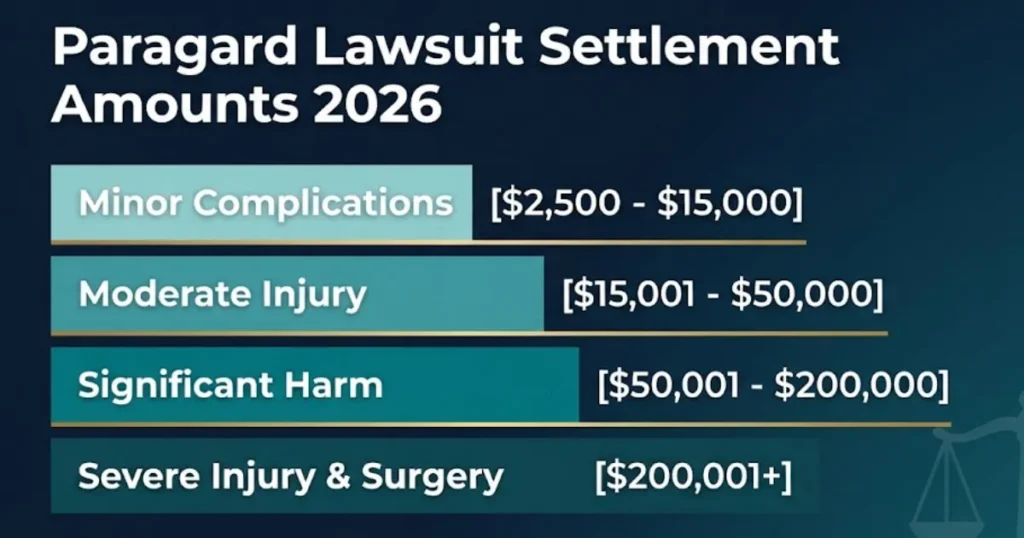
Calculating case value in mass tort litigation is not an exact science. It involves comparing your situation to similar cases, evaluating your medical evidence, and factoring in your total economic and non-economic damages.
Components that determine your case value:
- Medical bills: Total cost of treatment, surgeries, imaging, and follow-up care
- Future medical costs: Ongoing treatment needs related to your injury
- Lost income: Wages lost during recovery and any reduced earning capacity
- Pain and suffering: Physical pain and emotional distress caused by the device failure
- Loss of consortium: Impact on your relationships and quality of life
- Punitive damages: Possible if evidence shows the manufacturer acted with reckless disregard
| Damage Category | Examples |
|---|---|
| Economic damages | Medical bills, surgery costs, lost wages |
| Non-economic damages | Pain, emotional distress, loss of fertility |
| Punitive damages | Manufacturer misconduct evidence |
An attorney experienced in Paragard cases can provide a more specific estimate after reviewing your medical records. Free case evaluations are common in mass tort litigation.
Don’t accept any early settlement offer without understanding the full value of your case. Once you settle, you cannot come back for more money later.
Paragard IUD Removal Problems Lawsuit
The Paragard IUD removal problems lawsuit focuses on cases where the device caused injury specifically during the removal procedure. This is the most common scenario in the litigation.
Standard IUD removal is supposed to be simple. A doctor grasps the device’s strings and pulls gently. The arms fold up and the device slides out. With Paragard, that process sometimes goes wrong.
When the arms break during removal, women can experience:
- Retained fragments: Broken pieces left inside the uterus or abdominal cavity
- Uterine perforation: Device fragments puncturing the uterine wall
- Migration: Pieces traveling to other organs like the bladder or intestines
- Infection: Foreign body reaction causing pelvic inflammatory disease
- Emergency surgery: Procedures to locate and extract broken pieces
- Hysterectomy: Complete removal of the uterus in severe cases
Some women endure multiple surgeries to recover all the fragments. Others live with chronic pain from pieces that cannot be safely removed.
The lawsuit argues that CooperSurgical knew the removal failure rate was higher than industry standards for IUDs. Internal communications may show the company received numerous adverse event reports but did not strengthen warnings.
Doctors performing the removal often have no advance warning that the device might break. That lack of information is central to the failure-to-warn claims in the litigation.
Key Takeaway: Paragard removal problems ranging from retained fragments to emergency surgery are the primary basis for these lawsuits, and the manufacturer is accused of knowing about these risks and failing to provide adequate warnings to doctors and patients.
How to File a Paragard Lawsuit
Filing a Paragard lawsuit starts with contacting an attorney who handles medical device mass tort cases. Most law firms offer free consultations and work on a contingency fee basis, meaning you pay nothing upfront.
The process is more straightforward than most people expect. You don’t need to go to court yourself or do anything complicated. Your attorney handles the legal work.
Here are the basic steps:
- Contact a mass tort attorney who is actively handling Paragard cases
- Provide your medical records showing Paragard use, breakage, and injury
- Complete a case intake form with details about your experience
- Sign a retainer agreement with the law firm (contingency fee, no upfront cost)
- Your attorney files the complaint in the MDL or appropriate state court
- Your case enters the litigation and proceeds through discovery and settlement
| Step | What You Need to Do |
|---|---|
| Initial consultation | Describe your Paragard experience |
| Medical records | Gather or authorize release of records |
| Case evaluation | Attorney reviews your eligibility |
| Filing | Attorney handles all paperwork |
| Ongoing | Respond to occasional requests for information |
You do not need to travel to Georgia where the MDL is located. Everything is handled through your attorney’s office.
The most important thing you can do is gather your medical records early. Records from the insertion, removal, and any follow-up procedures are all relevant.
Paragard Lawsuit Filing Deadline
The Paragard lawsuit filing deadline varies by state, but most states impose a two to three year statute of limitations for product liability claims. Some states allow longer periods under the discovery rule.
There is no single nationwide deadline. Each state sets its own rules for how long you have to file after an injury occurs or is discovered.
| State | Statute of Limitations (Product Liability) |
|---|---|
| California | 2 years from injury |
| Texas | 2 years from injury |
| New York | 3 years from injury |
| Florida | 2 years from injury (4 years for some claims) |
| Illinois | 2 years from discovery |
| Pennsylvania | 2 years from injury |
| Ohio | 2 years from injury |
| Georgia | 2 years from injury |
The discovery rule is critical for Paragard cases. Many women didn’t know their device broke until months or years after removal. In states with a discovery rule, the clock starts when you knew or should have known about the injury.
If you think you might be close to your deadline, contact an attorney immediately. Missing the filing deadline means losing your right to sue forever. No exceptions.
Some women assume they’ve missed the window and don’t bother calling. That’s a mistake. An experienced attorney can evaluate whether the discovery rule extends your deadline.
Paragard Lawsuit Statute of Limitations
The statute of limitations for Paragard lawsuits is the legal deadline for filing your claim. Miss it, and your case is permanently barred regardless of how strong your evidence might be.
Every state has its own statute of limitations for product liability cases. The range is typically one to six years, with most states falling in the two to three year range.
What makes Paragard cases unique is the discovery rule. This legal principle says the clock doesn’t start ticking until you discover the injury or reasonably should have discovered it.
Here’s why that matters: A woman has her Paragard removed in 2022. The doctor says everything looks fine. In 2025, she has an X-ray for an unrelated issue and discovers IUD fragments in her abdomen. Under the discovery rule, her statute of limitations may start in 2025, not 2022.
Key points about the statute of limitations:
- Standard rule: Clock starts on the date of injury (removal date)
- Discovery rule: Clock starts when you discover or should have discovered the injury
- Tolling provisions: Some states pause the clock for certain circumstances
- Minor children: If a minor is involved, deadlines may extend until adulthood
The safest approach is to file as soon as you suspect a problem. Waiting only adds risk. There is no benefit to delaying.
Key Takeaway: The statute of limitations varies by state and is complicated by the discovery rule, so women who suspect their Paragard caused injury should contact an attorney immediately rather than assuming they’ve missed the deadline.
Paragard IUD Complications Lawsuit
The Paragard IUD complications lawsuit covers a range of injuries caused by the device’s tendency to break, migrate, or embed in tissue. These complications go beyond simple discomfort.
Women in the litigation report injuries that changed their lives. Some lost their ability to have children. Others endured multiple surgeries and months of recovery.
Common complications alleged in the lawsuits include:
- Device fracture during removal: Arms snapping off and remaining in the body
- Uterine perforation: Broken pieces puncturing the uterine wall
- Device migration: Fragments traveling to the abdomen, bowel, or bladder
- Chronic pelvic pain: Ongoing pain from embedded fragments
- Infection and inflammation: Pelvic inflammatory disease or abscess formation
- Ectopic pregnancy: Device failure leading to pregnancy outside the uterus
- Infertility: Permanent inability to conceive due to device-related damage
- Hysterectomy: Complete uterine removal as a last resort
The FDA’s MAUDE database contains thousands of adverse event reports related to Paragard. These reports document real women reporting real injuries to the federal government.
Many of these complications require invasive surgical intervention. Laparoscopic surgery, hysteroscopy, or open abdominal surgery may be needed to locate and remove fragments.
The emotional toll is significant too. Women who wanted children and lost that ability due to a defective medical device carry psychological wounds that settlement money cannot fully heal.
Paragard IUD Side Effects Lawsuit
The Paragard IUD side effects lawsuit addresses both the known side effects that were inadequately disclosed and the severe adverse events tied to device defects. Side effects and complications are not the same thing, and the legal claims treat them differently.
Known Paragard side effects include heavier periods, cramping, and spotting. These are expected and disclosed. The lawsuit isn’t about those.
The legal claims focus on severe outcomes that go beyond normal side effects:
| Normal Side Effects (Not Sued Over) | Severe Adverse Events (Basis for Lawsuit) |
|---|---|
| Heavier menstrual bleeding | Device arm fracture during removal |
| Cramping during insertion | Uterine perforation from fragments |
| Spotting between periods | Migration of device to other organs |
| Mild pelvic discomfort | Emergency surgery to remove fragments |
| Temporary pain after insertion | Hysterectomy due to device failure |
The distinction between a side effect and a defect-related injury is central to the case. Defendants argue that breakage is a disclosed risk. Plaintiffs argue the breakage rate was severely understated.
Copper toxicity claims have surfaced in some cases. Women allege that the copper components of the IUD caused systemic symptoms including fatigue, brain fog, and mood changes. These claims are harder to prove and are not the primary driver of the MDL.
The strongest cases involve clear, documented device failure with resulting physical injury requiring medical treatment.
Is There a Paragard IUD Recall in 2026
There is no Paragard IUD recall in 2026. The FDA has not issued a recall for the Paragard T 380A copper IUD. The device remains on the market and continues to be prescribed.
This surprises many people. With thousands of lawsuits alleging a defective device, you’d expect a recall. But the FDA recall process and the civil lawsuit process operate independently.
A recall requires the FDA to determine that a device poses an unreasonable risk that the manufacturer has not adequately addressed. So far, the FDA has not made that determination for Paragard.
Key facts about the Paragard recall status:
- FDA recall status: No recall issued as of 2026
- Device availability: Still available and prescribed by doctors
- Adverse event reports: Thousands filed in the MAUDE database
- Manufacturer response: CooperSurgical maintains the device is safe when used as directed
The absence of a recall does not mean the device is safe. It means the FDA has not yet taken that specific regulatory action. Lawsuits and recalls are different processes with different standards.
Some legal experts believe a recall could follow if bellwether trials produce large plaintiff verdicts. Regulatory action sometimes trails behind litigation outcomes.
If you currently have a Paragard IUD and are concerned, talk to your doctor about your options. The decision to remove or keep the device is a medical one, separate from any legal claim.
Key Takeaway: Despite thousands of lawsuits and adverse event reports, the Paragard IUD has not been recalled by the FDA in 2026, and it remains available on the market while the litigation proceeds.
Frequently Asked Questions
How much money can I get from the Paragard IUD lawsuit?
Most claimants can expect between $50,000 and $500,000 depending on injury severity.
Cases involving hysterectomy or infertility tend to fall in the higher range.
No global settlement has been finalized yet, so exact figures are still projections.
Is the Paragard lawsuit still accepting new cases in 2026?
Yes, new Paragard cases are still being filed in 2026.
The MDL remains open, and attorneys are actively accepting clients with qualifying injuries.
Check your state’s statute of limitations to confirm you are within the filing window.
What injuries qualify for a Paragard IUD lawsuit?
Qualifying injuries include device breakage during removal, retained fragments, uterine perforation, organ damage, infection, and hysterectomy.
You need documented medical evidence linking your injury to the Paragard device.
Minor side effects like cramping or heavier periods do not qualify.
Has there been a Paragard settlement yet?
No global Paragard settlement has been announced as of 2026.
Settlement negotiations are ongoing, and bellwether trial results are expected to drive those talks forward.
Some individual cases may have settled privately, but terms are typically confidential.
How long will the Paragard lawsuit take to resolve?
The Paragard MDL could reach a global settlement in late 2026 or early 2027.
After a settlement is announced, claims processing and payouts typically take another 6 to 18 months.
Total resolution from filing to payout could span two to three more years for cases filed today.
The Paragard IUD lawsuit is approaching a turning point in 2026. Bellwether trials, active settlement talks, and years of completed discovery all point toward resolution.
If you had a Paragard IUD that broke during removal, now is the time to act. Gather your medical records, check your state’s filing deadline, and speak with an attorney who handles these cases.
Waiting costs you nothing in legal fees. But waiting too long could cost you your right to file.







