

A suboxone lawsuit lawyer represents people who suffered severe dental damage after using Suboxone sublingual film. If you lost teeth, needed root canals, or had dental surgery linked to this medication, you may have a valid claim heading into 2026.
Thousands of lawsuits are now consolidated in federal court. The litigation targets Indivior, the company that makes Suboxone film.
The FDA flagged the dental risks back in June 2022. Since then, case filings have surged. Bellwether trials and settlement talks could define what happens next year.
This article breaks down everything you need to know. You will learn who qualifies, what payouts look like, how attorney fees work, key deadlines, and what evidence you need to build a strong case.
What Does a Suboxone Lawsuit Lawyer Do for Your Case
A suboxone lawsuit lawyer handles every legal step of your tooth decay claim, from initial case review through settlement or trial. Think of them as the person who translates your dental suffering into a legal argument that holds up in federal court.
Your attorney will start by reviewing your medical and dental records. They look for a clear connection between Suboxone film use and your dental injuries. This initial evaluation is free at most firms.
Once your case is accepted, the lawyer files your individual complaint. Even though thousands of cases sit in the MDL, each plaintiff has their own claim. Your lawyer manages your paperwork within that larger structure.
| Lawyer’s Role | What It Means for You |
|---|---|
| Case evaluation | Free review of your dental and medical records |
| Complaint filing | Your claim is filed in federal court or state court |
| Evidence gathering | Dental records, prescriptions, and expert opinions collected |
| MDL coordination | Your case is managed within the larger Suboxone litigation |
| Settlement negotiation | Your lawyer fights for the best payout on your behalf |
| Trial representation | If your case goes to trial, you have legal counsel ready |
During the discovery phase, your lawyer works with experts. Dentists, pharmacologists, and medical researchers may testify about the link between Suboxone film and enamel destruction.
The bottom line: you don’t do the heavy lifting. Your lawyer handles the legal machinery while you focus on your health.
Suboxone Tooth Decay Lawsuit Explained
The Suboxone tooth decay lawsuit alleges that Indivior’s sublingual film causes serious dental injuries, including tooth decay, fractures, extractions, and gum disease. Plaintiffs say the company knew about these risks and failed to warn patients or doctors.
Suboxone is a prescription medication used to treat opioid addiction. It contains buprenorphine and naloxone. The film dissolves under the tongue or against the cheek, exposing teeth and gums to an acidic environment for extended periods.
The FDA issued a Drug Safety Communication in June 2022 confirming reports of dental problems. The agency had received hundreds of adverse event reports describing tooth decay, cavities, oral infections, and complete tooth loss.
Plaintiffs argue that Indivior had data suggesting dental risks for years. The original Suboxone tablet’s label included limited dental warnings. When the company switched to the film formulation, those warnings were not adequately updated.
- The film’s acidity erodes tooth enamel during dissolution
- Patients were not told to rinse their mouths or wait before brushing
- Dentists were not informed about the medication’s dental risks
- Some patients lost multiple teeth within months of starting treatment
Many of the people affected were already in a vulnerable position. They were seeking help for addiction. The idea that their treatment would destroy their teeth feels like a betrayal.
Suboxone Lawsuit Settlement Amounts in 2026
Suboxone lawsuit settlement amounts in 2026 have not been officially announced, but legal analysts project individual payouts could range from $50,000 to over $500,000 depending on the severity of dental injuries. No global settlement has been reached yet.
These estimates come from comparing the Suboxone litigation to similar pharmaceutical mass torts. Cases involving severe physical harm, clear manufacturer negligence, and FDA warnings tend to settle in higher ranges.
| Injury Severity | Estimated Settlement Range |
|---|---|
| Mild dental decay (fillings, minor treatment) | $10,000 to $50,000 |
| Moderate damage (multiple crowns, root canals) | $50,000 to $150,000 |
| Severe damage (extractions, dental implants, surgery) | $150,000 to $300,000 |
| Catastrophic (full mouth reconstruction, extensive loss) | $300,000 to $500,000+ |
These figures are projections, not guarantees. Actual settlements depend on bellwether trial outcomes and global settlement negotiations.
Cases with detailed dental records showing a clear before-and-after timeline tend to be valued higher. If you had healthy teeth before Suboxone and suffered rapid deterioration during use, your claim carries more weight.
Quick Fact: In similar pharmaceutical lawsuits like the Zantac litigation, settlement tiers were based on injury severity and strength of evidence. Expect the Suboxone MDL to follow a similar tiered approach.
Key Takeaway: A Suboxone lawsuit lawyer manages your entire claim, the tooth decay lawsuit centers on Indivior’s failure to warn, and 2026 settlement amounts could range from $10,000 to over $500,000 based on injury severity.
Who Qualifies for the Suboxone Lawsuit
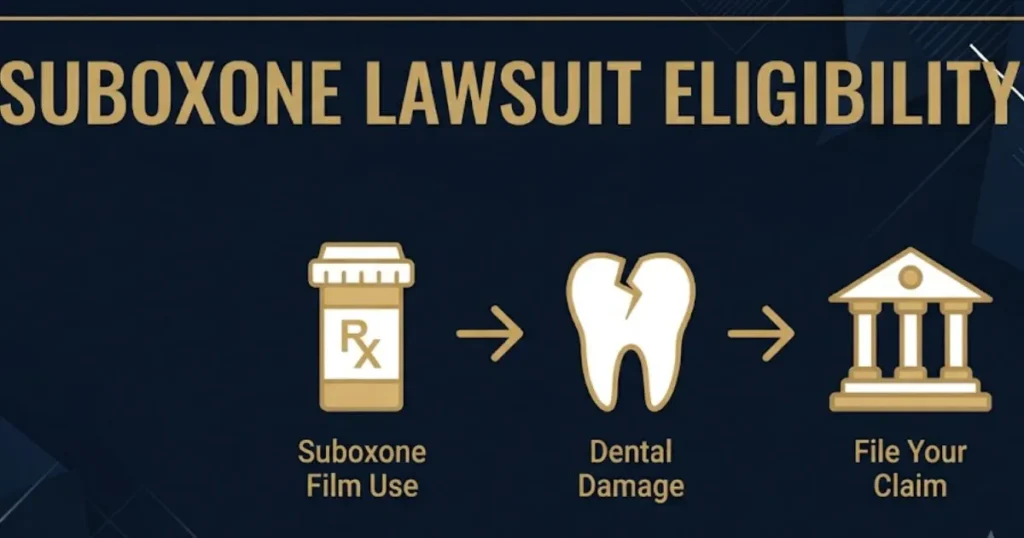
You qualify for the Suboxone lawsuit if you used Suboxone sublingual film and developed dental problems during or after treatment. The key factor is proving a connection between the medication and your dental injuries.
Not every Suboxone user automatically has a case. The litigation specifically targets the film formulation, not the tablet version. The film dissolves against oral tissues and creates the acidic conditions that damage teeth.
Here is a quick eligibility checklist:
- You were prescribed Suboxone sublingual film (not tablets)
- You used the film for a sustained period (typically weeks or months)
- You developed dental problems during or shortly after use
- Your dental issues include decay, cavities, fractures, extractions, or gum disease
- You have dental records that show the timeline of damage
People who had pre-existing dental problems may still qualify. The question is whether Suboxone made those problems significantly worse. A suboxone lawsuit lawyer can evaluate your specific situation.
| Qualifying Factor | Details |
|---|---|
| Product used | Suboxone sublingual film specifically |
| Time of use | Any period; longer use strengthens claim |
| Dental damage | Decay, cavities, tooth loss, gum disease, fractures |
| Records available | Dental records, prescription history, pharmacy receipts |
| Pre-existing conditions | May still qualify if Suboxone worsened dental health |
Age does not disqualify you. Neither does the state you live in, though filing deadlines vary.
How to File a Suboxone Lawsuit in 2026
Filing a Suboxone lawsuit in 2026 starts with contacting an experienced mass tort attorney for a free case evaluation. The process is straightforward, and you do not pay anything upfront.
Here is the step-by-step process:
Step 1: Free Consultation
You speak with a lawyer or legal team. They ask about your Suboxone use, dental history, and injuries. This usually takes 15 to 30 minutes by phone.
Step 2: Record Collection
Your lawyer gathers your dental records, medical records, and prescription history. They may request pharmacy records and insurance claims. You sign release forms so the legal team can access these documents.
Step 3: Case Filing
Your attorney drafts and files your individual complaint. Depending on your state and circumstances, the case may be filed in federal court (joining MDL 3092) or in state court.
Step 4: Discovery and Litigation
Your case enters the legal process. Your lawyer handles depositions, expert witness coordination, and all court filings.
Step 5: Resolution
Your case resolves through settlement negotiation or trial verdict.
| Filing Step | Timeline |
|---|---|
| Initial consultation | 1 day |
| Record gathering | 2 to 6 weeks |
| Case filing | 1 to 2 weeks after records are ready |
| Active litigation | Months to years depending on MDL progress |
| Settlement or trial | Projected mid to late 2026 or beyond |
You do not need to visit a courthouse. Most of the process happens remotely. Your lawyer handles the paperwork, filings, and court appearances.
Suboxone Lawsuit Payout Per Person
The Suboxone lawsuit payout per person will likely be determined by a tiered system based on injury severity, similar to how other pharmaceutical mass torts have resolved. Individual payouts have not been finalized as of early 2026.
Mass tort settlements rarely pay every plaintiff the same amount. Instead, cases are sorted into categories. Someone who lost all their teeth will receive a much larger payout than someone who needed two fillings.
Several factors influence your individual payout:
- Severity of dental damage: Full mouth reconstruction cases rank highest
- Duration of Suboxone film use: Longer use often correlates with worse damage
- Quality of evidence: Strong dental records with clear timelines increase value
- Pre-existing dental conditions: Cases with healthy teeth before Suboxone are strongest
- Out-of-pocket costs: Dental bills, implant costs, and related expenses
Quick Fact: Dental implants alone can cost $3,000 to $6,000 per tooth. Full mouth reconstruction runs $30,000 to $90,000 or more. These real costs factor heavily into payout calculations.
People who documented their dental health before starting Suboxone have the strongest position. A dental exam from before your prescription serves as baseline evidence.
Key Takeaway: Eligibility centers on Suboxone film use and documented dental damage; filing is a straightforward five-step process; and individual payouts will be tiered by injury severity and evidence quality.
Suboxone Class Action Lawsuit Update for 2026
The Suboxone litigation is not technically a class action. It is a multidistrict litigation (MDL), which means each plaintiff has an individual case, but all federal cases are grouped together for pretrial proceedings. This distinction matters for your payout.
In a class action, everyone gets the same settlement amount. In an MDL, each case is evaluated separately. Your payout depends on your personal injuries and evidence. That is why the MDL structure generally benefits plaintiffs with serious dental damage.
As of early 2026, the Suboxone MDL (No. 3092) is housed in the U.S. District Court for the Northern District of Ohio. The Judicial Panel on Multidistrict Litigation centralized the cases there to streamline the process.
Key developments heading into 2026:
- Thousands of individual cases have been filed in the MDL
- Discovery between the parties is progressing
- Bellwether trial selections are underway
- Settlement discussions have occurred but no global deal has been announced
- New cases continue to be filed as more patients come forward
The litigation has picked up momentum. Each new case filing adds pressure on Indivior to consider a global settlement rather than facing thousands of individual trials.
Suboxone MDL Update 2026
The Suboxone MDL (No. 3092) is in active pretrial proceedings in the Northern District of Ohio as of 2026. Bellwether cases are being selected, and both sides are deep into discovery.
Bellwether trials are test cases. The court picks a handful of representative cases and tries them first. The outcomes of these trials set the tone for settlement negotiations. If plaintiffs win big verdicts, Indivior faces enormous pressure to settle the remaining cases.
| MDL Milestone | Status (2026) |
|---|---|
| MDL consolidation | Complete (Northern District of Ohio) |
| Discovery phase | Ongoing |
| Bellwether case selection | In progress |
| First bellwether trial | Expected 2026 |
| Global settlement talks | Preliminary; no deal announced |
| New case filings | Still being accepted |
The judge overseeing the MDL has pushed for efficiency. Pretrial orders have set deadlines for expert reports, depositions, and document production. Both sides have exchanged significant volumes of internal documents.
Indivior’s internal communications and research data are central to the litigation. Plaintiffs’ attorneys are looking for evidence that the company knew about dental risks earlier than it disclosed publicly.
The pace of the MDL suggests that 2026 could be a defining year. Bellwether trial outcomes will likely determine whether a global settlement happens or the cases proceed individually.
Suboxone Lawsuit Eligibility Requirements
Suboxone lawsuit eligibility requires three core elements: use of the sublingual film product, documented dental damage, and a causal timeline linking the two. Meeting all three gives you a viable claim.
The litigation focuses exclusively on the film version of Suboxone. The tablet formulation is swallowed differently and does not create the same prolonged oral exposure. If you only used Suboxone tablets, your case is significantly weaker.
Here are the specific eligibility requirements broken down:
| Requirement | What You Need |
|---|---|
| Product type | Suboxone sublingual film (brand or generic equivalent) |
| Usage period | Documented use through prescription records |
| Dental injury | Diagnosed dental problems: decay, erosion, extractions, fractures, gum disease |
| Timeline | Dental damage occurred during or after Suboxone film use |
| Causation | No other obvious cause fully explains the dental deterioration |
People who used generic versions of buprenorphine/naloxone sublingual film may also have claims. The mechanism of injury is the same: acidic film dissolving against teeth and gum tissue.
Your dentist’s records are your strongest ally here. Treatment notes, X-rays, and diagnosis codes paint the clinical picture that connects Suboxone to your dental problems.
Quick Fact: The FDA’s 2022 safety communication documented cases where patients with no prior dental history developed severe tooth decay, sometimes within weeks of starting Suboxone film.
Key Takeaway: The Suboxone MDL is not a class action but an MDL where individual cases are evaluated separately; bellwether trials expected in 2026 will drive settlement dynamics; and eligibility requires film use, documented dental damage, and a clear timeline.
Suboxone Sublingual Film Lawsuit Background
The Suboxone sublingual film lawsuit traces back to Indivior’s decision to transition patients from the original Suboxone tablet to the film formulation starting around 2010. That switch is at the center of this litigation.
Suboxone was first approved by the FDA in 2002 as a tablet. It became the leading medication for opioid addiction treatment. In 2010, Indivior (then a division of Reckitt Benckiser) introduced the sublingual film version.
The company aggressively pushed doctors and patients toward the film. By 2013, the tablet was discontinued. Plaintiffs allege this move was financially motivated, as the film was more profitable and harder for generics to replicate.
The film dissolves slowly against oral tissues. This prolonged contact exposes tooth enamel to acidic conditions. Unlike the tablet, which dissolved and was swallowed relatively quickly, the film sits against teeth and gums for minutes.
- 2002: Suboxone tablet approved by the FDA
- 2010: Suboxone sublingual film introduced
- 2013: Suboxone tablet discontinued by Indivior
- 2022: FDA issues Drug Safety Communication on dental risks
- 2022 to 2023: First lawsuits filed; MDL established
- 2024 to 2026: MDL grows; bellwether preparation begins
The lawsuit alleges that Indivior had safety data suggesting dental harm but did not include adequate warnings. The company’s own clinical trial data and post-market surveillance reports are now key evidence.
Suboxone Side Effects and Tooth Decay
Suboxone’s most significant side effect driving this litigation is severe tooth decay caused by the sublingual film’s prolonged oral contact. The acidic environment created by the dissolving film erodes enamel and promotes bacterial growth.
The dental problems linked to Suboxone film go well beyond ordinary cavities. Patients have reported rapid, aggressive dental deterioration that shocked their dentists.
Common dental side effects reported by Suboxone film users:
- Tooth decay and cavities: Often in teeth that were previously healthy
- Tooth fractures: Weakened enamel leads to cracking and breaking
- Tooth loss: Multiple extractions needed in severe cases
- Gum disease: Inflammation, bleeding, and tissue deterioration
- Oral infections: Abscesses and infections requiring surgery
- Enamel erosion: Visible wearing of tooth surfaces
The FDA’s 2022 Drug Safety Communication reviewed 305 adverse event reports submitted between 2002 and 2022. Of those, 131 cases were classified as serious. Some patients reported losing all their teeth.
What makes this particularly harmful is the patient population. People using Suboxone are treating opioid addiction. They trusted this medication to help them recover. Instead, many ended up with thousands of dollars in dental bills and permanent oral damage.
The biological mechanism is straightforward. The film’s pH is acidic. Extended contact with teeth demineralizes enamel. Once enamel is gone, it does not grow back.
Suboxone Lawsuit Deadline in 2026
The Suboxone lawsuit deadline depends on your state’s statute of limitations for product liability or personal injury claims. Most states allow two to three years from the date you discovered (or should have discovered) the connection between Suboxone and your dental damage.
This is where timing gets critical for 2026 filers. The FDA’s warning came in June 2022. If your state has a three-year statute of limitations and the clock started when the FDA issued its warning, your deadline could fall in mid-2025. But in many cases, the clock starts from when you personally learned about the connection.
| State Example | Statute of Limitations | Potential Deadline |
|---|---|---|
| California | 2 years | 2 years from discovery of injury |
| Texas | 2 years | 2 years from discovery |
| New York | 3 years | 3 years from discovery |
| Florida | 4 years (product liability) | 4 years from discovery |
| Ohio | 2 years | 2 years from discovery |
| Pennsylvania | 2 years | 2 years from discovery |
The “discovery rule” is your friend here. It means the clock starts when you knew or reasonably should have known that Suboxone caused your dental problems. For many people, that was not until 2022 or later.
Still, waiting is risky. Every month you delay makes evidence harder to collect. Dental records get archived. Memories fade. Dentists retire or close practices.
If you are reading this in 2026, contact a lawyer now. Even if your deadline has technically passed, an attorney can evaluate whether exceptions apply in your state.
Key Takeaway: The sublingual film’s transition from tablet created the conditions for dental harm; tooth decay from Suboxone is severe and well-documented by the FDA; and filing deadlines vary by state, so 2026 filers should act immediately.
Finding a Suboxone Lawyer Near Me
Finding a suboxone lawyer near you starts with looking for firms experienced in pharmaceutical mass tort litigation, not just any personal injury attorney. This type of case requires specific expertise in drug manufacturer liability and MDL procedures.
Geography matters less than you might think. Most Suboxone lawsuits are handled remotely. Your lawyer does not need to be in your city. They need to know pharmaceutical litigation and have resources to handle complex federal cases.
Here is what to look for in a Suboxone attorney:
- Mass tort experience: They have handled pharmaceutical lawsuits before
- MDL involvement: They are actively working within MDL 3092 or similar federal consolidations
- Contingency fee basis: They charge nothing upfront and take a percentage only if you win
- Medical expert network: They work with dentists and pharmacologists who can support your case
- Track record: They have secured settlements or verdicts in drug injury cases
- Communication: They keep you updated and answer your questions promptly
Avoid firms that seem to be processing cases like a factory. You want a team that will evaluate your individual situation, not just sign you up and forget about you.
Ask direct questions during your consultation. How many Suboxone cases are they handling? What is their fee structure? Who will be your point of contact? How often will you receive updates?
The right lawyer makes a real difference in how much you ultimately receive and how smoothly the process goes.
How Much Is a Suboxone Lawsuit Worth
A Suboxone lawsuit’s worth depends entirely on your individual injuries, evidence strength, and the litigation’s trajectory. Cases involving severe dental damage with strong documentation could be worth $100,000 to $500,000 or more.
Valuing a mass tort case before settlement is part science and part educated guessing. Lawyers look at similar pharmaceutical settlements, the strength of the evidence against the manufacturer, and the specific injuries in each case.
Factors that increase your case value:
- Total tooth loss or near-total loss: These cases sit at the top tier
- Expensive dental repairs: Implants, bridges, and full reconstructions drive up documented damages
- Lost income: If dental problems forced you to miss work
- Pain and suffering: Physical pain, emotional distress, and reduced quality of life
- Clear before-and-after records: Dental exams showing healthy teeth before Suboxone
| Case Value Factor | Impact on Worth |
|---|---|
| Number of teeth lost | Higher loss = higher value |
| Cost of dental treatment | Documented expenses increase claim |
| Duration of Suboxone use | Longer use supports stronger causation |
| Pre-existing dental health | Good prior health strengthens claim |
| Emotional and social impact | Documented distress adds value |
Compare this to other pharmaceutical mass torts. The 3M earplug litigation saw settlements averaging around $30,000 per plaintiff. But those involved hearing damage. Dental destruction, with its visible impact and high repair costs, may command higher individual payouts.
The true value becomes clearer after bellwether trials. Those test cases give both sides real data to negotiate with.
Suboxone Dental Lawsuit Attorney Fees
Suboxone dental lawsuit attorneys work on a contingency fee basis, meaning you pay nothing upfront and the lawyer takes a percentage of your settlement or verdict. If you receive no money, you owe nothing.
This is standard in mass tort litigation. The contingency model exists specifically so that regular people can take on large corporations without needing to write a check first. It levels the playing field.
| Fee Element | Typical Range |
|---|---|
| Contingency fee percentage | 25% to 40% of your settlement |
| Upfront cost to you | $0 |
| Case expenses (filing fees, experts) | Deducted from settlement or absorbed by firm |
| Payment if you lose | $0; you owe nothing |
The typical contingency fee in pharmaceutical mass tort cases runs between 33% and 40%. Some firms charge on the lower end if the case settles quickly. Trials that go to verdict often have higher fee percentages because of the extra work involved.
Case expenses are separate from attorney fees. These include filing costs, medical record retrieval, expert witness fees, and travel. Most firms advance these costs and deduct them from your settlement. Ask your lawyer to explain this clearly before signing.
Read your fee agreement carefully. Every reputable firm will walk you through the contract and answer questions. If a firm pressures you to sign quickly without explaining fees, that is a red flag.
The contingency structure means your lawyer has the same financial motivation as you do. They only get paid when you get paid, so they are incentivized to maximize your recovery.
Key Takeaway: The right Suboxone lawyer specializes in mass tort cases and works on contingency; your lawsuit’s value depends on injury severity and evidence quality; and you pay zero out of pocket unless you receive a settlement.
Suboxone Lawsuit Evidence You Need
The evidence you need for a Suboxone lawsuit includes dental records, prescription history, pharmacy records, and documentation of your dental treatment costs. Strong evidence separates high-value claims from weak ones.
Think of your evidence as telling a story. The story goes: “I had healthy teeth, I started Suboxone film, and my teeth fell apart.” Every piece of evidence supports a chapter of that story.
Essential evidence for your claim:
- Pre-Suboxone dental records: X-rays and exams from before you started the medication
- Post-Suboxone dental records: Treatment notes, X-rays, and diagnoses showing dental damage
- Prescription records: Proof you were prescribed Suboxone sublingual film
- Pharmacy records: Dates you filled your prescriptions and the specific product dispensed
- Dental bills and receipts: Documentation of costs you have incurred
- Insurance claims: Dental insurance records showing treatments and payments
- Personal timeline: Your own notes about when dental problems started and progressed
- Photos: Any images of dental damage you or your dentist took
| Evidence Type | Why It Matters |
|---|---|
| Pre-treatment dental records | Establishes baseline oral health |
| Prescription records | Confirms Suboxone film was prescribed |
| Pharmacy records | Proves you actually filled and received the medication |
| Post-treatment dental records | Documents the damage that occurred |
| Treatment cost records | Quantifies your financial losses |
| Personal notes and photos | Adds context and human impact |
If you no longer have some of these records, don’t panic. Your lawyer’s team can request records from dental offices, pharmacies, and insurance companies. Medical records are typically retained for seven to ten years.
Start gathering what you can now. The sooner your attorney has your records, the faster your case moves forward.
The Indivior Suboxone Lawsuit
The Indivior Suboxone lawsuit targets Indivior PLC, the pharmaceutical company that manufactures and markets Suboxone sublingual film. Indivior is the primary defendant in the majority of Suboxone tooth decay cases.
Indivior was formerly the pharmaceutical division of Reckitt Benckiser, the British consumer goods company. In 2014, Reckitt spun off Indivior as an independent, publicly traded company. This split happened right around the time concerns about Suboxone’s dental effects were growing.
Indivior’s legal troubles extend beyond the tooth decay litigation. In 2019, the company was indicted on federal fraud charges for allegedly marketing Suboxone film as less prone to diversion and abuse than competitors, without adequate scientific support. Indivior eventually agreed to a $600 million settlement to resolve those criminal and civil charges.
That 2019 settlement is relevant to the current dental litigation. It established a pattern: Indivior prioritized profits and market share over accurate safety disclosures. Plaintiffs’ lawyers point to this history as evidence of corporate recklessness.
Key allegations against Indivior in the tooth decay lawsuit:
- Failure to warn: The company did not adequately disclose dental risks to patients or prescribers
- Defective product design: The film’s formulation creates an unnecessarily acidic oral environment
- Negligent marketing: Promotional materials downplayed or ignored dental side effects
- Fraud: The company concealed known safety data about dental harm
| Indivior Legal History | Details |
|---|---|
| Former parent company | Reckitt Benckiser |
| Spinoff year | 2014 |
| 2019 federal fraud settlement | $600 million |
| Current dental litigation | MDL 3092, Northern District of Ohio |
| Primary allegations | Failure to warn, defective design, negligent marketing |
Indivior has significant financial resources to fight the litigation. But the combination of FDA warnings, thousands of injured plaintiffs, and the company’s prior legal history creates real pressure to reach a settlement.
The company’s internal documents, now being produced through discovery, will reveal how much Indivior knew and when. That timeline could make or break the entire litigation.
Key Takeaway: Your evidence package should include pre- and post-treatment dental records, prescription history, and cost documentation; Indivior is the primary defendant with a history of fraud settlements; and the company’s internal documents are central to the litigation’s outcome.
Frequently Asked Questions
Can I still file a Suboxone lawsuit in 2026?
Yes, many people can still file a Suboxone lawsuit in 2026.
The statute of limitations varies by state, typically ranging from two to four years from the date you discovered the connection between Suboxone and your dental damage.
Contact a mass tort attorney immediately to confirm your specific deadline.
How much money can I get from a Suboxone lawsuit?
Individual payouts are projected to range from $10,000 to $500,000 or more.
The exact amount depends on your injury severity, dental repair costs, and the strength of your evidence.
Settlement amounts will become clearer after bellwether trial outcomes in 2026.
Do I need a lawyer to file a Suboxone tooth decay claim?
You technically can file without a lawyer, but it is not advisable in mass tort litigation.
A suboxone lawsuit lawyer works on contingency, meaning you pay nothing unless you win.
The complexity of MDL proceedings and pharmaceutical liability law makes experienced legal representation essential.
What dental problems qualify for the Suboxone lawsuit?
Qualifying dental problems include tooth decay, cavities, tooth fractures, tooth loss, gum disease, oral infections, and enamel erosion.
The damage must have occurred during or after your use of Suboxone sublingual film.
Cases involving multiple extractions or full mouth reconstruction are typically valued highest.
How long does a Suboxone lawsuit take to settle?
Most mass tort pharmaceutical cases take two to five years from filing to settlement.
The Suboxone MDL has been active since 2022, and bellwether trials are expected in 2026.
A global settlement could follow successful bellwether outcomes, but individual timelines vary.
The Suboxone tooth decay litigation is heading into a pivotal year. If you used the sublingual film and suffered dental damage, 2026 may be your best window to act.
Gather your dental records. Speak with a suboxone lawsuit lawyer who handles mass tort cases. The consultation costs you nothing, and the clock is ticking on filing deadlines.
Your teeth mattered. Your case matters. Don’t let a deadline pass you by.







