

A progressive insurance lawsuit can help policyholders recover money when Progressive wrongfully denies, delays, or underpays a valid insurance claim. Thousands of customers file lawsuits and complaints against Progressive every single year, and 2026 is shaping up to be one of the most active years yet.
If Progressive sent you a lowball offer or flat-out denied your claim, you have legal options. This guide breaks down every type of lawsuit, who qualifies, what kind of money people are recovering, and exactly how to take action.
Here is one stat worth knowing right now. Progressive received over 10,000 consumer complaints through the NAIC in recent reporting years, ranking it among the most-complained-about auto insurers in America.
This article covers class action cases, bad faith claims, settlement amounts, filing steps, timelines, and the latest 2026 updates. Everything you need is right here.
Progressive Insurance Lawsuit
A progressive insurance lawsuit is a legal action filed by a policyholder or claimant who believes Progressive failed to handle their claim fairly. These lawsuits fall into several categories, including bad faith, breach of contract, claim denial, and underpayment disputes.
Progressive is the third-largest auto insurer in the United States. The company covers more than 28 million policies. With that volume comes a massive number of disputes.
Lawsuits against Progressive typically allege that the company used unfair tactics. These include delaying payments, using biased valuation software, and offering settlement amounts far below actual damages.
Some cases are filed individually by one policyholder. Others become class action lawsuits representing thousands of people with similar complaints. Both paths can lead to significant compensation.
The legal basis for most of these cases comes from state insurance laws. Every state requires insurers to act in “good faith.” When Progressive violates that duty, it opens the door to lawsuits.
| Lawsuit Type | What It Covers | Who Files It |
|---|---|---|
| Bad Faith | Unfair claim handling | Policyholder |
| Breach of Contract | Failure to pay per policy terms | Policyholder or claimant |
| Class Action | Systematic unfair practices | Group of affected customers |
| Personal Injury | Underpayment of injury claims | Accident victim |
| Total Loss Dispute | Undervaluing a totaled vehicle | Vehicle owner |
Whether your claim involves a car accident, property damage, or uninsured motorist coverage, the core issue is usually the same. Progressive did not pay what it owed.
Progressive Insurance Lawsuit 2026
The progressive insurance lawsuit picture in 2026 includes multiple active cases in state and federal courts across the country. Several new filings from late 2025 are now moving through discovery and pre-trial phases.
One of the biggest trends this year is the rise in total loss valuation lawsuits. Policyholders are suing Progressive for using flawed comparable vehicle data to undervalue totaled cars. These cases argue that Progressive’s valuation methods systematically shortchange vehicle owners by hundreds or even thousands of dollars.
Bad faith claim lawsuits also continue to climb in 2026. States like Florida, California, Pennsylvania, and Ohio have seen a notable increase in filings.
Progressive reported $65.8 billion in net premiums written for 2024, and premium increases over the past two years have frustrated policyholders. When customers pay more and receive less at claim time, lawsuits follow.
New state regulations in 2025 and 2026 have given consumers stronger tools to fight insurers. Several states have updated their unfair claims practices acts, making it easier to prove bad faith.
| 2026 Trend | Details |
|---|---|
| Total Loss Lawsuits | Rising, based on flawed vehicle valuation software |
| Bad Faith Filings | Up in FL, CA, PA, OH |
| Premium Complaints | Increasing as rates climb |
| Regulatory Changes | Stronger consumer protections in multiple states |
If you had a claim denied or underpaid by Progressive in 2024, 2025, or 2026, the legal window to take action is still open in most states.
Progressive Insurance Class Action Lawsuit
A progressive insurance class action lawsuit is a single case filed on behalf of a large group of people who share the same complaint against the company. These cases typically involve systematic practices that affected thousands of customers the same way.
Class actions against Progressive have targeted several practices over the years. The most common allegations include failing to pay proper sales tax and fees on total loss claims, using biased repair estimates, and systematically underpaying uninsured motorist claims.
In recent years, class action lawsuits have been filed in states including Ohio, Florida, New York, and California. Some of these cases have resulted in multimillion-dollar settlements.
One well-known pattern involves total loss payments. When Progressive totals a vehicle, it owes the actual cash value. Class action plaintiffs have argued that Progressive deducts improper fees and fails to include taxes, title costs, and registration fees that the policyholder must pay to replace the car.
- Class actions require “numerosity,” meaning enough affected people to justify group litigation
- A lead plaintiff represents the entire class
- Settlement funds are divided among all qualifying class members
- Individual payouts in class actions are often smaller than individual lawsuits
- You usually receive a notice if you qualify for an existing class
Key Takeaway: Progressive faces class action lawsuits in multiple states for systematic practices like underpaying total loss claims and failing to include required taxes and fees in payouts.
Progressive Insurance Bad Faith Lawsuit
A progressive insurance bad faith lawsuit alleges that Progressive violated its legal duty to treat policyholders fairly and honestly. Bad faith is not just a disagreement about money. It means the insurer acted unreasonably or with improper motive.
Every state has laws requiring insurance companies to handle claims in good faith. When Progressive ignores evidence, delays investigations without reason, or denies valid claims based on technicalities, that behavior can cross the line into bad faith.
Bad faith lawsuits against Progressive carry serious consequences for the company. In many states, a bad faith finding means Progressive must pay not only the original claim but also additional damages, attorney fees, and sometimes punitive damages.
Some states allow “first-party” bad faith claims, where you sue your own insurer. Others only allow “third-party” bad faith, where the person injured by Progressive’s insured sues for bad faith handling.
Common bad faith behaviors alleged against Progressive include:
- Ignoring or not fully investigating a claim
- Unreasonable delays in processing payments
- Offering far less than the claim is worth without explanation
- Misrepresenting policy language to deny coverage
- Failing to communicate with the policyholder
- Refusing to settle a clear liability claim within policy limits
| State | Bad Faith Law Strength | Punitive Damages Available |
|---|---|---|
| Florida | Strong | Yes |
| California | Strong | Yes |
| Ohio | Moderate | Yes, with limitations |
| Texas | Strong | Yes, under Insurance Code |
| New York | Weaker | Limited |
Winning a bad faith case often requires documentation. Save every email, letter, and recorded call with Progressive. That paper trail becomes your strongest evidence.
Progressive Insurance Lawsuit Settlement
A progressive insurance lawsuit settlement is an agreement where Progressive pays money to resolve a legal claim without going to trial. The vast majority of lawsuits against Progressive end in settlement, not a jury verdict.
Settlements happen because trials are expensive and unpredictable for both sides. Progressive often prefers to settle once it becomes clear a case has merit, especially when bad faith is involved.
Settlement amounts vary wildly depending on the type of case. A simple underpayment dispute might settle for a few thousand dollars. A bad faith case with punitive damages on the table could settle for six or even seven figures.
Class action settlements work differently. The total settlement fund might be $10 million, but individual payouts could be $50 to $500 per class member. It depends on the size of the class and the claims process.
In individual lawsuits, settlement negotiations typically begin after discovery. That is when both sides exchange evidence. Progressive’s willingness to settle often increases once internal documents and claims handling notes are exposed.
- Settlements are usually confidential in individual cases
- Class action settlements are public record
- Settlement payments can take 60 to 120 days after agreement
- Accepting a settlement means you give up the right to sue again on the same issue
If Progressive offers you a settlement, have a lawyer review it before signing. The first offer is almost never the best one.
Progressive Insurance Settlement Amounts
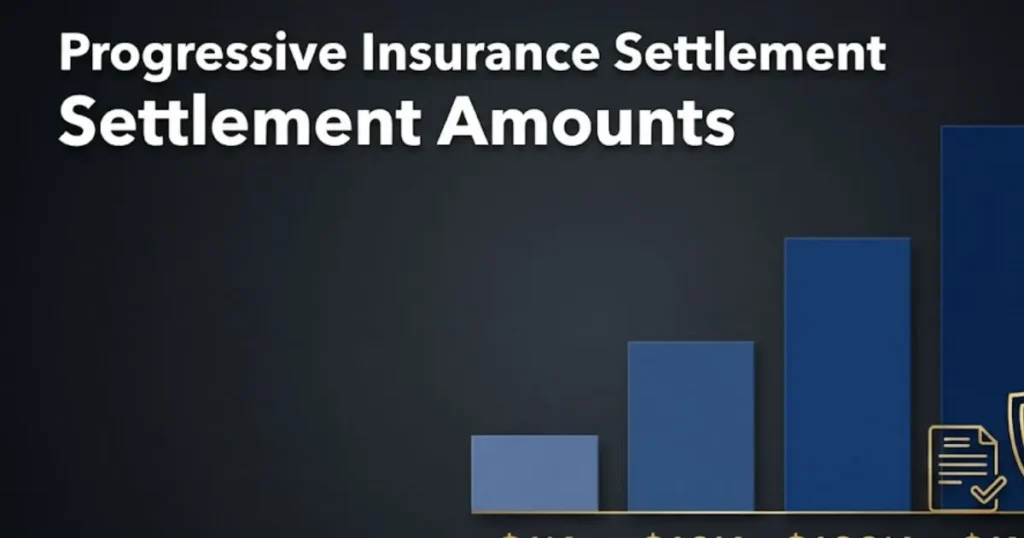
Progressive insurance settlement amounts range from a few hundred dollars in small claims to millions in bad faith and catastrophic injury cases. The amount depends on the type of claim, the severity of damages, and whether bad faith is proven.
Here is a realistic breakdown of what different types of Progressive lawsuits have yielded:
| Case Type | Typical Settlement Range | Factors That Increase Value |
|---|---|---|
| Underpayment (property) | $1,000 to $10,000 | Documented repair estimates |
| Total Loss Dispute | $2,000 to $15,000 | Independent appraisal |
| Personal Injury Underpayment | $10,000 to $100,000+ | Medical records, lost wages |
| Bad Faith (individual) | $25,000 to $500,000+ | Provable insurer misconduct |
| Bad Faith with Punitive Damages | $100,000 to $5,000,000+ | Egregious conduct |
| Class Action (per person) | $50 to $500 | Size of class, claim type |
A totaled car claim where Progressive undervalued the vehicle by $3,000 might settle for $3,000 to $5,000 once you hire an attorney. The attorney fees come from the settlement, typically 33% on a contingency basis.
Bad faith cases produce the largest settlements. When Progressive’s own internal documents show the company knew a claim was valid and denied it anyway, settlement values spike dramatically.
Key Takeaway: Individual progressive insurance lawsuit settlements can range from a few thousand dollars to several million, depending heavily on whether bad faith is involved and how well the claim is documented.
Progressive Insurance Lawsuit Payout
A progressive insurance lawsuit payout is the actual money a claimant receives after a settlement or court judgment, minus attorney fees and costs. Understanding the difference between a settlement amount and a payout is important.
If your case settles for $30,000 and your attorney works on a 33% contingency fee, your actual payout is roughly $20,000 before costs. Court costs, expert witness fees, and filing fees are typically deducted separately.
Class action payouts work on a different scale. Individual class members often receive checks ranging from $25 to a few hundred dollars. The lead plaintiff may receive a larger “incentive award,” usually $2,500 to $10,000.
Payout timelines also matter. After a settlement agreement, it can take 60 to 180 days to receive your check. Class action payouts sometimes take a year or more because the court must approve the settlement and process all claims.
- Individual lawsuit payouts: Usually received within 30 to 90 days of final agreement
- Class action payouts: 6 to 18 months after settlement approval
- Structured settlements: Paid out over time in installments
- Lump sum: One single payment
| Payout Type | Timeline | Typical Amount After Fees |
|---|---|---|
| Individual Settlement | 30 to 90 days | 60% to 67% of settlement |
| Class Action | 6 to 18 months | $25 to $500 per person |
| Court Judgment | Varies, could be appealed | Full judgment minus fees |
Do not expect a fast check. Insurance companies, including Progressive, sometimes drag their feet even after agreeing to pay.
Progressive Insurance Denial of Claim Lawsuit
A progressive insurance denial of claim lawsuit is filed when Progressive refuses to pay a valid claim entirely. These cases argue that the denial was wrongful, either because the policy clearly covered the loss or because Progressive misinterpreted the policy terms.
Claim denials happen for many reasons. Some are legitimate. Others are not. Progressive has been accused in numerous lawsuits of denying claims using policy exclusions that do not actually apply to the situation.
Common wrongful denial scenarios include:
- Denying a claim by saying the policyholder failed to report the accident on time when they reported it within the required window
- Claiming a pre-existing condition excludes injury coverage when the injury was clearly caused by the accident
- Denying uninsured motorist claims by disputing who was at fault
- Refusing coverage based on alleged policy lapses when premiums were paid
- Claiming damage was not caused by the covered event
When Progressive denies your claim, the denial letter usually cites a specific policy provision. Your first step is to get that letter reviewed by someone who understands insurance law.
If the denial was wrongful, you can sue for the full amount of the claim plus damages. In bad faith denial cases, courts can award two to three times the original claim value in some states.
| Denial Reason Given | Is It Legitimate? | What To Do |
|---|---|---|
| Late reporting | Sometimes | Check policy deadlines vs. actual report date |
| Policy exclusion | Check carefully | Have a lawyer review the exclusion language |
| Coverage lapse | Verify | Confirm payment records |
| Disputed liability | Often challengeable | Gather your own evidence |
| Pre-existing condition | Frequently misapplied | Get independent medical evaluation |
A denial is not the end. It is often just the beginning of a fight that Progressive does not want to have in court.
Progressive Insurance Underpayment Lawsuit
A progressive insurance underpayment lawsuit alleges that Progressive paid a claim but for significantly less than it was actually worth. This is the most common type of dispute with Progressive and the reason thousands of policyholders take legal action each year.
Underpayment often flies under the radar because policyholders receive a check and assume the amount is fair. Many people do not realize they were shortchanged until they get an independent estimate or talk to an attorney.
Progressive has been accused of using automated claims valuation software that systematically produces lower repair estimates and vehicle values than independent appraisals. Programs like Colossus and Mitchell have faced criticism across the insurance industry for favoring the insurer.
Here is how underpayment typically shows up:
- Vehicle repair estimates that do not include all necessary work
- Total loss valuations based on cherry-picked comparable vehicles
- Medical bill reductions based on “usual and customary” rates that are below actual costs
- Failure to include rental car costs during repair delays
- Ignoring diminished value of a repaired vehicle
A $15,000 repair job that Progressive values at $11,000 means you are $4,000 short. If your car was totaled and Progressive says it is worth $18,000 when comparable sales show $23,000, you lost $5,000.
Key Takeaway: Progressive’s automated valuation tools have been criticized for systematically producing below-market estimates, and policyholders should always get independent appraisals before accepting a payout.
Progressive Insurance Lowball Offer
A progressive insurance lowball offer is an initial settlement offer that is significantly below the true value of your claim. This tactic is not unique to Progressive, but the company has been named in numerous complaints and lawsuits for consistently offering less than claims are worth.
Think of it like a used car dealer offering you half of what your car is worth, hoping you will take it because you need the money. Insurance companies know that accident victims are often financially stressed and may accept a quick check out of desperation.
Progressive adjusters are trained to settle claims quickly and cheaply. The first offer is almost always a starting point, not a final number.
Signs you received a lowball offer:
- The offer does not cover all your medical bills
- It does not include future medical treatment you will need
- Lost wages are undervalued or ignored
- Pain and suffering are dismissed or minimized
- The property damage amount is below independent estimates
Here is what a lowball scenario can look like:
| Claim Component | Your Actual Damages | Progressive’s Offer |
|---|---|---|
| Medical Bills | $22,000 | $14,000 |
| Lost Wages | $8,000 | $3,500 |
| Pain and Suffering | $15,000 | $2,000 |
| Vehicle Repair | $9,500 | $7,000 |
| Total | $54,500 | $26,500 |
That is a $28,000 gap. It happens more often than you would think. Never accept the first offer without getting your own assessment of what the claim is truly worth.
Progressive Insurance Bad Faith Claim
A progressive insurance bad faith claim is a specific legal cause of action where you argue that Progressive breached its duty of good faith and fair dealing. This is different from simply disagreeing with a claims decision. Bad faith requires proof that Progressive acted unreasonably.
To win a bad faith claim, you typically need to show two things. First, Progressive had no reasonable basis for denying or underpaying your claim. Second, Progressive knew, or should have known, it was acting unreasonably.
The evidence that wins bad faith claims often comes from Progressive’s own files. During a lawsuit, your attorney can subpoena Progressive’s internal claims notes, adjuster communications, and supervisor directives. These documents sometimes reveal that employees flagged a claim as valid but were overruled.
States vary in how they handle bad faith claims:
- First-party bad faith: You sue your own insurer. Available in most states.
- Third-party bad faith: An injured person sues the at-fault driver’s insurer. Available in fewer states.
- Statutory bad faith: Based on specific state insurance codes. Often provides automatic attorney fee recovery.
- Common law bad faith: Based on court precedent. May allow punitive damages.
| Element of Bad Faith | What You Must Prove |
|---|---|
| Unreasonable Conduct | Progressive had no valid basis for its decision |
| Knowledge | Progressive knew or should have known its conduct was wrong |
| Damages | You suffered financial harm because of the bad faith |
| Causation | The bad faith directly caused your damages |
Filing a bad faith claim escalates the situation significantly. Progressive takes these cases seriously because punitive damages can be many times larger than the original claim value.
Suing Progressive Insurance
Suing Progressive Insurance is a legal right available to any policyholder or claimant who believes Progressive violated its obligations under an insurance policy or state law. You do not need to be wealthy or have a perfect case to file a lawsuit.
Most people who sue Progressive work with an attorney on a contingency fee basis. That means the attorney gets paid only if you win. Typical contingency fees run between 33% and 40% of the recovery.
Before you file a lawsuit, most states require you to exhaust internal remedies first. This means filing an appeal of the denial or underpayment with Progressive directly. If they refuse to budge, the next step is legal action.
There are several paths to suing Progressive:
- Small claims court: For disputes under $5,000 to $10,000, depending on your state. No lawyer needed.
- State court: For larger claims, including bad faith cases. Attorney recommended.
- Federal court: For claims involving diversity of citizenship and amounts over $75,000.
- Arbitration: Some Progressive policies include mandatory arbitration clauses.
Check your policy carefully for arbitration clauses. If your policy requires arbitration, you may need to go through that process instead of filing a traditional lawsuit. However, bad faith claims can sometimes bypass arbitration requirements.
Key Takeaway: Most attorneys take Progressive insurance cases on contingency, meaning you pay nothing upfront, and multiple legal paths exist depending on the size and type of your claim.
How to Sue Progressive Insurance
Here is how to sue Progressive Insurance, broken down into clear steps. The process is straightforward, but each step matters.
Step 1: Document Everything
Gather every piece of evidence related to your claim. This includes the accident report, photos, medical records, repair estimates, Progressive’s denial letter, and all correspondence with adjusters.
Step 2: Get an Independent Valuation
If your dispute involves the value of your vehicle or repairs, get an independent appraisal. If it involves medical bills, compile all records and receipts.
Step 3: File an Internal Appeal
Send a written appeal to Progressive with supporting documentation. Keep copies. This creates a record showing you tried to resolve the issue before suing.
Step 4: Consult an Attorney
Find an attorney who specializes in insurance disputes or bad faith claims. Most offer free initial consultations. They will evaluate whether your case has merit.
Step 5: File the Lawsuit
Your attorney will draft a complaint and file it with the appropriate court. Progressive will be formally served with the lawsuit.
Step 6: Discovery and Negotiation
Both sides exchange evidence. Settlement negotiations often happen during this phase. Most cases settle before trial.
| Step | Action | Timeline |
|---|---|---|
| 1 | Document everything | Immediately after denial |
| 2 | Get independent valuation | 1 to 2 weeks |
| 3 | File internal appeal | 2 to 4 weeks |
| 4 | Consult attorney | 1 to 2 weeks |
| 5 | File lawsuit | 2 to 6 weeks after consultation |
| 6 | Discovery and negotiation | 3 to 12 months |
| 7 | Trial (if no settlement) | 12 to 24 months |
The entire process can take anywhere from 6 months to 2 years. Most cases resolve in the settlement phase, usually within 6 to 12 months.
Progressive Insurance Lawsuit Eligibility
Progressive insurance lawsuit eligibility depends on the specifics of your situation, but the bar is lower than most people think. You do not need a “slam dunk” case to take legal action.
You may be eligible to sue Progressive if any of the following apply to you:
- Progressive denied your claim and you believe the denial was wrong
- Progressive paid your claim but for less than it was worth
- Progressive delayed your claim for an unreasonable amount of time
- Progressive failed to investigate your claim properly
- Progressive misrepresented your policy terms to justify a denial
- You were injured by a Progressive-insured driver and the company refused to negotiate fairly
- Your vehicle was totaled and Progressive’s valuation was below fair market value
There are some basic requirements for eligibility:
| Requirement | Details |
|---|---|
| Valid Policy or Claim | You must have had coverage or been a claimant |
| Documented Dispute | Written denial, underpayment, or delay |
| Statute of Limitations | Must file within your state’s deadline (typically 2 to 6 years) |
| Damages | You suffered actual financial harm |
| Causation | Progressive’s actions caused your loss |
The statute of limitations is the most time-sensitive factor. In most states, you have 2 to 4 years to file a bad faith claim and 4 to 6 years for breach of contract. Miss the deadline and your case is over, no matter how strong it is.
Progressive Insurance Complaint
A progressive insurance complaint is a formal grievance filed with your state’s department of insurance. This is a separate track from a lawsuit, and it can put real pressure on Progressive.
State insurance departments regulate how insurers handle claims. When you file a complaint, the department investigates and contacts Progressive directly. Progressive must respond within a set timeframe, usually 15 to 30 days.
Filing a complaint costs nothing. You can do it online through your state’s insurance department website. The process typically requires a summary of the issue, copies of correspondence, and your policy number.
Complaints serve multiple purposes:
- They create an official record of Progressive’s behavior
- They can trigger a state investigation
- They strengthen your position if you later file a lawsuit
- They contribute to pattern-of-conduct data that can support class actions
The NAIC (National Association of Insurance Commissioners) tracks complaint data for all insurers. Progressive consistently ranks among the companies with the highest complaint ratios for auto insurance.
| State | Complaint Filing Method | Response Deadline |
|---|---|---|
| Florida | Online portal | 20 days |
| California | Online portal | 15 days |
| Ohio | Online portal | 30 days |
| Texas | Online portal | 15 days |
| New York | Online portal | 30 days |
Key Takeaway: Filing a complaint with your state insurance department is free, creates an official record, and forces Progressive to respond within a specific deadline, which can strengthen any future lawsuit.
Progressive Insurance Lawsuit Timeline
A progressive insurance lawsuit timeline typically spans 6 months to 2 years from filing to resolution. Most cases settle without going to trial, but some complex cases or bad faith claims take longer.
Here is a realistic timeline for how these cases progress:
| Phase | Timeframe | What Happens |
|---|---|---|
| Pre-Suit Negotiation | 1 to 3 months | Demand letter sent, Progressive responds |
| Filing the Lawsuit | 1 to 2 weeks | Complaint filed with court |
| Service and Answer | 20 to 30 days | Progressive served and responds |
| Discovery | 3 to 9 months | Both sides exchange documents and take depositions |
| Mediation | 1 day to 1 month | Court-ordered settlement conference |
| Settlement Negotiations | Ongoing | Can happen at any point |
| Trial Preparation | 1 to 3 months | If settlement fails |
| Trial | 3 to 10 days | Jury or bench trial |
| Post-Trial/Appeal | 6 to 18 months | If either side appeals |
The discovery phase is where most of the heavy lifting happens. This is when your attorney obtains Progressive’s internal claims files, adjuster notes, and communications. Many cases settle during or shortly after discovery because the evidence becomes clear.
Some factors can speed up or slow down the timeline:
- Speeds it up: Small claim amount, clear liability, strong evidence, Progressive’s desire to avoid bad publicity
- Slows it down: Large damages, contested facts, multiple parties, appeals
Class action timelines are even longer. From filing to final payout, a class action against Progressive can take 2 to 5 years.
Progressive Insurance Lawsuit Update 2026
The progressive insurance lawsuit update for 2026 shows several active legal fronts against the company. Here is what is happening right now.
Total Loss Valuation Cases: Multiple lawsuits in Florida and Texas continue to challenge how Progressive calculates the actual cash value of totaled vehicles. Plaintiffs allege Progressive uses stale or geographically irrelevant comparable vehicle data to produce lower valuations.
Bad Faith Cases: Courts in Pennsylvania and California have allowed several bad faith cases to proceed past the motion-to-dismiss stage in early 2026. This means judges found enough evidence to let the claims go to trial.
Premium Overcharge Complaints: A growing number of complaints in 2026 involve Progressive’s rate increases. While rate disputes are typically handled by state regulators rather than courts, some have evolved into class action filings alleging deceptive pricing practices.
Regulatory Actions: The Ohio Department of Insurance and California Department of Insurance have both increased scrutiny of Progressive’s claims handling practices in 2025 and 2026.
| 2026 Update | Status | States Affected |
|---|---|---|
| Total Loss Valuation Lawsuits | Active, multiple pending | FL, TX, OH |
| Bad Faith Cases Past Dismissal | Proceeding to trial | PA, CA |
| Premium Overcharge Complaints | New filings | Multiple |
| Regulatory Scrutiny Increasing | Under investigation | OH, CA |
| Class Action Filings | New and pending | FL, NY |
Stay on top of these developments. New settlements and rulings could create opportunities for people who have not yet filed claims.
Progressive Auto Insurance Lawsuit
A progressive auto insurance lawsuit specifically targets disputes related to auto coverage. Since auto insurance is Progressive’s largest business line, this is where the vast majority of legal battles play out.
Auto insurance lawsuits against Progressive cover a wide range of issues. The most common involve car accidents where Progressive either insured the at-fault driver or insured the victim.
When Progressive insures the at-fault driver, injured victims often find themselves battling the company for fair compensation. Progressive’s adjusters are known for aggressive negotiation tactics that minimize payouts, especially in personal injury cases.
When Progressive is your own insurer, disputes typically involve:
- Collision coverage: Disagreements over repair costs or total loss value
- Uninsured/underinsured motorist (UM/UIM) coverage: Progressive undervaluing injury claims
- Personal injury protection (PIP): Denying or reducing medical bill payments
- Rental reimbursement: Cutting off rental car coverage prematurely
- Diminished value: Refusing to pay for the reduced resale value of a repaired vehicle
Some states have specific protections for auto insurance policyholders. In Florida, for example, the PIP statute creates additional obligations for insurers. In Georgia, the diminished value doctrine gives claimants extra leverage.
| Auto Claim Type | Common Progressive Tactic | Your Best Response |
|---|---|---|
| Total Loss | Use low comparable values | Get independent appraisal |
| Repair Underpayment | Use preferred shop with lower estimates | Get independent repair estimate |
| Injury Claim | Lowball or delay | Document all treatment, demand full amount |
| UM/UIM Claim | Dispute severity of injuries | Independent medical exam |
| Diminished Value | Deny it exists | State law research, expert report |
Key Takeaway: Auto insurance disputes make up the largest category of Progressive lawsuits, and getting independent appraisals and estimates is the single most effective way to fight back against underpayment.
Frequently Asked Questions
Can I sue Progressive Insurance for denying my claim?
Yes, you can sue Progressive for wrongfully denying your claim.
You will need to show that the denial violated your policy terms or state insurance laws.
Many attorneys take these cases on contingency, so you pay nothing upfront.
How much can I get from a Progressive Insurance lawsuit?
Settlement amounts range from $1,000 to over $1 million, depending on the case type.
Simple underpayment claims settle for $1,000 to $15,000 on average.
Bad faith cases with punitive damages can reach six or seven figures.
Is there a class action lawsuit against Progressive in 2026?
Yes, multiple class action lawsuits against Progressive are active in 2026.
These cases focus on total loss underpayment, fee deductions, and unfair claims practices.
You may automatically be a class member if you fall within the defined group.
How long does a Progressive Insurance lawsuit take?
Most individual cases resolve within 6 to 18 months.
Class action lawsuits can take 2 to 5 years from filing to final payout.
The timeline depends on case complexity and whether Progressive agrees to settle.
What is bad faith insurance and does Progressive do it?
Bad faith insurance means an insurer fails to handle claims fairly and honestly.
Progressive has been named in numerous bad faith lawsuits across the country.
Common allegations include claim denial without investigation, unreasonable delays, and lowball offers.
Take Action Now
Progressive collects billions in premiums every year. When it refuses to pay valid claims, policyholders have the right to fight back. The lawsuits and legal tools covered in this guide are available to you right now.
If Progressive denied your claim, underpaid your damages, or gave you a lowball offer, start by documenting everything. Get independent valuations. File a complaint with your state insurance department.
Then talk to an attorney who handles insurance disputes. Most will evaluate your case for free. The clock is ticking on your statute of limitations, so do not wait.







