

A bad faith insurance lawsuit is your legal weapon when an insurance company refuses to honor its own policy. If your insurer denied a legitimate claim, dragged its feet on payments, or offered you pennies on the dollar, you may have grounds to sue for far more than your original claim was worth.
Bad faith lawsuits have produced verdicts and settlements ranging from tens of thousands to tens of millions of dollars. That is not an exaggeration. Courts take these cases seriously because insurers have a legal duty to treat you fairly.
This guide covers everything you need to know for 2026. You will learn what counts as bad faith, how to spot it, what proof you need, filing deadlines by state, and realistic settlement ranges. We also break down New Mexico’s specific bad faith laws.
One fact worth knowing right away: juries in bad faith cases routinely award punitive damages on top of compensatory damages. That means the insurance company could owe you penalty money designed to punish their behavior.
What Is Bad Faith Insurance
Bad faith insurance refers to an insurer’s intentional refusal to fulfill its contractual obligations to a policyholder. Every insurance policy carries an implied duty of good faith and fair dealing. When a company violates that duty, it crosses from a simple contract dispute into bad faith territory.
Think of it this way. You pay premiums every month like clockwork. In return, the insurance company promises to pay covered claims. When they break that promise without a legitimate reason, they are acting in bad faith.
Bad faith can be based on common law or statutory law, depending on the state. Common law bad faith comes from court decisions built over decades. Statutory bad faith comes from specific state laws that define unfair claims practices.
| Bad Faith Type | Source | How It Works |
|---|---|---|
| Common Law Bad Faith | Court rulings and precedent | Policyholder proves insurer acted unreasonably |
| Statutory Bad Faith | State insurance codes | Violation of specific unfair practices statutes |
| First-Party Bad Faith | Your own policy | Insurer wrongs you, the policyholder directly |
| Third-Party Bad Faith | Liability claims | Insurer fails to defend or settle for insured |
The distinction matters because statutory bad faith often comes with built-in penalties. Some states allow attorney fee recovery and treble damages under their insurance codes.
In 2026, courts across the country continue expanding what counts as bad faith. The trend favors policyholders. Judges are less patient with delay tactics and lowball offers than they were a decade ago.
Bad Faith Insurance Claim Examples
Bad faith insurance claim examples include wrongful claim denials, unreasonable delays in processing, inadequate investigations, and offering far less than a claim is worth. These are the most common patterns courts see.
Here are real-world scenarios that frequently lead to lawsuits:
- Denying a covered claim without explanation. Your homeowner’s policy covers water damage, but the insurer says no without pointing to a specific exclusion.
- Lowball offers. Your car is totaled and worth $25,000. The company offers $12,000 and refuses to negotiate.
- Refusing to investigate. The insurer denies your claim without sending an adjuster, reviewing your documents, or interviewing witnesses.
- Misrepresenting policy language. The company tells you something is not covered when the policy clearly says it is.
- Threatening the policyholder. Using intimidation to discourage you from pursuing your claim.
A 2024 verdict in Florida awarded a homeowner $2.8 million after their insurer denied a hurricane damage claim without conducting an inspection. The jury found the denial was made purely to avoid paying out.
Another common example involves health insurers denying pre-authorized procedures after they have already been performed. The patient gets stuck with the bill. Courts have consistently ruled this behavior qualifies as bad faith.
These are not edge cases. They happen every day in every state. The insurance industry paid out over $1.1 trillion in claims in 2023 alone. Even a small percentage of bad faith conduct across that volume affects millions of people.
Signs of Bad Faith Insurance Practices
The clearest sign of bad faith insurance practices is when your insurer’s behavior does not match what your policy promises. If the company seems more interested in avoiding payment than helping you recover, that is a red flag.
Watch for these specific warning signs:
- Unexplained delays. Weeks or months pass with no updates on your claim.
- Repeated requests for the same documents. This stall tactic forces you to keep proving what you have already proven.
- Changing the reason for denial. First they say one thing. Then another. The story keeps shifting.
- Failure to acknowledge your claim. Most states require insurers to acknowledge receipt within 15 to 30 days.
- Using your words against you. Recorded statements twisted to minimize your claim.
- Offering a settlement far below your documented losses. Especially when their own adjuster’s report supports a higher number.
| Warning Sign | What It Really Means |
|---|---|
| No response for 30+ days | Possible violation of state prompt-pay laws |
| Denial without citing policy language | Likely lacks legitimate basis |
| Adjuster never visits the damage | Investigation was inadequate |
| Settlement offer under 50% of documented loss | Potential lowball tactic |
| Company hires private investigator on routine claim | Fishing for reasons to deny |
Keep every piece of communication. Save emails, letters, and voicemails. Write down the date and time of every phone call. This paper trail becomes your evidence if you decide to sue.
Insurance Company Acting in Bad Faith
An insurance company acting in bad faith means it is prioritizing its own financial interests over its contractual duty to you. This is not a gray area. Courts view it as a breach of the fundamental promise that makes insurance work.
Insurance companies are businesses. They make money by collecting premiums and paying out as little as possible. That profit motive is legal. What is not legal is when the company crosses the line from aggressive business practices into dishonest or unreasonable conduct.
Key Takeaway: Bad faith is not just a disagreement over how much a claim is worth. It is a pattern of behavior that shows the insurer never intended to treat your claim fairly.
Some companies have internal policies that incentivize claim denials. Adjusters may face pressure to close files quickly or keep payouts under certain thresholds. When those internal policies override legitimate claim evaluations, that is systemic bad faith.
Several major insurers have faced large-scale bad faith litigation. State Farm, Allstate, and GEICO have all been defendants in high-profile cases. In 2023, a California jury hit an insurer with a $155 million verdict for systematically undervaluing auto claims.
The size of the company does not matter. Small regional carriers can act in bad faith too. What matters is the conduct, not the brand name.
If your gut tells you something is wrong with how your claim is being handled, trust that instinct. Compare what your policy says to what the company is doing. The gap between those two things is where bad faith lives.
Bad Faith Insurance Denial
A bad faith insurance denial occurs when an insurer rejects a valid claim without a reasonable basis. Not every denial is bad faith. But a denial that ignores evidence, contradicts the policy language, or lacks any stated reason almost certainly qualifies.
Insurance companies must provide a written explanation when they deny a claim. Most state laws require this. The explanation must reference specific policy provisions that justify the denial.
Here is what separates a legitimate denial from a bad faith one:
| Legitimate Denial | Bad Faith Denial |
|---|---|
| Cites specific policy exclusion | No explanation given |
| Based on thorough investigation | Denied without investigation |
| Consistent with policy language | Contradicts what the policy says |
| Communicated promptly | Delayed for months |
| Offers appeal process | Ignores appeal requests |
If your claim was denied, request the full claim file. You have the right to see everything the insurer reviewed. In many states, they must provide it within 30 days of your written request.
Review the denial letter word by word. Compare every cited exclusion to your actual policy. Insurance policies are contracts. The words mean what they say. If the company is stretching an exclusion beyond its plain meaning, that is a problem.
Getting denied does not mean the fight is over. It often means the real fight is just starting. A denial letter is actually useful evidence in a bad faith lawsuit because it locks the company into a position they will have to defend later.
Key Takeaway: A claim denial is only the first step. If the insurer cannot point to a clear, honest reason backed by your policy language, that denial may be the foundation of a bad faith lawsuit worth far more than the original claim.
First Party Bad Faith Insurance Claims
First party bad faith insurance claims arise when your own insurance company mistreats you on a claim under your own policy. This is the most common type of bad faith case. You bought the policy. You paid the premiums. The company owes you coverage.
First-party claims cover situations like:
- Homeowner’s insurance denying storm or fire damage
- Auto insurance lowballing your total loss or collision claim
- Health insurance refusing to cover a medically necessary procedure
- Disability insurance cutting off benefits prematurely
- Life insurance denying a death benefit to beneficiaries
The legal theory is straightforward. You have a contract with the insurer. The contract says they will pay certain claims. They refused to pay without a valid reason. That is a breach of the duty of good faith and fair dealing.
First-party bad faith is recognized in most states either through common law or statute. Some states, like California and New Mexico, allow broad recovery including emotional distress damages. Others, like New York, limit recovery to contract damages in most situations.
| State Approach | What You Can Recover |
|---|---|
| Broad (CA, NM, AZ) | Contract damages, emotional distress, punitive damages |
| Moderate (TX, FL, CO) | Contract damages, some extra-contractual damages |
| Narrow (NY, VA) | Mostly limited to contract damages |
The amount at stake in a first-party case depends on the underlying claim value and how badly the insurer behaved. A denied $50,000 homeowner’s claim can become a $500,000 verdict when punitive damages enter the picture.
Third Party Bad Faith Insurance
Third party bad faith insurance happens when your insurer fails to properly defend you or refuses to settle a claim brought against you by someone else. This type of bad faith puts the policyholder at risk of a judgment that exceeds their policy limits.
Here is a common scenario. Someone sues you after a car accident. Your auto insurer is supposed to defend you and negotiate a settlement. Instead, the company refuses a reasonable settlement offer within your policy limits. The case goes to trial. The jury awards more than your policy covers. Now you are personally on the hook for the excess.
That failure to settle is classic third-party bad faith.
- The insurer had a chance to resolve the case within policy limits
- They refused without a reasonable basis
- You, the policyholder, got stuck with a judgment you cannot pay
Courts have been especially tough on insurers in these cases. The reasoning is simple. The insurance company gambled with your money, not theirs. When that gamble fails, they should bear the consequences.
In some states, the injured third party can step into your shoes and sue the insurer directly. This is called an “assignment of rights.” The policyholder assigns their bad faith claim to the person who won the underlying lawsuit.
Third-party bad faith cases often involve the largest verdicts. A 2024 case in Texas produced a $40 million excess judgment after the insurer refused a $100,000 settlement demand. The insurer ended up paying the entire amount.
How to Prove Bad Faith Insurance
To prove bad faith insurance, you must show that the insurer acted unreasonably and knew (or should have known) it had no valid basis to deny, delay, or underpay your claim. The standard varies by state, but the core idea is consistent.
Most courts require you to prove two things:
- Benefits were due under the policy. Your claim was valid and covered.
- The insurer unreasonably withheld benefits. They had no legitimate reason to deny or delay.
Some states add a third element: you must show the insurer knew its position was unreasonable or acted with reckless disregard for whether it was reasonable.
Here is the evidence that wins bad faith cases:
- The policy itself. Showing coverage existed for your loss.
- The claim file. Internal notes, adjuster reports, and communications.
- Expert testimony. An insurance industry expert can testify about standard claims handling practices and how the insurer deviated from them.
- Communication records. Your emails, letters, and call logs showing the company ignored or delayed.
- Comparable claims data. Evidence that the insurer paid similar claims for other policyholders.
| Evidence Type | Why It Matters |
|---|---|
| Policy language | Proves the claim should have been covered |
| Internal claim notes | Shows what the insurer actually knew |
| Expert witness testimony | Establishes industry standards were violated |
| Your communication log | Documents delays and non-responses |
| Prior similar claims | Proves inconsistent treatment |
The discovery process in a bad faith lawsuit is where cases are won. Once your attorney gets access to the insurer’s internal files, damaging evidence often surfaces. Emails between adjusters, memos from supervisors pushing denials, and training materials that prioritize savings over fair claims handling.
Key Takeaway: The strongest bad faith cases are built on the insurer’s own internal documents, which is why getting access to the full claim file early is so important.
How to File a Bad Faith Insurance Lawsuit
To file a bad faith insurance lawsuit, you start by exhausting internal remedies, gathering evidence, hiring an attorney, and filing a complaint in the appropriate court. The process has clear steps, and skipping any of them can weaken your case.
Step-by-step process:
- Document everything. Before you even think about suing, collect every piece of paper, email, letter, and record related to your claim.
- File a complaint with your state insurance department. This creates an official record and may trigger a regulatory investigation. It also shows the court you tried to resolve things before suing.
- Hire an attorney who specializes in bad faith insurance litigation. This is not a DIY area of law. The insurer will have a team of defense lawyers.
- Send a demand letter. Your attorney will send a formal letter outlining the bad faith conduct and demanding a specific dollar amount.
- File the lawsuit. If the company does not respond adequately, your attorney files a complaint in state court (or federal court if diversity jurisdiction applies).
- Discovery and litigation. Both sides exchange evidence, take depositions, and prepare for trial or settlement.
| Step | Typical Timeframe |
|---|---|
| Document gathering | 2 to 4 weeks |
| State insurance complaint | 1 to 3 months for response |
| Attorney consultation | 1 to 2 weeks |
| Demand letter and response | 30 to 60 days |
| Filing complaint in court | 1 day (after preparation) |
| Discovery phase | 6 to 12 months |
| Trial or settlement | 12 to 24 months from filing |
Most bad faith cases are taken on a contingency fee basis. That means you pay nothing upfront. The attorney gets a percentage of your recovery, typically 33% to 40%.
Do not wait too long. Statutes of limitations apply to bad faith claims, and the clock starts ticking from the date of the wrongful conduct.
Bad Faith Insurance Lawyer
A bad faith insurance lawyer is an attorney who specializes in holding insurance companies accountable for unfair claims practices. Not every personal injury lawyer or general practitioner has the skills for these cases. Bad faith litigation requires specific knowledge of insurance law, policy interpretation, and industry practices.
When choosing a lawyer, look for these qualifications:
- Track record of bad faith verdicts and settlements. Ask for specific case results.
- Experience in your state. Bad faith law varies dramatically from state to state.
- Willingness to go to trial. Insurers know which attorneys will actually try a case. Lawyers who always settle get smaller offers.
- Resources to fight a large corporation. Bad faith cases against major insurers can cost $50,000 to $200,000 in litigation expenses. Your attorney needs the financial ability to front those costs.
- No upfront fees. Reputable bad faith lawyers work on contingency.
The right lawyer changes everything in these cases. Insurance companies have massive legal departments. They track which plaintiff’s attorneys are serious threats and which ones are not. A lawyer with a reputation for winning trials will get your case more attention and better offers.
Ask during your consultation: “What is the largest bad faith verdict or settlement you have obtained?” and “How many bad faith cases have you taken to trial?” The answers will tell you everything you need to know.
Some states have bar association referral services that can connect you with vetted insurance litigation attorneys. Your state’s trial lawyers association is another good resource.
Statute of Limitations Bad Faith Insurance
The statute of limitations for a bad faith insurance lawsuit ranges from 1 to 6 years depending on your state and whether the claim is based on contract, tort, or statute. Missing this deadline means your case is dead, no matter how strong the evidence.
Here are the deadlines for key states in 2026:
| State | Statute of Limitations | Basis |
|---|---|---|
| New Mexico | 4 years (tort) / 6 years (contract) | NMSA 37-1-4 / 37-1-3 |
| California | 2 years (tort) / 4 years (contract) | CCP 339 / 337 |
| Texas | 2 years | CPRC 16.003 |
| Florida | 5 years (contract) | F.S. 95.11 |
| New York | 6 years (contract) | CPLR 213 |
| Arizona | 2 years (tort) / 6 years (contract) | ARS 12-542 / 12-548 |
| Colorado | 2 years (tort) / 3 years (statutory) | CRS 13-80-102 |
The tricky part is figuring out when the clock starts. In most states, it starts when you knew or should have known about the bad faith conduct. That is usually the date of the denial letter or the date the insurer’s unreasonable behavior became clear.
Some states use a “discovery rule” that delays the start of the limitations period until you actually discover the bad faith. Others start the clock from the date of the wrongful act itself, regardless of when you learned about it.
Do not try to calculate this yourself. A one-month miscalculation can cost you your entire case. Get legal advice about your specific deadline as early as possible.
Key Takeaway: Statutes of limitations in bad faith cases are strict and vary widely by state. In New Mexico, you may have up to 6 years on a contract theory, but in Texas, you only get 2 years. Know your deadline.
Bad Faith Insurance Lawsuit Timeline
A bad faith insurance lawsuit timeline typically runs 18 to 36 months from filing to resolution. Some cases settle faster. Complex cases with large damages can take 3 to 5 years.
Here is a realistic breakdown of what to expect:
| Phase | Duration | What Happens |
|---|---|---|
| Pre-suit investigation | 1 to 3 months | Attorney reviews claim, gathers evidence |
| Demand letter and negotiation | 1 to 3 months | Formal demand sent; insurer responds |
| Filing the lawsuit | Immediate | Complaint filed in court |
| Discovery | 6 to 12 months | Document exchange, depositions, expert reports |
| Mediation | 1 to 2 months | Court-ordered or voluntary settlement conference |
| Trial preparation | 2 to 4 months | Motions, jury selection prep, trial strategy |
| Trial | 3 to 10 days | Presentation of evidence, jury verdict |
| Post-trial / appeal | 6 to 18 months | If either side appeals the verdict |
Most bad faith cases settle before trial. The settlement rate for insurance bad faith litigation hovers around 85% to 90%. Insurers generally prefer to settle rather than risk a punitive damages verdict in front of a jury.
The discovery phase is where cases often turn. Once the insurer must hand over its internal claim file, training manuals, and adjuster communications, the evidence of bad faith becomes harder to deny.
Patience matters in these cases. Insurers sometimes use delay as a weapon, hoping you will give up or accept a low offer. A good attorney will keep the pressure on and push the case forward through each phase.
If your case does go to trial, expect it to last about a week for a standard bad faith claim. Complex cases with multiple plaintiffs or systemic bad faith allegations can run longer.
Bad Faith Insurance Settlement Amounts
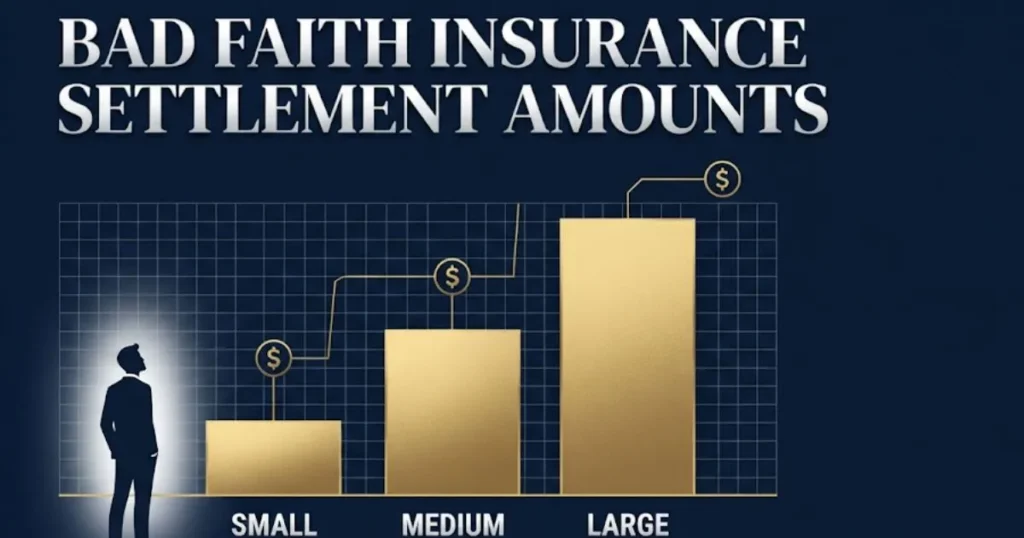
Bad faith insurance settlement amounts range from $15,000 for simple cases to $10 million or more for cases involving egregious conduct and large underlying claims. The wide range reflects how much these cases depend on specific facts.
Several factors determine your potential recovery:
- Size of the underlying claim. A denied $200,000 homeowner’s claim will produce a larger bad faith recovery than a denied $5,000 auto claim.
- Severity of the insurer’s conduct. Did they simply delay, or did they actively fabricate reasons to deny your claim?
- Emotional impact. Did the denial cause you to lose your home, go into debt, or suffer psychological harm?
- Duration of the bad faith. Was it a single wrongful denial or a pattern over months or years?
- State law. States that allow punitive damages and emotional distress claims produce larger settlements.
| Case Type | Typical Settlement Range |
|---|---|
| Auto claim bad faith | $15,000 to $150,000 |
| Homeowner’s claim bad faith | $50,000 to $500,000 |
| Health insurance bad faith | $75,000 to $1,000,000 |
| Disability insurance bad faith | $100,000 to $2,000,000 |
| Life insurance bad faith | $100,000 to $5,000,000 |
| Systemic/class action bad faith | $1,000,000 to $100,000,000+ |
Real examples from recent years: A 2023 Oregon case settled for $3.2 million after an auto insurer denied a UIM claim. A 2024 Arizona case produced a $7.5 million jury verdict on a denied homeowner’s claim after a wildfire.
Keep in mind that these numbers represent total recovery before attorney fees and costs. Your net recovery after a 33% contingency fee on a $300,000 settlement would be approximately $200,000.
Punitive Damages Bad Faith Insurance
Punitive damages in a bad faith insurance case are extra money awarded to punish the insurer and deter similar conduct in the future. They go beyond compensating you for your losses. They exist to send a message.
Not every bad faith case qualifies for punitive damages. You typically must prove the insurer’s conduct was:
- Willful or wanton
- Malicious or fraudulent
- Done with reckless disregard for your rights
The threshold is higher than ordinary negligence. A simple mistake in claims handling probably will not trigger punitive damages. But a deliberate scheme to deny valid claims, or a corporate policy designed to minimize payouts regardless of merit, absolutely can.
| State | Punitive Damages Available? | Cap or Limit |
|---|---|---|
| New Mexico | Yes | No statutory cap |
| California | Yes | No fixed cap; must be reasonable |
| Texas | Yes | Capped at 2x economic + up to $750,000 |
| Florida | Yes | 3x compensatory or $500,000 (whichever is greater) |
| New York | Limited | Generally not available in contract cases |
| Arizona | Yes | No statutory cap |
New Mexico is one of the most plaintiff-friendly states for punitive damages. There is no cap. Juries can award whatever amount they believe is necessary to punish and deter. In practice, New Mexico punitive damages awards in bad faith cases have ranged from $100,000 to over $20 million.
The threat of punitive damages is often what forces a settlement. Insurers fear the unpredictability of a jury deciding how much punishment is appropriate. That fear is your strongest bargaining chip.
Key Takeaway: Punitive damages are the nuclear option in bad faith cases, and they are available in most states. New Mexico’s lack of a punitive damages cap makes it one of the strongest states for policyholders.
What Damages Can You Recover Bad Faith Insurance
The damages you can recover in a bad faith insurance case fall into three categories: contract damages, extra-contractual (tort) damages, and punitive damages. Your total recovery depends on what your state allows and how badly the insurer behaved.
Contract damages include:
- The policy benefits you were owed (the original claim amount)
- Interest on the delayed payment
- Attorney fees and litigation costs (in states that allow them)
Extra-contractual (tort) damages include:
- Emotional distress caused by the denial or delay
- Financial harm beyond the policy amount (lost home, bankruptcy, damaged credit)
- Loss of use (for property claims)
- Medical expenses resulting from stress or untreated conditions
Punitive damages are awarded separately to punish the insurer.
| Damage Category | Examples | Availability |
|---|---|---|
| Contract | Policy benefits, interest | All states |
| Emotional distress | Anxiety, depression, PTSD | Most states (varies) |
| Financial consequential | Foreclosure, bankruptcy costs | Many states |
| Attorney fees | Lawyer costs reimbursed | Some states (statutory) |
| Punitive | Punishment for egregious conduct | Most states (with limits) |
In a strong case, your total recovery could be 3 to 10 times the value of the original claim. A $100,000 denied homeowner’s claim could produce a $500,000 verdict when emotional distress and punitive damages are included.
Some states also allow recovery of attorney fees by statute. This is significant because bad faith cases are expensive to litigate. Getting your fees paid by the losing insurer means you keep more of the compensatory award.
The key to maximizing damages is documentation. Keep records of every financial consequence you suffered because of the denial. Medical bills for stress-related treatment, late fees on your mortgage, credit score drops, temporary housing costs. All of it matters.
New Mexico Bad Faith Insurance Lawsuit
A New Mexico bad faith insurance lawsuit is governed by both common law and the New Mexico Unfair Insurance Practices Act, codified at NMSA 59A-16-20. New Mexico is widely considered one of the most pro-policyholder states in the country for bad faith claims.
The New Mexico Supreme Court has established that insurance companies owe a duty of good faith and fair dealing to their policyholders. This duty is implied in every insurance contract. Violating it gives rise to both contract and tort claims.
Key features of New Mexico bad faith law in 2026:
- No cap on punitive damages. Juries have full discretion.
- Emotional distress damages are recoverable without requiring physical injury.
- The Unfair Insurance Practices Act provides an independent cause of action. You can sue under both common law and the statute.
- Attorney fees may be recoverable under certain circumstances.
- Statute of limitations: 4 years for tort claims, 6 years for contract claims.
| NM Bad Faith Element | Detail |
|---|---|
| Legal basis | Common law + NMSA 59A-16-20 |
| Punitive damages | Available, no cap |
| Emotional distress | Recoverable |
| Statute of limitations | 4 years (tort) / 6 years (contract) |
| Attorney fees | Potentially recoverable |
| Key court | NM Supreme Court, NM Court of Appeals |
Notable New Mexico cases include Sloan v. State Farm, which reinforced that insurers must give equal consideration to the policyholder’s interests. The court ruled that an insurer cannot prioritize its own financial interests over its duty to the insured.
New Mexico’s combination of no punitive damages cap and broad emotional distress recovery makes it one of the best states to bring a bad faith lawsuit. Insurers operating in New Mexico know this, which often leads to larger pre-trial settlements to avoid the risk of a runaway jury verdict.
If you are a New Mexico policyholder and your insurer has denied or underpaid your claim, the legal landscape is strongly in your favor.
Bad Faith Lawsuit Against Insurance Company
A bad faith lawsuit against an insurance company is a civil action where you, the policyholder, hold your insurer accountable for dishonest or unreasonable claims handling. This type of lawsuit has grown significantly in volume over the past decade, and 2026 trends suggest continued expansion of policyholder rights.
These lawsuits can be filed against any type of insurer:
- Auto insurance companies (State Farm, GEICO, Progressive, Allstate)
- Homeowner’s insurance companies (Farmers, Liberty Mutual, Nationwide)
- Health insurance companies (UnitedHealthcare, Anthem, Cigna)
- Life insurance companies (MetLife, Prudential, Lincoln Financial)
- Disability insurance companies (Unum, Hartford, Guardian)
| Insurer Category | Most Common Bad Faith Conduct |
|---|---|
| Auto | Lowball total loss valuations, UIM claim denials |
| Homeowner’s | Storm damage denials, delayed payments |
| Health | Prior authorization denials, coverage disputes |
| Life | Beneficiary claim denials, contestability disputes |
| Disability | Premature benefit termination, surveillance abuse |
The playing field is not level. Insurance companies have billions in resources and dedicated legal teams. But the law is designed to protect you. Courts recognize that policyholders are at a significant disadvantage, which is why bad faith law exists in the first place.
In 2026, several trends are shaping bad faith litigation. Artificial intelligence used by insurers to auto-deny claims is facing legal challenges. Regulators in multiple states are investigating whether algorithm-driven denials violate unfair claims practices laws. This could open new avenues for bad faith lawsuits.
Class action bad faith cases are growing too. When an insurer applies the same unfair practice to thousands of policyholders, a class action allows all affected people to sue together. These cases produce the largest settlements.
Filing a bad faith lawsuit against your insurance company is not just about recovering what you are owed. It forces the company to change how it treats policyholders. Every successful verdict raises the cost of bad behavior.
Key Takeaway: You can file a bad faith lawsuit against virtually any type of insurance company, and 2026 trends including AI-driven claim denials are creating new legal grounds for policyholders to fight back.
Frequently Asked Questions
What qualifies as a bad faith insurance lawsuit in 2026?
A bad faith insurance lawsuit qualifies when an insurer unreasonably denies, delays, or underpays a valid claim without a legitimate basis.
The insurer must have owed you a duty under the policy and breached that duty through unfair conduct.
In 2026, AI-driven denials and algorithmic claims handling are emerging as new grounds for bad faith claims.
How much can you get from a bad faith insurance settlement?
Most bad faith settlements range from $15,000 to $5 million depending on the underlying claim and severity of misconduct.
Cases involving punitive damages can exceed $10 million.
Your net recovery will be reduced by attorney fees, typically 33% to 40% of the total.
How long does a bad faith insurance lawsuit take to resolve?
The average bad faith insurance lawsuit takes 18 to 36 months from filing to resolution.
About 85% to 90% of cases settle before trial.
Complex cases or those involving appeals can take 3 to 5 years.
Can you sue your insurance company for denying a valid claim?
Yes, you can sue your insurance company if it denied a valid claim without a reasonable basis.
A wrongful denial is one of the most common grounds for a bad faith lawsuit.
You may recover the original claim amount plus emotional distress and punitive damages.
What is the statute of limitations for a bad faith insurance lawsuit?
The statute of limitations ranges from 1 to 6 years depending on your state and legal theory.
In New Mexico, the deadline is 4 years for tort claims and 6 years for contract claims.
Missing the deadline permanently bars your case regardless of its merits.
Bad faith insurance lawsuits are one of the most powerful tools available to policyholders in 2026. If your insurer treated you unfairly, the law gives you a real path to hold them accountable.
Check your state’s statute of limitations immediately. Gather your documents. Talk to a bad faith insurance lawyer who has actual trial experience. The sooner you act, the stronger your position.
Your insurance company bet that you would not fight back. Prove them wrong.







