

The JPMorgan Chase interest rate lawsuit is one of the biggest banking class actions heading into 2026, with millions of customers potentially owed money for alleged interest rate manipulation and overcharges. If you hold a Chase savings account, mortgage, credit card, or auto loan, this case could directly affect your wallet.
This guide breaks down everything you need to know. You will learn what JPMorgan Chase is accused of doing, which accounts are involved, how much money you might receive, and exactly how to file a claim before the deadline passes.
Here is one fact worth knowing right away: some estimates suggest Chase customers could recover anywhere from $50 to $1,500 per account, depending on the type of product and how long the alleged overcharging lasted. That is real money sitting on the table.
Let’s get into the details.
JPMorgan Chase Interest Rate Lawsuit 2026
The JPMorgan Chase interest rate lawsuit in 2026 refers to a group of class action and individual claims alleging that JPMorgan Chase & Co. manipulated, withheld, or unfairly adjusted interest rates on consumer banking products. These claims span multiple account types, including savings accounts, mortgages, credit cards, and auto loans.
The core accusation is straightforward. Chase allegedly kept savings account interest rates artificially low while simultaneously charging borrowers higher rates than what market conditions justified. Think of it like a casino where the house always wins, except here the “house” is the largest bank in the United States.
Several of these cases have been consolidated in federal court. The U.S. District Court for the Southern District of New York is handling key proceedings.
| Detail | Info |
|---|---|
| Primary Defendant | JPMorgan Chase & Co. / Chase Bank N.A. |
| Case Type | Class Action / Multi-District Litigation |
| Court | U.S. District Court, Southern District of New York |
| Accounts Involved | Savings, Mortgage, Credit Card, Auto Loan |
| Status as of 2026 | Active litigation with settlement discussions |
The lawsuits gained momentum after federal regulators, including the Consumer Financial Protection Bureau, flagged concerns about Chase’s interest rate practices. Consumer complaints spiked between 2022 and 2025, pushing legal teams to consolidate claims.
What makes 2026 different is timing. Several of these cases are approaching class certification or settlement negotiations, which means real money could start moving toward affected customers this year.
JPMorgan Chase Interest Rate Manipulation
JPMorgan Chase interest rate manipulation refers to allegations that the bank deliberately set interest rates on consumer products at levels designed to maximize profit at the expense of customers, rather than reflecting true market conditions.
On the savings side, plaintiffs allege Chase paid interest rates as low as 0.01% APY on standard savings accounts even when the federal funds rate climbed above 5%. That gap between what Chase earned on deposited money and what it paid customers is at the heart of these claims.
On the lending side, borrowers claim Chase applied rate adjustments, margin calculations, and index selections that resulted in them paying more interest than their loan agreements should have allowed.
- Chase allegedly failed to pass along rate increases to savings customers
- Mortgage borrowers claim Chase used outdated rate benchmarks to inflate costs
- Credit card holders allege variable rate calculations favored the bank
- Auto loan customers report rate markups beyond what their creditworthiness justified
The legal theory rests on breach of contract, unjust enrichment, and violations of the Truth in Lending Act (TILA). Some plaintiffs also cite the Real Estate Settlement Procedures Act (RESPA) for mortgage-related claims.
The manipulation allegations are not entirely new for JPMorgan. The bank paid $920 million in 2020 to settle charges related to market manipulation in precious metals and Treasuries. That history of rate-related misconduct strengthens the current plaintiffs’ arguments.
Chase Bank Interest Rate Class Action
A Chase Bank interest rate class action is a lawsuit filed on behalf of a large group of customers who experienced the same type of harm from Chase’s interest rate practices. Instead of each customer suing individually, one or more “named plaintiffs” represent everyone in the class.
This is how class actions work in practice. A few people step forward, file the case, and if the court certifies the class, every qualifying customer gets included automatically. You do not have to do anything to be part of the class unless you choose to opt out.
Several class actions related to Chase interest rates are pending in 2026. The most significant ones involve:
| Class Action Type | Primary Allegation | Approximate Class Size |
|---|---|---|
| Savings Account Class | Artificially low APY on deposits | Tens of millions of customers |
| Mortgage Rate Class | Inflated rate margins on home loans | Hundreds of thousands of borrowers |
| Credit Card Rate Class | Unfair variable rate adjustments | Millions of cardholders |
| Auto Loan Rate Class | Rate markups beyond risk-based pricing | Hundreds of thousands of borrowers |
Class certification is a critical milestone. Once a court certifies the class, JPMorgan faces the prospect of paying damages to every member, not just the named plaintiffs. This is often the point where settlement talks accelerate.
In 2026, at least two of these classes are expected to receive certification rulings. That makes this year a pivotal one for affected customers.
Chase Bank Interest Rate Lawsuit Update
The latest Chase Bank interest rate lawsuit update as of 2026 shows the litigation is moving toward resolution on multiple fronts. Court filings from early 2026 indicate that both sides have exchanged discovery materials, expert reports have been submitted, and mediation sessions have been scheduled.
Here is what has happened recently:
- Q4 2025: Plaintiffs filed amended complaints adding new allegations about Chase’s internal rate-setting policies
- Q1 2026: The court ordered mediation between the parties in the savings account class action
- Q2 2026 (projected): Class certification hearing scheduled for the mortgage rate claims
- Late 2026 (projected): Possible preliminary settlement approval in one or more cases
JPMorgan Chase has denied all allegations. The bank’s legal team argues that its interest rate practices comply with all applicable laws and that customers agreed to the rate terms in their account agreements.
That defense is standard in banking litigation. But courts have increasingly scrutinized the gap between what banks earn on deposits and what they pay customers, especially during periods of rising federal interest rates.
Key Takeaway: The JPMorgan Chase interest rate lawsuits are active in 2026 with class certification hearings, mediation, and potential settlement discussions all on the calendar, making this a critical year for affected customers to pay attention.
JPMorgan Chase Savings Account Interest Rate Lawsuit
The JPMorgan Chase savings account interest rate lawsuit is arguably the broadest claim in this litigation. It alleges that Chase deliberately kept savings account APYs near zero while earning substantially higher returns on customer deposits.
To put this in real terms: between 2022 and 2025, the Federal Reserve raised rates aggressively. Banks like Chase earned 4% to 5% or more by lending out depositor money. Yet Chase’s standard savings account paid just 0.01% APY for most of that period.
Online banks and competitors were offering 4% to 5% APY on savings accounts during the same timeframe. Chase’s refusal to raise rates created a massive gap.
| Year | Federal Funds Rate | Chase Standard Savings APY | Top Online Savings APY |
|---|---|---|---|
| 2022 | 4.25% to 4.50% | 0.01% | 3.50% to 4.00% |
| 2023 | 5.25% to 5.50% | 0.01% | 4.50% to 5.25% |
| 2024 | 4.50% to 5.00% | 0.01% | 4.00% to 4.75% |
| 2025 | 4.00% to 4.50% | 0.01% to 0.02% | 3.75% to 4.50% |
Plaintiffs argue this gap constitutes unjust enrichment. Chase profited enormously from depositor funds while passing virtually none of those earnings back to account holders.
The class potentially includes tens of millions of customers. Even a modest per-account payout would add up to billions of dollars in potential liability for JPMorgan.
This claim hits especially hard for customers who kept large balances in Chase savings accounts, trusting the bank to offer competitive returns. Many lost thousands of dollars in potential interest earnings over several years.
Chase Mortgage Interest Rate Lawsuit
The Chase mortgage interest rate lawsuit centers on allegations that JPMorgan Chase applied inflated interest rate margins, used disadvantageous rate indices, and failed to properly adjust rates on variable-rate mortgages.
Borrowers with adjustable-rate mortgages (ARMs) are the primary affected group. The lawsuit alleges Chase used rate benchmarks and calculation methods that consistently resulted in higher payments than what the mortgage terms should have produced.
Some specific allegations include:
- Using LIBOR-based calculations even after the transition to SOFR, resulting in higher rates
- Applying rate floors that prevented downward adjustments when market rates dropped
- Charging origination rate markups that exceeded the risk profile of borrowers
- Failing to disclose the full methodology behind rate adjustment calculations
| Mortgage Claim Type | Allegation | Potential Impact |
|---|---|---|
| ARM Rate Adjustment | Rates not properly lowered when market rates fell | Overpayments of $100 to $500 per month |
| Rate Lock Disputes | Lock periods expired due to Chase processing delays | Borrowers forced into higher rates |
| Origination Markup | Rates marked up beyond creditworthiness | Thousands in excess interest over loan life |
| Index Selection | Disadvantageous benchmark used for calculations | Systematic overcharging on all adjustments |
Mortgage claims tend to involve larger dollar amounts than savings account claims. A borrower who overpaid even half a percentage point on a $300,000 mortgage over five years could be owed $7,500 or more in excess interest.
These claims are being closely watched by consumer advocates and the CFPB, which has made mortgage rate transparency a priority in recent years.
JPMorgan Chase Credit Card Interest Rate Lawsuit
The JPMorgan Chase credit card interest rate lawsuit alleges that Chase improperly calculated variable interest rates on credit cards, resulting in cardholders paying more than they should have.
Chase credit cards typically carry variable APRs tied to the prime rate. The lawsuit claims Chase added margin percentages that were higher than what cardholders were originally promised or that Chase manipulated the timing of rate adjustments to benefit the bank.
When the prime rate went up, Chase raised credit card rates quickly. When the prime rate dropped, those reductions came slowly or not at all. This asymmetric adjustment pattern is sometimes called “rocket up, feather down” pricing.
- Cardholders allege APR increases happened within one billing cycle of rate hikes
- APR decreases allegedly took two to three billing cycles to appear
- Some cardholders report rates never decreased despite multiple Fed rate cuts
- Balance transfer promotional rates allegedly converted to inflated standard rates
Quick Facts:
- Average Chase credit card APR in 2025: 22.49% to 29.99%
- Average competitor APR: 20.99% to 27.99%
- Alleged overcharge per cardholder: $75 to $600 annually
- Potential class size: Millions of active cardholders
For someone carrying a $5,000 balance, even a 2% APR overcharge means roughly $100 per year in unnecessary interest. Over three to five years, that adds up fast.
The credit card claims strengthen the overall case by showing a pattern. If Chase engaged in similar rate manipulation across savings, mortgages, and credit cards, it suggests a systemic corporate strategy rather than isolated decisions.
Key Takeaway: JPMorgan Chase allegedly manipulated interest rates across four major product categories, from savings accounts paying near-zero APY to credit cards and mortgages charging inflated rates, creating a pattern of systemic overcharging that could affect tens of millions of customers.
Chase Auto Loan Interest Rate Overcharge Lawsuit
The Chase auto loan interest rate overcharge lawsuit accuses JPMorgan Chase of marking up interest rates on auto loans beyond what a borrower’s credit profile justified, with some claims also alleging discriminatory pricing practices.
Auto loan rate markups work like this. Chase receives a “buy rate” from its own underwriting, which is the lowest rate a borrower qualifies for based on credit score and other factors. The dealer or Chase’s own lending division then adds a markup. Plaintiffs allege these markups were excessive and inconsistent.
Some borrowers with strong credit reportedly received rates 2% to 4% higher than their buy rate. Over a 60-month auto loan on a $35,000 vehicle, that markup could cost a borrower $1,800 to $3,600 in excess interest payments.
| Borrower Credit Tier | Alleged Buy Rate | Alleged Rate Charged | Estimated Excess Interest (60 months, $35K loan) |
|---|---|---|---|
| Excellent (750+) | 4.5% | 6.5% to 7.5% | $1,800 to $2,700 |
| Good (700 to 749) | 6.0% | 8.5% to 9.5% | $2,200 to $3,100 |
| Fair (650 to 699) | 8.0% | 11.0% to 12.5% | $2,700 to $3,600 |
The auto loan claims carry an additional layer. Some plaintiffs allege that the rate markups disproportionately affected minority borrowers, raising potential violations of the Equal Credit Opportunity Act (ECOA).
The CFPB has previously taken action against other lenders for similar auto loan markup practices. That regulatory history gives plaintiffs a stronger foundation for their claims against Chase.
JPMorgan Chase Lawsuit Settlement 2026
A JPMorgan Chase lawsuit settlement in 2026 is a real possibility based on the current pace of litigation. Settlement talks are underway in at least two of the consolidated cases, and court-ordered mediation suggests both sides recognize the value of resolving claims without a full trial.
Settlements in banking class actions typically follow a predictable pattern. The parties negotiate a total settlement fund, the court reviews it for fairness, customers receive notice, and then payouts are distributed.
Here is the projected settlement timeline for 2026:
| Phase | Projected Timing |
|---|---|
| Mediation Sessions | Q1 to Q2 2026 |
| Preliminary Settlement Agreement | Q2 to Q3 2026 |
| Court Preliminary Approval | Q3 2026 |
| Notice Period for Class Members | Q3 to Q4 2026 |
| Objection and Opt-Out Deadline | Q4 2026 |
| Final Approval Hearing | Late Q4 2026 or Q1 2027 |
| Payout Distribution | Q1 to Q2 2027 |
The total settlement fund could range from $500 million to over $2 billion, depending on how many claims are consolidated and what the court determines as the scope of affected customers.
JPMorgan Chase generated $49.6 billion in net revenue in 2024 alone. A settlement in the low billions, while significant, would not threaten the company’s financial stability. This makes settlement more likely than a drawn-out trial.
For reference, Wells Fargo paid $3.7 billion in 2022 to settle claims involving improper fees and interest charges. JPMorgan’s case involves similar conduct across a potentially larger customer base.
JPMorgan Chase Class Action Settlement Payout
The JPMorgan Chase class action settlement payout is what most people care about. How much money will actually reach your bank account?
Individual payouts in banking class actions vary widely based on the settlement fund size, the number of claimants, the type of account, and how long the alleged overcharging lasted. Based on precedent from similar cases and the scope of these claims, here are reasonable payout estimates:
| Account Type | Estimated Payout Range | Factors Affecting Amount |
|---|---|---|
| Savings Account | $25 to $250 | Account balance, duration of low APY |
| Mortgage (ARM) | $500 to $5,000 | Loan size, overpayment duration, rate differential |
| Credit Card | $50 to $600 | Average balance carried, APR overcharge amount |
| Auto Loan | $200 to $1,500 | Loan amount, rate markup percentage, loan term |
These numbers are estimates based on similar banking settlements. The actual amounts will depend on the final settlement terms and how many customers file valid claims.
Here is an important detail that often gets overlooked. In most class actions, only 5% to 15% of eligible class members actually file claims. If fewer people file, each claimant gets a larger share of the settlement fund.
That means filing your claim is not just a formality. It directly affects how much money you receive.
How Much Will I Get From the JPMorgan Chase Interest Rate Lawsuit?
Your payout from the JPMorgan Chase interest rate lawsuit depends on which accounts you hold, how long you have been a customer, and the specific overcharge amounts associated with your accounts.
Let’s break this down with real-world examples:
Example 1: Savings Account Customer
Sarah kept an average balance of $20,000 in her Chase savings account from 2022 to 2025. At 0.01% APY, she earned about $8 total over three years. At a competitive 4.5% APY, she would have earned roughly $2,700. Her potential claim value: approximately $2,692 in lost interest, though her actual settlement payout would be a fraction of that, likely $100 to $250.
Example 2: Mortgage Borrower
David has a $400,000 ARM with Chase. His rate was allegedly marked up by 0.75% above what market benchmarks dictated. Over four years, that translates to roughly $12,000 in excess interest. His estimated settlement payout: $1,000 to $3,000.
Example 3: Credit Card Holder
Maria carried an average $3,500 balance on her Chase credit card with an APR that was allegedly 1.5% higher than it should have been. Annual overcharge: about $52.50. Over four years: approximately $210. Her estimated payout: $50 to $150.
Key Takeaway: Settlement payouts will vary significantly by account type, with mortgage borrowers likely receiving the largest individual payments and savings account holders receiving smaller but still meaningful amounts, especially if participation rates stay low and the settlement fund is divided among fewer claimants.
Chase Bank Overcharging Interest
Chase Bank overcharging interest is the central allegation tying all of these lawsuits together. Whether you had a savings account earning almost nothing or a loan charging too much, the common thread is that Chase allegedly kept more of your money than it was entitled to.
The overcharging took different forms depending on the product:
- Savings accounts: Chase kept rates at 0.01% while earning 4% to 5% on customer deposits
- Mortgages: Rate margins were allegedly inflated beyond contractual terms
- Credit cards: Variable APR adjustments favored the bank on both rate increases and decreases
- Auto loans: Rate markups exceeded what borrowers’ credit profiles warranted
What makes this especially frustrating for customers is that Chase is not some obscure financial institution. It is the largest bank in the United States by total assets, with over $3.9 trillion under management. The bank reported $58.5 billion in net interest income in 2024.
A significant portion of that income came from the spread between what Chase earned on customer deposits and what it paid those same customers in interest. That spread is at the heart of these lawsuits.
The term “overcharging interest” covers both sides of the coin. Paying too little on deposits is effectively the same as charging too much. Chase profited from both directions simultaneously.
Consumer advocates have pointed out that Chase’s internal documents, revealed through discovery, show the bank was fully aware its savings rates were dramatically below market. Despite this knowledge, the bank chose not to raise rates because doing so would have reduced quarterly profits.
JPMorgan Chase Lawsuit Eligibility
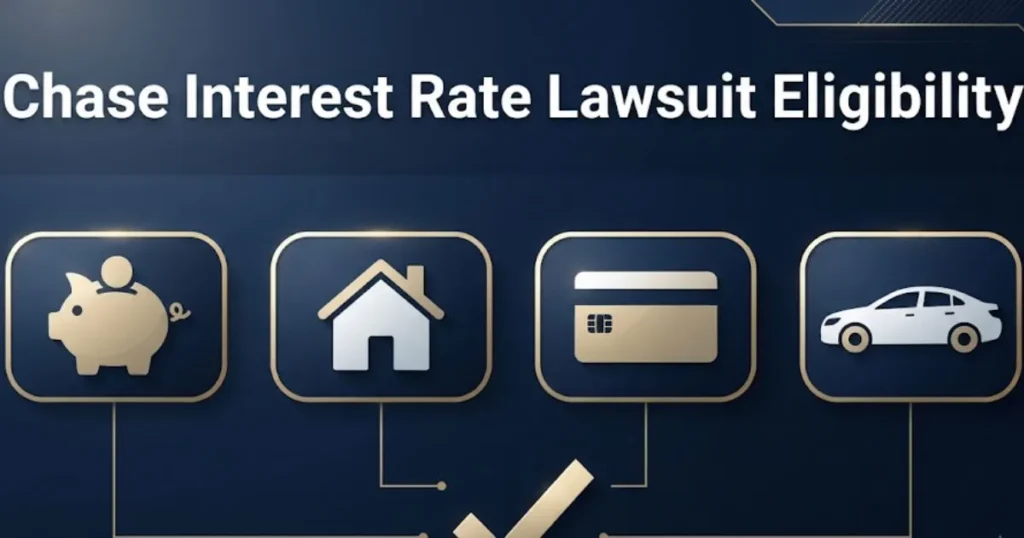
JPMorgan Chase lawsuit eligibility depends on the specific class action and the type of account you hold. Generally, you may be eligible if you had a qualifying Chase account during the relevant time period and were affected by the interest rate practices at issue.
Here are the general eligibility criteria across the different claims:
| Claim Type | Who Is Eligible | Time Period |
|---|---|---|
| Savings Account Class | Any customer with a Chase savings account earning below-market rates | January 2020 to present |
| Mortgage Rate Class | Borrowers with Chase ARMs or rate lock disputes | January 2019 to present |
| Credit Card Rate Class | Chase credit cardholders with variable APR accounts | January 2020 to present |
| Auto Loan Rate Class | Chase auto loan borrowers with alleged rate markups | January 2018 to present |
You do not need to prove that you personally lost a specific amount of money. Class action eligibility is typically based on simply being a member of the affected group during the relevant period.
There are some exclusions. Business accounts are generally not covered. Customers who previously settled individual claims with Chase on the same issues may be excluded. And customers who opted out of arbitration clauses in their account agreements have different options.
If you are not sure whether you qualify, the safest approach is to file a claim anyway. The settlement administrator will verify eligibility based on Chase’s internal records.
Who Qualifies for the Chase Interest Rate Lawsuit?
You qualify for the Chase interest rate lawsuit if you held one or more eligible Chase accounts during the affected time period and experienced the rate practices at issue. Here is a simple checklist:
You likely qualify if:
- You had a Chase savings account with a balance above $0 from 2020 to present
- You had a Chase adjustable-rate mortgage originated or adjusted from 2019 to present
- You carried a balance on a Chase credit card with variable APR from 2020 to present
- You had a Chase auto loan originated from 2018 to present
- You were a U.S. resident during the affected period
You likely do NOT qualify if:
- Your only Chase product was a checking account (not included in current claims)
- You held a business or commercial account only
- You already settled an individual claim with Chase on the same issue
- You signed an arbitration agreement and did not opt out (varies by claim)
One thing that catches people off guard: you may qualify even if you closed your account. Former Chase customers who held qualifying accounts during the relevant period are still class members. The key factor is whether you had the account during the time the alleged overcharging occurred, not whether you still have it today.
If you had multiple account types with Chase, you could qualify for multiple classes. A customer with both a savings account and a Chase credit card might be eligible for payouts from two separate settlement funds.
How to File a Claim Against JPMorgan Chase
To file a claim against JPMorgan Chase, you will need to submit a proof of claim form through the designated settlement administrator once a settlement receives preliminary court approval.
Here is the expected step-by-step process:
Step 1: Receive or locate the claim notice
Once the court approves a settlement, a notice will be sent to all identified class members. This typically arrives by mail or email at the address Chase has on file for your account.
Step 2: Verify your eligibility
Check the notice to confirm your account type, account number, and the relevant time period. The notice will specify exactly which customers are included.
Step 3: Complete the claim form
Fill out the proof of claim form. This will ask for your name, contact information, Chase account number(s), and the approximate time period you held the account.
Step 4: Gather supporting documentation
While not always required, having old account statements, loan documents, or rate disclosure forms can strengthen your claim and potentially increase your payout.
Step 5: Submit before the deadline
Submit your completed claim form by the stated deadline. Late claims are almost always rejected.
| Filing Method | Details |
|---|---|
| Online | Through the settlement administrator’s claim portal |
| By Mail | Print and mail the claim form to the administrator’s address |
| Required Info | Name, address, Chase account number, account type |
| Supporting Docs | Account statements, loan agreements (optional but helpful) |
You do not need to hire a lawyer to file a claim. The process is designed for individual consumers to complete on their own.
Key Takeaway: Filing a claim is free, does not require a lawyer, and typically involves a simple form with your account details, but you must submit it before the deadline to receive any payout.
Chase Interest Rate Lawsuit Deadline
The Chase interest rate lawsuit deadline is the date by which you must file your claim to receive payment from any settlement. Missing this deadline means forfeiting your right to compensation, even if you are a verified class member.
As of 2026, specific deadlines have not been finalized for all claims because some cases are still in pre-settlement phases. However, based on the projected timeline, here is what to expect:
| Milestone | Projected Date |
|---|---|
| Settlement Notice Mailed | Q3 2026 |
| Claim Filing Period Opens | Q3 2026 |
| Claim Filing Deadline | 60 to 90 days after notice (Q4 2026) |
| Opt-Out Deadline | Same as claim deadline |
| Objection Deadline | Same as claim deadline |
In most class action settlements, the claim filing window runs 60 to 90 days from the date the official notice is distributed. That may sound like plenty of time, but it passes quickly.
Here is a practical tip: set a calendar reminder as soon as you receive your notice. Do not wait until the last week. Settlement administrator websites sometimes experience high traffic near deadlines, and mailed forms need to arrive by the deadline, not be postmarked by it.
If you believe you are an affected customer but do not receive a notice, you can proactively check with the settlement administrator or monitor court filings in the U.S. District Court for the Southern District of New York.
The statute of limitations for individual claims varies by state and claim type, but generally ranges from 3 to 6 years from the date the alleged overcharge occurred.
JPMorgan Chase Interest Rate Lawsuit Filing Process
The JPMorgan Chase interest rate lawsuit filing process differs depending on whether you are joining the class action or pursuing an individual claim. Most customers will participate through the class action, which is simpler and does not require personal legal representation.
Class Action Participation (Most Common):
If you are a class member, you are automatically included in the lawsuit unless you opt out. To receive a settlement payout, you simply file a claim form when the settlement is approved.
Individual Lawsuit (Less Common):
Some customers with large claims, particularly mortgage borrowers with significant overcharges, may choose to opt out of the class action and file their own lawsuit. This approach can potentially yield a higher payout but requires hiring an attorney and going through individual litigation.
Here is a comparison of the two paths:
| Factor | Class Action | Individual Lawsuit |
|---|---|---|
| Cost to You | Free | Attorney fees (typically 33% to 40% of recovery) |
| Effort Required | Fill out a claim form | Active participation in litigation |
| Potential Payout | Fixed share of settlement fund | Potentially higher but not guaranteed |
| Timeline | Follows court schedule | Could be faster or slower |
| Risk | Minimal | Risk of losing and recovering nothing |
| Best For | Most customers | Customers with large, provable losses |
For the vast majority of affected Chase customers, participating in the class action is the smarter choice. The process is free, requires minimal effort, and carries no risk.
Only customers with documented losses exceeding $10,000 should seriously consider opting out to pursue individual claims. Even then, consulting with a consumer rights attorney before making that decision is strongly recommended.
The filing process is intentionally designed to be accessible. Banks like JPMorgan fight hard against class certification precisely because these claims are so easy for consumers to join once a settlement is reached.
Frequently Asked Questions
Is there a class action lawsuit against JPMorgan Chase for interest rates in 2026?
Yes, multiple class action lawsuits against JPMorgan Chase over interest rate practices are active in 2026.
Cases cover savings accounts, mortgages, credit cards, and auto loans.
Settlement discussions and class certification hearings are expected throughout the year.
How much money can I get from the Chase interest rate lawsuit?
Estimated payouts range from $25 to $5,000 depending on your account type and the duration of alleged overcharging.
Mortgage borrowers may receive the highest individual payments.
Savings account holders can expect smaller amounts, typically $25 to $250.
What is the deadline to file a claim in the JPMorgan Chase lawsuit?
The claim filing deadline is expected to fall in Q4 2026, approximately 60 to 90 days after settlement notices are distributed.
Exact dates will be published once the court grants preliminary settlement approval.
Set a reminder as soon as you receive your notice to avoid missing the window.
Do I need a lawyer to join the Chase interest rate class action?
No, you do not need a lawyer to participate in the class action.
The claim process involves filling out a simple form with your account details.
Attorneys representing the class handle all legal work, and their fees come from the settlement fund, not from you.
Which Chase accounts are covered by the interest rate lawsuit?
The lawsuits cover Chase savings accounts, adjustable-rate mortgages, variable-rate credit cards, and auto loans.
Standard checking accounts are generally not included in the current claims.
Both current and former account holders may be eligible if they held qualifying accounts during the affected time periods.
What to Do Next
The JPMorgan Chase interest rate lawsuit is real, it is active, and 2026 is the year when settlement outcomes start taking shape. If you had a Chase savings account, mortgage, credit card, or auto loan during the affected time periods, you may be owed money.
Keep your old account statements. Watch your mail and email for a class action notice. When the claim form becomes available, fill it out promptly.
This is your money. The only way to lose it is by doing nothing.







