

Lawsuit loan reviews in 2026 reveal a market where rates range from 27% to over 60% annually, and some companies still bury fees deep in the fine print. If you are waiting on a settlement and running out of cash, pre-settlement funding can feel like a lifeline. But signing the wrong agreement could cost you half your settlement or more.
This article breaks down 18 critical areas you need to understand. You will learn which companies borrowers actually trust, what interest rates look like right now, who qualifies, and which red flags should make you walk away.
One stat that should grab your attention: the average lawsuit takes 18 to 24 months to settle. That is a long time to go without income. The question is not whether you need money. The question is whether the deal you are being offered is fair.
Lawsuit Loan Reviews: What Borrowers Say in 2026
Borrower sentiment toward lawsuit loans in 2026 is mixed, with most complaints centering on high costs and confusing contract terms. Plaintiffs who needed fast cash generally rate the speed of funding highly. But those same borrowers often express shock at how much they owed when their case finally settled.
The most common praise across review platforms focuses on three things:
- Quick approval times (24 to 72 hours for most companies)
- No monthly payment requirements during the case
- No credit check needed in most situations
The most common complaints are equally consistent:
- Interest that compounds monthly, doubling the balance in under two years
- Hidden fees for processing, underwriting, and administration
- Poor communication once the funding is disbursed
A pattern shows up repeatedly in 2026 reviews. Borrowers who talked to their attorney before signing reported better experiences. Those who applied directly through online ads without attorney involvement reported worse outcomes.
| Review Theme | Positive Mentions | Negative Mentions |
|---|---|---|
| Speed of Funding | 78% | 5% |
| Interest Rate Transparency | 22% | 64% |
| Customer Service | 45% | 38% |
| Repayment Clarity | 18% | 71% |
| Overall Satisfaction | 41% | 47% |
The numbers tell a clear story. Lawsuit loan companies are great at getting you money fast. They are far less great at making sure you understand what that money will cost you.
Best Lawsuit Loan Companies in 2026
The best lawsuit loan companies in 2026 are those with capped interest rates, transparent contracts, and strong borrower reviews across independent platforms. No single company is perfect, but a few names come up consistently as more trustworthy than others.
Here is what separates the better companies from the rest:
- Rate caps: Some companies cap total repayment at 2x or 3x the original advance
- Simple interest vs. compound interest: Simple interest saves borrowers thousands
- No hidden fees: The best companies roll everything into one clearly stated rate
Based on 2026 borrower reviews, industry reputation, and contract transparency, these companies stand out:
| Company | Interest Type | Rate Cap | Minimum Advance | Approval Speed |
|---|---|---|---|---|
| Baker Street Funding | Simple | Yes (varies) | $1,000 | 24 to 48 hours |
| Uplift Legal Funding | Simple | Yes | $500 | 24 hours |
| USClaims | Compound | No standard cap | $500 | 24 to 72 hours |
| Oasis Financial | Compound | Case-by-case | $500 | 24 to 48 hours |
| Capital Now Funding | Simple | Yes | $1,000 | 48 hours |
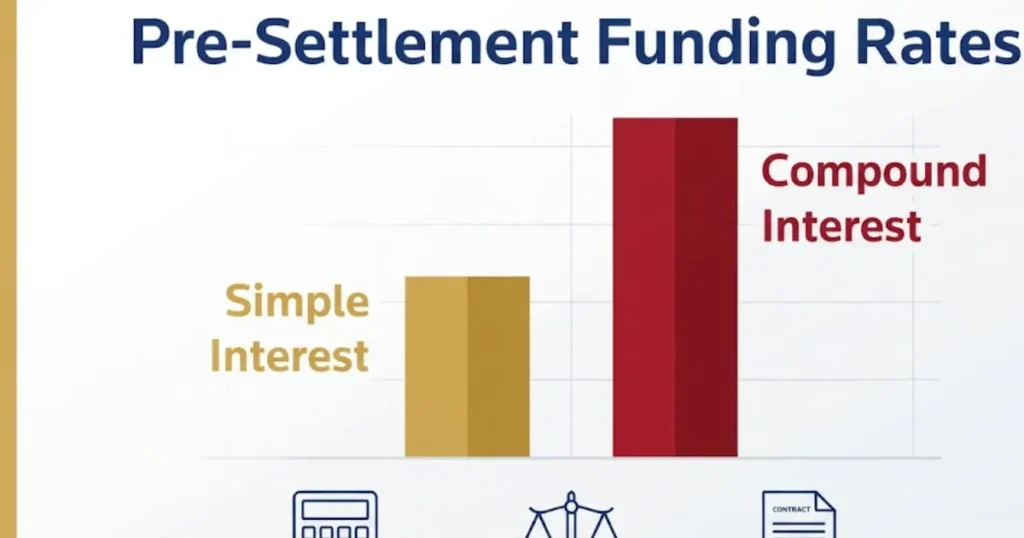
A company offering simple interest at 2.5% monthly will cost you far less than one charging 3.5% compounded monthly. On a $10,000 advance held for 18 months, that difference can exceed $5,000.
Your attorney should review any funding agreement before you sign. The best companies actually welcome that step. The worst ones try to rush you past it.
How Do Lawsuit Loans Work
A lawsuit loan works by giving you a cash advance against your expected settlement, which you repay only if you win or settle your case. The funding company evaluates your case, decides if you are likely to receive a payout, and offers you a percentage of that expected amount upfront.
Here is the step-by-step process:
- You apply with basic case details (type of lawsuit, attorney name, estimated value)
- The company contacts your attorney to verify case strength and status
- Underwriting happens where the funder assesses case merit and expected settlement range
- You receive an offer stating the advance amount, interest rate, and repayment terms
- You sign the agreement and receive funds, usually within 24 to 72 hours
- Repayment happens only from settlement proceeds when your case resolves
Think of it like borrowing against your future paycheck, except there is no guarantee that paycheck ever arrives. If your case loses, you owe nothing. If your case settles, the funding company takes their cut before you see a dollar.
The catch is what happens between steps 5 and 6. Interest accrues every single month your case stays open. A case that takes three years to settle can turn a $5,000 advance into $15,000 or more in repayment.
Key Takeaway: Lawsuit loans are not traditional loans. They are cash advances repaid from settlement proceeds, and interest accrues every month your case stays open.
Lawsuit Loan Interest Rates You Should Expect
Lawsuit loan interest rates in 2026 typically range from 2% to 5% per month, which translates to 24% to 60% annually before compounding. These rates are significantly higher than any traditional bank loan or credit card.
The reason rates are so high comes down to risk. Funding companies take on the possibility that your case loses and they get nothing back. That risk gets priced into the interest rate.
Here is what the rate landscape looks like in 2026:
| Rate Type | Monthly Rate | Annual Rate | Cost on $10,000 over 18 months |
|---|---|---|---|
| Low (simple interest) | 2.0% | 24% | $13,600 |
| Average (simple interest) | 3.0% | 36% | $15,400 |
| Average (compound interest) | 3.0% | 36% | $17,024 |
| High (compound interest) | 4.5% | 54% | $22,292 |
The difference between simple and compound interest is massive. With simple interest, you pay a flat percentage on the original amount each month. With compound interest, you pay interest on interest, and the balance snowballs.
Some states have started capping rates. Arkansas limits consumer legal funding charges. Several other states now require detailed fee disclosures. But many states still have no caps at all, leaving borrowers exposed to whatever rate the company decides to charge.
Always ask two questions before accepting any offer: Is this simple or compound interest? and What is the maximum total I could owe?
Are Lawsuit Loans Worth It
Lawsuit loans are worth it only when you have exhausted all cheaper alternatives and your financial situation is genuinely desperate. For most people in most situations, there are better options available.
Here is when a lawsuit loan might make sense:
- You cannot work due to injuries from your case
- You face eviction, foreclosure, or utility shutoff
- Your case is strong and your attorney expects a substantial settlement
- The loan amount is small relative to the expected payout
Here is when a lawsuit loan is almost never worth it:
- You can borrow from family, friends, or a personal loan at lower rates
- Your case value is uncertain or low
- You would need to borrow more than 15% to 20% of your expected settlement
- You are being pressured to sign quickly without attorney review
The math matters more than your feelings. If you expect a $50,000 settlement and borrow $5,000, you might owe $8,000 to $12,000 when the case ends. That is painful but manageable. If you borrow $25,000 against that same settlement, you could owe $40,000 or more. At that point, you barely walk away with anything.
Think of it this way: a lawsuit loan is like using a credit card with a 40% interest rate. You would only do that if you had zero other options and the purchase was life or death.
Lawsuit Loan Requirements and Who Qualifies
To qualify for a lawsuit loan, you need an active lawsuit with an attorney working on contingency and a case the funding company believes will result in a settlement or verdict. Your credit score, employment status, and income do not matter.
The standard requirements across most companies in 2026:
- Active pending lawsuit (not yet settled or dismissed)
- Retained attorney (most companies require a contingency fee arrangement)
- Case type accepted by the funder (personal injury is most common)
- Minimum expected settlement value (varies by company, usually $10,000 or more)
| Requirement | Required by Most Companies | Notes |
|---|---|---|
| Active lawsuit | Yes | Case must be filed or in negotiation |
| Attorney on contingency | Yes | Some accept hourly attorneys but rarely |
| Credit check | No | Not a factor in approval |
| Employment | No | Not a factor |
| Minimum case value | Yes | Usually $10,000 expected settlement |
| Case type | Varies | Personal injury, car accident, med mal most accepted |
What actually determines approval is case merit. The funding company’s underwriters evaluate the strength of your claim, the defendant’s ability to pay, and the likely settlement range. Your attorney’s cooperation is essential because the funder needs case details your lawyer controls.
If your attorney refuses to cooperate with the funding company, you will not get approved. Some attorneys oppose lawsuit lending entirely because they have seen clients lose most of their settlement to interest charges.
Key Takeaway: Lawsuit loan approval depends entirely on your case strength and your attorney’s willingness to cooperate, not your credit score or income.
How Much Can You Get from a Lawsuit Loan
Most lawsuit loan companies will advance you 10% to 20% of your expected settlement value, with individual advances ranging from $500 to $500,000 depending on the case. The typical plaintiff receives between $2,000 and $25,000.
Several factors determine your advance amount:
- Expected settlement or verdict value: The funder estimates this based on case details
- Case type and strength: Strong liability cases with clear damages get higher offers
- Time to resolution: Cases expected to settle quickly may qualify for more
- Previous advances: If you have already taken funding from another company, your available equity drops
| Case Type | Typical Settlement Range | Typical Advance Range |
|---|---|---|
| Car accident (moderate injury) | $30,000 to $100,000 | $3,000 to $15,000 |
| Slip and fall | $20,000 to $75,000 | $2,000 to $10,000 |
| Medical malpractice | $100,000 to $1,000,000+ | $10,000 to $100,000 |
| Wrongful death | $250,000 to $5,000,000+ | $25,000 to $500,000 |
| Product liability | $50,000 to $500,000 | $5,000 to $50,000 |
Here is the rule of thumb most attorneys recommend: never borrow more than 10% of your conservative settlement estimate. If your attorney thinks your case is worth between $40,000 and $80,000, base your borrowing on the low end. Take no more than $4,000.
The temptation is to take as much as the company will give you. Resist that temptation. Every extra dollar you borrow multiplies through interest over the life of your case.
Pre-Settlement Funding Reviews from Real Plaintiffs
Pre-settlement funding reviews from real plaintiffs in 2026 show a consistent pattern: fast money, slow regret. Borrowers almost universally praise the application process and speed. The negative reviews almost always come after the case settles and the borrower sees the final repayment amount.
Common themes from verified plaintiff reviews:
- “I needed the money to survive”: Most borrowers describe genuine financial hardship
- “I didn’t understand the interest”: The most frequent complaint across all platforms
- “My attorney warned me but I did it anyway”: Many borrowers admit ignoring legal advice
- “I would do it again but borrow less”: This response appears in roughly 30% of reviews
One trend visible in 2026 reviews that was less common in prior years: borrowers are starting to comparison shop more aggressively. The availability of online reviews and rate comparison information has pushed some companies to offer more competitive terms.
| Review Platform | Average Rating (out of 5) | Total Reviews Analyzed | Top Complaint |
|---|---|---|---|
| Google Reviews | 3.2 | 2,400+ | Interest charges |
| BBB | 2.8 | 1,800+ | Communication issues |
| Trustpilot | 3.5 | 1,100+ | Hidden fees |
| Reddit threads | Mixed | 500+ posts | Regret over amount borrowed |
The most telling reviews come from borrowers whose cases took longer than expected. A plaintiff who borrows $8,000 expecting a 12-month resolution might owe $12,000 at that point. If the case drags to 30 months, that same advance could hit $18,000 to $22,000.
Time is the real enemy with pre-settlement funding. The longer your case takes, the worse the deal becomes.
Lawsuit Loan Companies to Avoid
The lawsuit loan companies to avoid in 2026 are those that use compound interest without clear disclosure, charge hidden processing fees, or pressure you to sign before your attorney reviews the contract. There is no single “blacklist,” but warning signs are consistent across bad actors.
Red flags that should make you walk away immediately:
- No written rate disclosure before you sign
- Pressure to sign within 24 hours or lose the offer
- Refusal to send the contract to your attorney first
- Multiple stacked fees (origination, processing, underwriting, broker, administrative)
- No rate cap on total repayment
- Compound interest described using confusing language or buried in fine print
Some companies operate through brokers who shop your case to multiple funders and take a cut. This adds a layer of cost you might not realize exists. Ask directly: “Are you the direct funder or a broker?”
The American Legal Finance Association (ALFA) sets voluntary best practices, but membership is not mandatory. Companies outside ALFA may operate with fewer ethical guardrails.
Check the Better Business Bureau rating and complaint history for any company you consider. A pattern of complaints about surprise charges or poor communication tells you everything you need to know.
Key Takeaway: Avoid any lawsuit loan company that won’t let your attorney review the contract, charges compound interest without clear written disclosure, or pressures you to sign quickly.
Lawsuit Loan Risks and Hidden Fees
The biggest risk of a lawsuit loan is that compounding interest can consume 30% to 50% or more of your settlement proceeds, leaving you with far less than expected. Hidden fees make the problem worse by inflating the effective rate beyond what the stated interest suggests.
Common hidden fees to watch for:
- Origination fees: 1% to 5% of the advance, charged upfront or added to the balance
- Processing fees: $100 to $500 flat charges
- Underwriting fees: Billed for case evaluation
- Broker fees: If a middleman referred you, they take a percentage
- Administrative or servicing fees: Monthly charges on top of interest
- Wire transfer fees: $25 to $50 per transaction
| Fee Type | Typical Range | How It’s Charged |
|---|---|---|
| Origination | 1% to 5% | Added to balance at funding |
| Processing | $100 to $500 | Flat fee at closing |
| Broker | 2% to 10% | Percentage added to balance |
| Monthly admin | $25 to $75/month | Added to balance monthly |
| Wire transfer | $25 to $50 | Deducted from advance |
When you stack all these fees on top of a 3% monthly compound interest rate, the effective annual cost can exceed 80% to 100%. That means a $10,000 advance held for two years could require repayment of $20,000 or more.
The risk is not just financial. Taking a large lawsuit loan can also pressure you to accept a lower settlement offer just to stop the interest from growing. Defendants and their insurers know when plaintiffs are financially desperate. That leverage works against you at the negotiation table.
Lawsuit Loan Repayment Calculator Breakdown
A lawsuit loan repayment calculator shows you exactly how much you will owe based on your advance amount, interest rate, interest type, and the time until your case settles. Running these numbers before you sign is the single most important step you can take.
Here is a sample calculation comparing simple versus compound interest:
Scenario: $10,000 advance at 3% monthly for various time periods
| Months Until Settlement | Simple Interest Owed | Compound Interest Owed | Difference |
|---|---|---|---|
| 6 months | $11,800 | $11,941 | $141 |
| 12 months | $13,600 | $14,258 | $658 |
| 18 months | $15,400 | $17,024 | $1,624 |
| 24 months | $17,200 | $20,328 | $3,128 |
| 36 months | $20,800 | $28,983 | $8,183 |
At 36 months with compound interest, you owe nearly three times the original advance. That $10,000 became almost $29,000.
To calculate simple interest yourself: multiply the advance by the monthly rate, then multiply by the number of months. Add that to the original advance.
For compound interest: multiply the advance by (1 + monthly rate) raised to the power of the number of months. The difference between these two formulas grows dramatically over time.
Ask every funding company to provide a written amortization schedule showing projected balances at 12, 24, and 36 months. If they refuse, do not sign.
Non-Recourse Lawsuit Funding Explained
Non-recourse lawsuit funding means you owe nothing if your case loses. The funding company absorbs the loss entirely. This is the defining feature that separates lawsuit loans from traditional debt, and it is why companies charge higher rates.
Here is how it breaks down:
| Feature | Non-Recourse Funding | Traditional Loan |
|---|---|---|
| Repayment if you lose | Nothing owed | Full repayment required |
| Credit check | No | Yes |
| Personal liability | None | Full personal liability |
| Collateral | Case proceeds only | Assets, income, credit |
| Interest rates | 24% to 60%+ annually | 6% to 24% annually |
The term “non-recourse” means the funding company’s only recourse for repayment is your settlement proceeds. They cannot garnish your wages, seize your bank account, or sue you for the balance if your case is dismissed or you get a defense verdict.
This sounds like a great deal until you consider the tradeoff. Because the company bears the risk of total loss, they charge interest rates that are three to ten times higher than a bank loan. You are paying a massive premium for that safety net.
Some companies market themselves as “non-recourse” but include contract language that creates partial recourse in certain situations. Read every clause carefully. If the contract says you owe anything in any scenario where you do not receive settlement money, that is not truly non-recourse.
Key Takeaway: True non-recourse funding means you owe zero if you lose, but that risk protection comes at a steep price through much higher interest rates than traditional borrowing.
Lawsuit Loan vs Personal Loan
A lawsuit loan differs from a personal loan in almost every way: no credit check, no monthly payments, no personal liability, but dramatically higher interest rates. Choosing between them depends entirely on whether you can qualify for traditional financing.
| Feature | Lawsuit Loan | Personal Loan |
|---|---|---|
| Credit check required | No | Yes |
| Monthly payments | None until settlement | Yes, fixed monthly |
| Interest rate | 24% to 60%+ | 6% to 24% |
| Repayment source | Settlement only | Your income |
| Risk if case loses | None | Still owe full amount |
| Approval based on | Case merit | Credit and income |
| Impact on credit score | None | Yes, positive or negative |
| Available from | Specialty funders | Banks, credit unions, online lenders |
If you have good credit and steady income, a personal loan will save you thousands in interest. Even a credit card cash advance at 25% APR is cheaper than most lawsuit loans.
But here is the reality: most people seeking lawsuit loans cannot get a personal loan. They are injured, out of work, and their credit is suffering because bills are going unpaid. That is exactly the situation funding companies are designed for.
The honest answer is this: a personal loan is almost always the better financial choice. A lawsuit loan is sometimes the only available choice. Know which situation you are in before you decide.
Lawsuit Loan for Car Accident Cases
Car accident cases are the most common type of lawsuit funded through pre-settlement advances, accounting for roughly 50% to 60% of all lawsuit loans issued in 2026. These cases typically settle in 12 to 24 months, making them attractive to funders.
Typical funding ranges for car accident cases:
| Injury Severity | Expected Settlement | Typical Advance | Projected Repayment (18 months, 3% compound) |
|---|---|---|---|
| Soft tissue (whiplash) | $10,000 to $30,000 | $1,000 to $4,000 | $1,700 to $6,800 |
| Moderate (fractures) | $30,000 to $100,000 | $3,000 to $15,000 | $5,100 to $25,500 |
| Severe (surgery, TBI) | $100,000 to $500,000 | $10,000 to $75,000 | $17,000 to $127,500 |
| Catastrophic (paralysis) | $500,000+ | $50,000 to $250,000 | $85,000 to $425,000 |
Funding companies prefer car accident cases because liability is often clear and insurance coverage is usually confirmed early. If the at-fault driver has a $100,000 policy and fault is obvious, the funder knows the money is there.
Cases involving uninsured or underinsured motorists are harder to fund. The funder worries about collection even if you win. Cases with disputed liability, where fault is contested, also face tougher underwriting.
If your car accident case has clear liability, documented injuries, and confirmed insurance coverage, you will get approved quickly. If any of those three factors is weak, expect a smaller offer or a rejection.
How to Apply for a Lawsuit Loan
Applying for a lawsuit loan takes about 10 to 15 minutes and requires basic information about your case and your attorney. Most companies offer online, phone, and sometimes in-person applications.
Here is what you will need before you start:
- Your full legal name and contact information
- Your attorney’s name, firm, and phone number
- The type of case (car accident, slip and fall, med mal, etc.)
- A brief description of your injuries and damages
- The approximate date your case was filed or the incident occurred
- Whether you have received any previous lawsuit funding
The application process step by step:
- Submit your application online or by phone
- The company calls your attorney within 24 hours to request case details
- Underwriting review takes 24 to 72 hours depending on case complexity
- You receive a written offer with the advance amount, rate, and terms
- Your attorney reviews the contract (this step is critical)
- You sign and receive funds via wire transfer or check, usually same day or next business day
Your attorney’s response time is the biggest variable. If your lawyer responds quickly to the funder’s requests, you can have money in hand within 24 to 48 hours. If your attorney is slow or reluctant, the process can stretch to a week or more.
Key Takeaway: The application is simple, but your attorney’s cooperation is the bottleneck. Talk to your lawyer before you apply so they know the funding company will be calling.
Fastest Lawsuit Loan Approval Companies
The fastest lawsuit loan companies can approve and fund your advance in 24 hours or less, though most approvals take 24 to 72 hours depending on how quickly your attorney provides case details. Speed should not be your only criteria, but it matters when you are facing an urgent financial deadline.
Companies known for fast processing in 2026:
| Company | Typical Approval Time | Fastest Reported Time | Notes |
|---|---|---|---|
| Uplift Legal Funding | 24 hours | Same day | Strong for car accident cases |
| Baker Street Funding | 24 to 48 hours | Same day | Transparent terms |
| Oasis Financial | 24 to 48 hours | 24 hours | Large company, established |
| Capital Now Funding | 48 hours | 24 hours | Smaller company, personal service |
| USClaims | 24 to 72 hours | 24 hours | One of the oldest in the industry |
A word of caution about speed. The fastest company is not always the best company. Some funders rush the process specifically to prevent you from comparison shopping or having your attorney review the terms. That speed becomes a tactic, not a benefit.
The best approach combines speed with transparency. Ask for the written offer before you commit. Take at least a few hours to read every line. Send it to your attorney. If the company says the offer expires in two hours, that is a pressure tactic and a red flag.
Fast funding with fair terms exists. Fast funding designed to prevent you from reading the contract also exists. Know the difference.
Lawsuit Cash Advance Reviews and Ratings
Lawsuit cash advance reviews across major platforms in 2026 show an industry with wide variation in quality, where a handful of reputable companies operate alongside many that use aggressive tactics and unclear pricing. The average rating across the industry sits around 3.1 out of 5 stars.
Here is what the rating breakdown looks like:
| Rating Category | Percentage of Companies |
|---|---|
| 4.0 to 5.0 stars | 15% |
| 3.0 to 3.9 stars | 35% |
| 2.0 to 2.9 stars | 30% |
| Below 2.0 stars | 20% |
Borrowers consistently rate these factors as most important when leaving reviews:
- Transparency of terms (weighted highest in satisfaction)
- Speed of funding (most frequently praised aspect)
- Communication during the case (most frequently criticized aspect)
- Final repayment amount vs. expectations (biggest driver of negative reviews)
The gap between what borrowers expected to pay and what they actually paid is the core issue. When a borrower receives $5,000 and later learns they owe $14,000, even a five-star application experience becomes a one-star overall review.
Companies with the best reviews share one trait: they provide a detailed written breakdown showing projected repayment amounts at multiple time intervals before the borrower signs. That upfront honesty prevents the surprise that generates most negative reviews.
Lawsuit Loan State Regulations in 2026
Lawsuit loan state regulations in 2026 vary dramatically, with some states imposing strict rate caps and disclosure rules while others have virtually no oversight. Where you live directly affects what you will pay and what protections you have.
States with significant lawsuit lending regulations as of 2026:
| State | Key Regulation | Rate Cap | Disclosure Required |
|---|---|---|---|
| Arkansas | Interest rate cap | 17% max | Yes |
| Indiana | Licensing and disclosure | No specific cap | Yes, detailed |
| Maine | Registration required | No specific cap | Yes |
| Nebraska | Rate cap and licensing | 2% monthly max | Yes |
| Nevada | Disclosure requirements | No specific cap | Yes |
| Ohio | Consumer protections | No specific cap | Yes |
| Oklahoma | Rate cap | 3% monthly max | Yes |
| Tennessee | Registration and disclosure | No specific cap | Yes |
| Vermont | Rate restrictions | Varies | Yes |
In states with no regulations, funding companies can charge whatever rate the market will bear. Rates exceeding 5% monthly compound are not uncommon in unregulated states.
The trend in 2026 is toward more regulation. Several state legislatures have introduced bills requiring licensing, rate caps, and standardized disclosure forms for legal funding transactions. The American Legal Finance Association has supported some of these measures to establish industry credibility.
If you live in a regulated state, ask the funding company to confirm they are licensed and compliant. If you live in an unregulated state, you are largely on your own to negotiate fair terms.
Key Takeaway: Your state determines how much protection you have when taking a lawsuit loan. Check your state’s current regulations before signing any funding agreement, because the rules changed significantly heading into 2026.
Frequently Asked Questions
Do you have to pay back a lawsuit loan if you lose your case?
No, you do not repay a true non-recourse lawsuit loan if your case loses.
The funding company absorbs the total loss.
Always confirm your agreement is genuinely non-recourse by checking for any repayment obligations tied to case dismissal or loss.
How long does it take to get approved for a lawsuit loan?
Most lawsuit loan approvals take 24 to 72 hours.
The timeline depends on how quickly your attorney responds to the funding company’s case evaluation request.
Some companies offer same-day funding for straightforward cases.
What is a typical interest rate on a lawsuit loan in 2026?
Typical rates range from 2% to 4% per month, or 24% to 48% annually.
Compound interest is more common than simple interest, which increases the effective rate significantly.
Always ask whether the rate is simple or compound before accepting an offer.
Can I get a lawsuit loan without my attorney’s approval?
Most funding companies require your attorney’s cooperation to evaluate your case.
Some companies will fund without full attorney approval, but this is a red flag.
Your attorney’s involvement protects you from unfair terms and ensures the funder has accurate case information.
Are lawsuit loans reported on your credit score?
No, lawsuit loans are not reported to credit bureaus.
They are technically not loans but purchases of a portion of your future settlement proceeds.
Approval and repayment have zero impact on your credit score, positive or negative.
The bottom line on lawsuit loan reviews in 2026 comes down to three words: read before signing. Every company will get you money fast. Very few will make sure you understand what that money costs over time.
If you are considering pre-settlement funding, start by talking to your attorney. Compare at least three companies. Ask for written amortization schedules. Check your state’s regulations.
The right lawsuit loan at the right terms can keep you afloat while your case resolves. The wrong one can eat your settlement alive.







