

The river valley loans lawsuit alleges that borrowers were trapped by interest rates as high as 800% APR, far exceeding what most state laws allow. This legal fight centers on whether a tribal-affiliated online lender can dodge state usury caps by claiming sovereign immunity.
If you took out a loan from River Valley Loans, you may be owed money. Thousands of borrowers across multiple states are part of legal actions seeking refunds of excessive interest and fees.
This article covers every angle of the case as it stands in 2026. You’ll find the latest case updates, who qualifies, how to file, and what kind of payout you might realistically expect.
One number puts the whole situation in perspective: some borrowers paid back three to five times what they originally borrowed, all within a matter of months.
River Valley Loans Lawsuit
The River Valley Loans lawsuit is a legal action brought by borrowers who claim the lender charged illegally high interest rates on short-term and installment loans. The case targets both the lending entity and its corporate partners.
River Valley Loans operates as a tribal lending entity affiliated with a Native American tribe. The company used this structure to argue that state lending laws don’t apply to it.
Borrowers in the lawsuit say they were lured by fast online approval. They didn’t realize they’d end up paying back far more than they borrowed.
| Detail | Info |
|---|---|
| Defendant | River Valley Loans (tribal lending entity) |
| Primary Allegation | Predatory lending with illegal APRs |
| Loan Types | Short-term and installment loans |
| Borrowers Affected | Thousands across multiple states |
| Legal Status (2026) | Active litigation and regulatory actions |
The core legal argument is straightforward. State laws cap interest rates for consumer loans. River Valley allegedly blew past those caps, sometimes by a factor of ten or more.
Plaintiffs also claim the company’s tribal affiliation was largely a front. They argue that non-tribal corporate entities actually controlled lending operations, funded the loans, and collected the profits.
River Valley Loans Lawsuit Update 2026
As of 2026, the River Valley Loans lawsuit has progressed through several important stages. Courts have issued rulings on jurisdiction and the tribal immunity question.
Multiple state attorneys general have taken enforcement actions against tribal lenders using similar business models. These actions have strengthened the legal position of borrowers suing River Valley Loans.
The CFPB has been active in targeting tribal lending operations throughout 2024 and 2025. That regulatory pressure has pushed some tribal lenders toward settlement negotiations.
Key developments in the case timeline:
- 2023: Initial complaints filed by borrowers in multiple jurisdictions
- 2024: Courts begin ruling on whether tribal immunity applies
- 2025: State AG enforcement actions against similar tribal lenders accelerate
- 2026: Settlement discussions reported; class certification proceedings underway
The legal picture has shifted in borrowers’ favor over the past year. Several federal courts have ruled that tribal immunity does not protect lenders when non-tribal entities control the actual lending business.
That’s a big deal. It strips away the main legal shield that River Valley Loans has relied on.
River Valley Loans Class Action
A River Valley Loans class action is a lawsuit where one or more named plaintiffs represent a larger group of borrowers who all suffered the same harm. This approach lets thousands of people pursue claims together.
Class action status matters because individual lawsuits against a tribal entity can be expensive and slow. Grouping claims gives borrowers more bargaining power.
For a class action to move forward, a court must certify the class. That means the judge agrees that the claims share common facts and legal questions.
| Class Action Element | Status |
|---|---|
| Named Plaintiffs | Multiple borrowers identified |
| Class Size (Estimated) | Several thousand |
| Common Questions | Interest rate legality, tribal immunity applicability |
| Class Certification | Pending in 2026 |
| Court | Federal court (jurisdiction varies by filing) |
The strength of this class action hinges on proving that River Valley applied the same lending terms across borrowers. If every borrower signed the same agreement and paid the same inflated rates, that consistency helps the case.
Think of it like a neighborhood where every house has the same leaky roof from the same builder. You don’t need to prove each roof is defective separately.
Key Takeaway: The River Valley Loans lawsuit is an active legal fight in 2026, with class action proceedings underway and courts increasingly rejecting the tribal immunity defense.
River Valley Loans Predatory Lending
River Valley Loans predatory lending refers to the practice of offering loans with terms designed to trap borrowers in cycles of debt. The allegations focus on sky-high interest rates, aggressive collection tactics, and misleading loan terms.
Predatory lending isn’t just about high rates. It’s about targeting people who have few other options and structuring loans so repayment becomes nearly impossible.
Borrowers report that they took out loans of $500 to $5,000 and ended up owing two to five times the original amount. Monthly payments were structured to cover mostly interest, leaving the principal barely touched.
Signs of predatory lending in these loans:
- APRs exceeding 300% to 800%
- Automatic bank withdrawals that drained accounts
- Rollover features that extended debt indefinitely
- No clear disclosure of total repayment costs
- Marketing targeted at financially distressed consumers
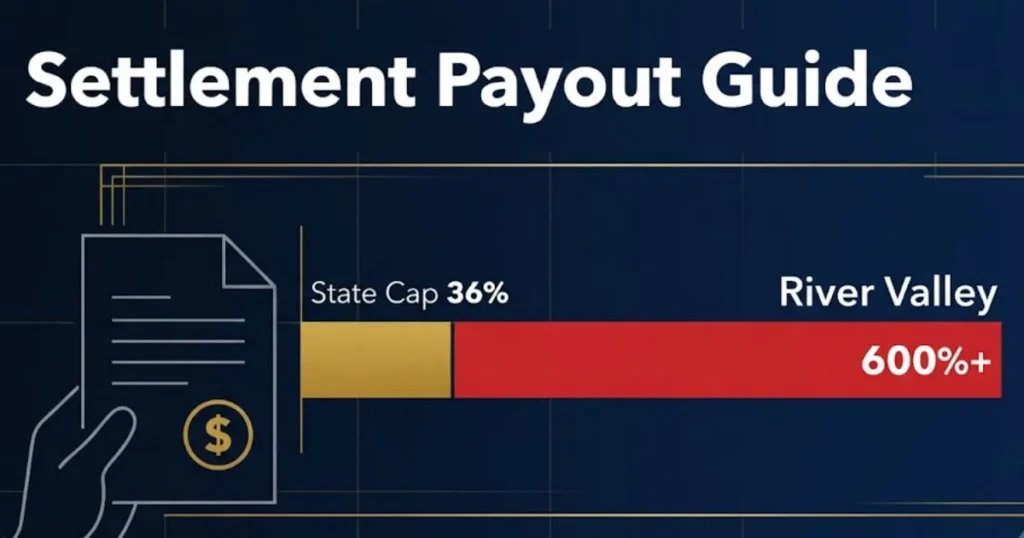
The legal standard for predatory lending varies by state. But most states consider any consumer loan with an APR above 36% to be problematic. Some states cap rates even lower.
When a lender charges 600% on a loan in a state that caps rates at 24%, that’s not a gray area. It’s a direct violation, unless the lender can prove it’s exempt from state law.
River Valley Loans Interest Rate
River Valley Loans interest rates reportedly ranged from 300% to over 800% APR, depending on the loan amount and repayment term. These rates are dramatically higher than what state usury laws permit.
To put that in real numbers: a $1,000 loan at 600% APR could cost a borrower over $3,000 in interest alone over a 12-month repayment period. That’s before any fees.
| Loan Amount | Reported APR | Total Repaid (est.) | State Cap (typical) |
|---|---|---|---|
| $500 | 650% | $1,750 | 24% to 36% |
| $1,000 | 600% | $4,000 | 24% to 36% |
| $2,500 | 450% | $8,500 | 24% to 36% |
| $5,000 | 350% | $14,000 | 24% to 36% |
Most states set usury caps between 24% and 36% APR for consumer installment loans. A handful of states allow higher rates for certain licensed lenders, but none authorize the rates River Valley allegedly charged.
Compare this to a credit card. The average credit card APR in 2025 was around 22%. River Valley’s rates were roughly 15 to 35 times higher than a typical credit card.
That comparison alone tells you why this lawsuit exists. No legitimate lending product charges rates that make credit card debt look like a bargain.
River Valley Loans Hidden Fees
River Valley Loans hidden fees are charges that borrowers say were not clearly disclosed before they signed their loan agreements. These fees inflated the true cost of borrowing well beyond the stated interest rate.
Common hidden charges reported by borrowers include origination fees, processing fees, late payment penalties, and returned payment fees. Some borrowers say fees were deducted from loan proceeds before they received their money.
Types of hidden fees reported:
- Origination fees: 5% to 15% of the loan amount, deducted upfront
- Processing fees: Charged at disbursement, reducing the actual cash received
- Late payment penalties: $25 to $75 per missed or delayed payment
- Returned payment fees: $30 to $50 when automatic withdrawals failed
- Early payoff penalties: Fees for paying the loan off ahead of schedule
The origination fee issue is particularly problematic. If you borrow $1,000 but only receive $850 after a $150 origination fee, you’re paying interest on money you never actually got.
That’s like ordering a full pizza, getting six slices, and being charged for eight. The math doesn’t work in the borrower’s favor.
Key Takeaway: River Valley Loans allegedly charged interest rates between 300% and 800% APR, combined with hidden fees that made the true borrowing cost even higher than the stated rate.
River Valley Loans State Law Violations
River Valley Loans state law violations involve the lender allegedly operating in states where it lacked proper licensing and where its interest rates exceeded legal limits. Most states require lending licenses and enforce usury caps.
The company made loans to borrowers in states with strict consumer lending laws. By operating online, it reached consumers in jurisdictions where it had no legal authority to lend.
| State Category | Usury Cap | River Valley Compliance | Status |
|---|---|---|---|
| States with strict caps (e.g., New York, 16%) | 16% to 25% | Non-compliant | Active enforcement |
| States with moderate caps (e.g., California, 36%) | 30% to 36% | Non-compliant | Lawsuits pending |
| States with limited regulation | Varies | Potentially compliant | Under review |
| States banning payday lending entirely | N/A | Non-compliant | AG actions |
States like New York, New Jersey, and Connecticut have been particularly aggressive in pursuing tribal lenders. New York’s usury cap of 16% makes River Valley’s alleged rates laughably illegal under state law.
The key question in every state is whether the tribal lending structure exempts River Valley from these rules. Courts have given different answers depending on the jurisdiction, but the trend is moving toward holding these lenders accountable.
Several state attorneys general have issued cease-and-desist orders to tribal lenders. Those orders tell the lender to stop operating in the state immediately.
Is River Valley Loans Legal
Is River Valley Loans legal? The answer depends on which state you’re in and how courts rule on the tribal immunity question. In most states, the interest rates River Valley charged violate state lending laws.
River Valley Loans claims legal authority through its affiliation with a federally recognized tribe. Tribal entities generally enjoy sovereign immunity from state regulation, similar to how foreign embassies operate under different rules.
But here’s the catch. Courts have increasingly found that this immunity only applies when the tribe genuinely owns and operates the lending business.
Factors courts examine:
- Does the tribe actually control daily lending operations?
- Does the tribe receive a meaningful share of the profits?
- Did non-tribal companies create and fund the lending program?
- Is the tribal affiliation genuine or just a legal shield?
When courts find that a non-tribal company is the real operator, the tribal immunity defense falls apart. The lender then becomes subject to state laws like any other company.
Several recent court decisions have gone this direction. The Second Circuit ruled in a related tribal lending case that immunity doesn’t apply when the tribe is a front for outside investors.
That ruling sent shockwaves through the tribal lending industry. It’s one of the reasons settlement talks are now happening.
River Valley Loans Tribal Lending Lawsuit
The River Valley Loans tribal lending lawsuit challenges the legal model where online lenders partner with Native American tribes to avoid state consumer protection laws. This model has been called “rent-a-tribe” by critics.
In a rent-a-tribe arrangement, a non-tribal company designs the loan products, provides the technology, funds the loans, and collects most of the profits. The tribe lends its name and legal status in exchange for a fee.
This arrangement has been under fire from regulators, courts, and consumer advocates for years. The River Valley Loans case is one of several tribal lending lawsuits working through the courts.
Comparable tribal lending cases:
- Think Finance: Settled for $40 million after courts found the tribal structure was a sham
- Big Picture Loans: Court ruled tribal immunity applied, but the decision was heavily debated
- Great Plains Lending: CFPB action resulted in enforcement and penalties
- CashCall (Western Sky): Tribal lender shut down after widespread legal challenges
These precedents matter because they show how courts have handled similar arguments. The Think Finance settlement is especially relevant because the facts mirror the River Valley Loans case closely.
When a tribal lending model collapses in court, borrowers typically get refunds of excess interest. That’s the outcome plaintiffs in the River Valley case are pushing for.
Key Takeaway: Courts are increasingly rejecting the “rent-a-tribe” lending model, and precedents from cases like Think Finance suggest borrowers have strong grounds for recovering excess interest payments.
River Valley Loans Sovereign Immunity Defense
River Valley Loans sovereign immunity defense is the legal argument that the company cannot be sued in state court because it operates as an arm of a federally recognized Native American tribe. Sovereign immunity typically protects tribal governments from lawsuits.
This defense has been the company’s primary legal shield. If the court accepts it, borrowers would have limited options for pursuing their claims.
But sovereign immunity has limits. It doesn’t protect every business that a tribe is involved with.
| Immunity Factor | Helps River Valley | Hurts River Valley |
|---|---|---|
| Tribal ownership on paper | Yes | If ownership is nominal only |
| Tribe controls operations | Yes, if true | No, if non-tribal company manages |
| Tribe receives majority of profits | Yes, if true | No, if profits go to outside investors |
| Lending licensed through tribe | Yes | Doesn’t override state consumer protection |
| Federal court jurisdiction | Varies | Some circuits reject immunity for commercial activity |
The Supreme Court has not directly ruled on whether tribal immunity applies to online lending operations. Lower courts have split on the issue, creating a patchwork of rulings.
In the Second Circuit, courts have leaned toward stripping immunity when the tribal affiliation is superficial. In other circuits, tribes have had more success defending their lending operations.
For borrowers, the practical question is whether the court handling their case will follow the trend of piercing tribal immunity. Based on recent rulings, the odds have been improving.
Who Qualifies for River Valley Loans Lawsuit
Who qualifies for the River Valley Loans lawsuit? Generally, any borrower who took out a loan from River Valley Loans and was charged interest rates exceeding their state’s legal limit may be eligible to join.
Eligibility doesn’t require that you defaulted on the loan. Even borrowers who fully repaid their loans can qualify if the terms violated state law.
Basic eligibility criteria:
- You took out a loan from River Valley Loans
- The loan was made while you were a resident of a state with usury caps
- The interest rate on your loan exceeded your state’s legal limit
- You have documentation of the loan (statements, emails, bank records)
| Borrower Situation | Likely Eligible? |
|---|---|
| Borrowed and fully repaid | Yes |
| Borrowed and defaulted | Yes |
| Borrowed and currently paying | Yes |
| Loan was refinanced or rolled over | Yes |
| Borrowed from a different tribal lender | No (separate case) |
| Live in a state with no usury cap | Possibly not |
You don’t need to have filed a complaint or contacted an attorney previously. If you can prove you had a loan with River Valley, that’s usually enough to start.
Keep your loan agreement, payment history, and any communications from River Valley Loans. Bank statements showing automatic withdrawals are also strong evidence.
How to File a Claim Against River Valley Loans
How to file a claim against River Valley Loans: Start by gathering your loan documents, then submit your information through the designated claims process for the class action. If no formal claims process exists yet, you can register with attorneys handling the case.
The exact filing process depends on where the lawsuit stands when you’re reading this. If a settlement has been reached, there will be a formal claims administrator.
Steps to file your claim:
- Collect your documents: Loan agreement, payment receipts, bank statements, emails from River Valley
- Verify your eligibility: Confirm your loan terms and state of residence
- Register with the class action: Submit your information to the attorneys handling the case
- Complete claim forms: Fill out any required paperwork with accurate details
- Submit by the deadline: Make sure you file before the cutoff date
If you no longer have your original documents, check your email for loan confirmation messages. Your bank can also provide transaction records showing payments to River Valley Loans.
Don’t wait until the last minute. Claims processes have strict deadlines, and late submissions are typically rejected. Even if the formal claims window hasn’t opened yet, registering your interest early ensures you’ll be notified when it does.
Key Takeaway: Most borrowers who took a loan from River Valley Loans in a state with usury caps are likely eligible to file a claim, and gathering your loan documents now is the smartest step you can take.
River Valley Loans Complaint
A River Valley Loans complaint is a formal filing, either with a court or a regulatory agency, that describes the borrower’s experience and the alleged violations. Complaints serve as the foundation of legal action.
You can file complaints with multiple agencies simultaneously. Each complaint creates a record that strengthens the overall case against the lender.
Where to file a complaint:
- CFPB (Consumer Financial Protection Bureau): Handles federal complaints about lending practices
- State Attorney General: Investigates state law violations by lenders
- FTC (Federal Trade Commission): Accepts complaints about deceptive business practices
- State Banking Regulator: Oversees lending licenses and rate compliance
- Better Business Bureau: Creates a public record of consumer experiences
| Agency | What They Do | Response Time |
|---|---|---|
| CFPB | Investigates, mediates, enforces | 15 to 60 days |
| State AG | Issues cease-and-desist, files suit | 30 to 90 days |
| FTC | Collects data, takes enforcement action | Varies |
| State Banking Regulator | Reviews licensing compliance | 30 to 60 days |
Filing a complaint with the CFPB is particularly effective. The bureau tracks complaints and can force lenders to respond. CFPB complaint data has been used as evidence in several tribal lending lawsuits.
Your complaint should include specific details: the loan amount, interest rate, fees charged, total amount repaid, and any communications where River Valley made promises about loan terms.
River Valley Loans CFPB Action
River Valley Loans CFPB action refers to any enforcement measures taken by the Consumer Financial Protection Bureau against the lender or similar tribal lending operations. The CFPB has been the most active federal regulator in pursuing tribal lenders.
The bureau has authority to investigate and penalize lenders that violate federal consumer financial protection laws, regardless of tribal affiliation.
CFPB actions in the tribal lending space:
- Enforcement actions against multiple tribal lending entities since 2017
- Public warnings about predatory tribal lending practices
- Data collection from thousands of consumer complaints
- Coordination with state attorneys general on joint investigations
The CFPB’s position is clear: tribal affiliation does not exempt a lender from federal consumer protection laws. The bureau has successfully argued this position in multiple cases.
In 2024 and 2025, the CFPB increased its focus on online lending practices. That broader push has put additional pressure on tribal lenders, including River Valley Loans.
One significant CFPB precedent involved a tribal lender that was ordered to pay $10 million in restitution to borrowers. That case established that the bureau can reach tribal lending entities and force them to refund illegal charges.
For borrowers, CFPB involvement is a positive sign. It means a powerful federal agency is backing the same claims that individual borrowers are making in court.
River Valley Loans Settlement
A River Valley Loans settlement would be an agreement to resolve the lawsuit by paying compensation to affected borrowers without going to trial. As of early 2026, settlement negotiations are reportedly underway.
Settlement is the most likely outcome. Going to trial is expensive and risky for both sides, and most tribal lending lawsuits end in negotiated agreements.
| Settlement Factor | Details |
|---|---|
| Likelihood of Settlement | High, based on similar cases |
| Comparable Settlements | Think Finance: $40M; Other tribal lenders: $5M to $30M |
| Timeline for Agreement | Estimated mid to late 2026 |
| Distribution Method | Direct payments to verified claimants |
| Tax Implications | Refunds of interest may not be taxable; consult a tax professional |
When a settlement happens, a claims administrator handles distribution. Borrowers who register and submit valid claims receive payment, usually by check or direct deposit.
The Think Finance settlement is the most relevant comparison. That case involved a tribal lending operation with a nearly identical business model. The $40 million settlement provided meaningful refunds to borrowers.
Not every borrower gets the same amount. Settlement payouts are typically based on how much excess interest you paid. Borrowers who paid more get more back.
Key Takeaway: Settlement negotiations are reportedly underway for the River Valley Loans case, and comparable tribal lending settlements have resulted in payouts ranging from $5 million to $40 million total.
River Valley Loans Settlement Payout
The River Valley Loans settlement payout will depend on the total settlement amount, the number of claimants, and how much each borrower overpaid in interest and fees. Based on comparable cases, individual payouts could range from $50 to $1,500 or more.
Exact payout amounts won’t be known until a settlement is finalized and the claims process is complete. But we can estimate ranges based on what happened in similar tribal lending cases.
| Borrower Profile | Estimated Payout Range |
|---|---|
| Small loan ($500 or less), paid off quickly | $50 to $200 |
| Medium loan ($500 to $2,000), repaid over months | $200 to $700 |
| Large loan ($2,000 to $5,000), extended repayment | $500 to $1,500 |
| Multiple loans or rollovers | $800 to $2,000+ |
| Borrower who defaulted and was sent to collections | Varies; may include debt cancellation |
Factors that affect your payout:
- Total amount of excess interest you paid
- Whether you had one loan or multiple loans
- The state you lived in and its usury cap
- Whether the loan was fully repaid, defaulted, or is still active
- How many other borrowers file valid claims
In the Think Finance settlement, some borrowers received refunds equal to a significant portion of the excess interest they paid. Others received smaller amounts due to the large number of claimants.
The bottom line: if you paid back significantly more than you borrowed, you have a strong claim for a meaningful payout. Larger overpayments generally mean larger refunds.
River Valley Loans Borrower Rights
River Valley Loans borrower rights include the right to fair lending terms, accurate disclosure of loan costs, and protection from illegal interest rates under state and federal law. These rights exist regardless of what the loan agreement says.
Many borrowers believe they gave up their rights by signing the loan agreement. That’s not true. You cannot waive your right to protection from illegal lending practices.
Rights every borrower has:
- Truth in Lending Act (TILA): Lenders must clearly disclose APR, total payments, and all fees before you sign
- State usury laws: Interest rates cannot exceed state-mandated caps
- Fair Debt Collection Practices Act: Collectors cannot harass, threaten, or deceive you
- Right to dispute: You can challenge any charges you believe are illegal
- Right to file complaints: You can report violations to federal and state regulators
A loan agreement that includes an arbitration clause or a tribal jurisdiction clause does not eliminate your rights. Courts have struck down these clauses in multiple tribal lending cases.
If River Valley Loans sent you to collections for a balance that includes illegal interest charges, you may have grounds to challenge that debt entirely. Some borrowers in similar cases have had their remaining balances wiped out as part of settlement agreements.
Your rights are real and enforceable. The fact that you signed an agreement doesn’t mean you agreed to be overcharged.
River Valley Loans Lawsuit Deadline
The River Valley Loans lawsuit deadline depends on the specific legal action and your state’s statute of limitations. Most states give borrowers 2 to 6 years from the date of the loan or the last payment to file a claim.
Missing the deadline can permanently bar you from recovering money. That’s why acting sooner rather than later is always the better choice.
| State Statute of Limitations Category | Typical Timeframe | Action Needed |
|---|---|---|
| States with 2-year limit | 2 years from last payment | File immediately |
| States with 3-year limit | 3 years from last payment | File soon |
| States with 4 to 6-year limit | 4 to 6 years from last payment | File before expiration |
| Class action filing | Varies by case | Register interest now |
| Settlement claims window | Typically 60 to 120 days after approval | Submit claim promptly |
Important deadline considerations:
- The statute of limitations clock usually starts ticking from your last payment or last contact with the lender
- Joining a class action may toll (pause) the statute of limitations for your individual claims
- Settlement claims windows are separate from statutes of limitations and are usually much shorter
- Some states have special rules for fraud claims that extend the filing period
If you’re unsure whether your deadline has passed, the safest move is to register your interest with the class action now. Attorneys handling the case can evaluate whether your claim is still timely.
Don’t assume you’ve waited too long. Many borrowers who think they missed the window discover they still have time.
Key Takeaway: Lawsuit deadlines vary by state, but most borrowers still have time to file in 2026. Registering your claim now protects your rights even if the settlement hasn’t been finalized.
Frequently Asked Questions
Can I still join the River Valley Loans lawsuit in 2026?
Yes, most borrowers can still join the lawsuit in 2026.
The class action is active and accepting new claimants.
Check your state’s statute of limitations to confirm your claim is timely.
How much money will I get from the River Valley Loans settlement?
Individual payouts are estimated between $50 and $1,500, depending on how much you borrowed and overpaid.
Larger loans with more excess interest paid will receive higher amounts.
Final payout amounts depend on the total settlement and number of claimants.
Does tribal sovereign immunity protect River Valley Loans from lawsuits?
Courts have increasingly ruled that tribal immunity does not apply when non-tribal companies control the lending operation.
If the tribal affiliation is found to be a legal shield rather than a genuine business arrangement, immunity can be stripped.
Recent federal court decisions have favored borrowers on this issue.
What interest rates did River Valley Loans charge?
River Valley Loans reportedly charged between 300% and 800% APR on consumer loans.
Most states cap consumer loan interest rates between 24% and 36%.
The gap between these rates and state caps is the foundation of the lawsuit.
How do I file a complaint against River Valley Loans?
File a complaint with the CFPB online, your state attorney general, and the FTC.
Include your loan amount, interest rate, fees paid, and any supporting documents.
Filing with multiple agencies increases the chance of regulatory action.
The River Valley Loans lawsuit represents one of the most significant challenges to the tribal lending model in recent years. Borrowers who were charged excessive interest rates have real options for recovery in 2026.
If you borrowed from River Valley Loans, gather your documents today. Register your interest with the class action and file complaints with the CFPB and your state attorney general.
This is the year to take action. Deadlines are real, and the legal momentum is on borrowers’ side.







