

Georgia lawsuit loans let you borrow against a pending legal case so you can pay bills while waiting for your settlement. In 2026, dozens of companies offer this type of funding to Georgia plaintiffs, but the rates, terms, and risks vary wildly from one provider to the next.
This guide breaks down exactly how lawsuit loans work in Georgia this year. You will learn who qualifies, how much you can get, what interest rates look like, and which companies operate in the state.
The average Georgia lawsuit takes 12 to 24 months to settle. During that time, most plaintiffs lose income, pile up medical debt, and face real financial pressure. That is exactly why pre-settlement funding exists.
One stat worth knowing right away: some Georgia lawsuit loans carry annual rates above 40%, which means a $5,000 advance could cost you over $10,000 if your case drags on. Knowing the details before you sign matters more than most people realize.
Georgia Lawsuit Loans
Georgia lawsuit loans are cash advances given to plaintiffs with pending legal cases in the state. They are not traditional bank loans. Instead, a funding company evaluates the strength of your case and offers you money upfront based on your expected settlement value.
The biggest difference between a lawsuit loan and a regular loan is risk. With a lawsuit loan, you only repay the money if you win or settle your case. If you lose, you owe nothing. That is why these products are called “non-recourse.”
In Georgia, lawsuit loans are available for a wide range of case types. Personal injury, car accidents, slip and falls, medical malpractice, and workers compensation cases all qualify with most funding companies.
| Feature | Georgia Lawsuit Loan | Traditional Bank Loan |
|---|---|---|
| Credit Check Required | No | Yes |
| Repayment If You Lose | None | Full repayment required |
| Collateral | Your pending case | Assets or credit score |
| Approval Based On | Case strength | Income and credit |
| Typical Funding Speed | 24 to 72 hours | Days to weeks |
The funding amounts in Georgia typically range from $500 to $500,000, depending on the estimated value of your settlement. Smaller personal injury cases often receive between $1,000 and $15,000.
How Do Lawsuit Loans Work in Georgia
Lawsuit loans in Georgia work by advancing you a portion of your expected settlement before the case resolves. The funding company reviews your case details, makes an offer, and sends you money, sometimes within one business day.
Here is the basic process, step by step:
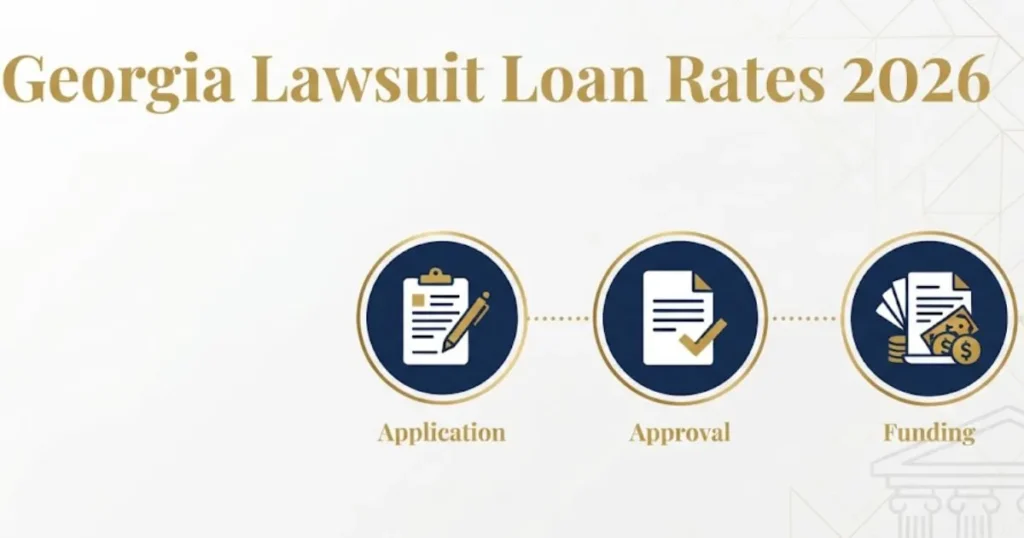
- You apply with a lawsuit funding company
- The company contacts your attorney for case details
- An underwriter reviews the strength of your claim
- You receive a funding offer with terms and fees
- If you accept, money is deposited into your account
- You repay the advance plus fees from your settlement proceeds
Your attorney plays a key role. Most Georgia funding companies require your lawyer to cooperate by sharing case documents and signing an acknowledgment letter. Without attorney involvement, approval rarely happens.
Think of it like a cash advance on a paycheck you have not received yet. The “paycheck” is your settlement, and the funding company is betting that it will come through.
One thing to understand clearly: you are not borrowing based on your income, credit score, or employment history. The only thing that matters is whether your case is strong enough to likely produce a settlement or verdict.
Pre-Settlement Funding Georgia
Pre-settlement funding in Georgia refers to money you receive while your lawsuit is still active and unresolved. It is the same product as a “lawsuit loan,” just described differently by some companies.
Georgia does not have a single law that defines pre-settlement funding under one clear label. Some companies call it a “lawsuit loan.” Others call it a “lawsuit cash advance” or “litigation funding.” The product is essentially the same.
Quick Facts:
- Other names: Lawsuit loan, settlement advance, litigation funding, plaintiff funding
- Availability: Statewide across all Georgia counties
- Typical case stage: After filing a lawsuit but before settlement or trial
- Who provides it: Private funding companies, not banks or credit unions
The important thing is that pre-settlement funding in Georgia is non-recourse. You do not make monthly payments. There is no repayment schedule. The full amount plus fees comes out of your settlement when the case ends.
If your case settles for less than expected, some agreements reduce what you owe. If it goes to zero, you owe zero. That is the fundamental trade-off: the funding company takes on risk, and in exchange, they charge higher rates than a traditional lender would.
Key Takeaway: Georgia lawsuit loans are non-recourse cash advances based on your pending case, not your credit. You repay only if you win, and the process usually takes 24 to 72 hours.
Georgia Personal Injury Lawsuit Loans
Personal injury cases are the most common type funded by Georgia lawsuit loan companies. If you were hurt because of someone else’s negligence and filed a claim, you likely qualify for pre-settlement funding.
The types of personal injury cases that get funded most often in Georgia include:
- Motor vehicle accidents
- Slip and fall injuries
- Dog bites
- Assault claims
- Premises liability
- Defective product injuries
- Nursing home abuse
Funding companies look at several factors when evaluating a personal injury case. Liability clarity is the biggest one. If it is obvious the other party was at fault, your case is more attractive to funders.
| Case Factor | What Funders Want to See |
|---|---|
| Liability | Clear fault on the defendant’s side |
| Medical Treatment | Documented injuries with ongoing treatment |
| Insurance Coverage | Defendant has adequate insurance |
| Attorney Involvement | Experienced personal injury lawyer on your case |
| Case Stage | Past the initial investigation phase |
In Georgia, the average personal injury settlement ranges from $15,000 to $75,000 for moderate cases. Funding companies typically advance 10% to 15% of the expected settlement value. So a case worth $50,000 might get you a $5,000 to $7,500 advance.
The stronger your medical documentation, the better your funding offer. Cases with clear MRI results, surgery records, or long-term treatment plans tend to get approved faster and for higher amounts.
Georgia Lawsuit Loan Requirements
To qualify for a Georgia lawsuit loan, you need a pending legal case with a reasonable chance of success. That is the primary requirement, and everything else flows from it.
Most Georgia lawsuit funding companies share these standard requirements:
- Active lawsuit filed in Georgia (or soon to be filed)
- Attorney representation (you must have a lawyer)
- Viable claim (the case must have strong enough facts)
- Sufficient expected settlement (the amount must cover the advance plus fees)
- No prior liens that consume too much of the settlement
Credit score does not matter. Employment status does not matter. Immigration status is generally not a barrier either. The funding decision is based entirely on the merits of your legal case.
Your attorney’s willingness to cooperate is also a requirement. The funding company will need your lawyer to share case details, confirm representation, and sign a lien acknowledgment letter.
One factor that can disqualify you: if your case already has too many liens against the expected settlement, a funder may decline. Medical liens, prior lawsuit loans, and attorney fees all eat into the available settlement amount. If there is not enough left over, the funding company will pass.
How Much Can I Get from a Lawsuit Loan in Georgia
Most Georgia plaintiffs receive between $1,000 and $100,000 from a lawsuit loan, though the typical advance falls in the $2,500 to $25,000 range.
The amount depends entirely on your case value. Funding companies generally advance 10% to 20% of what they estimate your settlement will be. Here is how that math usually works:
| Estimated Settlement | Typical Advance (10% to 15%) | Maximum Advance (20%) |
|---|---|---|
| $20,000 | $2,000 to $3,000 | $4,000 |
| $50,000 | $5,000 to $7,500 | $10,000 |
| $100,000 | $10,000 to $15,000 | $20,000 |
| $250,000 | $25,000 to $37,500 | $50,000 |
| $500,000+ | $50,000 to $75,000 | $100,000+ |
Cases with larger potential payouts qualify for bigger advances. A catastrophic injury case in Fulton County, for instance, could potentially receive $100,000 or more.
But here is the catch: taking too much upfront can eat into your final settlement in a big way. Between the advance, the funding fees, your attorney’s contingency fee, and medical liens, you could end up with very little in your pocket.
Smart plaintiffs take only what they need to cover immediate expenses. Rent, groceries, car payments, medical bills. Taking the maximum amount available almost always costs more in the long run.
Key Takeaway: Most Georgia lawsuit loans range from $2,500 to $25,000, based on 10% to 20% of your estimated settlement, and taking only what you need saves you money when fees stack up.
Georgia Lawsuit Loan Interest Rates
Georgia lawsuit loan interest rates typically range from 27% to 60% annually, with some companies charging even higher through compounding fee structures.
These rates are much higher than traditional loans. The reason is risk. Because funding companies lose their entire investment if your case loses, they charge more to offset that possibility.
Here is what rates look like across different funding models:
| Rate Structure | Annual Rate Range | How It Works |
|---|---|---|
| Simple Interest | 24% to 36% per year | Interest calculated on original advance only |
| Compound Interest | 30% to 60% per year | Interest charged on interest each period |
| Flat Fee (Tiered) | Fixed % per 6 or 12 months | Set fee per period, often increases over time |
| Capped Rate | Varies | Total fees capped at a percentage of the advance |
Simple interest is the cheapest option. If you borrow $5,000 at 30% simple interest for one year, you owe $6,500 total. With compound interest at the same rate, you could owe $7,000 or more.
Georgia does not currently cap lawsuit loan interest rates the way some states do. The state’s usury laws have traditionally not applied to lawsuit funding because courts have sometimes classified these transactions as sales of future settlement proceeds rather than loans.
This is why shopping around matters enormously. A 10% difference in annual rate on a $10,000 advance over two years can mean thousands of extra dollars out of your settlement.
Always ask for the total payoff amount at 6, 12, 18, and 24 months before signing anything. That single question reveals more about true cost than the quoted “rate” ever will.
Best Lawsuit Loan Companies in Georgia 2026
The best Georgia lawsuit loan companies in 2026 offer transparent rates, fast approval, and fair contract terms. Not all funders are equal, and the differences can cost or save you thousands.
Based on industry reputation, rate transparency, and Georgia-specific availability, here are some of the most active companies funding Georgia cases this year:
| Company | Typical Rate Range | Funding Speed | Min/Max Advance | Notable Feature |
|---|---|---|---|---|
| Oasis Financial | 27% to 40% annually | 24 to 48 hours | $500 to $100,000 | Rate caps on some products |
| USClaims | 30% to 42% annually | 24 to 72 hours | $1,000 to $500,000 | Large case specialty |
| Baker Street Funding | 24% to 36% annually | 24 hours | $1,000 to $500,000 | Competitive simple interest |
| Legal Bay | 30% to 45% annually | Same day possible | $500 to $500,000 | Fast processing |
| Peachtree Financial | Varies | 48 to 72 hours | $1,000 to $250,000 | Georgia-based operations |
A few things to look for when choosing a company:
- Does the contract clearly state simple or compound interest?
- Is there a cap on total repayment?
- Are there hidden processing, origination, or broker fees?
- Will the company let you review the contract with your attorney?
- Does the company have complaints filed with the Georgia Attorney General?
Getting quotes from at least three different companies is the smartest move you can make. Rates and terms vary significantly, and a little comparison shopping can literally save you thousands of dollars.
Georgia Lawsuit Funding Companies
Georgia lawsuit funding companies include both national firms that serve Georgia plaintiffs and smaller regional operations based within the state. The industry has grown rapidly in recent years, giving Georgia plaintiffs more options than ever before.
National companies like Oasis Financial, USClaims, and Baker Street Funding have established processes for handling Georgia cases. They work with Georgia attorneys regularly and understand state-specific procedures.
Regional or Georgia-based funders sometimes offer more personalized service. They may have relationships with local attorneys and courts that speed up the process. However, smaller companies do not always offer the most competitive rates.
Here is what to verify before choosing any Georgia funding company:
- Licensing: Check if the company is registered to operate in Georgia
- ALFA membership: Companies in the American Legal Finance Association follow voluntary best practices
- Attorney General complaints: Search the Georgia Department of Law consumer protection division
- Contract clarity: Every fee and rate should be spelled out in plain language
- Attorney review: The company should encourage you to have your lawyer review the agreement
One red flag: any company that pressures you to sign immediately or discourages you from showing the contract to your attorney. Legitimate funders want your lawyer involved because it protects everyone.
Key Takeaway: Always compare at least three Georgia lawsuit funding companies on rates, fees, and contract terms before signing, and verify their standing with Georgia’s consumer protection division.
Georgia Car Accident Lawsuit Funding
Car accident cases are the single most funded case type in Georgia. If you were injured in a collision caused by another driver and have filed a claim, you are a strong candidate for lawsuit funding.
Georgia follows a modified comparative negligence rule. This means you can recover damages as long as you are less than 50% at fault. Funding companies pay close attention to this. If there is any question about shared fault, it affects your approval odds and funding amount.
Car accident cases that get funded most quickly in Georgia share these traits:
- Police report clearly documenting the other driver’s fault
- Documented injuries requiring medical treatment
- Insurance coverage on the at-fault driver’s policy
- Attorney already engaged and working the case
- No prior funding liens against the case
| Car Accident Case Detail | Impact on Funding |
|---|---|
| Rear-end collision (other driver at fault) | High approval rate |
| T-bone at intersection with witness statements | Strong approval |
| Multi-vehicle pileup with unclear fault | Harder to fund |
| DUI driver caused the accident | Very strong case for funding |
| Minor fender bender, soft tissue only | Lower funding amounts |
Georgia has a two-year statute of limitations for personal injury from car accidents. If you are getting close to that deadline, a lawsuit needs to be filed before funding companies will consider your case.
Average funding amounts for Georgia car accident cases range from $2,000 to $20,000 depending on injury severity and expected settlement value.
Georgia Workers Comp Lawsuit Funding
Workers compensation cases in Georgia can qualify for lawsuit funding, but the process is slightly different than personal injury cases. Many funding companies are more cautious with workers comp claims because the payout structure is different.
In Georgia, workers comp benefits are set by a formula based on your average weekly wage. The maximum weekly benefit in Georgia for 2026 is expected to remain around $725 per week for temporary total disability. That formula limits the total settlement value, which in turn limits how much a funding company will advance.
Some important differences with workers comp funding:
- Benefits are determined by Georgia’s workers comp formula, not a jury
- Maximum medical improvement (MMI) ratings affect settlement value
- The Georgia State Board of Workers’ Compensation oversees claims
- Settlements often require board approval
- Funding amounts tend to be lower than personal injury advances
| Workers Comp Factor | Effect on Funding |
|---|---|
| Clearly documented workplace injury | Positive |
| Employer disputes the claim | Negative |
| Permanent partial disability rating | Increases settlement value |
| Case at settlement negotiation stage | Best time to apply |
| Prior workers comp liens on record | May reduce available funds |
Not all lawsuit funding companies serve Georgia workers comp cases. You will want to specifically ask whether the company funds this case type before applying. Companies like USClaims and Legal Bay have historically funded workers comp matters in Georgia.
Typical advances for Georgia workers comp cases range from $1,000 to $10,000, depending on the stage of the claim and the expected settlement.
Non-Recourse Lawsuit Loans Georgia
Non-recourse means you pay nothing back if you lose your case. This is the defining feature of Georgia lawsuit loans and what separates them from every other type of borrowing.
With a bank loan, you repay no matter what happens in your life. With a non-recourse lawsuit loan, the repayment obligation is tied entirely to the outcome of your case. Win or settle, and the funding company gets repaid from your proceeds. Lose, and you walk away owing zero.
Think of it like this: the funding company is buying a small piece of your future settlement. If that settlement never materializes, they eat the loss. Not you.
Why this matters for Georgia plaintiffs:
- Zero financial risk if your case is dismissed or you lose at trial
- No monthly payments during the life of the case
- No impact on credit since there is no debt to report if you lose
- Your attorney’s fee is separate from the funding repayment
The non-recourse structure is why rates are higher than traditional loans. The funding company accepts real risk. Roughly 5% to 10% of funded cases result in a total loss for the funder. That risk is priced into every contract.
Make sure your Georgia lawsuit loan contract explicitly states it is non-recourse. Some shady operators use language that creates a gray area. If the contract says anything about “personal obligation” or “guaranty,” that is a red flag.
Key Takeaway: Non-recourse protection is the most important feature of any Georgia lawsuit loan. If you lose your case, you owe nothing, but always confirm this is clearly stated in your contract.
Georgia Lawsuit Cash Advance
A Georgia lawsuit cash advance is the same product as a lawsuit loan, just marketed under a different name. Funding companies use the term “cash advance” because, legally, many prefer to classify these transactions as purchases of future settlement proceeds rather than loans.
The distinction is not just marketing. It has legal consequences. In Georgia, if a transaction is classified as a loan, it may fall under the state’s usury and lending laws. If it is classified as a purchase of a future receivable, different rules apply.
For you as the plaintiff, the practical experience is identical:
- You apply and submit case information
- The company evaluates your case
- You receive a lump sum of cash
- You repay from your settlement proceeds
- If you lose, you owe nothing
Quick Facts about Georgia Lawsuit Cash Advances:
- Same as a lawsuit loan in practical terms
- Legal classification may differ (sale vs. loan)
- No credit check required
- No employment verification
- Funds deposited to your bank account or mailed as a check
- Typical turnaround: 24 to 48 hours after attorney cooperates
Whether a company calls it a “loan,” “advance,” or “funding,” your job is the same: read the contract carefully. Look at the total repayment amount. Understand the rate structure. And compare offers from multiple companies.
How to Apply for a Lawsuit Loan in Georgia
Applying for a Georgia lawsuit loan takes about 10 to 15 minutes. The process is straightforward, but having your information ready speeds things up considerably.
Here is the typical application process from start to finish:
Step 1: Gather Your Information
- Your attorney’s name and contact information
- The type of case (car accident, slip and fall, etc.)
- The county where your case is filed
- A brief description of your injuries
Step 2: Submit an Application
- Most companies offer online or phone applications
- You will provide basic personal details and case information
- No credit check is run at this stage
Step 3: Attorney Verification
- The funding company contacts your lawyer
- Your attorney shares case documents and confirms representation
- This step takes the longest, usually 24 to 48 hours
Step 4: Underwriting Review
- The company evaluates your case strength
- They estimate your likely settlement amount
- An offer is prepared with specific terms
Step 5: Review and Sign
- You receive the funding agreement
- Review it with your attorney before signing
- Sign and return the agreement
Step 6: Receive Funds
- Money is deposited into your bank account
- Some companies offer same-day or next-day funding
- Check delivery takes 3 to 5 business days
| Application Stage | Typical Timeline |
|---|---|
| Application Submitted | Day 1 |
| Attorney Contacted | Day 1 to 2 |
| Case Review Completed | Day 2 to 3 |
| Offer Presented | Day 2 to 4 |
| Contract Signed | Day 3 to 5 |
| Funds Received | Day 3 to 7 |
The biggest delay in the process is almost always attorney response time. If your lawyer responds quickly with case documents, you can be funded within 24 to 48 hours.
Georgia Lawsuit Loan Repayment Terms
Repayment on a Georgia lawsuit loan happens only when your case settles or you win a verdict. There are no monthly payments, no installment plans, and no due dates during the life of your case.
When your case resolves, your attorney distributes the settlement funds. The funding company’s repayment comes directly from those proceeds before you receive your share. Your lawyer handles this distribution.
Here is what a typical settlement distribution looks like with a lawsuit loan:
| Settlement Component | Amount |
|---|---|
| Total Settlement | $75,000 |
| Attorney Fee (33%) | $25,000 |
| Medical Liens | $10,000 |
| Lawsuit Loan Repayment | $8,500 |
| Case Expenses | $2,000 |
| Your Take-Home | $29,500 |
Notice how the lawsuit loan repayment is just one of several deductions. Between attorney fees, medical liens, and funding costs, a $75,000 settlement can leave you with less than $30,000.
Repayment terms vary by company. Some key variables:
- Simple vs. compound interest affects total payoff
- Rate escalation clauses increase the rate over time
- Minimum repayment periods mean you pay a set fee even if the case settles quickly
- Caps on total repayment limit the maximum you will owe
Always ask for a full repayment schedule before signing. Request the total owed at 6 months, 12 months, 18 months, and 24 months. If the company will not provide this, that is a warning sign.
Key Takeaway: Georgia lawsuit loan repayment comes only from your settlement proceeds, but fees can take a large bite out of your final payout, so request a full repayment schedule at multiple time intervals before signing.
Georgia Lawsuit Funding Regulations
Georgia does not have a single, specific statute that regulates the lawsuit funding industry the way some other states do. This creates a less structured environment for both consumers and funders.
In some states, lawsuit funding is tightly regulated with required disclosures, rate caps, and licensing requirements. Georgia has taken a more hands-off approach historically, though legislative interest has increased in recent years.
Here is how Georgia’s regulatory picture looks in 2026:
| Regulatory Area | Georgia’s Position |
|---|---|
| Specific Lawsuit Funding Statute | No dedicated statute as of 2026 |
| Interest Rate Caps for Lawsuit Loans | Not currently capped |
| Required Disclosures to Consumers | Limited requirements |
| Licensing for Funding Companies | No specific license required |
| Attorney General Oversight | Consumer protection division can investigate complaints |
| Court Involvement | Some judges review funding agreements in certain cases |
The Georgia General Assembly has considered bills related to lawsuit funding regulation. HB 397 and similar proposals have addressed consumer protections for plaintiffs using funding products. As of early 2026, no sweeping reform has been enacted.
The Georgia Department of Law, under the Attorney General, handles consumer complaints about lawsuit funding companies. If you believe a company has engaged in deceptive practices, this is the office to contact.
Without strong regulation, the burden falls on you as the consumer. Read every line of the contract. Have your attorney review it. Ask questions about every fee. Georgia’s lack of rate caps means companies have wide latitude to set terms.
One positive development: the American Legal Finance Association (ALFA), an industry group, requires its members to follow certain best practices. These include fee disclosures, a right to cancel within a set period, and a prohibition on steering plaintiffs to specific attorneys or doctors.
Risks of Lawsuit Loans in Georgia
The biggest risk of a Georgia lawsuit loan is that high fees can consume a massive portion of your settlement. What looks like easy money today can become an expensive mistake over time.
Here are the primary risks Georgia plaintiffs need to understand:
High Cost Over Time
A $5,000 advance at 36% annual compound interest becomes roughly $9,250 after two years. If your case takes three years, that same advance could top $12,500. The longer your case takes, the more expensive the funding becomes.
Reduced Settlement Take-Home
Between attorney fees (usually 33% to 40%), medical liens, case costs, and lawsuit loan repayment, your net payout can shrink dramatically. Some plaintiffs end up with less than 20% of their gross settlement.
| Risk Factor | Why It Matters |
|---|---|
| Compound interest | Total owed grows exponentially over time |
| Long case duration | More interest accrues the longer your case takes |
| Multiple funding advances | Each additional advance adds separate fees |
| Unclear contract terms | Hidden fees or escalating rates increase costs |
| Pressure to settle early | Wanting to stop interest can lead to accepting a low settlement |
Pressure to Settle Low
When you know your lawsuit loan balance is growing every month, you might feel pressure to accept a lower settlement offer. Insurance companies know this. A quick, low settlement can hurt you more than the funding helps.
Stacking Multiple Advances
Some plaintiffs take a second or third advance from the same or different companies. Each advance carries its own fees. Stacking can leave you owing more than your case is worth.
Limited Regulation in Georgia
As covered in the previous section, Georgia does not cap rates or require extensive disclosures. This puts more responsibility on you to understand the terms.
The best way to manage risk: take the smallest amount you need, choose a company with simple interest and a rate cap, and discuss the decision with your attorney before signing anything.
Frequently Asked Questions
Do I Need Good Credit to Get a Lawsuit Loan in Georgia?
No, credit scores do not matter for Georgia lawsuit loans.
Funding companies base their decision on the strength of your legal case, not your financial history.
People with bad credit, no credit, or even bankruptcy histories can qualify.
What Happens If I Lose My Case After Getting a Lawsuit Loan?
You owe nothing if you lose your case.
Georgia lawsuit loans are non-recourse, meaning the funding company absorbs the loss entirely.
There is no personal obligation to repay from your own pocket.
How Fast Can I Get Funded for a Georgia Lawsuit Loan?
Most Georgia plaintiffs receive funds within 24 to 72 hours after approval.
The speed depends largely on how quickly your attorney provides case information.
Some companies offer same-day funding for straightforward cases.
Can My Attorney Stop Me from Getting a Lawsuit Loan in Georgia?
Your attorney cannot legally stop you, but they can refuse to cooperate with the funding company.
Without your lawyer’s participation, the application cannot move forward.
Most attorneys who object do so because they believe the terms are unfavorable.
Are Georgia Lawsuit Loans Taxable Income?
Lawsuit loans are generally not considered taxable income at the time you receive them.
The advance is treated as a loan or purchase of future settlement proceeds, not earned income.
Your settlement itself may or may not be taxable depending on the case type, so check with a tax professional.
Georgia lawsuit loans give plaintiffs real options during a difficult financial stretch. But they come with real costs that demand careful attention.
Before you sign with any company, compare at least three offers. Read every word of the contract. Have your attorney review the terms.
Your settlement is your money. Protect as much of it as you can by making informed decisions now.







