

The Bright Lending lawsuit is a legal fight against one of the most aggressive online tribal lenders in the country. Borrowers across multiple states say they were trapped with interest rates that would be illegal under any state lending law.
If you took a loan from Bright Lending, you may be owed money back. Some borrowers report paying back three to five times what they originally borrowed, thanks to annual percentage rates that climbed past 700%.
This article covers everything happening with the case in 2026. You’ll find settlement details, payout estimates, eligibility requirements, and step-by-step filing instructions.
One striking number stands out: the average Bright Lending borrower paid more in interest and fees than the actual loan principal within the first few months.
What Is the Bright Lending Lawsuit About
The Bright Lending lawsuit alleges that the company charged illegally high interest rates while hiding behind a tribal affiliation to dodge state consumer protection laws. At its core, this case is about whether a lender can claim tribal sovereign immunity to avoid following the rules every other lender must follow.
Bright Lending operates as an online installment lender. It offers small-dollar loans, typically between $300 and $3,000, with repayment terms stretching over several months.
The problem is the cost. Borrowers routinely face APRs between 300% and 800%. In most states, charging rates that high violates usury statutes.
Plaintiffs argue Bright Lending is not a genuine tribal enterprise. They claim the tribal affiliation is a front used by non-tribal financial operators to skirt state and federal lending regulations.
| Key Fact | Detail |
|---|---|
| Defendant | Bright Lending, LLC |
| Tribal Affiliation | Fort Belknap Indian Community |
| Loan Amounts | $300 to $3,000 |
| Reported APRs | 300% to 800%+ |
| Primary Allegation | Predatory lending; illegal interest rates |
| Legal Theory | Tribal immunity misuse; state law violations |
The legal arguments center on two questions. First, is Bright Lending truly an arm of the tribe? Second, does tribal status exempt a lender from all state lending laws?
Courts in similar cases have answered “no” to both questions. That precedent gives borrowers real leverage in this fight.
Bright Lending Lawsuit Update 2026
As of 2026, the Bright Lending lawsuit continues to move through litigation with significant developments. Multiple legal actions at both the state and federal level are actively progressing.
Several state attorneys general have opened formal investigations. Colorado and Virginia have been particularly aggressive in targeting tribal lending operations that serve their residents.
Court rulings in related tribal lending cases throughout 2024 and 2025 have weakened the sovereign immunity defense. Judges in the Fourth Circuit ruled that entities structured primarily to benefit non-tribal investors cannot hide behind tribal status.
Here’s what’s happened recently:
- Late 2024: Additional borrower complaints filed with the CFPB spiked sharply
- Early 2025: Related tribal lending lawsuits produced favorable rulings for borrowers
- Mid 2025: Settlement discussions reportedly began in at least one consolidated case
- 2026: Active litigation continues; new class certification motions pending
The trend line is clear. Courts are increasingly skeptical of the “rent-a-tribe” lending model. Each ruling chipping away at sovereign immunity defenses improves the odds for Bright Lending borrowers.
If you’ve been waiting for the right moment to pay attention, that moment is now. The case is hitting critical stages where class membership and claim filing windows matter.
Bright Lending Class Action Lawsuit Explained
A class action lawsuit against Bright Lending allows a large group of affected borrowers to sue together rather than each person filing separately. This structure makes it financially possible for ordinary people to take on a well-funded lending operation.
In a class action, one or more “named plaintiffs” represent everyone who falls into the defined class. That class typically includes all borrowers who received loans from Bright Lending during a specific time period and in specific states.
The benefits of the class action format are straightforward:
- Individual borrowers don’t pay upfront legal fees
- Attorneys work on contingency, meaning they get paid only if the case wins
- The collective power of thousands of claims forces the defendant to take the case seriously
- Settlements are typically larger than what individual lawsuits would produce
| Class Action Element | How It Works |
|---|---|
| Named Plaintiffs | Represent the entire group |
| Class Members | All qualifying borrowers |
| Attorney Fees | Paid from settlement (typically 25% to 33%) |
| Individual Cost | Usually $0 out of pocket |
| Opt-Out Option | You can exclude yourself to sue individually |
Class certification is a critical milestone. The court must agree that enough borrowers share common legal questions to justify a class action. Once certified, the case gains significant momentum.
If the court certifies the class, you may automatically be included if you meet the criteria. You’ll typically receive a notice by mail or email explaining your options.
Key Takeaway: The Bright Lending lawsuit is a class action where affected borrowers can participate at no upfront cost, and 2026 is shaping up to be a pivotal year for the case.
Bright Lending Settlement Details
No final, court-approved settlement in the Bright Lending lawsuit has been publicly announced as of early 2026. Settlement discussions, however, are reportedly underway based on patterns from related tribal lending cases.
In comparable cases involving other tribal lenders, settlements have included several types of relief:
- Cash payments to affected borrowers
- Debt cancellation for outstanding loan balances
- Refund of excess interest paid above legal state caps
- Agreement to stop lending in certain states
The Think Finance settlement, which involved a nearly identical tribal lending model, resulted in approximately $40 million in relief for borrowers. Big Picture Loans, another tribal lender, faced similar legal action that led to debt cancellation for thousands of borrowers.
| Settlement Comparison | Think Finance | Big Picture Loans | Bright Lending (Projected) |
|---|---|---|---|
| Total Relief | ~$40 million | Debt cancellation | TBD |
| Cash Payments | Yes | Limited | Expected |
| Debt Forgiveness | Yes | Yes | Likely |
| Lending Changes | Yes | Yes | Expected |
These precedents strongly suggest that a Bright Lending settlement will include both cash payments and some form of debt relief. The exact structure will depend on the total number of borrowers, the amount of provable damages, and the outcome of sovereign immunity arguments.
Keep your loan documents. Every payment confirmation, every email, every original loan agreement. These records directly affect what you can claim.
Bright Lending Settlement Payout Amounts
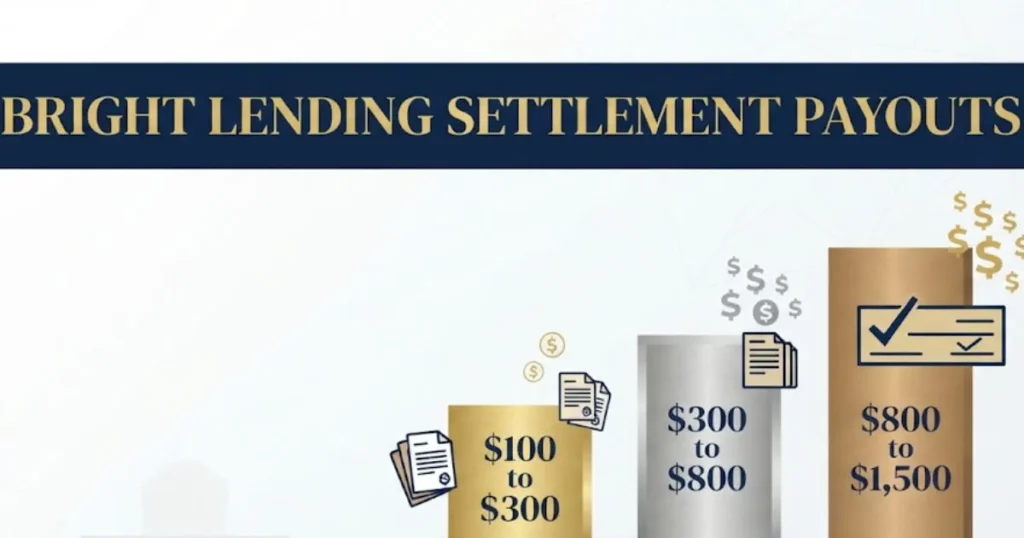
Estimated payouts in the Bright Lending settlement could range from $100 to $1,500 per borrower, depending on how much you borrowed, how much interest you paid, and how long you held the loan. These figures are based on outcomes from comparable tribal lending settlements.
The payout you receive will likely depend on a tiered system. Borrowers who paid the most in excess interest stand to recover the most.
Here’s how payout tiers typically work in these cases:
| Payout Tier | Borrower Profile | Estimated Range |
|---|---|---|
| Tier 1 | Borrowed $1,000+; paid full term with interest | $800 to $1,500 |
| Tier 2 | Borrowed $500 to $999; made multiple payments | $300 to $800 |
| Tier 3 | Borrowed under $500; limited payment history | $100 to $300 |
These estimates are projections, not guarantees. The actual amounts will depend on the settlement fund size, the number of valid claims filed, and attorney fee deductions.
In the Think Finance case, some borrowers received checks exceeding $1,000. Others received smaller amounts but had significant debt balances wiped clean, which was worth even more.
The strongest claims come from borrowers who can document the gap between what they paid and what state law would have allowed. If your state caps interest at 36% APR and you paid 600%, that difference is your potential recovery.
How Much Will I Get From the Bright Lending Lawsuit
How much you get depends on your specific loan history, your state’s usury limits, and the total settlement fund. There’s no single number that applies to everyone.
Think of it like this. If you borrowed $1,000 and ended up paying back $4,000, the $3,000 difference between what you paid and the original loan is the starting point for calculating your damages. Your state’s legal interest cap further refines that number.
A borrower in Colorado, where the maximum APR for consumer loans is capped around 36%, would have stronger claims than a borrower in a state with looser restrictions. The bigger the gap between the legal cap and what Bright Lending charged, the larger the potential payout.
Factors that determine your individual payout:
- Total interest and fees paid over the life of the loan
- Your state’s maximum allowable APR for similar loans
- The length of time you made payments
- Whether your debt was sold to a third-party collector
- How many other borrowers file valid claims
If the settlement fund totals $30 million and 50,000 borrowers file claims, the average payout would be roughly $600 per person. Fewer claims filed means larger individual checks.
Filing early and providing complete documentation puts you in the best position to maximize your recovery.
Key Takeaway: Your payout from the Bright Lending lawsuit depends on your loan amount, state law limits, and total interest paid; borrowers with larger loans in stricter states will recover the most.
Who Is Eligible for the Bright Lending Lawsuit
You are likely eligible if you received a loan from Bright Lending and were charged an interest rate that exceeds your state’s legal limit. Most online borrowers from Bright Lending will qualify.
The typical class definition in tribal lending cases includes anyone who:
- Received a loan from Bright Lending during the relevant time period
- Was a resident of a state with usury caps or lending license requirements
- Paid interest, fees, or principal on the loan
- Did not have a separate, individually negotiated commercial loan agreement
| Eligibility Factor | Qualifies | Does Not Qualify |
|---|---|---|
| Received a Bright Lending loan | Yes | N/A |
| Resident of state with usury laws | Yes | States without interest caps |
| Consumer loan (personal use) | Yes | Business/commercial loan |
| Loan within statute of limitations | Yes | Loans from 10+ years ago |
| Made at least one payment | Yes (stronger claim) | Applied but never received funds |
You don’t need to have paid off the loan. Borrowers who defaulted, had debts sent to collections, or still carry outstanding balances can all potentially qualify.
Even if you settled your debt directly with Bright Lending for a reduced amount, that doesn’t necessarily disqualify you. The argument is that the loan itself was illegal from the start, which is a legal concept called “void ab initio.”
Check your email and bank records for any transactions with Bright Lending. That’s the fastest way to confirm your eligibility.
How to Join the Bright Lending Lawsuit
Joining the Bright Lending lawsuit typically requires either submitting a claim form through the designated settlement administrator or contacting one of the law firms handling the class action. The process is usually free.
Here’s a step-by-step approach:
- Gather your documents. Find your original loan agreement, payment receipts, bank statements showing Bright Lending debits, and any correspondence from the company.
- Check for a class notice. If the class has been certified, you may have already received a notice by mail or email. That notice will contain instructions and deadlines.
- File a claim form. Most class action settlements provide an online claim form. Fill it out completely and attach supporting documents.
- Keep copies of everything. Save a copy of your submitted claim and any confirmation numbers.
- Watch for deadline updates. Filing deadlines are strict. Missing the deadline usually means losing your right to participate.
| Filing Step | What You Need |
|---|---|
| Loan Agreement | Original terms, interest rate, loan amount |
| Payment Records | Bank statements showing debits to Bright Lending |
| Claim Form | Available through settlement administrator |
| Proof of Residency | State where you lived when you took the loan |
| Deadline Compliance | File before the posted cut-off date |
If no formal claim process has opened yet, you can still register your interest with law firms investigating the case. Doing so puts you on the notification list for when the filing window opens.
The sooner you organize your records, the stronger your position will be when the claim window opens.
Is Bright Lending Legal
Bright Lending’s legality is the central question in this entire lawsuit. The company claims it operates legally under tribal sovereign immunity, but multiple courts and regulators have challenged that position.
Tribal sovereign immunity is a real legal doctrine. It protects Native American tribes and their genuine economic enterprises from certain state and federal regulations. The tribe operates as a sovereign nation, similar to how a foreign embassy operates on U.S. soil.
The catch is that the immunity only applies to entities that are truly “arms of the tribe.” Courts use a multi-factor test to determine whether a lending operation genuinely belongs to the tribe or whether the tribal name is just a shield for outside investors.
Factors courts examine include:
- Whether the tribe created and controls the entity
- Whether tribal members receive the profits
- Whether the tribe manages daily operations
- Whether the entity was formed primarily to benefit the tribe
- Whether non-tribal parties control the financial structure
In several landmark rulings, courts found that tribal lenders were controlled by non-tribal financial companies. The tribal connection was essentially a licensing arrangement, not a genuine business operation.
When courts strip away the immunity defense, the lender must comply with state laws. In most states, that means Bright Lending’s rates are illegal, and affected borrowers are owed refunds.
Key Takeaway: Courts are increasingly ruling that tribal lending entities like Bright Lending cannot use sovereign immunity if the tribal connection is just a corporate arrangement designed to avoid state lending laws.
Bright Lending and the Tribal Lending Model
Bright Lending uses the tribal lending model, which means it operates under the legal umbrella of a Native American tribe to avoid state lending regulations. The Fort Belknap Indian Community in Montana is the tribal entity associated with Bright Lending.
Here’s how the model works in practice. A tribe charters a lending company on tribal land. The company then offers loans nationwide through an online platform. Because the company is technically a tribal entity, it claims exemption from state usury laws, licensing requirements, and consumer protection rules.
The arrangement sounds clean on paper. In reality, critics and courts have found that many tribal lending operations follow a “rent-a-tribe” pattern:
- An outside financial company designs the loan products
- Non-tribal investors provide the capital
- The tribe receives a small percentage of revenue (often 1% to 4%)
- Non-tribal managers run daily operations
- The tribe’s primary role is to provide its sovereign status as a legal shield
| Tribal Lending Breakdown | Genuine Tribal Enterprise | “Rent-a-Tribe” Model |
|---|---|---|
| Who provides capital | The tribe | Outside investors |
| Who designs loan products | Tribal management | Non-tribal fintech company |
| Revenue to tribe | Majority | Small percentage (1% to 4%) |
| Daily operations | Tribal employees | Non-tribal contractors |
| Primary purpose | Tribal economic development | Profit for non-tribal parties |
The Fourth Circuit Court of Appeals ruled in related cases that when the economic reality shows non-tribal control, the entity does not qualify for sovereign immunity. That ruling has ripple effects across the tribal lending industry, including for Bright Lending.
Bright Lending Predatory Lending Allegations
Borrowers and regulators allege that Bright Lending engaged in predatory lending by trapping consumers in cycles of debt through excessively high interest rates, misleading loan terms, and aggressive collection practices.
Predatory lending isn’t just about high rates. It’s a pattern of behavior designed to extract maximum money from people who have limited financial options.
The specific predatory practices alleged against Bright Lending include:
- Burying the true cost of the loan in complex disclosure language
- Targeting financially vulnerable borrowers through online advertising
- Structuring payments so early installments go almost entirely toward interest
- Using automatic bank withdrawals that borrowers struggle to cancel
- Charging origination fees on top of already extreme interest rates
- Rolling over loans or encouraging repeat borrowing
A borrower who takes a $1,000 loan at 600% APR will pay roughly $500 in interest within the first two months alone. After six months of minimum payments, they may have paid back $2,500 while still owing most of the original principal.
That math is the definition of a debt trap. The loan is designed so that the borrower can never get ahead of the interest, making full repayment nearly impossible without paying several times the original amount.
State usury laws exist specifically to prevent this kind of lending. By sidestepping those laws through tribal affiliation, Bright Lending allegedly operated outside the system designed to protect consumers.
Bright Lending Interest Rate Lawsuit Claims
The interest rate claims in the Bright Lending lawsuit argue that the company charged rates far exceeding what any state allows for consumer loans, making those loans void under state law. This is the strongest legal argument plaintiffs hold.
Every state has some form of interest rate regulation. Most states cap consumer loan APRs between 24% and 36%. A few states allow higher rates for certain loan products, but none permit the 300% to 800% APR range Bright Lending commonly charged.
| State | Max Consumer Loan APR | Bright Lending APR | Difference |
|---|---|---|---|
| Colorado | 36% | 600%+ | 564%+ over limit |
| New York | 25% | 700%+ | 675%+ over limit |
| Virginia | 36% | 500%+ | 464%+ over limit |
| Georgia | 60% (some products) | 600%+ | 540%+ over limit |
| Illinois | 36% | 600%+ | 564%+ over limit |
The legal theory is straightforward. If a court determines that Bright Lending must follow state law, then every dollar charged above the state cap is illegal. The borrower is entitled to a refund of those excess charges.
Some courts have gone further, ruling that loans originated at illegal rates are “void ab initio.” That legal term means the loan never legally existed. If a loan is void from the start, the borrower may owe nothing at all.
This is why keeping records of what you paid is so important. The gap between legal rates and what you actually paid defines your damages.
Key Takeaway: Bright Lending charged interest rates that exceed state legal limits by hundreds of percentage points, and courts may rule those loans were illegal from the very beginning, meaning borrowers could owe nothing.
What Is Bright Lending’s APR
Bright Lending’s annual percentage rate typically ranges from 300% to over 800%, depending on the loan amount, repayment term, and borrower’s state of residence. These rates are among the highest in the online lending industry.
To put that in perspective, here’s what different types of lenders charge:
| Lender Type | Typical APR |
|---|---|
| Credit union personal loan | 6% to 18% |
| Bank personal loan | 8% to 24% |
| Credit card cash advance | 20% to 30% |
| Payday loan (storefront) | 300% to 500% |
| Bright Lending | 300% to 800%+ |
A $1,000 Bright Lending loan at 600% APR, repaid over 9 months, would cost the borrower approximately $3,500 to $4,000 in total repayment. That means you’d pay back nearly four times what you borrowed.
The APR disclosure is technically included in Bright Lending’s loan agreements. The complaint, though, is that the true cost is obscured by how the information is presented. Payment schedules emphasize the monthly amount rather than the total cost.
Imagine buying a $1,000 used television and being told the monthly payment is only $350. Sounds manageable until you realize you’ll make 11 payments totaling $3,850. That’s what these APRs look like in practice.
The extreme APR is the foundation of every legal claim against Bright Lending. Without rates this high, there would be no lawsuit.
Bright Lending and the CFPB
The Consumer Financial Protection Bureau has been monitoring tribal lending operations, including entities like Bright Lending, as part of its broader enforcement against predatory online lending. The CFPB has the authority to take action against lenders that violate federal consumer financial laws.
The CFPB’s role matters because it operates at the federal level. Even when a tribal lender claims immunity from state laws, federal regulations still apply. The Truth in Lending Act and the Electronic Fund Transfer Act are federal statutes that all lenders must follow.
Key areas where the CFPB has focused enforcement:
- Failure to clearly disclose APR and total loan cost (TILA violations)
- Unauthorized debits from borrower bank accounts (EFTA violations)
- Deceptive marketing that misrepresents loan terms
- Unfair debt collection practices by the lender or its agents
- Failure to maintain proper lending licenses
The CFPB took action against several tribal lending operations between 2020 and 2025. In one case involving a similar tribal lender, the bureau secured over $60 million in borrower relief.
Borrowers can file complaints directly with the CFPB. Every complaint creates a public record and adds pressure on the lender. High complaint volumes often trigger formal CFPB investigations.
Filing a CFPB complaint does not replace joining the class action. You can do both. The complaint strengthens the regulatory case while the lawsuit pursues your financial recovery.
Bright Lending Complaints From Borrowers
Thousands of borrowers have filed complaints against Bright Lending with the CFPB, the Better Business Bureau, and state consumer protection agencies. The most common themes are shockingly high repayment totals, difficulty canceling automatic payments, and aggressive collection tactics.
Here are the complaint categories that appear most frequently:
| Complaint Category | Percentage of Total Complaints |
|---|---|
| Excessive interest/total cost | ~35% |
| Difficulty stopping auto-payments | ~25% |
| Aggressive debt collection | ~20% |
| Misleading loan terms at origination | ~12% |
| Unauthorized bank withdrawals | ~8% |
Borrowers consistently report the same experience. They needed quick cash, found Bright Lending online, and applied for a modest loan. The approval was fast. The money arrived quickly. Then the repayment reality hit.
One pattern stands out across complaints. Borrowers say they tried to cancel the automatic bank withdrawals but found the process intentionally difficult. Some report that debits continued even after they thought they had canceled.
Another common complaint involves the tone and frequency of collection calls. Borrowers who fell behind on payments describe receiving multiple calls per day, sometimes to family members or workplaces.
These complaints create a paper trail. Regulators and courts use complaint data to identify patterns of behavior. Your individual complaint might seem small, but combined with thousands of others, it builds the case.
Key Takeaway: Borrower complaints against Bright Lending paint a consistent picture of hidden costs, difficult-to-cancel payments, and aggressive collections, all of which support the predatory lending claims in the lawsuit.
Bright Lending Loan Forgiveness Options
Loan forgiveness through the Bright Lending lawsuit could eliminate some or all of your outstanding balance if courts determine the loans were illegal. This form of relief has been included in several comparable tribal lending settlements.
Loan forgiveness in this context works differently than federal student loan forgiveness. Here, the argument is that the loan itself was unlawful. If a court agrees, the lender has no legal right to collect on it.
There are several ways forgiveness could happen:
- Court order: A judge rules the loan void ab initio, meaning it never legally existed
- Settlement agreement: Bright Lending agrees to cancel outstanding balances as part of a negotiated settlement
- Regulatory action: The CFPB or a state attorney general orders debt cancellation as an enforcement remedy
- Voluntary cessation: The lender stops collecting in exchange for reduced penalties
| Forgiveness Scenario | What It Means for You |
|---|---|
| Loan declared void | You owe nothing; may receive refund of payments made |
| Settlement with debt cancellation | Outstanding balance wiped; partial refund possible |
| CFPB enforcement order | Debt canceled; lender may also pay penalties |
| Lender stops collecting | No more payments; balance written off |
If you currently have an outstanding Bright Lending balance, do not ignore collection attempts. Respond in writing and note that the debt is disputed and subject to active litigation.
Keeping records of every collection contact helps your case. Dates, times, caller names, and what was said all matter.
How to Get a Refund From Bright Lending
Getting a refund from Bright Lending typically happens through the class action settlement process, not through a direct refund request to the company. The lawsuit is your primary path to recovering overpaid interest and fees.
Here’s the reality. You’re unlikely to call Bright Lending’s customer service line and receive a refund check. Companies facing lawsuits don’t voluntarily hand out money.
Instead, refunds flow through these channels:
- Class action settlement fund. If the case settles, a claims administrator distributes payments to eligible borrowers who file valid claims.
- CFPB enforcement. If the CFPB takes action, it may order Bright Lending to issue refunds directly to affected consumers.
- State attorney general action. Your state AG may negotiate refunds as part of a consent order with the lender.
- Individual lawsuit. If you opt out of the class action and sue independently, you could potentially recover more, but you’d bear the legal costs.
| Refund Path | Your Cost | Typical Timeline |
|---|---|---|
| Class action settlement | $0 | 12 to 24 months after settlement |
| CFPB enforcement | $0 | 6 to 18 months |
| State AG action | $0 | Varies by state |
| Individual lawsuit | Legal fees apply | 1 to 3 years |
The most important thing you can do right now is calculate your total payments to Bright Lending. Add up every debit from your bank account. Compare that total to your original loan amount. The difference is your starting point for a refund claim.
Bright Lending Debt Collection Lawsuit Issues
Bright Lending debt collection lawsuits raise serious legal questions because if the underlying loan is illegal, the debt itself may be unenforceable, and collection attempts may violate federal fair debt collection laws. This is a two-sided problem for Bright Lending.
If you’re being contacted by debt collectors about a Bright Lending loan, you have rights under the Fair Debt Collection Practices Act (FDCPA). Collectors must follow strict rules about when, how, and how often they can contact you.
Common FDCPA violations reported in connection with Bright Lending debts:
- Calling before 8 AM or after 9 PM
- Contacting you at work after being told to stop
- Using threatening or abusive language
- Failing to validate the debt when requested
- Continuing collection after receiving a written dispute
- Contacting third parties (family, employer) about your debt
| Your Right | What to Do |
|---|---|
| Right to dispute the debt | Send a written dispute letter within 30 days |
| Right to stop calls | Send a cease-and-desist letter in writing |
| Right to validation | Request written proof of the debt amount and origin |
| Right to sue | File an FDCPA complaint if violations occur |
Here’s the powerful part. If the Bright Lending loan is ruled illegal, then the debt doesn’t exist. Collecting on a nonexistent debt is itself a violation. That means you could have a counter-claim against the collector.
Every collection call you receive is potentially evidence. Document everything. Dates, times, what was said, who called. That information has value in court.
Key Takeaway: If your Bright Lending loan is ruled illegal, not only is the debt unenforceable, but collection attempts on that void debt could give you grounds for an additional lawsuit against the collector.
Frequently Asked Questions
Can I still file a claim in the Bright Lending lawsuit in 2026?
Yes, in most cases, the claim filing window is still open or has not yet formally opened as of 2026.
Watch for official class notices that will be sent to borrowers by mail or email.
Filing deadlines will be strictly enforced once announced, so gather your loan documents now.
How much money will I get from the Bright Lending settlement?
Most borrowers can expect between $100 and $1,500 depending on their loan size and total interest paid.
The exact payout depends on the final settlement amount and how many valid claims are filed.
Borrowers with larger loans and higher interest payments will receive more.
Does Bright Lending have to follow state lending laws?
Courts are increasingly ruling that Bright Lending must follow state lending laws if it is not a genuine arm of the tribe.
The tribal sovereign immunity defense only applies to true tribal enterprises, not arrangements where outside investors control the operation.
Several federal courts have already rejected immunity claims from similar tribal lenders.
What happens if Bright Lending uses tribal immunity as a defense?
Tribal immunity can be challenged and has been successfully defeated in multiple related cases.
Courts apply a multi-factor test examining who really controls and profits from the lending operation.
If the court finds that non-tribal parties run the business, the immunity defense fails.
Will my Bright Lending debt be forgiven if the lawsuit succeeds?
Debt forgiveness is a likely outcome if the court rules the loans were illegal from the start.
In comparable tribal lending cases, settlements have included full cancellation of outstanding balances.
Even if total forgiveness doesn’t occur, significant reductions in what you owe are common.
The Bright Lending lawsuit could put real money back in borrowers’ pockets and wipe out illegally created debts. The case is active and moving forward in 2026.
If you borrowed from Bright Lending, pull your records together now. Check your bank statements for every payment you made to them.
Stay informed about filing deadlines and class notice updates. The borrowers who act early and document their claims thoroughly are the ones who recover the most.
META BLOCK
Meta Title: Bright Lending Lawsuit 2026: Payouts and Eligibility
Meta Title Chars: 55/59
Meta Desc: The Bright Lending lawsuit targets predatory rates and illegal lending. See 2026 updates, settlement payouts, eligibility rules, and how to file.
Meta Desc Chars: 153/159
Focus Keywords: bright lending lawsuit, bright lending settlement, bright lending class action, bright lending eligibility, bright lending payout
Slug: /bright-lending-lawsuit/
PHASE 5: IMAGE PROMPTS
Image Prompt 1 (Hero Banner):
A professional editorial-style horizontal banner with the bold headline text “Bright Lending Lawsuit” centered in large, clean white sans-serif typography against a deep navy blue background. Below the headline, smaller gold text reads “2026 Updates, Payouts & Eligibility.” The background features subtle, abstract courthouse columns on the left side fading into shadow, with faint golden scales of justice icon watermarked behind the text. A silhouette of stacked legal documents and a gavel rests on the right side in dark charcoal tones. The overall mood is serious, authoritative, and modern. High contrast lighting with crisp edges. No human faces. Color palette restricted to deep navy, white, and gold accents. 1920×1080 landscape format with breathing room on the right for optional overlay text.
Alt Text 1: Bright lending lawsuit 2026 hero banner with legal scales and gavel on navy background
Image Prompt 2 (Supporting Image):
A horizontal in-article graphic with the headline text “Bright Lending Settlement Payouts” displayed in bold gold typography on a deep navy rectangular banner across the top third. Below, a stylized infographic layout shows three tiers represented by ascending bar chart columns in gold, silver, and bronze tones, each labeled with dollar ranges ($100 to $300, $300 to $800, $800 to $1,500). Small icons of loan documents and dollar signs float beside each tier. The background is clean white with subtle geometric line patterns. A faint silhouette of a courtroom bench appears at the bottom edge in light gray. Professional, modern editorial design. No human faces. Deep navy, white, and gold color palette. 1920×1080 landscape format with open space on the left side for text overlay.
Alt Text 2: Bright lending lawsuit settlement payout tiers infographic with gold bar chart design







