

The CareCredit lawsuit is one of the biggest consumer finance cases heading into 2026, and millions of cardholders may be owed money. If you ever used CareCredit for dental work, medical bills, or vet expenses and got slammed with surprise interest charges, this case directly involves you.
The CFPB ordered CareCredit’s parent company to pay at least $13.4 million in consumer refunds. That number could grow as additional state and class action claims move forward.
This article breaks down every angle of the CareCredit lawsuit for 2026. You’ll learn who qualifies, how much you could receive, what the allegations are, and exactly how to file a claim before deadlines close.
One fact that catches most people off guard: CareCredit reportedly enrolled consumers in deferred interest plans without clearly explaining that the “zero interest” deal would charge them retroactive interest on the entire balance if they missed the payoff window by even one day.
CareCredit Lawsuit 2026: What You Need to Know Right Now
The CareCredit lawsuit in 2026 centers on allegations that the company used deceptive promotional financing to trap consumers in high-interest debt. Federal regulators and private plaintiffs have both brought legal action against the company and its parent, Synchrony Financial.
At the heart of this case is a simple bait-and-switch claim. CareCredit marketed “no interest” financing at doctor’s offices, dental clinics, and veterinary practices. But the fine print buried a costly surprise.
If you didn’t pay off the full balance before the promotional period ended, CareCredit charged interest retroactively. That means interest from day one, calculated on the original full amount, even if you’d paid most of it off.
The CFPB took formal enforcement action against CareCredit in September 2023. Since then, the case has expanded. Multiple private lawsuits have been filed in federal courts across the country.
| Key Detail | Information |
|---|---|
| Main Regulator | Consumer Financial Protection Bureau (CFPB) |
| Parent Company | Synchrony Financial |
| Core Allegation | Deceptive deferred interest practices |
| Enforcement Date | September 2023 |
| Consumer Refunds Ordered | $13.4 million minimum |
| Status in 2026 | Active and expanding |
For 2026, the legal situation is still evolving. New claims continue to surface, and existing cases are moving toward resolution. Anyone who held a CareCredit account during the affected period should pay close attention to updates over the coming months.
Is There a CareCredit Class Action Lawsuit
Yes, there is an active CareCredit class action lawsuit. Multiple class action filings target both CareCredit and Synchrony Financial for deceptive lending practices tied to promotional financing offers.
The class action claims are separate from the CFPB enforcement action. They were filed by private plaintiffs and consumer rights attorneys on behalf of large groups of cardholders.
These suits argue that CareCredit systematically failed to disclose the true cost of its deferred interest promotions. Consumers say they were enrolled at medical offices under pressure, often while dealing with health emergencies. They didn’t have time to read pages of fine print.
One key class action was filed in the U.S. District Court for the Southern District of New York. It represents consumers nationwide who opened CareCredit accounts and were charged retroactive interest after promotional periods expired.
The class representatives claim that CareCredit’s enrollment process at healthcare providers was designed to minimize disclosure. Sign-up often happened on a tablet in a waiting room, with no printed terms to review.
Several other individual and class claims have been consolidated as the court system works to manage the volume. The class has not yet been formally certified in all cases, which means the court is still deciding whether these claims can proceed as a single group action.
- Class actions target both CareCredit and Synchrony Financial
- Filed in multiple federal courts
- Claims allege systemic deception at point of enrollment
- Class certification is pending in several jurisdictions
Key Takeaway: CareCredit faces both federal regulatory action and private class action lawsuits, and both tracks are active heading into 2026.
CareCredit Settlement: Current Status and Updates
The CareCredit settlement process is underway but has not reached a final resolution for all claims as of early 2026. The CFPB consent order represents the most concrete settlement action so far, requiring Synchrony Financial to refund affected consumers.
Under the consent order, Synchrony agreed to pay $13.4 million in direct consumer refunds. The company also agreed to a $3 million civil money penalty paid to the CFPB’s victims relief fund.
Beyond the federal settlement, private class action settlements are still being negotiated. These cases could add significantly to the total compensation pool. Attorneys involved in the class actions have signaled that they expect settlement talks to progress in 2026.
| Settlement Component | Details |
|---|---|
| CFPB Consumer Refunds | $13.4 million |
| CFPB Civil Penalty | $3 million |
| Private Class Action | Negotiations ongoing |
| Total Potential Exposure | Estimated $50 million or more |
| Settlement Status | Partially resolved, partially pending |
Synchrony Financial has not admitted wrongdoing in any of the settlements. That’s standard in these cases. Companies agree to pay without saying they did anything wrong. It’s the legal equivalent of paying someone to stop arguing.
For consumers, what matters is the money, not the admission. And more money may be on the way as private claims move toward resolution.
CareCredit Lawsuit Payout: How Much Money to Expect
CareCredit lawsuit payouts will vary based on how much retroactive interest you were charged and what type of claim you fall under. Consumers affected by the CFPB enforcement action can expect refunds equal to the deferred interest charges they should never have paid.
The CFPB order specifically targets consumers who were charged deferred interest between January 1, 2017 and the date of the consent order. If you fell into that window and got hit with surprise interest, your refund should roughly equal the improper charges.
For the class action cases, payout estimates are harder to pin down. These depend on the final settlement amount, the number of claimants, and attorney fees. In similar consumer finance class actions, individual payouts have ranged from $50 to $500 per person.
Some consumers with larger balances could receive more. If you had a $5,000 dental procedure financed through CareCredit and were charged 26.99% retroactive interest, your refund or payout could be well over $1,000.
- CFPB refunds: Based on actual improper charges
- Class action payouts: Estimated $50 to $500 for most claimants
- High-balance consumers: Could receive $1,000 or more
- Payment timing: CFPB refunds already being distributed; class action payouts expected later in 2026
The difference between the CFPB track and the class action track matters. CFPB refunds are calculated individually based on your account history. Class action payouts are typically divided among all participants in the class.
CareCredit Settlement Amount Per Person
The CareCredit settlement amount per person depends on which legal action applies to your situation. Under the CFPB order, refunds are personalized to match the interest charges each consumer was unfairly billed.
Think of it this way. If CareCredit charged you $300 in retroactive interest that you shouldn’t have owed, your refund targets that $300. The CFPB didn’t set a flat per-person amount. Instead, it ordered Synchrony to make each affected consumer whole.
For the class action cases, the math works differently. Settlement funds get divided among all eligible class members after attorneys take their fees, which typically run about 25% to 33% of the total.
| Claim Type | Estimated Per-Person Amount | Basis for Calculation |
|---|---|---|
| CFPB Refund | Varies (matches actual charges) | Individual account review |
| Class Action (small balance) | $50 to $200 | Pro-rata share of settlement |
| Class Action (large balance) | $200 to $500+ | Pro-rata share of settlement |
| High-damage individual claim | $1,000+ | Direct litigation recovery |
If you had multiple CareCredit promotional plans that each triggered retroactive interest, your total refund could be higher. Some consumers carried three or four different promotional balances across dental, vision, and medical expenses.
The biggest individual claims will come from people who can prove they were enrolled without adequate disclosure and suffered significant financial harm. Those cases, if pursued individually rather than through the class, could yield substantially higher recoveries.
Key Takeaway: CFPB refunds match your actual overcharges dollar for dollar, while class action payouts will be smaller but still meaningful for most claimants.
Who Qualifies for the CareCredit Lawsuit
You qualify for the CareCredit lawsuit if you held a CareCredit credit card and were charged deferred interest on a promotional financing plan without receiving clear, adequate disclosure of the terms. The qualification criteria differ slightly between the CFPB action and the class action claims.
For the CFPB enforcement action, you likely qualify if:
- You opened a CareCredit account between 2017 and 2023
- You were enrolled in a deferred interest promotional plan
- You were charged retroactive interest when the promotional period expired
- The terms were not clearly explained to you at enrollment
For the class action lawsuits, the qualification window may extend further. Some claims cover accounts opened as far back as 2014. The class definition is still being finalized, but it generally includes anyone who was subjected to CareCredit’s deferred interest practices.
You don’t need to have filed a complaint previously. You don’t need to have disputed the charges with CareCredit. Simply having been charged under these conditions makes you a potential class member.
Even if you paid off the retroactive interest and closed your account, you still qualify. The harm happened when you were charged, not based on whether the account is still open.
One important point: if you enrolled in a CareCredit plan and paid off the entire balance before the promotional period ended, you would not have been charged deferred interest. In that case, you likely don’t have a qualifying claim unless you can show enrollment deception on its own caused you harm.
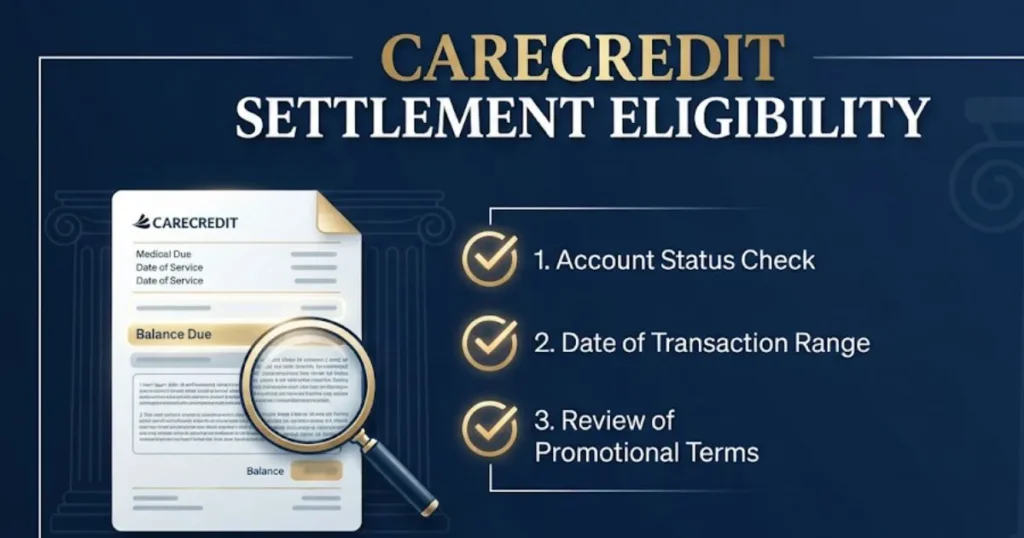
CareCredit Lawsuit Eligibility Requirements Explained
CareCredit lawsuit eligibility requirements boil down to three core factors: you had a CareCredit account, you were charged deferred interest, and the promotional terms were not properly disclosed. Let’s break each requirement down.
Requirement 1: Active CareCredit Account
You must have held a CareCredit credit card during the relevant time period. The CFPB action covers accounts from roughly 2017 through 2023. Class actions may cover broader periods.
Requirement 2: Deferred Interest Charges Applied
Your account must show that deferred interest was assessed. This means the promotional period ended, and CareCredit charged you interest going back to the original purchase date. Monthly statements would reflect this as a sudden large interest charge appearing on your bill.
Requirement 3: Inadequate Disclosure
This is where many consumers have the strongest case. CareCredit enrolled people at healthcare provider offices. The sign-up process happened quickly, often on digital devices, with minimal explanation.
| Eligibility Factor | What It Means |
|---|---|
| Account Period | 2014 to 2023 (varies by claim) |
| Deferred Interest Charged | Yes, must appear on statements |
| Disclosure Received | None or inadequate at enrollment |
| Account Status | Open or closed, both qualify |
| Prior Complaints Filed | Not required |
| Minimum Charge Amount | No minimum threshold |
If you aren’t sure whether you were charged deferred interest, pull your old CareCredit statements. Look for a large interest charge that appeared suddenly after a period of zero-interest payments. That’s the red flag.
CareCredit Hidden Fees Lawsuit Details
The CareCredit hidden fees lawsuit alleges that the company concealed the true cost of its financing products by burying key terms in fine print and rushing consumers through enrollment. These weren’t “fees” in the traditional sense. They were retroactive interest charges disguised behind promotional offers.
Here’s how the hidden fee scheme worked. You walk into a dentist’s office needing a crown that costs $2,500. The front desk offers you CareCredit with “zero interest for 24 months.” Sounds great. You sign up on a tablet.
What you probably didn’t hear: if you still owe even $1 after those 24 months, CareCredit charges you interest from the very first day. At rates as high as 26.99% APR. On the full original balance. Not just the remaining dollar.
That $2,500 crown could suddenly generate over $1,300 in retroactive interest charges. One day late, one dollar short, and the “zero interest” deal evaporates entirely.
The lawsuit claims CareCredit trained healthcare providers to push enrollment. Office staff received commissions or incentives for signing patients up. They weren’t trained to explain the deferred interest risk.
- Retroactive interest rates reached 26.99% APR
- Interest calculated from original purchase date
- One dollar remaining could trigger full retroactive charges
- Healthcare providers incentivized to push enrollment
- Digital sign-up process minimized disclosure
The hidden nature of these charges is the backbone of every legal claim against CareCredit. Regulators called it deceptive. Plaintiffs call it fraud. Either way, consumers paid the price.
Key Takeaway: CareCredit’s “zero interest” promotions hid a deferred interest trap that charged consumers retroactive interest at rates up to 26.99% APR if they didn’t pay the full balance before the promotional period ended.
CareCredit Deferred Interest Lawsuit Breakdown
The CareCredit deferred interest lawsuit specifically targets the company’s use of deferred interest financing as a deceptive product. Deferred interest is not the same as zero interest, and the lawsuit argues CareCredit deliberately blurred that distinction.
To understand the legal claim, you need to understand the difference between two financing models:
| Feature | True Zero Interest | Deferred Interest |
|---|---|---|
| Interest During Promo | None charged | Accrues but is hidden |
| After Promo Ends | Interest starts on remaining balance | All accrued interest hits at once |
| Risk to Consumer | Low | Extremely high |
| Transparency | Clear | Often misleading |
| CareCredit Model | Not this | This one |
With true zero-interest financing, you pay no interest during the promotional period. After it ends, interest starts accumulating only on whatever balance remains. That’s fair and straightforward.
Deferred interest works differently. Interest is actually accumulating the entire time. The company just doesn’t charge it to you yet. If you pay everything off before the period ends, the accrued interest gets waived. If you don’t, every penny of that hidden interest gets dumped on your account at once.
CareCredit used the deferred interest model while marketing it as if it were zero interest. The CFPB found that this practice was misleading and harmed consumers who didn’t understand what “deferred” actually meant.
Most people don’t know what deferred interest means. That’s the whole point of the lawsuit. CareCredit counted on consumer confusion. When regulators investigated, they found exactly that: widespread consumer harm driven by a confusing product sold through a rushed enrollment process.
CareCredit CFPB Enforcement Action
The CareCredit CFPB enforcement action was filed in September 2023 and resulted in a consent order requiring Synchrony Financial to pay millions in consumer refunds and penalties. This is the most significant regulatory action taken against CareCredit to date.
The CFPB investigation found that CareCredit engaged in unfair and deceptive acts. Specifically, the bureau concluded that:
- CareCredit enrolled consumers in deferred interest plans without adequate disclosure
- Consumers were led to believe they were getting zero-interest financing
- The enrollment process at healthcare providers was rushed and confusing
- CareCredit failed to ensure consumers understood the retroactive interest risk
- The company’s practices violated the Consumer Financial Protection Act
The consent order imposed three key requirements on Synchrony Financial:
| Requirement | Details |
|---|---|
| Consumer Refunds | $13.4 million to affected cardholders |
| Civil Money Penalty | $3 million to CFPB victims relief fund |
| Business Practice Changes | Must clearly disclose deferred interest terms going forward |
The CFPB’s action was led by then-Director Rohit Chopra, who publicly stated that CareCredit’s practices caused real financial harm to people seeking medical care. The bureau framed this as a case where a financial product exploited consumers at their most vulnerable.
Since the consent order, Synchrony has begun implementing changes to its CareCredit enrollment process. But those changes only affect new accounts. They don’t undo the damage already done to millions of existing cardholders.
This CFPB action gave the class action lawsuits significant momentum. When a federal regulator says a company’s practices were deceptive, that finding becomes powerful evidence in private litigation.
CareCredit and Synchrony Financial Lawsuit Connection
CareCredit is not a standalone company. It is a product issued by Synchrony Financial, one of the largest consumer finance companies in the United States. Every legal claim against CareCredit is effectively a claim against Synchrony.
This matters for several reasons. Synchrony has deep pockets. The company reported $2.2 billion in net income in recent fiscal years. It issues credit cards for dozens of major retail brands, including Amazon, Lowe’s, and PayPal.
When the CFPB went after CareCredit, it named Synchrony Financial in the enforcement action. The consent order binds Synchrony, not just the CareCredit brand. That means the parent company bears full financial and legal responsibility.
Synchrony’s exposure extends beyond CareCredit. The company has faced separate regulatory scrutiny for similar deferred interest practices across its other branded cards. This pattern of behavior strengthens the legal case against CareCredit because it suggests systemic issues, not isolated mistakes.
- Synchrony Financial is the issuer behind CareCredit
- All legal liability flows to Synchrony
- Synchrony has faced similar complaints across other products
- The company’s net income exceeds $2 billion annually
- CareCredit lawsuits could set precedent for claims against other Synchrony brands
For consumers, the Synchrony connection is good news. It means the company paying your settlement or refund has the financial resources to actually pay. Unlike some small companies that go bankrupt during litigation, Synchrony can cover massive settlement obligations without blinking.
Key Takeaway: CareCredit is owned by Synchrony Financial, a multi-billion-dollar company, which means there is no risk of the defendant being unable to pay settlements or refunds.
CareCredit Dental Lawsuit: Are Dental Patients Affected
Yes, dental patients are among the most affected consumers in the CareCredit lawsuit. Dental offices have been one of CareCredit’s primary enrollment channels for years, and a large percentage of claims come from people who financed dental work.
Think about how dental financing typically happens. You need a root canal or a crown. Insurance covers part of it. The dentist’s office says you owe $2,000 out of pocket. Then someone at the front desk hands you a tablet and says, “We can get you approved for zero-interest financing right now.”
You’re sitting there in pain or anxiety. You sign up in two minutes. Nobody explains what deferred interest means. Nobody tells you what happens if you miss the payoff window.
Dental procedures commonly financed through CareCredit include:
- Crowns and bridges ($1,000 to $3,500)
- Root canals ($700 to $1,500)
- Dental implants ($3,000 to $6,000)
- Orthodontics ($3,000 to $8,000)
- Cosmetic dentistry ($1,500 to $10,000+)
| Dental Procedure | Typical Cost | Potential Retroactive Interest at 26.99% (24-month promo) |
|---|---|---|
| Crown | $1,500 | Up to $810 |
| Root Canal | $1,000 | Up to $540 |
| Dental Implant | $4,000 | Up to $2,160 |
| Orthodontics | $5,000 | Up to $2,700 |
Dental patients have filed some of the highest-value individual claims in the CareCredit lawsuit. The combination of high procedure costs, aggressive enrollment tactics in dental offices, and the emotional pressure of needing treatment makes dental cases particularly strong.
If you financed dental work through CareCredit and were charged deferred interest, you are a prime candidate for this lawsuit.
CareCredit Interest Charge Complaints
CareCredit interest charge complaints have flooded the CFPB’s consumer complaint database for years. These complaints paint a consistent picture: consumers who thought they had interest-free financing were blindsided by massive retroactive charges.
The CFPB’s database shows thousands of complaints filed against CareCredit. Common themes include:
- “I was told there would be no interest”
- “A huge interest charge appeared on my statement with no warning”
- “I paid on time every month but still got charged”
- “The dental office said it was zero percent, period”
- “Nobody explained what deferred interest meant”
One complaint, representative of many, describes a consumer who financed $3,200 in dental work. She made every monthly payment on time. With two payments left, she missed the promotional deadline by three days. CareCredit charged her $1,100 in retroactive interest overnight.
Another consumer reported financing $800 in veterinary care. He paid $750 over the promotional period. Because $50 remained on the last day, CareCredit assessed the full retroactive interest on the original $800 balance. His bill jumped by over $400.
These aren’t unusual cases. They represent the standard experience for consumers who didn’t fully understand what deferred interest meant. The lawsuit argues that CareCredit knew most consumers wouldn’t understand, and that was by design.
The volume and consistency of these complaints became critical evidence in the CFPB enforcement action. Regulators used consumer complaint data to demonstrate that CareCredit’s disclosure failures weren’t one-off errors. They were a pattern.
Key Takeaway: Thousands of consumer complaints to the CFPB showed the same pattern: people thought they had zero-interest plans and were hit with massive retroactive charges, which became key evidence in the lawsuit.
CareCredit Consumer Protection Case Overview
The CareCredit consumer protection case involves violations of federal consumer financial protection laws. The core legal theory is that CareCredit engaged in unfair, deceptive, and abusive acts or practices, commonly called UDAAP violations.
Under the Consumer Financial Protection Act, companies cannot:
- Deceive consumers about the terms of financial products
- Use unfair practices that cause substantial consumer harm
- Take advantage of consumers’ lack of understanding
The CFPB found that CareCredit violated all three standards. The company’s promotional financing was deceptive because it was marketed as “no interest” when it was actually deferred interest. It was unfair because consumers couldn’t reasonably avoid the harm. And it was abusive because it took advantage of the fact that most people don’t understand how deferred interest works.
Beyond federal law, CareCredit’s practices may violate state consumer protection statutes as well. Several states have their own versions of unfair business practice laws, and state attorneys general have shown interest in the CareCredit situation.
| Legal Standard | How CareCredit Allegedly Violated It |
|---|---|
| Deceptive | Marketed deferred interest as “zero interest” |
| Unfair | Consumers couldn’t avoid harm they didn’t know about |
| Abusive | Exploited lack of consumer understanding |
| State Laws | Potential violations in multiple states |
State-level actions could open additional compensation channels for affected consumers. If your state attorney general brings a case, you might qualify for relief under both federal and state claims. That could mean two separate payouts from two separate legal actions.
The consumer protection framework gives this case real teeth. It’s not just a contract dispute. It’s a regulatory finding that a major financial company systematically deceived its customers.
CareCredit Refund 2026: When Will Payments Arrive
CareCredit refunds under the CFPB consent order began distribution in late 2024 and are expected to continue through 2026. If you haven’t received your refund yet, it may still be coming.
Synchrony Financial is processing refunds in batches. The company is reviewing individual account histories to calculate how much retroactive interest each consumer was improperly charged. This account-by-account review takes time, which is why distribution is happening in waves.
Here’s the expected timeline:
| Refund Phase | Timing | Who Gets Paid |
|---|---|---|
| Phase 1 | Late 2024 | Consumers with clear-cut deferred interest charges |
| Phase 2 | Early to mid 2025 | Consumers requiring account review |
| Phase 3 | 2026 | Remaining eligible consumers and disputed accounts |
| Class Action Payouts | Late 2026 (estimated) | Class members, if settlement finalized |
Refunds from the CFPB order are being sent as credits to existing CareCredit accounts or as checks to consumers who closed their accounts. If you closed your account, make sure your mailing address with Synchrony is current.
For class action payouts, the timing depends on when settlements are finalized and approved by the court. Attorneys involved in the cases estimate that class action distributions could begin in late 2026, though delays are always possible in complex litigation.
You do not need to apply for the CFPB refund. Synchrony is identifying eligible consumers through its own records. But for class action claims, you will likely need to submit a claim form when one becomes available.
Keep your old CareCredit statements. Save any correspondence from Synchrony. These documents will be valuable if you need to prove your eligibility for either the CFPB refund or the class action payout.
How to File a CareCredit Claim
To file a CareCredit claim, you need to determine which legal action applies to you and follow the appropriate process. The steps differ depending on whether you’re pursuing a CFPB refund or joining the class action lawsuit.
For CFPB Refunds:
You don’t need to file anything. Synchrony Financial is required to identify eligible consumers and issue refunds automatically. If you believe you qualify but haven’t been contacted:
- Check your CareCredit account for credits or pending refunds
- Call Synchrony Financial customer service and ask about CFPB refund eligibility
- File a complaint with the CFPB if Synchrony does not respond
For Class Action Claims:
Once a class action settlement receives court approval, a claims administrator will set up a process for eligible consumers. To participate:
- Watch for a class action notice by mail or email
- Visit the official settlement website when one is established
- Fill out the claim form with your account information
- Submit supporting documentation (old statements, account numbers)
- Meet the filing deadline posted in the notice
| Step | CFPB Refund | Class Action Claim |
|---|---|---|
| Action Required | None (automatic) | Submit claim form |
| Documentation Needed | None | Statements, account info |
| Deadline | Already processing | TBD (likely mid to late 2026) |
| How to Check Status | Contact Synchrony | Check settlement website |
For Individual Lawsuits:
If your damages are significant, say over $5,000 in improper charges, you may want to pursue an individual claim. Contact a consumer protection attorney to evaluate whether a standalone lawsuit would yield a better recovery than the class action.
Key Takeaway: CFPB refunds are automatic, but class action claims will require you to submit a form, so keep your old CareCredit statements and watch for official notices in 2026.
Is There a CareCredit Class Action Lawsuit Still Open
Yes, as of 2026, the CareCredit class action lawsuit remains open and active. New claimants can still join the class in most pending cases because class certification and settlement proceedings have not been fully completed.
The window to participate typically stays open until a court issues a final settlement approval order. At that point, the court sets a deadline for class members to submit claims or opt out. Since no final approval has been issued in the primary class action cases, the opportunity to participate still exists.
Here’s where things stand with the major legal tracks:
| Legal Track | Status in 2026 | Can You Still Join? |
|---|---|---|
| CFPB Enforcement | Consent order active | Automatic, no action needed |
| Federal Class Action | Pre-settlement | Yes, class still open |
| State Class Actions | Various stages | Depends on your state |
| Individual Claims | Statute of limitations varies | Consult an attorney |
If you haven’t been contacted about the class action, it doesn’t mean you’re excluded. Many consumers don’t receive notice until the settlement is closer to final approval. Class action notices are typically sent by mail and email to all identified class members once a settlement is reached.
The statute of limitations could affect individual claims. Most states have a three to six year statute of limitations for consumer fraud. If your deferred interest charges occurred more than six years ago, an individual claim might be time-barred. But class action participation can sometimes extend those deadlines through a legal doctrine called tolling.
Don’t assume you’ve missed your chance. The CareCredit lawsuit is still in its active phase, and 2026 is shaping up to be the year when major settlement decisions will be made.
Frequently Asked Questions
How much will I get from the CareCredit lawsuit?
Most claimants can expect between $50 and $500 from class action settlements.
CFPB refunds are based on your actual improper charges, so they could be higher.
Consumers with large balances and significant retroactive interest charges may receive $1,000 or more.
Who qualifies for the CareCredit class action settlement?
Anyone who held a CareCredit account and was charged deferred interest during the covered period qualifies.
You do not need to have filed a prior complaint or disputed the charges.
Both open and closed accounts are eligible.
Is CareCredit still being sued in 2026?
Yes, CareCredit faces ongoing class action lawsuits and continuing CFPB enforcement in 2026.
The legal cases are active and moving toward settlement resolution.
New claims are still being accepted in most pending class actions.
How do I file a claim against CareCredit?
CFPB refunds are automatic and do not require you to file anything.
For class action claims, watch for an official notice with a claim form and deadline.
Keep your old CareCredit statements ready as supporting documentation.
What did the CFPB find wrong with CareCredit?
The CFPB found that CareCredit used deceptive marketing to sell deferred interest products as “zero interest” plans.
Consumers were enrolled without clear disclosure of retroactive interest risks.
The agency ordered $13.4 million in refunds and a $3 million penalty.
The CareCredit lawsuit is far from over. With federal enforcement, active class actions, and potential state-level cases all in play, 2026 could be the year affected consumers finally see meaningful payouts.
If you used CareCredit and got hit with surprise interest charges, take action. Gather your old statements, check whether a refund has been credited to your account, and watch for class action notices.
Your money was taken through a process regulators have called deceptive. Getting it back starts with knowing your rights and staying informed as these cases move forward.







