

The BHG Financial class action lawsuit centers on claims that the company used deceptive lending practices, charged hidden fees, and locked borrowers into unfair loan terms. If you took out a loan through BHG Financial and felt something was off about the rates or charges, you are not alone.
Thousands of borrowers, many of them healthcare professionals, have raised concerns about how BHG Financial operates. The company has faced mounting legal pressure heading into 2026.
This article breaks down the allegations, who qualifies, what kind of settlement money might be on the table, and exactly how to get involved. One thing that stands out: BHG Financial’s own contract language could be the biggest hurdle for borrowers trying to sue.
By the time you finish reading, you will know whether this lawsuit affects you and what steps to take next.
BHG Financial Class Action Lawsuit Overview
The BHG Financial class action lawsuit involves allegations that the company engaged in unfair, deceptive, and abusive lending practices targeting professionals. BHG Financial, formerly known as Bankers Healthcare Group, primarily markets unsecured personal loans to dentists, physicians, veterinarians, and other licensed professionals.
Borrowers allege that BHG misrepresented loan terms during the sales process. Many claim they were quoted one interest rate on the phone but received a different, higher rate in their final loan documents.
The core of the case rests on several claims:
- Misleading APR disclosures during the application process
- Hidden origination fees not clearly explained before signing
- Aggressive collection tactics for borrowers who fell behind
- Failure to honor promotional rate promises made by sales representatives
| Key Case Detail | Information |
|---|---|
| Defendant | BHG Financial (Bankers Healthcare Group) |
| Headquarters | Syracuse, New York |
| Primary Borrowers | Healthcare professionals |
| Loan Type | Unsecured personal loans |
| Core Allegations | Deceptive lending, hidden fees, rate misrepresentation |
BHG Financial has originated billions of dollars in loans since its founding. The company partners with community banks across the country to fund these loans, which adds another layer of complexity to the legal picture.
This is not a small dispute. The number of affected borrowers could reach into the tens of thousands based on complaint volume alone.
BHG Financial Lawsuit 2026: What Has Changed
The BHG Financial lawsuit in 2026 has entered a more active phase compared to prior years. Several individual lawsuits and regulatory inquiries that began in 2023 and 2024 have matured, and attorneys are now building a broader case framework.
What changed most recently is the growing involvement of state regulators. At least three state attorneys general offices have reportedly opened inquiries into BHG’s lending practices. These investigations run parallel to the private lawsuits.
The legal environment for fintech and specialty lenders shifted significantly in 2025. Federal regulators tightened scrutiny on companies that partner with banks to issue loans, a model BHG relies on heavily.
Key 2026 developments include:
- Expanded attorney investigations across multiple states
- Increased CFPB attention to bank-fintech lending partnerships
- Growing plaintiff pool as more borrowers come forward
- Possible consolidation of individual claims into a formal class
| Timeline | Development |
|---|---|
| 2023 | Initial complaints filed, BBB volume spikes |
| 2024 | Attorney investigations launched |
| 2025 | Regulatory scrutiny intensifies |
| 2026 | Class certification efforts underway |
For borrowers who complained years ago, 2026 may be the year that momentum finally tips in their favor.
Is BHG Financial Being Sued Right Now
Yes, BHG Financial is facing active legal challenges in 2026. Multiple individual lawsuits have been filed in federal and state courts, and attorneys are working to consolidate claims into class action status.
The lawsuits are not limited to one type of claim. Some borrowers are suing over interest rate misrepresentation. Others focus on origination fee disputes. A separate group of plaintiffs alleges that BHG’s collection practices violated state consumer protection laws.
It is worth understanding that “being sued” can mean different things. BHG Financial has not yet had a single, certified class action in the traditional sense. Instead, the current legal situation involves:
- Individual lawsuits filed by borrowers in various states
- Attorney-led investigations gathering potential class members
- Regulatory inquiries from state-level consumer protection agencies
- Arbitration claims filed by borrowers whose contracts include arbitration clauses
BHG Financial has denied wrongdoing in public statements. The company maintains that its lending practices comply with all applicable laws and regulations.
Still, the volume of complaints tells its own story. The Better Business Bureau shows hundreds of complaints, and online forums are filled with borrower frustrations.
Key Takeaway: BHG Financial faces active lawsuits, regulatory inquiries, and growing attorney investigations in 2026, though a formally certified class has not yet been announced.
BHG Financial Lawsuit Update for This Year
The most important BHG Financial lawsuit update in 2026 is the push toward class certification. Attorneys representing multiple borrowers are working to establish that the alleged harm is common enough to justify a single class action rather than hundreds of separate cases.
Class certification is the make-or-break moment in any class action. If a court certifies the class, BHG Financial faces much greater financial exposure. If certification is denied, each borrower must fight individually.
Several factors are working in plaintiffs’ favor this year:
- Consistent complaint patterns across different states
- Similar contract language used in thousands of loan agreements
- Identical sales tactics described by borrowers who never spoke to each other
- Digital records of promotional rate offers that differ from final terms
| Update Category | 2026 Status |
|---|---|
| Class Certification | Under review |
| Number of Individual Cases | Dozens filed |
| Regulatory Investigations | Active in at least 3 states |
| BHG Financial’s Position | Denies all allegations |
| Settlement Talks | Not publicly confirmed |
Borrowers who filed complaints in 2024 or 2025 may be contacted by attorneys seeking to include them in a broader class. Keeping records of your loan documents, emails, and phone call notes is critical right now.
The landscape for specialty lending lawsuits is heating up across the industry. BHG Financial is one of several companies facing increased legal attention.
BHG Financial Lending Practices Lawsuit Explained
The BHG Financial lending practices lawsuit focuses on how the company markets, sells, and services its loan products. Plaintiffs allege a pattern of conduct that prioritizes sales volume over borrower transparency.
BHG Financial targets a specific audience: high-earning professionals who need quick access to capital. Think of a dentist opening a second practice, or a physician covering expenses during a career transition. These borrowers often need money fast and trust that a company marketing specifically to their profession will treat them fairly.
The allegations paint a different picture:
- Sales representatives allegedly quoted rates as low as 5% to 7% during initial phone calls, only for final loan documents to show rates of 12% to 18% or higher
- Origination fees of 3% to 6% were reportedly buried in fine print or disclosed only at closing
- Loan terms were presented verbally in ways that contradicted the written agreements
| Lending Practice Issue | Alleged Problem |
|---|---|
| Quoted Interest Rate | Lower than actual rate in documents |
| Origination Fee Disclosure | Not clearly communicated upfront |
| Prepayment Terms | Penalties not explained during sales calls |
| Loan Servicing | Payment application disputes |
This pattern, if proven, could violate the Truth in Lending Act. TILA requires lenders to clearly disclose all material terms before a borrower signs.
BHG Financial’s sales model relies heavily on outbound phone calls. That creates a situation where verbal promises and written contracts may not match. The gap between what borrowers heard and what they signed is the heart of this case.
BHG Financial Predatory Lending Claims
Predatory lending claims against BHG Financial allege that the company deliberately targeted borrowers with loans designed to maximize company profit at the borrower’s expense. These are some of the most serious allegations in the case.
Predatory lending is not just about high interest rates. It is about a pattern of behavior where the lender knows the terms are unfavorable but pushes the loan anyway. Several elements of BHG’s business model raise red flags for consumer protection attorneys.
Indicators cited in predatory lending claims:
- Interest rates significantly higher than what borrowers could obtain elsewhere given their credit profiles
- Loan amounts pushed higher than what borrowers requested
- Aggressive upselling of larger loan products during the application process
- High-pressure sales tactics creating urgency to sign quickly
- Minimal underwriting review despite advertising “thorough” evaluations
A dentist with an 800 credit score should be able to get an unsecured personal loan at competitive rates. When that same dentist ends up paying 15% APR through BHG, attorneys argue something is wrong with the process.
The predatory lending angle adds potential state law claims on top of federal TILA violations. Many states have their own unfair lending statutes with damages multipliers and fee-shifting provisions that make lawsuits more attractive for plaintiffs’ attorneys.
Key Takeaway: Predatory lending claims add significant legal weight to the BHG Financial case because they open the door to state-level consumer protection damages beyond standard federal claims.
BHG Financial Interest Rate Lawsuit Details
The BHG Financial interest rate lawsuit centers on the gap between advertised rates and actual rates borrowers received. This is one of the most concrete and provable aspects of the broader legal action.
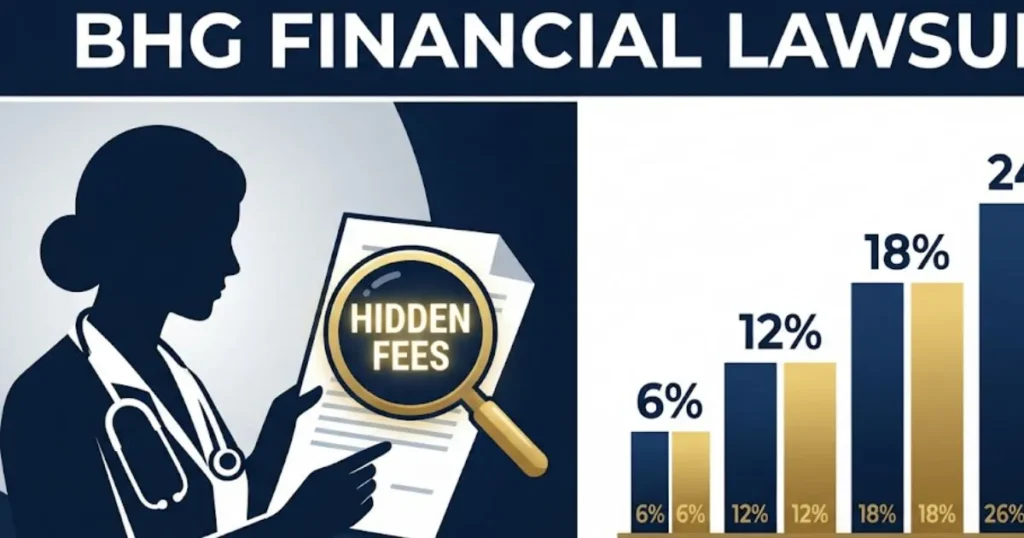
BHG Financial advertises rates “as low as” single digits on its marketing materials. Borrowers report being told during sales calls that they would likely qualify for rates in the 5% to 9% range. When final documents arrived, many borrowers saw rates between 12% and 24%.
That gap matters enormously over the life of a loan. Consider the math on a $100,000 unsecured loan over 10 years:
| Interest Rate | Monthly Payment | Total Interest Paid |
|---|---|---|
| 6% APR | $1,110 | $33,224 |
| 12% APR | $1,435 | $72,169 |
| 18% APR | $1,802 | $116,231 |
| 24% APR | $2,201 | $164,127 |
The difference between a 6% rate and an 18% rate on a $100,000 loan is roughly $83,000 in extra interest. That is not a rounding error. That is a second house payment.
Plaintiffs argue that BHG’s sales representatives knew the final rate would be much higher than what they quoted. The company’s internal rate sheets and underwriting criteria could prove critical during discovery.
If attorneys can demonstrate that BHG systematically quoted low rates to get borrowers on the hook, then raised rates before closing, that pattern could satisfy class action commonality requirements.
BHG Financial Consumer Complaints Exposed
BHG Financial consumer complaints reveal a consistent pattern across hundreds of borrowers in different states, different professions, and different years. The consistency is what makes these complaints legally significant.
The Better Business Bureau alone shows a substantial volume of complaints against BHG Financial. Online review platforms and professional forums add hundreds more. When you read through them, the same themes repeat almost word for word.
Most common consumer complaint categories:
- “I was told my rate would be X, but my documents showed Y”
- “They charged an origination fee I was never told about”
- “I tried to pay off my loan early and was hit with penalties”
- “My payments are not being applied correctly to principal”
- “Customer service stopped responding after I signed”
| Complaint Theme | Approximate Frequency |
|---|---|
| Rate Bait-and-Switch | Very High |
| Hidden Fees | High |
| Poor Customer Service | High |
| Payment Application Issues | Moderate |
| Collections Harassment | Moderate |
What makes these complaints powerful in a legal context is their consistency. When hundreds of people who never met each other describe the same experience, courts pay attention.
BHG Financial has responded to many BBB complaints by stating that all terms were disclosed in the loan agreement. The company often points to the signed documents as evidence that borrowers agreed to the terms. Plaintiffs counter that the documents were presented only at the moment of signing, leaving no time for review.
BHG Financial Loan Complaints: Common Patterns
BHG Financial loan complaints follow predictable patterns that suggest systemic issues rather than isolated mistakes. Attorneys building the class action case argue these patterns point to company-wide policies, not rogue sales representatives.
The typical borrower journey described in complaints follows a remarkably consistent script:
- Initial Contact: Borrower receives a targeted mailer or online ad promising low rates for professionals
- Phone Call: Sales representative quotes an attractive rate and loan amount
- Application: Borrower provides financial documents and agrees to a credit check
- Approval Call: Representative confirms approval at terms different from the initial quote
- Signing Pressure: Documents arrive with instructions to sign and return quickly
- Post-Closing Surprise: Borrower realizes the actual rate, fees, or terms differ from what was discussed
This pattern resembles what consumer attorneys call a “bait-and-switch” scheme. It is one of the oldest tricks in lending. The digital age just makes it faster.
Common loan-specific complaints include:
- Loan amounts funded that exceeded the borrower’s original request
- Automatic payment setups that made it difficult to monitor charge accuracy
- Difficulty obtaining payoff statements for early repayment
- Credit reporting issues when borrowers disputed terms
The repetitive nature of these complaints across years and states strengthens the argument that BHG Financial’s practices were intentional rather than accidental.
Key Takeaway: The consistency of loan complaints across states, years, and borrower types suggests a systemic company practice rather than individual employee mistakes, which is exactly what class action attorneys need to prove.
BHG Financial Lawsuit Eligibility: Who Qualifies
Eligibility for the BHG Financial lawsuit generally includes anyone who took out a loan through BHG Financial and experienced deceptive practices related to interest rates, fees, or loan terms. You do not need to have defaulted or suffered a specific financial loss in every case.
The exact eligibility criteria will depend on how the class is ultimately defined by the court. Based on current attorney investigations, the likely qualifying factors include:
Potential eligibility requirements:
- You obtained a loan directly through BHG Financial (not through a partner bank independently)
- Your loan was originated within the applicable statute of limitations period (typically 3 to 6 years depending on the state)
- You experienced one or more of the alleged practices: rate misrepresentation, undisclosed fees, or deceptive sales tactics
- You are a U.S. resident
| Eligibility Factor | Details |
|---|---|
| Loan Type | Unsecured personal loan through BHG Financial |
| Time Period | Loans originated roughly 2019 to 2025 |
| Geography | All U.S. states, though some states have stronger claims |
| Profession | Any licensed professional (dentists, doctors, vets, attorneys, CPAs) |
| Required Proof | Loan documents, promotional materials, phone records, emails |
You do not need to have filed a previous complaint to be eligible. You do not need to have missed payments. Even borrowers who paid off their loans in full may qualify if they paid inflated rates or undisclosed fees.
Healthcare professionals make up the largest group of potential claimants, but BHG Financial also lends to attorneys, accountants, and other licensed professionals. All may qualify.
How to Join the BHG Financial Lawsuit
Joining the BHG Financial lawsuit currently involves submitting your information through attorney investigation forms or contacting law firms that are actively building the case. There is no single court-approved claim form yet because the class has not been formally certified.
Here is what you can do right now to participate:
Steps to get involved:
- Gather your documents: Collect your original loan agreement, any promotional materials you received, emails from BHG representatives, and records of phone calls if available
- Document the discrepancy: Write down what you were told verbally versus what appeared in your signed documents
- Contact an investigating attorney: Several consumer rights law firms are accepting inquiries from BHG Financial borrowers
- File a CFPB complaint: Submitting a formal complaint to the Consumer Financial Protection Bureau creates an official record
- File a BBB complaint: This adds to the documented pattern of consumer harm
| Step | Action | Why It Matters |
|---|---|---|
| 1 | Gather all loan documents | Provides evidence of actual terms |
| 2 | Note verbal vs. written discrepancies | Core of the rate misrepresentation claim |
| 3 | Contact investigating attorneys | Gets you on the potential class list |
| 4 | File CFPB complaint | Creates federal regulatory record |
| 5 | Save all communications | Prevents BHG from disputing your account |
Timing matters. Statutes of limitations vary by state, but most consumer protection claims must be filed within 3 to 6 years. If your loan is from 2019 or 2020, the window may be closing.
Do not wait for a class to be certified before taking action. The borrowers who document their cases early typically receive better outcomes.
BHG Financial Arbitration Clause Problems
BHG Financial’s arbitration clause is the single biggest obstacle for borrowers trying to participate in a class action. Most BHG loan agreements contain a mandatory arbitration provision with a class action waiver.
Think of an arbitration clause like a locked side door. Instead of going through the main courthouse entrance where you can join other borrowers, the company forces you through a private room where you fight alone. That is exactly how BHG’s contract is designed to work.
What the arbitration clause typically requires:
- All disputes must be resolved through private arbitration, not court
- Borrowers waive their right to participate in class actions
- Arbitration must follow rules set by a specific arbitration organization
- The borrower often bears a portion of arbitration costs
- Discovery (the process of obtaining evidence) is more limited
| Arbitration Issue | Impact on Borrowers |
|---|---|
| Class Action Waiver | Prevents joining a group lawsuit |
| Limited Discovery | Harder to obtain BHG’s internal documents |
| Private Proceedings | No public record of outcomes |
| Cost Sharing | Borrower may pay arbitration fees |
| Location Requirements | May require travel to arbitrate |
However, arbitration clauses are not bulletproof. Courts have invalidated arbitration provisions in lending contracts when they are found to be unconscionable, meaning they are so one-sided that enforcing them would be fundamentally unfair.
Attorneys challenging BHG’s arbitration clause argue that the clause itself was not adequately disclosed, which mirrors the broader pattern of inadequate disclosure. If the court agrees, the class action can proceed despite the contract language.
Key Takeaway: BHG Financial’s arbitration clause is the biggest legal hurdle for class certification, but attorneys are challenging it as unconscionable, and courts in several states have shown willingness to strike down similar clauses in lending contracts.
BHG Financial Borrower Rights You Should Know
BHG Financial borrowers have significant legal rights under both federal and state law, regardless of what the loan agreement says. No contract can strip away protections established by Congress or state legislatures.
Your rights as a borrower include protections you may not even realize you have. Here are the most relevant ones for the BHG Financial case:
Federal protections:
- Truth in Lending Act (TILA): Requires clear disclosure of APR, total cost of the loan, and all fees before you sign
- Equal Credit Opportunity Act (ECOA): Prohibits discrimination in lending
- Fair Debt Collection Practices Act (FDCPA): Limits how and when a lender or collector can contact you about a debt
- Electronic Fund Transfer Act: Protects against unauthorized automatic deductions
State protections:
- Many states have unfair and deceptive acts and practices (UDAP) statutes
- Some states cap interest rates on personal loans
- Several states require specific cooling-off periods after signing loan documents
- State-level consumer protection laws often provide treble (triple) damages
| Right | What It Means for You |
|---|---|
| TILA Disclosure | BHG must clearly show your rate and fees before closing |
| Rescission Rights | Some loans carry a right to cancel within 3 business days |
| UDAP Protections | State laws may provide additional damages |
| Fair Collections | BHG cannot harass you over disputed payments |
Knowing your rights changes the power dynamic. BHG Financial is a large company with a legal team. But the law was written to protect individual borrowers from exactly the kind of practices alleged in this case.
If BHG violated TILA, you may be entitled to statutory damages of up to $4,000 per violation in an individual action, plus actual damages, plus attorney fees. In a class action, statutory damages are capped but can still be substantial.
BHG Financial Class Action Settlement Prospects
A BHG Financial class action settlement has not been announced as of early 2026, but the trajectory of the case suggests settlement discussions could begin once class certification is decided. Most class action lawsuits against financial companies settle before trial.
Settlement is a numbers game for both sides. BHG Financial would weigh the cost of defending thousands of individual claims against the cost of a single settlement payment. Plaintiffs’ attorneys know that trials are risky and expensive. Both sides have strong incentives to negotiate.
Factors that could influence settlement:
- Whether the class is certified (biggest factor)
- The total number of borrowers who join the class
- The aggregate amount of damages provable through documents
- Regulatory pressure from the CFPB or state attorneys general
- The strength of the arbitration clause challenge
| Settlement Factor | Current Status |
|---|---|
| Class Certification | Pending |
| Plaintiff Pool Size | Growing, thousands estimated |
| Regulatory Pressure | Increasing |
| BHG’s Financial Position | Company is profitable |
| Legal Precedent | Similar lending cases have settled for millions |
Companies in BHG’s position often settle for amounts in the $10 million to $50 million range when the class includes thousands of borrowers. That range is based on comparable fintech lending class actions from the past several years.
Settlement typically includes both monetary compensation and changes to business practices. BHG Financial could be required to reform its sales process, improve fee disclosures, and retrain representatives.
BHG Financial Settlement Payout Estimates
Individual BHG Financial settlement payouts would likely range from $200 to $5,000 per borrower, depending on the size of the loan, the amount of overcharges, and the terms of any settlement agreement. Borrowers with larger loans and bigger rate discrepancies would receive more.
These estimates are based on comparable class action settlements in the specialty lending space. They are not guaranteed and could shift significantly based on how the case develops.
Factors that determine individual payout amounts:
- Original loan amount
- Difference between quoted rate and actual rate
- Total fees paid, including undisclosed origination charges
- Length of the loan and total interest paid
- Whether the borrower can document verbal rate quotes
| Loan Size | Estimated Payout Range |
|---|---|
| Under $25,000 | $200 to $800 |
| $25,000 to $75,000 | $500 to $2,000 |
| $75,000 to $150,000 | $1,000 to $3,500 |
| Over $150,000 | $2,000 to $5,000+ |
These numbers assume a settlement structure where claimants receive a percentage of their provable damages. In some class actions, there is a flat payment to all class members plus additional amounts for those who submit documentation.
Borrowers who kept their promotional mailers, saved emails from sales reps, or documented phone conversations will be in the strongest position. The more evidence you have of a rate discrepancy, the larger your potential payout.
It is also common for class action settlements to include non-monetary relief like loan modifications, interest rate reductions, or fee refunds applied directly to outstanding balances.
Key Takeaway: Individual settlement payouts in the BHG Financial case could range from $200 to over $5,000, with the exact amount depending on your loan size, rate discrepancy, and available documentation.
BHG Financial Refund: Can You Get Your Money Back
Getting a refund from BHG Financial is possible through the class action, through individual arbitration, or through regulatory channels. The path you take depends on your contract terms, your state’s laws, and the strength of your documentation.
A “refund” in the legal sense means recovering money you should not have paid. This can include excess interest, undisclosed fees, and penalty charges that were improperly assessed. It does not mean getting your entire loan principal back.
Ways to pursue a refund:
- Class Action Participation: If the class is certified and settles, eligible members receive automatic compensation
- Individual Arbitration: File your own claim through BHG’s arbitration process for potentially larger recovery
- CFPB Complaint: The bureau can order restitution to consumers when it finds violations
- State Attorney General Action: State regulators can require company-wide refunds
- Private Lawsuit: Hire your own attorney for an individual case
| Refund Method | Potential Recovery | Timeline |
|---|---|---|
| Class Action Settlement | $200 to $5,000 | 12 to 24 months after settlement |
| Individual Arbitration | $1,000 to $20,000+ | 6 to 12 months |
| CFPB Complaint | Varies | 3 to 18 months |
| State AG Action | Varies | Depends on investigation |
Individual arbitration can sometimes yield better financial results than class action participation. The tradeoff is that you bear more of the burden yourself. You need to present your own case, though an attorney can represent you in arbitration.
Some borrowers have reported success by filing detailed CFPB complaints that prompted BHG Financial to offer direct refunds or account adjustments. This is not guaranteed, but the CFPB complaint process is free and creates a federal record.
BHG Financial Legal Action in 2026 and Beyond
Legal action against BHG Financial in 2026 represents the most significant escalation of borrower claims since complaints first began surfacing. The path forward depends on several key developments that should unfold throughout the year.
The biggest question mark is class certification. If a federal court certifies a class of BHG Financial borrowers, the company will face enormous pressure to settle. If certification is denied, the fight continues through individual arbitration and state court actions.
What to watch for in 2026:
- Court ruling on class certification motion
- CFPB enforcement action announcements
- State attorney general investigation outcomes
- Potential legislative changes affecting fintech lending partnerships
- BHG Financial’s response to growing regulatory scrutiny
| 2026 Milestone | Expected Timing |
|---|---|
| Class Certification Decision | Mid to Late 2026 |
| CFPB Enforcement Updates | Ongoing |
| Settlement Discussions | Possible Late 2026 |
| Attorney Filing Deadlines | Vary by state |
| Statute of Limitations Cutoffs | Rolling, check your state |
The broader trend in financial regulation is moving toward stricter oversight of companies like BHG Financial. The rent-a-bank model, where fintech companies partner with chartered banks to issue loans, is under increasing scrutiny at both federal and state levels.
For borrowers, the message is clear: document everything, file complaints through official channels, and connect with investigating attorneys sooner rather than later. The cases built on strong documentation are the ones that produce results.
Even if BHG Financial prevails on the arbitration clause issue, the company still faces regulatory risk. The CFPB and state attorneys general do not need to go through arbitration. They can bring enforcement actions directly.
Frequently Asked Questions
Is there a class action lawsuit against BHG Financial in 2026?
Yes, attorneys are actively investigating and building a class action against BHG Financial in 2026.
Individual lawsuits have been filed, and efforts to certify a formal class are underway.
A court ruling on class certification is expected by mid to late 2026.
How much money could I get from a BHG Financial settlement?
Most borrowers can expect between $200 and $5,000 depending on their loan size and provable damages.
Larger loans with bigger rate discrepancies will receive higher payouts.
Individual arbitration claims may yield even more than class action participation.
Who qualifies for the BHG Financial class action lawsuit?
Any borrower who obtained an unsecured personal loan through BHG Financial and experienced rate misrepresentation, hidden fees, or deceptive sales practices may qualify.
Loans originated between approximately 2019 and 2025 are within the likely eligibility window.
You do not need to have defaulted on the loan to be eligible.
Does BHG Financial have an arbitration clause that blocks lawsuits?
Most BHG Financial loan agreements include a mandatory arbitration clause with a class action waiver.
Attorneys are challenging this clause as unconscionable and unenforceable.
Courts in several states have struck down similar clauses in comparable lending cases.
How do I file a complaint or join the BHG Financial lawsuit?
Start by gathering your loan documents, promotional materials, and any records of communications with BHG representatives.
File a complaint with the CFPB and your state attorney general to create official records.
Contact a consumer rights law firm investigating BHG Financial to submit your information for potential class inclusion.
The BHG Financial class action lawsuit is gaining real traction in 2026. Borrowers who act now, gather documents, file complaints, and connect with attorneys, put themselves in the best position for recovery.
If you took out a BHG Financial loan and the terms were not what you were promised, this case may be your chance to get money back. Check your eligibility and take the first step today.
Do not let the statute of limitations run out. Your window to act has a deadline







