

Railroad workers diagnosed with multiple myeloma are filing lawsuits in 2026 at a pace not seen before. A railroad lawsuit for multiple myeloma allows workers exposed to toxic chemicals on the job to seek compensation under a federal law called FELA.
Thousands of rail employees spent years handling benzene, breathing diesel exhaust, and working around creosote. Many of them are now fighting blood cancers they never expected.
This article covers everything you need to know about these claims right now. You will learn who qualifies, how much money is at stake, what evidence you need, and which railroad companies face the most lawsuits.
Here is one fact that might surprise you: some railroad multiple myeloma verdicts have exceeded $3 million in recent years. The money is real, and the cases are moving.
Railroad Lawsuit Multiple Myeloma: What You Need to Know in 2026
A railroad lawsuit for multiple myeloma is a legal claim filed by a railroad worker (or surviving family member) who developed this blood cancer after being exposed to toxic chemicals during railroad employment. These lawsuits are filed under the Federal Employers Liability Act, commonly known as FELA.
Multiple myeloma is a cancer of the plasma cells in bone marrow. It is not common in the general population, but railroad workers develop it at higher rates than average. Researchers have linked this increased risk to workplace carcinogens that railroad companies knew about for decades.
In 2026, these cases are gaining serious traction. More medical studies have connected chemicals like benzene and diesel exhaust to blood cancers. Courts are increasingly siding with workers who can show their employers failed to provide safe working conditions.
| Quick Facts | Details |
|---|---|
| Type of Lawsuit | Individual FELA claim (not class action) |
| Cancer | Multiple myeloma (plasma cell cancer) |
| Key Chemicals | Benzene, diesel exhaust, creosote, solvents |
| Who Can File | Current or former railroad workers, or families of deceased workers |
| Filing Law | Federal Employers Liability Act (FELA) |
| Status in 2026 | Active and accepting new claims |
What makes these cases different from a typical workplace injury claim is that FELA does not require the railroad to be the sole cause. The worker only needs to prove that the railroad’s negligence played some part in causing the cancer. That is a much lower bar than most people expect.
Railroad Cancer Lawsuit Settlement Amounts
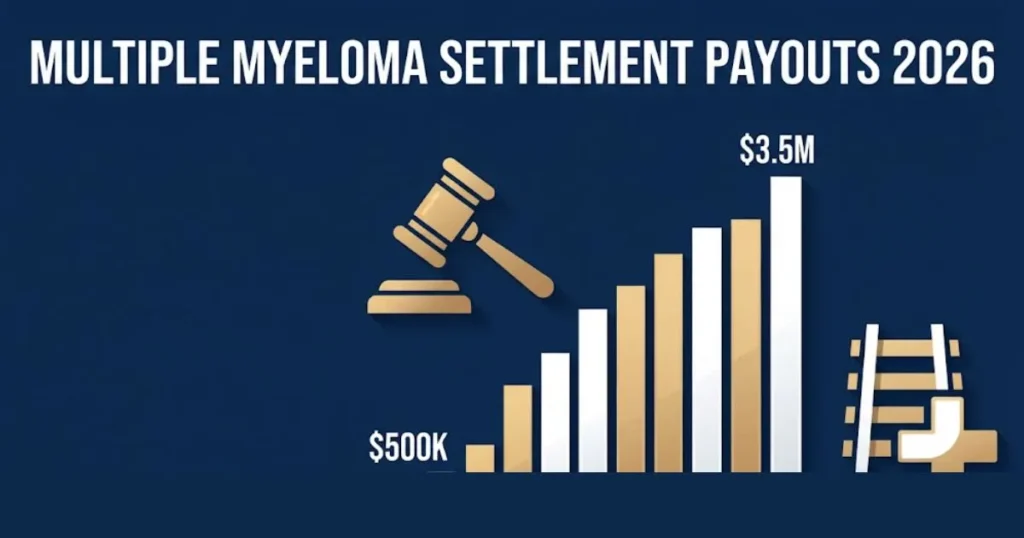
Railroad cancer lawsuit settlement amounts for multiple myeloma cases vary widely, but most resolved claims fall between $500,000 and $3.5 million. The exact figure depends on the severity of the illness, length of exposure, and strength of evidence.
Some cases have gone to trial and resulted in even higher verdicts. A jury might award more when the railroad’s behavior was especially reckless. For example, knowingly exposing workers to benzene without protective equipment can push verdicts above $4 million.
Settlement amounts are influenced by several factors:
- Stage of cancer at diagnosis: Later-stage myeloma typically means higher compensation.
- Duration of railroad employment: Longer careers often mean more exposure and stronger claims.
- Type and level of chemical exposure: Workers in rail yards or maintenance shops face the heaviest exposure.
- Medical expenses: Treatment for multiple myeloma can cost $150,000 to $500,000 or more over a lifetime.
- Lost wages and earning capacity: Workers who can no longer work receive compensation for future income lost.
Settlements are private agreements. Railroads prefer them because they avoid public trials. That is why exact numbers are hard to pin down, but the ranges above come from cases reported in court filings and legal industry data through 2025.
Think of it this way: a settlement is a negotiation, not a fixed price tag. The stronger your evidence, the higher your number goes.
Multiple Myeloma Settlement Payouts in 2026
Multiple myeloma settlement payouts in 2026 are expected to increase compared to prior years. Medical costs for myeloma treatment have risen, courts have become more receptive to toxic exposure claims, and public awareness of railroad health hazards is growing.
Several factors are pushing payouts upward this year:
| Factor | Impact on 2026 Payouts |
|---|---|
| Rising medical treatment costs | Higher damage calculations |
| New medical research linking benzene to myeloma | Stronger causation arguments |
| Aging workforce filing claims | More advanced-stage diagnoses |
| Railroad industry consolidation | Fewer defendants with deeper pockets |
| Precedent from recent large verdicts | Sets floor for settlement negotiations |
The average expected payout range for a 2026 multiple myeloma railroad claim sits between $750,000 and $3 million. Some wrongful death claims filed by surviving spouses have settled for over $2 million in recent years.
Payouts are usually made as lump sums after the settlement agreement is finalized. Some cases include structured payment plans, but those are less common. From the time a settlement is reached, it typically takes 60 to 120 days for the claimant to receive funds.
The key thing to understand is that 2026 is a strong year to pursue these claims. The combination of better science, more experienced attorneys, and established legal precedent means railroad companies have fewer places to hide.
Key Takeaway: Railroad multiple myeloma lawsuits are active in 2026 with settlement amounts generally ranging from $500,000 to $3.5 million depending on the strength of evidence and severity of illness.
Railroad Multiple Myeloma Compensation Breakdown
Railroad multiple myeloma compensation covers several categories of damages, not just one lump payment for having cancer. Each category addresses a different type of harm the worker suffered.
Here is how compensation breaks down in a typical claim:
| Compensation Category | What It Covers | Typical Range |
|---|---|---|
| Medical expenses | Past and future treatment costs, including chemo, stem cell therapy, medications | $200,000 to $800,000+ |
| Lost wages | Income lost during treatment and recovery | $50,000 to $500,000 |
| Loss of earning capacity | Future income the worker can no longer earn | $100,000 to $1,000,000+ |
| Pain and suffering | Physical pain, emotional distress, reduced quality of life | $100,000 to $1,500,000 |
| Wrongful death damages | Filed by family if the worker passed away | $500,000 to $3,000,000+ |
Multiple myeloma treatment is brutal and expensive. Most patients undergo chemotherapy, immunotherapy, and possibly stem cell transplants. Those costs add up fast, and juries know it.
Pain and suffering is harder to quantify, but it often makes up a large portion of the total compensation. Living with an incurable blood cancer changes every aspect of daily life. Courts recognize that.
One important detail: FELA uses a “comparative fault” system. If the railroad proves the worker was partially responsible (say, for not wearing safety gear that was actually provided), the total compensation gets reduced by that percentage. A 20% fault finding on a $2 million verdict means the worker receives $1.6 million.
Railroad Multiple Myeloma Lawsuit Eligibility
Railroad multiple myeloma lawsuit eligibility requires three basic things: you worked for a railroad, you were exposed to toxic chemicals on the job, and you were diagnosed with multiple myeloma.
That sounds simple, but each element has specific requirements:
- Railroad employment: You must have worked for a railroad engaged in interstate commerce. This includes Class I carriers like BNSF and Union Pacific, but it also covers short line railroads and switching companies.
- Toxic exposure: You need to show you were exposed to carcinogens during your work. Common sources include diesel exhaust, benzene in solvents, creosote on railroad ties, herbicides sprayed along tracks, and asbestos in older equipment.
- Multiple myeloma diagnosis: A confirmed diagnosis from a qualified oncologist or hematologist is required.
You do not need to prove that railroad work was the only cause of your cancer. Under FELA, you just need to show that the employer’s negligence contributed to your illness, even partially.
Family members can file on behalf of deceased workers. These are called wrongful death FELA claims, and surviving spouses, children, or dependents may qualify.
| Eligibility Requirement | Details |
|---|---|
| Employment | Current or former railroad worker |
| Exposure | Contact with carcinogens during work duties |
| Diagnosis | Confirmed multiple myeloma |
| Causation Standard | Employer negligence contributed to illness |
| Family Claims | Wrongful death claims available for surviving family |
Retired workers are absolutely eligible. In fact, many claimants are retirees who worked decades ago. Multiple myeloma often takes 10 to 30 years to develop after initial exposure.
Railroad Workers and Multiple Myeloma Claims
Railroad workers file multiple myeloma claims individually, not as part of a class action. Each case is its own FELA lawsuit with its own facts, evidence, and outcome.
This matters because your claim is evaluated on your specific work history. A track laborer who spent 25 years handling creosote-soaked ties has a different claim than a locomotive engineer who breathed diesel fumes for 15 years. Both may have valid cases, but the details shape the compensation.
The types of railroad jobs most commonly linked to multiple myeloma include:
- Track maintenance workers (creosote, herbicide exposure)
- Locomotive engineers and conductors (diesel exhaust exposure)
- Rail yard workers (benzene in fuels and solvents)
- Maintenance of way employees (asbestos, silica dust, chemical solvents)
- Signal maintainers (solvent and chemical exposure)
- Carmen and mechanical workers (benzene, asbestos, diesel exhaust)
Unions like the Brotherhood of Locomotive Engineers (BLET) and the Transportation Communications Union (TCU) have supported members in pursuing these claims. Union records can sometimes provide valuable documentation of work conditions and chemical use.
If you spent any significant time around railroad chemicals and later received a myeloma diagnosis, your claim deserves a serious evaluation. The connection between this job and this cancer is well documented.
Key Takeaway: You qualify for a railroad multiple myeloma lawsuit if you worked for a railroad, were exposed to carcinogens on the job, and received a confirmed myeloma diagnosis, even if you retired years ago.
FELA Lawsuit for Multiple Myeloma
A FELA lawsuit for multiple myeloma is the legal path that allows railroad workers to sue their employers directly for negligence that led to cancer. FELA stands for the Federal Employers Liability Act, a law passed in 1908 that covers railroad workers specifically.
Here is why FELA is different from regular workers’ compensation:
| Feature | FELA Lawsuit | Workers’ Compensation |
|---|---|---|
| Must prove employer fault | Yes, negligence required | No, it’s no-fault |
| Jury trial available | Yes | No |
| Compensation caps | None | Often capped by state |
| Pain and suffering | Included | Usually excluded |
| Punitive damages | Possible in extreme cases | Not available |
| Applies to | Railroad workers only | Most other workers |
Under FELA, you must show that the railroad was negligent. This means the company failed to provide a reasonably safe workplace. For multiple myeloma claims, negligence typically involves:
- Failing to warn workers about chemical dangers
- Not providing adequate protective equipment
- Ignoring known health risks from diesel exhaust or benzene
- Continuing to use carcinogenic materials when safer alternatives existed
FELA is a powerful tool for railroad workers. There are no caps on damages, and juries can award full compensation for all harms. That is why these cases often result in much larger payouts than standard workers’ comp claims would provide.
The trade-off is that you carry the burden of proof. You have to demonstrate negligence, not just show that you got sick on the job.
How to File a Railroad Cancer Lawsuit
Filing a railroad cancer lawsuit starts with gathering your medical records and employment history, then contacting an attorney experienced in FELA claims. The process typically takes several months before a formal complaint is filed in court.
Here is the step-by-step process:
Step 1: Medical documentation. Get your complete medical records, including your multiple myeloma diagnosis, treatment history, pathology reports, and any notes from your oncologist about potential causes.
Step 2: Employment records. Collect records of your railroad career. Pay stubs, union records, job descriptions, and any documentation of chemicals you worked with or around.
Step 3: Attorney consultation. Speak with a lawyer who handles FELA cancer cases specifically. Most offer free initial consultations. They will evaluate whether your case has merit.
Step 4: Case investigation. Your attorney will investigate your exposure history, consult with medical and occupational health experts, and identify which chemicals you encountered.
Step 5: Filing the complaint. The formal lawsuit is filed in either federal or state court. The complaint names the railroad company and describes the negligence and injuries.
Step 6: Discovery and depositions. Both sides exchange evidence. You may be deposed, and so will company representatives.
Step 7: Settlement negotiation or trial. Most cases settle before trial. If no agreement is reached, the case goes before a jury.
| Filing Timeline | Expected Duration |
|---|---|
| Initial consultation to filing | 1 to 3 months |
| Discovery phase | 6 to 12 months |
| Settlement negotiation | 3 to 6 months |
| Trial (if needed) | 1 to 3 weeks |
| Total from start to resolution | 12 to 30 months |
One thing that catches people off guard: your attorney does not get paid unless you win. FELA attorneys work on contingency, meaning their fee comes from a percentage of your settlement or verdict.
Benzene Exposure and Railroad Cancer
Benzene is the single most significant chemical linking railroad work to multiple myeloma. It is classified as a Group 1 carcinogen by the International Agency for Research on Cancer, meaning there is definitive evidence it causes cancer in humans.
Railroad workers encounter benzene in several ways:
- Diesel fuel and exhaust: Benzene is a natural component of petroleum products and is released when diesel fuel burns.
- Solvents and degreasers: Railroad shops use benzene-containing solvents to clean parts and equipment.
- Gasoline vapors: Workers near fueling stations inhale benzene vapors regularly.
- Creosote: This wood preservative used on railroad ties contains benzene compounds.
The problem is not a single exposure event. It is the cumulative effect of breathing in benzene fumes day after day, year after year. A track worker who spent 20 years around creosote-treated ties absorbed benzene through both the lungs and the skin.
Benzene damages DNA in bone marrow cells. Over time, this damage can trigger the abnormal plasma cell growth that defines multiple myeloma. The latency period between first exposure and cancer diagnosis is typically 10 to 30 years.
Studies published in medical journals including the Journal of Occupational and Environmental Medicine have documented elevated multiple myeloma rates among benzene-exposed workers. Railroad companies were aware of benzene hazards as early as the 1940s, yet many continued using benzene-containing products without adequate worker protections for decades.
Key Takeaway: Benzene is the primary chemical linking railroad work to multiple myeloma, and railroad companies knew about its dangers for decades before taking protective action.
Railroad Chemical Exposure and Multiple Myeloma
Railroad chemical exposure that causes multiple myeloma goes beyond benzene alone. Workers encounter a cocktail of carcinogens throughout their careers, and the combined effect of these chemicals increases cancer risk significantly.
Here are the major chemicals implicated in railroad multiple myeloma cases:
| Chemical | Where Found on Railroads | Cancer Link |
|---|---|---|
| Benzene | Diesel fuel, solvents, creosote | Confirmed cause of blood cancers |
| Diesel exhaust particulates | Locomotive engines, rail yards | Classified as carcinogenic by IARC |
| Creosote | Railroad ties, timber bridges | Contains PAHs linked to multiple cancers |
| Asbestos | Older locomotives, brake shoes, insulation | Known carcinogen, linked to myeloma |
| Herbicides (glyphosate) | Sprayed along tracks for vegetation control | Classified as probable carcinogen |
| Silica dust | Ballast, sand used for traction | Linked to blood cancers in studies |
| Industrial solvents | Parts cleaning, shop maintenance | Various carcinogenic compounds |
The real danger is chronic low-level exposure over many years. You do not need one massive chemical spill to get sick. Breathing contaminated air in a rail yard for 15 to 25 years is enough.
Railroad companies had a duty to monitor air quality, provide respirators, and limit worker exposure to these chemicals. Many failed to do any of those things. Internal company documents revealed in lawsuits show that some railroads actively concealed exposure data from their employees.
This pattern of concealment strengthens multiple myeloma claims. When a company hid what it knew, juries tend to award higher damages.
Railroad Diesel Exhaust Cancer Risk
Railroad diesel exhaust is a confirmed carcinogen that increases the risk of multiple myeloma among exposed workers. The World Health Organization reclassified diesel engine exhaust as a Group 1 carcinogen in 2012, placing it in the same category as asbestos and benzene.
Locomotive engineers, conductors, and rail yard workers face the highest exposure levels. Inside locomotive cabs, diesel exhaust concentrations can exceed outdoor levels by 5 to 10 times. Ventilation systems in older locomotives were notoriously inadequate.
Rail yard workers face a similar problem. Dozens of idling locomotives in a single yard create a persistent cloud of exhaust that workers breathe throughout their shifts.
- Diesel exhaust contains over 40 toxic air contaminants.
- It includes fine particulate matter that penetrates deep into lung tissue and enters the bloodstream.
- Studies show railroad workers have 30% to 40% higher rates of blood cancers compared to the general population.
The challenge with diesel exhaust claims is that exposure is so constant and pervasive that it can be hard to measure exactly how much a worker inhaled. But courts have accepted occupational health expert testimony and exposure modeling as sufficient evidence.
Some railroads began installing cleaner engines and improved ventilation after the WHO reclassification. But workers who spent their careers before those improvements have already absorbed decades of exposure. The cancer risk does not disappear when the exposure stops.
Multiple Myeloma Diagnosis for Railroad Workers
Multiple myeloma is typically diagnosed through blood tests, urine tests, bone marrow biopsy, and imaging scans. Railroad workers often receive their diagnosis years or even decades after their chemical exposure began.
Early symptoms of multiple myeloma are easy to miss:
- Bone pain, especially in the back or ribs
- Fatigue and weakness
- Frequent infections
- Unexplained weight loss
- Numbness or tingling in hands and feet
- Elevated calcium or protein levels in blood work
Many railroad workers write off early symptoms as normal aging or the physical toll of manual labor. That delay in diagnosis often means the cancer is more advanced when finally detected.
| Diagnosis Method | What It Reveals |
|---|---|
| Complete blood count (CBC) | Abnormal blood cell levels |
| Serum protein electrophoresis | M-protein (monoclonal protein) presence |
| Urine protein analysis | Bence Jones proteins indicating myeloma |
| Bone marrow biopsy | Percentage of abnormal plasma cells |
| PET/CT scan | Bone lesions and tumor locations |
| MRI | Bone marrow involvement |
A key precursor condition is called MGUS (monoclonal gammopathy of undetermined significance). Some railroad workers are first diagnosed with MGUS, which later progresses to full multiple myeloma. If you have been diagnosed with MGUS and have a history of railroad chemical exposure, that information is legally significant.
Getting diagnosed early gives you both medical and legal advantages. Treatment is more effective, and your claim is stronger when filed sooner.
Key Takeaway: Multiple myeloma often develops 10 to 30 years after chemical exposure, and railroad workers should watch for early symptoms like bone pain, fatigue, and frequent infections.
Evidence Needed for a Railroad Cancer Claim
The evidence needed for a railroad cancer claim includes your medical records, employment history, documentation of chemical exposure, and expert testimony connecting your work to your diagnosis. Building this evidence package is the foundation of every successful FELA case.
Here is what strong claims typically include:
Medical evidence:
- Complete diagnosis records from your oncologist
- Pathology and biopsy reports
- Treatment history and prognosis
- Expert medical opinion linking your cancer to chemical exposure
Employment evidence:
- Railroad employment records (dates, positions, locations)
- Job descriptions detailing duties and chemical contact
- Union records and seniority lists
- Payroll records confirming employment duration
Exposure evidence:
- Industrial hygiene reports from your work locations
- OSHA inspection records for your rail yard or shop
- Material Safety Data Sheets (MSDS) for chemicals used
- Coworker testimony about chemical use and conditions
- Photographs of work conditions
Expert testimony:
- Occupational health expert explaining exposure levels
- Oncologist or toxicologist connecting exposure to myeloma
- Industrial hygienist calculating cumulative chemical exposure
| Evidence Type | Why It Matters |
|---|---|
| Medical records | Proves diagnosis and treatment costs |
| Employment records | Confirms you worked for the railroad |
| Exposure documentation | Shows which chemicals you contacted |
| Expert testimony | Connects exposure to cancer scientifically |
| Coworker statements | Corroborates your account of conditions |
One piece of advice: start collecting this evidence now. Employment records from decades ago can disappear. Coworkers who witnessed conditions may become unreachable. The earlier you start building your file, the stronger your claim will be.
FELA Claim Deadline for Multiple Myeloma
The FELA claim deadline for multiple myeloma is three years from the date you knew or should have known that your cancer was related to your railroad employment. This is called the statute of limitations, and missing it means you lose your right to sue entirely.
Here is where it gets tricky. The clock does not always start on your diagnosis date. Under the “discovery rule,” the three-year period begins when you become aware (or reasonably should have become aware) that your multiple myeloma was caused by workplace exposure.
For example, if you were diagnosed in 2022 but did not learn until 2024 that benzene exposure at work was a likely cause, your three-year window may start in 2024 rather than 2022.
| Deadline Scenario | Clock Starts | Filing Deadline |
|---|---|---|
| Diagnosed and told about work link in 2024 | 2024 | 2027 |
| Diagnosed in 2023, learned work link in 2025 | 2025 | 2028 |
| Diagnosed in 2021, should have known by 2022 | 2022 | 2025 (may be expired) |
Wrongful death claims have a slightly different timeline. The three-year clock starts from the date of death, not the date of diagnosis.
Do not gamble with these deadlines. If you are anywhere close to the three-year mark, act immediately. Courts enforce FELA deadlines strictly. There is almost never an extension granted once the statute of limitations expires.
The safest approach is to consult with an attorney as soon as you receive a multiple myeloma diagnosis, even if you are not yet certain your job caused it.
Railroad Companies Facing Cancer Lawsuits
The largest railroad companies in the United States have all faced multiple myeloma and cancer lawsuits from current and former employees. Class I railroads carry the most claims because they employ the most workers and operate the biggest facilities.
Here are the railroad companies most frequently named in cancer lawsuits:
| Railroad Company | Headquarters | Notable Lawsuit Activity |
|---|---|---|
| BNSF Railway | Fort Worth, TX | Hundreds of FELA cancer claims, including multiple myeloma |
| CSX Transportation | Jacksonville, FL | Significant number of blood cancer claims |
| Norfolk Southern | Atlanta, GA | Active litigation, especially after East Palestine derailment scrutiny |
| Union Pacific | Omaha, NE | Long history of FELA cancer cases |
| Canadian National (CN) | Montreal, QC (US operations) | Growing number of US-based cancer claims |
| Kansas City Southern | Kansas City, MO | Fewer claims but active litigation |
BNSF and Union Pacific face the highest volume of claims, partly because they are the two largest freight railroads in North America. Their operations span thousands of miles with massive rail yards where chemical exposure is highest.
Internal documents from these companies, uncovered during litigation, have revealed that many of them tracked employee cancer rates internally. Some knew their workers were getting sick at higher rates than the general population. The fact that they continued operations without meaningful changes to protect workers strengthens negligence claims.
Smaller regional and short line railroads also face lawsuits, though less frequently. If you worked for any railroad and developed multiple myeloma, the size of the company does not determine whether you have a valid claim.
Key Takeaway: All major U.S. railroad companies face active cancer lawsuits, with BNSF and Union Pacific seeing the highest volume of multiple myeloma claims.
BNSF and CSX Multiple Myeloma Lawsuits
BNSF and CSX are two of the most frequently sued railroads in multiple myeloma cases. Both companies have paid millions in settlements and verdicts to workers diagnosed with blood cancers linked to workplace chemical exposure.
BNSF Railway operates the largest freight rail network in North America. Its workers handle massive volumes of diesel fuel, creosote-treated ties, and industrial solvents across rail yards in the western United States. BNSF has faced FELA cancer lawsuits consistently for over two decades. In several cases, juries awarded plaintiffs over $2 million after finding the company failed to protect employees from known carcinogens.
CSX Transportation dominates the eastern U.S. rail network. CSX workers in maintenance shops and rail yards have reported high levels of benzene and diesel exhaust exposure. CSX has settled numerous multiple myeloma claims, though exact amounts are typically sealed under confidentiality agreements.
Both companies employ aggressive defense strategies:
- Arguing the worker’s cancer was caused by genetics or lifestyle factors
- Claiming the worker failed to use available safety equipment
- Disputing the scientific link between specific chemicals and myeloma
- Seeking to reduce damages through comparative fault arguments
Despite these defense tactics, plaintiffs continue to win. The scientific evidence connecting workplace chemicals to blood cancers has become too strong for juries to ignore. When internal company documents show the railroad knew about hazards and failed to act, the defense crumbles.
If you worked for BNSF or CSX and have been diagnosed with multiple myeloma, your employer’s litigation history actually works in your favor. Established precedent from prior cases makes new claims easier to build.
FELA vs Workers Comp for Railroad Cancer
FELA and workers’ compensation are two completely different systems, and the difference matters enormously for railroad workers with cancer. FELA typically results in much higher compensation than workers’ comp would provide.
Here is a direct comparison:
| Feature | FELA (Railroad Workers) | Workers’ Compensation (Most Other Workers) |
|---|---|---|
| Fault required | Yes, must prove employer negligence | No, it’s a no-fault system |
| Compensation limits | No caps | Capped by state law |
| Pain and suffering | Fully recoverable | Usually not included |
| Jury trial | Yes | No |
| Average cancer claim value | $500,000 to $3.5 million | $100,000 to $300,000 |
| Punitive damages | Available in extreme cases | Not available |
| Attorney fees | Contingency (paid from award) | Varies by state |
| Filing deadline | 3 years (discovery rule) | Varies, often 1 to 2 years |
Railroad workers are exempt from state workers’ compensation systems. This was a deliberate decision by Congress when FELA was enacted. The idea was that railroads posed unique dangers, and workers deserved the right to pursue full compensation through the courts.
The downside of FELA is that you must prove negligence. Workers’ comp pays regardless of fault. But the upside is enormous: no damage caps, full pain and suffering awards, and jury trials where sympathy for a cancer victim can drive verdicts much higher.
For a railroad worker with multiple myeloma, FELA is almost always the better path. The potential compensation dwarfs what workers’ comp would pay, and the negligence standard in toxic exposure cases is well established. If your employer exposed you to carcinogens and failed to provide protection, proving negligence is often straightforward.
Key Takeaway: FELA provides railroad workers with far greater compensation potential than workers’ comp, including uncapped damages, pain and suffering awards, and the right to a jury trial.
Frequently Asked Questions
Can railroad workers sue for multiple myeloma in 2026?
Yes, railroad workers can file FELA lawsuits for multiple myeloma in 2026.
Claims are actively being filed against major railroad companies across the country.
You must show that workplace chemical exposure contributed to your cancer diagnosis.
How much is a railroad multiple myeloma lawsuit worth?
Most railroad multiple myeloma cases settle for $500,000 to $3.5 million.
The exact amount depends on your exposure history, medical costs, and the strength of your evidence.
Some jury verdicts have exceeded $4 million in cases involving clear employer negligence.
What chemicals on railroads cause multiple myeloma?
Benzene, diesel exhaust, creosote, asbestos, and herbicides are the main chemicals linked to multiple myeloma in railroad workers.
Benzene is the most significant, with decades of scientific research confirming its role in blood cancers.
Workers in rail yards and maintenance shops typically face the highest exposure levels.
What is the deadline to file a FELA claim for cancer?
The FELA statute of limitations is three years from when you knew or should have known your cancer was related to your railroad work.
This is called the discovery rule, and it can extend the deadline beyond your diagnosis date.
Wrongful death claims have a separate three-year deadline starting from the date of death.
Do I need proof of chemical exposure to file a railroad cancer lawsuit?
Yes, you need evidence of chemical exposure, but it does not have to be a single smoking-gun document.
Employment records, coworker testimony, OSHA reports, and expert analysis can all establish exposure.
Your attorney will work with industrial hygienists and medical experts to build the exposure case for you.
Take Action on Your Railroad Multiple Myeloma Claim
Railroad workers with multiple myeloma have real legal options in 2026. The cases are strong, the science backs the claims, and settlements continue to grow.
If you worked for a railroad and received a myeloma diagnosis, start gathering your medical and employment records today. The three-year FELA deadline waits for no one.
Check your eligibility, talk to a FELA attorney, and protect the compensation you and your family deserve.







