

Railroad workers across the country are filing lawsuits over interstitial lung disease caused by years of toxic exposure on the job. A railroad lawsuit for interstitial lung disease falls under the Federal Employers Liability Act, and settlements in these cases have reached six and seven figures.
If you worked around diesel fumes, asbestos, silica, or coal dust, this article breaks down everything you need to know. You will learn who qualifies, how much these cases pay, and exactly how to file in 2026.
Here is one number that matters: FELA lung disease verdicts have exceeded $1 million in multiple recent cases. The railroad industry has known about these hazards for decades. Workers are now holding them accountable.
This guide covers every angle. From eligibility rules to settlement timelines, from evidence requirements to choosing the right attorney, it is all here.
Railroad Lawsuit Interstitial Lung Disease Overview
A railroad lawsuit for interstitial lung disease is a legal claim filed by a railroad worker who developed ILD from breathing harmful substances at work. These cases are filed under the Federal Employers Liability Act, not workers’ compensation.
ILD is a group of lung disorders that cause scarring of lung tissue. The scarring makes it hard to breathe and worsens over time. There is no cure for most forms of ILD.
Railroad workers face higher ILD rates than the general population. That is because they spend years breathing diesel exhaust, silica particles, asbestos fibers, and welding fumes inside rail yards, tunnels, and maintenance shops.
| Key Fact | Detail |
|---|---|
| Legal Basis | Federal Employers Liability Act (FELA) |
| Who Can Sue | Current or former railroad workers |
| Common Cause | Diesel exhaust, asbestos, silica dust |
| Case Type | Individual lawsuit, not class action |
| Burden of Proof | Railroad negligence contributed to illness |
The key difference between FELA and workers’ comp is important. Under FELA, you must show the railroad was at least partly negligent. But the standard is lower than most people think. You only need to prove the railroad’s negligence played “any part” in causing your disease.
Thousands of railroad employees have already filed these claims. Major carriers like BNSF, Union Pacific, CSX, and Norfolk Southern have faced ILD lawsuits. The trend is growing in 2026 as more retired workers receive diagnoses.
Railroad Lawsuit Black Lung Disease in 2026
A railroad lawsuit for black lung disease targets the same employers but involves a specific type of lung scarring caused by inhaling coal dust or similar dark particulate matter. Black lung has historically been linked to coal miners, but railroad workers face similar exposure risks.
Railroad employees who handled coal shipments or worked near coal-fired operations breathed in fine carbon particles for years. Those particles embed in lung tissue. Over time, the tissue hardens and loses its ability to transfer oxygen.
In 2026, black lung claims from railroad workers are increasing for two reasons. First, workers exposed in the 1980s and 1990s are now showing symptoms after long latency periods. Second, medical imaging technology has improved, making diagnosis easier and more precise.
- Coal handling workers who loaded or unloaded coal cars
- Locomotive engineers on older diesel and coal routes
- Track maintenance crews in areas near coal operations
- Yard workers in facilities that processed coal shipments
Filing a black lung railroad lawsuit in 2026 follows the same FELA process as other lung disease claims. You need a diagnosis, a work history showing exposure, and evidence the railroad failed to protect you.
The average settlement for railroad black lung cases ranges from $150,000 to over $1 million, depending on disease severity and lost wages.
FELA Lawsuit Lung Disease Claims Explained
A FELA lawsuit for lung disease is a federal claim that allows railroad workers to sue their employer for negligence that caused or contributed to a respiratory illness. FELA is the exclusive legal remedy for railroad employees injured on the job.
Think of FELA like this: regular employees get workers’ comp automatically, no questions asked. Railroad workers instead get the right to sue, which means higher potential payouts but the requirement to prove fault.
Under FELA, the worker must show two things. The railroad was negligent in some way. That negligence played any part in causing the lung disease.
| FELA Element | What It Means |
|---|---|
| Negligence | Railroad failed to provide safe workplace |
| Causation | Exposure contributed to lung disease |
| Damages | Medical bills, lost income, pain and suffering |
| Standard | “Any part” test (very worker-friendly) |
| Jury Trial | Available in federal or state court |
The “any part” causation standard is extremely favorable to workers. You do not need to prove that railroad work was the sole cause of your lung disease. If it was even a contributing factor, that is enough.
FELA covers all types of lung disease caused by occupational exposure. This includes interstitial lung disease, black lung, asbestosis, silicosis, chronic obstructive pulmonary disease, and pulmonary fibrosis.
Key Takeaway: FELA gives railroad workers the right to sue for lung disease, and the legal standard for proving causation is much lower than most people expect.
Railroad Worker Lung Disease Settlement Amounts
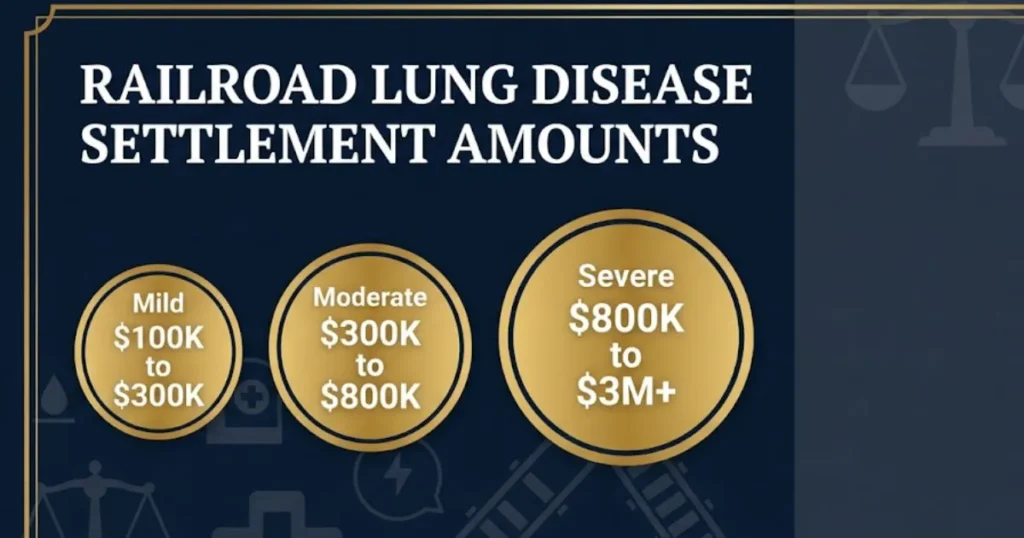
Railroad worker lung disease settlements in 2026 typically range from $100,000 to $2.5 million, with the exact amount depending on disease type, severity, and lost earning capacity. Some cases have settled for even more.
Settlement amounts vary widely because every case is different. A 55-year-old engineer with severe pulmonary fibrosis who can no longer work will receive far more than a 70-year-old retiree with mild symptoms.
Here is what drives settlement value in these cases:
- Severity of disease (mild restriction vs. oxygen dependency)
- Age at diagnosis (younger workers lose more future income)
- Medical expenses (past and projected future costs)
- Lost wages (past and future earning capacity)
- Pain and suffering (quality of life impact)
- Strength of negligence evidence (clear safety failures vs. borderline cases)
| Settlement Tier | Typical Range | Disease Severity |
|---|---|---|
| Tier 1 (Mild) | $100,000 to $300,000 | Early-stage ILD, mild symptoms |
| Tier 2 (Moderate) | $300,000 to $800,000 | Moderate restriction, medication needed |
| Tier 3 (Severe) | $800,000 to $1.5 million | Oxygen dependency, unable to work |
| Tier 4 (Catastrophic) | $1.5 million to $3 million+ | End-stage disease, lung transplant needed |
Railroads often prefer to settle these cases before trial. Going to trial risks a runaway verdict, and juries tend to sympathize with sick workers. In 2024, a BNSF case involving pulmonary fibrosis resulted in a $3.2 million jury verdict.
Railroad Lung Disease Lawsuit Payout Amounts
Railroad lung disease lawsuit payouts represent the actual money a worker receives after legal fees and costs are deducted. This number is always lower than the gross settlement figure.
Most FELA attorneys work on contingency, meaning they take a percentage of the recovery. The standard fee ranges from 25% to 40% of the total settlement or verdict. Case costs like expert witnesses, medical records, and filing fees are deducted separately.
Here is a realistic breakdown of what a worker takes home:
| Gross Settlement | Attorney Fee (33%) | Case Costs | Net Payout |
|---|---|---|---|
| $200,000 | $66,000 | $15,000 | $119,000 |
| $500,000 | $165,000 | $25,000 | $310,000 |
| $1,000,000 | $330,000 | $40,000 | $630,000 |
| $2,000,000 | $660,000 | $60,000 | $1,280,000 |
These numbers assume a 33% contingency fee, which is common in FELA practice. Some firms charge higher percentages if the case goes to trial.
Payouts are typically received as lump sums. Structured settlements are less common in FELA cases than in other personal injury matters. Most workers receive their money within 30 to 90 days after the settlement agreement is signed.
One thing to watch: Medicare and Medicaid may have liens on your settlement if they paid for your medical treatment. Those liens get resolved before you receive your check. Your attorney should handle this process.
Interstitial Lung Disease Railroad Worker Compensation
Interstitial lung disease railroad worker compensation covers medical bills, lost income, pain and suffering, and future care needs. Unlike workers’ comp, FELA allows you to recover the full value of your damages without arbitrary caps.
Workers’ compensation programs in most states limit what injured workers can receive. FELA has no such limits. A railroad worker with severe ILD can recover every dollar of economic and non-economic loss.
The compensation categories break down like this:
- Past medical expenses: hospital stays, doctor visits, medications, tests
- Future medical expenses: ongoing treatment, oxygen therapy, pulmonary rehab
- Past lost wages: income missed from the time of diagnosis forward
- Future lost earning capacity: money you would have earned if healthy
- Pain and suffering: physical discomfort and emotional distress
- Loss of enjoyment of life: activities you can no longer perform
Quick Facts Box:
- FELA has no damage caps
- Railroad workers can recover pain and suffering (workers’ comp does not allow this)
- Compensation is reduced by your percentage of fault under comparative negligence
- Railroad pension benefits are typically not offset against FELA recovery
The comparative negligence rule matters. If the railroad proves you were 20% at fault (say you refused to wear provided respiratory protection), your award gets reduced by 20%. A $1 million verdict becomes $800,000.
Key Takeaway: FELA compensation for interstitial lung disease has no caps and includes pain and suffering, making it far more generous than workers’ compensation in most states.
FELA Claim Interstitial Lung Disease Eligibility
FELA claim eligibility for interstitial lung disease requires you to meet three basic criteria: you worked for a railroad, you developed ILD, and railroad negligence played some part in causing it. That is the core test.
Not every railroad worker qualifies automatically. You need a confirmed medical diagnosis of interstitial lung disease from a qualified physician. Self-diagnosis or suspicion is not enough to file a claim.
The eligibility requirements include:
| Requirement | What You Need |
|---|---|
| Employment | Worked for a railroad engaged in interstate commerce |
| Diagnosis | Confirmed ILD diagnosis (CT scan, lung biopsy, PFT) |
| Exposure | History of breathing toxic substances at work |
| Negligence | Evidence the railroad failed to protect you |
| Timing | Filed within the statute of limitations |
“Railroad” under FELA has a specific definition. It means a common carrier by railroad engaged in interstate or foreign commerce. This covers every major Class I railroad and most short line railroads. Amtrak employees also qualify.
Independent contractors generally do not qualify. If you were employed directly by the railroad, you are covered. Subcontractors who worked on railroad property may have other legal options, but FELA is typically not one of them.
Retired workers absolutely qualify. Many ILD cases involve workers who retired years ago and are just now developing symptoms. The disease often has a latency period of 10 to 30 years.
Railroad Black Lung Disease vs Interstitial Lung Disease
Black lung disease is one specific type of interstitial lung disease, but the two terms are not interchangeable. Understanding the difference matters because it affects your diagnosis, your case strategy, and potentially your settlement value.
Black lung disease, medically called coal workers’ pneumoconiosis, results specifically from inhaling coal dust. The carbon particles create dark spots on the lungs visible on X-rays. It is called “black lung” because the coal dust literally turns lung tissue black.
Interstitial lung disease is a broader category. ILD includes dozens of different conditions that cause inflammation and scarring between the air sacs in the lungs.
| Feature | Black Lung Disease | Interstitial Lung Disease (General) |
|---|---|---|
| Medical Term | Coal workers’ pneumoconiosis | Various (IPF, asbestosis, silicosis, etc.) |
| Cause | Coal dust inhalation | Multiple toxic substances |
| Appearance on Imaging | Dark spots/masses | Ground glass opacities, honeycombing |
| Progression | Slow, progressive | Varies by type |
| Treatment | Supportive care only | Varies; some respond to medication |
| Prognosis | No cure | Depends on specific type |
For railroad workers, this distinction matters in legal proceedings. A black lung diagnosis points directly to coal dust exposure. A broader ILD diagnosis requires more work to connect the dots between workplace substances and your specific condition.
Attorneys handling these cases often work with occupational medicine specialists to establish which workplace exposures caused which type of lung damage. This expert testimony is critical in both settlement negotiations and trial.
Railroad Worker Toxic Exposure and Lung Damage
Railroad workers face toxic exposure to multiple lung-damaging substances every day on the job. The combination of these exposures over years and decades is what causes permanent lung damage.
The railroad work environment is essentially an open-air chemistry lab of harmful particles and fumes. Workers inhale these substances without adequate protection, often in enclosed or poorly ventilated spaces.
Here are the most common toxic exposures for railroad workers:
- Diesel exhaust: locomotive fumes containing particulate matter and carcinogens
- Asbestos: found in older brake shoes, insulation, and building materials
- Silica dust: released when cutting, grinding, or blasting ballast rock
- Welding fumes: metal oxide particles from track and equipment repair
- Creosote: a wood preservative used on railroad ties
- Manganese: found in welding rods and steel alloys
- Coal dust: from transporting and handling coal shipments
- Sand dust: from locomotive traction sanders
The damage from these exposures is cumulative. Think of it like filling a bucket one drop at a time. Each shift adds a little more. After 20 or 30 years, the bucket overflows and your lungs stop functioning properly.
Railroads have known about these dangers since at least the 1970s. OSHA has published permissible exposure limits for every substance on this list. When railroads fail to monitor air quality, provide respirators, or install ventilation systems, they are negligent under FELA.
Key Takeaway: Railroad workers are exposed to at least eight different toxic substances that cause lung damage, and railroads have known about these hazards for over 50 years.
Railroad Diesel Exhaust Lung Disease Cases
Railroad diesel exhaust lung disease cases are among the most common FELA claims in 2026 because nearly every railroad worker has some history of diesel fume exposure. Diesel exhaust is classified as a known human carcinogen by the World Health Organization.
Locomotive engineers, conductors, and yard workers are the most heavily exposed. They spend hours in and around running diesel engines. In rail yards, multiple locomotives idle simultaneously, creating a thick haze of particulate matter.
The harmful components of diesel exhaust include:
- Fine particulate matter (PM2.5): penetrates deep into lung tissue
- Nitrogen oxides: irritate airways and cause inflammation
- Polycyclic aromatic hydrocarbons (PAHs): known carcinogens
- Carbon monoxide: reduces oxygen delivery to tissues
- Formaldehyde: irritates respiratory tract
| Railroad Job | Diesel Exposure Level | ILD Risk |
|---|---|---|
| Locomotive Engineer | Very High | High |
| Yard Worker | High | High |
| Track Maintenance | Moderate to High | Moderate |
| Signal Maintainer | Moderate | Moderate |
| Clerk/Office Staff | Low | Low |
Several major cases have established that diesel exhaust causes interstitial lung disease in railroad workers. In a 2023 CSX case, a jury found the railroad negligent for failing to provide adequate ventilation in a locomotive cab where the engineer developed pulmonary fibrosis.
The strongest diesel exhaust cases involve workers who spent most of their careers in enclosed spaces with running engines. Roundhouses, maintenance shops, and older locomotive cabs without proper ventilation are prime examples.
Railroad Asbestos Lung Disease Lawsuit
A railroad asbestos lung disease lawsuit targets the railroad for exposing workers to asbestos fibers that caused asbestosis, mesothelioma, or other asbestos-related interstitial lung disease. These cases carry some of the highest settlement values in FELA practice.
Asbestos was used extensively in the railroad industry from the 1940s through the 1980s. It appeared in locomotive brake shoes, pipe insulation, gaskets, boiler lagging, and building insulation in railroad shops and offices.
Workers who repaired brakes, rebuilt engines, or maintained buildings were especially at risk. Every time they sanded a brake shoe or stripped insulation, they released microscopic asbestos fibers into the air.
| Asbestos Source | Railroad Application | Workers at Risk |
|---|---|---|
| Brake shoes | Locomotive and car braking systems | Mechanics, car men |
| Pipe insulation | Steam lines, heating systems | Pipefitters, laborers |
| Gaskets | Engine and boiler components | Machinists, engineers |
| Building materials | Shop walls, ceilings, floor tiles | All shop workers |
| Boiler lagging | Older steam and diesel locomotives | Boilermakers |
Asbestos-related ILD cases are different from other lung disease claims in one important way. Asbestos has an extremely long latency period. Workers exposed in the 1970s may not develop symptoms until 2026 or later. That is 50 years of silent damage.
These cases often settle for $500,000 to $3 million or more, depending on diagnosis severity. Mesothelioma cases, the most serious asbestos disease, routinely result in seven-figure verdicts.
Railroad companies cannot claim ignorance. The health dangers of asbestos were well documented by the 1960s. Any railroad that continued using asbestos products after that point faces strong negligence arguments.
Railroad Silica Dust Lung Disease Claims
Railroad silica dust lung disease claims involve workers who developed silicosis or other ILD from breathing crystalline silica particles on the job. Silica exposure is one of the most overlooked hazards in the railroad industry.
Silica is present in granite, sandstone, and the ballast rock used under railroad tracks. When workers cut, crush, drill, or blast this rock, it releases fine silica dust into the air. The particles are small enough to reach the deepest parts of the lungs.
Track maintenance crews face the highest silica exposure. Ballast work, tunnel construction, and bridge repair all generate silica dust. Workers who operated tamping machines, ballast regulators, or rock crushers without respiratory protection are prime candidates for these claims.
- Ballast work generates airborne silica from crushed granite
- Tunnel boring releases silica from rock cutting
- Sandblasting on bridges and structures produces concentrated silica dust
- Locomotive sanders disperse fine sand near track level
Silicosis is a progressive disease with no cure. Once silica particles scar the lung tissue, the damage is permanent. Workers may need supplemental oxygen, medication, and eventually lung transplantation.
The Occupational Safety and Health Administration set a permissible exposure limit for respirable crystalline silica at 50 micrograms per cubic meter of air over an 8-hour shift. Many railroad work environments exceed this limit, especially during ballast operations conducted without dust suppression measures.
Key Takeaway: Silica dust from ballast rock and construction work is a major but underrecognized cause of lung disease in railroad workers, and OSHA exposure limits are frequently exceeded in railroad operations.
How to File a Railroad Lung Disease Lawsuit
Filing a railroad lung disease lawsuit starts with getting a proper medical diagnosis and then contacting an attorney experienced in FELA cases. The process involves several clear steps, and getting them right from the beginning matters.
Here is the step-by-step process for filing in 2026:
Step 1: Get a Medical Diagnosis
See a pulmonologist or occupational medicine specialist. You need a confirmed ILD diagnosis backed by imaging (CT scan), pulmonary function tests, and possibly a lung biopsy.
Step 2: Document Your Work History
Write down every job you held with the railroad. Note dates, locations, job duties, and specific toxic substances you were exposed to. The more detail, the better.
Step 3: Contact a FELA Attorney
Find a lawyer who specializes in railroad injury cases. Most offer free consultations. They will evaluate whether you have a viable claim.
Step 4: Investigation and Evidence Gathering
Your attorney will collect your medical records, employment records, safety records, and potentially hire expert witnesses. This phase takes 3 to 12 months.
Step 5: File the Lawsuit
Your attorney files the complaint in federal or state court. The railroad is formally notified.
Step 6: Discovery and Depositions
Both sides exchange documents and take depositions. You will likely be deposed by the railroad’s lawyers.
Step 7: Settlement Negotiation or Trial
Most cases settle before trial. If not, your case goes before a jury.
| Phase | Typical Duration |
|---|---|
| Medical workup | 1 to 3 months |
| Attorney consultation | 1 to 2 weeks |
| Investigation | 3 to 12 months |
| Filing to trial | 12 to 24 months |
| Total timeline | 18 to 36 months |
Do not wait too long to start. The statute of limitations is a hard deadline, and gathering evidence gets harder as time passes.
Railroad Lung Disease Lawsuit Statute of Limitations
The statute of limitations for a railroad lung disease lawsuit under FELA is three years from the date you knew or should have known your disease was caused by your railroad work. Miss this deadline and your case is permanently barred.
This is not three years from your last day of work. It is not three years from your first exposure. The clock starts when you become aware of the connection between your lung disease and your railroad employment.
This concept is called the “discovery rule.” It recognizes that occupational diseases develop slowly. A worker might retire in 2015 and not receive an ILD diagnosis until 2024. The three-year clock starts in 2024, not 2015.
| Scenario | Clock Starts | Deadline |
|---|---|---|
| Diagnosed January 2024, told it is work-related | January 2024 | January 2027 |
| Diagnosed March 2025, doctor links to diesel exposure | March 2025 | March 2028 |
| Diagnosed June 2023, but not told cause until 2025 | 2025 (discovery date) | 2028 |
The discovery rule can be tricky. Railroads will argue you should have known sooner. Maybe you had breathing problems for years before your formal diagnosis. The railroad might claim your clock started when symptoms first appeared, not when you were diagnosed.
Getting an attorney involved early protects you from these arguments. Your lawyer will help establish the exact date your statute of limitations began and make sure your case is filed well before the deadline.
Do not assume you have plenty of time. Even if your diagnosis is recent, talk to a lawyer now. Building a strong case takes months, and you do not want to be rushing against a deadline.
Railroad Lung Disease Medical Evidence Requirements
Medical evidence for a railroad lung disease lawsuit must prove two things: you have interstitial lung disease, and your railroad work caused or contributed to it. Without solid medical proof, your case will not survive.
The medical evidence you need falls into two categories: diagnostic evidence and causation evidence.
Diagnostic Evidence (Proving You Have ILD):
- High-resolution CT scan showing characteristic ILD patterns
- Pulmonary function tests (PFTs) documenting reduced lung capacity
- Lung biopsy results (if performed) confirming tissue scarring
- Chest X-rays showing abnormalities
- Blood oxygen level tests demonstrating impaired gas exchange
Causation Evidence (Proving Work Caused Your ILD):
- Occupational medicine expert report linking exposure to diagnosis
- Industrial hygiene assessment documenting workplace toxin levels
- Railroad safety records showing failed inspections or missing protections
- Co-worker testimony about working conditions
- Published medical literature connecting specific substances to ILD
| Evidence Type | Who Provides It | Importance Level |
|---|---|---|
| CT scan results | Radiologist | Critical |
| Pulmonary function tests | Pulmonologist | Critical |
| Expert causation opinion | Occupational medicine doctor | Critical |
| Work history documentation | Worker and attorney | High |
| Railroad safety records | Railroad (via discovery) | High |
| Co-worker statements | Fellow employees | Moderate |
Your treating physician’s records matter, but they are not always enough. FELA cases typically require an independent medical expert who can testify about the specific relationship between railroad toxin exposure and your ILD diagnosis. This expert is separate from your regular doctor.
Key Takeaway: Winning a railroad lung disease case requires both a confirmed ILD diagnosis and an expert medical opinion linking that diagnosis to specific toxic exposures during your railroad career.
Railroad Lung Disease Settlement Timeline 2026
The settlement timeline for a railroad lung disease case filed in 2026 typically runs 18 to 36 months from the initial attorney consultation to final payout. Some cases resolve faster; complex cases take longer.
Here is what the timeline looks like in practice:
| Phase | Timeframe | What Happens |
|---|---|---|
| Initial consultation | Week 1 | Attorney reviews your case for viability |
| Medical records collection | Months 1 to 3 | Gathering all diagnostic records and work history |
| Expert evaluation | Months 3 to 6 | Medical and industrial hygiene experts review your case |
| Filing the lawsuit | Month 6 to 8 | Complaint filed in court |
| Discovery phase | Months 8 to 18 | Document exchanges, depositions, expert reports |
| Mediation/Settlement talks | Months 16 to 24 | Negotiation between both sides |
| Trial (if no settlement) | Months 24 to 36 | Jury trial and verdict |
| Payment received | 30 to 90 days after settlement | Check delivered after liens cleared |
Most railroad lung disease cases settle during the mediation phase. Railroads prefer settlement because jury trials are unpredictable, and juries often award large sums in sympathy with sick workers.
Cases involving clear negligence, strong medical evidence, and severe disease settle fastest. If the railroad knows it will lose at trial, it has every incentive to negotiate early and avoid a public verdict.
Cases that drag out are usually ones where causation is disputed. The railroad might argue your lung disease came from smoking, genetics, or non-work exposures. These disputed cases require more expert testimony and more time to resolve.
If you file your case in early 2026, you could potentially receive settlement funds by late 2027 or mid-2028. Cases that go to trial might not resolve until 2029.
Railroad Worker Interstitial Lung Disease Symptoms
Railroad worker interstitial lung disease symptoms typically begin with a dry, persistent cough and shortness of breath during physical activity. These early symptoms are often mistaken for normal aging or simple respiratory infections.
The symptoms progress gradually. What starts as mild breathlessness during exertion eventually becomes difficulty breathing even at rest. Many railroad workers ignore early signs for years, attributing them to being out of shape or getting older.
Here are the common ILD symptoms in order of typical progression:
- Dry cough that does not produce mucus and will not go away
- Shortness of breath during moderate activity (walking upstairs, lifting)
- Fatigue and reduced exercise tolerance
- Chest tightness or discomfort when breathing deeply
- Clubbing of fingers (fingertips become rounded and enlarged)
- Unintended weight loss as disease progresses
- Cyanosis (bluish tint to lips and fingernails from low oxygen)
- Shortness of breath at rest in advanced stages
| Symptom Stage | Typical Signs | When It Appears |
|---|---|---|
| Early | Dry cough, mild breathlessness | 10 to 20 years after exposure |
| Moderate | Fatigue, chest tightness, reduced activity | 15 to 25 years after exposure |
| Severe | Oxygen dependency, weight loss, finger clubbing | 20 to 35 years after exposure |
| End-stage | Breathing difficulty at rest, cyanosis | 25+ years after exposure |
If you are a current or former railroad worker experiencing any of these symptoms, get evaluated by a pulmonologist. Request a high-resolution CT scan of your chest. Standard chest X-rays can miss early ILD.
Early diagnosis does not cure the disease, but it gives you the best chance of slowing its progression through treatment. It also strengthens your legal case by documenting the disease at its current stage.
Railroad Worker Lung Disease Attorney: What to Look For
A railroad worker lung disease attorney should have direct experience handling FELA cases, specific knowledge of occupational lung disease, and a track record of results against major railroads. Not every personal injury lawyer qualifies.
FELA law is a specialized area. General personal injury attorneys may not understand the nuances of railroad employment, federal jurisdiction, or the specific causation arguments used in occupational disease cases. Choosing the wrong lawyer can cost you hundreds of thousands of dollars.
Here is what to look for when selecting an attorney:
- FELA-specific experience: Have they handled railroad cases before? How many?
- Lung disease case history: Have they won or settled ILD, black lung, or asbestosis cases?
- Railroad knowledge: Do they understand railroad operations, job titles, and work environments?
- Expert network: Do they have relationships with occupational medicine doctors and industrial hygienists?
- Trial willingness: Will they take your case to trial if the railroad lowballs the settlement?
- Contingency fee structure: What percentage do they charge? Is it negotiable?
| What to Ask | Why It Matters |
|---|---|
| “How many FELA cases have you handled?” | Confirms railroad-specific experience |
| “Have you tried ILD cases to verdict?” | Shows willingness to fight, not just settle cheap |
| “What is your contingency fee?” | Affects your net payout directly |
| “Who are your medical experts?” | Expert testimony wins or loses these cases |
| “How long do your cases typically take?” | Sets realistic timeline expectations |
Red flags include attorneys who guarantee specific dollar amounts, refuse to discuss their fee structure, or have no verifiable history of railroad cases. Any lawyer who pressures you to sign immediately is not acting in your interest.
The best FELA attorneys often work at firms that focus exclusively or primarily on railroad worker cases. These firms have built decades of institutional knowledge about specific railroads, their safety practices, and their litigation strategies.
Key Takeaway: Choose a FELA attorney with proven railroad lung disease case experience, a strong expert witness network, and a willingness to go to trial if the railroad refuses to offer fair compensation.
Frequently Asked Questions
Can railroad workers sue for interstitial lung disease in 2026?
Yes, railroad workers can sue their employer for interstitial lung disease under the Federal Employers Liability Act.
The worker must show the railroad was negligent and that negligence contributed to the disease.
There is no deadline specific to 2026; the three-year statute of limitations runs from the date of discovery.
How much is a railroad lung disease settlement worth?
Most railroad lung disease settlements range from $100,000 to $2.5 million.
The amount depends on disease severity, lost wages, medical costs, and the strength of negligence evidence.
Cases involving severe ILD requiring supplemental oxygen or lung transplant settle at the higher end.
What is the difference between black lung and interstitial lung disease?
Black lung disease is a specific type of interstitial lung disease caused by coal dust inhalation.
Interstitial lung disease is a broader category that includes black lung, asbestosis, silicosis, and pulmonary fibrosis.
For railroad workers, the specific diagnosis affects which workplace exposures must be proven in court.
What is the statute of limitations for a railroad lung disease lawsuit?
The FELA statute of limitations is three years from the date you discovered or should have discovered your disease was work-related.
This deadline is strict, and courts will dismiss cases filed even one day late.
The discovery rule applies, meaning the clock starts when you learn the connection, not when exposure occurred.
What evidence do I need for a railroad lung disease FELA claim?
You need a confirmed ILD diagnosis from imaging and pulmonary function tests, plus an expert medical opinion linking the disease to your railroad work.
Supporting evidence includes your employment records, railroad safety records, and co-worker statements about working conditions.
An occupational medicine expert and industrial hygienist are typically essential witnesses for trial or settlement negotiations.
Take Action Now
Railroad workers who developed interstitial lung disease or black lung from toxic workplace exposure have strong legal options under FELA. The settlements in these cases are real, and the filing process is straightforward with the right attorney.
Do not let the statute of limitations expire on your claim. Every day you wait is a day closer to that three-year deadline.
Start by getting a medical evaluation from a pulmonologist. Then contact a FELA attorney who handles lung disease cases. Your health and your rights deserve attention today.







