

The Hyundai class action lawsuit theft case is one of the biggest auto-related settlements in U.S. history. It stems from millions of vehicles that shipped without basic anti-theft technology. If you own or owned a Hyundai or Kia made between 2011 and 2022 with a standard key ignition, you might be owed money.
As of 2026, the settlement is in its payment distribution phase. Some owners have already received checks. Others still have time to file.
This guide breaks down everything for 2026. You’ll learn about payout amounts, eligibility rules, filing deadlines, and how the settlement interacts with your insurance claim. Over 9 million vehicles were affected. That’s not a typo.
What Is the Hyundai Class Action Lawsuit for Theft?
The Hyundai class action lawsuit for theft is a federal case alleging that Hyundai and Kia sold millions of cars without engine immobilizer technology. This made them absurdly easy to steal using a USB cable and a screwdriver.
The case was consolidated into a multidistrict litigation (MDL No. 3052) in the U.S. District Court for the Western District of Missouri. Judge Stephen R. Bough has overseen the proceedings.
Between 2011 and 2022, most Hyundai and Kia models with traditional key ignitions lacked an engine immobilizer. This is a basic anti-theft chip embedded in the key that prevents the engine from starting without the correct key signal. Most automakers included this technology as standard for over a decade.
The problem exploded in 2022 when a TikTok trend showed teenagers (dubbed “Kia Boys”) how to steal these vehicles in under 60 seconds. Theft rates for affected models spiked by over 800% in some cities.
| Detail | Info |
|---|---|
| Case Name | In re: Hyundai and Kia Vehicle Theft Litigation |
| MDL Number | 3052 |
| Court | Western District of Missouri |
| Judge | Stephen R. Bough |
| Defendants | Hyundai Motor America, Kia America Inc. |
| Vehicles Affected | Approximately 9 million |
| Core Allegation | Failure to include engine immobilizer technology |
The lawsuit argues that both automakers knew about the vulnerability and chose to skip the immobilizer to save roughly $30 per vehicle in manufacturing costs. That decision led to billions in stolen property, injuries, and even deaths from stolen vehicle crashes.
Hyundai Kia Theft Settlement 2026: What’s New This Year
The Hyundai Kia theft settlement in 2026 has entered the claims payment phase. The court granted final approval to the settlement, and the administrator is now processing and distributing payments to verified claimants.
The total settlement value exceeds $200 million in direct cash payments. On top of that, Hyundai and Kia committed to providing free anti-theft software upgrades, steering wheel locks, and reimbursements for theft-related expenses.
Here’s what changed heading into 2026:
- Payment processing has begun for claims submitted during the initial filing window
- A secondary filing period may still be open for late claimants in certain categories
- The free anti-theft software update program continues at authorized dealerships
- Reimbursement claims for out-of-pocket theft expenses are still being reviewed
The settlement isn’t just about writing checks. It required Hyundai and Kia to install immobilizer software on all affected vehicles at no cost to owners. This update makes the cars significantly harder to steal.
Think of it like a product recall, but with a cash payout attached. You get the fix and the money. That’s unusual for class action settlements, which typically offer one or the other.
Key point for 2026: If you already filed a claim and received approval, your payment should arrive during the scheduled distribution windows this year. If you haven’t filed, check whether the late claims process is still accepting submissions.
Hyundai Theft Settlement Payout Amounts Explained
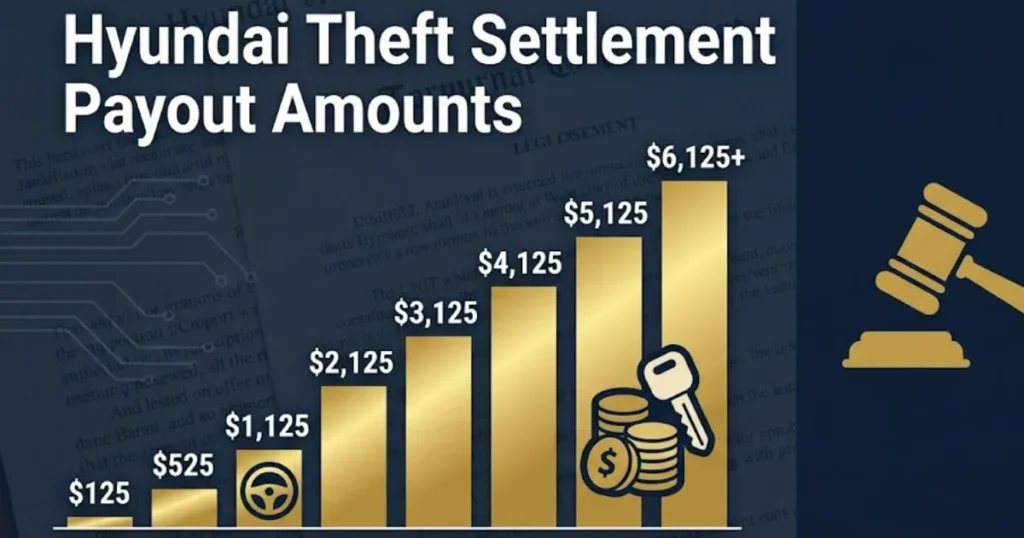
Hyundai theft settlement payout amounts range from $125 to over $6,125 depending on your specific situation. The amount you receive depends on which category of harm you experienced.
The settlement created a tiered system. Not everyone gets the same check. Your payout depends on whether your car was stolen, whether you experienced out-of-pocket costs, or whether you simply own an affected vehicle.
| Claim Category | Estimated Payout Range |
|---|---|
| Current owner (no theft, no expenses) | $125 to $300 |
| Owner who paid for anti-theft upgrade | Up to $300 reimbursement |
| Owner with theft-related expenses (deductible, rental, etc.) | Up to $3,375 |
| Vehicle stolen and recovered | Up to $3,375 |
| Vehicle stolen and totaled/not recovered | Up to $6,125 |
| Former owner (sold vehicle) | $50 to $125 |
These numbers are estimates based on the settlement terms. Actual payments could be adjusted depending on how many valid claims are filed. If fewer people file, individual payouts may be higher.
Owners who paid out-of-pocket for aftermarket anti-theft devices like steering wheel locks or kill switches can also seek reimbursement. You’ll need receipts or proof of purchase.
The settlement also covers insurance deductibles paid after a theft. If your Hyundai was stolen and you paid a $500 or $1,000 deductible, that amount is reimbursable through the claims process.
Key Takeaway: The Hyundai theft lawsuit centers on missing immobilizer technology in roughly 9 million vehicles, with settlement payouts in 2026 ranging from $125 for unaffected owners up to $6,125 for those whose cars were stolen and never recovered.
Hyundai Kia Theft Lawsuit Eligibility Requirements
You’re eligible for the Hyundai Kia theft lawsuit if you currently own or previously owned an affected Hyundai or Kia vehicle that lacked factory-installed engine immobilizer technology. The vehicle must have been equipped with a traditional turn-key ignition.
Eligibility comes down to a few factors:
- Vehicle make and model: Your car must be on the list of affected models
- Model year: Generally 2011 through 2022 for Hyundai, 2011 through 2022 for Kia
- Ignition type: Turn-key ignition only; push-button start vehicles already had immobilizers
- Ownership: You must have owned or leased the vehicle at some point
- Location: You must be a U.S. resident
You don’t need to have experienced a theft to qualify. Simply owning an affected vehicle makes you a class member. However, your payout will be lower if your car was never stolen or broken into.
People who sold their vehicles before the settlement was announced are still eligible. Former owners fall into a lower payout tier, but they’re not excluded.
| Eligibility Factor | Requirement |
|---|---|
| Vehicle Type | Hyundai or Kia with turn-key ignition |
| Model Years | 2011 to 2022 (varies by model) |
| Ownership | Current or former owner/lessee |
| Residency | United States |
| Theft Required? | No (but affects payout tier) |
| Opted Out? | Must not have opted out of class |
If you opted out of the class action during the opt-out period, you cannot file a claim. However, you retain the right to file an individual lawsuit against Hyundai or Kia.
Which Hyundai Models Are Affected by the Theft Lawsuit?
The affected Hyundai models include the Elantra, Sonata, Tucson, Santa Fe, Venue, Kona, Accent, and Veloster from model years 2011 through 2022 that came with standard key ignitions. Kia models include the Optima, Forte, Rio, Soul, Sportage, Seltos, and Sorento.
Not every trim level is affected. If your vehicle came with push-button start and a smart key fob, it already had an immobilizer. Those vehicles are not part of this lawsuit.
Affected Hyundai Models:
- Hyundai Accent (2011 to 2022)
- Hyundai Elantra (2011 to 2022)
- Hyundai Elantra GT (2013 to 2020)
- Hyundai Kona (2018 to 2022)
- Hyundai Santa Fe (2011 to 2022, select trims)
- Hyundai Sonata (2011 to 2022, select trims)
- Hyundai Tucson (2011 to 2022, select trims)
- Hyundai Veloster (2012 to 2021)
- Hyundai Venue (2020 to 2022)
Affected Kia Models:
- Kia Forte (2011 to 2022)
- Kia Optima (2011 to 2020)
- Kia K5 (2021 to 2022, select trims)
- Kia Rio (2011 to 2022)
- Kia Seltos (2021 to 2022)
- Kia Soul (2011 to 2022)
- Kia Sorento (2011 to 2022, select trims)
- Kia Sportage (2011 to 2022, select trims)
The easiest way to check is to look at how you start your car. If you insert a metal key and turn it, your vehicle is likely affected. If you press a button, it’s probably not.
Your VIN (Vehicle Identification Number) is the most reliable way to confirm eligibility. The settlement administrator’s claims portal allows you to enter your VIN to verify whether your specific vehicle is covered.
How to File a Hyundai Theft Claim in 2026
To file a Hyundai theft claim in 2026, you need to submit a claim form through the official settlement website or by mail. The process requires basic information about your vehicle and any theft-related losses you experienced.
Here’s the step-by-step process:
Step 1: Locate your VIN. It’s on your registration, insurance card, or the driver’s side dashboard near the windshield.
Step 2: Visit the official claims portal. Enter your VIN to confirm your vehicle is covered.
Step 3: Select your claim category. Are you a current owner with no theft? A theft victim? A former owner? Each category has a different form.
Step 4: Upload supporting documents. This may include:
- Proof of ownership (title, registration, purchase agreement)
- Police report (if your vehicle was stolen)
- Insurance claim documentation
- Receipts for anti-theft devices or repairs
- Rental car receipts or towing bills
Step 5: Submit your claim and save your confirmation number.
| Filing Step | What You Need |
|---|---|
| Verify eligibility | VIN number |
| Choose claim type | Knowledge of your situation |
| Gather documents | Police reports, receipts, proof of ownership |
| Submit | Online form or mailed paper form |
| Track status | Confirmation number |
Paper forms are available for people without internet access. You can request one by calling the settlement administrator’s toll-free number listed in any class notice you received by mail.
The process takes about 15 to 30 minutes for most people. Theft victims with extensive documentation may need more time to gather and upload files.
Key Takeaway: Eligibility covers Hyundai and Kia models from 2011 to 2022 with turn-key ignitions, and filing a claim requires your VIN, proof of ownership, and any documentation of theft-related losses.
Hyundai Theft Lawsuit Deadline 2026: Key Dates
The primary claims filing deadline has already passed for most categories, but a late claims process may still be available in 2026 for certain eligible owners. Deadlines vary based on your claim type and when the court approved extensions.
Here are the key dates that matter:
| Milestone | Date |
|---|---|
| Original settlement announced | 2023 |
| Preliminary court approval | 2023 |
| Initial claims filing deadline | Varied by category (2024 to 2025) |
| Final court approval | 2024 |
| Late claims window (if applicable) | Check with settlement administrator |
| Payment distribution begins | 2025 to 2026 |
| Anti-theft software update availability | Ongoing through 2026 |
If you missed the initial deadline, don’t assume you’re out of luck. Class action settlements sometimes allow late filings under certain conditions. These include:
- You never received a class notice
- You purchased your vehicle after the original deadline
- You experienced a theft after the filing window closed
- You have a documented reason for late submission
Contact the settlement administrator directly to ask about late claim options. The worst they can say is no.
Critical for 2026: Even if you can’t file a claim for cash, you can still get the free anti-theft software update installed at any authorized Hyundai or Kia dealership. This update alone could save you from a theft that costs you thousands.
Hyundai Kia Theft Lawsuit Status in 2026
The Hyundai Kia theft lawsuit in 2026 is in its post-settlement execution phase. The court has approved the settlement, claims have been processed, and payments are being distributed to verified class members.
The MDL litigation itself is winding down. Most legal disputes between the parties have been resolved. What remains is administrative work: processing remaining claims, handling appeals or objections, and distributing funds.
Several parallel legal actions are still active:
- State attorney general lawsuits: Multiple states filed their own cases against Hyundai and Kia. Some have reached separate settlements with additional funds for residents of those states.
- Individual lawsuits: People who opted out of the class action may still be pursuing individual claims for higher damages.
- Insurance company lawsuits: Major insurers like State Farm and Progressive have filed subrogation claims against Hyundai and Kia to recover billions in theft claim payouts.
The insurance company lawsuits are worth watching. If insurers win their cases, it won’t directly put money in your pocket. But it signals the strength of the underlying legal argument that Hyundai and Kia were negligent.
As a class member, the most important thing to know in 2026 is this: your obligation is to make sure your claim is filed and your contact information is current with the settlement administrator. If you’ve moved, update your address. Checks sent to old addresses cause payment delays.
Hyundai Theft Class Action Settlement Amount Breakdown
The total Hyundai theft class action settlement amount is valued at approximately $200 million in direct payments, plus hundreds of millions more in vehicle upgrades and anti-theft measures. The combined value with remedial measures exceeds $1.3 billion.
Here’s how the money breaks down:
| Settlement Component | Estimated Value |
|---|---|
| Cash fund for class members | $200 million |
| Anti-theft software upgrades (all vehicles) | $500+ million |
| Steering wheel lock distribution | $40+ million |
| Vehicle trade-in and buyback programs | Varies |
| Extended warranty-like protections | Varies |
| Administrative and legal costs | Included in total |
The $200 million cash pool is divided among all valid claimants. This is a “common fund” settlement, meaning the total is fixed. If 1 million people file claims, each person gets less. If 200,000 people file, each person gets more.
That’s why actual payouts may differ from the estimated ranges. The settlement agreement sets maximum amounts per category, but pro-rata adjustments could reduce them if claims volume is extremely high.
To put the numbers in perspective, the average auto class action settlement pays between $50 and $200 per person. The Hyundai settlement’s upper tiers of $3,375 to $6,125 for theft victims are unusually generous by class action standards.
The non-cash components are significant too. Getting a free immobilizer software update on a vehicle that previously had none can increase your car’s resale value and dramatically lower your theft risk.
Key Takeaway: The total settlement exceeds $1.3 billion in combined value, with direct cash payouts up to $6,125 for theft victims and free anti-theft upgrades for all affected vehicle owners.
Hyundai Stolen Car Settlement: What Theft Victims Get
If your Hyundai was stolen, you are in the highest payout tier of the settlement. Theft victims can receive up to $6,125 depending on whether the vehicle was recovered or declared a total loss.
The settlement treats theft victims differently based on outcome:
Vehicle stolen and not recovered (total loss):
- Up to $6,125 in settlement funds
- Reimbursement for insurance deductible
- Rental car costs covered
- Towing and storage fees covered
Vehicle stolen and recovered:
- Up to $3,375 in settlement funds
- Reimbursement for repair costs not covered by insurance
- Deductible reimbursement
- Rental car and transportation costs
Vehicle broken into but not stolen:
- Reimbursement for damage repair costs
- Potential eligibility for general class member payment
| Theft Scenario | Max Settlement Payout | Additional Reimbursements |
|---|---|---|
| Stolen, not recovered | Up to $6,125 | Deductible, rental, towing |
| Stolen, recovered | Up to $3,375 | Repairs, deductible, rental |
| Break-in, not stolen | Varies | Repair costs |
| Attempted theft (damage only) | Varies | Repair costs |
To claim these amounts, you need documentation. A police report is the most important piece of evidence. Without it, proving theft becomes extremely difficult.
Insurance claim records are the second most valuable document. They show what was paid, what your deductible was, and whether the vehicle was totaled. If you kept any records from the theft, gather them before filing.
Even if you don’t have every receipt, file anyway. The settlement administrator can sometimes verify claims through insurance databases and police records.
Can I Still File a Hyundai Theft Claim?
Whether you can still file a Hyundai theft claim in 2026 depends on your specific situation and whether the settlement administrator is accepting late claims. The initial filing deadline has passed for most categories, but exceptions exist.
You may still be able to file if:
- You recently purchased an affected vehicle and weren’t aware of the settlement
- Your vehicle was stolen after the original claims deadline
- You never received a class action notice by mail or email
- You were a minor at the time of the original deadline
- The court has extended the deadline for your claim category
Here’s what to do right now:
Step 1: Check the settlement website. Look for any announcements about extended or reopened filing periods.
Step 2: Call the settlement administrator. Explain your situation. Ask specifically about late filing procedures.
Step 3: Gather your documents. Even if you’re late, having everything ready makes your case stronger.
If the claims window is fully closed, you still have options. You can file an individual lawsuit against Hyundai or Kia. Individual lawsuits aren’t bound by class action deadlines and can sometimes result in larger payouts, though they require hiring an attorney and may take years.
Some state attorney general settlements have separate filing deadlines and claims processes. Check whether your state’s AG reached an independent settlement that may still be open.
Hyundai Anti Theft Software Update Lawsuit
The anti-theft software update is a central part of the settlement. Hyundai and Kia agreed to develop and install a free software upgrade that adds immobilizer-like protection to affected vehicles.
This update changes how the vehicle’s ignition system works. After installation, the car requires the correct key to start, rather than just any object that can turn the ignition cylinder. It essentially retrofits the security feature that should have been included from the factory.
The update takes about one hour to install at an authorized dealership. It’s completely free. You don’t need to be part of the class action to get it. Any owner of an affected vehicle can drive to a dealership and request the upgrade.
Some owners reported issues with the software update:
- Check engine lights appearing after installation
- Slight changes in how the ignition feels
- Rare reports of vehicles not starting after the update
- Concerns about warranty coverage for update-related problems
Hyundai and Kia have stated they will cover any repair costs caused by the software update itself. If your car has a problem directly related to the update, the dealership should fix it at no charge.
A separate but related legal argument exists: some plaintiffs claim the software update is an inadequate fix that doesn’t truly solve the underlying engineering deficiency. This argument supports ongoing individual lawsuits seeking damages beyond what the class settlement provides.
Quick fact: As of early 2026, over 5 million vehicles have received the anti-theft software update through the free dealership program.
Key Takeaway: Even if you missed the claims deadline, you should still get the free anti-theft software update at a dealership, and late filing options or individual lawsuits may still be available depending on your circumstances.
Kia Boys Lawsuit Update for 2026
The “Kia Boys” phenomenon is what turned a design flaw into a national crisis. The term refers to a social media trend where young people filmed themselves stealing Hyundai and Kia vehicles and posted tutorials online. By 2026, the legal fallout from this trend continues.
The viral videos showed how to steal affected vehicles using a USB cable, a screwdriver, or even a phone charger. The whole process took less than a minute. What started in Milwaukee spread to every major U.S. city.
Here’s the impact by the numbers:
| Statistic | Figure |
|---|---|
| Increase in Hyundai/Kia thefts (2020 to 2023) | Over 800% in some cities |
| Estimated total vehicles stolen | 1 million+ |
| Deaths linked to stolen vehicle crashes | Dozens reported |
| Cities that sued Hyundai/Kia | Over 20 |
| TikTok videos removed | Thousands |
Multiple cities filed their own lawsuits against Hyundai and Kia. Cities like Milwaukee, Columbus, St. Louis, Cleveland, and others argued that the automakers’ negligence imposed massive costs on law enforcement, emergency services, and local governments.
Some of these city lawsuits have settled independently. Others are still being litigated in 2026.
The Kia Boys trend also raised questions about social media liability. TikTok removed thousands of theft tutorial videos, but the damage was already done. The method became common knowledge.
For individual vehicle owners, the Kia Boys phenomenon strengthened the class action case enormously. It proved that the design flaw was exploitable, widespread, and foreseeable. Hyundai and Kia could no longer argue the vulnerability was theoretical.
Hyundai Kia Theft Lawsuit Payment Schedule
Payments from the Hyundai Kia theft lawsuit are being distributed in phases during 2026. The exact timing depends on your claim category, when you filed, and whether your claim required additional review.
Here’s the general payment timeline:
| Phase | Timing | Who Gets Paid |
|---|---|---|
| Phase 1 | Late 2025 to early 2026 | Simple claims (owners, no theft) |
| Phase 2 | Mid 2026 | Theft victims with complete documentation |
| Phase 3 | Late 2026 | Complex claims, late filers, disputed amounts |
| Ongoing | Throughout 2026 | Reimbursement claims processed on rolling basis |
Payments are sent by check to the address on file with the settlement administrator. Some settlements offer electronic payment options like direct deposit or prepaid debit cards. Check the settlement website for available payment methods.
If you filed a claim and haven’t heard anything, be patient but proactive. Class action payment processing is notoriously slow. Think of it like tax refunds, but with even more bureaucracy.
You can check your claim status through the settlement portal using the confirmation number you received when filing. If you lost your confirmation number, contact the administrator with your name and VIN.
Watch for scams. Legitimate settlement payments will come from the settlement administrator, not from random emails or phone calls asking for your bank information. Never pay a fee to receive a settlement check. That’s always a scam.
Hyundai Theft Insurance Claim vs Settlement
The Hyundai theft settlement and your personal insurance claim are two separate things, and accepting one does not automatically cancel the other. However, the interaction between them is more complicated than most people realize.
Here’s how they relate:
If your insurance paid your theft claim:
- You can still file a class action claim for reimbursement of your deductible
- You may receive additional settlement funds for out-of-pocket expenses insurance didn’t cover
- Your insurance company may have its own separate lawsuit against Hyundai/Kia (subrogation)
If you didn’t have insurance or your claim was denied:
- The settlement may be your primary source of compensation
- You could potentially receive higher payouts since you absorbed more of the loss
| Scenario | Insurance Payout | Settlement Payout | Total Recovery |
|---|---|---|---|
| Stolen, insured, $1,000 deductible | Vehicle value minus deductible | Up to $6,125 plus deductible reimbursement | Both combined |
| Stolen, uninsured | Nothing | Up to $6,125 | Settlement only |
| Not stolen, insured | N/A | $125 to $300 | Settlement only |
| Break-in damage, insured | Repair minus deductible | Deductible reimbursement | Both combined |
One thing to watch: some insurance policies have subrogation clauses. This means your insurer could claim a portion of your settlement payout to reimburse themselves for what they paid you. Read your policy carefully or ask your insurance agent about this.
The major insurance companies (State Farm, Progressive, Geico, Allstate) have filed massive lawsuits against Hyundai and Kia. These lawsuits seek to recover the billions they paid out in theft claims. This is separate from your individual claim and won’t reduce your settlement payment.
Key Takeaway: Settlement payments and insurance claims are separate recovery paths; you can pursue both, but watch for subrogation clauses in your insurance policy that might allow your insurer to claim a portion of your settlement money.
Hyundai Immobilizer Lawsuit Explained
The Hyundai immobilizer lawsuit is the technical foundation of the entire class action. An engine immobilizer is a small electronic chip inside the car key that communicates with a receiver in the vehicle’s ignition system. Without the matching chip signal, the engine won’t start.
This technology has been standard in most vehicles since the early 2000s. Toyota, Honda, Ford, GM, and nearly every other major automaker included immobilizers across their lineups. Hyundai and Kia chose not to include them in base-model and mid-trim vehicles to cut costs.
The cost savings per vehicle was estimated at roughly $30 to $50. For a company selling millions of cars, that adds up to hundreds of millions in savings. But the consequence was catastrophic.
Without an immobilizer, the ignition cylinder on affected Hyundai and Kia models could be turned by any flat object that fit inside it. A USB connector. A screwdriver. Even the back end of a pair of scissors. The steering column lock was also weak and could be broken with minimal force.
| Feature | With Immobilizer | Without Immobilizer |
|---|---|---|
| Key chip required to start | Yes | No |
| Can be started with USB cable | No | Yes |
| Theft difficulty level | High | Extremely low |
| Cost to manufacturer | $30 to $50 per vehicle | $0 |
| Industry standard since | Early 2000s | N/A |
The legal argument is straightforward: Hyundai and Kia knew this technology existed, knew it was industry standard, knew its absence made vehicles easy targets, and chose to skip it anyway to save money. That’s textbook product liability negligence.
The immobilizer issue is not just a U.S. problem. Similar lawsuits and regulatory actions have occurred in Canada, Australia, and parts of Europe.
Frequently Asked Questions
How much money will I get from the Hyundai theft lawsuit settlement?
Most class members will receive between $125 and $6,125.
The exact amount depends on whether your car was stolen, whether it was recovered, and what out-of-pocket costs you had.
Owners whose cars were never stolen will receive the lower end of that range.
What Hyundai models are part of the theft class action lawsuit?
Affected models include the Elantra, Sonata, Tucson, Santa Fe, Accent, Kona, Venue, and Veloster from 2011 to 2022.
Only vehicles with traditional turn-key ignition are included.
Push-button start models are excluded because they already had immobilizers.
Is it too late to file a Hyundai theft claim in 2026?
The main filing deadline has passed, but late claims may still be accepted in certain situations.
Contact the settlement administrator to ask about late filing procedures for your specific claim type.
Some state attorney general settlements have separate, later deadlines.
Does the Hyundai theft settlement affect my insurance claim?
No, the settlement and your insurance claim are separate.
You can collect from both, though your insurer may have subrogation rights to recover some funds.
The settlement may reimburse your insurance deductible on top of what your insurer paid.
When will Hyundai theft lawsuit payments be sent out?
Payments are being distributed in phases throughout 2026.
Simple claims are paid first, followed by theft-related and complex claims.
Check your claim status online using the confirmation number from your submission.
The Hyundai theft class action is real, it’s paying out, and 2026 is the year most claimants will see their money. Whether your car was stolen or you simply own an affected model, there’s likely a payment waiting for you.
Check your claim status with the settlement administrator. If you haven’t filed, find out whether late submissions are still possible. And no matter what, get the free anti-theft software update installed at your nearest dealership.
Your car’s security gap can be fixed. Don’t leave money or protection on the table.
META BLOCK
Meta Title: Hyundai Class Action Lawsuit Theft: 2026 Full Guide
Meta Title Chars: 55/59
Meta Desc: Hyundai class action lawsuit theft updates for 2026. See who qualifies, payout amounts, deadlines, and how to file your claim today.
Meta Desc Chars: 152/159
Focus Keywords: hyundai class action lawsuit theft, hyundai kia theft settlement 2026, hyundai theft settlement payout amounts, hyundai theft lawsuit deadline 2026, hyundai kia theft lawsuit eligibility
Slug: /hyundai-class-action-lawsuit-theft/
PHASE 5: IMAGE PROMPTS
Image Prompt 1 (Hero Banner):
A wide horizontal editorial banner, 1920×1080 pixels. Bold white text reading “Hyundai Class Action Lawsuit Theft” centered in the upper third of the image. Below the text, a stylized dark silhouette of a sedan car with a broken lock icon floating above the hood, glowing faintly in gold. The background is deep navy blue with subtle geometric legal patterns like a faint courthouse column motif and abstract circuit board lines representing digital security. A gold accent bar runs beneath the headline text. Clean modern typography, high contrast, professional editorial quality similar to Bloomberg Law or Reuters legal section. No real human faces. No logos or watermarks. Left side has breathing room for optional text overlay.
Alt Text 1: Hyundai class action lawsuit theft 2026 guide banner with car silhouette and broken lock icon
Image Prompt 2 (Supporting Image):
A wide horizontal in-article graphic, 1920×1080 pixels. The title text “Hyundai Theft Settlement Payout Amounts” appears in bold white lettering in the upper left quadrant. The center of the image features a stylized infographic layout showing a tiered payment scale with ascending gold bars labeled with dollar amounts from $125 to $6,125. A silhouette of a gavel rests to the right side. The background is deep navy with a subtle texture of faded legal document text. White and gold accent colors dominate. Clean lines, modern design, editorial quality. No real faces, no logos, no stock photo feel. Right side has open space for additional text overlay if needed.
Alt Text 2: Hyundai theft settlement payout amounts chart showing tiered payment ranges for 2026







