

A fort worth auto accident lawsuit can help you recover money for medical bills, lost income, and pain caused by someone else’s bad driving. If you were hurt in a crash anywhere in Tarrant County, Texas law gives you the right to hold the at-fault driver accountable through the civil court system.
This guide breaks down everything about filing a car accident lawsuit in Fort Worth in 2026. You will learn about settlement amounts, filing deadlines, what evidence you need, and how local courts handle these cases.
Here is one number worth knowing: Tarrant County saw over 4,800 injury crashes in a single recent year according to TxDOT data. That means thousands of people face the same questions you are asking right now.
We will walk through each step so you know exactly where you stand.
Fort Worth Auto Accident Lawsuit Overview for 2026
A Fort Worth auto accident lawsuit is a civil case filed in Tarrant County court to recover damages from a driver or party whose negligence caused your crash. These lawsuits fall under Texas personal injury law and are governed by the Texas Civil Practice and Remedies Code.
In 2026, the legal framework for these cases remains largely the same as prior years. Texas uses a modified comparative negligence system, meaning you can file a claim as long as you are less than 51% at fault for the accident.
Fort Worth sits at the crossroads of several major highways including I-35W, I-30, and I-820. High traffic volumes on these corridors make Tarrant County one of the busiest areas for auto accident litigation in Texas.
Most lawsuits begin after insurance negotiations stall or fail. When an insurance company lowballs your claim or denies it outright, filing a lawsuit becomes the next step.
| Detail | Info |
|---|---|
| Court | Tarrant County District Court |
| Legal Standard | Negligence (modified comparative fault) |
| Governing Law | Texas Civil Practice and Remedies Code |
| Filing Deadline | 2 years from date of accident |
| Common Defendants | At-fault drivers, trucking companies, employers |
These cases can involve car-on-car collisions, truck crashes, motorcycle wrecks, pedestrian accidents, and rideshare incidents. The type of crash affects the complexity and potential value of your case.
How to File an Auto Accident Lawsuit in Fort Worth
Filing an auto accident lawsuit in Fort Worth starts with preparing and submitting a petition to the Tarrant County District Court. This petition names the defendant, describes what happened, and states the damages you are seeking.
Before you file, you typically go through a pre-suit phase. This is when your attorney sends a demand letter to the at-fault driver’s insurance company. If the insurer refuses to pay a fair amount, you move to litigation.
Here are the basic steps to file:
- Gather your records: police report, medical bills, photos, witness statements
- Draft the Original Petition: this is the legal document that officially starts your case
- File with the Tarrant County District Clerk: you pay a filing fee (typically around $300 to $350 in 2026)
- Serve the defendant: the other driver must be formally notified of the lawsuit
- Wait for the defendant’s answer: they usually have 20 days to respond under Texas rules
After the answer is filed, both sides enter the discovery phase. This is where each party exchanges evidence, takes depositions, and builds their case.
Your case number and assigned court will determine your schedule from that point forward. Tarrant County has multiple district courts that handle civil cases, and each judge runs their docket a little differently.
Fort Worth Car Accident Settlement Amounts in 2026
Fort Worth car accident settlement amounts in 2026 typically range from $15,000 to $300,000 for most injury cases, with severe or catastrophic injuries pushing settlements into the millions. The exact number depends on the type and extent of your injuries.
Insurance companies look at several factors when calculating a settlement offer. Medical bills are the starting point. Lost wages add to the total. Pain and suffering usually makes up the largest single category in bigger cases.
| Injury Type | Estimated Settlement Range (2026) |
|---|---|
| Minor soft tissue (whiplash, sprains) | $10,000 to $30,000 |
| Moderate injuries (fractures, herniated discs) | $50,000 to $150,000 |
| Severe injuries (TBI, spinal cord) | $200,000 to $1,000,000+ |
| Wrongful death | $500,000 to $5,000,000+ |
These ranges reflect settlements, not jury verdicts. Jury awards in Tarrant County can be higher, but they can also be lower. There is no guarantee.
One thing that skews Fort Worth numbers higher than rural Texas counties is the cost of medical care in the DFW metro area. When your hospital bills are bigger, your settlement demand is bigger too.
Keep in mind that Texas does not cap compensatory damages in auto accident cases. There is a cap on exemplary (punitive) damages, but those only apply in cases involving extreme misconduct like drunk driving.
Key Takeaway: Most Fort Worth auto accident lawsuits are filed in Tarrant County District Court when insurance negotiations fail, and settlements in 2026 range from $15,000 for minor injuries to over $1 million for catastrophic cases.
How Much Is My Fort Worth Car Accident Case Worth
Your Fort Worth car accident case is worth the total of your economic damages plus your non-economic damages, minus any percentage of fault assigned to you. There is no fixed formula, but attorneys and insurers use consistent factors to estimate value.
Economic damages are the things you can put a receipt on:
- Medical bills (past and future)
- Lost wages and lost earning capacity
- Property damage to your vehicle
- Out-of-pocket expenses (prescriptions, medical devices, travel to appointments)
Non-economic damages are harder to measure but often worth more:
- Physical pain and suffering
- Mental anguish
- Loss of enjoyment of life
- Disfigurement or scarring
- Loss of consortium (for spouses)
A rough method some attorneys use is to multiply your medical bills by a factor of 1.5 to 5, depending on injury severity. A $20,000 medical bill for a moderate injury might generate a case value of $50,000 to $100,000 total.
But that multiplier is a guideline, not a rule. Tarrant County juries have awarded both more and less than what the math would predict. The strength of your evidence and the likability of your case matter enormously at trial.
If you had surgery, missed months of work, or have permanent limitations, your case is worth significantly more than a soft tissue claim that resolved in a few weeks.
Who Qualifies for a Car Accident Lawsuit in Texas
Anyone injured in a car accident caused by another person’s negligence qualifies to file a lawsuit in Texas, as long as they were less than 51% at fault for the crash. This rule comes from Texas Civil Practice and Remedies Code Section 33.001.
You do not need to be a Texas resident to file. If your accident happened on a Fort Worth road, you can bring your case in Tarrant County regardless of where you live.
Here is who qualifies:
- Drivers injured by another at-fault driver
- Passengers in any vehicle involved in the crash
- Pedestrians struck by a vehicle
- Cyclists hit by a car or truck
- Family members of someone killed in a crash (wrongful death claims)
Children injured in accidents can have claims filed on their behalf by a parent or legal guardian. The statute of limitations for minors does not begin until they turn 18, giving them until age 20 to file.
You do not need to have been taken to the hospital by ambulance. You do not need a police report that assigns fault to the other driver. Those things help your case, but they are not requirements to file.
The key legal question is whether the other party was negligent. Did they run a red light? Were they texting? Were they speeding? Were they drunk? If yes, you likely qualify.
Texas Statute of Limitations for Car Accidents in 2026
The statute of limitations for car accident lawsuits in Texas is two years from the date of the accident. This deadline is set by Texas Civil Practice and Remedies Code Section 16.003 and applies to all personal injury claims, including auto accidents.
If your crash happened on March 15, 2024, your lawsuit must be filed by March 15, 2026. Miss that date by even one day and the court will almost certainly dismiss your case permanently.
| Claim Type | Deadline |
|---|---|
| Personal injury (adults) | 2 years from accident date |
| Property damage only | 2 years from accident date |
| Wrongful death | 2 years from date of death |
| Minor’s injury claim | 2 years after the minor turns 18 |
| Claims against a government entity | 6 months to give notice; 2 years to file suit |
There are a few narrow exceptions. If the at-fault driver left the state after the accident, the clock may pause under Texas’s tolling rules. If you were mentally incapacitated due to your injuries, the deadline could be extended.
Government entity cases deserve extra attention. If a City of Fort Worth vehicle or a TxDOT maintenance issue caused your crash, you must provide formal notice within 6 months. That is a much shorter window than the standard two-year limit.
Do not wait until the last few months before the deadline. Filing early gives your attorney time to investigate, gather evidence, and attempt pre-suit settlement negotiations.
Key Takeaway: Texas gives you two years to file, but government entity claims require notice within six months, and waiting until the last minute puts your entire case at risk.
Fort Worth Auto Accident Lawsuit Timeline
A Fort Worth auto accident lawsuit typically takes 12 to 24 months from filing to resolution, though complex cases can stretch beyond three years. The timeline depends on the severity of injuries, whether liability is disputed, and how crowded the Tarrant County court docket is.
Here is a general timeline:
| Phase | Estimated Duration |
|---|---|
| Pre-suit negotiation | 1 to 6 months |
| Filing and service | 1 to 2 months |
| Discovery | 4 to 8 months |
| Mediation | Scheduled during or after discovery |
| Trial preparation | 2 to 4 months |
| Trial | 3 to 7 days (if reached) |
Most cases never make it to trial. Roughly 95% of Fort Worth auto accident cases settle before a jury hears the evidence. Settlement can happen at any point, from right after filing to the morning of trial.
The discovery phase eats the most time. Both sides exchange documents, take depositions, and hire expert witnesses. If the defendant’s insurance company is slow to respond to discovery requests, the timeline stretches.
Mediation is often court-ordered in Tarrant County. A neutral mediator tries to help both sides reach a deal. Many cases that seem stuck will settle at mediation because both parties want to avoid the unpredictability of a jury.
If you have ongoing medical treatment, your attorney may advise waiting until you reach maximum medical improvement before settling. Settling too early could mean leaving money on the table for future medical costs.
What to Do After a Car Accident in Fort Worth
After a car accident in Fort Worth, your first priority is safety and documentation. What you do in the hours and days after the crash directly affects the strength of any future lawsuit.
Here is a step-by-step list:
- Call 911 and report the accident to Fort Worth Police
- Get medical attention immediately, even if you feel fine (adrenaline masks pain)
- Document the scene: take photos of all vehicles, road conditions, traffic signals, and visible injuries
- Exchange information with the other driver: name, insurance, license plate, phone number
- Get witness contact info if anyone saw the crash
- Do not admit fault at the scene, not even a casual “I’m sorry”
- Notify your own insurance company within the timeframe your policy requires
- Keep all medical records and bills organized from day one
The Fort Worth Police Department will generate an official crash report. You can request a copy from the department or through the Texas Department of Transportation’s online crash report system. This report often includes the officer’s determination of fault.
One mistake people make is waiting days or weeks to see a doctor. Insurance adjusters use gaps in treatment to argue your injuries are not serious. If you felt pain after the accident, see a doctor within 24 to 48 hours.
Save everything. Text messages with the other driver, photos of your damaged car, receipts for rental cars and Uber rides, notes about days you missed work. All of it becomes evidence.
Evidence Needed for an Auto Accident Lawsuit in Fort Worth
The evidence you need for a Fort Worth auto accident lawsuit includes the police crash report, medical records, photographs, witness statements, and proof of financial losses. Strong evidence is what separates winning cases from ones that settle for pennies.
Primary evidence categories:
- Police crash report: contains the officer’s narrative, diagrams, and sometimes a fault determination
- Medical records and bills: every visit, scan, surgery, and prescription tied to the accident
- Photographs and video: scene photos, vehicle damage, visible injuries, traffic camera or dashcam footage
- Witness statements: written or recorded accounts from people who saw the crash
- Expert opinions: accident reconstruction specialists, medical experts, economists for future damages
Financial documentation:
- Pay stubs and tax returns showing lost income
- Repair estimates or salvage value for your vehicle
- Receipts for any out-of-pocket costs related to the accident
In 2026, digital evidence is more important than ever. Dashcam footage, security camera recordings from nearby businesses, and data from vehicle event data recorders (the car’s “black box”) can all be pulled into your case.
Your attorney will also subpoena the defendant’s cell phone records if distracted driving is suspected. Texas law allows discovery of phone activity at the time of the crash.
The more evidence you gather early, the less you have to rely on memory later. Memory fades. Photos and documents do not.
Key Takeaway: Start collecting evidence the day of the crash because police reports, medical records, photos, and digital data like dashcam footage are what make or break your case in Tarrant County court.
Comparative Fault in Texas Auto Accidents
Comparative fault in Texas auto accidents means your compensation is reduced by whatever percentage of fault is assigned to you, and you lose the right to recover anything if you are 51% or more at fault. This is called modified comparative negligence under Texas law.
Here is how it works in practice. Say a jury finds you were 20% at fault for the crash and awards you $100,000. Your actual recovery drops to $80,000 because of your share of the blame.
| Your Fault Percentage | Award Amount | What You Actually Receive |
|---|---|---|
| 0% | $100,000 | $100,000 |
| 20% | $100,000 | $80,000 |
| 50% | $100,000 | $50,000 |
| 51% or more | $100,000 | $0 (barred from recovery) |
Insurance companies love to use comparative fault against you. They will look for any excuse to pin some blame on you. You changed lanes? You were going 5 mph over the speed limit? You were adjusting your GPS? All of that can be used to reduce your payout.
This is why your own conduct at the accident scene matters. If you admitted fault, apologized, or posted something on social media suggesting you were distracted, the defense will use it.
In Tarrant County, juries are given specific instructions on how to allocate fault percentages. The verdict form asks them to assign a number to each party. Even a small percentage against you can cost you tens of thousands of dollars.
Expect the other side’s insurance adjuster to bring up comparative fault early and often. It is their most effective tool for shrinking your claim.
Fort Worth Car Crash Injury Compensation
Fort Worth car crash injury compensation covers both economic losses you can calculate and non-economic losses that require judgment to value. Texas law allows injury victims to recover for all damages that naturally flow from the accident.
Economic compensation includes:
- Past and future medical expenses
- Lost wages and diminished earning capacity
- Vehicle repair or replacement costs
- Home modification costs (for severe disabilities)
- In-home care and rehabilitation expenses
Non-economic compensation includes:
- Physical pain and suffering (past and future)
- Mental anguish and emotional distress
- Loss of enjoyment of life
- Disfigurement and physical impairment
- Loss of consortium for spouses
Texas does not cap compensatory damages in auto accident cases. That means there is no maximum limit on what a jury can award for your injuries and losses.
Punitive damages are a separate category. Texas calls them exemplary damages. They are only available when the defendant acted with gross negligence, fraud, or malice. Think drunk driving or intentional road rage. The cap on exemplary damages is the greater of $200,000 or two times economic damages plus $750,000.
The biggest compensation awards in Fort Worth come from cases involving traumatic brain injuries, spinal cord damage, and wrongful death. A single TBI case with lifelong care needs can generate a claim worth several million dollars.
Your total compensation also depends on insurance policy limits. If the at-fault driver only carries the Texas minimum of $30,000 per person, collecting a larger judgment may require going after personal assets or your own underinsured motorist coverage.
Fort Worth Uninsured Motorist Accident Claims
A Fort Worth uninsured motorist accident claim is what you file when the driver who hit you has no insurance or not enough insurance to cover your damages. Texas law requires insurers to offer UM/UIM coverage, and this is where it pays off.
According to the Insurance Research Council, roughly 14% of Texas drivers are uninsured. In a metro area like Fort Worth with heavy traffic, your odds of being hit by one of them are real.
How UM/UIM coverage works:
- Uninsured Motorist (UM): covers you when the at-fault driver has zero insurance
- Underinsured Motorist (UIM): kicks in when the at-fault driver’s policy limits are too low to cover your damages
- You file the claim with your own insurance company
| Scenario | Coverage That Applies |
|---|---|
| At-fault driver has no insurance | Your UM policy |
| At-fault driver has $30,000 limit but your damages are $100,000 | Other driver’s $30,000 + your UIM policy |
| Hit and run (driver not identified) | Your UM policy |
Here is the catch: your own insurance company is not your friend in this situation. They will fight just as hard to minimize your UM/UIM claim as the other driver’s insurer would. Some people are shocked by this, but it happens constantly.
If your insurer acts in bad faith by unreasonably denying or delaying your UM/UIM claim, you can bring a separate bad faith insurance claim against them under Texas Insurance Code Chapter 541.
You can also file a lawsuit directly against the uninsured driver. However, collecting a judgment from someone with no insurance often means they have no assets either. That is why UM/UIM coverage is so important to carry.
Key Takeaway: About 14% of Texas drivers are uninsured, which means your own UM/UIM coverage is your financial safety net, and your insurer may still fight to pay you as little as possible.
Fort Worth Truck Accident Lawsuits
Fort Worth truck accident lawsuits involve commercial vehicles weighing over 10,000 pounds and are significantly more complex than standard car accident cases. They often involve multiple defendants, federal regulations, and much larger damage amounts.
Fort Worth’s position along I-35W, I-20, and I-30 makes it a major corridor for 18-wheelers and commercial freight. Truck accident injuries tend to be more severe simply because of the size and weight difference between a semi and a passenger car.
What makes truck cases different:
- Multiple liable parties: the driver, the trucking company, the cargo loader, the maintenance contractor, and even the truck manufacturer could share fault
- Federal Motor Carrier Safety Administration (FMCSA) regulations: truckers must follow hours-of-service rules, weight limits, and maintenance schedules
- Electronic logging devices (ELDs): these record driving hours and can prove violations
- Higher insurance policies: commercial trucks typically carry $750,000 to $1,000,000 or more in liability coverage
Trucking companies often send their own investigators to the crash scene within hours. They start building their defense before you even get out of the hospital. This is why acting fast in truck accident cases is critical.
Black box data from the truck, driver qualification files, drug and alcohol test results, and maintenance logs are all discoverable in litigation. Your attorney will need to send a spoliation letter immediately to prevent the trucking company from destroying evidence.
Settlement values in Fort Worth truck accident cases are typically 3 to 10 times higher than comparable car accident cases because of the severity of injuries and the deeper insurance pockets involved.
Fort Worth Hit and Run Accident Lawsuits
A Fort Worth hit and run accident lawsuit can proceed even when the at-fault driver is not immediately identified, though your legal options depend on whether that driver is eventually found. Texas treats hit and run as both a criminal offense and a civil matter.
Under Texas Transportation Code Section 550.022, leaving the scene of an accident that causes injury is a felony. But criminal charges do not automatically put money in your pocket. The civil case is what recovers your damages.
If the driver is identified:
- You file a standard negligence lawsuit against them
- Their insurance company handles the defense
- Hit and run behavior can be used as evidence of consciousness of guilt, which strengthens your case
If the driver is never found:
- Your uninsured motorist (UM) policy is your primary source of recovery
- You file a claim with your own insurance company
- Texas requires that you report the hit and run to police to activate UM coverage
Fort Worth Police use traffic cameras, surveillance footage from nearby businesses, and witness descriptions to track down hit and run drivers. In 2026, the presence of doorbell cameras and dashcams has made identification more likely than ever.
The emotional weight of a hit and run case is different from a normal crash. Juries tend to be angrier at defendants who fled the scene. That anger can translate into higher pain and suffering awards if the case goes to trial.
File your police report immediately. Time matters because camera footage gets overwritten and witness memories fade fast.
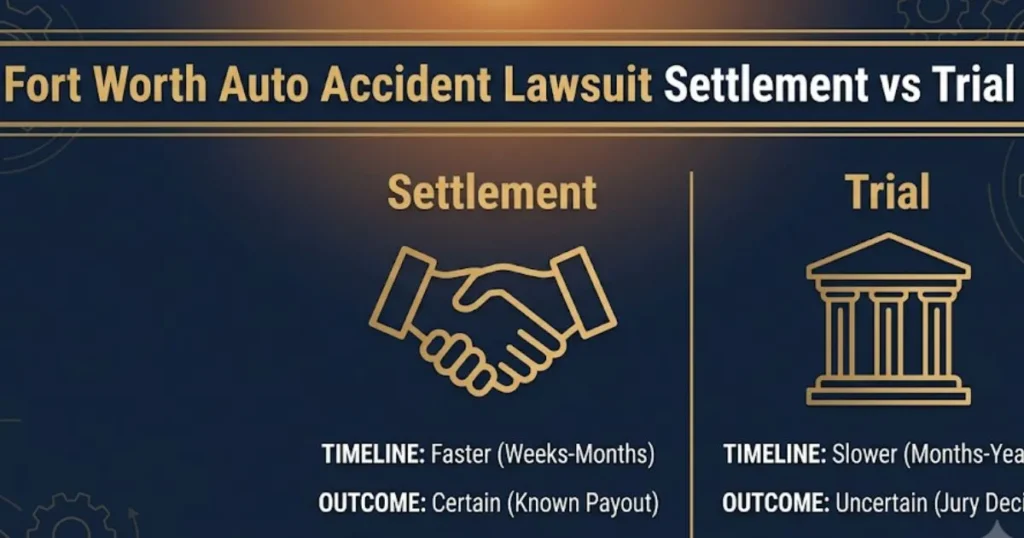
Fort Worth Auto Accident Lawsuit: Settlement vs Trial
Most Fort Worth auto accident lawsuits settle before trial, with approximately 95% of cases reaching a resolution through negotiation or mediation. But knowing the difference between settlement and trial helps you make the right decision for your case.
| Factor | Settlement | Trial |
|---|---|---|
| Timeline | 6 to 18 months | 18 to 36+ months |
| Certainty of outcome | You know the exact amount | Jury could award more or less, or nothing |
| Cost | Lower attorney costs and expenses | Higher costs (expert witnesses, trial prep) |
| Privacy | Terms can be confidential | Public record |
| Emotional toll | Lower stress | High stress, testimony required |
| Appeal risk | No appeal possible | Defendant can appeal the verdict |
Settlement gives you control. You decide whether the offer is acceptable. Once you accept, the case is closed and the check arrives within a few weeks.
Trial is a gamble with potentially bigger rewards. Tarrant County juries have awarded millions in auto accident cases, but they have also returned defense verdicts where the plaintiff got nothing. You need to have a strong stomach for uncertainty.
Your attorney’s trial experience matters enormously here. Insurance companies track which lawyers actually take cases to trial and which ones always settle. If your attorney has a reputation for going to court, the insurance company is more likely to make a serious offer early.
The best strategy for most people is to prepare for trial while staying open to a fair settlement. That dual approach puts maximum pressure on the insurance company.
Key Takeaway: About 95% of Fort Worth auto accident cases settle, but preparing for trial gives your attorney the strongest position to demand a fair offer from the insurance company.
Tarrant County Auto Accident Claims
Tarrant County auto accident claims are filed in the county’s district courts, with specific procedures and local rules that differ from other Texas counties. Understanding how Tarrant County handles these cases gives you a practical advantage.
Tarrant County is part of the Second Court of Appeals district, which means any appeals from local verdicts go to that appellate court in Fort Worth. The appellate court’s history on auto accident cases can influence how aggressively insurance companies litigate at the trial level.
Tarrant County specifics:
- Cases are randomly assigned to one of several district courts within the county
- The county uses a central jury room for jury selection in civil cases
- Mediation is frequently ordered before trial
- Local rules require pretrial disclosures and expert witness designations on specific schedules
The Tarrant County District Clerk’s office handles all filings. In 2026, most filings can be submitted electronically through the Texas eFile system, which speeds up the process compared to in-person paper filing.
Fort Worth is the county seat, and all district court proceedings take place at the Tarrant County Justice Center or the Tim Curry Criminal Justice Center (criminal matters) downtown. Civil auto accident cases go through the civil courts at the Justice Center.
Jury pools in Tarrant County tend to be diverse, drawing from Fort Worth, Arlington, Mansfield, Keller, Southlake, and surrounding communities. The political and demographic makeup of the jury pool can affect verdict tendencies, which is something experienced local attorneys factor into their trial strategy.
If your accident happened on a highway that crosses county lines, venue rules determine which county you file in. Generally, you can file in the county where the accident occurred or where the defendant lives.
How a Fort Worth Car Accident Lawyer Can Help
A Fort Worth car accident lawyer handles every part of your case from the initial investigation through settlement or trial, allowing you to focus on recovery instead of fighting with insurance adjusters. The right attorney can significantly increase the value of your claim.
What a car accident lawyer does for you:
- Investigates the accident and preserves evidence
- Calculates the full value of your claim (including future damages most people forget)
- Handles all communication with the insurance company
- Files the lawsuit and manages court deadlines
- Hires expert witnesses: accident reconstructionists, medical professionals, economists
- Negotiates settlement offers on your behalf
- Takes your case to trial if a fair offer is not on the table
Most Fort Worth car accident lawyers work on a contingency fee basis. That means you pay nothing upfront. The attorney takes a percentage of your recovery, usually 33% before trial and 40% if the case goes to court. If you do not win, you owe nothing.
| Fee Structure | Typical Percentage |
|---|---|
| Pre-suit settlement | 25% to 33% |
| Post-filing settlement | 33% to 40% |
| After trial begins | 40% to 45% |
Not every accident requires a lawyer. If you had a minor fender bender with no injuries and the insurance company is offering a fair amount for property damage, you can probably handle it yourself.
But if you have injuries, medical bills, missed work, or a disputed liability situation, handling it alone usually means accepting far less than your case is worth. Studies consistently show that represented claimants receive higher settlements than unrepresented ones.
Choose an attorney who focuses specifically on auto accident cases in Tarrant County. Local experience with the courts, judges, and opposing counsel matters more than flashy TV ads.
Frequently Asked Questions
How long do I have to file an auto accident lawsuit in Fort Worth?
You have two years from the date of the accident to file under Texas law.
If a government entity is involved, you must give formal notice within six months.
Missing the deadline permanently bars your case.
What is the average car accident settlement in Fort Worth in 2026?
Most Fort Worth car accident settlements range from $15,000 to $300,000 depending on injury severity.
Minor soft tissue injuries settle on the lower end while severe injuries like TBI or spinal damage push into six or seven figures.
Your specific medical bills, lost income, and pain level determine where you fall in that range.
Can I sue if I was partially at fault in a Fort Worth car accident?
Yes, Texas allows you to sue as long as you are less than 51% at fault.
Your compensation is reduced by your percentage of blame.
If a jury finds you 30% at fault on a $100,000 award, you receive $70,000.
How long does a Fort Worth auto accident lawsuit take from start to finish?
Most cases resolve within 12 to 24 months from the date of filing.
Complex cases involving truck accidents or disputed liability can take three years or more.
About 95% of cases settle before reaching a jury trial.
Do I need a lawyer for a car accident lawsuit in Fort Worth?
You do not legally need one, but hiring a lawyer almost always results in a higher recovery.
Attorneys handle evidence collection, expert witnesses, and insurance negotiations that most people cannot do effectively on their own.
Most work on contingency, so you pay nothing unless you win.
If you were hurt in a Fort Worth auto accident, 2026 is the year to understand your rights and act on them. The filing deadline, the evidence you collect, and the decisions you make now shape everything that comes next.
Check whether you qualify. Start gathering your records. Talk to an attorney who handles Tarrant County cases and knows the local court system inside and out.
Your case has a clock on it. Make sure you beat it.







