

The ultra processed food lawsuit wave is gaining serious traction in 2026. Major food corporations face mounting legal claims from consumers who say they were harmed by products engineered to be addictive and marketed as safe.
Billions of dollars are potentially at stake. Lawsuits allege that companies like PepsiCo, Nestle, and Kraft Heinz knowingly sold products linked to diabetes, heart disease, obesity, and certain cancers.
This article breaks down everything happening right now. You will learn which companies are being sued, what health conditions qualify, how much settlements could pay, and exactly how to file.
Here is one number that puts this in perspective. A 2024 BMJ study found that ultra processed foods are associated with 32 different adverse health outcomes. That kind of science is fueling courtroom battles in 2026.
Ultra Processed Food Lawsuit 2026
The ultra processed food lawsuit in 2026 represents a growing body of legal action against food manufacturers accused of hiding the health dangers of their products. Multiple cases are now moving through federal and state courts across the United States.
These lawsuits build on filings that began in 2023 and 2024. They gained momentum after major scientific publications confirmed strong links between ultra processed food consumption and chronic disease.
By early 2026, attorneys in several states had expanded their claims. New plaintiffs have joined existing cases, and fresh lawsuits target additional companies and product lines.
The legal theories center on two core claims. First, that companies knew their products caused harm. Second, that they actively misled consumers through deceptive labeling and marketing.
| Detail | Info |
|---|---|
| Current Status | Active filings in multiple U.S. courts |
| Key Legal Theories | Failure to warn, deceptive marketing, product liability |
| Primary Defendants | Major packaged food and beverage corporations |
| Plaintiffs | U.S. consumers who developed chronic health conditions |
| Year of Peak Filing Activity | 2025 to 2026 |
Courts in California, Illinois, and New York are handling the bulk of these cases. Some attorneys are pushing for multidistrict litigation (MDL) to consolidate cases for efficiency.
The trajectory looks similar to early tobacco litigation. That comparison keeps coming up among legal analysts watching this space.
Ultra Processed Food Class Action Lawsuit
An ultra processed food class action lawsuit allows a large group of consumers to sue a food manufacturer together in a single case. Several class actions have been filed or proposed since late 2024.
Class actions work well here because millions of people bought the same products. They experienced similar health effects. And they were exposed to the same misleading marketing.
In a class action, one or a few named plaintiffs represent everyone in the group. If the case succeeds, all class members share in the settlement or verdict.
Some of these cases target specific products. Others challenge entire product lines from a single company. A few attempt to hold multiple corporations accountable at once.
- Class actions filed in California target sugary cereals and snack products
- Illinois cases focus on deceptive “natural” labeling on ultra processed items
- New York filings challenge marketing of ultra processed foods aimed at children
Not every case will proceed as a class action. Some judges may deny class certification if individual health differences are too varied. In those situations, cases may shift to mass tort or individual lawsuits.
The class action approach gives regular consumers leverage they would not have alone. Fighting PepsiCo or Nestle as an individual is expensive and slow. Doing it as part of a group changes the math entirely.
Ultra Processed Food Companies Sued
The companies sued in ultra processed food lawsuits read like a grocery store hall of fame. PepsiCo, Nestle, Kraft Heinz, General Mills, Kellogg’s, and Mondelez International all face legal claims as of 2026.
These are not small operations. These companies generate hundreds of billions in combined annual revenue. Their products fill entire aisles in every supermarket in America.
| Company | Notable Products Under Scrutiny | Lawsuit Status |
|---|---|---|
| PepsiCo | Doritos, Cheetos, Lay’s, Gatorade | Active claims |
| Nestle | Hot Pockets, Stouffer’s, DiGiorno | Active claims |
| Kraft Heinz | Lunchables, Oscar Mayer, Velveeta | Active claims |
| General Mills | Lucky Charms, Fruit Snacks, Pillsbury | Active claims |
| Kellogg’s | Froot Loops, Pop-Tarts, Pringles | Active claims |
| Mondelez | Oreo, Chips Ahoy, Ritz | Under review |
| Coca-Cola | Various sugary beverages | Under review |
| Mars Inc. | Snickers, M&Ms, processed food brands | Under review |
Lawsuits allege these companies spent decades perfecting “bliss point” formulations. That is the exact combination of sugar, salt, and fat designed to make you eat more than you intended.
Internal documents from some of these companies may prove damaging. Plaintiffs’ attorneys are seeking records showing that executives knew about health risks but chose profits over consumer safety.
Think of it like the moment Big Tobacco’s internal memos went public. That was the turning point. Food litigation lawyers are betting on a similar moment here.
Key Takeaway: Ultra processed food lawsuits in 2026 target the biggest food companies in the world, using class action and individual claims built on deceptive marketing and failure to warn theories.
Ultra Processed Food Health Risks Lawsuit
Ultra processed food health risks form the backbone of every lawsuit in this litigation wave. Plaintiffs must prove that consuming these products caused specific, diagnosable medical conditions.
The science has strengthened dramatically. A landmark 2024 BMJ umbrella review analyzed 45 meta-analyses covering nearly 10 million participants. It found convincing evidence linking ultra processed foods to 32 adverse health outcomes.
These are not minor complaints. We are talking about conditions that kill people or permanently alter their quality of life.
- Type 2 diabetes: Up to 40% increased risk with high UPF consumption
- Cardiovascular disease: Significant associations with heart attack and stroke
- Obesity: Strong dose-response relationship documented across multiple studies
- Depression and anxiety: Emerging links to mental health conditions
- All-cause mortality: Higher UPF intake associated with increased death risk
Lawsuits argue that companies had access to this science for years. Some had their own internal research. Yet they continued selling products without warnings.
The legal term for this is “failure to warn.” It is the same claim used in asbestos cases, pharmaceutical lawsuits, and chemical exposure litigation.
Proving causation in any individual case remains the biggest challenge. Defense attorneys will argue that other factors caused a plaintiff’s diabetes or heart disease. That is where medical records, consumption history, and expert witnesses become critical.
What Makes Food Ultra Processed
Ultra processed food refers to industrial formulations made mostly or entirely from substances derived from foods and additives. The NOVA classification system, developed by researchers at the University of Sao Paulo in Brazil, is the standard used in both scientific literature and courtrooms.
NOVA divides all foods into four groups. Only Group 4 qualifies as ultra processed.
| NOVA Group | Description | Examples |
|---|---|---|
| Group 1 | Unprocessed or minimally processed | Fresh fruit, vegetables, eggs, plain meat |
| Group 2 | Processed culinary ingredients | Olive oil, butter, salt, sugar |
| Group 3 | Processed foods | Canned vegetables, cheese, fresh bread |
| Group 4 | Ultra processed foods | Soft drinks, packaged snacks, instant noodles, frozen meals |
What separates Group 4 from everything else is the use of industrial techniques and additives you would never find in a home kitchen. Emulsifiers, hydrogenated oils, high fructose corn syrup, flavor enhancers, colorings, and preservatives are hallmarks.
A simple test: look at the ingredient list. If you see substances your grandmother would not recognize as food, it is probably ultra processed.
About 73% of the U.S. food supply qualifies as ultra processed according to researchers at Northeastern University. That staggering number helps explain why lawsuits are targeting an entire industry, not just one bad product.
Ultra Processed Food Linked to Disease
Ultra processed food is linked to dozens of serious diseases through large-scale, peer-reviewed research. The connection is no longer theoretical or speculative. It is backed by data from millions of study participants worldwide.
The NutriNet-Sante cohort study in France tracked over 100,000 adults. It found that a 10% increase in ultra processed food consumption corresponded with a significant increase in cancer risk.
A 2023 study published in JAMA Internal Medicine followed over 44,000 people for more than a decade. Higher ultra processed food intake was associated with increased mortality from cardiovascular disease.
Diseases most strongly linked to ultra processed food consumption:
- Type 2 diabetes
- Coronary heart disease
- Stroke
- Colorectal cancer
- Breast cancer
- Obesity
- Metabolic syndrome
- Inflammatory bowel disease
- Non-alcoholic fatty liver disease
- Depression
These associations hold up even when researchers control for total calorie intake, physical activity, smoking, and alcohol use. That detail matters enormously in court because it weakens the defense argument that other lifestyle factors caused the illness.
The dose-response relationship is particularly compelling. The more ultra processed food someone eats, the higher their risk. That is the same pattern that helped prove cigarettes cause lung cancer.
Key Takeaway: Peer-reviewed studies involving millions of participants show that ultra processed food consumption directly correlates with increased risk of cancer, heart disease, diabetes, and early death, and these studies form the evidentiary backbone of current lawsuits.
Ultra Processed Food Cancer Risk
Ultra processed food cancer risk is one of the most alarming and legally significant aspects of these lawsuits. Research specifically tying UPF consumption to cancer diagnoses gives plaintiffs a powerful claim.
The World Health Organization’s International Agency for Research on Cancer (IARC) has classified several additives common in ultra processed foods as possible or probable carcinogens. Titanium dioxide, certain artificial colorings, and sodium nitrite are among them.
Colorectal cancer gets the most attention in litigation. A 2024 study found that young adults who consumed the highest levels of ultra processed foods had a significantly elevated risk of developing colorectal cancer before age 50.
This matters because colorectal cancer rates in people under 50 have been rising sharply. Researchers point to diet, specifically ultra processed food, as a leading suspect.
| Cancer Type | Strength of UPF Association | Key Study |
|---|---|---|
| Colorectal cancer | Strong | BMJ 2024 meta-analysis |
| Breast cancer | Moderate | NutriNet-Sante cohort |
| Pancreatic cancer | Emerging evidence | JAMA Oncology review |
| Esophageal cancer | Emerging evidence | European cohort studies |
Lawsuits involving cancer claims tend to produce larger settlements. The reason is straightforward. Cancer is devastating, treatment is expensive, and juries are sympathetic.
If you were diagnosed with cancer and consumed ultra processed foods regularly for years, your case could carry significant value. Attorneys handling these cases typically bring oncologists and epidemiologists as expert witnesses.
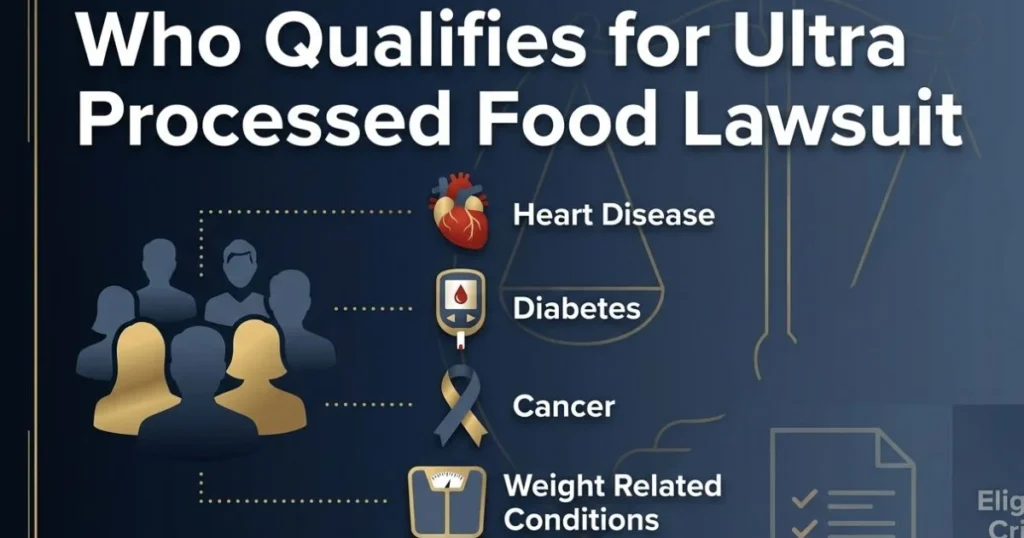
Who Qualifies for Ultra Processed Food Lawsuit
You may qualify for an ultra processed food lawsuit if you regularly consumed ultra processed products and later developed a serious health condition linked to those foods. That is the basic threshold.
Qualification is not automatic. You need to demonstrate a pattern of consumption and a medical diagnosis. The stronger the connection between the two, the stronger your case.
General qualification criteria:
- You consumed ultra processed foods regularly over a sustained period (typically several years)
- You were diagnosed with a qualifying health condition (diabetes, heart disease, cancer, obesity, metabolic syndrome)
- Your consumption predates or coincides with the onset of your condition
- You can provide medical records documenting your diagnosis
- You can show evidence of purchasing or consuming specific products (receipts, loyalty card data, personal testimony)
Age is not a barrier. Adults and children may both qualify. Cases involving children who developed obesity or diabetes from ultra processed school lunches and snacks are particularly compelling.
You do not need to prove that ultra processed food was the sole cause. You need to show it was a contributing factor. That is a lower bar than most people assume.
Geographic location matters for jurisdictional reasons. Most lawsuits are filed in federal courts or in state courts where the plaintiff lives or where the company operates.
Ultra Processed Food Lawsuit Eligibility Requirements
Ultra processed food lawsuit eligibility requirements are more specific than general qualification criteria. Meeting these requirements determines whether your case can actually proceed in court.
Attorneys evaluating cases in 2026 typically look for several concrete elements.
| Requirement | What You Need |
|---|---|
| Medical Diagnosis | Documented diagnosis of a qualifying condition from a licensed physician |
| Consumption History | Evidence of regular UPF consumption over at least 2 to 5 years |
| Product Identification | Ability to identify specific brands or products consumed |
| Medical Records | Treatment records, prescriptions, hospital stays related to the condition |
| Timeline Consistency | Diagnosis occurred after sustained UPF consumption, not before |
| No Disqualifying Factors | No pre-existing genetic condition that fully explains the diagnosis |
Receipts and store loyalty card records are surprisingly useful. Many grocery chains keep purchase histories. Your attorney can subpoena those records.
Social media posts, photos of meals, and even testimony from family members about dietary habits can support your case. Attorneys build consumption profiles from multiple evidence sources.
One important detail: you do not need to have consumed only one brand. Many plaintiffs consumed products from multiple defendant companies. Your case can name several defendants.
If you have health insurance, your insurer’s records of condition management and treatment costs also strengthen the damages portion of your claim.
Can I Sue for Ultra Processed Food Health Problems
Yes, you can sue for ultra processed food health problems if you meet eligibility requirements. The legal system allows consumers to hold manufacturers accountable for products that cause foreseeable harm.
Three main legal theories support these claims:
- Product liability: The product itself was unreasonably dangerous when consumed as intended
- Failure to warn: The manufacturer knew about health risks but did not adequately warn consumers
- Deceptive marketing: The company made false or misleading claims about the product’s nutritional value or safety
You do not need a lawyer to technically file a lawsuit. But realistically, you should have one. These cases are complex. They involve expert witnesses, extensive discovery, and well-funded corporate defense teams.
Most attorneys handling ultra processed food cases work on contingency. That means you pay nothing upfront. The attorney takes a percentage of your settlement or verdict, typically 25% to 40%.
Think of it this way. If a car manufacturer sold vehicles with brakes they knew would fail, you would expect accountability. The same principle applies to food companies selling products they knew could cause diabetes or cancer.
The legal system is designed for exactly these situations. You are not being frivolous by filing. You are exercising a right that exists to protect consumers.
Key Takeaway: If you consumed ultra processed foods for years and developed a qualifying health condition, you likely meet the basic requirements to pursue a legal claim, and most attorneys will take your case on contingency with no upfront cost.
Ultra Processed Food Lawsuit Settlement Amounts
Ultra processed food lawsuit settlement amounts have not been finalized in most cases because the litigation is still in early to mid stages. However, legal analysts project substantial settlements based on comparable food industry and consumer product cases.
No global settlement has been reached yet. Individual cases and class actions are still working through courts. But the financial exposure for defendant companies is enormous.
| Settlement Comparison | Industry | Total Settlement | Per-Person Range |
|---|---|---|---|
| Tobacco Master Settlement (1998) | Tobacco | $206 billion | Varies by state |
| Opioid Settlements (2021 to 2025) | Pharmaceutical | $50+ billion | $300 to $15,000 per claimant |
| Roundup/Monsanto (2020 to 2025) | Chemical/Agricultural | $11+ billion | $5,000 to $250,000 |
| Baby Food Heavy Metals (ongoing) | Food | TBD | Projected $50,000 to $500,000 |
| Ultra Processed Food (projected) | Food | TBD | Projected $5,000 to $100,000+ |
These projections depend on many variables. The severity of your health condition matters most. A cancer diagnosis will yield a much higher settlement than an obesity claim.
The number of plaintiffs also affects individual payouts. More claimants in a class action means the total settlement gets divided more ways.
Individual lawsuits that go to trial can produce verdicts well above class action settlement averages. But they carry more risk and take longer to resolve.
Early settlements in food deception cases have ranged from a few hundred dollars per consumer to tens of thousands. Cases involving serious health harm like cancer or heart attacks tend to settle in the five to six figure range.
Ultra Processed Food Lawsuit Payout Estimates
Ultra processed food lawsuit payout estimates in 2026 range from $5,000 to over $100,000 per claimant depending on the type of claim, severity of injury, and whether the case is a class action or individual suit.
These are projections based on similar litigation outcomes. Actual payouts will depend on court rulings, settlement negotiations, and the strength of individual evidence.
Estimated payout tiers by condition:
| Health Condition | Estimated Payout Range | Case Strength |
|---|---|---|
| Obesity (documented, long-term) | $5,000 to $25,000 | Moderate |
| Type 2 Diabetes | $15,000 to $75,000 | Strong |
| Cardiovascular Disease | $25,000 to $100,000 | Strong |
| Colorectal Cancer | $50,000 to $250,000+ | Very Strong |
| Other Cancers | $40,000 to $200,000+ | Strong |
| Wrongful Death (family claim) | $100,000 to $500,000+ | Very Strong |
These numbers assume the plaintiff has solid medical documentation. Weak records reduce payout potential significantly.
Class action payouts tend to be lower per person than individual settlements. If 500,000 people join a class action that settles for $500 million, individual checks could range from a few hundred to a few thousand dollars.
The biggest payouts go to plaintiffs who file individual claims with strong medical evidence. These cases take longer but typically result in substantially higher compensation.
If your situation involves a cancer diagnosis or death of a family member, your case falls into the highest value category. Those are the claims attorneys prioritize.
How to File Ultra Processed Food Lawsuit
Filing an ultra processed food lawsuit starts with contacting an attorney who handles food product liability or mass tort cases. Most offer free case evaluations and work on contingency.
Here is the step-by-step process for filing in 2026:
Step 1: Gather your records. Collect medical records showing your diagnosis, treatment history, and any doctor’s statements about dietary factors. Pull together any evidence of your consumption habits.
Step 2: Contact an attorney. Reach out to a law firm handling ultra processed food cases. Provide your medical and consumption information during the initial consultation.
Step 3: Case evaluation. The attorney reviews your records and determines whether your case meets eligibility requirements. This evaluation is typically free.
Step 4: Engagement. If accepted, you sign a contingency agreement. The firm handles all legal work. You pay nothing unless you win.
Step 5: Filing. Your attorney files the complaint in the appropriate court. This could be a state court, federal court, or part of an MDL.
Step 6: Discovery and litigation. Both sides exchange evidence. Expert witnesses are retained. The case either moves toward trial or settlement negotiations.
| Filing Step | Typical Timeline |
|---|---|
| Initial Consultation | 1 to 2 weeks |
| Case Evaluation | 2 to 4 weeks |
| Filing the Complaint | 1 to 3 months after engagement |
| Discovery Phase | 6 to 18 months |
| Settlement or Trial | 1 to 3 years from filing |
Do not wait to start this process. Statutes of limitations put hard deadlines on when you can file.
Key Takeaway: Filing an ultra processed food lawsuit involves gathering medical records and consumption evidence, then contacting an attorney who will handle the case on contingency with no upfront cost, but acting quickly is essential because filing deadlines apply.
Ultra Processed Food Lawsuit Deadline 2026
The ultra processed food lawsuit deadline depends on your state’s statute of limitations for personal injury or product liability claims. Most states set this deadline at 2 to 6 years from the date of diagnosis or injury discovery.
There is no single national deadline. Each state has its own rules. And the clock starts ticking at different points depending on your situation.
| State | Statute of Limitations (Personal Injury) | Notes |
|---|---|---|
| California | 2 years | Discovery rule may extend deadline |
| Texas | 2 years | Strict enforcement |
| New York | 3 years | From date of injury discovery |
| Florida | 4 years | Recently shortened from previous period |
| Illinois | 2 years | Discovery rule applies |
| Pennsylvania | 2 years | Standard personal injury statute |
The “discovery rule” is important here. In many states, the clock does not start until you knew or should have known that ultra processed food caused your condition. Given how recently the science became widely publicized, many plaintiffs may have extended deadlines.
If you were diagnosed with type 2 diabetes in 2022 but only learned in 2025 that ultra processed foods contributed to your condition, the statute of limitations may start in 2025 under the discovery rule.
Do not rely on these estimates alone. Statutes of limitations have exceptions and nuances. Every month you delay increases the risk of losing your right to file.
2026 is a critical year. Many people who developed conditions in 2020 to 2024 are approaching their filing deadlines right now.
Ultra Processed Food Lawsuit Statute of Limitations
The ultra processed food lawsuit statute of limitations is the legal time limit for filing your claim. Once this deadline passes, you permanently lose the right to sue, no matter how strong your case is.
Statutes of limitations exist to keep the legal system from dealing with indefinitely old claims. They also ensure that evidence is still fresh and available.
For ultra processed food cases, the relevant statute depends on your legal theory:
- Personal injury claims: 2 to 6 years depending on state
- Product liability claims: 2 to 4 years in most states
- Wrongful death claims: 1 to 3 years from date of death
- Consumer fraud/deceptive practices: 3 to 6 years depending on state
Some states have separate statutes for product liability and personal injury. Your attorney will determine which applies and file under the most favorable timeline.
Tolling exceptions can pause or extend the deadline. These include:
- The plaintiff was a minor at the time of injury
- The plaintiff was mentally incapacitated
- The defendant concealed evidence of harm (fraudulent concealment)
- The plaintiff could not reasonably have known about the connection between UPF and their condition
That last exception, the discovery rule, is particularly relevant. The scientific consensus on ultra processed food dangers has only crystallized in the last few years. Attorneys are arguing that consumers could not have filed earlier because the link was not publicly established.
Ultra Processed Food Litigation Update
The ultra processed food litigation update for 2026 shows significant momentum across multiple fronts. New filings, expanding plaintiff classes, and evolving regulatory postures are shaping this litigation into one of the most significant consumer protection battles of the decade.
Recent developments in 2025 and 2026:
- Multiple federal lawsuits have been consolidated for pretrial proceedings
- State attorneys general in at least three states have opened investigations into food company marketing practices
- The FDA has proposed new labeling requirements that would distinguish ultra processed foods on front-of-package labels
- Several companies have begun reformulating products, which plaintiffs’ attorneys argue is an admission of prior wrongdoing
- Expert witness lists have been filed, including prominent epidemiologists and nutritional scientists
The FDA’s labeling initiative is a double-edged factor. On one hand, it validates the science behind the lawsuits. On the other, companies could argue that new labels constitute compliance and reduce future liability.
Congressional hearings on ultra processed food in schools have also increased public awareness. Several proposed bills would restrict UPF sales in school cafeterias. This political attention puts additional pressure on settlement negotiations.
| Development | Impact on Litigation |
|---|---|
| FDA labeling proposals | Validates health risk claims |
| State AG investigations | Increases pressure on companies |
| Product reformulation by defendants | Could be used as evidence of prior knowledge |
| Congressional hearings | Raises public awareness and jury sympathy |
| New scientific publications | Strengthens causation arguments |
Legal analysts believe the first major settlement could come in late 2026 or early 2027. The companies facing the most lawsuits have the strongest incentive to settle before trial.
Key Takeaway: Ultra processed food litigation in 2026 is accelerating with new filings, FDA labeling proposals, state investigations, and growing scientific evidence, and the first major settlements could arrive by late 2026 or early 2027.
Frequently Asked Questions
How much money can I get from an ultra processed food lawsuit?
Most claimants can expect between $5,000 and $100,000 depending on their health condition and evidence.
Cancer and wrongful death claims can exceed $250,000.
Class action participants typically receive lower individual amounts than those who file individual lawsuits.
Who qualifies for the ultra processed food class action in 2026?
You may qualify if you regularly consumed ultra processed foods and developed a serious health condition like diabetes, heart disease, or cancer.
You need medical records documenting your diagnosis and evidence of your consumption history.
Both adults and children who were harmed can participate.
What health conditions are linked to ultra processed food lawsuits?
The primary conditions are type 2 diabetes, cardiovascular disease, obesity, colorectal cancer, and metabolic syndrome.
Depression, inflammatory bowel disease, and other cancers are also included in some filings.
Each condition must be supported by a medical diagnosis and treatment records.
Is there a deadline to file an ultra processed food lawsuit?
Yes, every state has a statute of limitations that sets a filing deadline, typically 2 to 6 years from diagnosis or discovery.
The discovery rule may extend your deadline if you recently learned about the connection between UPFs and your condition.
2026 is a critical year because many potential plaintiffs are approaching their deadlines now.
Which companies are being sued over ultra processed foods?
PepsiCo, Nestle, Kraft Heinz, General Mills, Kellogg’s, and Mondelez International face active legal claims.
Coca-Cola, Mars Inc., and other major manufacturers are under review for additional lawsuits.
These companies are accused of deceptive marketing and failure to warn about known health risks.
Your Next Step Matters
The ultra processed food lawsuit is not slowing down. If anything, 2026 marks the year this litigation shifts from buildup to real accountability.
Check whether your health condition and consumption history meet the eligibility requirements outlined above. Gather your medical records and any purchase evidence you can find.
Then reach out to an attorney handling these cases. Time is not on your side. Filing deadlines are real, and they do not wait.







