

Food allergy lawsuit settlement amounts in 2026 range from $10,000 for mild reactions to over $5 million in wrongful death cases. The exact payout depends on how severe the allergic reaction was, who caused it, and how strong the evidence is.
These lawsuits are growing fast. The FDA now enforces stricter allergen labeling rules under the FASTER Act, and courts are holding restaurants and manufacturers to a higher standard than ever before.
In this article, you will find real settlement ranges broken down by injury type, details on the Food Allergy Institute lawsuit, and a clear guide on who qualifies to file a claim. One thing that might surprise you: peanut allergy cases alone have driven settlements exceeding $30 million in combined payouts over the past five years.
Whether your child had a reaction at school or you ate something mislabeled at a restaurant, this guide covers every angle of food allergy litigation in 2026.
Food Allergy Lawsuit Settlement Amounts
Food allergy lawsuit settlement amounts vary widely based on injury severity and defendant type. Settlements in 2026 typically fall into three tiers: mild, severe, and fatal.
A mild reaction case involving hives or temporary discomfort usually settles between $10,000 and $75,000. Severe cases involving anaphylaxis, hospitalization, or lasting health damage push into the $100,000 to $1 million range. Wrongful death claims from fatal allergic reactions have produced settlements and verdicts exceeding $5 million.
| Injury Severity | Typical Settlement Range | Common Scenarios |
|---|---|---|
| Mild reaction | $10,000 to $75,000 | Hives, minor swelling, brief ER visit |
| Severe reaction | $100,000 to $1,000,000 | Anaphylaxis, ICU stay, lasting damage |
| Fatal reaction | $1,000,000 to $10,000,000+ | Wrongful death from undisclosed allergen |
Several factors influence where your case falls within these ranges. The strength of your medical records matters a lot. So does proof that the defendant knew about the allergen risk and failed to act.
Cases against large corporations tend to settle higher because those companies have more to lose in terms of brand reputation. Individual restaurant cases often settle for less, but they still produce meaningful compensation when negligence is clear.
Average Food Allergy Lawsuit Payout
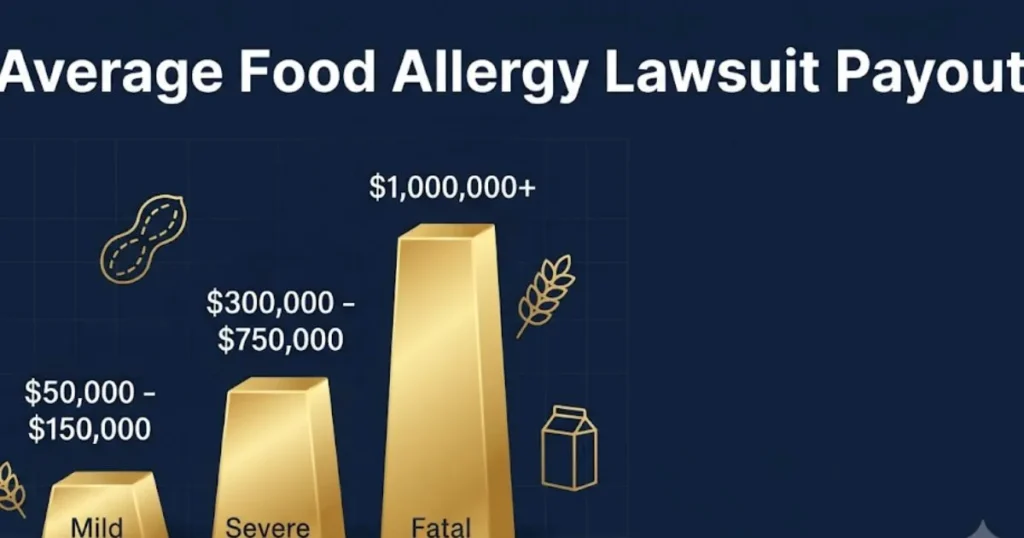
The average food allergy lawsuit payout in 2026 sits around $150,000 to $300,000 for cases that go to settlement. Jury verdicts tend to run higher because juries often add punitive damages.
That average includes a wide range of case types. A straightforward mislabeling claim with documented medical bills might settle for $50,000. A case involving a child who suffered brain damage from anaphylactic shock could reach $3 million or more.
Here is what drives the numbers up or down:
- Medical expenses: Higher bills mean higher settlements
- Lost wages: Time off work due to a reaction adds to the total
- Pain and suffering: Courts assign dollar values to physical and emotional distress
- Punitive damages: If the defendant acted recklessly, courts can multiply the payout
- Child victims: Juries tend to award more when children are harmed
Keep in mind that roughly 95% of food allergy cases settle before trial. Going to court is expensive for both sides. Defendants often prefer to write a check rather than face a jury sympathetic to someone who nearly died from eating a cookie.
Can You Sue for an Allergic Reaction to Food
Yes, you can sue for an allergic reaction to food if someone else’s negligence caused or contributed to your reaction. The key question is whether the defendant had a duty to warn you and failed.
You have legal grounds to sue in several situations:
- A packaged food contained an allergen not listed on the label
- A restaurant served you a dish with an allergen after you disclosed your allergy
- A school or daycare gave your child food they knew was unsafe
- A manufacturer failed to prevent cross-contamination during production
Not every allergic reaction leads to a valid lawsuit. If you ate something you knew contained peanuts and reacted, that is your own assumption of risk. But if you asked a waiter about peanuts, were told the dish was safe, and then suffered anaphylaxis, that is negligence.
The legal theory usually falls under product liability (for packaged foods) or negligence (for restaurants and institutions). Some states allow strict liability claims, which means you do not even have to prove the defendant was careless. You just have to prove the product was defective.
Key Takeaway: Food allergy lawsuits range from $10,000 for mild cases to over $5 million for wrongful death, with the average payout landing around $150,000 to $300,000 in 2026.
Food Allergy Institute Lawsuit
The Food Allergy Institute lawsuit refers to legal actions and regulatory scrutiny involving the Food Allergy Institute (FAI), a clinic that gained attention for its Tolerance Induction Program (TIP). This program claimed to help patients overcome food allergies through a structured desensitization protocol.
Critics and former patients have raised concerns about the program’s safety record and marketing claims. Some families reported severe allergic reactions during treatment. Others alleged that the institute overstated success rates without adequate clinical trial data to back them up.
| Issue | Details |
|---|---|
| Primary allegation | Misleading claims about allergy cure rates |
| Treatment involved | Tolerance Induction Program (TIP) |
| Reported problems | Severe reactions during treatment, disputed outcomes |
| Regulatory attention | FDA and state medical board inquiries |
| Status in 2026 | Ongoing litigation and investigations |
The situation is complicated because oral immunotherapy for food allergies is a legitimate area of medicine. The FDA approved Palforzia for peanut allergy treatment in 2020. But Palforzia went through rigorous clinical trials, while the FAI’s TIP program has faced questions about transparency.
Families considering legal action against the Food Allergy Institute should gather all treatment records, communications with the clinic, and documentation of any adverse reactions. These cases typically proceed as medical malpractice or consumer fraud claims.
Anaphylaxis Lawsuit Settlement
Anaphylaxis lawsuit settlements are among the highest in food allergy litigation, averaging $250,000 to $2 million when the victim survives. Cases involving death from anaphylactic shock settle for significantly more.
Anaphylaxis is the body’s most extreme allergic response. It can cause throat swelling, breathing failure, cardiac arrest, and death within minutes. When it happens because a food company or restaurant failed to disclose an allergen, the legal consequences are severe.
Courts treat anaphylaxis cases differently from mild reactions for a simple reason: the harm is catastrophic and often preventable. A restaurant that ignores an allergy warning or a manufacturer that skips allergen testing is gambling with someone’s life.
Recent anaphylaxis settlements worth noting:
- $4.7 million to a family after a child suffered brain damage from peanut exposure at a restaurant
- $1.2 million to an adult who experienced anaphylaxis from undisclosed tree nuts in a bakery product
- $850,000 settlement against a food manufacturer for cross-contaminated packaging
- $2.3 million verdict for a college student who died after eating mislabeled campus food
The presence of an EpiPen at the time of the reaction can actually affect the settlement. If the victim used an epinephrine auto-injector and still required hospitalization, it demonstrates the severity of the exposure and strengthens the claim.
Food Allergy Wrongful Death Settlement
Food allergy wrongful death settlements represent the most serious cases in this area of law, with payouts typically ranging from $1 million to $10 million or more. These cases arise when someone dies from an allergic reaction caused by another party’s negligence.
The families who bring these claims have lost a loved one. Courts and juries recognize that, and awards reflect both the economic loss and the profound emotional devastation.
| Factor | Impact on Settlement |
|---|---|
| Age of victim | Younger victims typically result in higher awards |
| Defendant’s conduct | Reckless behavior increases punitive damages |
| Prior warnings | If victim warned defendant about allergy, liability strengthens |
| Economic losses | Future earnings, funeral costs, medical bills |
| State wrongful death caps | Some states cap non-economic damages |
A few states limit wrongful death damages, which can affect total recovery. For example, states with damage caps may restrict non-economic damages to $250,000 to $500,000, even if a jury would have awarded more.
The most impactful wrongful death cases involve children. When a school cafeteria or daycare serves a known allergen to a child whose allergy is documented in their file, the negligence is hard to deny. These cases rarely go to full trial because the optics for the defendant are devastating.
Key Takeaway: Anaphylaxis and wrongful death cases carry the heaviest settlements, with wrongful death payouts reaching $10 million or more when defendants acted recklessly or ignored clear warnings.
Food Allergy Lawsuit Against Restaurant
A food allergy lawsuit against a restaurant is a negligence claim filed when a dining establishment serves food containing an allergen it was warned about or should have disclosed. These cases have surged in 2026 as more states adopt mandatory allergen disclosure laws.
Restaurants have a legal duty of care to their customers. When you tell your server about a food allergy, the restaurant becomes responsible for ensuring your meal is safe. That duty extends to kitchen staff, management, and anyone involved in food preparation.
Common restaurant failures that lead to lawsuits:
- Server fails to relay allergy information to the kitchen
- Kitchen uses shared equipment that causes cross-contamination
- Menu lists ingredients incorrectly
- Restaurant has no allergen protocol in place
- Staff dismisses or ignores allergy warnings from customers
Restaurant cases typically settle between $25,000 and $500,000, depending on the severity of the reaction. Fast food chains and large restaurant groups face higher exposure because they serve thousands of meals daily and should have standardized allergen procedures.
Think of it this way: if a pilot ignored a cockpit warning light and the plane crashed, nobody would question liability. When a restaurant ignores an allergy warning and someone ends up in the ER, the same logic applies.
Restaurant Allergen Negligence Lawsuit
A restaurant allergen negligence lawsuit requires proving four elements: the restaurant owed you a duty of care, it breached that duty, the breach caused your allergic reaction, and you suffered real damages. All four must be present for a successful claim.
The duty of care is usually straightforward. Every restaurant that serves food to the public has a basic obligation to serve safe meals. The breach is where most cases are won or lost.
| Element | What You Must Show |
|---|---|
| Duty of care | Restaurant had obligation to serve safe food |
| Breach | Restaurant failed to warn about or remove allergen |
| Causation | The breach directly caused your allergic reaction |
| Damages | You suffered medical bills, lost wages, or pain |
Proving breach is easier when you told the restaurant about your allergy in advance. Text messages, reservation notes, or verbal disclosures to the server all count as evidence. Some plaintiffs have won cases using restaurant surveillance footage showing the server never visiting the kitchen after an allergy disclosure.
Corporate chain restaurants are particularly vulnerable to these claims. Many have written allergen policies. When their own employees violate those policies, the corporate documentation becomes evidence that the company knew the right procedures but failed to follow them.
Food Allergy Mislabeling Lawsuit
A food allergy mislabeling lawsuit targets manufacturers or distributors who sell products with incorrect or incomplete allergen labels. Under federal law, all major allergens must be clearly identified on food packaging. When they are not, the manufacturer is liable for any resulting harm.
The FALCPA (Food Allergen Labeling and Consumer Protection Act) requires labeling for eight major allergens: milk, eggs, fish, shellfish, tree nuts, peanuts, wheat, and soybeans. The FASTER Act added sesame as the ninth major allergen starting in 2023.
Mislabeling cases are powerful because liability is often clear-cut. If the label says “allergen free” and the product contains that allergen, the manufacturer has no real defense. These are strict liability cases in most states.
Recent mislabeling lawsuits have targeted:
- Snack manufacturers whose “nut-free” products tested positive for peanut protein
- Bakeries that failed to list milk or egg in ingredient panels
- Imported foods with labels that did not comply with U.S. allergen requirements
- Meal kit companies that shipped ingredients with incorrect allergen warnings
Settlement amounts in mislabeling cases range from $50,000 for individual claims to tens of millions in class action settlements. The FDA’s increased enforcement in 2025 and 2026 has created a friendlier environment for plaintiffs.
Key Takeaway: Restaurant negligence and food mislabeling lawsuits are among the most common food allergy claims, with liability often hinging on whether the defendant was warned or required by law to disclose the allergen.
Food Allergen Labeling Lawsuit 2026
Food allergen labeling lawsuits in 2026 are shaped by stronger FDA enforcement of the FASTER Act and increased scrutiny of “may contain” advisory statements. The legal ground has shifted significantly in favor of consumers this year.
Before 2023, sesame was not a recognized major allergen under federal law. Now it is. That single change opened a wave of new claims against manufacturers who still fail to label sesame properly or who use vague precautionary language instead of clear warnings.
| Regulatory Change | Year Effective | Impact on Lawsuits |
|---|---|---|
| FALCPA enacted | 2006 | Required labeling of 8 major allergens |
| FASTER Act (sesame added) | 2023 | Created new claims for sesame-related injuries |
| FDA enforcement expansion | 2025-2026 | More recalls, more violations documented |
| “May contain” scrutiny | 2026 | Advisory labels face legal challenges |
The “may contain” issue is particularly interesting in 2026. These advisory labels (like “may contain traces of peanuts”) are voluntary and unregulated. Some attorneys are now arguing that manufacturers use them as a blanket shield instead of actually preventing cross-contamination. If a product says “may contain nuts” but the company never tested for nut residue, that advisory label may not protect them in court.
Recalls are rising too. Every FDA recall for undeclared allergens becomes potential evidence in a lawsuit. In 2025 alone, the FDA issued over 100 recalls related to undeclared allergens, setting up a strong pipeline of cases heading into 2026.
School Food Allergy Lawsuit
School food allergy lawsuits target school districts, cafeteria operators, and staff members who fail to protect students with known food allergies. These cases are especially emotional because the victims are children who depend on adults for safety.
Schools are required under Section 504 of the Rehabilitation Act and the ADA to accommodate students with food allergies. That means creating individualized health plans, training staff, and ensuring the cafeteria has protocols to prevent exposure.
When a school fails, the consequences can be devastating. Cases have involved children given peanut butter despite documented peanut allergies, field trip snacks that contained undisclosed allergens, and cafeteria cross-contamination from shared serving utensils.
Key facts about school food allergy lawsuits:
- Schools with allergy action plans on file face higher liability when they violate their own plans
- Teachers and staff who administer food to allergic students may be personally named in lawsuits
- School districts carry insurance that often covers settlements up to $1 million to $5 million
- Parents must typically file notice of claim within 60 to 180 days against government entities like public schools
Settlements in school cases range from $100,000 to $5 million, with higher amounts when the child suffered anaphylaxis, long-term health damage, or death. The duty of care is heightened because schools act “in loco parentis,” meaning they stand in the place of parents during school hours.
Food Allergy Lawsuit Eligibility
Food allergy lawsuit eligibility depends on three core factors: you had a documented food allergy, someone else’s negligence exposed you to an allergen, and you suffered verifiable harm as a result. Meeting all three is essential.
Not everyone who has an allergic reaction has a lawsuit. The reaction must be tied to someone else’s failure. If you bought a clearly labeled product and ate it despite knowing it contained your allergen, you do not have a viable claim.
Here is who typically qualifies:
- Consumers who ate mislabeled or unlabeled food products
- Restaurant patrons who disclosed an allergy and were served the allergen anyway
- Parents of children whose schools or daycares served known allergens
- Patients who received improper allergy treatment at a clinic
- Workers exposed to allergens in workplaces that failed to accommodate their condition
| Eligibility Factor | Requirement |
|---|---|
| Documented allergy | Medical records showing diagnosed food allergy |
| Defendant negligence | Proof the defendant failed to warn or prevent exposure |
| Verifiable harm | Medical bills, lost wages, pain documentation |
| Timely filing | Claim filed within statute of limitations |
You do not need a prior formal diagnosis in every case. If you had your first-ever allergic reaction because a product was mislabeled, you can still sue. The manufacturer’s duty to label correctly exists regardless of whether you knew about your allergy.
Key Takeaway: Eligibility for a food allergy lawsuit requires a provable link between someone else’s negligence and your allergic reaction, backed by medical records and filed within your state’s deadline.
How to File a Food Allergy Lawsuit
To file a food allergy lawsuit, start by preserving all evidence, obtaining your medical records, and consulting a personal injury or product liability attorney who handles food allergy cases. Time is critical because evidence can disappear quickly.
Step one is preserving the evidence. Save the food packaging, take photos of the product and label, and keep your receipt. If you ate at a restaurant, get the name of your server and any documentation of your allergy disclosure. Some people take screenshots of online orders or reservation notes where allergies were listed.
Step two is getting your medical records organized. You need emergency room records, ambulance reports, pharmacy records for epinephrine or other medications, follow-up visit notes, and documentation of any long-term effects.
Here is a timeline for a typical food allergy lawsuit:
| Phase | Timeframe | What Happens |
|---|---|---|
| Evidence gathering | Weeks 1 to 4 | Collect records, packaging, photos |
| Attorney consultation | Weeks 2 to 6 | Case evaluation, retainer agreement |
| Demand letter sent | Months 2 to 4 | Attorney contacts defendant or insurer |
| Negotiation period | Months 4 to 12 | Settlement discussions, possible mediation |
| Filing lawsuit | Month 6 to 18 | If no settlement, formal complaint filed |
| Discovery and trial | Year 1 to 3 | Evidence exchange, depositions, trial |
Most food allergy cases settle during the negotiation or early litigation phase. Going to trial is expensive, and defendants with clear liability often prefer to settle quickly and quietly. An attorney experienced in food allergy cases will know the typical settlement range for your type of injury and can push for fair compensation.
Food Allergy Lawsuit Evidence Needed
The evidence needed for a food allergy lawsuit includes medical records, the food product or packaging, proof of the defendant’s negligence, and documentation of your damages. Strong evidence is the single biggest factor in determining your settlement amount.
Your medical records are the foundation. They prove the allergic reaction happened, what treatment was required, and how severe the injury was. Without medical records, your case is essentially dead on arrival.
Physical evidence matters enormously too. The actual food product, its packaging, photos of the label, and receipts connect the reaction to a specific source. Think of the packaging like a smoking gun. If it says “peanut-free” but contains peanuts, the case nearly argues itself.
Essential evidence checklist:
- Medical records: ER visit, ambulance report, follow-up care, specialist referrals
- Food product or packaging: The actual item or clear photographs
- Purchase records: Receipt, credit card statement, delivery confirmation
- Communication records: Texts or notes showing you disclosed your allergy
- Witness statements: People who saw the reaction or the allergy disclosure
- Expert testimony: Allergist or toxicologist who can explain causation
- Financial records: Medical bills, lost wages, out-of-pocket expenses
One piece of evidence many people overlook is the allergen report or test result. If you had the food product tested by a lab and it confirmed the presence of an undisclosed allergen, that evidence is extremely powerful. Private lab testing typically costs $200 to $500 and can make or break your case.
Food Allergy Lawsuit Statute of Limitations
The statute of limitations for a food allergy lawsuit varies by state but typically ranges from one to four years from the date of the allergic reaction. Miss this deadline and your case is permanently barred, no matter how strong the evidence.
Every state sets its own deadline. Personal injury claims (which include food allergy cases) follow the general personal injury statute of limitations in your state.
| State | Statute of Limitations | Notes |
|---|---|---|
| California | 2 years | From date of injury |
| Texas | 2 years | From date of injury |
| New York | 3 years | From date of injury |
| Florida | 2 years | Reduced from 4 years in 2024 |
| Illinois | 2 years | From date of injury |
| Pennsylvania | 2 years | From date of injury |
| Ohio | 2 years | From date of injury |
| New Jersey | 2 years | From date of injury |
Some states apply a “discovery rule.” This means the clock starts when you discovered (or should have discovered) that the food caused your reaction. That is relevant when reactions are delayed or when the allergen source was not immediately identified.
Special rules apply when the victim is a minor. In many states, the statute of limitations is “tolled” (paused) until the child reaches age 18. This gives parents or guardians additional time to file. Claims against government entities like public schools often have much shorter notice periods, sometimes as brief as 60 to 90 days.
Key Takeaway: The statute of limitations for food allergy lawsuits is usually two to three years, but special rules for minors and government entities can shorten or extend that window significantly.
Undisclosed Allergen Lawsuit Payout
Undisclosed allergen lawsuit payouts depend on whether the case is an individual claim or part of a class action. Individual claims with severe injuries settle between $100,000 and $2 million, while class action settlements distribute smaller amounts to larger groups of affected consumers.
The term “undisclosed allergen” covers situations where a food product contains an allergen that is not listed on the label, not mentioned on a menu, or not communicated to the consumer despite a specific request. This is different from a “may contain” advisory because the allergen was completely hidden.
| Claim Type | Typical Payout | Example |
|---|---|---|
| Individual (mild reaction) | $10,000 to $100,000 | Hives from unlabeled milk protein |
| Individual (severe reaction) | $100,000 to $2,000,000 | Anaphylaxis from hidden peanut |
| Individual (wrongful death) | $1,000,000 to $10,000,000+ | Death from undisclosed tree nut |
| Class action (per claimant) | $25 to $500 | Mislabeled product sold nationwide |
Class action payouts per person are low, but they serve a different purpose. They punish the manufacturer and force changes in labeling practices. The total class action settlement might be $5 million to $50 million, split among thousands or millions of consumers.
Individual claims produce larger per-person payouts because the plaintiff can present their specific medical history, expenses, and suffering. If you experienced a serious reaction from an undisclosed allergen, an individual lawsuit almost always yields a better financial result than waiting for a class action.
The FDA’s recall data strengthens undisclosed allergen claims. Each time the FDA announces a recall for undeclared allergens, it creates a public record that the product was defective. Plaintiffs can use that recall notice as evidence without needing to prove independently that the allergen was present.
Frequently Asked Questions
How much is the average food allergy lawsuit settlement?
The average food allergy lawsuit settlement in 2026 is approximately $150,000 to $300,000.
Mild reaction cases settle on the lower end near $10,000, while anaphylaxis and wrongful death cases can exceed $5 million.
The exact amount depends on medical costs, injury severity, and the strength of your evidence.
Can I sue a restaurant for an allergic reaction in 2026?
Yes, you can sue a restaurant if you disclosed your food allergy and the restaurant served you the allergen anyway.
You need proof of disclosure, medical records from the reaction, and evidence that the restaurant breached its duty of care.
Restaurant allergy lawsuits commonly settle between $25,000 and $500,000.
What is the Food Allergy Institute lawsuit about?
The Food Allergy Institute lawsuit involves allegations that the institute’s Tolerance Induction Program made misleading claims about curing food allergies.
Former patients reported severe reactions during treatment and questioned the program’s transparency.
Litigation and regulatory investigations are ongoing in 2026.
How long do I have to file a food allergy lawsuit?
Most states give you two to three years from the date of the allergic reaction to file a lawsuit.
Some states apply shorter deadlines for claims against government entities like public schools.
If the victim is a minor, the deadline may be extended until the child turns 18.
What evidence do I need to win a food allergy case?
You need medical records documenting the allergic reaction, the food product or its packaging, and proof the defendant failed to disclose the allergen.
Witness statements, communication records, and lab testing of the food product strengthen your case significantly.
Financial records showing medical bills and lost wages help establish the dollar value of your damages.
Food allergy lawsuits in 2026 are producing real settlements for people harmed by negligence and mislabeling. The legal tools are stronger than ever, and courts are taking these cases seriously.
If you or someone in your family suffered an allergic reaction from mislabeled food, restaurant negligence, or institutional failure, act quickly. Preserve your evidence, organize your medical records, and get your case evaluated before the statute of limitations runs out.







