

The McDonald coffee lawsuit is one of the most misunderstood legal cases in American history. Stella Liebeck spilled McDonald’s coffee on herself in 1992, suffered third-degree burns across 16 percent of her body, and nearly died.
This was not a get-rich-quick scheme. The 79-year-old grandmother needed skin grafts and spent eight days in the hospital. She originally asked McDonald’s for just $20,000 to cover medical bills. They offered her $800.
What followed was a trial that exposed corporate negligence, changed product liability law, and became a political weapon in the tort reform debate. In this article, you will get the real facts about the case, the actual settlement amount, what the jury decided, and why this case still matters in 2026.
McDonald’s had received more than 700 burn complaints before Liebeck’s lawsuit. That single fact changes everything about how you see this case.
What Was the McDonald Coffee Lawsuit?
The McDonald coffee lawsuit refers to the 1994 case Liebeck v. McDonald’s Restaurants, filed in Bernalillo County District Court in Albuquerque, New Mexico. Stella Liebeck, a 79-year-old retired department store clerk, sued McDonald’s after their coffee caused severe third-degree burns.
On February 27, 1992, Liebeck sat in the passenger seat of her grandson’s parked Ford Probe. She placed the cup between her knees to add cream and sugar. The lid came off, and the entire cup of coffee spilled into her lap.
The coffee was between 180 and 190 degrees Fahrenheit. At that temperature, liquid causes full-thickness burns to human skin in under seven seconds. Liebeck was wearing cotton sweatpants, which absorbed the coffee and held it against her skin.
| Case Detail | Information |
|---|---|
| Case Name | Liebeck v. McDonald’s Restaurants, P.T.S., Inc. |
| Case Number | CV-93-02419 |
| Court | Bernalillo County District Court, NM |
| Year Filed | 1993 |
| Trial Year | 1994 |
| Plaintiff | Stella Liebeck |
| Plaintiff’s Attorney | S. Reed Morgan |
| Presiding Judge | Robert Scott |
The case was never about someone being careless. It was about a corporation knowingly serving a dangerous product at temperatures that could cause life-threatening injuries.
McDonald’s Coffee Lawsuit Facts You Should Know
The most important McDonald’s coffee lawsuit facts are buried under decades of misinformation and late-night comedy jokes. Here is what actually happened, stripped of spin.
Fact one: Liebeck was not driving. She was a passenger in a parked car. The vehicle was stationary when the spill occurred.
Fact two: She did not want millions. Her initial request to McDonald’s was $20,000 to cover medical expenses and lost income for her daughter, who had to care for her.
Fact three: McDonald’s quality assurance manager, Christopher Appleton, testified during the trial that the company knew its coffee could cause serious burns. He said McDonald’s had no plans to lower the serving temperature.
Key facts at a glance:
- Liebeck was hospitalized for 8 days
- She underwent skin grafting surgery
- Her medical bills exceeded $10,000 in 1992 dollars
- McDonald’s had settled over 700 prior burn claims
- The coffee was served at 180 to 190 degrees Fahrenheit
- Most home coffee makers brew at 135 to 140 degrees
Fact four: McDonald’s own operations manual required franchises to hold coffee at 180 to 190 degrees. Internal documents showed the company was aware this temperature was dangerous to human tissue.
This was not a case of an opportunistic plaintiff. It was a case of a corporation choosing profits over safety.
Who Was Stella Liebeck in the McDonald’s Lawsuit?
Stella Liebeck was a 79-year-old retired department store worker from Albuquerque, New Mexico. She was not the cartoon character that media coverage and corporate PR campaigns turned her into.
Before the lawsuit, Liebeck had never filed a legal claim against anyone. She lived a quiet life and was riding with her grandson Chris to pick up breakfast at a McDonald’s drive-through on February 27, 1992.
After the spill, she spent eight days in the burn unit. Doctors removed dead tissue from her thighs, groin, and buttocks. She then spent weeks in follow-up treatment and required skin grafts.
Her recovery lasted more than two years. She lost approximately 20 percent of her body weight during the ordeal. Liebeck’s daughter Judy had to take unpaid leave from work to serve as her caretaker.
Stella Liebeck died on August 5, 2004, at the age of 91. She spent her remaining years largely out of the public eye. Few people who mocked her case ever saw the photographs of her injuries, which showed burns that exposed muscle and tissue beneath the skin.
She became the face of “frivolous lawsuits” in America. That label was never deserved. She was a grandmother who got hurt by a product she trusted.
Key Takeaway: The McDonald coffee lawsuit was filed by a 79-year-old grandmother who suffered life-threatening burns, initially asked for only $20,000, and was turned into a punchline by corporate-funded media campaigns.
How Severe Were the McDonald’s Coffee Burn Injuries?
Stella Liebeck suffered third-degree burns across six percent of her body and lesser burns covering an additional ten percent. Third-degree burns destroy all layers of skin and damage the tissue beneath.
The burns covered her inner thighs, groin, perineum, and buttocks. Third-degree burns in these areas are extremely painful and carry a high risk of infection. Liebeck’s injuries were so severe that her treating physician compared them to injuries seen in house fire victims.
She underwent multiple surgical procedures, including debridement, where dead and damaged skin is cut away. Skin graft surgery followed.
| Injury Detail | Specifics |
|---|---|
| Burn Severity | Third-degree (6%) and second/first-degree (10%) |
| Body Areas Affected | Inner thighs, groin, perineum, buttocks |
| Hospitalization | 8 days in burn unit |
| Surgeries | Skin grafts and debridement |
| Recovery Time | Over 2 years |
| Weight Loss | Approximately 20% of body weight |
| Permanent Scarring | Yes |
Think of it this way. If you accidentally touched a hot pan, you would pull away in less than a second and probably get a small first-degree burn. Now imagine 12 ounces of near-boiling liquid soaking into fabric pressed against your skin for 30 seconds or more. That is what happened to Stella Liebeck.
These injuries were never minor. The photographs shown to the jury during trial were so graphic that some jurors later said the images haunted them.
What Was the McDonald’s Coffee Temperature at the Time?
McDonald’s served its coffee at 180 to 190 degrees Fahrenheit during the early 1990s, which is the temperature range that caused Stella Liebeck’s injuries. This was roughly 40 to 50 degrees hotter than coffee served at most other restaurants and homes at the time.
At 180 degrees, coffee causes a full-thickness burn to human skin in approximately two to seven seconds. At 155 degrees, that same burn takes about 60 seconds, giving a person far more time to react and remove the liquid.
McDonald’s quality assurance manager testified that the company chose this temperature for a specific reason. The higher temperature extended the “holding time” of the coffee, meaning franchises could brew fewer batches per day. It was a cost-saving measure.
| Temperature | Burn Time (Full Thickness) |
|---|---|
| 180-190°F (McDonald’s) | 2 to 7 seconds |
| 160°F | About 20 seconds |
| 155°F | About 60 seconds |
| 130°F (typical home brew) | Minutes to hours |
Burn experts from the Shriner’s Burn Institute testified during trial. They explained that small reductions in temperature dramatically increase the time before serious burns occur.
McDonald’s argued customers wanted their coffee “piping hot.” But their own internal research showed most customers planned to drink the coffee at their destination, not immediately at the drive-through window. By the time they arrived where they were going, the coffee would have cooled.
The company chose speed and cost savings over customer safety. That was the core of the entire lawsuit.
McDonald’s Had 700 Burn Complaints Before the Lawsuit
McDonald’s had received more than 700 reports of customers burned by its coffee in the decade before Stella Liebeck’s case went to trial. That is roughly one burn complaint every five days for ten years.
This fact was central to the jury’s decision. It proved that McDonald’s knew its coffee was injuring people and chose to keep serving it at the same dangerous temperature anyway.
Among those 700 complaints, many involved third-degree burns. Some involved children. McDonald’s had settled burn claims quietly for years, paying out hundreds of thousands of dollars without ever changing its coffee temperature policy.
- 700+ burn reports filed before the Liebeck trial
- Multiple settlements paid to injured customers
- Internal documents showed McDonald’s was aware of the danger
- No changes were made to temperature protocols
- Quality assurance staff testified they saw no need to change
During the trial, McDonald’s quality assurance manager Christopher Appleton admitted on the stand that he was aware of the burn risk. When asked if McDonald’s intended to lower the temperature, he said no.
Compare this to how car manufacturers handle safety. If 700 people reported a seatbelt failure, a recall would happen immediately. McDonald’s essentially ignored 700 reports that its product was burning people.
This is what transformed the case from a simple personal injury claim into a product liability bombshell. The jury did not just see one woman hurt by one cup of coffee. They saw a pattern of corporate indifference.
Key Takeaway: McDonald’s knew for a decade that its coffee was burning hundreds of customers, settled claims quietly, and never lowered the serving temperature until after the Liebeck verdict.
Liebeck v McDonald’s Case Summary
Liebeck v. McDonald’s Restaurants, P.T.S., Inc., Case No. CV-93-02419, was a product liability lawsuit tried in August 1994 in Bernalillo County District Court, Albuquerque, New Mexico. The jury found McDonald’s 80 percent at fault for Liebeck’s injuries.
Here is the full timeline of the case:
| Date | Event |
|---|---|
| February 27, 1992 | Stella Liebeck burned by McDonald’s coffee |
| 1992-1993 | Liebeck requests $20,000 from McDonald’s; they offer $800 |
| 1993 | Liebeck hires attorney S. Reed Morgan and files suit |
| August 1994 | Case goes to trial |
| August 18, 1994 | Jury awards $200,000 compensatory, $2.7 million punitive |
| Post-verdict | Judge reduces punitive damages to $480,000 |
| Late 1994 | Both parties settle out of court for undisclosed amount |
The trial lasted seven days. Liebeck’s legal team presented evidence of the 700 prior burn claims, expert testimony on burn science, and McDonald’s internal documents showing awareness of the danger.
McDonald’s defense argued that Liebeck was responsible for spilling the coffee on herself. They said the risk was obvious and that customers wanted hot coffee.
The jury disagreed. They assigned 80 percent fault to McDonald’s and 20 percent fault to Liebeck. Under New Mexico’s comparative negligence rules, Liebeck’s compensatory damages were reduced from $200,000 to $160,000.
The $2.7 million in punitive damages represented approximately two days of McDonald’s coffee sales revenue at the time. The jury specifically chose that number to send a financial message.
What Was the Hot Coffee Lawsuit Verdict?
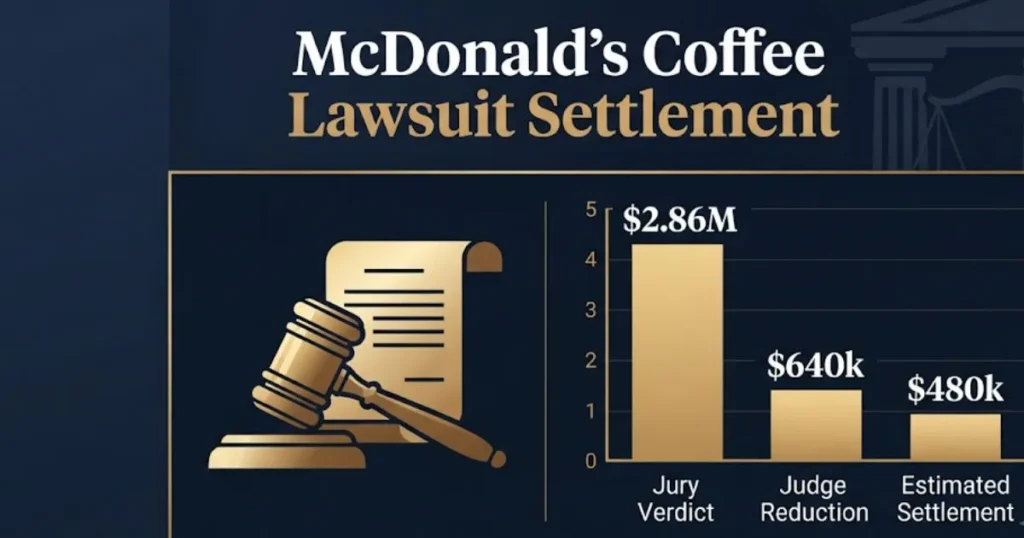
The jury in the hot coffee lawsuit returned a verdict of $200,000 in compensatory damages and $2.7 million in punitive damages against McDonald’s on August 18, 1994. The total verdict was $2.86 million before reductions.
The compensatory damages covered Liebeck’s medical expenses, pain and suffering, lost income, and her daughter’s caregiving costs. The jury then reduced this amount by 20 percent because they found Liebeck partially at fault, bringing it to $160,000.
The punitive damages were the headline number. The jury chose $2.7 million deliberately. That figure equaled roughly two days of McDonald’s coffee revenue across all U.S. locations. Jurors wanted a number large enough to get the corporation’s attention.
| Verdict Component | Amount |
|---|---|
| Compensatory Damages (original) | $200,000 |
| Liebeck’s Fault Reduction (20%) | -$40,000 |
| Compensatory Damages (final) | $160,000 |
| Punitive Damages (jury) | $2,700,000 |
| Punitive Damages (judge-reduced) | $480,000 |
| Total After Reduction | $640,000 |
Judge Robert Scott later reduced the punitive damages to $480,000, which was triple the compensatory damages. This is a common judicial practice when punitive awards are considered excessive relative to compensatory damages.
The total award after the judge’s reduction was $640,000. But Liebeck never received that exact amount. Both sides appealed, and the case was settled out of court before the appeal was heard.
McDonald’s Coffee Lawsuit Settlement Amount Explained
The final McDonald’s coffee lawsuit settlement amount is confidential. After the jury verdict was reduced by the judge and both parties appealed, Liebeck and McDonald’s reached a private out-of-court settlement in late 1994.
Most legal analysts estimate the settlement was less than $600,000. Some reports suggest it may have been closer to $500,000. The exact number was never disclosed publicly, and Liebeck’s family has never confirmed a specific figure.
Here is what we know about the money:
- The jury originally awarded $2.86 million total
- The judge reduced the total to $640,000
- Both sides appealed the judge’s decision
- A confidential settlement was reached before the appeal was decided
- Liebeck’s attorney, Reed Morgan, worked on a contingency fee, meaning he received a percentage (typically 33 to 40 percent)
- After attorney fees, Liebeck likely received between $300,000 and $400,000
| Financial Stage | Amount |
|---|---|
| Liebeck’s Original Request | $20,000 |
| McDonald’s Counter-Offer | $800 |
| Jury Verdict (total) | $2,860,000 |
| Judge-Reduced Total | $640,000 |
| Estimated Settlement | Less than $600,000 |
| Estimated After Attorney Fees | $300,000 to $400,000 |
That means Stella Liebeck, who suffered two years of painful recovery, skin grafts, and permanent disfigurement, likely took home less than $400,000. Not the millions that everyone believes.
The case was never about a windfall. It was about accountability.
Key Takeaway: Stella Liebeck likely received between $300,000 and $400,000 after attorney fees, a fraction of the $2.86 million jury verdict that made headlines and shaped public perception of the case.
How Much Did the McDonald’s Coffee Lady Actually Get?
The McDonald’s coffee lady, Stella Liebeck, most likely received between $300,000 and $400,000 after attorney fees were deducted from the confidential settlement. She did not walk away with millions.
This is one of the biggest misconceptions about the case. People heard “$2.7 million” on the news and assumed that is what she pocketed. Here is what actually happened to the money at each stage:
The jury awarded $2.86 million. The judge slashed it to $640,000. Both sides appealed. They settled privately for an amount believed to be under $600,000. Reed Morgan’s contingency fee (estimated at 33 to 40 percent) came out of that.
Even if you use the most generous estimate, Liebeck received less than $400,000 for injuries that included:
- Eight days in a hospital burn unit
- Skin graft surgery
- Two-plus years of recovery
- Permanent scarring and disfigurement
- Significant weight loss
- Lasting pain and reduced mobility
To put that in perspective, she spent about $10,000 on medical bills in 1992 dollars. Adjusted for inflation to 2026, that is approximately $22,000. Her total payout barely covered what an average medical malpractice case settles for today.
Liebeck did not sue to get rich. She sued because McDonald’s offered her $800 for third-degree burns caused by a product they knew was dangerous. She originally asked for $20,000. They said no.
Was the McDonald’s Coffee Lawsuit Frivolous?
No. The McDonald’s coffee lawsuit was not frivolous by any reasonable legal or factual standard. The case involved third-degree burns, documented corporate negligence, 700 prior burn complaints, and a jury that heard seven days of evidence before reaching its verdict.
The “frivolous lawsuit” label came from a coordinated corporate public relations effort. In the 1990s, business groups and tort reform advocates used the Liebeck case as a poster child for their campaign to limit jury awards and restrict consumer access to courts.
Here is why the case was the opposite of frivolous:
- The plaintiff suffered verifiable, life-threatening injuries
- The defendant had documented knowledge of the danger
- There were 700 prior burn reports in McDonald’s files
- Expert witnesses testified that the serving temperature was dangerous
- The jury deliberated and found McDonald’s 80 percent at fault
- A judge reviewed and upheld the finding of liability
The tort reform movement spent millions of dollars framing this case as an example of lawsuit abuse. Late-night talk show hosts made it a punchline. Newspapers ran stories focusing on the dollar amount without explaining the injuries.
Almost nobody in the general public saw the photographs of Liebeck’s burns. If they had, the jokes would have stopped immediately.
A frivolous lawsuit is one filed without legal basis. This case had overwhelming evidence of corporate negligence. The jury agreed. The judge agreed. The only people who disagreed were those who never read the facts.
How the McDonald’s Coffee Lawsuit Changed Tort Reform
The McDonald’s coffee lawsuit became the single most powerful symbol in the American tort reform movement, fueling legislation across multiple states that capped punitive damages and restricted jury awards. It changed how America talks about lawsuits.
After the verdict in 1994, corporate lobbying groups seized on the case. Organizations backed by the insurance industry, pharmaceutical companies, and fast food chains promoted the story as proof that the legal system was broken and juries were out of control.
The result was a wave of tort reform legislation:
- Multiple states enacted caps on punitive damages
- Some states required punitive awards to be proportional to compensatory damages
- Mandatory arbitration clauses became more common in consumer contracts
- Public opinion shifted against plaintiffs in personal injury cases
| Tort Reform Impact | Details |
|---|---|
| Punitive Damage Caps | Over 30 states now limit punitive damages |
| Mandatory Arbitration | Increased in consumer and employment contracts |
| Public Perception | Shift against “lawsuit culture” |
| Plaintiff Access to Courts | Restricted in many jurisdictions |
| Corporate Accountability | Weakened in some product liability areas |
The 2011 HBO documentary “Hot Coffee” examined how the Liebeck case was weaponized. The film showed that the corporations pushing tort reform were the same ones facing the most product liability lawsuits.
Ironically, the case that was supposed to prove lawsuits had gone too far actually proved the opposite. It showed that a jury of ordinary people, after hearing all the evidence, held a corporation accountable for knowingly injuring hundreds of customers.
The real story of tort reform is not about frivolous lawsuits. It is about corporations limiting your right to hold them responsible when their products hurt you.
Key Takeaway: The McDonald’s coffee lawsuit was weaponized by corporate interests to push tort reform legislation that now limits your ability to sue companies for dangerous products in over 30 states.
McDonald’s Coffee Lawsuit in 2026: What Has Changed?
The McDonald’s coffee lawsuit in 2026 remains one of the most referenced cases in American product liability law, and its effects on both corporate behavior and legal standards are still playing out more than 30 years later.
McDonald’s quietly lowered its coffee serving temperature after the lawsuit. Most McDonald’s locations today serve coffee at approximately 158 to 168 degrees Fahrenheit, which is still hotter than many competitors but significantly cooler than the 180 to 190 degree range from the 1990s.
Other fast food chains also reduced their serving temperatures. Starbucks, Dunkin’, and Burger King all adjusted their hot beverage protocols in the years following the Liebeck verdict.
| What Changed | Before Liebeck | After/Current (2026) |
|---|---|---|
| McDonald’s Coffee Temp | 180-190°F | 158-168°F |
| Warning Labels | Minimal or none | Standard on all hot cups |
| Industry Serving Standards | No uniform standard | Most chains serve below 170°F |
| Cup Design | Basic styrofoam | Double-walled, secure lids |
| Consumer Awareness | Low | High |
Warning labels on hot beverage cups became standard across the entire fast food industry after this case. Those “Caution: Contents Hot” labels you see on every coffee cup exist because of Stella Liebeck.
Cup design also changed. Double-walled cups, textured sleeves, and more secure lid designs all became industry norms in the wake of the lawsuit.
In 2026, the case is taught in nearly every law school in the country. It appears in product liability textbooks, consumer protection courses, and business ethics programs. The Liebeck case is a permanent part of American legal education.
Can You Sue for Hot Coffee Burns Today?
Yes, you can sue for hot coffee burns in 2026 if a business served a beverage at an unreasonably dangerous temperature or failed to provide adequate warnings. Product liability law still protects consumers from dangerous products, including hot beverages.
To win a burn injury lawsuit against a restaurant or coffee shop, you generally need to prove three things:
- The beverage was served at a temperature that was unreasonably dangerous
- The business knew or should have known about the risk
- The temperature or lack of warning directly caused your injuries
The legal standards vary by state. Some states follow strict liability rules, where you do not need to prove the business was negligent, only that the product was defective or unreasonably dangerous. Other states require proof of negligence.
| Legal Standard | What You Must Prove |
|---|---|
| Strict Liability | Product was unreasonably dangerous |
| Negligence | Business failed to exercise reasonable care |
| Breach of Warranty | Product did not meet safety expectations |
Several hot beverage burn lawsuits have been filed since the Liebeck case. In 2023, a woman sued Starbucks after a cup lid failed, causing hot coffee to spill on her. Similar cases have been filed against Dunkin’ and independent coffee shops.
Comparative negligence may reduce your award if you were partially at fault. For example, if you removed the lid yourself or held the cup carelessly, the jury could assign you a percentage of responsibility.
The Liebeck case did not create a guaranteed win for anyone burned by coffee. But it established a clear legal precedent that businesses have a duty to serve beverages at safe temperatures.
Product Liability and Hot Beverage Lawsuits
Product liability hot beverage lawsuits hold businesses responsible when their drinks cause burn injuries due to excessive temperatures, faulty cups, or defective lids. These cases fall under the broader category of product liability law.
There are three main theories under which you can bring a hot beverage product liability claim:
Manufacturing defect: The cup or lid had a flaw that caused it to fail. A lid that does not stay on properly is a manufacturing defect.
Design defect: The product design itself is inherently dangerous. Serving coffee at 190 degrees when 160 degrees is sufficient could qualify as a design defect in the product (the served beverage).
Failure to warn: The business did not adequately warn consumers about the risk of burns. Before the Liebeck case, most fast food cups had no temperature warnings.
| Liability Theory | Example |
|---|---|
| Manufacturing Defect | Lid pops off due to poor construction |
| Design Defect | Coffee served at excessively dangerous temperature |
| Failure to Warn | No warning label on cup or sleeve |
Since the Liebeck verdict, courts across the country have heard hundreds of hot beverage burn cases. The outcomes depend heavily on the specific facts, the serving temperature, and the state’s product liability laws.
One important difference from the 1990s is that warning labels are now standard. Because businesses now warn customers that their beverages are hot, it can be harder to win a failure-to-warn claim. However, a warning label does not protect a business that serves drinks at temperatures proven to cause instant burns.
Burns from hot beverages remain one of the most common consumer injuries reported to the Consumer Product Safety Commission. These cases are far from rare.
Key Takeaway: You can still sue for hot beverage burns in 2026 under product liability law, but modern warning labels and lower serving temperatures mean your case needs strong evidence of unreasonable danger or defective products.
How to File a Burn Injury Lawsuit
Filing a burn injury lawsuit starts with documenting your injuries immediately after the incident. Medical records, photographs, witness statements, and evidence of the product’s condition are the foundation of any successful claim.
Here is a step-by-step breakdown of the process:
Step 1: Get medical treatment right away. Go to the emergency room or urgent care. Every medical visit creates documentation of your injuries. Gaps in treatment weaken your case.
Step 2: Preserve evidence. Keep the cup, lid, receipt, and any clothing that was damaged. Take photographs of your injuries, the location, and the product that caused the burn.
Step 3: Document everything. Write down exactly what happened while it is fresh in your memory. Note the date, time, location, and names of any witnesses or employees who were present.
Step 4: Contact a personal injury attorney. Most burn injury attorneys work on contingency, meaning you pay nothing unless you win. They will evaluate your case and tell you if it has merit.
Step 5: File the claim. Your attorney will file a complaint in the appropriate court. This officially begins the lawsuit.
| Filing Step | Key Action |
|---|---|
| Immediate | Seek medical treatment |
| Same Day | Photograph injuries and preserve evidence |
| Within 48 Hours | Write detailed account of incident |
| Within Weeks | Consult a personal injury attorney |
| Varies by State | File lawsuit before statute of limitations expires |
Statute of limitations matters. Every state has a deadline for filing personal injury lawsuits. In most states, you have two to three years from the date of injury. Miss this deadline, and you lose your right to sue permanently.
Typical burn injury settlements in 2025 and 2026 range from $10,000 for minor burns to $500,000 or more for third-degree burns requiring surgery. The exact amount depends on the severity of injuries, medical costs, lost wages, and pain and suffering.
Do not wait. Evidence disappears. Memories fade. Witnesses become unreachable. If you have been burned by a dangerously hot beverage, start the process now.
Frequently Asked Questions
How much money did the McDonald’s coffee lady receive?
Stella Liebeck likely received between $300,000 and $400,000 after attorney fees.
The jury awarded $2.86 million, but the judge reduced it to $640,000, and the case settled privately for an undisclosed amount believed to be under $600,000.
After her attorney’s contingency fee, the final payout was far less than the headlines suggested.
What temperature was the McDonald’s coffee that burned Stella Liebeck?
McDonald’s served its coffee at 180 to 190 degrees Fahrenheit.
At that temperature, coffee causes third-degree burns to human skin in two to seven seconds.
Most home coffee makers brew at 135 to 140 degrees, which is 40 to 50 degrees cooler.
Was the McDonald’s hot coffee lawsuit thrown out?
No, the case was not thrown out.
A jury found McDonald’s 80 percent at fault and awarded damages after a seven-day trial.
The case later settled out of court during the appeals process.
Can I sue a restaurant if I get burned by hot coffee in 2026?
Yes, you can sue if the coffee was served at an unreasonably dangerous temperature or the cup was defective.
You will need medical records, evidence of the beverage temperature, and proof that the business was negligent.
Statutes of limitations vary by state, so act quickly.
Why is the McDonald’s coffee case considered important in legal history?
The case established a major precedent in product liability law for hot beverage serving temperatures.
It proved that corporations can be held liable for knowingly selling dangerous products, even common ones like coffee.
It also became the centerpiece of the American tort reform movement, influencing legislation in over 30 states.
What to Do Now
The McDonald coffee lawsuit was never the joke people made it out to be. It was a case about corporate negligence, a grandmother’s suffering, and a legal system that actually worked the way it should.
If you have been burned by a hot beverage, your injuries matter. Document everything. Get medical help. Talk to an attorney who handles burn injury cases.
This case changed an industry. It can also change how you think about your own rights as a consumer.







