

The yogurt lawsuit wave isn’t slowing down in 2026. Major brands like Chobani, Dannon, and Yoplait continue facing legal challenges over misleading labels, hidden sugar, and exaggerated health claims.
If you’ve bought yogurt from a grocery store in the last several years, you might be owed money. Some settlements have already paid out between $25 and $500 per person, depending on the case and your purchase history.
This guide breaks down every active yogurt lawsuit in 2026. You’ll learn which brands are involved, how much you could get, whether you qualify, and exactly how to file your claim before deadlines pass.
One fact that surprises most people: over $100 million in combined settlement funds have been approved across yogurt-related class actions since 2020.
What Is the Yogurt Lawsuit About
A yogurt lawsuit is a legal action against a yogurt manufacturer for misleading consumers about what’s actually in the product. These cases typically allege false advertising, deceptive labeling, or exaggerated health benefit claims.
The core argument is simple. Companies put things on their packaging that aren’t true, or at least aren’t the full truth. Consumers buy the product based on those claims and pay a premium price they wouldn’t have paid otherwise.
Think of it like a car dealership advertising a vehicle as “brand new” when it’s actually been in a minor accident. The yogurt might still taste fine, but the label told you something that wasn’t accurate.
| Common Allegations | Examples |
|---|---|
| False health claims | “Clinically proven to boost immunity” |
| Hidden sugar | Labeled “low sugar” but containing 15g+ |
| Misleading “natural” labels | Contains artificial flavors or preservatives |
| Protein inflation | Overstating protein grams per serving |
| Probiotics exaggeration | Claiming benefits not backed by science |
Most yogurt lawsuits fall under state consumer protection laws. These statutes exist in every state and prohibit deceptive business practices. The FTC also sets federal guidelines on what food companies can and cannot say on packaging.
Some cases are filed as individual lawsuits. Many become class actions, meaning one or a few plaintiffs represent thousands or millions of consumers who bought the same product.
Yogurt Class Action Lawsuit 2026: What’s New This Year
Several yogurt class action lawsuits are active or expected to reach key milestones in 2026. New filings continue to target brands that overstate nutritional benefits or hide ingredients behind confusing label language.
The biggest development this year involves ongoing cases related to added sugar disclosures. The FDA’s updated Nutrition Facts label requirements, which became fully enforceable, have given plaintiffs stronger ground to challenge brands that downplay sugar content.
At least three new class actions were filed in late 2025 and early 2026 targeting yogurt brands for using the word “natural” on products containing synthetic additives. These cases are moving through federal courts in New York, California, and Illinois.
- New York: A class action alleges a major brand’s “all natural” Greek yogurt contains potassium sorbate
- California: Plaintiffs challenge sugar claims on children’s yogurt products
- Illinois: A case targets probiotics marketing on yogurt packaging
Courts are also expected to issue final approval on at least two pending settlements in mid-2026. Those settlements could open claim filing windows for millions of consumers.
What makes 2026 different from prior years is the volume. Consumer awareness has grown, and law firms are filing cases faster. If you bought yogurt regularly over the past five years, at least one of these cases probably applies to you.
Yogurt Lawsuit Settlement: Cases Resolved So Far
Multiple yogurt lawsuit settlements have been finalized in recent years, with combined payouts exceeding $100 million across all cases. Some are still distributing funds in 2026.
The Dannon Activia and DanActive settlement was one of the largest. Dannon agreed to a $45 million settlement fund after the FTC found the company made misleading health benefit claims about its probiotic yogurts. That case set a precedent that still influences new filings today.
Chobani settled a class action over its “evaporated cane juice” labeling for an undisclosed amount. Yoplait faced a settlement over its “99% fat free” marketing that failed to disclose high sugar content.
| Settlement | Amount | Year Finalized | Status in 2026 |
|---|---|---|---|
| Dannon Activia/DanActive | $45 million | 2010 (FTC), ongoing class actions | Precedent for new cases |
| Chobani “evaporated cane juice” | Undisclosed | 2016 | Fully distributed |
| Yoplait sugar content | $8.5 million | 2020 | Fully distributed |
| Greek yogurt protein claims | $3.2 million | 2023 | Distribution ongoing |
| “Natural” label multi-brand | Pending | Expected 2026 | Claim window not yet open |
Not every settlement has been massive. Some resolved for as little as $1 million to $5 million. But even smaller settlements can mean real money for individual claimants, especially if the class size is small.
If you missed a past settlement deadline, don’t worry. New cases are constantly being filed, and 2026 has several active claim windows.
Key Takeaway: Yogurt lawsuits target false advertising and misleading labels, with over $100 million in settlements already paid and new cases actively moving through courts in 2026.
Yogurt False Advertising Lawsuit Explained
A yogurt false advertising lawsuit accuses a manufacturer of making marketing claims that are untrue or intentionally misleading. These cases argue that consumers were tricked into paying more for a product based on lies.
False advertising in the yogurt industry takes several forms. A brand might claim its yogurt “supports digestive health” without scientific evidence. Another might label a product “low sugar” while packing in 20 grams per serving through fruit purees and concentrates.
The legal standard is whether a “reasonable consumer” would be misled. Courts don’t require that every single buyer was fooled. They just need to show the label or marketing would mislead a typical, ordinary person reading it at the grocery store.
Common false advertising claims in yogurt lawsuits:
- Health benefits not supported by clinical studies
- Nutrient content that doesn’t match label claims
- “Made with real fruit” when fruit content is under 2%
- Serving size manipulation to make nutrition info look better
- Front-of-package claims that contradict the Nutrition Facts panel
These cases rely on state consumer fraud statutes and the federal Lanham Act. California’s Unfair Competition Law (UCL) and New York’s General Business Law Section 349 are two of the most commonly used statutes. They allow consumers to recover damages without proving individual reliance on the false claim.
It’s a bit like a restaurant advertising “fresh, never frozen” fish when it was actually frozen for three months. You still ate the fish. You might have even liked it. But you paid fresh-fish prices based on a false promise.
Who Qualifies for the Yogurt Lawsuit
Anyone who purchased a yogurt product that’s the subject of a class action lawsuit during the specified time period typically qualifies. You don’t need a lawyer, and in most cases, you don’t even need a receipt.
Eligibility varies by case. Each yogurt lawsuit defines a “class” of people. That class usually includes everyone in a specific state, or nationwide, who bought the product within a certain date range. The date range often spans 3 to 7 years before the lawsuit was filed.
| Eligibility Factor | Typical Requirement |
|---|---|
| Product purchased | Specific brand and product line named in the lawsuit |
| Purchase period | Usually 3 to 7 years before filing date |
| Location | Nationwide or specific states |
| Proof of purchase | Often not required; sworn statement accepted |
| Age | Must be 18 or older, or a parent/guardian can file |
Some cases require you to submit a claim form online. Others automatically include you in the class unless you actively opt out. This is called an “opt-out” class, and it’s the most common type.
Here’s the good news: most yogurt class actions accept a sworn statement instead of a receipt. You just sign a declaration saying you bought the product. Courts understand that nobody saves yogurt receipts.
If you bought yogurt from brands like Chobani, Dannon, Yoplait, Fage, or Stonyfield in the last five to seven years, check active cases. There’s a solid chance you qualify for at least one.
How Much Is the Yogurt Lawsuit Settlement Worth
Yogurt lawsuit settlements have ranged from $1 million to $45 million in total fund size, with individual payouts typically falling between $25 and $500 per person. Your exact amount depends on the specific case and how many people file claims.
The math works like this: the court approves a total settlement fund. Lawyers take their cut, usually around 25% to 33%. The remaining money gets divided among everyone who files a valid claim.
Fewer claimants mean bigger checks. If a $10 million fund only gets 50,000 claims, each person might receive $130 or more after legal fees. If 500,000 people file, you might get $13.
| Settlement Size | Est. Claims Filed | Approx. Payout Per Person |
|---|---|---|
| $2 million | 20,000 | $65 to $75 |
| $5 million | 50,000 | $65 to $70 |
| $10 million | 100,000 | $65 to $70 |
| $10 million | 500,000 | $13 to $15 |
| $45 million | 1,000,000+ | $25 to $35 |
Some settlements offer tiered payouts. If you can provide receipts showing heavy purchase history, you might qualify for a higher tier. Without receipts, you’ll typically receive the base amount.
Don’t expect a life-changing windfall from a yogurt lawsuit. But $50 to $200 for filling out a form that takes five minutes is a pretty good deal. It’s like finding money in a jacket pocket you forgot about.
Key Takeaway: Individual yogurt lawsuit payouts typically range from $25 to $500, and you usually don’t need receipts to file a claim.
Yogurt Sugar Content Lawsuit: The Hidden Sugar Problem
Yogurt sugar content lawsuits allege that manufacturers hide or downplay the amount of sugar in their products through deceptive labeling practices. These are among the most common yogurt lawsuits filed in recent years.
Here’s the problem. A single-serve cup of flavored yogurt can contain 20 to 30 grams of sugar. That’s as much as a candy bar. But the packaging might say “lightly sweetened” or feature images of fresh fruit, suggesting a healthy choice.
Some brands used the term “evaporated cane juice” instead of “sugar” in their ingredients list. The FDA issued guidance stating this practice is misleading because evaporated cane juice is, in fact, sugar. That guidance fueled a wave of lawsuits.
Key sugar-related allegations:
- Using “no added sugar” labels on products sweetened with fruit juice concentrates (which are functionally sugar)
- Listing sugar under alternative names to confuse consumers
- Marketing high-sugar yogurt to children as a “healthy snack”
- Manipulating serving sizes to make sugar content appear lower
Children’s yogurt products have faced especially intense scrutiny. Parents buy these products believing they’re making a healthy choice. Some kids’ yogurt tubes contain 9 to 12 grams of sugar per serving, which is roughly half the daily recommended limit for children under 6.
The FDA’s updated nutrition labeling rules now require companies to list “added sugars” separately. This change has strengthened plaintiff arguments in new cases filed in 2025 and 2026 by making it easier to show how much sugar the manufacturer deliberately added.
Chobani Lawsuit 2026: Latest Updates
Chobani faces ongoing legal challenges in 2026 related to labeling accuracy and marketing claims on several product lines. The company has been a frequent target of class action lawsuits since it became America’s top-selling Greek yogurt brand.
Past lawsuits against Chobani focused on “evaporated cane juice” labeling and “all natural” claims. A 2016 settlement resolved one major case. But new complaints have emerged targeting different product lines and different claims.
In 2025 and into 2026, Chobani faces scrutiny over its “Less Sugar” yogurt line. Plaintiffs argue the product still contains significant sugar and that the “Less Sugar” branding misleads consumers into thinking it’s a low-sugar option. The complaint alleges the product has 9 grams of sugar per serving, which plaintiffs say isn’t meaningfully “less” than competitors.
| Chobani Lawsuit History | Details |
|---|---|
| “Evaporated cane juice” case | Settled 2016, undisclosed amount |
| “All natural” labeling case | Partially resolved, some claims ongoing |
| “Less Sugar” line challenge | Filed 2025, active in 2026 |
| Protein content accuracy | Under investigation, no formal filing yet |
Chobani has defended its labeling practices. The company argues its products comply with FDA regulations and that “Less Sugar” accurately reflects a comparison to its original recipe.
If you’ve purchased Chobani products regularly, watch for settlement announcements later in 2026. The “Less Sugar” case could reach a resolution or certification decision by the end of the year.
Dannon Yogurt Lawsuit: What Happened
Dannon, now operating under parent company Danone, was the target of one of the largest yogurt lawsuits in history. The company paid $45 million to settle FTC charges that it made deceptive health claims about Activia and DanActive yogurt products.
The FTC’s complaint, filed in 2010, alleged that Dannon claimed Activia yogurt could relieve irregularity and that DanActive helped people avoid catching colds or the flu. The FTC said these claims were not supported by adequate scientific evidence.
Dannon marketed Activia with the tagline “clinically proven” and featured actress Jamie Lee Curtis in national TV commercials. The FTC determined these ads created the false impression that solid clinical evidence backed the health claims.
What the settlement required:
- Dannon paid $21 million in consumer refunds
- $24 million in additional penalties and compliance costs
- Dannon was barred from making similar health claims without FDA-approved evidence
- Future advertising required qualifying language about clinical support
The Dannon case became a turning point for the entire yogurt industry. After the settlement, other brands quietly pulled similar health claims from their packaging. It also gave consumer advocates a strong precedent to cite in later cases.
Several smaller class actions related to Dannon products have been filed since. Some target the Oikos line for protein content claims. Others challenge the DanActive probiotic marketing that continued in modified form.
Key Takeaway: Dannon’s $45 million FTC settlement over Activia health claims remains the largest yogurt lawsuit on record and set the standard for all cases that followed.
Yogurt Probiotics Lawsuit: Do the Claims Hold Up
Yogurt probiotics lawsuits challenge manufacturers who claim their products deliver specific health benefits from probiotic bacteria without sufficient scientific proof. These cases question whether the probiotics in commercial yogurt actually do what the label suggests.
The science is nuanced. Probiotics are live microorganisms that can provide health benefits when consumed in adequate amounts. The problem is that many yogurt manufacturers make broad claims like “supports immune health” or “promotes digestive balance” without rigorous clinical trials to back them up.
Even when a probiotic strain has been studied, the amount in a single yogurt serving might be too low to deliver the claimed benefit. Or the bacteria might not survive the manufacturing, shipping, and storage process in sufficient numbers.
| Probiotics Claim | Legal Status |
|---|---|
| “Clinically proven to aid digestion” | Successfully challenged in Dannon case |
| “Contains live active cultures” | Generally considered truthful |
| “Supports immune health” | Under legal challenge in multiple cases |
| “Billions of probiotics in every cup” | Questioned when actual counts fall short |
The FDA does not approve probiotics claims on food labels the same way it approves drug claims. This gray area lets companies make vague “structure/function” claims without premarket approval. But when those claims cross the line into implying disease treatment or prevention, they become legally vulnerable.
In 2026, at least two active cases challenge yogurt probiotics claims. Both allege that the marketed health benefits are either unproven or overstated. Consumers who bought these products expecting real health results could be eligible for compensation.
Greek Yogurt Protein Claims Lawsuit
Greek yogurt protein claims lawsuits allege that some brands overstate the protein content in their products or use “high protein” marketing in misleading ways. These cases focus on whether the actual protein per serving matches what the label promises.
Greek yogurt is marketed as a protein powerhouse. Most brands advertise 12 to 20 grams of protein per serving. But some products don’t deliver those numbers when independently tested. Others use serving size tricks to inflate the protein figure.
One common tactic is listing protein content for a larger serving size than consumers typically eat. If the label says “15 grams of protein” but bases that on a 200-gram serving, and the container holds 150 grams, the actual protein you consume is closer to 11 grams.
Issues raised in protein claims lawsuits:
- Actual protein content falls below labeled amount by 10% to 20%
- Serving size listed on label doesn’t match container size
- “High protein” front-of-package claim when protein is comparable to regular yogurt
- Protein added through non-dairy sources like milk protein concentrate, not the straining process
A class action filed in 2023 alleged that a popular Greek yogurt brand overstated protein by an average of 3 grams per serving. That case is still active in 2026, with a certification hearing expected in the second quarter.
For consumers, the issue is trust. You pick Greek yogurt over regular yogurt specifically because of the protein. If that number is inflated, you’re paying a premium for nothing extra. It’s like buying “premium gasoline” and getting regular grade.
Yogurt Natural Label Lawsuit: What “Natural” Really Means
A yogurt natural label lawsuit challenges brands that use the word “natural” on products containing artificial or synthetic ingredients. The legal fight centers on consumer expectations and what “natural” should actually mean on food packaging.
Here’s the thing: the FDA has never issued a formal regulatory definition of “natural” on food labels. The agency’s informal policy says “natural” means nothing artificial or synthetic has been added that wouldn’t normally be expected in that food. But this guidance is vague and not legally binding.
That vagueness creates lawsuits. When a yogurt brand labels its product “all natural” but includes ingredients like potassium sorbate (a preservative), citric acid (synthetically produced), or “natural flavors” derived through chemical processes, consumers argue they’ve been deceived.
| Ingredient | Natural or Synthetic | Often Found In |
|---|---|---|
| Potassium sorbate | Synthetic preservative | Fruit-flavored yogurts |
| Citric acid | Often synthetically produced | Flavored and Greek yogurts |
| “Natural flavors” | Can be chemically derived | Nearly all flavored yogurts |
| Carrageenan | Natural but controversial | Thickened yogurt products |
| Milk protein concentrate | Processed additive | High-protein yogurts |
Multiple cases in 2025 and 2026 target the “natural” label across several yogurt brands. Plaintiffs in California, where consumer protection laws are especially strong, have had significant success in keeping these cases alive past the motion-to-dismiss stage.
The FDA announced in 2023 that it would consider rulemaking on the “natural” label definition. As of early 2026, no final rule has been issued. Until the FDA acts, these lawsuits will keep coming.
Key Takeaway: The FDA has no binding definition of “natural” on food labels, which is why yogurt manufacturers keep getting sued over the term and why those lawsuits keep succeeding.
Yogurt Misleading Labels Lawsuit: The Bigger Picture
Yogurt misleading labels lawsuits go beyond any single claim. They target the overall impression a product’s packaging creates, including images, colors, font sizes, and placement of information that together paint a false picture for consumers.
A label doesn’t have to contain an outright lie to be misleading. If the front of a yogurt container shows heaps of fresh strawberries but the product contains less than 2% strawberry puree, that’s misleading. If “0 grams of fat” is printed in giant letters but the product is loaded with sugar, the overall message is deceptive.
Courts use a “reasonable consumer” standard. They ask: would an ordinary person, looking at this package in a grocery store, walk away with a false impression about what they’re buying?
Elements that create misleading impressions:
- Large fruit images when fruit content is minimal
- Health claims on the front that contradict the Nutrition Facts panel
- “No artificial ingredients” paired with synthetic preservatives
- Serving size listed in grams when most consumers think in cups
- Comparison claims (“50% less sugar”) without a clear reference product
These cases represent a broader trend in food industry litigation. Yogurt isn’t alone. Granola bars, juices, cereals, and snack foods all face similar lawsuits. But yogurt gets hit especially hard because it’s marketed as a health food.
The financial stakes are significant. Americans spend over $9 billion per year on yogurt. When labels mislead millions of consumers into paying premium prices, the potential damages add up fast.
In 2026, several misleading label cases are in active discovery. That means both sides are exchanging evidence, and settlement talks could begin soon.
How to File a Yogurt Lawsuit Claim
Filing a yogurt lawsuit claim takes about 5 to 10 minutes and usually requires nothing more than your name, address, and a statement that you purchased the product. Most claims are filed online through a settlement administrator’s website.
Here’s the step-by-step process:
Step 1: Identify which yogurt lawsuit applies to you. Check the product name, the purchase date range, and whether the case covers your state.
Step 2: Visit the official settlement website for that case. Every approved class action settlement has a dedicated site run by a court-appointed administrator.
Step 3: Fill out the claim form. You’ll enter your contact information, identify the products you bought, and estimate how often you purchased them.
Step 4: Submit proof of purchase if you have it. Receipts, loyalty card records, or bank statements work. If you don’t have proof, most settlements accept a signed declaration under penalty of perjury.
Step 5: Wait for confirmation. The administrator will send you an email or letter confirming your claim.
| Filing Detail | What to Know |
|---|---|
| Time to complete | 5 to 10 minutes |
| Cost to file | Free |
| Lawyer needed | No |
| Receipt required | Usually no |
| Filing method | Online form or mailed paper form |
| Confirmation | Email or postal letter |
One mistake people make is waiting too long. Claim deadlines are strict. Once the window closes, the court will not accept late filings. Set a calendar reminder as soon as you learn about an active settlement.
You can file claims in multiple yogurt lawsuits. There’s no limit on how many class actions you participate in, as long as you genuinely purchased the products in question.
Yogurt Lawsuit Deadline 2026: Don’t Miss These Dates
Several yogurt lawsuit deadlines fall in 2026, and missing them means losing your right to compensation. Courts enforce these deadlines without exception, so timing matters.
Claim filing deadlines are set by the court when it grants preliminary or final approval of a settlement. The typical claim window stays open for 60 to 120 days. After that, the administrator stops accepting submissions.
| Case | Expected Deadline | Type |
|---|---|---|
| Greek yogurt protein claims | Q2 2026 | Claim filing deadline |
| “Natural” label multi-brand case | Q3 2026 | Opt-out deadline |
| Children’s yogurt sugar case | Q4 2026 | Claim filing deadline |
| Probiotics marketing case | TBD 2026 | Settlement approval pending |
Deadlines to watch for:
- Claim filing deadline: The last day you can submit a claim form
- Opt-out deadline: The last day you can exclude yourself from the class (you’d do this if you want to sue individually)
- Objection deadline: The last day you can object to the settlement terms
If you miss the claim filing deadline, your only remaining option is to file an individual lawsuit. That requires hiring a lawyer and can take years. Filing the class action claim is almost always the better choice for individual consumers.
Mark your calendar now. Check settlement administrator websites periodically for updates. Courts sometimes extend deadlines, but you should never count on that.
Key Takeaway: Multiple yogurt lawsuit claim deadlines are expected throughout 2026, and courts do not grant extensions for late filers.
Yogurt Lawsuit Payout Per Person: What to Expect
The average yogurt lawsuit payout per person ranges from $25 to $500, with most claimants receiving between $50 and $150. Your actual payment depends on the settlement size, the number of claims filed, and whether you can provide purchase documentation.
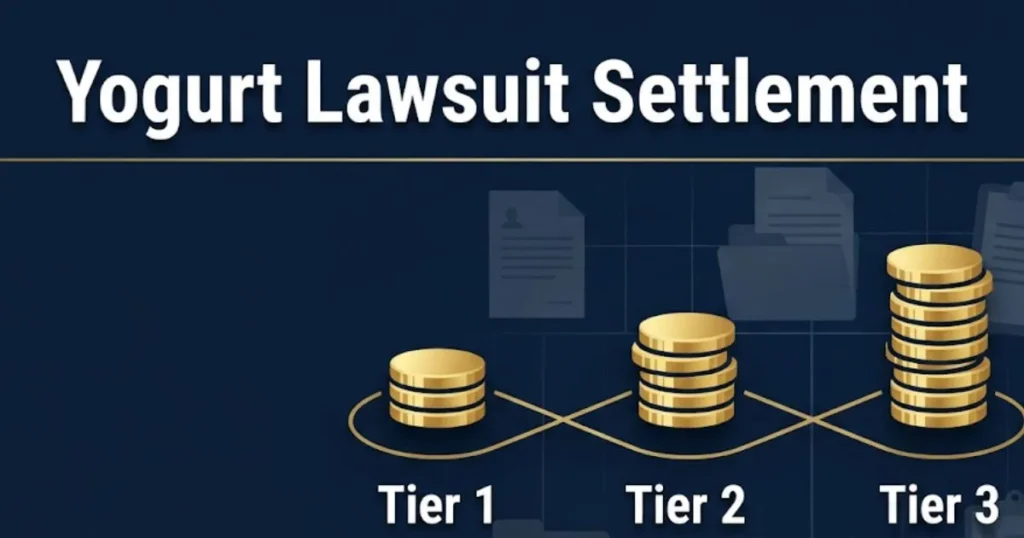
Settlement administrators use tiered payout structures in many cases. Claimants with receipts showing frequent purchases get higher payments. Those filing without receipts receive a base amount.
| Payout Tier | Proof Required | Estimated Payment |
|---|---|---|
| Tier 1 (base) | Sworn statement only | $25 to $50 |
| Tier 2 (moderate) | Some receipts or loyalty data | $50 to $150 |
| Tier 3 (high) | Detailed purchase records | $150 to $500 |
Here’s a practical example. If a settlement fund totals $5 million and 75,000 people file claims, the average payout after legal fees would be around $45 per person. If only 25,000 people file, that jumps to about $135 per person.
The irony of class actions is that the less attention a case gets, the more money each claimant receives. Big headline cases attract millions of filers, which dilutes the per-person payment.
Some yogurt settlements offer non-cash benefits instead of or in addition to money. These might include coupons, free product vouchers, or charitable donations on behalf of the class. Cash payments are always more valuable, and most recent yogurt settlements have offered direct cash.
Payments typically arrive 6 to 12 months after the claim deadline closes. The administrator needs time to process all claims, calculate distributions, and mail checks or send electronic payments.
Yogurt Class Action Settlement Update for 2026
As of 2026, the yogurt class action settlement picture includes both newly approved settlements entering their claim periods and older settlements completing their final distributions. The pace of new filings is accelerating.
Active settlements in 2026:
- A multi-brand “natural” label settlement is expected to receive final court approval in the second or third quarter. The settlement fund is estimated at $7 million to $12 million. Once approved, a 90-day claim window will open.
- The Greek yogurt protein claims case is in advanced settlement talks. If the parties reach agreement, a preliminary approval hearing could happen by mid-2026.
- A children’s yogurt sugar content case reached preliminary settlement in late 2025. The claim form became available in early 2026, with a deadline expected in Q4.
Cases still in litigation:
- At least three yogurt probiotics marketing cases remain in the discovery phase. Settlement is possible but not imminent. These cases might not resolve until 2027.
- Individual state-level cases in California, New York, and Illinois are progressing through motion practice. Some could be certified as state-wide classes in 2026.
| Case Status | Number of Cases | Expected Timeline |
|---|---|---|
| Settlement approved, claims open | 2 | Active now through Q4 2026 |
| Preliminary settlement reached | 1 | Claim window opens mid-2026 |
| Settlement negotiations ongoing | 2 | Possible resolution late 2026 |
| Active litigation, no settlement | 3+ | May extend into 2027 |
The trend is clear. Yogurt companies are settling more cases rather than risking trial. Jury verdicts in consumer fraud cases have been unpredictable, and companies prefer the certainty of a negotiated resolution.
If you haven’t checked recently, now is the time. New settlement websites launch throughout the year, and the earliest filers often receive their payments first.
Key Takeaway: At least two yogurt class action settlements have open claim windows in 2026, with several more expected to open before year’s end.
Frequently Asked Questions
Can I still file a claim in the yogurt lawsuit in 2026?
Yes, several yogurt lawsuits have active claim windows open in 2026.
New settlements are expected to launch claim periods throughout the year.
Check settlement administrator websites for the most current deadlines.
How much money will I get from the yogurt class action settlement?
Most claimants receive between $25 and $500 per settlement.
The exact amount depends on the fund size, number of filers, and your purchase history.
Payments with receipt documentation tend to be significantly higher.
Do I need a receipt to join the yogurt lawsuit?
No, most yogurt class action settlements accept a sworn statement in place of receipts.
You declare under penalty of perjury that you purchased the product during the eligible period.
Having receipts or loyalty card records can qualify you for a higher payout tier.
Which yogurt brands are involved in lawsuits right now?
Brands including Chobani, Dannon (Activia, Oikos, DanActive), Yoplait, and several store brands have faced or are currently facing lawsuits.
Cases target specific product lines rather than entire brands.
New cases are being filed regularly as consumer advocacy groups identify additional labeling issues.
How long does it take to receive a yogurt lawsuit payout?
Most claimants receive payment 6 to 12 months after the claim filing deadline closes.
The administrator must process all claims, run audits, and calculate distribution amounts before issuing payments.
Payments come as mailed checks or electronic transfers, depending on the settlement.
The yogurt lawsuit situation in 2026 is active and evolving. If you’ve bought any of the named products, filing a claim is free and takes minutes.
Don’t let deadlines pass you by. Check active settlements now, submit your claim form, and keep an eye on new cases opening later this year.
Your purchase history could translate into real money back in your pocket.







