The national trust trump lawsuit is a federal court fight over President Trump’s White House ballroom, and as of late 2026 it has reached the Supreme Court twice. This isn’t a class action with a payout. It’s a constitutional standoff over who gets to decide what happens to the White House.
This article walks through every stage of the case. You’ll learn why the lawsuit started, what the courts have ruled, and why a single historian’s monthly walk near the White House became the whole ballgame.
Here’s the surprising part. The Supreme Court never actually ruled on whether the ballroom itself is legal. It ruled on a technicality called standing, and that technicality might decide everything.
By the end, you’ll know exactly where this case stands heading into December 2026.
Related: Donald Trump Park Signage Lawsuit: National Parks Case Update
What Is the National Trust Trump Lawsuit About
The national trust trump lawsuit is a federal case challenging whether President Trump followed the law before demolishing the White House East Wing to build a new ballroom. The National Trust for Historic Preservation argues the administration skipped required federal reviews before tearing down part of the building.
This case isn’t about money for consumers. It’s about process, oversight, and whether a president can bypass planning commissions that normally review changes to federal property in Washington, D.C.
The National Trust for Historic Preservation sued President Donald Trump to block construction of his White House ballroom, arguing the project and his demolition of the East Wing have bulldozed past the necessary reviews by the Trust and Congress. Defendants in the suit include the president, the National Park Service, the Department of the Interior, the General Services Administration and their respective leaders.
Quick Facts Box
- Case type: Federal lawsuit, not a consumer class action
- Plaintiff: National Trust for Historic Preservation
- Core claim: Required federal reviews were skipped before demolition
- Current stage: Pending at the U.S. Supreme Court
Why Did the National Trust Sue Trump
The National Trust sued because it says Trump demolished the East Wing and began ballroom construction without the legally required sign off from federal planning bodies. The group tried to stop the work before suing, but says it got nowhere.
After learning of Trump’s unilateral decision to demolish the East Wing, the Trust wrote on Oct. 21 to the National Park Service, the National Capital Planning Commission and the Commission of Fine Arts, urging them to stop the work and begin required review procedures. Despite the urgency, the Trust received no response.
That silence pushed the group into court. The National Trust for Historic Preservation filed the first major lawsuit against President Trump and his administration in an effort to block construction of his planned ballroom on the grounds of the White House.
Key reasons behind the filing:
- No plans were submitted to the planning commissions before demolition began
- The Trust says it was legally entitled to a review process it never got
- Construction noise and a crane appeared on site while letters went unanswered
White House Ballroom Lawsuit Timeline 2026
The timeline of this case runs from a late 2025 filing through multiple appeals court rulings and two separate trips to the Supreme Court in 2026. Here’s the clearest breakdown available.
| Date | Event |
|---|---|
| October 21, 2025 | National Trust sends formal letter demanding review |
| December 12, 2025 | National Trust files federal lawsuit |
| April 27, 2026 | DOJ asks Trust to drop suit after WHCD shooting; Trust refuses |
| August 7, 2026 | D.C. Circuit affirms injunction, 2-1, finds standing |
| August 31, 2026 | Supreme Court stays injunction, 5-4, cites standing problem |
| November 5, 2026 | Government files new Supreme Court petition |
| December 7, 2026 | National Trust’s response deadline |
Each stage added a new legal wrinkle. The case has bounced between a federal district judge, a divided appeals panel, and a divided Supreme Court, with construction continuing through most of it.
Key Takeaway: The national trust trump lawsuit has shifted from a fight over demolition rules into a fight over whether the Trust even has the right to sue at all.
National Capital Planning Act Violation Claims
The lawsuit’s core legal claim is that federal law required Trump’s administration to submit ballroom plans to the National Capital Planning Commission before construction started. The Trust says that step never happened.
The Trust wants the court to declare that Trump, by fast-tracking the project, has committed multiple violations of the Administrative Procedures Act and the National Environmental Policy Act, while also exceeding his constitutional authority by not consulting lawmakers. The lawsuit also states an Environmental Impact Statement hasn’t been issued, a violation of the National Environmental Policy Act.
Three laws anchor the claims:
- National Capital Planning Act: requires commission review of federal construction in D.C.
- Administrative Procedure Act: requires agencies to follow proper process before major actions
- National Environmental Policy Act: requires an environmental impact statement for major federal projects
The Trust asserts that plans should have been submitted to the National Capital Planning Commission, the Commission of Fine Arts and Congress before any action. The White House has pushed back hard on every one of these claims from the start.
National Trust Standing Issue Explained
Standing means a plaintiff must prove it was actually harmed before a court will hear its case, and that single legal rule has become the entire battle in this lawsuit. Without standing, a court never even reaches the question of whether the ballroom itself is legal.
The majority per curiam unsigned opinion held that the National Trust, a private nonprofit originally chartered by Congress in 1949, lacked standing to challenge the ballroom project in court. The decision focused on the Article III concept of standing, where the National Trust needed to establish that it had suffered an injury in fact from the East Wing ballroom project, that the injury was traceable to actions of the Trump administration, and that the injury could be addressed by a judicial decision.
Think of standing like needing a ticket to get into a theater. You can have the best argument in the world about what’s playing on stage, but if you don’t have a ticket, security won’t even let you sit down. The Supreme Court majority said the National Trust failed those tests.
Who Is Alison Hoagland
Alison Hoagland is an architectural historian and National Trust executive committee member whose personal claim of harm became the legal foundation for the entire lawsuit. Her declaration is the only evidence of individual injury the Trust has offered.
The Trust rests its standing on a single member, Alison Hoagland, who alleges aesthetic harm that might arise from completion of the ballroom. Hoagland argued that the proposed ballroom’s size and design would diminish her enjoyment of the area by overshadowing the White House and weakening its aesthetic appeal.
Her routine matters legally because courts look for concrete, repeated harm rather than a one-time complaint. The Trust pointed to Hoagland’s asserted aesthetic injury from the ballroom’s construction, and the Supreme Court concluded that injury suffices for standing.
Quick Facts Box
- Role: National Trust executive committee member
- Occupation: Architectural historian
- Claimed harm: Loss of enjoyment during monthly walks near the White House
- Legal significance: Her declaration is the Trust’s entire standing argument
D.C. Circuit Ruling White House Ballroom
The D.C. Circuit Court of Appeals ruled in August 2026 that the National Trust had standing to sue and upheld the lower court’s order blocking construction. The panel split 2-1 on the question.
With respect to the first prong of the associational standing test, the National Trust clearly showed that one of its members, Professor Alison Hoagland, likely has standing to sue in her own right. The Circuit Court of Appeals upheld a lower court’s preliminary injunction in a 2-1 decision, ruling that the Trump administration cannot proceed with above ground construction of the ballroom without Congressional authorization.
Judge Neomi Rao dissented sharply. These allegations mirror those of a petitioner who lacked standing because she complained only about an eyesore she occasionally passed, and allowing standing here would permit adjudication of any government action a plaintiff finds unsightly, contravening the rule that general emotional harm cannot suffice for injury in fact.
That dissent became the roadmap for the government’s next move: straight to the Supreme Court.
Supreme Court Ruling National Trust V Trump
The Supreme Court ruled 5-4 on August 31, 2026 to let ballroom construction continue, finding the National Trust likely lacks standing to sue. The Court was explicit that it was not ruling on whether the ballroom itself is legal.
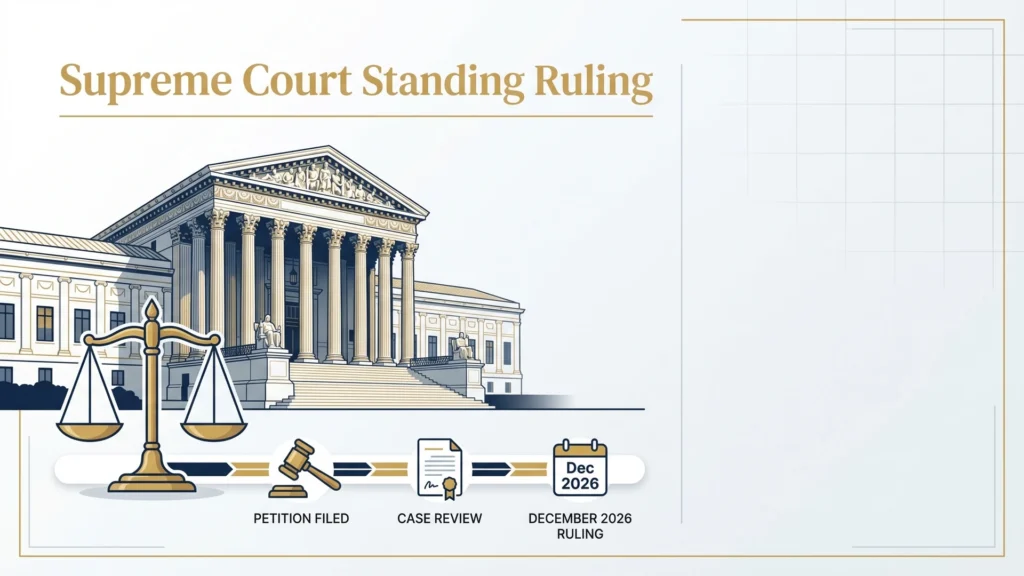
The Court granted the Government’s request to stay the injunction and allow construction to go forward, not because that construction is legal, but on the ground that the Trust likely lacks Article III standing to challenge it. The Court wrote that it did not pass upon the legality of the government’s East Wing project, concluding only that the government is likely to prevail in showing the Trust lacks standing and that the remaining stay factors favor relief.
Chief Justice Roberts dissented. Roberts said the Court’s majority incorrectly applied the standing test to the National Trust.
Key Takeaway: The Supreme Court let construction continue without ever deciding if the ballroom project itself broke the law.
DOJ Demand To Drop Lawsuit After Shooting
The Department of Justice demanded the National Trust drop its lawsuit in April 2026 following a shooting at the White House Correspondents’ Dinner, and the Trust refused. The request came directly from top Justice officials.
Preservationists pressed ahead with their lawsuit against President Trump’s planned $400 million White House ballroom, declining a request by the Department of Justice to withdraw the complaint following the shooting at the White House Correspondents’ Dinner. Top Justice officials said the government would ask a court to dismiss the lawsuit in light of the events if the Trust did not voluntarily drop it.
The Trust’s lawyer did not back down. Trust attorney Gregory Craig declined that request, writing to the Justice Department that the legal issues at the heart of the lawsuit are unchanged.
The Justice Department argued that the lawsuit puts the lives of the President, his family, and his staff at grave risk. The Trust called that characterization unfair and pointed back to the legal merits instead.
White House Ballroom Cost And Construction Details
The White House ballroom is now estimated to cost around $400 million and is designed to be a massive addition built where the East Wing used to stand. Construction has continued through most of the litigation.
The preservation group sued in December, a week after the White House finished demolishing the East Wing to make way for a ballroom that Trump said would fit 999 people. Trump says the project is funded by private donations, although public money is paying for a below ground bunker and security upgrades.
| Detail | Info |
|---|---|
| Estimated cost | $400 million |
| Capacity | 999 people |
| Original East Wing site | Fully demolished |
| Funding claim | Privately funded ballroom, public funding for underground bunker |
Even with the lawsuit active, planning bodies have moved forward on their own. The National Capital Planning Commission approved plans for the ballroom even though a judge had ruled construction must stop while the lawsuit proceeds.
What Is The National Trust For Historic Preservation
The National Trust for Historic Preservation is a congressionally chartered nonprofit that works to protect historic buildings and sites across the country. It has existed for decades and has no direct ownership stake in the White House.
The National Trust for Historic Preservation describes itself as having led the movement to save America’s historic places for more than 75 years. It is a congressionally chartered nonprofit organization designated by Congress to protect historic sites.
Its leadership has been vocal throughout the case. As the organization charged with protecting places where our history happened, the National Trust was compelled to file this case, Carol Quillen, National Trust for Historic Preservation president and CEO, said in a statement.
- Chartered by Congress in 1949
- Privately funded nonprofit, not a government agency
- Mission centers on preserving historic sites and buildings
- Has no formal ownership or management role at the White House
Key Takeaway: The Trust’s own congressional charter is actually part of why courts keep questioning whether it has standing to sue over the White House specifically.
East Wing Demolition Legal Fallout
The East Wing demolition triggered the entire legal fight because the Trust says it happened without any of the normally required reviews. The speed of the demolition is part of what drew criticism.
Critics argue his 90,000-square-foot White House ballroom is too big and that he’s moving too fast without the proper approvals. Still, no plans have been submitted to the commissions that normally oversee this kind of project.
The White House has defended the demolition as routine presidential authority. White House spokesman Davis Ingle said in a statement that President Trump has full legal authority to modernize, renovate and beautify the White House, just as all of his predecessors did.
That disagreement over presidential authority versus required review is still unresolved. The Supreme Court’s standing ruling means no court has actually decided who is right on that core question yet.
December 2026 Supreme Court Deadline
The National Trust faces a December 7, 2026 deadline to respond to a new government filing at the Supreme Court. This followed a fresh petition filed by the administration in early November 2026.
In November 2026, the Trump administration appealed the case back to the Supreme Court, asking it to finish the fight over the White House ballroom. The National Trust has been asked by the Court to respond to the government’s position by December 7, 2026.
This deadline matters because it could determine whether the Supreme Court takes up the full merits of the case. Right now the only ruling on record is about standing, not about the ballroom’s legality.
- Filing date: November 5, 2026
- Response deadline: December 7, 2026
- Case name: National Park Service v. National Trust for Historic Preservation
- Docket number: 26-599
What Happens Next In The Lawsuit
What happens next depends almost entirely on how the Supreme Court handles the Trust’s response due in December 2026. Multiple outcomes remain on the table.
The National Trust has since filed a notice of cross-appeal, and the government filed a further notice of appeal covering the district court’s subsequent orders. Subject to any onward appeal, the stay allows construction to continue while the standing question is litigated.
Legal analysts remain skeptical the Trust can clear the standing bar long term. Experts have said the Supreme Court won’t rule on the substantive issue if it can dismiss the case based on a lack of standing, and that they don’t know of anyone else who could establish standing to bring a lawsuit.
Key Takeaway: Unless the Trust clears the standing hurdle for good, the legality of the ballroom itself may never get a final court ruling.
Does This Lawsuit Affect Taxpayers
This lawsuit matters to taxpayers because public money is funding parts of the project even though the ballroom itself is described as privately financed. The case also sets a precedent for how much review future presidents owe before altering federal buildings.
As noted earlier, public money is paying for a below ground bunker and security upgrades tied to the ballroom project. That mix of private and public funding has fueled ongoing public debate.
Beyond dollars, the bigger stake is precedent. If the Trust’s standing claim fails for good, legal experts say it becomes much harder for any outside group to challenge similar federal construction decisions in the future. That reshapes oversight far beyond this one building.
Key Facts To Remember About The Case
The most important thing to remember is that this case has never actually resolved whether Trump’s ballroom broke the law. Every major ruling so far has turned on standing, not the merits.
Quick recap of where things stand:
- Lawsuit filed December 12, 2025
- D.C. Circuit sided with the Trust in August 2026
- Supreme Court paused that win in August 2026, citing standing
- New Supreme Court filing arrived November 2026
- Trust must respond by December 7, 2026
- Construction has largely continued throughout
| Stage | Who Won |
|---|---|
| District Court | National Trust |
| D.C. Circuit | National Trust |
| Supreme Court (emergency stay) | Trump administration |
| Pending Supreme Court review | Undecided |
Key Takeaway: The national trust trump lawsuit is far from over, and its final outcome could reshape how presidents handle federal property reviews for decades.
Frequently Asked Questions
What is the national trust trump lawsuit about?
The lawsuit challenges whether Trump followed required federal reviews before demolishing the White House East Wing for a new ballroom.
It is not a consumer case and involves no payouts.
It centers on planning law, not money damages.
Did the Supreme Court side with Trump or the National Trust?
The Supreme Court sided with Trump on a narrow point in August 2026, allowing construction to continue.
The ruling was based on standing, not on whether the ballroom is legal.
The underlying legal question remains unresolved.
Who is Alison Hoagland and why does she matter?
Alison Hoagland is a National Trust member whose personal claim of harm anchors the entire lawsuit’s standing argument.
She says the ballroom disrupts her regular walks near the White House.
Courts have split on whether that claim is enough.
Is White House ballroom construction still happening right now?
Yes, construction has continued through most of 2026 despite the ongoing lawsuit.
The Supreme Court’s stay in August 2026 cleared the way for work to resume.
Planning bodies have also approved project plans separately.
What happens next in the National Trust lawsuit?
The National Trust must respond to a new Supreme Court filing by December 7, 2026.
That response could determine whether the Court takes up the full case.
Until then, the ballroom’s underlying legality remains undecided.
Closing Thoughts
The national trust trump lawsuit shows how a fight over a building can turn into a fight over who gets to walk through the courthouse door at all.
Standing, not steel and concrete, has decided every major ruling so far.
Keep an eye on December 7, 2026. That response could shape whether this case ever reaches a final answer.