The Bradley Inc immigration lawsuit traces back to workers who say they were punished for standing up for immigrant rights. If you have searched this term, you are probably trying to find out whether you qualify, what agency handles a claim like this, and what kind of money is on the table.
Here is the short version. A Tennessee painting company called Bradley Coatings Inc fired eighteen employees after they joined a nationwide immigration rights protest. That incident still shapes how similar cases get handled today.
One surprising fact: the vast majority of the fired workers were themselves immigrants, according to the company’s own public statement. This guide breaks down the legal process, the agencies involved, and what 2026 workers in similar situations can actually do.
You will learn how eligibility works, what NLRB and EEOC claims look like, and realistic payout ranges for cases like this one.
Related: Immigration Lawsuit Lake Gregory 2026: Full Case Update
Bradley Inc Immigration Lawsuit Overview
The Bradley Inc immigration lawsuit refers to a labor dispute involving Bradley Coatings Inc, a commercial painting company, after it terminated workers connected to an immigration protest.
This is not a single massive class action sitting in federal court today. It is a pattern of worker terminations, union pressure, and agency complaints that fits a broader category of immigration status retaliation cases.
Employees with Bradley Coatings Inc., a commercial painting company founded in 1986, say they notified management they were going to participate in the protest and were fired after missing work. That single sentence is the entire foundation of the dispute.
Quick Facts box:
| Detail | Info |
|---|---|
| Company | Bradley Coatings Inc |
| Workers affected | 18 employees |
| Reason given | Missed work during immigration protest |
| Union involved | Laborers International Union |
| Company stance | Terminations were attendance based, not retaliatory |
The case matters because it is a template. Similar fact patterns keep showing up across construction, hospitality, and service industries whenever immigrant workers organize or protest.
What Is The Bradley Coatings Inc Immigration Case About
This case is about whether a company illegally punished workers for exercising protected rights tied to immigration status and protest participation.
More than 100 people were suddenly out of work across the country this past week after they participated in a “Day Without Immigrants” protest, including eighteen who were fired from Bradley Coatings Inc, which had warned employees they would lose their jobs if they didn’t come to work.
The company pushed back hard on the retaliation framing. Bradley Coatings stated that around twenty individuals came to protest the termination of eighteen employees, and maintained the former employees were terminated only because they failed to show up to work after receiving warnings.
Three things stand out here:
- The firings happened the same week as a national protest movement
- The company admits most of its workforce is immigrant labor
- Both sides agree on the facts, they disagree on the legal characterization
Key Takeaway: The entire legal fight hinges on one question, was this attendance discipline or retaliation for protected activity tied to immigration status.
Bradley Inc Workers Fired Immigration Protest
Workers were fired after missing shifts to join the “Day Without Immigrants” demonstration, a coordinated nationwide protest against immigration enforcement policy.
Employees with Bradley Coatings Inc., a commercial painting company founded in 1986, say they notified management they were going to participate in the protest and were fired after missing work.
The union got involved almost immediately. A representative with the Laborers International Union said the firings were retaliation and asked that Bradley rehire the workers and restore their pay.
Not everyone agreed the firings were unfair. Some community members pointed out that workers knew the attendance policy going in.
Here is what both camps are really arguing:
| Position | Argument |
|---|---|
| Workers and union | Firings were retaliation for immigration advocacy |
| Company | Firings followed standard attendance policy warnings |
| Neutral observers | Timing creates a retaliation inference even if policy existed |
Who Qualifies For The Bradley Inc Lawsuit
Qualifying generally requires proof you were disciplined or fired specifically because of protected activity tied to immigration status or organizing.
Not every termination that happens near a protest counts as retaliation. Timing alone is not proof, but it is strong circumstantial evidence when combined with other facts.
Workers typically need one or more of these to build a case:
- Written or verbal warnings that reference the protest specifically
- Evidence other absent employees were treated differently
- Proof the company knew about immigration status before acting
- Documentation showing union or advocacy involvement
Quick eligibility snapshot:
| Factor | Qualifies | Does Not Qualify |
|---|---|---|
| Fired same week as protest with no prior discipline history | Likely | N/A |
| Fired for unrelated performance issues months earlier | N/A | Not likely |
| Immigration status used as pretext after organizing activity | Likely | N/A |
Immigration Status Discrimination At Work Rules
Immigration status discrimination at work means treating employees differently, or punishing them, because of their national origin or immigration background.
Federal law under Title VII bars discrimination based on national origin regardless of citizenship status in many contexts. Separately, labor law protects workers who organize together, even informally.
The National Labor Relations Board has held that scrutiny of employees’ immigration status in response to protected concerted activity is extremely coercive and unlawful.
That ruling matters a lot here. In one case, a union filed unfair labor practice charges arguing layoffs were discriminatory and motivated by union formation, and when the company responded by re-examining laid off workers’ immigration documents, the NLRB concluded that action was unlawful because it was done solely due to the protected activity of filing charges.
That is directly relevant to any Bradley style case. Checking or weaponizing immigration paperwork after protected activity is its own violation, separate from the original firing.
Wrongful Termination And Immigration Status Lawsuits
Wrongful termination tied to immigration status happens when an employer fires someone for a reason the law specifically protects, even if the stated reason sounds neutral.
Courts have wrestled with this exact tension for decades. One landmark case still controls how backpay works when immigration status gets tangled into a labor dispute.
In Hoffman Plastic Compounds Inc v NLRB, federal immigration policy barred the NLRB from awarding backpay to a worker who had never been authorized to work in the United States.
That ruling created real limits. The Supreme Court held in a 5 to 4 decision that awarding backpay would conflict with federal immigration policy under the Immigration Reform and Control Act of 1986.
What this means practically:
- Workers with legal work authorization have stronger backpay claims
- Undocumented workers may still win liability findings but face capped remedies
- Reinstatement and front pay options vary case by case
Key Takeaway: Legal work status does not erase a retaliation claim, but it can limit the type of money damages a worker can recover.
NLRB Charges Against Bradley Inc
An NLRB charge is the formal complaint process workers use when they believe they were punished for organizing or group protest activity, known legally as protected concerted activity.
Filing with the NLRB does not require a lawyer and does not cost money. Workers typically have six months from the date of the retaliatory action to file.
The process generally moves like this:
| Step | What Happens |
|---|---|
| Charge filed | Worker or union submits charge to regional NLRB office |
| Investigation | NLRB agent interviews witnesses, reviews records |
| Complaint issued | If merit found, formal complaint moves to hearing |
| Settlement or hearing | Case resolves through settlement or administrative judge ruling |
On January 7, 2026, Republicans James Murphy and Scott Mayer were sworn in as Members of the National Labor Relations Board, joining Democrat David Prouty. That board composition shift matters because it can influence how aggressively future charges against companies like Bradley get pursued.
EEOC Immigration Discrimination Claims Explained
An EEOC claim is a federal complaint alleging workplace discrimination based on national origin, race, or related protected categories, separate from the NLRB’s labor organizing focus.
The EEOC’s enforcement priorities shifted heavily going into 2026. Under EEOC Chair Andrea Lucas’ leadership, the agency has focused on reverse bias claims against majority group workers, as well as national origin discrimination against American workers.
That shift cuts both directions for immigrant workers filing claims. Employers have a legal duty to prevent and stop all harassment based on national origin, including harassment of American workers, and are required to investigate complaints and take prompt action to stop it.
Filing steps workers should know:
- File a Charge of Discrimination within 180 days of the incident (300 days in some states)
- EEOC attempts conciliation before suing
- If conciliation fails, EEOC may sue directly or issue a right to sue letter
How To File An Immigration Retaliation Claim
Filing a claim starts with documenting the retaliation and picking the right agency based on what actually happened to you.
Most workers do not realize they may have two separate claims running at once, one labor focused and one discrimination focused.
Basic filing roadmap:
- Write down dates, names, and exact statements made by supervisors
- Gather text messages, schedules, or termination letters
- File an NLRB charge if organizing or group activity was involved
- File an EEOC charge if national origin bias was involved
- Consult an employment attorney for wrongful termination claims in civil court
| Claim Type | Agency | Deadline |
|---|---|---|
| Union or group retaliation | NLRB | 6 months |
| National origin discrimination | EEOC | 180 to 300 days |
| Civil wrongful termination | State court | Varies by state, often 1 to 3 years |
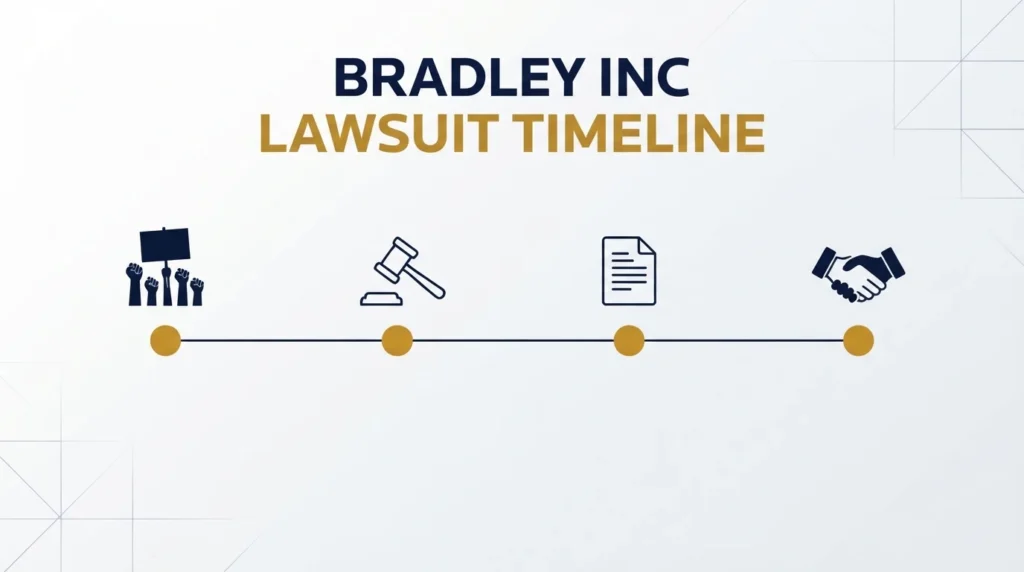
Bradley Inc Lawsuit Timeline 2026
The Bradley Inc case timeline starts with the original firings and runs through ongoing public attention that resurfaces periodically in 2026 coverage.
| Phase | Approximate Date | Event |
|---|---|---|
| Protest and firings | February 2017 | 18 workers terminated after missing shifts |
| Public protest outside company | March 2017 | Roughly 20 protesters rally, company issues statement |
| Union demand for reinstatement | March 2017 | Laborers International Union requests rehiring |
| Renewed public interest | 2026 | Immigration enforcement news cycle revives older cases as reference points |
As 2026 begins, employers with foreign national employees face an immigration environment marked by accelerated enforcement and lightning speed policy shifts, following extensive 2025 actions that reshaped legal immigration. That environment is exactly why older cases like this one keep resurfacing in searches today.
Key Takeaway: The original incident is years old, but 2026’s enforcement climate keeps pulling it back into relevant legal discussion.
Bradley Inc Lawsuit Court Filings And Case Number
There is no single master federal case number tied to the original Bradley Coatings Inc firing dispute, which causes a lot of search confusion.
Several unrelated federal cases share the “Bradley” name, which is why people searching for case numbers often land on the wrong docket.
Unrelated Bradley cases found in federal dockets include:
- Bradley v. SSG Inc, case number 3:18-cv-02979, Texas Northern District
- Bradley v. Socure Inc, case number 3:21-cv-01850, California Northern District
- Bradley v. American Wagering Inc, filed February 2026 in Nevada District Court
- Bradley v. United States Agency for International Development, case 1:26-cv-00950, filed March 18, 2026
None of these involve Bradley Coatings Inc or the immigration protest firings. If you are researching a specific claim, confirm the defendant name and filing court before assuming it relates to this case.
What Happens After A Lawsuit Is Filed Against Bradley Inc
Once a formal charge or lawsuit is filed, the process moves through investigation, response, and either settlement or a hearing.
Employers almost always respond first with a written position statement denying wrongdoing. That happened here too, with the company publicly defending its attendance policy.
Typical sequence after filing:
- Agency or court notifies the employer of the claim
- Employer submits a formal response or position statement
- Evidence gathering and witness interviews occur
- Settlement talks happen before any trial or hearing date
- Unresolved cases proceed to hearing or trial
Recent leadership changes left federal commissions with reduced membership, which can slow down how quickly contested cases move through the system. That kind of bottleneck affects timing for any worker waiting on a resolution.
How Much Can Workers Recover In Immigration Retaliation Lawsuits
Workers in immigration retaliation cases can potentially recover back pay, reinstatement, and in some cases compensatory damages, depending on which agency and which laws apply.
Recovery amounts vary enormously based on how long someone was out of work and whether punitive damages apply under state law.
Typical recovery categories:
| Remedy Type | What It Covers | Typical Range |
|---|---|---|
| Back pay | Lost wages from termination to resolution | Varies by salary and time elapsed |
| Reinstatement | Return to the same or similar job | Not monetary, but common remedy |
| Compensatory damages | Emotional distress, out of pocket costs | $5,000 to $50,000 in many Title VII cases |
| Punitive damages | Employer misconduct penalty | State dependent, can be capped federally |
In the Hoffman case, the NLRB had awarded a worker $66,951 plus interest, covering the period from his firing until the employer learned of his immigration status. That figure shows how backpay calculations work in practice, even though the Supreme Court later limited that specific award.
Immigration Lawsuit Payout Ranges By Case Type
Payout ranges differ sharply depending on whether a case runs through the NLRB, the EEOC, or civil court.
Here is a general comparison based on how these case types typically resolve:
| Case Type | Agency | Typical Payout Range |
|---|---|---|
| Labor organizing retaliation | NLRB | Back pay plus reinstatement, case specific |
| National origin discrimination | EEOC | $10,000 to $100,000+ depending on severity |
| Wrongful termination civil suit | State court | Varies widely, six figures possible in severe cases |
| Class or collective action | Federal court | Can scale into millions across large workforces |
These numbers are illustrative patterns from similar employment cases, not a guarantee for any specific worker. Every case depends on wage history, state law, and the strength of the evidence.
Key Takeaway: The agency you file with directly shapes both the timeline and the ceiling on what you can recover.
Bradley Inc Lawsuit Settlement News 2026
There is no confirmed, finalized settlement specific to the original Bradley Coatings Inc firings as of this writing in 2026.
Public reporting shows the dispute played out through protest, union pressure, and public statements rather than a reported court settlement. That is common for smaller workforce disputes that never escalate into federal litigation.
What we do know from the public record:
- The company never publicly admitted wrongdoing
- The union publicly requested reinstatement, not a specific dollar settlement
- No federal case number has surfaced tying this incident to a resolved lawsuit
Readers searching for “Bradley Inc lawsuit settlement” should verify they are not confusing this case with one of the many unrelated Bradley-named federal cases active in 2026 dockets.
Latest Updates On Bradley Inc Immigration Lawsuit
The latest relevant update is not about Bradley Coatings Inc directly, but about the legal environment surrounding similar cases in 2026.
Employers with foreign national employees now face accelerated enforcement and fast moving policy shifts, with coordinated agency scrutiny continuing to intensify into 2026. That pressure is pushing more companies toward documented, consistent discipline policies to avoid retaliation claims.
Meanwhile, EEOC enforcement priorities have shifted noticeably. Republican EEOC Chair Andrea Lucas has prioritized enforcing Title VII’s bar on national origin discrimination to ensure protections apply broadly across worker populations.
For anyone currently facing a similar termination situation, the smartest move is documenting everything now, not waiting.
Frequently Asked Questions
What is the Bradley Inc immigration lawsuit about?
It centers on Bradley Coatings Inc firing 18 workers after they joined an immigration rights protest in 2017.
The company says it was attendance based discipline.
Workers and their union called it retaliation.
Who qualifies to file a claim against Bradley Inc?
Workers fired or disciplined specifically for immigration related protest or organizing activity may qualify.
You need evidence connecting the discipline to protected activity, not just bad timing.
Documentation like warnings, texts, or witness statements strengthens eligibility.
How much money can I get from an immigration retaliation lawsuit?
Amounts vary widely based on lost wages and which agency handles your claim.
EEOC national origin cases often settle in the $10,000 to $100,000 range.
NLRB cases typically focus on back pay and reinstatement rather than large damage awards.
How long does an NLRB or EEOC case against an employer take?
NLRB charges must be filed within six months of the incident.
EEOC charges generally require filing within 180 to 300 days.
Full resolution can take anywhere from several months to over a year depending on complexity.
Is the Bradley Inc case still active in 2026?
There is no confirmed active federal lawsuit specifically tied to the original 2017 Bradley Coatings Inc firings.
The topic resurfaces in 2026 due to heightened immigration enforcement news cycles.
Workers facing similar situations today should pursue separate, current claims rather than assuming this older case is still pending.
Final Word
The Bradley Inc immigration lawsuit story is really a lesson in how retaliation claims work across NLRB, EEOC, and civil court tracks.
If you are facing something similar right now, document everything immediately and figure out which agency fits your situation.
Check your filing deadlines today. Waiting even a few months can cost you your entire claim.
================================================================