

Losing a lawsuit is stressful enough. Then the bill arrives and your bank account says no. If you lose a lawsuit and can’t pay, the creditor can garnish wages, freeze bank accounts, and place liens on property. But they cannot take everything you own.
Federal and state laws protect certain assets and income. You have more options than you think. This 2026 guide breaks down exactly what happens next.
You will learn the collection timeline, your legal protections, and real strategies to handle the debt. Roughly 70% of civil judgments go partially or fully uncollected. You are not alone in this situation.
What Happens If You Lose a Lawsuit and Can’t Pay
The court enters a money judgment against you. The winning party now has the legal right to collect. That person or company becomes your judgment creditor.
They do not get your money automatically. They must take active steps to enforce the judgment. This process is called post-judgment collection.
Think of it like a restaurant bill. The judge handed you the check. Now the creditor has to figure out how to get you to pay it. They have several tools available under state and federal law.
The most common enforcement actions include wage garnishment, bank levies, and property liens. Each method has strict legal rules. Creditors must follow specific procedures in your state.
Quick Fact: In 2026, the average time from judgment entry to first collection action is 30 to 90 days.
| Timeline | What Happens |
|---|---|
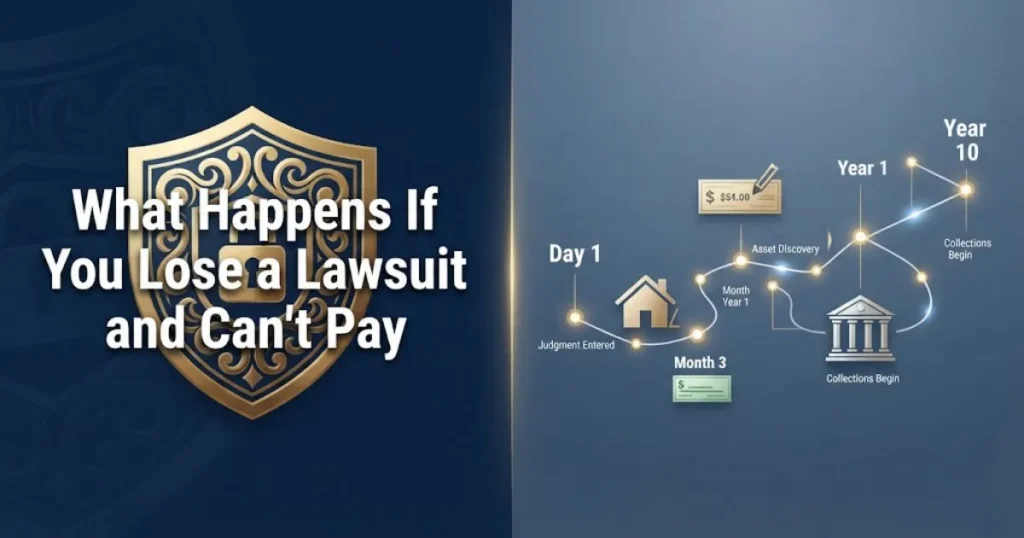
| Days 1 to 30 | Judgment is entered on court record |
| Days 30 to 60 | Creditor may request debtor examination |
| Days 60 to 90 | First garnishment or levy typically filed |
| Months 3 to 12 | Liens recorded on real property |
What Happens If You Can’t Pay a Lawsuit
Being unable to pay does not make the judgment disappear. The debt remains legally valid. Interest continues to accrue on the balance.
Most states charge post-judgment interest between 2% and 10% per year. That means a $10,000 judgment could grow to $11,000 in just one year. The clock starts ticking the day the judge signs the order.
However, creditors cannot collect money you do not have. If your income falls below certain thresholds, you may be effectively untouchable. This is a temporary shield, not a permanent one.
Your financial situation can change. A new job or inheritance can reopen collection efforts. The judgment stays active for years. Creditors can wait for your circumstances to improve.
Key Stat: Post-judgment interest in California is 10% annually as of 2026. In New York, it is 9%.
What Happens If You Lose a Civil Lawsuit and Can’t Pay
Civil lawsuits cover debts, contracts, personal injury, and property disputes. The collection process is the same regardless of the case type. A money judgment is a money judgment.
The main difference is the amount. Personal injury judgments can reach into the millions. Small claims judgments typically stay under $10,000. Larger judgments attract more aggressive collection tactics.
If you lost a personal injury case, the plaintiff may pursue your insurance coverage first. Your auto or homeowners policy might cover part or all of the award. Check your policy limits immediately.
Contract and debt lawsuits usually involve smaller amounts. Creditors in these cases often sell the judgment to collection agencies. The agency then pursues you for a fraction of what they paid.
| Case Type | Average Judgment | Collection Aggression |
|---|---|---|
| Debt Collection | $2,000 to $15,000 | Moderate |
| Personal Injury | $25,000 to $500,000+ | High |
| Contract Dispute | $5,000 to $50,000 | Moderate |
| Property Damage | $1,000 to $25,000 | Low to Moderate |
Key Takeaway: A judgment gives the creditor legal power to seize wages, freeze accounts, and lien property, but federal and state exemption laws limit how much they can actually take from you.
What Is a Judgment Debtor
A judgment debtor is the person who lost the lawsuit and owes money. That is you if the court ruled against you. The other party is the judgment creditor.
This label matters because it triggers specific legal obligations. You may receive a court order to disclose your financial information. This is called a debtor examination or supplementary proceeding.
During a debtor exam, you must answer questions under oath. The creditor wants to know where you work, what you own, and where you bank. Lying during this process is perjury.
You have the right to an attorney during the examination. You also have the right to claim exemptions on certain assets. Do not skip the hearing. Ignoring it can lead to a contempt of court order.
Quick Facts:
- You must receive formal notice of a debtor exam
- The hearing takes place at your local courthouse
- Bring financial records including pay stubs and bank statements
- Failure to appear can result in a bench warrant
Can You Go to Jail for Not Paying a Lawsuit
No. You cannot go to jail simply for owing money on a civil judgment. Debtors’ prisons were abolished in the United States in the 1830s. The Supreme Court confirmed this protection repeatedly.
There is one major exception. You can face jail time for contempt of court. This happens when you ignore a court order to appear at a debtor examination. The judge may issue a bench warrant for your arrest.
The jail time is not for the debt itself. It is for disobeying the judge. Once you appear in court, the contempt charge typically gets resolved. Think of it like a speeding ticket. The fine is one thing. Ignoring the court date is a separate problem.
In 2026, several states have tightened rules around debtor exam arrests. The Consumer Financial Protection Bureau has pushed back against abusive practices. You still must show up when ordered.
Bold Stat: Zero U.S. states allow imprisonment for civil debt alone as of 2026.
| Scenario | Jail Risk |
|---|---|
| Cannot pay judgment | None |
| Ignore court summons | Possible contempt |
| Skip debtor examination | Bench warrant likely |
| Lie under oath | Perjury charges |
Wage Garnishment After Lawsuit
Wage garnishment is the most common collection method after a lawsuit. The creditor gets a court order directing your employer to withhold part of your paycheck. The money goes straight to the creditor.
Federal law limits garnishment to 25% of your disposable earnings or the amount exceeding 30 times the federal minimum wage, whichever is less. In 2026, the federal minimum wage remains $7.25 per hour.
Some states offer stronger protections. Texas, Pennsylvania, and North Carolina ban most wage garnishment entirely. Other states cap it at 10% to 15% of gross pay.
Your employer cannot fire you for a single garnishment. Federal law protects you under the Consumer Credit Protection Act. However, that protection weakens if you have multiple garnishments.
Quick Facts:
- Garnishment starts after the creditor files a writ with the court
- Your employer receives the order and must comply within one pay period
- You can challenge the amount if it exceeds legal limits
- Child support and tax debts have higher garnishment caps
| State | Max Garnishment Rate (2026) |
|---|---|
| Federal Default | 25% of disposable income |
| Texas | 0% (banned for most debts) |
| New York | 10% of gross or 25% of disposable |
| California | 25% of disposable income |
| Florida | Head of household exemption applies |
Key Takeaway: Creditors use wage garnishment, bank levies, and property liens to collect judgments, but each method has strict legal limits that vary by state and federal law.
Bank Levy After Judgment
A bank levy freezes the money in your checking or savings account. The creditor gets a writ of execution from the court. The sheriff or marshal serves it on your bank.
Once served, the bank freezes your funds immediately. You typically have 10 to 15 days to challenge the levy. During that window, you cannot access the frozen money.
Certain funds are exempt from bank levies. Social Security benefits, veterans’ benefits, and Supplemental Security Income are protected under federal law. The bank must release those funds if you prove the source.
Joint accounts create complications. If you share an account with a spouse, the creditor may try to freeze the entire balance. You must prove which portion belongs to the non-debtor.
Bold Stat: In 2026, federal law protects up to two months of Social Security or federal benefit deposits from bank levies automatically.
- Notify your bank immediately if a levy hits
- Gather proof of exempt income sources
- File a claim of exemption with the court
- Act within the deadline or lose the funds
Can They Take Your House If You Lose a Lawsuit
Creditors can place a lien on your home but rarely force a sale. A judgment lien attaches to your property title. It sits there until you sell or refinance.
Forcing a home sale requires a writ of execution and a sheriff’s auction. This is expensive and complicated for creditors. Most choose not to pursue it for judgments under $50,000.
Every state has a homestead exemption that protects equity in your primary residence. In 2026, Texas and Florida offer unlimited homestead protection. California protects up to $600,000 in home equity for most homeowners.
If your home equity falls below your state’s exemption amount, the creditor cannot force a sale. The lien remains on the title but is effectively unenforceable. It becomes a problem only when you try to sell.
| State | Homestead Exemption (2026) |
|---|---|
| Texas | Unlimited |
| Florida | Unlimited |
| California | $300,000 to $600,000 |
| New York | $150,000 to $250,000 |
| Illinois | $15,000 |
Property Lien Lawsuit
A property lien is a legal claim against real estate you own. The creditor records the judgment with the county recorder’s office. It clouds your title until the debt is paid or the lien expires.
Liens do not require a separate lawsuit. The original judgment itself creates the lien in most states. The creditor simply files paperwork with the county.
The lien attaches to any real property in the county where it is recorded. If you own land in multiple counties, the creditor must file in each one. This costs them money and time.
When you sell the property, the lien must be satisfied from the sale proceeds. The title company will not close the deal until the judgment is paid. This is where liens cause the most pain.
Quick Facts:
- Judgment liens last as long as the judgment itself
- They accrue interest at the statutory post-judgment rate
- You can negotiate a lien release for a reduced payoff
- Liens show up on title searches during any real estate transaction
Key Takeaway: Your home, wages, and bank accounts face real collection risk after a judgment, but homestead exemptions, federal benefit protections, and state laws create significant shields that creditors cannot easily bypass.
Judgment Proof Meaning
Being judgment proof means you have no income or assets that a creditor can legally seize. The judgment still exists. The creditor simply cannot collect anything right now.
You are likely judgment proof if your only income is Social Security, disability, or unemployment benefits. These income sources are exempt under federal law. Creditors cannot touch them.
You may also qualify if your wages fall below the federal garnishment threshold. In 2026, that threshold is $217.50 per week in disposable earnings. Earn less than that and garnishment is off the table.
Being judgment proof is not permanent. If you get a higher-paying job or inherit money, the creditor can resume collection. The judgment stays active and waits for you.
Think of it like a rainstorm. You are under an umbrella right now. The rain has not stopped. It is just not reaching you at the moment.
Key Criteria for Judgment Proof Status:
- Income comes entirely from exempt sources
- No significant equity in real property
- Bank balances below exemption thresholds
- No valuable non-exempt personal property
What Assets Are Exempt From Judgment
Exempt assets are items and income that creditors cannot legally seize. Every state has its own exemption list. Federal exemptions also apply in some situations.
Common exempt assets include your primary vehicle up to a certain value, household goods, clothing, and tools of your trade. Retirement accounts like 401(k)s and IRAs are generally protected.
In 2026, the federal wildcard exemption allows you to protect up to $1,475 in any property plus up to $13,950 in unused homestead exemption. Many states offer higher amounts.
Here is a snapshot of commonly protected assets across most states:
| Asset Type | Typical Exemption (2026) |
|---|---|
| Primary Vehicle | $4,000 to $10,000 equity |
| Household Goods | $5,000 to $15,000 total |
| Clothing | Fully exempt in most states |
| Tools of Trade | $2,000 to $8,000 |
| 401(k) and IRA | Fully exempt (federal law) |
| Social Security | Fully exempt (federal law) |
| Workers’ Comp | Fully exempt in most states |
How Long Does a Judgment Last
Judgments last between 5 and 20 years depending on your state. Many states allow creditors to renew the judgment before it expires. This can extend collection indefinitely.
In California, a judgment lasts 10 years and can be renewed for another 10. In New York, judgments are valid for 20 years. Texas judgments last 10 years with unlimited renewals.
The clock starts on the date the court enters the judgment. Renewal requires the creditor to file paperwork before the expiration date. If they miss the deadline, the judgment dies.
Post-judgment interest runs for the entire life of the judgment. A $5,000 judgment at 8% interest becomes roughly $10,800 after 10 years. The debt grows even when the creditor is not actively collecting.
| State | Judgment Duration | Renewable |
|---|---|---|
| California | 10 years | Yes, unlimited |
| New York | 20 years | Yes |
| Texas | 10 years | Yes, unlimited |
| Florida | 20 years | Yes |
| Illinois | 7 years | Yes, up to 20 total |
Key Takeaway: Judgments last for years or even decades, and post-judgment interest keeps the balance growing, so ignoring the debt hoping it disappears is rarely a winning strategy.
Does Losing a Lawsuit affect Credit Score
Yes. A civil judgment can drop your credit score by 100 to 150 points or more. The impact depends on your starting score and the judgment amount.
As of 2026, the three major credit bureaus no longer include most civil judgments on credit reports. Equifax, Experian, and TransUnion removed most judgment data starting in 2018. This was a major shift.
However, the underlying debt may still appear as a collection account. If the creditor sells the judgment to a collection agency, that agency can report the debt. Collection accounts remain on your report for seven years.
The judgment itself is a public record. Lenders, landlords, and employers can find it through court record searches. It will show up on background checks even if it is not on your credit report.
Bold Stat: A single collection account from a judgment can lower a 700 credit score to roughly 550 to 600 within months.
- Check your credit reports at all three bureaus
- Dispute any inaccurate judgment entries
- Monitor for new collection accounts tied to the debt
- Rebuild with secured credit cards and on-time payments
How to Negotiate a Judgment After Losing
You can negotiate a reduced payoff even after the court enters a judgment. Creditors often accept 40% to 70% of the total balance as a lump sum settlement. They prefer guaranteed money over years of uncertain collection.
Start by contacting the judgment creditor or their attorney directly. Explain your financial situation honestly. Offer a specific dollar amount you can pay within 30 days.
Get any settlement agreement in writing before sending money. The document should state that the payment satisfies the judgment in full. Request a satisfaction of judgment filing with the court.
Timing matters. Creditors are more willing to negotiate when the judgment is older. A five-year-old judgment with no successful collections is a prime candidate for a deep discount.
Negotiation Tips:
- Lead with a lump sum offer, not a payment plan
- Start at 30% to 40% of the balance
- Emphasize your limited assets and income
- Request a written satisfaction of judgment
- File the satisfaction with the county recorder
How to Pay a Court Judgment in Installments
You can ask the court for an installment payment plan. File a motion requesting a payment schedule based on your income and expenses. The judge has discretion to approve or deny it.
Most courts require you to complete a financial affidavit. This form details your monthly income, rent, utilities, food costs, and other obligations. Be thorough and honest.
Judges typically set payments at an amount you can realistically afford. This might be $50 to $200 per month for smaller judgments. The key is consistency. Missing payments can void the arrangement.
An installment order does not stop interest from accruing. The balance may still grow if your payments are smaller than the monthly interest. Try to pay more than the minimum when possible.
Quick Facts:
- File your motion within 30 days of the judgment
- Bring proof of income and expenses to the hearing
- The creditor can object to your proposed amount
- Once approved, make every payment on time
| Judgment Amount | Typical Monthly Payment |
|---|---|
| Under $2,000 | $25 to $75 |
| $2,000 to $10,000 | $75 to $200 |
| $10,000 to $50,000 | $200 to $500 |
| Over $50,000 | $500+ (varies widely) |
Key Takeaway: You have real options after losing a lawsuit, including negotiating a reduced payoff, requesting court-ordered installment plans, and leveraging exemption laws to protect your essential assets and income.
Statute of Limitations on Judgment Collection
The statute of limitations on judgment collection is the legal deadline for enforcing a court judgment. Once it expires without renewal, the creditor loses the right to collect.
This deadline varies dramatically by state. It ranges from 5 years in some states to 20 years in others. The clock starts on the judgment entry date, not the original debt date.
Renewal resets the clock. In states like California and Texas, creditors can renew indefinitely. Each renewal gives them another full enforcement period. The debt can theoretically follow you for life.
Some states require the creditor to take active collection steps to keep the judgment alive. If they sit idle for the full statutory period, the judgment may become dormant. A dormant judgment can sometimes be revived, but the process is harder for the creditor.
Key Deadlines (2026):
- California: 10 years, renewable
- New York: 20 years, renewable
- Texas: 10 years, renewable
- Florida: 20 years, renewable
- Ohio: 5 years, renewable up to 20 total
Bankruptcy After Losing Lawsuit
Filing bankruptcy can discharge most civil judgments. Chapter 7 bankruptcy wipes out unsecured debts including lawsuit judgments. The process takes about four to six months.
Not all judgments are dischargeable. Judgments for fraud, intentional injury, or drunk driving accidents typically survive bankruptcy. Student loan judgments are also extremely difficult to discharge.
Chapter 13 bankruptcy offers a repayment plan over three to five years. You pay a portion of the judgment through the plan. The remaining balance gets discharged at the end.
The automatic stay kicks in the moment you file. This immediately stops all collection activity. Garnishments halt. Bank levies freeze. Phone calls from collectors must stop.
Quick Facts:
- Chapter 7 filing fee in 2026 is $338
- Chapter 13 filing fee is $313
- The automatic stay is immediate upon filing
- Most unsecured judgments are fully dischargeable
- You must complete credit counseling before filing
| Bankruptcy Type | Duration | Judgment Discharge | Cost (2026) |
|---|---|---|---|
| Chapter 7 | 4 to 6 months | Most unsecured judgments | $338 filing fee |
| Chapter 13 | 3 to 5 years | Remaining balance after plan | $313 filing fee |
Frequently Asked Questions
Can a creditor take everything I own after a lawsuit?
No. Federal and state exemption laws protect essential assets. Your primary home, vehicle, retirement accounts, and basic household goods are typically shielded. Creditors can only seize non-exempt property above specific dollar thresholds.
How quickly can wage garnishment start after losing a lawsuit?
Wage garnishment typically begins 30 to 90 days after the judgment. The creditor must file a writ of garnishment with the court first. Your employer then withholds up to 25% of your disposable income per pay period.
Will I lose my home if I cannot pay a court judgment?
Most homeowners will not lose their home over a civil judgment. State homestead exemptions protect significant equity in your primary residence. Creditors rarely force home sales for judgments under $50,000.
Does a civil judgment show up on background checks?
Yes. Civil judgments are public court records. Landlords, employers, and lenders can find them through background check services. The judgment may not appear on your credit report but it remains searchable in court databases.
Can I settle a judgment for less than the full amount?
Yes. Many creditors accept 40% to 70% of the judgment balance as a lump sum settlement. Older judgments with no successful collection history often settle for even less. Always get the agreement in writing.
Losing a lawsuit does not mean financial ruin. You have legal protections, negotiation options, and payment strategies available right now. Review your state’s exemption laws and consider your best path forward. Check your eligibility for installment plans or settlement offers. Stay informed and take action before collection efforts escalate in 2026.







