When a court case shows “disposed,” it means the case reached a final resolution. The court is done with it. No more hearings are scheduled.
This status appears on court records in all 50 states. Understanding what disposed means in a court case matters more than you think. Over 84 million cases were filed in U.S. state courts last year. Many of those people saw this term and panicked.
This guide breaks down every type of disposition you might find. You will learn what it means for criminal, civil, and family cases. We cover background checks and job impacts too.
Keep reading to decode your court record once and for all.
What Does Disposed Mean in a Court Case?
Disposed means a court case has been fully resolved by a judge or jury. The court entered a final decision. No further action is pending on the docket.
This is the most common status on public court records. It applies to every type of case. Criminal, civil, family, and traffic cases all use this term.
Think of it like closing a tab at a restaurant. The meal is over. The bill is settled. The transaction is complete.
A disposed status does not tell you who won. It only confirms the case is finished. The outcome could be a conviction, acquittal, or settlement.
Quick Facts About Disposed Cases:
- The term applies to all U.S. court systems
- Disposed does not automatically mean guilty
- The case cannot proceed without a new filing
- Records remain publicly accessible after disposition
Over 40 million cases are disposed each year in state courts. Your specific disposition type matters for your record.
What Does Disposed Mean in a Criminal Case?
In a criminal case, disposed means the charges have been fully resolved. The defendant was either convicted, acquitted, or the charges were dropped.
Criminal dispositions carry the heaviest long-term consequences. A felony disposition stays on your record for life in most states. Misdemeanor dispositions follow similar rules.
Here are the most common criminal disposition types you will see:
| Disposition Type | What It Means | Record Impact |
|---|---|---|
| Convicted | Found guilty at trial or by plea | Permanent record |
| Acquitted | Found not guilty | Stays on record |
| Nolle Prosequi | Prosecutor dropped charges | May be expunged |
| Diversion Complete | Defendant finished a program | Often eligible for sealing |
| Dismissed | Court threw out the case | Varies by state |
A 2026 federal report found that 94% of federal criminal cases end in a guilty plea. That means most criminal dispositions involve plea agreements.
The specific disposition code on your record tells the full story. Always request a copy from the court clerk.
Key Takeaway: A disposed criminal case is finished, but the type of disposition determines how it affects your future.
What Does Disposed Mean in a Civil Case?
In a civil case, disposed means the dispute between parties has been resolved. This could happen through a settlement, trial verdict, or court order.
Civil dispositions are different from criminal ones. No one goes to jail. The outcome usually involves money or a court order to do something.
Common civil disposition types include:
| Disposition Type | What It Means | Typical Timeline |
|---|---|---|
| Settlement | Parties agreed to terms | 3 to 12 months |
| Default Judgment | One side did not respond | 1 to 3 months |
| Summary Judgment | Judge decided without trial | 6 to 18 months |
| Jury Verdict | Jury reached a decision | 1 to 3 years |
| Voluntary Dismissal | Plaintiff dropped the case | Any time |
Most civil cases never reach a trial. About 97% of civil cases are disposed before a jury ever hears them. Settlements are the most common path.
If you see “disposed” on a civil docket, check the final order. It will tell you who owes what and by when.
Disposed vs Dismissed: What Is the Difference?
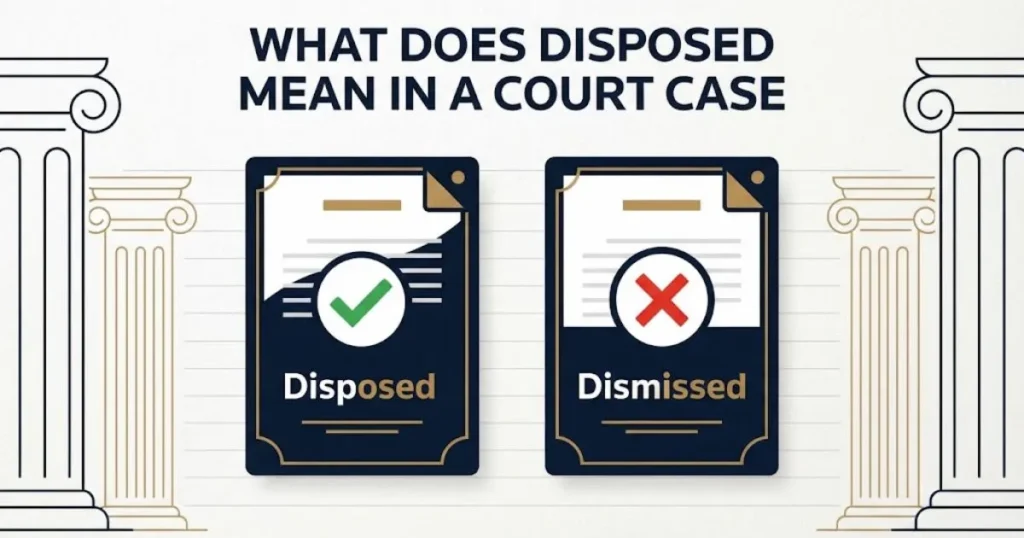
Disposed and dismissed are not the same thing. Disposed is the umbrella term for any final resolution. Dismissed is one specific type of disposition.
Think of it like squares and rectangles. Every dismissed case is disposed. Not every disposed case is dismissed.
A dismissed case means the court threw it out. The plaintiff or prosecutor failed to prove their case. Or a procedural error killed the lawsuit.
Here is a quick comparison:
| Factor | Disposed | Dismissed |
|---|---|---|
| Scope | Broad term for any resolution | Specific type of resolution |
| Outcome | Could be any result | Case was thrown out |
| Who Wins | Varies | Usually the defendant |
| Refiling | Depends on type | May or may not be allowed |
| Record Impact | Varies | Generally favorable for defendant |
A case can be disposed through a conviction, acquittal, or settlement. A dismissal is just one of those paths. Always check the specific disposition code on your docket.
Key Takeaway: Disposed is the big category. Dismissed is one small slice of that pie. Never confuse the two on your record.
What Does Disposed With Prejudice Mean?
Disposed with prejudice means the case is permanently closed. The plaintiff or prosecutor cannot file the same claim again. The door is shut for good.
This is the strongest type of case ending for a defendant. It provides total legal protection against repeat lawsuits on the same issue.
Courts grant dismissals with prejudice in specific situations:
- The statute of limitations has expired
- The plaintiff committed serious procedural fraud
- The parties reached a binding settlement agreement
- The court found the claim legally baseless
Imagine someone suing you for a fender bender from 2019. The court dismisses it with prejudice. That person can never sue you for that same accident again. The matter is dead.
In 2026, federal courts dismiss roughly 12% of civil cases with prejudice. State court rates vary widely by jurisdiction.
If your case was disposed with prejudice, you can breathe easy. No one can revive those specific claims against you.
What Does Disposed Without Prejudice Mean?
Disposed without prejudice means the case is closed for now. The plaintiff or prosecutor can refile the same claim later. The door remains open.
This is a temporary ending, not a permanent one. Courts use it when a technical issue prevents the case from moving forward.
Common reasons for a without prejudice disposition include:
- The plaintiff filed in the wrong court
- Paperwork was incomplete or incorrect
- The defendant was not properly served
- Both sides need more time to negotiate
Think of it like a referee pausing a game for a rule violation. The game is not over. It will resume once the issue is fixed.
The clock keeps ticking on the statute of limitations. If the deadline passes before refiling, the case dies permanently. That is when it converts to a with prejudice situation.
Check your court records carefully for the exact wording. The words “with” or “without” prejudice change everything about your legal exposure.
Key Takeaway: With prejudice means permanent. Without prejudice means temporary. Those two words carry enormous legal weight.
Case Disposed Meaning on a Background Check
A disposed case on a background check means the case is complete and the result is visible. Employers and landlords can see the final outcome.
This is where most people get nervous. A disposed case does not disappear from your record. It simply shows the case is finished.
What shows up depends on the type of background check:
| Check Type | What It Shows | Time Range |
|---|---|---|
| Basic Employment | Convictions only | 7 years typically |
| FBI Fingerprint | All dispositions | Lifetime |
| Tenant Screening | Convictions and evictions | 7 to 10 years |
| Government Clearance | Everything | Lifetime |
| State Repository | Varies by state | Varies |
The Fair Credit Reporting Act limits most employment checks to seven years. But exceptions exist for high-salary jobs and government positions.
A dismissed or acquitted case may still appear. The disposition type matters more than the disposed status itself. Always know what your full record looks like before applying for jobs.
What Does Disposed Mean in Family Court?
In family court, disposed means the family law matter has been resolved. This covers divorces, custody battles, child support, and restraining orders.
Family court dispositions work differently than criminal ones. The outcomes involve ongoing obligations rather than one-time penalties.
Common family court disposition types include:
- Final divorce decree issued by the judge
- Custody order establishing parenting time
- Child support order setting payment amounts
- Protective order granted or denied
- Adoption finalized through court approval
A disposed divorce case means the marriage is legally dissolved. Both parties must follow the terms of the final decree. Violating those terms can trigger new court action.
In 2026, the average divorce case takes 12 to 18 months from filing to disposition. Contested custody cases can stretch beyond two years.
Even after disposition, family court orders can be modified. A parent can request changes to custody or support if circumstances shift significantly.
Case Disposed vs Case Closed: Are They the Same?
Disposed and closed are often used interchangeably. But some court systems treat them as separate statuses with different meanings.
In most state courts, disposed means the legal issues are resolved. Closed means the administrative file is shelved. A case can be disposed but not yet closed.
Here is how the two statuses compare:
| Status | Legal Meaning | Administrative Meaning | Timing |
|---|---|---|---|
| Disposed | Judge made a final ruling | Case may still be active | Happens first |
| Closed | File is archived | All tasks are complete | Happens later |
Think of it like finishing a project at work. The work is done (disposed). But the file sits on your desk until you actually put it away (closed).
Some courts close a case weeks or months after disposition. Others do both on the same day. The gap depends on local court procedures.
If your record shows “disposed” but not “closed,” do not worry. It usually just means paperwork is still being processed by the clerk.
Key Takeaway: Disposed means the judge is done. Closed means the clerk is done. The legal result is the same either way.
What Does Disposed Mean on PACER?
On PACER, disposed means the federal court case has reached its final resolution. PACER is the federal system for accessing court records online.
PACER uses specific disposition codes that differ from state courts. You will see abbreviations like “DISP” next to case entries.
Key things to know about PACER dispositions:
- PACER covers all 94 U.S. District Courts
- Disposition codes follow the CM/ECF filing system
- Criminal and civil cases use different code sets
- Appeals court dispositions appear separately
Federal cases tend to have more detailed disposition records than state cases. You can often read the full final order through PACER for a small fee.
As of 2026, PACER charges $0.10 per page with a $3 cap per document. Fee waivers are available for low-income users.
If you see “disposed” on PACER, click the docket entry. The final order will explain exactly how the case was resolved.
Disposed Case Meaning in Legal Terms
In legal terms, a disposed case is one where the court has issued a final adjudication. The judicial process for that specific matter is complete.
Lawyers use the word “disposition” to describe the final outcome. The term comes from the Latin “disponere,” meaning to arrange or settle.
Key legal terms related to disposition include:
- Adjudication: The formal judgment by a court
- Final order: The last document the judge signs
- Docket entry: The official record of the disposition
- Judgment: The court’s binding decision
- Decree: A court order in equity or family cases
Black’s Law Dictionary defines disposition as “a final settlement or determination.” That definition has not changed in over a century.
Every court system in the United States tracks dispositions. The National Center for State Courts publishes annual disposition statistics for all 50 states.
Understanding the precise legal meaning helps you read your court records accurately. The specific disposition code tells the real story.
Key Takeaway: Disposed is a formal legal term meaning the court has issued its final word on the matter.
What Happens After a Case Is Disposed?
After a case is disposed, the court enters the final order and the enforcement phase begins. The winning party can now collect what they are owed.
The post-disposition timeline varies by case type. Criminal cases move to sentencing or release. Civil cases move to payment or compliance.
Here is a typical post-disposition timeline:
| Timeframe | What Happens |
|---|---|
| 0 to 30 days | Final order is entered on the docket |
| 30 to 60 days | Appeal window opens for the losing party |
| 60 to 90 days | Enforcement actions may begin |
| 90+ days | Case file moves to court archives |
If the losing party files an appeal, the disposition stays on record. But enforcement may pause until the appeals court rules.
In criminal cases, a disposed conviction triggers sentencing. The defendant may face jail time, probation, or fines. An acquittal means immediate release.
Check your court docket regularly after disposition. Some courts take weeks to update their online systems with the final order.
Does Disposed Mean Guilty?
No, disposed does not mean guilty. It simply means the case is over. The outcome could be a conviction, acquittal, or dismissal.
This is the most common misconception about court records. People see “disposed” and assume the worst. That assumption is wrong.
A disposed case could mean any of these outcomes:
- The defendant was found not guilty at trial
- The prosecutor dropped all charges
- The case was dismissed for procedural reasons
- The defendant completed a diversion program
- The parties reached a plea agreement
Only one of those five scenarios involves a guilty finding. The other four are neutral or favorable outcomes.
Over 30% of criminal cases are disposed without any conviction. That statistic alone proves that disposed and guilty are not synonyms.
Always read the full disposition details on your record. The specific outcome code tells you what actually happened. Never judge a case by the word “disposed” alone.
What Does Disposed Mean in Traffic Court?
In traffic court, disposed means the traffic violation has been resolved. You either paid the fine, completed traffic school, or the ticket was dismissed.
Traffic dispositions are the most common type most people encounter. Millions of Americans deal with traffic tickets every year.
Common traffic court disposition types include:
| Disposition | What It Means | Points on License |
|---|---|---|
| Guilty by Payment | You paid the fine | Yes, typically |
| Guilty by Trial | Judge found you liable | Yes, typically |
| Dismissed | Ticket was thrown out | No |
| Traffic School | You completed a course | Often reduced |
| Not Guilty | Judge cleared you | No |
A disposed traffic ticket stays on your driving record for 3 to 7 years in most states. The exact duration depends on your state and the violation severity.
If you see “disposed” on your traffic record, check whether points were assessed. Points affect your insurance rates more than the disposition status itself.
Case Disposed Meaning for Employment
A disposed case can affect employment depending on the disposition type and the job you want. Employers care about convictions, not just case status.
Most employers run background checks through third-party screening companies. These companies pull data from court records and criminal databases.
What employers actually see on your report:
- The disposition type (convicted, dismissed, acquitted)
- The date of disposition
- The charge classification (felony, misdemeanor)
- The court jurisdiction
A disposed case with a dismissal or acquittal rarely hurts your job chances. A disposed case with a conviction can limit opportunities in certain fields.
The EEOC prohibits employers from using arrest records alone to deny employment. They must consider the nature of the offense and how long ago it occurred.
In 2026, 35 states have “ban the box” laws. These laws prevent employers from asking about criminal history on initial job applications.
If a disposed case is hurting your job search, look into expungement. Many states now allow sealing of dismissed and acquitted cases.
Key Takeaway: Employers look at the disposition type, not just the word “disposed.” A dismissal looks very different from a conviction on a background report.
Frequently Asked Questions
Does a disposed case show up on a background check?
Yes, a disposed case typically appears on background checks. The report will show the final outcome, not just the disposed status. Employers can see whether you were convicted, acquitted, or had charges dismissed.
How long does a disposed case stay on your record?
A disposed criminal conviction stays on your record permanently in most states. Dismissed cases may be removed after 7 to 10 years. Federal background checks can show all dispositions for life.
Can a disposed case be reopened?
A disposed case can sometimes be reopened through a motion to vacate or an appeal. The window for appeals is typically 30 to 60 days after disposition. After that, reopening requires showing new evidence or legal error.
Is a disposed case the same as a conviction?
No, a disposed case is not the same as a conviction. Disposed simply means the case is finished. The outcome could be a conviction, acquittal, dismissal, or settlement.
What should I do if my case shows as disposed?
Request a full copy of your court record from the clerk’s office. Verify that the disposition type is accurate. If you find errors, file a motion to correct the record immediately.
Your court record tells a story. The word “disposed” is just the final chapter. It means the case is over, but the details of how it ended matter far more than the status label itself.
Pull your full court record today. Check the disposition type carefully. If anything looks wrong, take action now before it affects your next job application or housing search.