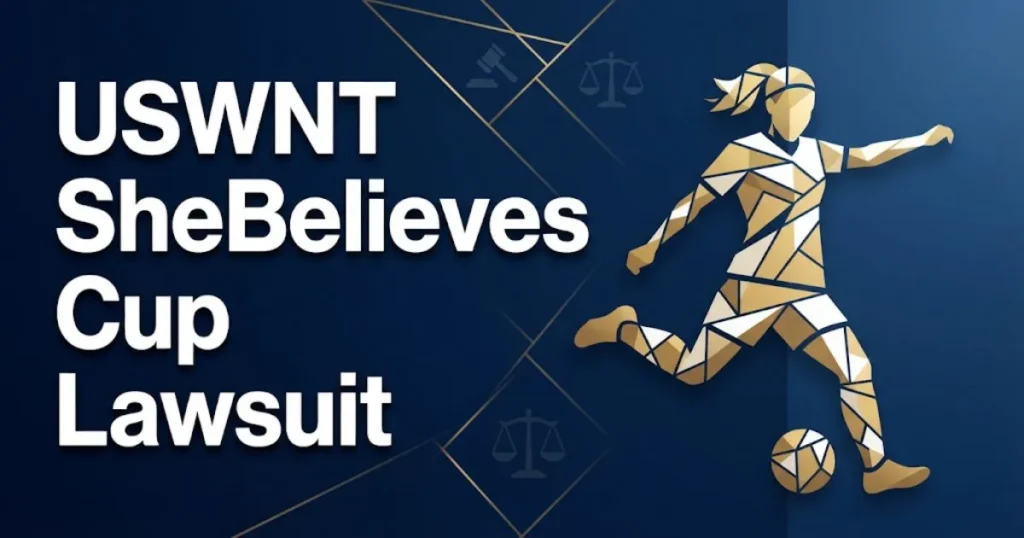
The USWNT SheBelieves Cup lawsuit changed women’s sports forever. A $24 million settlement ended years of bitter legal fighting.
Twenty-eight players sued U.S. Soccer for gender discrimination. They demanded equal pay and equal playing conditions. The SheBelieves Cup became the face of that fight.
Players protested artificial turf and unequal prize money. Their courage sparked a global movement for pay equity.
This guide covers every 2026 update you need. You will learn about payouts, deadlines, and eligibility. Over $22 million has already reached players. One surprising fact stands out. The women earned more revenue than the men in 2019.
USWNT SheBelieves Cup Lawsuit Overview
The USWNT SheBelieves Cup lawsuit is a gender discrimination case against U.S. Soccer. It challenged unequal pay and playing conditions for female players.
The case began with an EEOC complaint in 2016. Players argued they earned far less than the men’s team. This was true despite generating higher revenue in key years.
The SheBelieves Cup played a central role in the dispute. Players were forced to compete on artificial turf at the tournament. The men’s team played on natural grass at comparable events.
Think of it like two employees doing the same job. One gets a corner office and the other gets a basement cubicle. That disparity fueled the entire legal battle.
| Detail | Info |
|---|---|
| Case Type | Gender discrimination |
| Defendant | U.S. Soccer Federation |
| Total Settlement | $24 million |
| Year Filed | 2019 |
| Year Settled | 2022 |
Who Filed the USWNT Lawsuit
Twenty-eight members of the USWNT filed the original lawsuit. They sued as a class under the Equal Pay Act and Title VII.
The lead plaintiffs included some of the biggest names in soccer. Megan Rapinoe and Alex Morgan were among the most vocal. Carli Lloyd and Becky Sauerbrunn also joined the fight early.
The law firm Winston and Strawn represented the players. They built the case around documented pay disparities. Internal U.S. Soccer financial records became key evidence.
The players filed as a group for a specific reason. A class action gave them more bargaining power. It also ensured every affected player could benefit from the outcome.
Key Fact: All 28 plaintiffs were active USWNT roster players at the time of filing.
USWNT Lawsuit Timeline
The USWNT lawsuit timeline spans nearly a decade of legal action. The fight started long before the formal court filing.
March 2016: Five players filed an EEOC complaint. They alleged wage discrimination against U.S. Soccer.
March 2019: All 28 players filed a federal lawsuit. The case landed in the Central District of California.
May 2020: Judge R. Gary Klausner dismissed the equal pay claims. He kept the working conditions claims alive.
July 2021: The Ninth Circuit revived parts of the appeal. This gave the players new legal momentum.
February 2022: Both sides agreed to a $24 million settlement. The deal ended all active litigation.
May 2022: Players ratified a new collective bargaining agreement. It guaranteed equal pay going forward.
| Year | Event |
|---|---|
| 2016 | EEOC complaint filed |
| 2019 | Federal lawsuit filed |
| 2020 | Partial dismissal by judge |
| 2021 | Ninth Circuit appeal revived |
| 2022 | $24M settlement reached |
Key Takeaway: The lawsuit took six years from EEOC complaint to final settlement, with multiple court reversals along the way.
SheBelieves Cup Turf Lawsuit Claims
The SheBelieves Cup turf lawsuit claims centered on unsafe playing surfaces. Female players were required to play on artificial turf. Male players competed on natural grass at similar events.
This was not just about comfort. Artificial turf increases the risk of serious injuries. ACL tears and ankle sprains happen more often on synthetic surfaces.
Players protested at the 2017 SheBelieves Cup in a visible way. They wore warm-up shirts that read “Equal Play. Equal Pay.” The message was directed squarely at U.S. Soccer leadership.
The turf issue became one of the strongest claims in the case. It was easy for a jury to understand. You would not ask male players to accept inferior conditions. So why should the women accept them?
Bold Stat: Studies show artificial turf increases lower-body injury risk by up to 28 percent compared to natural grass.
Morgan v US Soccer Federation Case Details
Morgan v US Soccer Federation is the official case name for the lawsuit. Alex Morgan served as the lead named plaintiff.
The case was filed in the U.S. District Court for the Central District of California. The case number is 2:19-cv-01717. Judge R. Gary Klausner presided over the trial.
The plaintiffs brought claims under two federal laws. The Equal Pay Act requires equal pay for equal work. Title VII of the Civil Rights Act prohibits sex-based employment discrimination.
U.S. Soccer argued the pay gap resulted from different CBA structures. They claimed the women chose a safer salary model. The players rejected that argument entirely.
The judge initially sided with U.S. Soccer on pay claims. He ruled the women actually earned more per game. The Ninth Circuit later questioned that reasoning on appeal.
| Detail | Info |
|---|---|
| Case Name | Morgan v. U.S. Soccer Federation |
| Case Number | 2:19-cv-01717 |
| Court | Central District of California |
| Judge | R. Gary Klausner |
| Laws Cited | Equal Pay Act, Title VII |
Key Takeaway: The SheBelieves Cup turf protests and the Morgan v USSF case together created the legal pressure that forced a settlement.
USWNT Equal Pay Settlement Amount
The USWNT equal pay settlement amount totaled $24 million. This was one of the largest gender discrimination settlements in sports history.
The money was split into two main parts. $22 million went directly to the 28 plaintiffs. The remaining $2 million funded a player development program.
The $2 million fund supports former and current players. It covers career transition costs and post-career planning. U.S. Soccer committed to administering this fund transparently.
To put this number in perspective, the players originally sought over $66 million. The $24 million figure reflected a negotiated compromise. Both sides avoided the risk of a lengthy trial.
The settlement also required U.S. Soccer to equalize pay structures. This meant the new CBA had to match men’s and women’s compensation. That requirement proved even more valuable than the cash payout.
Bold Stat: The $24 million settlement was roughly 36 percent of the original $66 million demand.
How Much Did USWNT Players Get
Most USWNT players received between $500,000 and $1.5 million each. The exact amount depended on years of service and roster status.
The $22 million player pool was divided using a tiered system. Players with the most caps and longest tenure earned the largest shares. Newer roster players received smaller but still significant payouts.
Top veterans like Rapinoe and Morgan likely received the highest amounts. Players who joined the team later in the dispute earned less. Every plaintiff received something from the settlement fund.
Think of it like a company bonus pool. Senior employees get bigger checks based on their years of contribution. The same logic applied here.
| Tier | Estimated Payout |
|---|---|
| Senior veterans (100+ caps) | $1M to $1.5M |
| Mid-career players (50-99 caps) | $700K to $1M |
| Newer roster players (under 50 caps) | $500K to $700K |
Note: Exact individual amounts remain confidential under the settlement terms.
Key Takeaway: Individual payouts ranged from roughly $500,000 to $1.5 million based on caps and tenure, with the full $22 million player pool now distributed.
USWNT Settlement Payment Schedule 2026
The USWNT settlement payment schedule for 2026 covers the final distributions. Most of the $22 million player pool was paid out by late 2023.
The remaining payments in 2026 relate to the $2 million development fund. This fund supports player career transitions and education programs. Distribution deadlines extend through December 2026.
U.S. Soccer is required to report fund usage annually. The 2026 report is expected by March 2027. Players and their representatives can request accounting updates.
Some back-pay adjustments are still being processed. These involve players who were added to the roster after the initial filing. Their claims required separate calculations and verification.
| Payment Type | Status in 2026 |
|---|---|
| Player pool ($22M) | Fully distributed |
| Development fund ($2M) | Final distributions underway |
| Back-pay adjustments | Processing through Q2 2026 |
| Annual reporting | Due March 2027 |
US Soccer Equal Pay CBA 2026 Update
The US Soccer equal pay CBA in 2026 is in full effect. The agreement was ratified in May 2022 and runs through December 2028.
The CBA guarantees identical pay structures for the USWNT and USMNT. Both teams now receive the same match appearance fees. Win bonuses are equal across both squads.
The biggest win in the CBA involves FIFA World Cup prize money. U.S. Soccer now pools prize money from both World Cups. The men’s and women’s teams split the combined total equally.
This was a first in world soccer. No other federation had agreed to equal World Cup prize sharing. The 2026 men’s World Cup will test this provision at scale.
Bold Stat: The 2022 men’s World Cup prize pool was $440 million compared to $110 million for the 2023 women’s tournament. Under the new CBA, both teams share equally.
| CBA Provision | Detail |
|---|---|
| Match appearance fees | Equal for both teams |
| Win bonuses | Identical structure |
| World Cup prize money | Pooled and split 50/50 |
| CBA expiration | December 2028 |
| Revenue sharing | Equal commercial split |
Key Takeaway: The 2026 CBA ensures equal pay is no longer a goal but a contractual obligation, with the men’s World Cup this year serving as the first major test of the prize money pooling system.
USWNT Gender Discrimination Lawsuit Claims
The USWNT gender discrimination lawsuit claims covered two broad categories. The first was unequal pay under the Equal Pay Act. The second was unequal working conditions under Title VII.
Pay claims focused on base salary and bonus disparities. The women argued they earned less per game than the men. U.S. Soccer countered that the CBA structures differed by design.
Working conditions claims were harder for U.S. Soccer to defend. The women played on artificial turf more often than the men. They also faced inferior travel and hotel accommodations.
The SheBelieves Cup was a prime example of unequal treatment. Tournament venues for the women often had synthetic surfaces. Comparable men’s tournaments used natural grass fields.
Medical care and training resources also differed between the teams. The women had fewer charter flights and longer travel schedules. These disparities added up over years of competition.
Key Claim: The lawsuit alleged that U.S. Soccer paid the men’s team $17,000 per win while the women received $8,500 per win under the old structure.
SheBelieves Cup 2026 Legal Developments
The SheBelieves Cup 2026 legal developments center on CBA enforcement. The tournament now operates under the equal conditions mandate. All matches must be played on natural grass fields.
U.S. Soccer confirmed that the 2026 SheBelieves Cup venues meet CBA standards. This is a direct result of the lawsuit settlement terms. The turf issue that sparked protests is now contractually resolved.
New monitoring provisions require U.S. Soccer to document field conditions. Independent inspectors verify playing surfaces before each tournament. Any violations trigger automatic grievance procedures.
The 2026 tournament also features equal broadcast revenue sharing. This was not part of the original lawsuit but grew from its momentum. Commercial sponsors now pay equal rates for men’s and women’s matches.
One unresolved question involves youth tournament conditions. The CBA covers senior national teams only. Youth SheBelieves Cup events still face scrutiny from player advocates.
| 2026 Requirement | Status |
|---|---|
| Natural grass fields | Confirmed |
| Equal travel arrangements | Confirmed |
| Equal hotel accommodations | Confirmed |
| Broadcast revenue parity | Active |
| Youth tournament parity | Under review |
Key Takeaway: The 2026 SheBelieves Cup is the first edition fully governed by the post-lawsuit CBA, with natural grass fields and equal conditions now contractually mandated.
USWNT Lawsuit Players Involved
The USWNT lawsuit players involved included 28 active roster members. These women put their careers on the line to fight for equality.
Megan Rapinoe became the public face of the case. She testified before Congress about the pay gap. Her advocacy extended well beyond the soccer field.
Alex Morgan served as the lead named plaintiff. She coordinated communications between the players and their legal team. Her visibility helped keep the case in the news.
Becky Sauerbrunn played a quiet but vital role behind the scenes. As team captain, she helped maintain unity among the plaintiffs. Keeping 28 players aligned over six years was no small task.
Other key plaintiffs included Carli Lloyd, Tobin Heath, Christen Press, and Julie Ertz. Each brought unique leverage to the collective action. Veterans provided credibility while younger players added urgency.
Bold Fact: The 28 plaintiffs collectively held over 3,000 international caps at the time of filing.
USWNT Lawsuit Outcome and Impact
The USWNT lawsuit outcome was a $24 million settlement and a new CBA. But the real impact goes far beyond the dollar figure.
The case set a precedent for women’s sports globally. National federations in Norway, Australia, and Brazil adopted equal pay policies. They cited the USWNT case as direct inspiration.
Domestically, the lawsuit influenced pay equity debates in other leagues. The WNBA and NWSL both saw increased pressure from players. Collective bargaining negotiations shifted in favor of female athletes.
The legal impact extends to employment law as well. The Ninth Circuit’s willingness to revive the appeal sent a signal. Courts will scrutinize employer arguments about “different CBA structures” more carefully.
The cultural impact may be the most lasting change. The USWNT proved that female athletes can win in court. They also proved that public pressure and legal action work together.
| Impact Area | Result |
|---|---|
| Financial | $24M settlement paid |
| Contractual | Equal pay CBA through 2028 |
| Global | 5+ nations adopted equal pay |
| Legal | Ninth Circuit precedent set |
| Cultural | Shift in women’s sports advocacy |
Key Takeaway: The lawsuit outcome delivered $24 million and a historic CBA, but its global ripple effect on women’s sports pay equity may be its most significant legacy.
Who Qualifies for USWNT Settlement Funds
Who qualifies for USWNT settlement funds is limited to the original 28 plaintiffs. The case was not an open class action for all female players.
Only players named in the March 2019 filing received direct payouts. This means newer USWNT members are not eligible for settlement money. They benefit instead from the new CBA’s equal pay provisions.
The $2 million development fund has broader eligibility criteria. Current and former USWNT players can apply for career support. This includes education grants and job placement assistance.
If you played for the USWNT between 2015 and 2019 but were not named in the lawsuit, you may still qualify for the development fund. Contact the fund administrator through the USWNT Players Association for details.
| Eligibility Category | Qualifies? |
|---|---|
| Named plaintiff (28 players) | Yes, direct payout |
| USWNT player 2015-2019 not named | Development fund only |
| Current USWNT player (post-2022) | CBA benefits only |
| NWSL player (non-national team) | Not eligible |
| Youth national team player | Not eligible |
US Women’s Soccer Equal Pay Lawsuit Update 2026
The US women’s soccer equal pay lawsuit update for 2026 is positive. The settlement is fully implemented and the CBA is functioning as designed.
U.S. Soccer has not faced any new equal pay litigation since 2022. The federation reports full compliance with all settlement terms. Annual audits confirm equal pay structures are in place.
The 2026 men’s World Cup in North America is the next big test. FIFA has expanded the men’s prize pool to $600 million for this tournament. Under the CBA, the USWNT will receive a share of that money.
Player advocates are now turning their attention to club-level pay gaps. The NWSL still pays far less than MLS. Some legal experts predict a new lawsuit targeting club-level disparities within the next two years.
The SheBelieves Cup itself has grown in prestige since the lawsuit. The 2026 edition features stronger international competition. Equal conditions and equal investment have raised the tournament’s profile.
Bold Stat: USWNT players earned an estimated $1.2 million average annual salary in 2025, up from roughly $400,000 before the lawsuit.
Frequently Asked Questions
What is the USWNT SheBelieves Cup lawsuit about?
The lawsuit challenged gender discrimination in pay and playing conditions by U.S. Soccer. Players protested unequal compensation and artificial turf at the SheBelieves Cup. The case settled for $24 million in February 2022.
How much money did USWNT players receive from the settlement?
Individual payouts ranged from roughly $500,000 to $1.5 million per player. The total player pool was $22 million divided among 28 plaintiffs. Exact amounts remain confidential under settlement terms.
Is the USWNT lawsuit still active in 2026?
No, the lawsuit was fully settled in 2022 and all payments are complete. The new CBA with equal pay provisions runs through December 2028. U.S. Soccer remains in full compliance with all terms.
Who can file a claim in the USWNT settlement?
Only the 28 named plaintiffs from the 2019 filing received direct payouts. Former players from the 2015 to 2019 era may qualify for the $2 million development fund. Newer players benefit from the CBA instead.
When is the next USWNT settlement payment date?
All direct player payments were completed by late 2023. The development fund will make final distributions through December 2026. Annual compliance reports are due by March 2027.
The USWNT SheBelieves Cup lawsuit delivered real results. Players received $24 million and a binding equal pay contract. The 2026 CBA continues to enforce those gains on the field.
If you are a former player, check your development fund eligibility. If you are a fan, follow the 2026 World Cup prize money split. The fight for equal pay is far from over, but this case proved it can be won.