

An unlawful arrest lawsuit is a civil claim you can file when police arrest you without legal authority or probable cause. In 2026, these cases are paying out more than ever. Settlements now range from $10,000 to over $1 million depending on your circumstances.
This article covers everything you need to know. You will learn what qualifies as an unlawful arrest, how much money people are winning, what evidence you need, and exactly how to file.
One thing might surprise you. Cities and counties across America paid out over $3 billion in police misconduct settlements between 2019 and 2024, according to data tracked by The Washington Post.
If you were arrested without a warrant, held without probable cause, or detained based on racial profiling, you may have a strong case. Let’s break down every piece of it.
What Is an Unlawful Arrest Lawsuit
An unlawful arrest lawsuit is a civil action filed against law enforcement officers or their employers for arresting someone without legal justification. It falls under civil rights law, specifically the Fourth Amendment, which protects you from unreasonable seizures.
Think of it this way. A police officer cannot just grab you off the street because they feel like it. They need either a valid arrest warrant signed by a judge or probable cause to believe you committed a crime.
When an officer arrests you without either of those things, that arrest is illegal. You have the right to sue for it.
These cases can be filed in state court under tort law or in federal court under 42 U.S.C. Section 1983. Most plaintiffs choose federal court because the damages tend to be higher and the legal protections are stronger.
| Detail | Info |
|---|---|
| Legal Basis | Fourth Amendment, 42 U.S.C. Section 1983 |
| Who You Can Sue | Officers, police departments, cities, counties |
| Court Options | State court (tort claim) or federal court (Section 1983) |
| Common Causes | No warrant, no probable cause, racial profiling, mistaken identity |
The defendant in most cases is not just the officer. You can also sue the police department and the city or municipality that employs them. This matters because individual officers often have limited personal assets, but cities have deep pockets.
Your claim essentially says: “This officer violated my constitutional rights, and the government entity that trained and supervised them is responsible.”
Unlawful Arrest Lawsuit Settlement Amounts in 2026
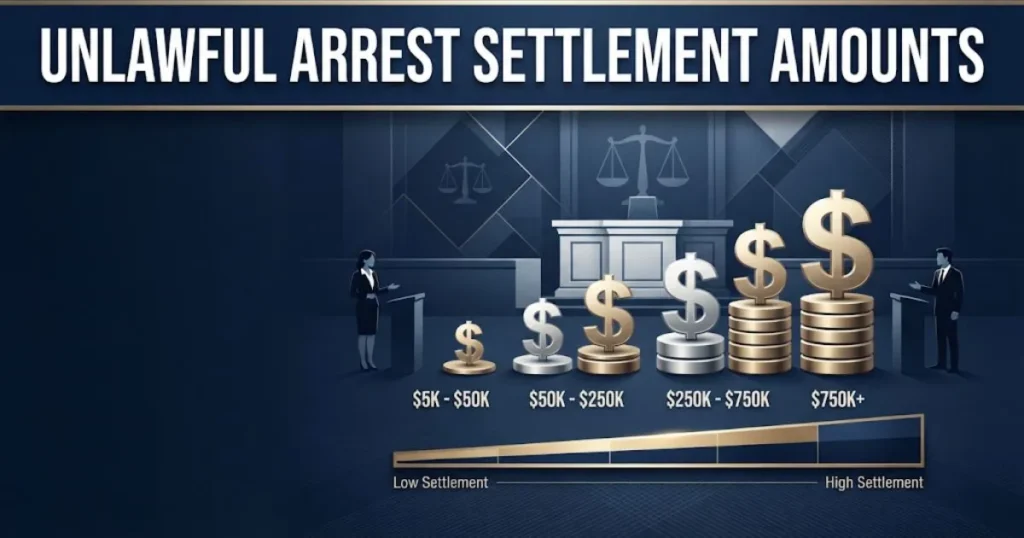
Settlement amounts for unlawful arrest lawsuits in 2026 typically range from $10,000 to $500,000, with extreme cases exceeding $1 million. The exact number depends on how badly the arrest affected your life.
Minor cases where someone was detained briefly and released without injury tend to settle in the $10,000 to $50,000 range. These involve short detention periods and minimal lasting harm.
Cases involving physical force during the arrest push payouts higher. If officers used excessive force, caused injuries, or held you for an extended period, settlements often land between $100,000 and $500,000.
The biggest payouts happen when arrests cause severe consequences. Job loss, destroyed reputation, physical injury, and extended jail time can push settlements past $1 million.
| Severity Level | Typical Settlement Range | Example Scenario |
|---|---|---|
| Minor | $10,000 to $50,000 | Brief detention, no injury, charges dropped quickly |
| Moderate | $50,000 to $250,000 | Hours or days in jail, emotional distress, lost wages |
| Severe | $250,000 to $500,000 | Physical injury during arrest, extended detention |
| Extreme | $500,000 to $2 million+ | Significant bodily harm, job loss, public humiliation, racial profiling |
Several recent cases set the bar high. In 2024, a man in Louisville, Kentucky received $750,000 after officers arrested him for filming a traffic stop from his own front yard. In 2023, a woman in Phoenix, Arizona settled for $475,000 after being arrested at a routine traffic checkpoint despite having valid identification.
Jury verdicts tend to be higher than settlements. When cases go to trial, juries sometimes award punitive damages on top of compensatory damages, especially when officer misconduct was intentional or reckless.
How to Sue for Unlawful Arrest
To sue for unlawful arrest, you need to file a civil complaint in either state or federal court, naming the officer and their employing agency as defendants. The process has clear steps, and timing matters.
Here is the basic sequence:
- Step 1: Document everything about your arrest immediately. Write down dates, times, officer names, badge numbers, and witness contact information.
- Step 2: Preserve all evidence. Save text messages, photos, videos, medical records, and booking paperwork.
- Step 3: File a complaint with the police department’s Internal Affairs division. This creates an official record.
- Step 4: Consult with an attorney who handles civil rights cases. Most work on contingency, meaning no upfront cost.
- Step 5: Your attorney files a civil complaint in court. In federal cases, this is filed under 42 U.S.C. Section 1983.
- Step 6: The discovery process begins. Both sides exchange evidence.
- Step 7: Settlement negotiations happen. If no deal is reached, the case goes to trial.
Some states require you to file a notice of claim before suing a government entity. This is a formal letter telling the city or county you plan to sue. Deadlines for this notice can be as short as 30 to 90 days after the arrest.
Missing the notice of claim deadline can kill your case entirely. Check your state’s rules immediately.
The entire lawsuit process takes 12 to 36 months from filing to resolution. Cases that settle avoid trial and typically resolve faster.
Key Takeaway: An unlawful arrest lawsuit can recover thousands to over a million dollars, but you must act fast, preserve evidence, and file within your state’s notice of claim deadline.
False Arrest Lawsuit Basics
A false arrest lawsuit is a civil claim based on being detained or arrested without proper legal authority. It overlaps significantly with unlawful arrest claims, but the terms have slightly different legal roots.
False arrest is technically a tort under state law. It means someone intentionally restricted your freedom of movement without consent and without legal justification.
Unlawful arrest is the broader term that can cover both state tort claims and federal civil rights claims. When people say “false arrest lawsuit,” they usually mean the same thing as an unlawful arrest lawsuit.
The distinction matters in one specific way. State tort claims (false arrest) may have damage caps set by state law. Federal claims under Section 1983 (unlawful arrest) generally do not have caps on compensatory or punitive damages.
| Term | Legal Basis | Damage Caps | Court |
|---|---|---|---|
| False Arrest | State tort law | Often capped by state statute | State court |
| Unlawful Arrest | Section 1983, Fourth Amendment | Generally no caps | Federal court |
| False Imprisonment | State tort law | Often capped | State court |
Many attorneys file both a state tort claim and a federal Section 1983 claim at the same time. This dual approach gives you two bites at the apple and maximizes your potential recovery.
You do not need to have been formally “charged” with a crime to bring a false arrest claim. The arrest itself, meaning the physical restraint of your liberty, is enough.
Filing a False Arrest Claim Against Police
Filing a false arrest claim against police starts with proving that the officers lacked legal authority to arrest you. This means showing they had no warrant and no probable cause at the moment they placed you in custody.
The key phrase is “at the moment.” Courts look at what the officer knew at the exact time of arrest. It does not matter if evidence of a crime was found later. If the officer had no reason to arrest you when they did it, the arrest was illegal.
Here is what your claim needs to establish:
- The officer intentionally confined or restrained you
- The confinement was against your will
- The officer had no legal authority (no warrant, no probable cause)
- You suffered harm as a result
Against police specifically, there is an extra layer. You are suing a government employee, which brings up questions about immunity and municipal liability.
Most false arrest claims against police are filed against both the individual officer and the police department. Under the legal principle from Monell v. Department of Social Services (1978), you can hold a city liable if the arrest resulted from an official policy, a pattern of misconduct, or inadequate training.
This is important because cities are more likely to settle than individual officers. A city has more money, more to lose from bad publicity, and a stronger incentive to make your case go away quietly.
If the charges against you were dropped, dismissed, or you were found not guilty, your case becomes significantly stronger. A conviction, on the other hand, makes a false arrest claim almost impossible to win.
Unlawful Arrest and Probable Cause
Probable cause is the legal standard that determines whether your arrest was lawful. An officer must have enough factual basis to make a reasonable person believe you committed, were committing, or were about to commit a crime.
This standard is not just a gut feeling. It requires specific, articulable facts. “He looked suspicious” is not probable cause. “I observed him breaking a car window and removing property” is.
Here is how courts evaluate probable cause:
- Was there a warrant? If yes, probable cause was already reviewed by a judge.
- Did the officer directly observe criminal activity?
- Did a credible witness report criminal activity with specific details?
- Did physical evidence at the scene point to the person arrested?
When probable cause is missing, the arrest violates the Fourth Amendment. Period. That gives you grounds for a lawsuit.
| Probable Cause Present | Probable Cause Absent |
|---|---|
| Officer saw you commit a crime | Officer arrested you based on a hunch |
| Reliable witness identified you | Anonymous tip with no corroboration |
| Warrant issued by a judge | No warrant, no observed crime |
| Physical evidence linked to you | Arrest based on your appearance or race |
One common scenario involves mistaken identity. Officers arrest the wrong person based on a vague description. Courts have ruled repeatedly that arresting someone solely because they “match a description” without more specific evidence can lack probable cause.
Another growing issue is pretextual arrests. This is when officers use a minor violation as an excuse to arrest someone they want to detain for other reasons. Courts scrutinize these heavily.
Key Takeaway: Probable cause is the make-or-break element of any unlawful arrest lawsuit; if the officer did not have specific facts justifying your arrest, you have a case.
Section 1983 Unlawful Arrest Claims
A Section 1983 claim is the most powerful legal tool available to someone filing an unlawful arrest lawsuit in federal court. It allows you to sue any government official who violates your constitutional rights while acting under color of law.
The statute, 42 U.S.C. Section 1983, was passed during Reconstruction in 1871. It was originally designed to protect formerly enslaved people from abuses by state and local officials. Today, it covers all civil rights violations by government actors.
To win a Section 1983 unlawful arrest claim, you must prove two things:
- Element 1: The defendant acted “under color of state law” (meaning they were on duty or using their government authority).
- Element 2: The defendant deprived you of a right secured by the Constitution (in arrest cases, the Fourth Amendment).
Section 1983 claims are filed in federal district court. This matters for several reasons.
Federal courts tend to be more favorable to civil rights plaintiffs. Federal judges handle these cases regularly and understand the constitutional standards. Federal juries can award both compensatory damages and punitive damages without the caps that some state laws impose.
| Feature | Section 1983 (Federal) | State Tort Claim |
|---|---|---|
| Court | Federal district court | State court |
| Legal Standard | Constitutional violation | State tort law |
| Damage Caps | Generally none | Often capped |
| Punitive Damages | Available | Varies by state |
| Attorney Fees | Winner can recover fees (42 U.S.C. 1988) | Varies |
One major advantage of Section 1983 is the attorney fee provision. Under 42 U.S.C. Section 1988, if you win, the court can order the defendant to pay your attorney’s fees. This makes it easier to find a lawyer willing to take your case.
The landmark case Monroe v. Pape (1961) confirmed that Section 1983 applies to local police officers. That ruling opened the door for millions of civil rights claims against law enforcement.
What Unlawful Arrest Damages Can You Recover
Unlawful arrest damages fall into three categories: compensatory, punitive, and nominal. The type and amount you recover depend on what happened to you and how badly the arrest affected your life.
Compensatory damages cover your actual losses. These are the most common and include:
- Lost wages from missed work
- Medical bills for injuries sustained during arrest
- Therapy and mental health treatment costs
- Damage to personal property
- Loss of earning capacity if the arrest cost you a job or career
Punitive damages are extra money awarded to punish the officer for particularly outrageous conduct. Courts award these when the officer acted with malice, recklessness, or deliberate indifference to your rights.
Nominal damages are small symbolic amounts (often $1) awarded when the court finds your rights were violated but you cannot prove specific financial losses. Even nominal damage awards matter because they establish that the officer acted wrongfully.
| Damage Type | Purpose | Typical Range |
|---|---|---|
| Compensatory | Cover actual financial losses | $5,000 to $500,000+ |
| Punitive | Punish outrageous conduct | $10,000 to $1 million+ |
| Nominal | Acknowledge rights violation | $1 to $100 |
| Attorney Fees | Reimburse legal costs | Varies |
Emotional distress is a compensatory damage category that deserves special attention. You do not need a physical injury to claim emotional distress. Anxiety, depression, PTSD, sleeplessness, and humiliation are all compensable.
In 2024, a federal jury in Chicago awarded $300,000 in emotional distress damages alone to a man who was falsely arrested in front of his children. No physical injury occurred. The humiliation and psychological impact were enough.
How Unlawful Arrest Compensation Works
Unlawful arrest compensation is paid by the government entity (city, county, or state) that employs the officer who arrested you. In most cases, you will not collect money directly from the officer.
Here is why. Most police departments have indemnification policies that cover officers who are sued. The city or county pays the settlement or judgment on the officer’s behalf. This is similar to how a company pays when its employee causes harm on the job.
The money comes from municipal budgets, insurance policies, or dedicated settlement funds. Some large cities like New York, Chicago, and Los Angeles set aside hundreds of millions of dollars annually to cover police misconduct payouts.
The payment process follows this timeline:
- Settlement reached or verdict awarded: Money amount is determined.
- 30 to 90 days after agreement: Government processes payment.
- Attorney takes contingency fee: Usually 33% to 40% of the total.
- You receive the remaining balance.
One thing people do not realize: your compensation is often tax-free. Under federal tax law, damages received for physical injuries or physical sickness are not taxable income. Emotional distress damages that are not connected to a physical injury may be partially taxable.
| Payment Stage | Timeframe |
|---|---|
| Case resolution (settlement or verdict) | 12 to 36 months after filing |
| Government payment processing | 30 to 90 days after resolution |
| Attorney fee deduction | Immediately upon receipt |
| Net payment to you | Within 30 days of attorney receipt |
Some cases involve structured settlements where you receive payments over time instead of one lump sum. This is more common in high-value cases exceeding $500,000.
Key Takeaway: Compensation for unlawful arrest comes from government budgets, is often tax-free for physical injury damages, and typically arrives 12 to 36 months after you file your case.
Suing Police for False Arrest
Suing police for false arrest is legal in all 50 states and has become increasingly common in 2025 and 2026. You are not just allowed to do it. The Constitution guarantees your right to seek accountability.
Many people hesitate because they think suing the police is pointless or dangerous. It is neither. Courts handle thousands of these cases every year. Juries regularly side with plaintiffs when the evidence shows a clear lack of probable cause.
Here is what makes suing police different from suing a private citizen:
- Government immunity rules apply. You must deal with qualified immunity (more on that below) and notice of claim requirements.
- Higher burden on the plaintiff. You must prove a constitutional violation, not just negligence.
- Bigger potential payouts. Government entities have deeper resources than individuals.
- Public accountability. Lawsuits create public records that expose misconduct patterns.
Recent data from 2024 shows that over 60% of false arrest lawsuits against police that reach federal court result in settlements before trial. Cities prefer settling over risking a larger jury verdict and negative press coverage.
The most successful cases share common characteristics:
- Charges were dropped or the plaintiff was acquitted
- Video evidence contradicts the officer’s version of events
- The officer has a history of complaints or prior lawsuits
- The arrest caused significant, documentable harm
You do not need to prove the officer was “evil” or acted with bad intentions. You only need to show they lacked probable cause. Even a well-meaning officer who makes a mistake can be held liable.
How to File an Unlawful Arrest Complaint
Filing an unlawful arrest complaint involves two tracks: an administrative complaint with the police department and a legal complaint filed in court. Both serve different purposes, and you should pursue both simultaneously.
Administrative Complaint (Internal Affairs):
This goes to the police department’s Internal Affairs division. It creates an official record that the officer was accused of misconduct. While Internal Affairs investigations rarely result in serious discipline, the complaint itself becomes valuable evidence in your civil lawsuit.
- Visit the police department’s website or office
- Request a complaint form
- Write a detailed account of what happened
- Include dates, times, locations, and officer identifying information
- Submit the form and keep a copy for your records
- You should receive a case number within 7 to 14 days
Legal Complaint (Court Filing):
This is the actual lawsuit. Your attorney drafts a civil complaint that outlines what happened, identifies the legal violations, names the defendants, and states the damages you are seeking.
| Filing Step | Who Does It | Timeline |
|---|---|---|
| Notice of claim (if required by state) | You or your attorney | 30 to 180 days after arrest |
| Civil complaint drafted | Attorney | 1 to 4 weeks |
| Complaint filed with court | Attorney | Same day as completion |
| Defendants served with papers | Process server | 30 to 120 days after filing |
| Defendants file response | Defense attorney | 21 to 60 days after service |
Many cities and counties require a notice of claim before you can file suit. This is a formal document that tells the government you intend to sue. Deadlines vary wildly:
- New York: 90 days
- California: 6 months
- Texas: 6 months
- Illinois: 1 year
- Florida: 3 years (no separate notice required for most claims)
Missing the notice of claim deadline is one of the most common reasons unlawful arrest cases fail. Do not wait.
What Evidence Do You Need for a False Arrest Lawsuit
Evidence is the backbone of every false arrest lawsuit. The strongest cases in 2026 rely on video footage, digital records, and documented inconsistencies in the officer’s account.
Here is the evidence that wins cases, ranked by impact:
- Body camera footage: This is the single most valuable piece of evidence. If the officer’s camera shows no criminal activity before the arrest, your case is strong.
- Bystander or surveillance video: Cellphone recordings and security camera footage provide independent verification.
- Police reports and arrest records: Inconsistencies between what the officer wrote and what actually happened undermine credibility.
- Dispatch records and 911 calls: These show what information the officer actually had before arriving on scene.
- Witness statements: Third-party accounts from people who saw the arrest.
- Medical records: Document any injuries sustained during the arrest.
- Text messages and social media posts: Can establish your whereabouts and activities.
In 2026, body-worn camera programs cover over 80% of large police departments in the United States. Many states now have laws requiring officers to activate cameras during all encounters with the public.
| Evidence Type | How to Obtain It | Impact Level |
|---|---|---|
| Body camera footage | Public records request or FOIA | Very High |
| Bystander video | Witness cooperation | Very High |
| Police report | Public records request | High |
| Dispatch records | Subpoena or FOIA | High |
| Medical records | Your healthcare provider | Medium to High |
| Witness statements | Your attorney interviews witnesses | Medium |
One strategy that attorneys use effectively: comparing the officer’s written report to the body camera footage. When there are discrepancies, it destroys the officer’s credibility and makes settlement far more likely.
You should request body camera footage through a Freedom of Information Act (FOIA) request or your state’s equivalent public records law as soon as possible. Some departments delete footage after 60 to 180 days.
Key Takeaway: Body camera footage and bystander video are the most powerful evidence in 2026 unlawful arrest cases; request body camera recordings immediately before departments delete them.
Qualified Immunity and Unlawful Arrest
Qualified immunity is the legal doctrine that protects government officials, including police officers, from personal liability unless they violate “clearly established” constitutional rights. It is the biggest obstacle in most unlawful arrest lawsuits.
Here is how it works in practice. Even if an officer arrested you without probable cause, they can claim qualified immunity if no prior court ruling in their jurisdiction specifically said that exact type of arrest was unconstitutional.
The standard is frustrating for plaintiffs. The officer’s behavior does not need to be identical to a prior case. But it needs to be similar enough that a “reasonable officer” would have known the arrest was illegal.
Courts across the country are split on how strictly to apply qualified immunity. Some federal circuits have made it very difficult to overcome. Others have narrowed its scope.
In 2024 and 2025, several significant developments shifted the landscape:
- Colorado, New Mexico, and New York City passed laws eliminating qualified immunity for state-level civil rights claims
- The Supreme Court has taken multiple qualified immunity cases, signaling potential changes
- Some federal circuits have started applying qualified immunity less rigidly
| Qualified Immunity Status | Jurisdictions |
|---|---|
| Eliminated for state claims | Colorado, New Mexico, New York City |
| Under legislative review | Connecticut, Massachusetts, Oregon |
| Fully applied | Most other states (federal claims) |
| Narrowed by circuit courts | 9th Circuit, 4th Circuit |
Here is the good news. Qualified immunity is a defense that officers raise during litigation. Your case does not get dismissed automatically. The officer must file a motion, and the judge decides whether immunity applies.
Many attorneys avoid qualified immunity problems by focusing the lawsuit on the city or municipality rather than the individual officer. Qualified immunity does not protect cities or counties. Under the Monell standard, if the city had policies or training deficiencies that caused the unlawful arrest, the city pays regardless of whether the officer has immunity.
Statute of Limitations for Unlawful Arrest
The statute of limitations for unlawful arrest lawsuits varies by state and by whether you file in state or federal court. For federal Section 1983 claims, the deadline is borrowed from your state’s personal injury statute of limitations.
This means the clock is different depending on where you live.
| State | Statute of Limitations (Section 1983) | Notice of Claim Deadline |
|---|---|---|
| California | 2 years | 6 months |
| New York | 3 years | 90 days |
| Texas | 2 years | 6 months |
| Florida | 4 years | 3 years (varies) |
| Illinois | 2 years | 1 year |
| Pennsylvania | 2 years | 6 months |
| Ohio | 2 years | None required for most claims |
| Georgia | 2 years | 12 months (ante-litem notice) |
The clock starts ticking on the date of the arrest. Not the date you were released. Not the date charges were dropped. The arrest date itself.
There is one important exception. If you were a minor at the time of the arrest, the statute of limitations may be tolled (paused) until you turn 18. This gives minors extra time to file.
Some states have separate, shorter deadlines for filing the notice of claim. New York’s 90-day notice requirement catches many people off guard. If you miss it, your case is dead before it starts.
Do not assume you have plenty of time. Even if your state allows 3 or 4 years, the best evidence disappears quickly. Witnesses forget details. Body camera footage gets deleted. Memories fade.
The safest approach is to contact an attorney within 30 days of your arrest. Even if you decide not to sue right away, an attorney can preserve evidence and protect your deadlines.
Unlawful Detention Lawsuit Claims
An unlawful detention lawsuit covers situations where you were held by police without legal authority but may not have been formally “arrested.” Being stopped, held, handcuffed, or confined in a patrol car without justification qualifies.
The legal distinction between a detention and an arrest matters:
- Detention (Terry stop): Officers can briefly stop you if they have reasonable suspicion of criminal activity. This is a lower standard than probable cause.
- Arrest: Officers take you into custody. This requires probable cause or a warrant.
Problems arise when a brief detention turns into a prolonged hold without justification. If officers stop you for 5 minutes to ask questions, that might be lawful. If they hold you for 2 hours without developing probable cause, that crosses the line into unlawful detention.
Courts use a “reasonable duration” test. The detention must last no longer than necessary to confirm or dispel the officer’s suspicion. Anything beyond that becomes an unlawful seizure under the Fourth Amendment.
| Detention Type | Legal Standard | When It Becomes Unlawful |
|---|---|---|
| Brief investigatory stop | Reasonable suspicion | When it exceeds a reasonable duration |
| Traffic stop | Reasonable suspicion of violation | When extended beyond the purpose of the stop |
| Handcuffed detention | Reasonable suspicion + safety concern | When used without justification or for extended periods |
| Held in patrol car | Reasonable suspicion + safety concern | When prolonged without arrest or release |
A growing category of unlawful detention cases involves immigration checkpoints. Federal courts have ruled that Border Patrol agents cannot detain people at interior checkpoints beyond the time needed to ask basic citizenship questions without developing individualized suspicion.
Unlawful detention cases often settle for lower amounts than full arrest cases because the confinement period is shorter. However, if the detention involved physical force, racial profiling, or public humiliation, damages can be substantial.
Key Takeaway: Even if you were never formally arrested, being held by police without justification beyond a reasonable duration gives you grounds for an unlawful detention lawsuit.
Police Misconduct Lawsuits in 2026
Police misconduct lawsuits in 2026 are being filed at record rates, driven by increased body camera evidence, public awareness, and evolving legal standards that make it easier to hold departments accountable.
Several trends are shaping these cases right now:
- Body camera mandates have expanded to smaller departments, creating more evidence for plaintiffs
- Pattern-and-practice investigations by the DOJ have resulted in consent decrees requiring reform in multiple cities
- State-level qualified immunity reforms in Colorado, New Mexico, and other jurisdictions have removed barriers to filing
- Social media documentation by bystanders provides independent evidence that was rarely available before 2020
The types of police misconduct that generate lawsuits include:
- Unlawful arrest and false imprisonment
- Excessive force and police brutality
- Racial profiling and discriminatory policing
- Illegal search and seizure
- Fabrication of evidence
- Failure to intervene when another officer violates rights
Major cities continue to pay enormous sums. New York City paid over $121 million in police misconduct settlements in fiscal year 2024 alone. Chicago paid approximately $80 million. Los Angeles paid roughly $60 million.
| City | Annual Police Misconduct Payouts (Approximate) |
|---|---|
| New York City | $121 million (FY 2024) |
| Chicago | $80 million (FY 2024) |
| Los Angeles | $60 million (FY 2024) |
| Philadelphia | $30 million (FY 2024) |
| Baltimore | $18 million (FY 2024) |
These numbers tell a clear story. Cities are paying a steep price for failing to hold officers accountable, and individual plaintiffs are the ones benefiting.
If you are considering filing a police misconduct lawsuit in 2026, conditions are more favorable than they have been in decades. More evidence tools are available. More legal precedents exist. More juries are willing to hold officers accountable.
Do You Need an Unlawful Arrest Attorney
You do not legally need an attorney to file an unlawful arrest lawsuit, but winning without one is extremely unlikely. These cases involve complex constitutional law, government immunity defenses, and procedural requirements that trip up even experienced lawyers.
Here is the reality. Civil rights attorneys who handle unlawful arrest cases typically work on a contingency fee basis. That means you pay nothing upfront. The attorney takes a percentage of your settlement or verdict, usually 33% to 40%.
If you lose, you owe nothing. The attorney absorbs the cost of the case.
What a good attorney does for your case:
- Identifies the strongest legal theory (Section 1983, state tort, or both)
- Files the notice of claim before the deadline expires
- Obtains body camera footage, dispatch records, and police reports through legal channels
- Deposes the arresting officer and other witnesses
- Negotiates with the city’s legal team
- Takes the case to trial if the settlement offer is too low
| Attorney Fee Structure | Details |
|---|---|
| Contingency fee | 33% to 40% of recovery; no upfront cost |
| Hourly rate (rare for these cases) | $200 to $600 per hour |
| Pro bono (nonprofit legal orgs) | Free, but limited availability |
When choosing an attorney, look for someone with specific experience in Section 1983 litigation and police misconduct cases. General personal injury attorneys may not understand the nuances of qualified immunity, municipal liability, or federal civil rights procedure.
The ACLU, National Police Accountability Project, and local legal aid societies can help connect you with attorneys who specialize in these cases.
Wrongful Arrest Civil Rights Claims
A wrongful arrest civil rights claim is a lawsuit that frames your illegal arrest as a violation of your constitutional rights rather than a simple tort. This distinction matters because civil rights claims carry stronger protections, higher potential damages, and federal court jurisdiction.
The constitutional basis for these claims comes from two amendments:
- Fourth Amendment: Protects against unreasonable searches and seizures (including arrests without probable cause)
- Fourteenth Amendment: Ensures equal protection and due process, which applies when arrests are motivated by racial bias or discrimination
Civil rights claims go beyond just saying “the officer made a mistake.” They say “the officer violated my fundamental rights as an American citizen.”
This framing has practical consequences:
- Federal courts have jurisdiction
- No damage caps in most circuits
- Attorney fees recoverable under 42 U.S.C. Section 1988
- Punitive damages available against individual officers
- Municipal liability available under the Monell doctrine
| Claim Type | Legal Basis | Key Advantage |
|---|---|---|
| Fourth Amendment claim | Unreasonable seizure | No probable cause needed to be proven by plaintiff; burden shifts |
| Fourteenth Amendment claim | Equal protection violation | Addresses racial profiling and discriminatory enforcement |
| First Amendment retaliation | Arrest in response to protected speech | Covers arrests for filming police, protesting, or criticizing officers |
A growing subset of wrongful arrest civil rights claims involves First Amendment retaliation. This is when officers arrest someone for filming them, speaking critically, or exercising free speech. Courts have increasingly ruled that these arrests violate the First Amendment, even when officers claim a technical violation like “obstruction.”
In 2024, the Third Circuit Court of Appeals ruled that arresting a bystander for filming police in a public place violates clearly established First Amendment rights. This ruling stripped officers of qualified immunity in filming-related arrest cases within that circuit.
If your arrest involved any element of discrimination, retaliation for speech, or targeting based on race, religion, or political activity, a civil rights framing dramatically strengthens your case.
Key Takeaway: Framing your case as a civil rights claim rather than a simple tort opens the door to federal court, higher damages, recoverable attorney fees, and stronger legal protections.
Frequently Asked Questions
How much can I get from an unlawful arrest lawsuit in 2026?
Most unlawful arrest settlements range from $10,000 to $500,000 depending on the severity of the arrest and resulting harm.
Cases involving physical injury, extended detention, or racial profiling often exceed $500,000.
Jury verdicts in extreme cases have reached $1 million or more.
Can I sue the police for arresting me without probable cause?
Yes, you can sue police for arresting you without probable cause under both state tort law and federal civil rights law (Section 1983).
You must prove the officer lacked specific facts justifying the arrest at the time it occurred.
If charges were dropped or you were acquitted, your case is significantly stronger.
What is the deadline to file an unlawful arrest lawsuit?
The statute of limitations for federal Section 1983 claims ranges from 2 to 4 years depending on your state.
Many states require a separate notice of claim filed within 30 to 180 days of the arrest.
Missing the notice of claim deadline can permanently bar your lawsuit.
Does qualified immunity prevent me from suing a police officer?
Qualified immunity does not automatically prevent your lawsuit from moving forward.
The officer must prove that the right they violated was not “clearly established” at the time of the arrest.
You can avoid qualified immunity entirely by suing the city or municipality instead of the individual officer.
What evidence do I need to win a false arrest case?
Body camera footage is the most powerful evidence in 2026 false arrest cases.
Bystander video, police reports with inconsistencies, dispatch records, and witness statements all strengthen your claim.
Request body camera footage immediately through a public records request because departments may delete it within 60 to 180 days.
Take Action Now
If you were arrested without probable cause, your rights were violated. The law gives you a clear path to hold officers and their departments accountable through an unlawful arrest lawsuit.
Do not wait until evidence disappears or deadlines expire. Start documenting everything today. Request body camera footage this week.
The strongest cases begin with early action. File your complaint, talk to a civil rights attorney, and protect the evidence that proves what happened to you.







