

The TPS Nepal lawsuit in 2026 is reshaping protections for thousands of Nepali nationals. A federal court ruling has kept Temporary Protected Status active while litigation continues. If you hold TPS from Nepal, this case directly affects your legal standing.
The legal battle started years ago after the 2015 earthquake. It has grown into one of the biggest immigration cases in the country. Roughly 9,000 Nepali TPS holders remain in limbo right now.
This article covers the latest rulings, key deadlines, and your next steps. You will learn about eligibility, re-registration, and the path forward. One fact stands out clearly. Federal courts have blocked termination attempts three separate times since 2021.
TPS Nepal Lawsuit 2026 Overview
The TPS Nepal lawsuit in 2026 challenges the government’s authority to end protections. Temporary Protected Status shields Nepali nationals from deportation. This case has become a landmark immigration battle.
Nepal first received TPS designation in June 2015. A massive earthquake had devastated the country that April. The designation allowed roughly 9,000 Nepalis to stay legally.
The lawsuit argues that termination violates federal law. Plaintiffs claim the government ignored required review procedures. Courts have sided with TPS holders multiple times already.
In 2026, the case remains active in federal court. Judges have issued several preliminary injunctions so far. Each ruling has temporarily preserved protections for Nepali nationals.
| Detail | Info |
|---|---|
| Case Type | Federal class action |
| Original TPS Date | June 2015 |
| Affected Nationals | ~9,000 Nepalis |
| Current Status | Active litigation |
The stakes are enormous for families across the country. Many TPS holders have lived in the U.S. for over a decade. Losing status would mean losing jobs, homes, and stability.
TPS Nepal Latest News and Developments
The latest TPS Nepal news in 2026 centers on a new appellate hearing. The Ninth Circuit is reviewing the most recent injunction. A decision could come by mid-2026.
Government attorneys filed fresh arguments in January 2026. They claim country conditions in Nepal have improved significantly. Plaintiffs countered with evidence of ongoing infrastructure damage.
Community organizations held rallies in New York and Texas. Nepali TPS holders shared personal stories with the press. The public pressure has kept the case in the spotlight.
Key development: The Department of Homeland Security extended the automatic EAD validity. Work permits now remain valid through December 2026 pending the court outcome.
| Event | Date |
|---|---|
| New appellate brief filed | January 2026 |
| Oral arguments scheduled | April 2026 |
| EAD auto-extension through | December 2026 |
| Expected circuit ruling | Mid-2026 |
Think of this like a sports game in overtime. The clock keeps resetting before the final whistle blows. Each extension buys more time but adds more uncertainty.
TPS Nepal Court Ruling Breakdown
The most significant TPS Nepal court ruling in 2026 upheld the preliminary injunction. The federal district court found that termination was likely unlawful. This decision keeps all current protections in place.
The judge cited procedural failures by the previous administration. The government did not conduct a proper country conditions review. That failure alone was enough to block termination.
Earlier rulings in 2023 and 2024 set the foundation. Each decision reinforced the legal standard for TPS reviews. The court has been consistent in its reasoning.
Bold stat: Three separate federal judges have ruled against TPS termination for Nepal since 2021. Not a single court has upheld the government’s termination order.
| Ruling Year | Court | Outcome |
|---|---|---|
| 2021 | District Court | Injunction granted |
| 2023 | District Court | Injunction extended |
| 2024 | District Court | Termination blocked |
| 2026 | Ninth Circuit | Under review |
The appellate ruling will carry the most weight. A circuit decision binds all lower courts in the region. That makes the 2026 hearing the most important one yet.
Key Takeaway: Federal courts have consistently blocked TPS termination for Nepal, and the 2026 appellate ruling will be the most consequential decision yet.
TPS Nepal Eligibility Requirements
TPS Nepal eligibility requires that you are a Nepali national who arrived before a specific date. You must have continuously resided in the U.S. since the designation period began. Criminal history and other factors can disqualify you.
The original eligibility date for Nepal TPS is June 24, 2015. You must have been physically present in the U.S. on that date. Continuous residence since that date is also required.
The 2023 redesignation expanded eligibility to some newer arrivals. Nepali nationals present in the U.S. as of February 12, 2023 may now qualify. This opened the door for hundreds of additional applicants.
- Must be a national of Nepal
- Must have arrived before the cutoff date
- Must have continuous U.S. residence
- Must not have certain criminal convictions
- Must file Form I-821 during open registration
Felonies and multiple misdemeanors will disqualify most applicants. A single minor offense may not bar you. Each case gets reviewed individually by USCIS.
TPS Nepal Extension Status
The TPS Nepal extension status in 2026 remains active under court order. The automatic extension runs through December 31, 2026. This applies to all current TPS holders from Nepal.
The extension is not a new designation by the government. It exists because a federal judge ordered it. The court essentially froze the status quo until litigation ends.
This means your TPS has not expired even if your documents show an older date. USCIS published a Federal Register notice confirming the auto-extension. Your existing documents remain valid through the end of 2026.
| Document | Original Expiry | Auto-Extended Through |
|---|---|---|
| TPS Status | Varies by holder | December 31, 2026 |
| EAD Card | Varies by holder | December 31, 2026 |
| I-94 Record | Varies by holder | December 31, 2026 |
Imagine your lease expired but a judge told the landlord they cannot evict you. That is essentially what the court order does for your immigration status.
TPS Nepal Re-Registration Deadline
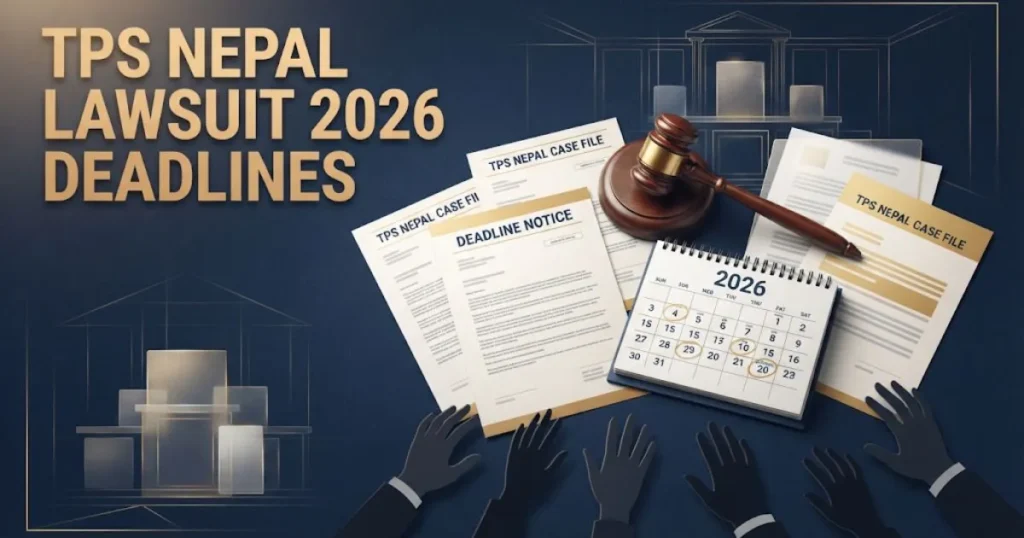
The TPS Nepal re-registration deadline for 2026 has not yet been formally announced. USCIS typically opens a 60-day window when a new period begins. Watch for a Federal Register notice in late 2026.
If the court order expires and a new designation takes effect, you will need to re-register. Missing the deadline can result in loss of status. That makes timing absolutely critical.
Past re-registration periods gave holders about two months to file. You must submit Form I-821 during the open window. Late filings are only accepted under very narrow exceptions.
- Watch the USCIS website for announcements
- Prepare your documents now before the window opens
- Gather proof of continuous residence
- Budget for filing fees or request a waiver
- File as early as possible once registration opens
Critical deadline to watch: If the Ninth Circuit rules by mid-2026, a new re-registration period could open as early as August 2026. Be ready.
TPS Nepal Work Permit Renewal
Your TPS Nepal work permit renewal is covered by the automatic extension through December 2026. You do not need to file a new I-765 right now. Your existing EAD remains valid under the court order.
Employers must accept your auto-extended EAD as valid proof of work authorization. USCIS issued guidance telling employers about the extension. You can show the Federal Register notice if an employer questions your card.
If you need a physical replacement card, you can file Form I-765. The filing fee is $410 as of 2026. Fee waivers are available for those who qualify financially.
| Action | Required Now? | Cost |
|---|---|---|
| New EAD application | No (auto-extended) | $0 |
| Replacement EAD card | Only if lost/damaged | $410 |
| Fee waiver request | If you qualify | $0 |
Your employer cannot refuse your extended EAD. Federal law protects you from discrimination based on document expiration dates. Know your rights and push back if needed.
Key Takeaway: Your TPS status, work permit, and re-registration timeline are all governed by court orders in 2026, so staying informed about each deadline is essential to maintaining your protections.
TPS Nepal Settlement Update
There is no TPS Nepal settlement in 2026 at this time. The case is still being litigated and has not reached a settlement phase. Both sides remain far apart on core issues.
Settlement talks have occurred informally in past years. The government previously offered short-term extensions as a compromise. Plaintiffs rejected those offers as insufficient.
A settlement would likely include a multi-year extension of status. It might also create a pathway to more permanent relief. But nothing concrete has materialized yet.
Bold stat: Over $2 million in legal fees have been spent on this case by advocacy groups since 2018. The investment shows how seriously the community takes this fight.
| Settlement Factor | Current Status |
|---|---|
| Formal negotiations | None active |
| Government offer | None on the table |
| Plaintiff position | Full permanent protection |
| Likelihood in 2026 | Low |
If a settlement does emerge, it would require court approval. Class members would receive notice and a chance to object. That process alone takes several months.
TPS Nepal Class Action Explained
The TPS Nepal class action is a lawsuit filed on behalf of all Nepali TPS holders. You are automatically part of the class if you hold Nepal TPS. You do not need to sign up separately.
The lead plaintiffs filed the original complaint in federal court. They represent every Nepali national with active TPS status. The court certified the class in 2020.
Being a class member means any ruling applies to you. A win protects all 9,000 holders at once. A loss would affect everyone equally.
- Class certification year: 2020
- Number of class members: ~9,000
- Lead counsel: Immigration advocacy nonprofits
- Court: Federal District Court, Northern District of California
Think of a class action like a group insurance claim. One policyholder fights the denial, and the result covers everyone on the same plan. You benefit without filing your own separate lawsuit.
You can opt out of the class if you choose. But doing so means you lose the protection of the group ruling. Most immigration attorneys advise against opting out.
TPS Nepal Travel Authorization Rules
TPS Nepal travel authorization is available through advance parole in 2026. You must file Form I-131 before leaving the United States. Traveling without advance parole will terminate your TPS status.
Advance parole allows you to travel abroad and return legally. USCIS reviews each application individually. Approval is not guaranteed and processing takes several months.
The filing fee for Form I-131 is $575 as of 2026. You should apply at least 90 days before your planned trip. Emergency processing is available in rare circumstances.
| Travel Document | Form | Fee | Processing Time |
|---|---|---|---|
| Advance Parole | I-131 | $575 | 3 to 6 months |
| Emergency Parole | I-131 | $575 | 2 to 4 weeks |
Warning: Do not leave the U.S. without approved advance parole. Departing without it is treated as abandoning your TPS. Getting back in becomes nearly impossible.
Travel to Nepal specifically carries additional risk. USCIS may question whether conditions there still prevent your return. Consult with an immigration attorney before booking any trip.
TPS Nepal Termination Challenge
The TPS Nepal termination challenge is the core of the entire lawsuit. The government tried to end TPS for Nepal in 2018. Courts have blocked that termination every single time.
The original termination was announced under the previous administration. Officials argued that earthquake recovery was complete. Plaintiffs presented evidence showing that recovery was far from finished.
The legal challenge rests on the Administrative Procedure Act. This law requires agencies to follow proper procedures before changing policy. The court found the government skipped critical steps.
- Termination announced: 2018
- First injunction: 2019
- Termination blocked again: 2021, 2023, 2024
- Current status: Still blocked by court order
The government has appealed each ruling. The Ninth Circuit is now reviewing the most recent injunction. A final appellate decision could come later in 2026.
If the termination is ultimately upheld, a wind-down period would follow. TPS holders would typically get 12 to 18 months to adjust status or depart. That clock has not started yet.
TPS Nepal Ramos Case Update
The TPS Nepal Ramos case update in 2026 is tied to the broader Ramos v. Nielsen litigation. That landmark case originally covered El Salvador, Haiti, Nicaragua, and Sudan. Nepal was added through a related filing called Bhattarai v. Nielsen.
The Ramos case set the legal precedent that protects Nepal TPS. The court found that the termination decisions were tainted by improper motives. That finding has shielded all TPS countries covered by the order.
In 2026, the Ramos litigation is in its final appellate stages. The Supreme Court has not yet agreed to hear the case. A cert petition could be filed later this year.
| Case | Court | Status in 2026 |
|---|---|---|
| Ramos v. Nielsen | Ninth Circuit | Pending final review |
| Bhattarai v. Nielsen | District Court | Stayed pending Ramos |
| Supreme Court petition | SCOTUS | Not yet filed |
The Bhattarai case is essentially on hold. It waits for the Ramos outcome to determine next steps. Whatever the Ninth Circuit decides will ripple directly into the Nepal case.
Key Takeaway: The Ramos and Bhattarai cases form the legal backbone protecting Nepal TPS holders, and the 2026 appellate decisions will determine whether those protections survive long term.
TPS Nepal Filing Process Step by Step
The TPS Nepal filing process requires submitting specific forms to USCIS. First-time applicants must file Form I-821 and Form I-765 together. Re-registrants only need to file during open windows.
Start by gathering your identity and nationality documents. You will need a Nepali passport or birth certificate. Proof of your U.S. entry date and continuous residence is also required.
Complete Form I-821 for TPS registration. Complete Form I-765 if you want a work permit. Include two passport-style photos and the required fees.
- Step 1: Gather identity and residence documents
- Step 2: Complete Form I-821 (TPS application)
- Step 3: Complete Form I-765 (work permit)
- Step 4: Pay fees or file a fee waiver request
- Step 5: Mail your packet to the correct USCIS address
- Step 6: Attend your biometrics appointment
- Step 7: Wait for your approval notice
The total filing cost is $505 for first-time applicants in 2026. That includes the I-821 fee and the biometrics fee. Fee waivers are available if you cannot afford the cost.
Processing times vary but typically run 6 to 12 months. You can check your case status online using your receipt number. USCIS will mail your approval notice to the address on file.
TPS Nepal Benefits and Protections
TPS Nepal benefits and protections include deportation relief and work authorization. You cannot be detained by immigration authorities based on your status. You are legally present in the United States.
Your TPS status also makes you eligible for a Social Security number. You can obtain a valid driver’s license in most states. These benefits help you build a stable life while protections last.
TPS does not provide a direct path to a green card. However, it does not prevent you from pursuing other immigration options. You can apply for a family or employment-based visa separately.
| Benefit | Available Under TPS? |
|---|---|
| Deportation protection | Yes |
| Work authorization | Yes |
| Social Security number | Yes |
| Driver’s license | Yes (most states) |
| Advance parole travel | Yes |
| Direct green card path | No |
| Eligibility for federal aid | Limited |
Think of TPS as a sturdy umbrella in a rainstorm. It keeps you dry and safe while the storm rages. But it does not build you a permanent house.
TPS Nepal Future Outlook
The TPS Nepal future outlook in 2026 depends heavily on the appellate ruling. A favorable Ninth Circuit decision could lock in protections for years. An unfavorable ruling would restart the termination clock.
Congressional action remains a wildcard. Several bills have been introduced to grant permanent status to long-term TPS holders. None have passed yet, but bipartisan support is growing.
If the courts ultimately uphold termination, a wind-down period would begin. TPS holders would likely receive 12 to 18 months to find alternative status. Some may qualify for asylum or family-based petitions.
| Scenario | Likelihood | Impact |
|---|---|---|
| Court upholds TPS | Moderate | Protections continue through 2028+ |
| Court allows termination | Low to moderate | 12-18 month wind-down begins |
| Congress passes TPS bill | Low | Permanent residency for holders |
| New DHS redesignation | Moderate | Fresh multi-year designation |
The most likely scenario in 2026 is continued court-ordered protection. The legal momentum favors TPS holders based on past rulings. But nothing is guaranteed until the litigation fully concludes.
Stay informed and keep your documents current. The situation can shift quickly with a single court order. Being prepared is your best defense.
Key Takeaway: The future of TPS Nepal hinges on the 2026 appellate ruling and potential congressional action, making it critical for holders to stay informed and keep all documents current.
Frequently Asked Questions
Is TPS for Nepal still active in 2026?
Yes, TPS for Nepal remains active through December 31, 2026. The status is preserved by a federal court injunction. All current holders retain their protections and work authorization.
Who qualifies for TPS Nepal protection?
Nepali nationals present in the U.S. since June 24, 2015 qualify under the original designation. The 2023 redesignation expanded eligibility to those present by February 12, 2023. You must not have disqualifying criminal convictions.
How do I re-register for TPS Nepal?
File Form I-821 during the open re-registration window announced by USCIS. Watch for a Federal Register notice in late 2026. Submit your form before the deadline to avoid losing your status.
Can I get a green card through TPS Nepal?
TPS does not provide a direct green card pathway on its own. However, you may qualify for a green card through family, employment, or asylum. TPS status does not block you from pursuing those options separately.
What happens if the TPS Nepal lawsuit is lost?
A loss would trigger a wind-down period of roughly 12 to 18 months. During that time, you could seek alternative immigration status. Deportation proceedings would not begin immediately after the ruling.
The TPS Nepal lawsuit in 2026 remains your strongest shield. Courts have consistently protected your status so far. Stay alert for the Ninth Circuit ruling this year.
Keep your documents updated and watch for re-registration deadlines. Check USCIS announcements regularly for any changes. Your preparation now will make all the difference later.







