The supreme court abortion case known as Dobbs reshaped American law in 2022. It ended nearly 50 years of federal abortion protections overnight. In 2026, the ripple effects are still unfolding in every state.
Multiple follow-up cases have reached the high court since then. The abortion pill case and the EMTALA emergency care case added new layers of confusion. Millions of Americans still do not know what their rights actually are.
This article breaks down every major ruling in plain English. You will learn what changed, who is affected, and what access looks like right now.
Over 14 states enacted near-total abortion bans within months of the Dobbs decision. That number has only grown since.
Related: Kwai Fun Wong Supreme Court Case Justice: Full 2026 Guide
Supreme Court Abortion Case 2026
The supreme court abortion case in 2026 refers to the ongoing legal fallout from Dobbs v. Jackson. That 2022 ruling overturned Roe v. Wade and returned abortion regulation to individual states.
The Court has not taken up a new major abortion case in 2026 so far. However, lower court battles continue to shape access nationwide. Several state supreme courts have issued their own rulings this year.
Think of it like a dam breaking in 2022. The floodwaters are still spreading through state legislatures and courtrooms in 2026.
| Detail | Info |
|---|---|
| Key Case | Dobbs v. Jackson (2022) |
| Current Status | Ongoing state-level battles |
| States with Bans | 14 or more in 2026 |
| Next Major SCOTUS Date | Pending |
Supreme Court Abortion Case Summary
The supreme court abortion case summary centers on one core holding. The Constitution does not protect a right to abortion. Justice Samuel Alito wrote the majority opinion in Dobbs.
The 6-3 decision struck down the viability framework from Roe. It also rejected the “undue burden” standard from Planned Parenthood v. Casey. States gained full authority to regulate or ban the procedure.
Three justices dissented. They warned the ruling would destabilize decades of settled law. Their prediction has largely come true in the years since.
Key fact: The Dobbs opinion was 213 pages long. It took the Court nearly seven months to release after oral arguments.
Dobbs v. Jackson Ruling Explained
Dobbs v. Jackson is the supreme court abortion case that changed everything. Mississippi passed a law banning abortion after 15 weeks of pregnancy. Jackson Women’s Health Organization sued to block it.
The case reached the Supreme Court in 2021. Oral arguments took place in December of that year. The Court issued its final ruling on June 24, 2022.
The majority held that Roe was “egregiously wrong from the start.” They argued the Constitution makes no reference to abortion. Therefore, the issue belongs to state lawmakers and voters.
| Vote | Justice | Position |
|---|---|---|
| Majority | Alito | Wrote the opinion |
| Majority | Thomas | Concurred separately |
| Majority | Gorsuch | Joined majority |
| Majority | Kavanaugh | Joined majority |
| Majority | Barrett | Joined majority |
| Dissent | Breyer | Joint dissent |
| Dissent | Sotomayor | Joint dissent |
| Dissent | Kagan | Joint dissent |
| Concurrence | Roberts | Would have upheld 15-week ban only |
Key Takeaway: Dobbs v. Jackson eliminated the federal constitutional right to abortion and gave states full power to regulate the procedure.
Roe v. Wade Overturned Impact
The Roe v. Wade overturned impact has been enormous and immediate. Before Dobbs, abortion was legal nationwide up to fetal viability. That was roughly 23 to 24 weeks of pregnancy.
After the ruling, trigger laws activated in over a dozen states. These laws were written years in advance. They were designed to take effect the moment Roe fell.
The impact hit hardest in the South and Midwest. States like Texas, Louisiana, and Missouri banned abortion within hours. Patients in those states suddenly had no local options.
Bold stat: Studies estimate that over 25,000 women in ban states were unable to access abortion in the first year after Dobbs. Many traveled hundreds of miles to reach a clinic.
Abortion Pill Supreme Court Ruling
The abortion pill supreme court ruling came in June 2024. The case was FDA v. Alliance for Hippocratic Medicine. Anti-abortion groups challenged the FDA’s approval of mifepristone.
The Supreme Court dismissed the case unanimously on standing grounds. The justices ruled the plaintiffs had not shown direct harm. This meant the challenge could not proceed.
The ruling preserved access to mifepristone for the time being. However, it did not settle the underlying legal questions permanently. New challenges could emerge in lower courts.
| Detail | Info |
|---|---|
| Case Name | FDA v. Alliance for Hippocratic Medicine |
| Decision Date | June 13, 2024 |
| Vote | 9-0 (unanimous) |
| Outcome | Case dismissed on standing |
| Mifepristone Status | Remains FDA-approved |
Mifepristone Supreme Court Case Update
The mifepristone supreme court case update in 2026 shows the fight is not over. While the 2024 ruling preserved access, new lawsuits are working through federal courts.
Mifepristone is the first pill in a two-drug abortion regimen. It blocks progesterone, a hormone needed for pregnancy to continue. The second drug, misoprostol, causes the uterus to empty.
Together, these pills account for over 60 percent of all abortions in the U.S. That makes any legal threat to mifepristone a threat to the majority of abortion care.
The FDA first approved mifepristone in 2000. It has been used safely by millions of patients over more than two decades.
Key Takeaway: The abortion pill remains legal and available in 2026, but new legal challenges continue to threaten long-term access.
EMTALA Abortion Supreme Court Case
The EMTALA abortion supreme court case tested whether federal emergency care law overrides state abortion bans. EMTALA requires hospitals to stabilize patients in medical emergencies.
Idaho argued its strict abortion ban should take priority. The federal government said EMTALA protections must come first. The Supreme Court dismissed the case in June 2024.
The dismissal was procedural, not a ruling on the merits. The Court said the case was premature. This left the core legal question unanswered.
For patients, this means confusion persists. Emergency room doctors in ban states still face legal uncertainty. They risk criminal charges if they provide abortion care during emergencies.
Key fact: EMTALA has been federal law since 1986. It was never controversial until abortion entered the picture.
Idaho Abortion Supreme Court Case
The Idaho abortion supreme court case is closely tied to the EMTALA dispute. Idaho enacted one of the strictest abortion bans in the country after Dobbs.
The state’s law allows no exceptions for rape or incest. It only permits abortion to prevent the death of the pregnant patient. Even then, doctors face potential felony charges.
The federal government sued Idaho in 2022. It argued the state ban conflicted with EMTALA obligations. The case bounced between courts for nearly two years.
| Detail | Info |
|---|---|
| Idaho Ban Type | Near-total with narrow exception |
| Rape/Incest Exception | None |
| Life Exception | Yes, but very narrow |
| Doctor Penalty | Up to 5 years in prison |
| Current Status | Ban enforced in 2026 |
Idaho’s situation mirrors what patients face in many ban states. The legal risk falls heavily on doctors. This creates a chilling effect on emergency care.
Key Takeaway: The EMTALA and Idaho cases left emergency abortion access in a legal gray area that persists into 2026.
Supreme Court Abortion Case Timeline
The supreme court abortion case timeline spans more than 50 years of legal history. Understanding this timeline helps explain why the current moment is so significant.
Here are the key dates every American should know:
- 1973: Roe v. Wade establishes a federal right to abortion.
- 1992: Planned Parenthood v. Casey upholds Roe but allows more state restrictions.
- 2016: Whole Woman’s Health v. Hellerstedt strikes down Texas clinic regulations.
- 2020: June Medical Services v. Russo blocks a Louisiana admitting privileges law.
- 2022: Dobbs v. Jackson overturns both Roe and Casey.
- 2024: FDA v. Alliance for Hippocratic Medicine preserves mifepristone access.
- 2024: Idaho v. United States (EMTALA) dismissed as premature.
- 2026: State-level battles continue with no new SCOTUS ruling yet.
Each of these cases built on or tore down the one before it. The legal foundation shifted dramatically in just a few years.
State Abortion Bans After Dobbs
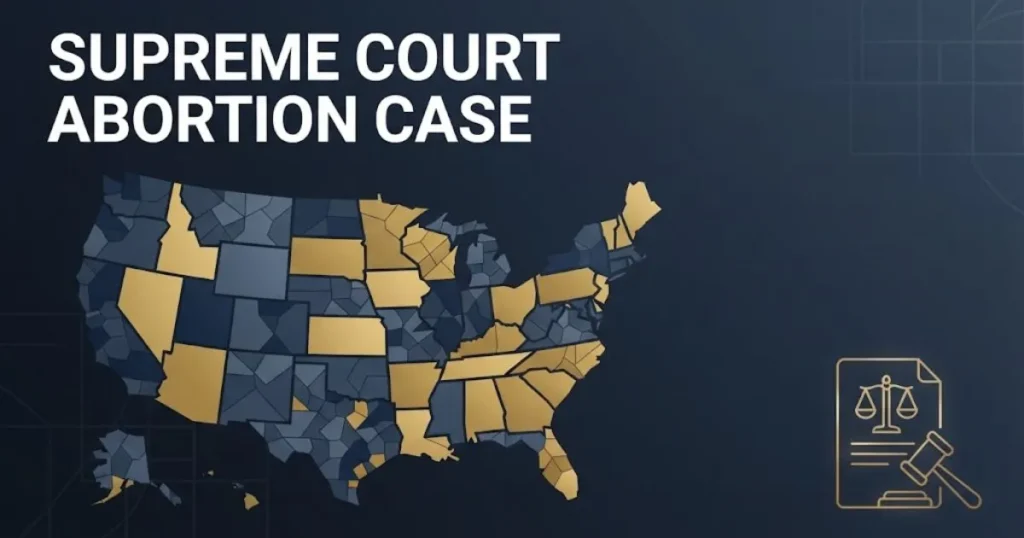
State abortion bans after Dobbs have created a patchwork of conflicting laws. What is legal in one state may be a felony in the next.
As of early 2026, at least 14 states enforce near-total abortion bans. Several more have gestational limits of six to 15 weeks. A handful of states have enshrined abortion rights in their own constitutions.
The divide largely follows geographic and political lines. Southern and Midwestern states tend to have the strictest bans. Western and Northeastern states tend to protect access.
| Ban Type | Number of States (2026) | Examples |
|---|---|---|
| Near-total ban | 14+ | Texas, Idaho, Missouri |
| 6-week ban | 3+ | Georgia, Florida, South Carolina |
| 12 to 15-week ban | 2+ | Arizona, Nebraska |
| Protected access | 10+ | California, New York, Colorado |
This patchwork means your zip code now determines your rights more than ever before.
Abortion Access by State 2026
Abortion access by state in 2026 varies dramatically depending on where you live. Some states have expanded access since Dobbs. Others have shut down nearly every clinic.
In states like California and New York, abortion remains legal through viability or later. These states have also passed shield laws to protect out-of-state patients. Doctors there cannot be prosecuted for treating patients who travel from ban states.
In states like Texas and Louisiana, almost no clinics remain open. Patients must travel to neighboring states or order pills by mail. The travel burden falls hardest on low-income women and women of color.
Bold stat: The average one-way travel distance to the nearest clinic in ban states exceeds 250 miles for many patients.
Key Takeaway: Your state of residence is now the single biggest factor determining whether you can access abortion care in 2026.
Who Is Affected by Dobbs Ruling
Who is affected by the Dobbs ruling extends far beyond pregnant women. The decision impacts doctors, pharmacists, hospitals, and entire communities.
Doctors in ban states face criminal prosecution for providing care. Some have stopped practicing obstetrics altogether. This has worsened maternal healthcare deserts in rural areas.
Pharmacists in some states now refuse to fill misoprostol prescriptions. They fear legal liability even when the drug is prescribed for miscarriage management. Misoprostol treats many conditions beyond abortion.
Low-income women, women of color, and young people are hit hardest. They are least able to afford travel to states where care remains legal.
| Group | Primary Impact |
|---|---|
| Pregnant patients | Lost local access in ban states |
| OB-GYN doctors | Criminal liability and clinic closures |
| Pharmacists | Fear of filling certain prescriptions |
| Low-income women | Cannot afford travel for care |
| Rural communities | Worsening maternal health outcomes |
Federal Abortion Law 2026
Federal abortion law in 2026 remains largely unchanged since Dobbs. Congress has not passed any new national legislation on the issue.
The Comstock Act of 1873 has become a flashpoint. Some lawmakers argue this old law bans mailing abortion pills. Others say it was never intended to apply this way.
The FDA continues to regulate mifepristone under its existing authority. The agency updated its rules in 2023 to allow retail pharmacies to dispense the drug. This change remains in effect in 2026.
Without new federal legislation, the patchwork of state laws will persist. The next presidential administration could shift enforcement priorities. But only Congress can create a uniform national standard.
Key fact: The Comstock Act is nearly 150 years old. It was originally written to ban “obscene” materials from the mail.
Supreme Court Abortion Case Outcome
The supreme court abortion case outcome from Dobbs is clear and final. The Constitution does not guarantee a right to abortion. States may ban, restrict, or protect the procedure as they choose.
This outcome reversed the legal framework that had governed abortion since 1973. Under Roe, states could not ban abortion before viability. Under Dobbs, they can ban it at any stage.
The outcome also emboldened state legislatures on both sides. Pro-ban states moved quickly to enforce trigger laws. Pro-access states rushed to codify protections in statutes and constitutions.
| Before Dobbs | After Dobbs |
|---|---|
| Federal right to abortion | No federal right |
| Viability standard applied | States set their own limits |
| Roe and Casey in effect | Both overturned |
| Uniform national framework | 50 different state frameworks |
Key Takeaway: The Dobbs outcome gave states total control over abortion law, creating 50 separate legal regimes across the country.
Abortion Medication Ruling 2026 Update
The abortion medication ruling 2026 update reflects a still-evolving legal picture. Mifepristone remains FDA-approved and available in states where abortion is legal.
Telehealth providers continue to prescribe abortion pills by mail in protected states. Shield laws in states like New York and Massachusetts protect these providers from out-of-state prosecution.
However, the legal ground could shift at any time. New challenges to FDA authority are pending in federal district courts. A future Supreme Court case could revisit the mifepristone question on the merits.
For now, patients in states with legal access can still obtain medication abortion through clinics and telehealth services. The two-drug regimen remains the most common method of early abortion care.
| Detail | Info |
|---|---|
| Mifepristone Status | FDA-approved, available |
| Telehealth Access | Legal in protected states |
| Shield Law States | NY, MA, CA, CO, and others |
| Pending Challenges | Active in lower courts |
| Most Common Method | Over 60% of all abortions |
Frequently Asked Questions
What did the Supreme Court decide about abortion in Dobbs?
The Court ruled 6-3 that the Constitution does not protect a right to abortion. This overturned both Roe v. Wade and Planned Parenthood v. Casey. States now have full authority to regulate or ban the procedure.
Is abortion still legal in the United States in 2026?
Abortion legality depends entirely on your state. It remains legal in roughly half the country. Over 14 states enforce near-total bans as of early 2026.
Can I get abortion pills by mail in 2026?
Yes, if you live in a state where abortion is legal. Telehealth providers can prescribe and mail mifepristone and misoprostol. Shield laws protect providers in several states from out-of-state prosecution.
What is the EMTALA abortion case about?
EMTALA requires hospitals to stabilize patients in medical emergencies. The case tested whether this federal law overrides state abortion bans. The Supreme Court dismissed the case in 2024 without resolving the core question.
How many states have banned abortion since Dobbs?
At least 14 states enforce near-total abortion bans in 2026. Several more have strict gestational limits of six to 15 weeks. The exact number shifts as courts issue new rulings.
The supreme court abortion case changed the legal ground beneath millions of Americans. The Dobbs ruling and its aftermath affect your rights, your healthcare, and your community right now.
Check your state’s current laws to understand your options. Stay informed as new cases move through the courts in 2026. The legal picture is still shifting, and your awareness matters.