Most people who settle a lawsuit in 2026 receive their money within 30 to 90 days of signing the agreement. You do not need to go to trial to get paid. The vast majority of civil cases end in settlement long before a judge ever sees them.
That fact surprises a lot of people. Roughly 95 percent of all civil lawsuits in the United States resolve through settlement. Only about 5 percent actually reach a verdict.
This guide breaks down every step of the process. You will learn how payouts work, what timelines look like, and how to negotiate a better deal. We cover personal injury, product liability, and class action cases.
One stat worth knowing: the median personal injury settlement in early 2026 sits around $52,000. That number varies wildly depending on your case type and the strength of your evidence.
How to Settle a Lawsuit
You settle a lawsuit by reaching a written agreement with the opposing party before a judge issues a verdict. Both sides agree on a dollar amount or specific terms. Then the case closes without a trial.
The process starts with a demand letter. Your side states what you want and why. The other side responds with a counteroffer. Back and forth negotiations continue until both parties agree.
Most settlements happen during the discovery phase. That is when both sides share evidence. Strong evidence pushes the other side toward a deal. Weak evidence gives them leverage to lowball you.
Quick Fact: Over 90 percent of civil cases filed in state courts settle before trial.
| Step | What Happens | Typical Duration |
|---|---|---|
| Demand Letter | You state your claim and amount | 1 to 2 weeks |
| Response | Opposing side replies with offer | 2 to 4 weeks |
| Negotiation | Both sides trade counteroffers | 1 to 6 months |
| Agreement | Final terms are signed | 1 to 2 weeks |
Settle Lawsuit Out of Court
Settling out of court means resolving your case privately without a judge or jury deciding the outcome. This is the most common path for civil disputes in 2026.
Out of court settlements save everyone time and money. Trials can drag on for years. They also cost tens of thousands in legal fees. A settlement cuts that timeline dramatically.
Privacy is another big advantage. Trial records are public. Settlement agreements can include confidentiality clauses. That keeps your personal details and payout amount out of the public record.

Think of it like haggling at a car dealership. You never pay the sticker price. You negotiate until both sides feel okay walking away. The same logic applies to legal disputes.
Key benefit: Out of court settlements typically cost 40 to 60 percent less than going through a full trial.
Lawsuit Settlement Process
The lawsuit settlement process is a structured series of steps that moves your case from initial claim to final payment. It follows a predictable pattern in most civil disputes.
First, your attorney sends a formal demand letter. This document outlines your injuries, losses, and the dollar amount you seek. The defendant or their insurance company reviews it.
Next comes the negotiation phase. The other side almost always starts with a low offer. Your attorney pushes back with evidence. Multiple rounds of offers and counteroffers follow.
Once both sides agree on a number, a settlement agreement is drafted. You sign a release of claims. That document legally ends the dispute. Payment follows within a set window.
- Step 1: File your claim or lawsuit
- Step 2: Enter the discovery phase
- Step 3: Exchange evidence and depositions
- Step 4: Attend mediation or settlement conference
- Step 5: Negotiate final terms
- Step 6: Sign the release and receive payment
Key Takeaway: Most lawsuits settle during discovery when both sides finally see the full strength of the evidence.
How Long to Settle a Lawsuit
A typical lawsuit settlement takes between 3 months and 18 months from the date you file your claim. Complex cases can stretch beyond two years.
Simple cases with clear liability move fast. A rear-end car accident with documented injuries might settle in 90 days. A medical malpractice case with disputed facts can take 24 months or more.
Several factors affect the timeline. The severity of your injuries matters. So does the number of defendants involved. Insurance company tactics also play a huge role.
Some insurers deliberately drag out negotiations. They hope you will get desperate and accept less money. Patience almost always pays off in these situations.
| Case Type | Average Time to Settle |
|---|---|
| Car Accident | 3 to 9 months |
| Slip and Fall | 6 to 12 months |
| Medical Malpractice | 12 to 24 months |
| Product Liability | 12 to 36 months |
| Class Action | 18 to 48 months |
Settle Lawsuit Before Trial
You can settle a lawsuit before trial at any point after filing your complaint. In fact, most attorneys actively push for pretrial resolution.
The strongest window for settlement is right after discovery closes. Both sides have seen all the evidence. The risks of trial become very real. That pressure drives deals.
Judges also encourage pretrial settlements. Many courts require mandatory mediation before a trial date is set. This forces both parties into the same room with a neutral mediator.
Pretrial settlement conferences are another common trigger. The judge meets with both attorneys in chambers. They discuss the strengths and weaknesses of each side. Many cases settle within days of this meeting.
Bold stat: Cases that settle after discovery but before trial yield payouts that average 25 to 40 percent higher than early pre-filing offers.
Key Takeaway: The closer you get to trial, the more pressure builds on both sides to reach a deal.
Average Lawsuit Settlement Amount
The average lawsuit settlement amount in 2026 varies enormously by case type. There is no single number that applies to every situation.
Personal injury cases average around $52,000 nationwide. Product liability settlements tend to run higher, often between $100,000 and $500,000. Class action payouts per claimant are usually smaller, ranging from $20 to $5,000.
Your specific payout depends on several factors. Medical bills, lost wages, and pain and suffering all factor in. The strength of your evidence matters just as much.
Do not compare your case to headlines about million-dollar verdicts. Those are outliers. The median settlement is far more modest but still meaningful for most plaintiffs.
| Case Category | Median Settlement Range |
|---|---|
| Personal Injury | $30,000 to $75,000 |
| Employment Discrimination | $40,000 to $120,000 |
| Product Liability | $100,000 to $500,000 |
| Class Action (per person) | $20 to $5,000 |
| Wrongful Death | $250,000 to $1,000,000 |
Should I Settle My Lawsuit
You should settle your lawsuit if the offer fairly covers your damages and the risk of losing at trial is real. That is the short answer. The longer answer requires some honest self-assessment.
Settling guarantees you get paid. Going to trial does not. A jury could award you millions. They could also award you nothing. That uncertainty is the biggest factor.
Consider your financial situation. Can you afford to wait another year or two for a trial? Do you have mounting medical bills that need covering now? These practical concerns matter.
Talk to your attorney about the odds. A good lawyer will give you a realistic assessment. If they say your chance of winning at trial is 60 percent, a solid settlement offer starts looking very attractive.
- Settle if: The offer covers your losses and trial risk is high
- Go to trial if: The offer is insultingly low and your case is strong
- Wait if: Your injuries are still developing and the full cost is unknown
Key Takeaway: A guaranteed settlement in hand is almost always worth more than a hypothetical jury award that might never come.
Lawsuit Settlement Timeline
The lawsuit settlement timeline follows distinct phases from filing to final payment. Understanding each phase helps you set realistic expectations.
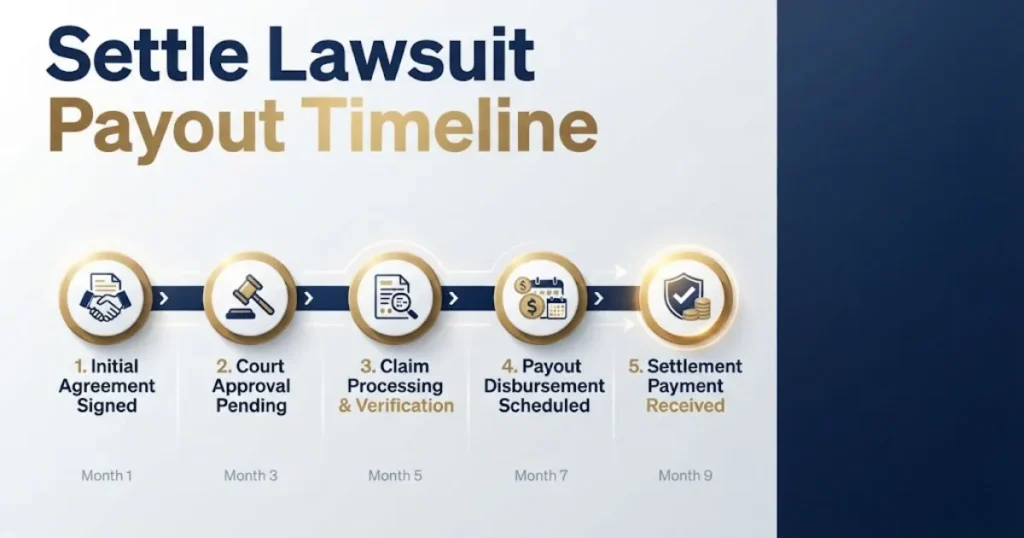
The first phase is pre-filing negotiation. This can last a few weeks to several months. Your attorney tries to resolve the matter before ever going to court. Many cases settle here.
If no deal is reached, you file the lawsuit. The discovery phase begins and typically lasts 6 to 12 months. This is where most settlements actually happen.
After discovery, the court schedules mediation or a settlement conference. If those fail, the case moves toward trial. Even then, settlements can happen on the courthouse steps.
| Phase | Duration | Settlement Likelihood |
|---|---|---|
| Pre-Filing | 1 to 6 months | Moderate |
| Discovery | 6 to 12 months | High |
| Mediation | 1 to 3 months | Very High |
| Pre-Trial | 1 to 2 months | High |
| During Trial | Days to weeks | Low but possible |
How to Negotiate Lawsuit Settlement
You negotiate a lawsuit settlement by anchoring high, presenting strong evidence, and refusing to accept the first offer. The first number on the table is almost never the final one.
Start with a demand that is 25 to 50 percent above your target number. This gives you room to concede without going below what you actually need. It is a standard tactic.
Document everything. Medical records, repair bills, pay stubs, and expert opinions all strengthen your position. The more proof you have, the harder it is for the other side to lowball you.
Never reveal your bottom line early. Let the other side make the first real move. Their initial offer tells you a lot about how they value your case.
Pro tip: Insurance adjusters are trained to start low. Their first offer is typically 30 to 50 percent of what they are actually authorized to pay.
Settle Lawsuit Without a Lawyer
You can settle a lawsuit without a lawyer, but it is risky for any case involving significant money or complex legal issues. Small claims court is the exception.
In small claims court, the stakes are usually under $10,000. The process is simplified. You can represent yourself without major disadvantage. Many people do this successfully.
For larger cases, going solo puts you at a serious disadvantage. The other side will have experienced attorneys. They know procedural rules you probably do not. They can exploit gaps in your filings.
If you do proceed without counsel, stick to the basics. Send a clear demand letter. Keep copies of every document. Never sign anything you do not fully understand.
- Good for pro se: Small claims, simple contract disputes, minor property damage
- Bad for pro se: Medical malpractice, product liability, wrongful death, class actions
Key Takeaway: Self-representation works for small, straightforward disputes but can cost you thousands in larger cases where legal expertise matters.
Lawsuit Settlement Payout
A lawsuit settlement payout is the money you receive after your case resolves. It can come as a lump sum or as structured payments over time.
Lump sum payments are the most common. You receive one check for the full agreed amount. The money typically arrives within 30 to 90 days after you sign the release.
Structured settlements spread payments over months or years. These are more common in large cases exceeding $250,000. They offer tax advantages and long-term financial stability.
Before you see a dime, several deductions come out. Attorney fees typically take 33 to 40 percent. Medical liens, court costs, and case expenses also reduce your net amount.
| Payout Type | Best For | Typical Timeline |
|---|---|---|
| Lump Sum | Cases under $250,000 | 30 to 90 days |
| Structured | Cases over $250,000 | Monthly for years |
| Hybrid | Large complex cases | Initial lump plus ongoing |
Settle Personal Injury Lawsuit
You settle a personal injury lawsuit by proving the other party caused your injuries and negotiating a fair dollar amount for your losses. These are the most commonly settled cases in America.
The key components of a personal injury settlement include medical expenses, lost wages, and pain and suffering. Pain and suffering is the hardest to quantify. It often accounts for the largest portion of the payout.
Insurance companies use formulas to calculate initial offers. A common method multiplies your medical bills by a factor of 1.5 to 5. The multiplier depends on injury severity.
Soft tissue injuries like whiplash get lower multipliers. Broken bones, surgeries, and permanent disabilities push the number higher. Documenting every medical visit is essential.
2026 update: The average car accident settlement in early 2026 is approximately $42,000 for moderate injuries. Severe injury cases average above $150,000.
Lawsuit Settlement Tax Implications
Lawsuit settlement tax implications depend on what the money compensates you for. Not all settlement money is taxable. The IRS treats different categories differently.
Compensation for physical injuries and physical sickness is generally tax-free under Section 104 of the Internal Revenue Code. That means your personal injury payout for a broken leg is not taxable income.
However, money awarded for emotional distress without a physical injury is taxable. So are punitive damages in most cases. Interest earned on delayed payments is also taxable.
Back pay from employment lawsuits is treated as regular income. You will owe federal and state taxes on that portion. Your attorney should help you allocate the settlement properly.
| Settlement Component | Tax Status |
|---|---|
| Physical Injury Compensation | Tax-Free |
| Medical Expense Reimbursement | Tax-Free |
| Emotional Distress (no physical injury) | Taxable |
| Punitive Damages | Taxable |
| Lost Wages / Back Pay | Taxable |
| Interest on Settlement | Taxable |
Key Takeaway: Physical injury settlements are mostly tax-free, but emotional distress, punitive damages, and lost wages will trigger a tax bill.
Settle Lawsuit After Filing
You can settle a lawsuit after filing at any stage of the litigation process. Filing the complaint actually strengthens your negotiating position in most cases.
Once a lawsuit is filed, the defendant takes you seriously. The clock starts ticking on their legal costs. They now face the prospect of discovery, depositions, and a public trial.
The post-filing discovery phase is the most productive settlement window. Both sides exchange documents and take depositions. Surprises during this phase often trigger settlement talks.
Do not feel locked in just because you filed. Settlement remains an option right up until the jury returns a verdict. Many cases settle during trial itself.
Key point: Filing a lawsuit does not burn bridges. It opens a formal channel for negotiation that often produces better offers than pre-filing demands.
How to Settle a Lawsuit Quickly
You settle a lawsuit quickly by presenting overwhelming evidence early, setting a firm deadline, and being willing to compromise on non-essential terms.
Speed starts with preparation. Have your medical records, bills, and evidence organized before you even send the demand letter. A complete file signals that you are ready to move.
Set a response deadline in your demand letter. Give the other side 30 days. This creates urgency and prevents the case from drifting into months of silence.
Consider mediation early. A skilled mediator can resolve a dispute in a single day. Many courts offer free or low-cost mediation programs for civil cases.
- Organize all evidence before filing
- Send a detailed demand letter with a deadline
- Respond to counteroffers within 48 hours
- Accept mediation at the first opportunity
- Be flexible on payment terms to close faster
Bold stat: Cases that enter mediation within the first 90 days of filing settle 3 times faster than those that skip early mediation.
Frequently Asked Questions
How much money will I get if I settle my lawsuit?
Most plaintiffs receive between $20,000 and $75,000 for standard personal injury cases.
Your exact amount depends on injury severity, medical costs, and the strength of your evidence.
Large product liability or wrongful death cases can reach six or seven figures.
Can I settle a lawsuit without hiring a lawyer?
Yes, you can settle small claims and simple disputes on your own.
For cases involving more than $10,000 or complex legal issues, hiring an attorney is strongly recommended.
Going solo against an experienced defense team usually results in a lower payout.
How long does it take to receive a settlement check?
Most settlement checks arrive within 30 to 90 days after you sign the release agreement.
Complex cases with multiple parties or structured payments may take longer.
Your attorney must also clear any medical liens before distributing your share.
Do I have to pay taxes on a lawsuit settlement?
Compensation for physical injuries is generally tax-free under IRS rules.
Punitive damages, emotional distress without physical harm, and lost wages are taxable.
Consult a tax professional to properly allocate your settlement and minimize your tax burden.
What happens if I reject a lawsuit settlement offer?
Your case continues toward trial if you reject the offer.
You can still negotiate a new settlement at any point before the jury decides.
Rejecting a fair offer carries the risk of getting less at trial or losing entirely.
Your settlement is within reach if you understand the process and prepare your evidence properly. Do not rush into the first offer you receive. Take the time to evaluate what your case is truly worth.
Check your eligibility for any active settlements that match your situation. Gather your documents and talk to a qualified professional about your options. The right strategy can make a significant difference in your final payout.