

The Scale AI lawsuit is one of the biggest tech cases of 2026. Thousands of data labelers are fighting for fair pay and proper worker classification. If you ever worked for Scale AI, you may be owed money.
This class action targets how Scale AI treated its gig workers. The company allegedly misclassified employees as independent contractors for years. That means workers missed out on benefits, overtime, and minimum wage protections.
In this article, you will learn exactly who qualifies for the settlement. We cover expected payouts, key filing deadlines, and step-by-step claim instructions. Recent court filings suggest over 100,000 workers could be eligible. The total settlement fund may exceed $200 million.
Scale AI Lawsuit
The Scale AI lawsuit refers to multiple legal actions filed against Scale AI Inc. The core claim is worker misclassification. Data labelers say they were treated as employees but paid as contractors.
Scale AI built its business on cheap human labor. The company hired thousands of workers to annotate data for AI models. These workers tagged images, labeled text, and rated AI outputs.
The legal trouble started gaining traction in late 2024. Workers in California filed the first major complaints. They argued Scale AI controlled their schedules, tasks, and pay rates. That level of control typically signals an employment relationship under state law.
The case now involves claims under both state and federal law. Plaintiffs cite the Fair Labor Standards Act and California AB5. Both laws set strict tests for contractor classification.
| Detail | Info |
|---|---|
| Defendant | Scale AI Inc. |
| Primary Claim | Worker misclassification |
| Key Laws | FLSA, California AB5 |
| Estimated Workers Affected | 100,000+ |
Scale AI Lawsuit 2026
The Scale AI lawsuit in 2026 has entered a critical phase. Settlement negotiations are actively underway. Both sides have signaled willingness to avoid a prolonged trial.
A federal judge granted preliminary class certification in early 2026. That ruling expanded the pool of eligible workers significantly. It now includes data labelers across multiple states, not just California.
The 2026 developments also brought new claim types into the case. Workers are now alleging unpaid overtime and minimum wage violations. Some claim they earned less than $3 per hour after expenses.
Think of it like a restaurant paying its cooks as “consultants.” The cooks show up on a schedule, use the restaurant’s kitchen, and follow the chef’s recipes. Calling them consultants does not make it legal.
Key 2026 milestone: The court set a settlement fairness hearing for late 2026.
Scale AI Class Action
The Scale AI class action consolidates dozens of individual complaints into one case. This gives workers more bargaining power against a well-funded tech company. Class actions are the legal equivalent of strength in numbers.
Lead plaintiffs filed the consolidated complaint in the Northern District of California. The case covers workers who used Scale AI platforms between 2020 and 2025. That includes workers on Remotasks and Outlier, two Scale AI subsidiaries.
Class certification means the court recognized common issues across all claims. The judge found that Scale AI used uniform policies for all labelers. Those policies allegedly violated wage laws in a consistent pattern.
- Class period: January 2020 through December 2025
- Jurisdiction: U.S. District Court, Northern District of California
- Class type: Nationwide with California subclass
- Status: Certified as of February 2026
Key Takeaway: The Scale AI class action covers over 100,000 workers across multiple states, and settlement talks are actively progressing in 2026.
Scale AI Worker Lawsuit
The Scale AI worker lawsuit centers on the people behind the AI. These are real humans who spent countless hours labeling data. They trained the models that power chatbots, self-driving cars, and search engines.
Workers say Scale AI dictated exactly how they performed tasks. They received detailed instructions, quality scores, and strict deadlines. Yet they were classified as independent contractors with no benefits.
Many workers reported earning below minimum wage. Some logged 40-hour weeks but received no overtime. Others were deactivated from the platform without warning or explanation.
The lawsuit argues this arrangement violates basic labor protections. Workers were not running their own businesses. They were doing Scale AI’s core work under Scale AI’s rules.
| Worker Complaint | Detail |
|---|---|
| Average reported hourly rate | $2 to $7 |
| Overtime pay received | None |
| Health benefits provided | None |
| Platform deactivation notice | None |
Scale AI Data Labeler Lawsuit
The Scale AI data labeler lawsuit specifically targets the annotation workforce. Data labelers are the backbone of AI training pipelines. Without them, machine learning models cannot learn from real-world data.
Scale AI hired labelers through its Remotasks and Outlier platforms. Workers signed up online and completed tasks from home. Tasks included drawing bounding boxes around objects in images. They also included rating AI-generated text for accuracy and safety.
Labelers argue they had zero autonomy over their work. Scale AI set the pay per task. Scale AI set the quality standards. Scale AI could reject work without paying for it.
This level of control is the central legal issue. Under the ABC test used in California, a worker is an employee unless the company proves otherwise. Plaintiffs say Scale AI cannot pass that test.
Bold stat: Some data labelers reported effective hourly earnings as low as $1.50 after unpaid review time.
Scale AI Gig Worker Lawsuit
The Scale AI gig worker lawsuit challenges the entire gig model used in AI. Scale AI positioned itself as a platform connecting freelancers with tasks. Workers say that framing is misleading and illegal.
Gig worker protections have expanded rapidly since 2024. Several states passed new laws tightening contractor classification rules. Scale AI’s model now faces scrutiny under these stricter standards.
The lawsuit highlights a growing tension in the AI industry. Companies need massive human labor to train their models. But they want to avoid the costs of traditional employment. Workers are pushing back.
- Workers had no ability to negotiate pay rates
- Workers could not set their own schedules freely
- Workers used Scale AI’s proprietary tools exclusively
- Workers faced penalties for not meeting company quotas
Key Takeaway: Data labelers and gig workers on Scale AI platforms allege they earned below minimum wage with no benefits, despite functioning as de facto employees.
Scale AI Independent Contractor Lawsuit
The Scale AI independent contractor lawsuit zeroes in on the legal classification issue. This is the technical heart of the entire case. The label “independent contractor” carries huge financial consequences.
True independent contractors run their own businesses. They set their own prices. They choose their own clients. They invest in their own equipment and marketing.
Scale AI labelers did none of those things. They logged into a company platform. They accepted company-assigned tasks at company-set rates. They followed company quality guidelines to the letter.
The lawsuit uses the IRS 20-factor test and the California ABC test. Both frameworks look at behavioral control, financial control, and relationship type. Plaintiffs argue Scale AI fails every prong of both tests.
| Test Factor | Scale AI Reality |
|---|---|
| Behavioral control | High. Detailed task instructions. |
| Financial control | High. Company sets all pay rates. |
| Relationship type | Ongoing. Not project-based. |
| Worker investment | Minimal. No independent business. |
Scale AI Lawsuit Eligibility
Scale AI lawsuit eligibility depends on your work history with the company. You likely qualify if you performed data labeling tasks through Scale AI platforms. This includes work on Remotasks and Outlier.
The class period covers January 1, 2020 through December 31, 2025. You must have completed at least one paid task during that window. The type of task does not matter for basic eligibility.
Eligibility varies slightly by state. California workers have the strongest claims under AB5. Workers in New York, Illinois, and Massachusetts also have strong state-level protections. Workers in other states fall under federal FLSA claims.
- Must have worked on: Remotasks, Outlier, or Scale AI direct
- Time period: January 2020 to December 2025
- Minimum work: At least one completed paid task
- Location: All 50 states, with enhanced claims in CA, NY, IL, MA
Quick Fact: You do not need to be a current worker to qualify. Former labelers are fully eligible.
How to Join Scale AI Lawsuit
To join the Scale AI lawsuit, you need to submit a claim form. The process is straightforward and takes about 15 minutes. You do not need to hire your own attorney to participate.
The settlement administrator will launch an official claims portal. You will need to provide basic identification and work history. This includes your Remotasks or Outlier username and email address.
Gather your records before the portal opens. Download any pay stubs, task logs, or payment receipts you still have. Screenshots of your dashboard earnings can also serve as proof.
Once you submit your claim, the administrator will verify your work history. They will cross-reference your info with Scale AI’s internal records. You should receive a confirmation email within two weeks.
| Step | Action | Time Needed |
|---|---|---|
| 1 | Gather work records | 30 minutes |
| 2 | Visit claims portal | 2 minutes |
| 3 | Fill out claim form | 15 minutes |
| 4 | Submit documentation | 10 minutes |
| 5 | Receive confirmation | 2 weeks |
Key Takeaway: Joining the Scale AI lawsuit requires submitting a claim form with your work history, and the process takes roughly 15 minutes with no lawyer required.
Scale AI Lawsuit Settlement
The Scale AI lawsuit settlement is still being negotiated as of mid-2026. Both sides have agreed to a mediation framework. A final settlement number has not been publicly confirmed yet.
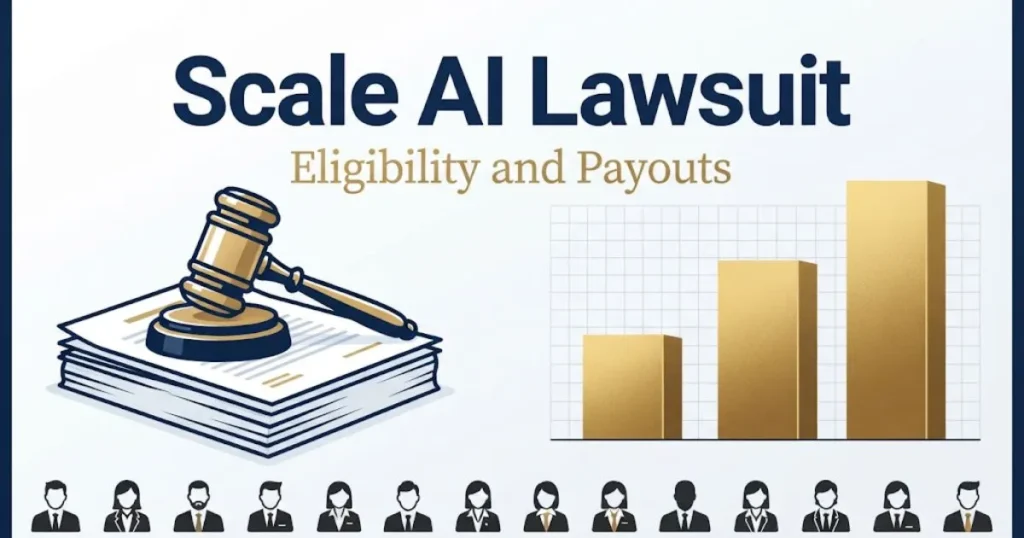
Industry analysts estimate the settlement fund could reach $200 million or more. That figure is based on the number of affected workers and the severity of the claims. Comparable gig worker settlements have ranged from $100 million to $400 million.
The settlement will likely include multiple tiers of compensation. Workers with more hours logged will receive larger payments. Workers in states with stronger labor laws may also receive more.
A settlement fairness hearing is expected in late 2026. The judge will review the terms to ensure they are fair to all class members. Workers will have the right to object or opt out before final approval.
Estimated settlement range: $150 million to $250 million total fund.
Scale AI Settlement Amount
The Scale AI settlement amount per worker will depend on several factors. The total fund gets divided among all approved claimants. Your individual share reflects your hours worked and state of residence.
Early estimates suggest payouts could range from $200 to $5,000 per worker. Workers who logged thousands of hours will be at the higher end. Casual workers who completed a few tasks will be at the lower end.
California workers may receive a premium due to stronger state penalties. California law allows for additional damages under the Private Attorneys General Act. That could add 20 to 40 percent to base payouts.
| Worker Tier | Hours Logged | Estimated Payout |
|---|---|---|
| Tier 1 | Under 100 hours | $200 to $500 |
| Tier 2 | 100 to 500 hours | $500 to $1,500 |
| Tier 3 | 500 to 2,000 hours | $1,500 to $3,000 |
| Tier 4 | Over 2,000 hours | $3,000 to $5,000 |
Scale AI Lawsuit Payout
The Scale AI lawsuit payout timeline depends on when the settlement receives final approval. Payments typically begin 60 to 90 days after the court signs off. That puts the earliest expected payments in early 2027.
Payouts will likely be distributed via direct deposit or check. The settlement administrator will contact approved claimants with payment details. You will need to keep your contact information updated on the claims portal.
One thing many workers overlook is the tax treatment of settlement money. Portions allocated to back wages are taxable as ordinary income. Portions allocated to penalties or emotional distress may be treated differently.
Think of it like a tax refund. The money is yours, but the IRS still wants its cut. Plan accordingly when you receive your payment.
- Back wages portion: Taxed as ordinary income
- Penalty portion: May be taxable depending on state
- Interest portion: Fully taxable
- Attorney fees: Deductible in some cases
Key Takeaway: Individual Scale AI settlement payouts are estimated between $200 and $5,000, with payments expected to begin in early 2027 after final court approval.
Scale AI Lawsuit Deadline
The Scale AI lawsuit deadline for filing claims has not been officially set yet. The court will establish a firm deadline after the settlement is finalized. That deadline will likely fall in late 2026 or early 2027.
Do not wait until the last minute to prepare your claim. Gathering old work records takes time, especially if you stopped using the platform years ago. Start collecting your documentation now.
Once the deadline passes, you lose your right to compensation permanently. The court will not accept late claims except in extremely rare circumstances. Missing the deadline is like missing a flight. The plane leaves without you.
Expected claims window: 90 to 120 days after settlement approval.
Projected deadline: Sometime between October 2026 and March 2027.
| Event | Estimated Date |
|---|---|
| Settlement agreement | Summer 2026 |
| Fairness hearing | Fall 2026 |
| Claims window opens | Late 2026 |
| Claims deadline | Early 2027 |
| First payments | Early to mid-2027 |
Scale AI Lawsuit Update
The latest Scale AI lawsuit update as of mid-2026 shows rapid progress. The case survived multiple motions to dismiss in early 2026. The judge ruled that plaintiffs presented sufficient evidence of misclassification.
Discovery is now largely complete. Both sides have exchanged millions of internal documents. Those documents reportedly include internal emails discussing worker classification strategy. Plaintiffs say the emails show Scale AI knew about the legal risks.
A separate but related development involves the Department of Labor. The DOL launched its own investigation into Scale AI’s labor practices in 2025. That investigation could result in additional penalties beyond the class action.
Most recent court action: Denial of Scale AI’s motion for summary judgment in March 2026.
Next major event: Settlement fairness hearing expected in the fourth quarter of 2026.
Scale AI Lawsuit News
Scale AI lawsuit news has dominated tech and legal media throughout 2026. Major outlets have covered the case as a bellwether for the entire AI industry. The outcome could reshape how AI companies hire human workers.
Several high-profile developments made headlines this year. A former Scale AI project manager testified about internal classification practices. The testimony reportedly damaged Scale AI’s defense significantly.
The case also drew attention from lawmakers. Members of Congress cited the Scale AI lawsuit during hearings on AI labor standards. Proposed federal legislation could create new protections for AI gig workers.
- January 2026: Class certification granted
- March 2026: Summary judgment denied
- April 2026: Mediation sessions began
- June 2026: DOL investigation expanded
- Expected Q4 2026: Settlement hearing
Key Takeaway: The Scale AI lawsuit has survived every major legal challenge in 2026, with settlement talks progressing and federal regulators now involved.
Scale AI Copyright Lawsuit
The Scale AI copyright lawsuit is a separate but related legal battle. This case involves allegations that Scale AI used copyrighted content to train AI models. Publishers and content creators filed these claims in 2025.
The copyright lawsuit argues that Scale AI scraped protected material without permission. This includes news articles, books, and academic papers. Scale AI allegedly used this content to build training datasets for its clients.
This case mirrors similar lawsuits against other AI companies. OpenAI, Meta, and Anthropic all face comparable copyright claims. The legal theory is that training AI on copyrighted works constitutes infringement.
The copyright case is at an earlier stage than the worker lawsuit. A ruling on the core legal questions could take another year or more. However, a settlement in the worker case could influence negotiations here.
| Case Type | Status | Expected Resolution |
|---|---|---|
| Worker misclassification | Settlement talks | Late 2026 |
| Copyright infringement | Early discovery | 2027 or later |
| DOL investigation | Active | Unknown |
Frequently Asked Questions
How much will I get from the Scale AI lawsuit?
Most claimants can expect between $200 and $5,000.
The exact amount depends on your hours logged and state of residence.
Payments are expected to begin in early 2027.
Who qualifies for the Scale AI class action?
You qualify if you completed paid tasks on Remotasks, Outlier, or Scale AI between 2020 and 2025.
Both current and former workers are eligible.
Workers in all 50 states can file claims.
What is the deadline to file a Scale AI claim?
The official deadline has not been set yet.
It will likely fall between October 2026 and March 2027.
Start gathering your work records now to avoid missing the window.
Do I need a lawyer for the Scale AI lawsuit?
No, you do not need your own lawyer to join the class action.
The class attorneys represent all members at no upfront cost.
Their fees come out of the settlement fund, not your payout.
When will Scale AI lawsuit payments be sent?
Payments typically begin 60 to 90 days after final court approval.
The earliest expected distribution date is early 2027.
You will receive payment via direct deposit or mailed check.
The Scale AI lawsuit represents a turning point for AI industry workers. If you performed data labeling tasks between 2020 and 2025, check your eligibility now. Gather your records and watch for the claims portal to open.
Do not wait for the deadline to sneak up on you. Stay informed, prepare your documentation, and file your claim as soon as the window opens. Your labor helped build the AI revolution, and you deserve fair compensation for it.







