A recent environment lawsuit in 2026 could put real money in your pocket. Billions of dollars in settlements are now active across the country. PFAS contamination, oil company climate cases, and toxic water claims top the list.
This guide covers every major environmental case you should know about. You will find settlement amounts, filing deadlines, and eligibility rules. We break down each case in plain English so you can act fast.
Over 30 million Americans may qualify for some form of environmental claim this year. Most people have no idea they are eligible. The average payout for water contamination claims now exceeds $2,500. Keep reading to find out if you are one of them.
Recent Environment Lawsuit 2026 Updates
The most active recent environment lawsuit cases in 2026 involve PFAS chemicals, climate fraud, and toxic water. Federal courts are processing over 12,000 environmental claims this year alone. That number has doubled since 2023.
Related: Environment Lawsuit Today: 2026 Settlements and Updates
The PFAS multidistrict litigation remains the single biggest case. Over 8,000 individual claims are consolidated under MDL 2873 in South Carolina. Judge Richard Gergel is overseeing the proceedings.
Climate litigation against fossil fuel companies has also accelerated. The Supreme Court allowed several city-led cases to proceed in state courts. This ruling opened the floodgates for new filings.
Think of it like a dam breaking. Once the first few cases succeeded, dozens more followed. State attorneys general are now joining the fight in record numbers.
| Case Category | Active Claims | Lead Court |
|---|---|---|
| PFAS Contamination | 8,200+ | MDL 2873, South Carolina |
| Climate Fraud | 2,400+ | Various State Courts |
| Water Pollution | 1,800+ | Federal District Courts |
Quick Fact: Environmental lawsuit filings increased 94% between 2023 and 2026.
Environmental Class Action Lawsuit Types
Environmental class action lawsuits fall into four main categories: water, air, soil, and climate. Each type follows different legal rules and offers different payout structures.
Water contamination cases are the most common. These involve chemicals leaching into drinking water supplies. PFAS, lead, and industrial solvents are the usual culprits.
Air pollution cases target factories and refineries. Residents near these facilities often develop respiratory illnesses. Courts have awarded large sums in these cases recently.
Soil contamination lawsuits involve toxic waste dumping. Superfund sites are a major source of these claims. The EPA tracks over 1,300 active Superfund locations nationwide.
Climate lawsuits are the newest category. Cities and states sue oil companies for damages caused by rising seas. These cases focus on fraud and deception rather than direct pollution.
- Water cases: Chemical spills, PFAS, lead pipes
- Air cases: Factory emissions, refinery pollution
- Soil cases: Toxic dumping, Superfund sites
- Climate cases: Fraud, misleading the public
PFAS Water Contamination Lawsuit
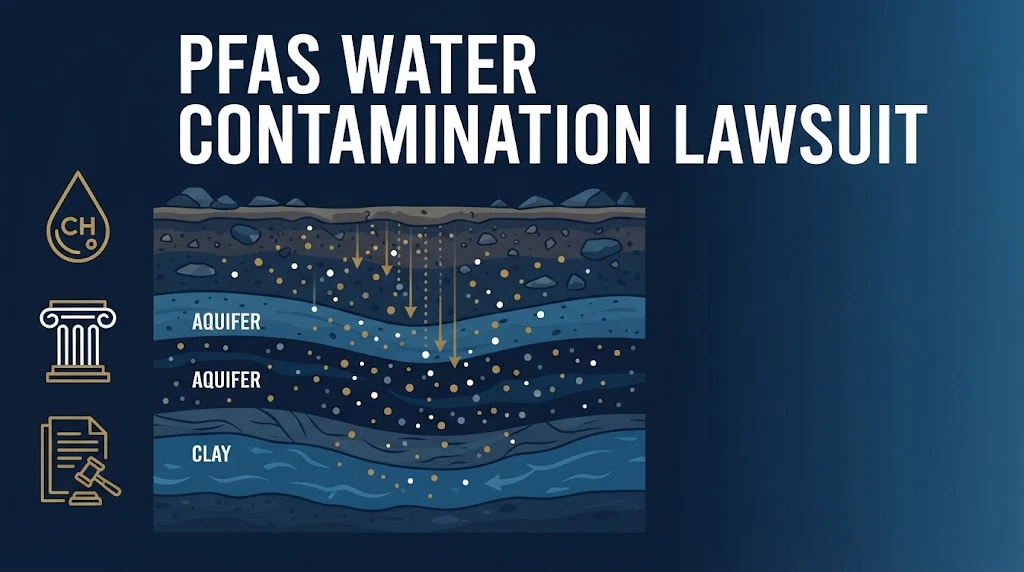
The PFAS water contamination lawsuit is the largest environmental case in American history. Settlements from 3M and DuPont have already exceeded $11 billion combined. More payouts are expected throughout 2026.
PFAS chemicals are called “forever chemicals” because they never break down. They accumulate in your blood and organs over time. Studies link them to kidney cancer, thyroid disease, and immune disorders.
The 3M settlement alone set aside $10.3 billion for public water systems. Individual claims are now being processed through a separate track. Claimants with documented health conditions receive priority.
DuPont and Chemours agreed to a $1.185 billion settlement in 2024. That fund is still distributing payments in 2026. The claims administrator is reviewing thousands of new submissions monthly.
If your tap water tested positive for PFOA or PFOS, you likely qualify. The contamination threshold is 4 parts per trillion under the new EPA rule.
| PFAS Defendant | Settlement Total | Payment Status |
|---|---|---|
| 3M Company | $10.3 billion | Active distribution |
| DuPont/Chemours | $1.185 billion | Active distribution |
| Tyco Fire Products | $750 million | Claims review phase |
Key Stat: Over 200 million Americans have detectable PFAS levels in their blood.
Key Takeaway: PFAS litigation dominates the environmental legal space in 2026, with over $12 billion in combined settlements now being distributed to affected communities and individuals.
Climate Change Lawsuit Against Oil Companies
Climate change lawsuits against oil companies are reshaping corporate accountability in 2026. Cities like Honolulu, Baltimore, and Boulder have active cases moving toward trial. The legal theory centers on consumer fraud.
These cases argue that ExxonMobil, Chevron, Shell, and BP knew about climate risks for decades. Internal documents prove they understood the danger as early as the 1970s. Yet they publicly denied the science and funded disinformation campaigns.
The Honolulu v. Sunoco case is the furthest along. Hawaii’s Supreme Court allowed it to proceed under state law. Trial preparation is underway for late 2026.
Baltimore’s case against 26 fossil fuel companies survived multiple appeal attempts. The Supreme Court declined to move it to federal court. This keeps the case in Maryland state court, which favors the plaintiffs.
These lawsuits seek billions in damages for infrastructure costs. Rising sea levels and extreme weather events have cost cities enormous sums. The legal argument is that oil companies should pay for the damage they concealed.
- Honolulu v. Sunoco: Trial expected late 2026
- Baltimore v. BP: Discovery phase ongoing
- Boulder v. Suncor: Pretrial motions active
- Rhode Island v. Chevron: Settlement talks reported
Environmental Lawsuit Settlement Amounts
Environmental lawsuit settlement amounts vary widely based on the type of harm you suffered. Individual payouts range from a few hundred dollars to over $1 million. The severity of your health condition is the biggest factor.
For PFAS water contamination claims, most claimants receive between $500 and $5,000. Those with diagnosed cancer or thyroid disease can receive $25,000 to $150,000. Wrongful death claims have reached $1 million or more.
Climate lawsuit settlements are different. These cases pay cities and states, not individuals. The money funds infrastructure repairs and flood defenses. Individual payouts are rare in climate cases.
Toxic exposure settlements from industrial sites tend to be higher. Camp Lejeune water contamination claims average $10,000 to $100,000. The most severe cases involving leukemia or Parkinson’s exceed $500,000.
| Case Type | Average Payout | Severe Harm Payout |
|---|---|---|
| PFAS Water | $500 to $5,000 | $25,000 to $150,000 |
| Industrial Exposure | $5,000 to $50,000 | $100,000 to $500,000 |
| Camp Lejeune | $10,000 to $100,000 | $250,000 to $1M+ |
| Climate (municipal) | City-level only | N/A for individuals |
Bold Stat: The median environmental lawsuit payout in 2026 is $3,200 per claimant.
Who Qualifies for Environmental Lawsuit
Who qualifies for an environmental lawsuit depends on three factors: exposure, location, and timing. You must prove you were exposed to a specific contaminant during a defined period.
For PFAS cases, you qualify if you lived near a military base, airport, or industrial site. Your water supply must have tested above 4 parts per trillion. Exposure must have occurred before 2024 for most claims.
For Camp Lejeune claims, you must have lived or worked on the base between 1953 and 1987. The minimum exposure period is 30 days. You also need a qualifying medical diagnosis.
For climate cases, individual qualification is limited. These lawsuits benefit municipalities rather than private citizens. Your city or county may receive funds that improve local infrastructure.
Think of it like a filter system. Each requirement narrows the pool of eligible claimants. Meeting all three criteria is the key to a successful claim.
- Exposure proof: Water test results, medical records, employment history
- Location proof: Utility bills, lease agreements, military records
- Timing proof: Dates of residence or employment during contamination period
Key Takeaway: Eligibility for environmental lawsuits hinges on documented exposure, geographic proximity to the contamination source, and residence during the specific contamination window defined by each case.
How to File an Environmental Lawsuit
Filing an environmental lawsuit starts with determining which case applies to your situation. Most people join existing class actions rather than filing individual suits. The process is simpler than you might think.
Step one is identifying the correct settlement fund. Each major case has its own claims administrator. The PFAS settlement uses a different portal than the Camp Lejeune fund.
Step two is gathering your documentation. You will need proof of address, water quality reports, and medical records. The more evidence you provide, the higher your potential payout.
Step three is submitting your claim form before the deadline. Most claims can be filed online in under 30 minutes. You do not need a lawyer to submit a basic class action claim.
Step four is waiting for the claims review process. Administrators verify your documents and assign a payout tier. This review typically takes three to six months.
- Step 1: Identify your case and settlement fund
- Step 2: Gather address, water, and medical records
- Step 3: Submit claim form online before the deadline
- Step 4: Wait for review and payout determination
Quick Tip: Keep copies of every document you submit. Claims administrators sometimes request additional proof.
Environmental Lawsuit Deadlines 2026
Environmental lawsuit deadlines in 2026 vary by case and jurisdiction. Missing a deadline means losing your right to compensation permanently. This is the one area where you cannot afford to procrastinate.
The PFAS public water system settlement has a rolling deadline. Individual claims must be filed by December 31, 2026 for the current payment cycle. Late filings roll into the 2027 distribution pool.
Camp Lejeune claims under the CLJA have a hard deadline of August 10, 2026. This date is set by federal statute and will not be extended. Over 180,000 claims have already been filed.
State-level environmental cases follow their own statutes of limitations. Most states allow two to three years from the date of discovery. Discovery means when you first learned about the contamination.
| Case | Filing Deadline | Extension Possible |
|---|---|---|
| PFAS Individual Claims | December 31, 2026 | No |
| Camp Lejeune (CLJA) | August 10, 2026 | No |
| East Palestine Derailment | March 15, 2027 | Under review |
| Roundup/Glyphosate | Varies by state | Case by case |
Urgent: The Camp Lejeune deadline is less than six months away. File immediately if you qualify.
Largest Environmental Lawsuits in History
The largest environmental lawsuits in history have produced settlements exceeding $20 billion each. These landmark cases set the precedent for every active claim in 2026.
The BP Deepwater Horizon spill remains the biggest. BP paid over $65 billion in total costs and settlements. The 2010 disaster released 134 million gallons of oil into the Gulf of Mexico.
The Volkswagen emissions scandal ranks second. VW paid $33 billion worldwide for cheating on diesel emissions tests. The fraud affected 11 million vehicles across the globe.
The 3M PFAS settlement is the largest chemical contamination payout ever. At $10.3 billion, it surpasses the previous DuPont Teflon settlement of $671 million by a wide margin.
These cases share a common thread. Corporations knew about the harm and chose profits over safety. Juries and judges have consistently punished that behavior with massive verdicts.
| Case | Year | Total Cost |
|---|---|---|
| BP Deepwater Horizon | 2010 | $65 billion |
| Volkswagen Emissions | 2015 | $33 billion |
| 3M PFAS Settlement | 2023 | $10.3 billion |
| Exxon Valdez Spill | 1989 | $7 billion |
Key Takeaway: Historical environmental lawsuits show a clear pattern of escalating penalties, with the three largest settlements all occurring in the last 15 years and totaling over $100 billion combined.
Toxic Exposure Lawsuit Eligibility
Toxic exposure lawsuit eligibility requires proof that a specific chemical caused your health condition. This is called causation, and it is the hardest part of any environmental claim.
Courts use a standard called “more likely than not.” You must show that the contaminant probably caused your illness. Expert medical testimony is usually required to establish this link.
The strongest cases involve chemicals with well-documented health effects. PFAS, benzene, asbestos, and glyphosate all have extensive scientific literature. Courts accept these links more readily than newer chemicals.
Your exposure level matters too. Drinking contaminated water for 10 years carries more weight than a single month of exposure. Duration and concentration both factor into the eligibility calculation.
Age at the time of exposure can also affect your claim. Children exposed to lead or PFAS often receive higher payouts. Their developing bodies absorb toxins more readily than adults.
- Strongest evidence: Medical diagnosis plus water or soil test results
- Moderate evidence: Medical diagnosis plus proximity to contamination source
- Weakest evidence: Symptoms without documented exposure or diagnosis
Key Fact: Courts accept PFAS causation for six specific cancers as of 2026.
Environmental Lawsuit Payout Timeline
The environmental lawsuit payout timeline typically spans 12 to 36 months from claim submission to payment. Some complex cases take longer, but most claimants see money within two years.
Class action settlements pay faster than individual lawsuits. Once a settlement is approved, the claims administrator begins processing payments. PFAS claimants who filed in 2024 are receiving checks now.
Mass tort cases take longer because each claim is evaluated individually. Camp Lejeune claims are still in the administrative review phase. The Department of the Navy processes these claims directly.
Bellwether trials can speed things up. These test cases establish payout benchmarks for the larger group. Once a few bellwether verdicts come in, bulk settlements usually follow quickly.
Think of it like an insurance claim after a natural disaster. The first wave of payments goes to the most severely affected. Everyone else follows in subsequent rounds.
| Phase | Duration | What Happens |
|---|---|---|
| Claim Submission | 1 to 3 months | Documents reviewed and verified |
| Eligibility Review | 3 to 6 months | Exposure and harm confirmed |
| Payout Calculation | 2 to 4 months | Tier assignment and amount set |
| Payment Distribution | 1 to 3 months | Check or direct deposit issued |
Average Total Wait: 14 months from filing to payment for standard claims.
Corporate Pollution Lawsuit Updates
Corporate pollution lawsuit updates in 2026 show a sharp increase in enforcement actions. The EPA has filed 40% more cases this year compared to 2024. Fines and penalties have reached record levels.
The East Palestine train derailment case against Norfolk Southern is a major focus. The company agreed to a $600 million settlement in 2024. Additional claims from residents are still being processed in 2026.
Chemical manufacturers face growing pressure over PFAS discharges. The EPA’s new drinking water standards have triggered a wave of enforcement actions. Companies that exceed the 4 parts per trillion limit face daily fines.
Agricultural chemical cases are also heating up. Bayer continues to defend Roundup glyphosate claims. Over 100,000 lawsuits have been filed since the first verdict in 2018.
The trend is clear. Regulators and juries are no longer giving corporations the benefit of the doubt. The era of cheap pollution is ending.
- Norfolk Southern: $600M settlement, individual claims ongoing
- Bayer/Monsanto: 100,000+ Roundup claims active
- Chemours: New PFAS discharge fines in 2026
- Dow Chemical: Superfund cleanup litigation expanding
Key Takeaway: Corporate polluters face unprecedented legal pressure in 2026, with EPA enforcement up 40% and individual settlements reaching hundreds of millions of dollars per case.
Environmental Justice Lawsuit Cases
Environmental justice lawsuit cases focus on communities disproportionately harmed by pollution. Low-income neighborhoods and communities of color bear the heaviest burden of toxic exposure.
In 2026, the EPA has prioritized these cases through its Office of Environmental Justice. Federal funding for environmental justice litigation has tripled since 2023. This means more resources for affected communities.
The Cancer Alley cases in Louisiana are among the most prominent. Residents near petrochemical plants face cancer rates 50 times the national average. Multiple lawsuits against Formosa Plastics and Denka are active.
Flint, Michigan’s water crisis litigation continues to produce payments. The $626 million settlement is still being distributed to affected families. Children with elevated lead levels receive the largest shares.
These cases matter because they address systemic inequality. Pollution does not affect all communities equally. The legal system is slowly catching up to that reality.
| Community | Contaminant | Active Case |
|---|---|---|
| Cancer Alley, LA | Industrial chemicals | Formosa Plastics, Denka |
| Flint, MI | Lead | $626M settlement active |
| Newark, NJ | Lead and PFAS | Multiple federal claims |
| Navajo Nation | Uranium | Federal cleanup litigation |
Key Stat: Communities of color face 28% higher exposure to toxic pollutants nationwide.
Groundwater Contamination Lawsuit Claims
Groundwater contamination lawsuit claims represent a growing share of environmental litigation. When chemicals seep into underground water sources, entire communities lose their drinking water supply.
The most common groundwater contaminants are PFAS, trichloroethylene (TCE), and perchlorate. These chemicals come from military bases, dry cleaners, and manufacturing plants. They can travel miles underground before surfacing in wells.
TCE contamination cases have produced significant verdicts in 2026. A jury in Arizona awarded $230 million to families near a former semiconductor plant. The ruling is being appealed but sets a strong precedent.
Perchlorate cases are emerging as the next wave. This rocket fuel chemical has contaminated groundwater in over 30 states. The EPA is expected to issue new regulations by mid-2026.
Groundwater cases are harder to prove than surface water cases. The contamination is invisible and moves slowly. Expert hydrogeologists are essential to trace the pollution back to its source.
- PFAS in groundwater: 2,800+ sites identified by EPA
- TCE in groundwater: 1,200+ Superfund sites affected
- Perchlorate in groundwater: Emerging issue in 30+ states
Quick Fact: Groundwater supplies drinking water for 145 million Americans.
Environmental Lawsuit Attorney Fees
Environmental lawsuit attorney fees typically range from 25% to 40% of your settlement amount. Most environmental lawyers work on contingency, meaning you pay nothing upfront. They only get paid if you win.
For class action claims, attorney fees are negotiated as part of the settlement. The court must approve the fee percentage. Judges typically cap fees at 25% to 33% of the total settlement fund.
For individual mass tort claims, your attorney’s fee is usually 33% to 40%. This percentage may increase if the case goes to trial. Trial fees often reach 40% due to the extra work involved.
Some states cap contingency fees by law. California limits fees to 25% for the first $50,000 recovered. New York uses a sliding scale that decreases as the recovery amount increases.
You should never pay an environmental lawyer an hourly rate for a contingency case. If a firm asks for upfront payment, walk away. Legitimate environmental attorneys absorb all costs until the case resolves.
| Fee Type | Typical Range | When It Applies |
|---|---|---|
| Class action fee | 25% to 33% | Court-approved from settlement fund |
| Mass tort contingency | 33% to 40% | Individual settlement or verdict |
| Trial premium | Up to 40% | Cases that go to jury trial |
| Hourly rate | $300 to $800/hr | Rare, usually corporate defense |
Key Takeaway: Most environmental lawsuit attorneys work on contingency and take 25% to 40% of your recovery, meaning you pay zero out of pocket unless your claim succeeds.
Frequently Asked Questions
How much can I get from a recent environment lawsuit?
Most claimants receive between $500 and $5,000 for standard environmental claims.
Severe health conditions like cancer can increase payouts to $25,000 or more.
The exact amount depends on your exposure duration, medical diagnosis, and the specific case.
Who qualifies for environmental lawsuit settlements in 2026?
You qualify if you were exposed to a documented contaminant during the case timeframe.
Proof of residence near the pollution source and medical records strengthen your claim.
Each case has specific eligibility rules based on location, chemical type, and exposure dates.
What is the deadline to file an environmental lawsuit?
Deadlines vary by case but most 2026 filings close between August and December.
The Camp Lejeune deadline is August 10, 2026 and will not be extended.
PFAS individual claims must be submitted by December 31, 2026 for the current cycle.
Do I need a lawyer to join an environmental class action?
You do not need a lawyer to join most environmental class action settlements.
Claims administrators provide online forms that you can complete yourself in under 30 minutes.
A lawyer is helpful for individual mass tort claims involving serious health conditions.
How long does an environmental lawsuit payout take?
Most claimants receive payment within 12 to 18 months of filing a complete claim.
Complex cases involving severe health conditions may take 24 to 36 months to resolve.
Class action payouts are generally faster than individual mass tort settlements.
Your next step is simple. Check the eligibility requirements for the cases that match your situation. Gather your water bills, medical records, and proof of address. File your claim before the deadline passes. Millions of dollars in settlement funds are waiting to be claimed. Do not leave your share on the table.