

Pre settlement lawsuit loans give plaintiffs cash before their case settles. They are not traditional loans. You only pay them back if you win.
If you are waiting on a personal injury settlement, money gets tight fast. Medical bills pile up. Rent is due. Your paycheck stopped months ago.
That is exactly why legal funding companies offer these advances. In 2026, the industry is expected to top $3.2 billion in annual funding. But rates vary wildly, and some companies charge far more than others.
This guide breaks down exactly how pre settlement lawsuit loans work this year. You will learn who qualifies, what it really costs, how fast you can get funded, and what pitfalls to avoid. No sales pitch. Just the facts you need to make a smart decision.
What Are Pre Settlement Lawsuit Loans
Pre settlement lawsuit loans are cash advances given to plaintiffs while their legal case is still pending. The funding company gives you money now, and you repay from your settlement later.
Here is the important part: these are technically not loans. They are classified as non-recourse funding. That means repayment depends entirely on the outcome of your case.
If you lose your case, you owe nothing. Zero. The funding company absorbs the loss. That is the biggest difference between this type of funding and a bank loan or credit card.
The legal funding industry calls them “loans” because that is what people search for. But legally, they function more like an investment in your case. The company is betting that you will win.
| Feature | Pre Settlement Lawsuit Loan | Traditional Loan |
|---|---|---|
| Repayment Required If You Lose | No | Yes |
| Credit Check | Usually none | Yes |
| Based On | Case strength | Credit score and income |
| Interest Type | Often compounding | Fixed or variable |
| Approval Speed | 24 to 48 hours | Days to weeks |
Most funding amounts range from $500 to $500,000 depending on the expected value of your case. Smaller personal injury claims typically receive between $1,000 and $25,000.
How Pre Settlement Lawsuit Loans Work
Pre settlement lawsuit loans work by advancing you a portion of your expected settlement in exchange for a fee or interest charge that grows over time.
The process starts when you apply with a legal funding company. They contact your attorney to evaluate your case. If the case looks strong and the expected payout is large enough, they approve your funding.
Once approved, the money goes directly to your bank account. Some companies wire funds within 24 hours. Others take a few days.
When your case finally settles, the funding company gets paid first. They take their original advance plus all accrued fees and interest. Your attorney then takes their contingency fee. Whatever remains goes to you.
Step-by-step breakdown:
- You apply with a funding company
- The company reviews your case with your attorney
- They evaluate the likely settlement value
- If approved, you receive a cash advance
- Interest or fees begin accumulating immediately
- When the case settles, the company takes their cut
- You receive the remaining settlement funds
Think of it like a payday advance, except the “payday” is your settlement. And if that payday never comes because you lose, you walk away without owing a dime.
The catch is cost. Interest rates can compound monthly, meaning a $10,000 advance can become a $25,000 repayment if your case drags on for two years. Speed matters.
Who Qualifies for Pre Settlement Lawsuit Loans
Anyone with an active lawsuit and a lawyer working on contingency can typically qualify for a pre settlement lawsuit loan.
The funding company does not care about your credit score. They do not check your employment history. They do not look at your bank statements. They only care about one thing: the strength of your case.
Basic eligibility requirements:
- You have an active, pending lawsuit
- Your case has a reasonable chance of winning
- You are represented by an attorney
- Your attorney works on a contingency fee basis
- Your expected settlement is large enough to cover the advance plus fees
That last point matters a lot. If your case might settle for $15,000 and you want a $10,000 advance, a funding company will probably say no. There would not be enough left to pay the attorney, the funding fees, and still leave you with something.
| Qualification Factor | What They Look For |
|---|---|
| Active Lawsuit | Must be filed or have a signed retainer |
| Attorney Representation | Required in nearly all cases |
| Case Strength | Liability must be reasonably clear |
| Expected Settlement Value | Must exceed the advance plus fees |
| Your Credit Score | Not a factor |
| Your Income | Not a factor |
Some types of plaintiffs get approved more easily than others. Motor vehicle accident victims with clear liability and documented injuries tend to get the fastest approvals.
Key Takeaway: Pre settlement lawsuit loans are non-recourse cash advances based on your case strength, not your credit, and you owe nothing if you lose.
Types of Cases Eligible for Lawsuit Loans
Most personal injury and tort cases qualify for pre settlement lawsuit loans. Funding companies prefer cases where liability is clear and damages are well documented.
Not every type of lawsuit is eligible, though. Family law cases, criminal defense cases, and small claims court disputes almost never qualify.
Common case types that qualify:
- Car accidents and truck accidents
- Slip and fall injuries
- Medical malpractice
- Workplace injuries (in some states)
- Product liability claims
- Wrongful death lawsuits
- Premises liability
- Dog bite cases
- Assault and battery (civil claims)
- Mass tort and class action cases
Cases that rarely qualify:
- Divorce or custody disputes
- Criminal cases
- Workers’ compensation claims (state dependent)
- Cases without an attorney
- Cases still in the investigation stage without a filed claim
The case type directly affects how much you can borrow and what rate you get. Car accident cases with police reports and clear fault tend to get the best terms. Medical malpractice cases, which are harder to predict, often come with higher fees.
| Case Type | Typical Approval Rate | Typical Advance Range |
|---|---|---|
| Auto Accident | High | $1,000 to $50,000 |
| Slip and Fall | Medium to High | $1,000 to $30,000 |
| Medical Malpractice | Medium | $5,000 to $100,000 |
| Product Liability | Medium | $5,000 to $75,000 |
| Wrongful Death | Medium to High | $10,000 to $500,000 |
If your case type is not on the common list, it is still worth asking. Some funding companies specialize in niche case types.
Pre Settlement Lawsuit Loans with No Credit Check
Pre settlement lawsuit loans require no credit check in almost every case. Your credit score, debt history, and income are irrelevant to the approval decision.
This is one of the main reasons people turn to legal funding instead of banks. When you are out of work due to an injury and your credit is already stretched thin, traditional borrowing is not an option.
Funding companies skip the credit check because repayment is tied to your case, not your personal finances. If they believe your case will settle for enough money, that is all the collateral they need.
What they check instead:
- The type of case you have
- How strong the evidence is
- Who the defendant is (and their insurance coverage)
- Your attorney’s track record
- The estimated settlement range
- Whether other liens or advances are already on your case
That last point is important. If you already took an advance from another funding company, a second funder will see less available equity in your case. It is like a second mortgage on a house. There is more risk, so terms get worse.
Some companies advertise “guaranteed approval” with no credit check. Be cautious with those claims. Nobody can guarantee approval because it always depends on the case details.
The honest version is this: you will not be denied because of bad credit. But you can be denied if your case is weak, your expected settlement is too low, or too many other parties already have claims against your payout.
How to Apply for Pre Settlement Lawsuit Loans
Applying for a pre settlement lawsuit loan takes about 10 minutes. Most companies accept applications online or by phone.
You do not need much to get started. The application itself asks basic questions about your case and your attorney. The real evaluation happens behind the scenes when the funding company contacts your lawyer.
Typical application steps:
- Fill out an online application or call the funding company
- Provide your attorney’s name and contact information
- Describe your case type and injuries briefly
- Sign an authorization allowing the funder to speak with your attorney
- Wait while the company reviews your case file
- Receive an offer with the advance amount, rate, and terms
- Accept or decline the offer
- If accepted, receive funds in your bank account
Your attorney does most of the heavy lifting during the review phase. They provide case documents, medical records, and their assessment of the expected settlement value.
| Application Step | Time Required |
|---|---|
| Initial Application | 10 to 15 minutes |
| Attorney Contact | 1 to 2 business days |
| Case Review | 24 to 48 hours |
| Offer Presentation | Same day as review completion |
| Funding After Acceptance | 24 hours (often same day) |
One thing to know: your attorney has to cooperate. If your lawyer refuses to share case information with the funding company, you cannot get funded. Most personal injury attorneys are familiar with the process and will cooperate, but some prefer their clients avoid legal funding.
Key Takeaway: The application process is fast and requires no credit check, but your attorney must participate for approval to happen.
How Fast Can You Get a Pre Settlement Lawsuit Loan
Most pre settlement lawsuit loans are funded within 24 to 48 hours of approval. Some companies offer same-day funding.
Speed is the whole selling point. People applying for this type of funding are usually in a financial emergency. They cannot wait weeks for a bank loan approval.
The fastest part of the process is the money transfer itself. Once you accept the offer, most companies wire funds the same business day. Some offer overnight checks, but wire transfers are faster.
The slowest part is the case review. That depends entirely on how quickly your attorney responds to the funding company’s request for information.
What affects funding speed:
- How fast your attorney provides case documents
- Complexity of your case (simple car accident vs. complex malpractice)
- Whether other liens exist on your case
- The funding company’s internal review process
- Time of day you apply (morning applications close faster)
| Scenario | Expected Timeline |
|---|---|
| Simple auto accident, responsive attorney | Same day to 24 hours |
| Moderate complexity case | 24 to 48 hours |
| Complex case or slow attorney response | 3 to 5 business days |
| Cases with existing liens | 5 to 7 business days |
If speed is your top priority, call the funding company directly rather than using an online form. Tell your attorney to expect the call and to respond quickly.
Some companies promise “funding in 4 hours.” That can happen, but only when everything aligns perfectly. A realistic expectation for most people is one to two business days.
Documents Needed for Lawsuit Loan Application
You need very little paperwork to apply for a pre settlement lawsuit loan. The funding company gets most of the information directly from your attorney.
From your side, you typically provide:
- Your full legal name
- Contact information
- Your attorney’s name and firm
- A brief description of your case
- A signed authorization form
That is it. You do not need tax returns, pay stubs, bank statements, or credit reports.
The funding company then contacts your attorney and requests the real documents they need for underwriting:
- The complaint or petition filed in court
- Police reports (for accident cases)
- Medical records and bills
- Insurance policy information for the defendant
- Any demand letters or settlement offers
- Attorney’s assessment of the case value
- Information about existing liens or prior advances
Quick Facts:
- You provide: Basic personal info and attorney contact
- Your attorney provides: Case file details and settlement estimate
- Nobody asks for: Credit reports, pay stubs, or tax returns
Your attorney will not share confidential legal strategy with the funding company. They share enough to let the funder evaluate your case’s strength and potential value. That is the boundary.
If your attorney has already sent a demand letter or received a settlement offer, the process moves much faster. Those documents give the funding company a concrete number to work with rather than guessing.
How Much Do Pre Settlement Lawsuit Loans Cost
Pre settlement lawsuit loans cost between 27% and 60% annually in most cases. That means a $10,000 advance can cost you $2,700 to $6,000 per year in fees alone.
The total cost depends on three factors: the interest rate, whether the rate is simple or compounding, and how long your case takes to settle. Longer cases cost dramatically more.
Here is a real-world example to make this concrete:
| Advance Amount | Annual Rate | Case Length | Total Owed at Settlement |
|---|---|---|---|
| $10,000 | 30% simple | 12 months | $13,000 |
| $10,000 | 30% compounding | 12 months | $13,449 |
| $10,000 | 30% simple | 24 months | $16,000 |
| $10,000 | 30% compounding | 24 months | $18,100 |
| $10,000 | 40% compounding | 24 months | $21,296 |
Look at that last row. A $10,000 advance turns into over $21,000 in just two years with 40% compounding interest. That is more than double what you borrowed.
The difference between simple and compounding interest is everything. Simple interest charges you a flat percentage on the original amount each period. Compounding interest charges you on the original amount plus all previously accumulated interest.
With compounding rates, your balance grows like a snowball rolling downhill. The longer your case takes, the bigger the snowball gets.
What drives the cost up:
- Higher interest rates (varies by company)
- Compounding vs. simple interest
- Longer case duration
- Origination fees and processing fees added upfront
- Administrative fees charged monthly
Always ask for the total repayment amount at 12, 24, and 36 months. Do not just ask for the rate. The rate alone does not tell you what you will actually owe.
Key Takeaway: The true cost of a pre settlement lawsuit loan depends on whether interest compounds and how long your case takes; always ask for total repayment projections.
Pre Settlement Lawsuit Loan Interest Rates
Pre settlement lawsuit loan interest rates typically range from 2% to 4% per month in 2026, which translates to roughly 24% to 48% annually.
Those numbers sound high, and they are. But comparing them directly to credit card rates or mortgage rates is not quite fair. The non-recourse nature of these advances means the funding company takes on significant risk. If you lose, they lose everything.
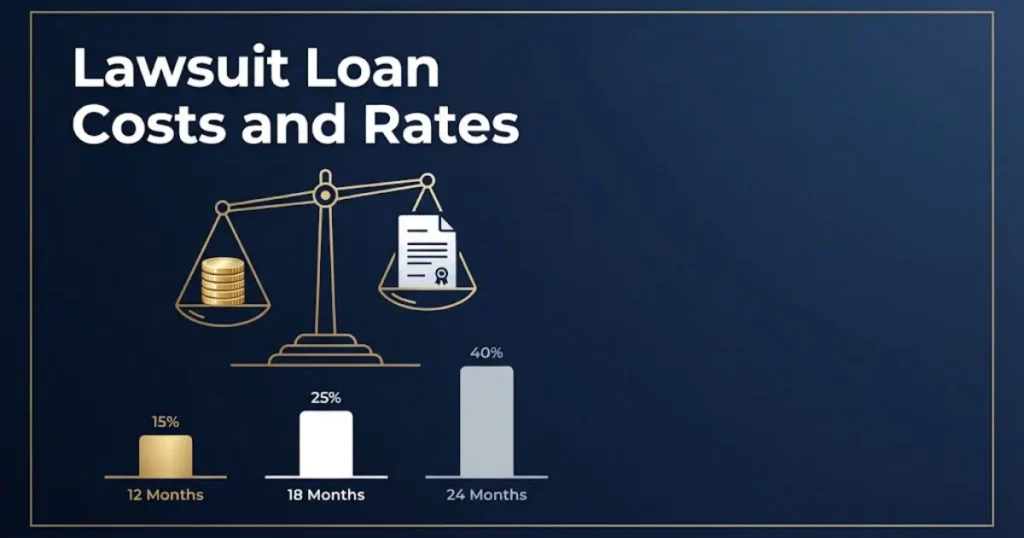
That said, rates vary enormously from one company to the next. Some charge as low as 2% per month simple interest. Others charge 3.5% per month compounding. Over a two-year case, the difference in total repayment is thousands of dollars.
| Company Rate Type | Monthly Rate | Annual Equivalent | $10,000 Owed After 18 Months |
|---|---|---|---|
| Low (simple) | 2.0% | 24% | $13,600 |
| Mid (simple) | 3.0% | 36% | $15,400 |
| Mid (compounding) | 3.0% | 36% | $16,878 |
| High (compounding) | 4.0% | 48% | $20,363 |
Notice how the compounding rate at 3% actually costs more than the simple rate at 3%. The math matters.
Red flags to watch for:
- Rates quoted as “monthly” to make them sound smaller
- Compounding interest not clearly disclosed
- “Teaser” rates that increase after 6 months
- Rates that jump if your case exceeds a certain duration
Some states have started capping rates. In 2026, at least nine states have regulations limiting how much legal funding companies can charge. Ask any company you are considering whether they comply with your state’s rate limits.
The American Legal Finance Association, the industry’s trade group, has voluntary rate guidelines. But not all companies are members, and membership does not guarantee low rates.
Pre Settlement Lawsuit Loan Repayment Terms
Repayment for a pre settlement lawsuit loan happens in one lump sum when your case settles. You make no monthly payments while waiting.
That is different from every other type of borrowing. There are no installment plans. No minimum monthly payments. No payment due dates during the life of the advance.
When your case reaches a settlement or verdict, your attorney distributes the funds. The funding company gets paid directly from the settlement proceeds before you receive your share.
Typical payout order from your settlement:
- Court costs and case expenses
- Attorney contingency fee (usually 33% to 40%)
- Pre settlement lawsuit loan repayment (advance plus fees)
- Medical liens and other liens
- Your remaining balance
That payout order means the funding company gets paid before you do. If your settlement is smaller than expected, your share shrinks. In some cases, plaintiffs end up with very little after everyone else takes their cut.
| Settlement Amount | Attorney Fee (33%) | Lawsuit Loan Repayment | Medical Liens | Your Share |
|---|---|---|---|---|
| $50,000 | $16,500 | $15,000 | $5,000 | $13,500 |
| $50,000 | $16,500 | $25,000 | $5,000 | $3,500 |
| $30,000 | $9,900 | $15,000 | $5,000 | $100 |
Look at that third row. A $30,000 settlement with a $15,000 loan repayment leaves you with practically nothing. This is why borrowing too much relative to your expected settlement is dangerous.
Non-recourse protection means if you lose completely, you owe zero. But “winning” with a settlement smaller than expected can still leave you in trouble.
Hidden Fees in Lawsuit Loans
Hidden fees in pre settlement lawsuit loans can add 10% to 25% to your total repayment on top of the stated interest rate.
Not every company charges these fees. But enough of them do that you need to ask specifically before signing anything. The interest rate they quote is sometimes just the beginning.
Common hidden or poorly disclosed fees:
- Origination fee: 5% to 10% of the advance amount, deducted upfront
- Processing fee: Flat fee of $100 to $500
- Underwriting fee: $250 to $1,000 for case evaluation
- Monthly maintenance fee: $25 to $50 per month
- Wire transfer fee: $25 to $50 per transaction
- Late case fee: Additional charges if the case exceeds a certain duration
- Attorney communication fee: Charged for contacting your lawyer
Here is what that looks like in practice:
| Fee Type | Amount | On a $10,000 Advance |
|---|---|---|
| Origination (7.5%) | Deducted from advance | You receive $9,250 |
| Processing | $350 flat | Added to balance |
| Monthly maintenance | $35/month for 18 months | $630 added to balance |
| Wire fee | $30 | Added to balance |
| Total fees before interest | $1,760 |
So you borrow $10,000, actually receive $9,250, and owe $11,760 before a single dollar of interest accrues. Then interest starts compounding on that inflated balance.
How to protect yourself:
- Ask for a complete fee schedule in writing
- Request the total payoff amount at 12, 18, and 24 months
- Compare the amount you receive to the amount you will owe
- Get everything in the contract, not just verbal promises
Key Takeaway: Always ask for the total payoff amount at multiple time points, because hidden fees can inflate your repayment far beyond the quoted interest rate.
Pre Settlement Lawsuit Loans Pros and Cons
Pre settlement lawsuit loans offer fast cash with no personal financial risk, but they come at a steep price that can eat into your settlement.
No financial product is all good or all bad. Legal funding fills a real need for injured people who cannot work and cannot wait. But the costs are real and sometimes brutal.
Pros:
- No repayment if you lose your case
- No credit check or income verification required
- Fast funding, often within 24 to 48 hours
- No monthly payments while waiting for settlement
- Can help you avoid accepting a lowball settlement offer
- Available even with bad credit, unemployment, or bankruptcy
Cons:
- Interest rates are significantly higher than traditional loans
- Compounding interest can double or triple your balance
- Hidden fees increase total cost beyond the quoted rate
- Reduces the amount you receive from your settlement
- Some companies use aggressive or misleading marketing
- Limited regulation in many states
- Your attorney must cooperate, and some refuse
The biggest pro, and the one funding companies emphasize most, is the ability to hold out for a better settlement. Insurance companies know when plaintiffs are desperate for money. They lowball accordingly. Having cash from a lawsuit advance can give you staying power.
But that advantage only works if the cost of the advance does not eat up the extra settlement money you negotiate. If you gain $10,000 in a better settlement but pay $12,000 in funding fees, you lost money.
It is simple math. Run the numbers before you sign.
Risks of Pre Settlement Lawsuit Loans
The biggest risk of pre settlement lawsuit loans is ending up with little or nothing from your settlement after repaying the advance.
That happens more often than most people expect. The combination of attorney fees, medical liens, and a ballooning lawsuit loan balance can consume an entire settlement.
Top risks to understand:
- Balance explosion: Compounding interest over a long case can triple your original advance
- Settlement shortfall: If your case settles for less than projected, your share disappears
- Multiple advances: Taking a second or third advance multiplies the problem
- Unclear contracts: Some agreements contain terms that are hard to understand without a lawyer
- Pressure to settle early: Some plaintiffs settle sooner than ideal to stop the interest clock
- Relationship with attorney: Some lawyers discourage funding, creating friction
Here is a real-world risk scenario:
| Timeline Event | Amount |
|---|---|
| Original advance | $15,000 |
| Interest after 24 months (35% compounding) | $12,318 |
| Fees | $2,500 |
| Total owed to funding company | $29,818 |
| Settlement amount | $60,000 |
| Attorney fee (33%) | $19,800 |
| Medical liens | $8,000 |
| Lawsuit loan repayment | $29,818 |
| Plaintiff receives | $2,382 |
That plaintiff waited two years, endured an injury, fought a legal battle, and walked away with $2,382 from a $60,000 settlement. The funding company took nearly half.
To reduce your risk, borrow the absolute minimum you need. Not the maximum you are approved for. Treat a lawsuit loan like emergency surgery: necessary sometimes, but you want as little as possible.
Alternatives to Pre Settlement Lawsuit Loans
Before taking a pre settlement lawsuit loan, explore cheaper options that could cover your expenses without eating into your settlement.
Legal funding should be a last resort, not a first choice. The interest rates make it one of the most expensive forms of borrowing available. Other options, while harder to access, cost far less.
Alternatives to consider:
- Personal loans from a bank or credit union: Interest rates of 8% to 15% are dramatically cheaper. You need decent credit.
- Credit card cash advance: Expensive at 20% to 28%, but still cheaper than most lawsuit loans.
- Borrowing from family or friends: Zero interest if the relationship can handle it.
- Negotiating with creditors: Many medical providers and landlords will defer payments if you explain your situation.
- Hardship programs: Utility companies, mortgage servicers, and credit card companies often have hardship programs for temporarily disabled or unemployed people.
- Attorney advance: Some attorneys will advance small amounts against your future settlement at zero or low interest.
- Government assistance: Medicaid, SNAP, disability benefits, or state assistance programs may cover basic needs.
- Nonprofit legal aid: Organizations sometimes help injured plaintiffs bridge financial gaps.
| Option | Typical Cost | Requires Credit Check | Repayment if You Lose |
|---|---|---|---|
| Pre settlement lawsuit loan | 27% to 60% annually | No | No |
| Personal loan | 8% to 15% annually | Yes | Yes |
| Credit card advance | 20% to 28% annually | Yes | Yes |
| Family loan | Usually 0% | No | Depends |
| Attorney advance | Usually 0% | No | Depends |
| Government assistance | Free | No | No |
The right choice depends on your situation. If you have no credit, no family support, and no income, a lawsuit loan may genuinely be your only option. But explore everything else first. Every dollar you avoid borrowing is a dollar you keep from your settlement.
Key Takeaway: Pre settlement lawsuit loans should be your last option; explore personal loans, hardship programs, and attorney advances first, because they cost far less.
State Laws Regulating Pre Settlement Lawsuit Loans
State laws governing pre settlement lawsuit loans vary dramatically. Some states cap rates, some ban the practice, and many have no regulation at all.
The legal funding industry operates in a regulatory gray area. Because these advances are technically not loans, they often fall outside traditional lending laws. That means no Truth in Lending Act protections in most states.
As of 2026, here is how the regulatory picture looks across the country:
| State Category | States (Examples) | What the Law Says |
|---|---|---|
| Strong regulation with rate caps | Arkansas, Indiana, Maine, Nebraska, Oklahoma, Tennessee, Vermont | Caps on interest rates, disclosure requirements, cooling-off periods |
| Moderate regulation | Ohio, Nevada, West Virginia | Some disclosure rules but limited rate caps |
| Minimal or no regulation | Texas, California, Florida, New York | Few or no specific laws governing legal funding |
| Effective ban | Colorado (limited scope) | Laws make it very difficult for funding companies to operate |
Key state developments in 2025 and 2026:
- Indiana enacted disclosure requirements forcing companies to show total repayment amounts
- Oklahoma capped rates and required licensing for funding companies
- Nebraska passed consumer protection rules requiring clear fee schedules
- Several states considered bills modeled on the Uniform Consumer Legal Funding Act, which creates standardized rules
What to check in your state:
- Whether legal funding companies must be licensed
- Whether interest rates are capped
- Whether you have a right to cancel within a certain period (cooling-off period)
- Whether the company must disclose the total repayment amount at multiple time points
- Whether your attorney must approve the transaction
If you live in a state with no regulation, you are essentially relying on the funding company’s honesty. Read every line of the contract. Ask your attorney to review it before you sign. No regulation means no safety net.
The American Legal Finance Association has pushed for industry self-regulation, but critics argue voluntary guidelines lack enforcement teeth. Legislative action continues to expand slowly across the country.
Frequently Asked Questions
Do I Have to Pay Back a Pre Settlement Lawsuit Loan If I Lose?
No. Pre settlement lawsuit loans are non-recourse, meaning you owe nothing if you lose your case.
The funding company absorbs the entire loss.
This applies whether your case is dismissed, you get a defense verdict, or your attorney withdraws.
How Much Can I Get from a Pre Settlement Lawsuit Loan?
Most plaintiffs receive between $1,000 and $100,000, depending on the expected value of their case.
Funding companies typically advance 10% to 20% of the anticipated settlement.
Larger cases like wrongful death or catastrophic injury claims can qualify for up to $500,000.
How Long Does It Take to Get Approved for a Lawsuit Loan?
Most applicants get approved within 24 to 48 hours.
The timeline depends on how quickly your attorney responds to the funding company’s request for case information.
Some companies offer same-day funding for straightforward auto accident cases.
Can I Get a Pre Settlement Lawsuit Loan with Bad Credit?
Yes. Credit scores are not part of the approval process.
Funding companies evaluate your case, not your personal finances.
Even people in active bankruptcy can qualify if their lawsuit is strong enough.
Are Pre Settlement Lawsuit Loans Legal in Every State?
Pre settlement lawsuit loans are legal in most states, but regulations vary widely.
Some states cap interest rates and require specific disclosures.
A few states have restrictions that make it very difficult for funding companies to operate there.
Your Next Move
Pre settlement lawsuit loans can be a lifeline when bills are crushing you and your case is still months from settling. They can also be a financial trap if you borrow too much at rates you do not fully understand.
Get the total repayment number in writing before you sign anything. Compare at least three companies. Ask your attorney for their honest opinion on the terms.
Borrow the minimum you need to survive, not the maximum they offer. Every dollar you do not borrow is a dollar that stays in your pocket when your settlement finally arrives.







