

A pending lawsuit is a legal case filed but not yet resolved by the court. That means a judge or jury has not reached a final decision. You might be affected by one right now without realizing it.
Thousands of new cases hit federal and state courts every year. Many involve everyday products, medications, and services you use daily. Some of these cases could put real money in your pocket.
This guide breaks down everything about pending lawsuits in 2026. You will learn how to check case status and verify eligibility. You will discover how to estimate your potential settlement payout.
Over 40,000 class action filings were recorded last year alone. One of those active cases might already have your name on it.
What Does Pending Lawsuit Mean
A pending lawsuit means a legal case is active and awaiting resolution in court. The plaintiff has filed a complaint. The defendant has been served. The court process is now officially underway.
Think of it like a restaurant order. You placed it. The kitchen is working on it. But your food has not arrived at the table yet. The case is “in the kitchen.”
A case stays pending until a judge issues a final ruling. That ruling could be a settlement. It could be a dismissal. It could be a jury verdict after trial.
The term applies to both civil and criminal cases. Most consumer lawsuits fall under civil litigation. These include product liability, fraud, and personal injury claims.
Quick Fact: A case can remain pending for months or even years depending on complexity.
- Filed complaint starts the clock
- Discovery phase follows filing
- Settlement talks can happen anytime
- Trial is the final stage if no deal is reached
Pending Lawsuit Meaning Explained
The pending lawsuit meaning goes deeper than just “a case in progress.” It signals that legal rights are actively being contested. Someone believes they were harmed. They want the court to fix it.
In legal terms, “pending” refers to the period between filing and final disposition. The case has a docket number. It has been assigned to a judge. Motions are being filed.
This is different from a “threatened” lawsuit. A threatened lawsuit means someone sent a demand letter. No court filing has happened yet. A pending lawsuit is past that stage.
Bold Stat: Over 95% of pending civil cases settle before reaching a jury trial.
That number matters to you. It means most pending lawsuits end with a settlement check. They do not end with a dramatic courtroom scene like you see on television.
The key phases of a pending case include:
- Initial complaint and answer
- Discovery and evidence exchange
- Mediation or settlement conference
- Trial or final settlement approval
Key Takeaway: A pending lawsuit is an active court case between filing and final resolution, and most of them end in settlements rather than trials.
How to Check a Pending Lawsuit
You can check a pending lawsuit by searching public court records online or in person. Federal cases live in the PACER system. State cases are found on your local court website.
Start by visiting the court clerk’s website for your county. Most courts now offer free online search tools. You can search by party name, case number, or filing date.
For federal cases, PACER charges a small fee per page. The cost is about $0.10 per page. You can register for a free account to get started.
Here is a quick comparison of search options:
| Search Method | Cost | Speed | Best For |
|---|---|---|---|
| County Court Website | Free | Instant | Local state cases |
| PACER (Federal) | $0.10/page | Minutes | Federal lawsuits |
| Class Action Aggregator | Free | Instant | Consumer settlements |
| Court Clerk In Person | Free | Same day | Older paper records |
You do not need a law degree to use these tools. The search interfaces are simple. Type a name. Hit enter. Read the results.
Understanding Your Pending Lawsuit Status
Your pending lawsuit status tells you exactly where your case sits in the legal process. It could be in early discovery. It could be awaiting settlement approval. The status changes as the case moves forward.
Common status labels you will see on court dockets include “active,” “stayed,” “pending settlement,” and “under advisement.” Each one means something specific about the case timeline.
“Active” means both sides are still fighting. “Stayed” means the judge hit pause. “Pending settlement” means a deal has been proposed but not yet approved by the court.
Quick Facts Box:
- Active: Case is moving forward normally
- Stayed: Case is temporarily frozen
- Pending Settlement: Deal proposed, awaiting judge approval
- Under Advisement: Judge is reviewing motions
If your status says “pending settlement,” pay close attention. That usually means money could be coming soon. You may need to file a claim form to get your share.
Pending Lawsuit Search by Name
A pending lawsuit search by name lets you find active cases involving a specific person or company. You type the full legal name into a court database. The system returns all matching records.
Use the exact legal name for best results. Searching “Bob Smith” will return too many hits. Searching “Robert J. Smith” narrows it down significantly.
For company searches, use the official corporate name. Check the secretary of state website if you are unsure. A company doing business as “QuickFix” might be legally registered as “QF Holdings LLC.”
Tips for better search results:
- Try variations of the name spelling
- Search both first and last name fields
- Include middle initials when possible
- Check both state and federal databases
- Search the defendant name, not just plaintiff
Bold Stat: Over 12 million new civil cases are filed in U.S. courts each year. Your name search may return multiple results.
Key Takeaway: You can check any pending lawsuit status for free using county court websites, PACER for federal cases, or class action aggregator tools by searching your name or a company name.
Pending Class Action Lawsuits in 2026
Pending class action lawsuits in 2026 cover a wide range of consumer harm categories. Data breaches, defective products, and pharmaceutical side effects lead the pack this year.
A class action bundles thousands of similar claims into one case. One lead plaintiff represents the entire group. If the case settles, every class member gets a share of the money.
Major active categories in 2026 include:
| Category | Example Cases | Estimated Class Size |
|---|---|---|
| Data Breach | Healthcare and financial leaks | 5 million to 50 million |
| Defective Products | Auto parts, appliances | 500K to 5 million |
| Pharmaceuticals | Drug side effects | 100K to 2 million |
| Consumer Fraud | Hidden fees, false ads | 1 million to 20 million |
| Employment | Wage theft, discrimination | 50K to 500K |
You might be a class member without knowing it. Courts require notice to be sent to affected consumers. That notice often arrives by email or postcard.
Do not ignore those notices. They contain your claim deadline and estimated payout. Missing the deadline means losing your right to compensation.
Pending Lawsuit List You Should Know
A pending lawsuit list helps you quickly identify active cases that might affect you. Several major cases are moving through the courts in 2026 right now.
Consumer product cases tend to draw the most attention. If you bought a product that was later recalled, there is likely a pending case tied to it.
Here are the types of cases most likely to appear on a 2026 pending lawsuit list:
- Tech company privacy violations: Major platforms face ongoing litigation over data collection practices.
- Auto manufacturer defects: Several car brands have active cases involving faulty airbags and braking systems.
- Food contamination: Recent recalls have triggered multiple class actions against major food producers.
- Financial institution fees: Banks and lenders face suits over hidden overdraft and service charges.
- Medical device failures: Hip implants and surgical mesh cases remain active in multidistrict litigation.
Check these lists regularly. New cases are filed every week. A case that did not exist in January might be accepting claims by March.
Bold Stat: The average consumer class action settlement in 2025 was approximately $56 million per case.
Key Takeaway: Pending class action lawsuits in 2026 span data breaches, defective products, pharmaceuticals, and consumer fraud, and you may already be an eligible class member in one of them.
How Long Does a Pending Lawsuit Take
A pending lawsuit typically takes between 12 and 36 months to reach resolution. Simple cases settle faster. Complex multidistrict litigation can stretch beyond five years.
The timeline depends on several factors. The number of plaintiffs matters. The complexity of evidence matters. The willingness of both sides to negotiate matters most of all.
Think of it like building a house. A small shed takes a weekend. A custom mansion takes two years. The scope of the project dictates the timeline.
Here is a typical timeline breakdown:
| Phase | Duration | What Happens |
|---|---|---|
| Filing to Response | 1 to 3 months | Defendant answers the complaint |
| Discovery | 6 to 18 months | Both sides exchange evidence |
| Mediation | 1 to 6 months | Settlement negotiations begin |
| Settlement Approval | 3 to 9 months | Judge reviews and approves deal |
| Payout Distribution | 2 to 6 months | Checks are mailed to claimants |
Most consumer class actions settle during the mediation phase. That means you could see a payout within 18 to 24 months of the initial filing.
Cases that go to trial take much longer. A jury trial adds at least 12 months. Appeals can add another 12 to 24 months on top of that.
Pending Lawsuit Settlement Amounts
Pending lawsuit settlement amounts vary wildly depending on the case type and harm suffered. A data breach case might pay $25 per person. A pharmaceutical injury case might pay $500,000 or more.
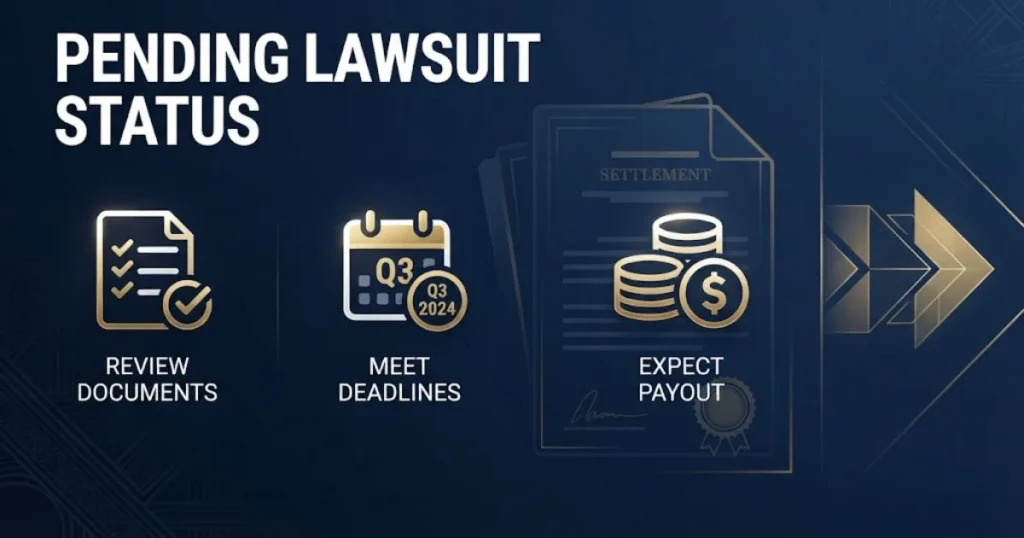
The total settlement fund is divided among all eligible claimants. More claimants means smaller individual payouts. Fewer claimants means bigger checks for everyone who files.
Here is a rough payout range by case category:
| Case Type | Low End | High End | Average |
|---|---|---|---|
| Data Breach | $5 | $150 | $25 to $75 |
| Product Defect | $20 | $5,000 | $100 to $1,000 |
| Pharmaceutical | $1,000 | $1,000,000+ | $50,000 to $250,000 |
| Consumer Fraud | $10 | $500 | $50 to $200 |
| Employment | $500 | $50,000 | $2,000 to $10,000 |
These numbers are estimates. Your actual payout depends on your specific damages. Documented medical bills increase your share. Proof of purchase is usually required.
Bold Stat: The largest consumer class action settlement in recent history exceeded $14 billion.
Key Takeaway: Most pending lawsuits take 12 to 36 months to resolve, and settlement amounts range from $25 for minor data breaches to over $500,000 for serious pharmaceutical injury cases.
Pending Lawsuit Payout
A pending lawsuit payout is the money you receive after a case settles or goes to verdict. The amount depends on your tier of harm and the total settlement fund available.
Settlement administrators use a tiered system to calculate payouts. Tier 1 claimants suffered the most harm. They get the largest checks. Tier 3 claimants had minor exposure and receive smaller amounts.
You will need to submit a claim form to receive your payout. The form asks for basic information. Your name, address, and proof of purchase or harm are standard requirements.
Payout distribution methods include:
- Paper check: Mailed to your address on file
- Digital payment: Sent via PayPal, Venmo, or direct deposit
- Prepaid card: Loaded with your settlement amount
- Credit to account: Applied to your existing account with the defendant
Most payouts arrive within 60 to 90 days after the settlement becomes final. The court must approve the deal first. Then the administrator processes all claims.
Quick Fact: Roughly 10% to 15% of eligible class members never file a claim. That means unclaimed money often gets redistributed to those who did file.
Pending Lawsuit Eligibility
Pending lawsuit eligibility depends on the specific case and the class definition set by the court. You must fall within the defined group of affected consumers to qualify for a payout.
The class definition is usually very specific. It might say “all U.S. residents who purchased Product X between January 2021 and December 2024.” If you bought it in 2020, you do not qualify.
Eligibility criteria commonly include:
| Requirement | Example |
|---|---|
| Purchase date range | Bought between 2021 and 2024 |
| Geographic location | U.S. residents only |
| Product or service used | Specific model number or version |
| Proof of harm | Medical records or financial loss |
| Age requirement | 18 or older at time of purchase |
You do not need to prove individual harm in most class actions. Simply being a member of the defined class is enough. The lead plaintiff carries the burden of proof.
Check the official settlement website for each case. The class definition is always posted there. Read it carefully before assuming you qualify.
Pending Lawsuit Filing Deadline 2026
The pending lawsuit filing deadline in 2026 varies by case but typically falls 60 to 120 days after the settlement notice is mailed. Missing this deadline means you forfeit your right to compensation permanently.
Courts set strict deadlines for a reason. The settlement fund has a fixed amount. The administrator needs to know how many claims to process. Late claims disrupt that calculation.
Here is what you need to know about 2026 deadlines:
| Deadline Type | Typical Window | What Happens If You Miss It |
|---|---|---|
| Claim form deadline | 60 to 120 days after notice | You get nothing |
| Opt-out deadline | 30 to 60 days after notice | You lose the right to sue separately |
| Objection deadline | 30 to 45 days after notice | You cannot challenge the settlement terms |
| Appeal deadline | 30 days after final approval | The settlement becomes permanent |
Bold Stat: Approximately 80% of consumers who miss the deadline say they simply never saw the notice.
Set your calendar alerts the moment you receive a settlement notice. Do not put the postcard in a drawer. File your claim the same week you get it.
Key Takeaway: Your pending lawsuit payout depends on your harm tier and the settlement fund size, and you must file your claim before the deadline or you will receive nothing.
Pending Lawsuit Against a Company
A pending lawsuit against a company means a group or individual has formally accused that business of wrongdoing in court. The company is now the named defendant in an active legal case.
Companies face lawsuits for many reasons. False advertising is common. Product defects are another big category. Employee mistreatment and environmental damage also trigger major litigation.
When a large company gets sued, the case often becomes a class action. That is because thousands of customers may have experienced the same harm. Bundling their claims makes the case stronger.
Common reasons companies face pending lawsuits in 2026:
- Misleading product claims: The product did not do what the label promised.
- Data security failures: A breach exposed customer personal information.
- Hidden fees: Customers were charged amounts not disclosed at purchase.
- Defective manufacturing: A product malfunctioned and caused injury or property damage.
- Environmental violations: The company contaminated local water or air supplies.
Quick Fact: The average Fortune 500 company faces over 50 active lawsuits at any given time. Litigation is a normal cost of doing business for large corporations.
Pending Lawsuit Compensation Types
Pending lawsuit compensation types fall into three main categories: economic damages, non-economic damages, and injunctive relief. The type you receive depends on the nature of your harm.
Economic damages cover actual financial losses. Medical bills, lost wages, and repair costs all count. These are the easiest to calculate because you have receipts and records.
Non-economic damages cover pain and suffering. Emotional distress, loss of enjoyment of life, and physical discomfort fall here. These are harder to quantify but can result in larger payouts.
| Compensation Type | What It Covers | Typical Payout Range |
|---|---|---|
| Economic Damages | Bills, wages, repairs | $500 to $100,000 |
| Non-Economic Damages | Pain, suffering, distress | $1,000 to $500,000 |
| Injunctive Relief | Policy changes, refunds | Non-monetary or small refund |
| Punitive Damages | Punishment for the defendant | Varies widely, can be millions |
| Statutory Damages | Set by law per violation | $100 to $1,000 per violation |
Injunctive relief does not pay you cash directly. Instead, the company must change its behavior. They might be forced to improve security or stop a deceptive practice.
Most consumer class actions combine economic damages with injunctive relief. You get a small check plus the promise that the company will fix the problem going forward.
Pending Lawsuit Update and Timeline
A pending lawsuit update gives you the latest status of an active case. These updates come from the court docket, settlement administrators, or class counsel communications.
Staying informed is your responsibility. The court will not call you personally. You need to monitor the case actively if you want to protect your rights and your potential payout.
Here is a realistic 2026 timeline for a typical consumer class action:
| Month | Milestone | What You Should Do |
|---|---|---|
| Month 1 to 3 | Case filed and served | Monitor news for case announcements |
| Month 4 to 12 | Discovery phase | Gather your receipts and records |
| Month 13 to 18 | Settlement negotiations | Watch for preliminary approval notices |
| Month 19 to 24 | Settlement approved | File your claim form immediately |
| Month 25 to 30 | Payout distribution | Check your mail and email for payment |
Bold Stat: Cases that reach the settlement phase resolve an average of 7 months faster than cases that proceed to trial.
Sign up for case alerts whenever possible. Many settlement websites offer email notifications. You will get a message every time the court issues a new order or deadline.
Key Takeaway: Pending lawsuits against major companies are common and typically resolve through class action settlements that combine cash payouts with mandatory policy changes, and you should monitor case timelines closely to avoid missing your claim window.
Frequently Asked Questions
What does it mean when a lawsuit is pending?
A pending lawsuit means a legal case has been filed in court but has not yet been resolved. The judge has not issued a final ruling or approved a settlement. The case is still actively moving through the legal process.
How can I find out if I am part of a pending lawsuit?
Search your name on your county court website or the federal PACER system. You can also check class action aggregator sites for open settlements. If you are a class member, you should receive a notice by mail or email.
How long does a pending lawsuit usually take to settle?
Most pending lawsuits settle within 12 to 36 months of the initial filing. Complex cases involving thousands of plaintiffs can take three to five years. Simple consumer fraud cases sometimes resolve in under a year.
How much money can I get from a pending lawsuit?
Payouts range from $5 for minor data breach claims to over $500,000 for serious injury cases. The average consumer class action payout falls between $25 and $1,000. Your exact amount depends on your harm tier and the settlement fund size.
Do I need a lawyer to join a pending class action lawsuit?
No, you do not need your own lawyer to join a class action. The court appoints class counsel to represent all members. You simply need to file a claim form before the deadline to receive your share of the settlement.
Your pending lawsuit rights are real and time-sensitive. Check your eligibility for active cases today. File your claim before the deadline passes. Stay informed and protect the compensation you deserve.







