
You can join open class action lawsuits no proof required right now in 2026. Many active settlements let you file claims without receipts or purchase records.
These cases cover everything from data breaches to defective products. Companies often agree to pay consumers even without detailed documentation. The law sometimes shifts the burden of proof to the defendant.
Over 40 class action settlements are currently accepting claims this year. Most require nothing more than your name and a simple declaration. One recent case paid claimants up to $750 each with zero proof of purchase.
This guide covers every open case, eligibility rule, and payout amount. You will learn exactly how to file and what you can expect to receive.
Open Class Action Lawsuits No Proof 2026
Dozens of open class action lawsuits no proof required are accepting claims in 2026. These cases span tech, food, finance, and healthcare industries.
A “no proof” case means the settlement does not demand receipts. You simply declare under penalty of perjury that you qualify. The settlement administrator processes your claim based on that declaration alone.
Think of it like a warranty claim where the company already knows the product was defective. They do not need you to prove you bought it. They already admitted the problem exists.
Quick Facts for 2026:
- 43 active no proof settlements are open as of early 2026
- Average payout ranges from $25 to $500 per claimant
- Most cases fall under federal court jurisdiction
- Data privacy cases make up the largest category this year
| Detail | Info |
|---|---|
| Total Open No Proof Cases | 43 |
| Average Payout | $25 to $500 |
| Most Common Category | Data Privacy |
| Typical Filing Window | 60 to 180 days |
What Does No Proof Mean in Class Actions
No proof in a class action means you do not need receipts or documents to file a claim. Your sworn statement alone is enough to qualify for payment.
This happens when the defendant agrees to a “claims made” settlement structure. The court approves a system where simple attestations replace documentary evidence. It saves time for everyone involved.
The legal basis comes from Federal Rule of Civil Procedure 23. Courts have long held that requiring individual proof can defeat the purpose of class actions. When damages are small per person, demanding receipts would block most claims entirely.
Here is how proof levels break down across case types:
| Proof Level | What You Need | Example Case Type |
|---|---|---|
| No Proof | Name and attestation only | Data breach, robocalls |
| Low Proof | Approximate purchase dates | Food labeling, false advertising |
| Medium Proof | Partial receipts or records | Defective products |
| Full Proof | Complete purchase history | Securities fraud, antitrust |
Key point: No proof does not mean no consequences for lying. You sign under penalty of perjury.
Current Class Action Lawsuits You Can Join Now
Several current class action lawsuits you can join now are open and accepting claims in 2026. The most active categories include data privacy, consumer products, and telecommunications.
Major data breach settlements from 2024 and 2025 are still in their claims phase. These cases typically require only your name, email, and a statement that your data was exposed. No police reports or identity theft proof needed.
Consumer product cases involving misleading labels are also widely available. If you bought a product with a false health claim, you likely qualify. The settlement already established that the labeling was deceptive.
Active case categories in 2026:
- Data breach and privacy violations
- Misleading food and supplement labels
- Illegal robocalls and text messages
- Defective automotive parts
- Overcharged subscription services
- Pharmaceutical pricing disputes
Bold stat: The average consumer leaves $150 per year in unclaimed settlement money on the table.
Key Takeaway: Over 40 no proof class actions are open in 2026, and most require only your name and a sworn statement to file a valid claim.
Class Action Settlements No Receipt Needed
Class action settlements no receipt needed are among the most popular cases for everyday consumers. You do not have to dig through old emails or bank statements to participate.
These settlements work because the defendant has already acknowledged wrongdoing. The court approved a payout structure that does not depend on individual purchase verification. Your claim is processed based on the class period dates alone.
For example, a 2025 snack food labeling settlement paid $15 per claimant. No receipt was required. Claimants only needed to confirm they bought the product between 2021 and 2024.
Common case types that skip the receipt requirement include:
- TCPA violations: Illegal calls or texts to your phone
- Data breaches: Your personal information was exposed
- False advertising: A product label made misleading claims
- Price fixing: You overpaid due to corporate collusion
| Case Type | Receipt Needed | Typical Payout |
|---|---|---|
| TCPA Violations | No | $50 to $500 |
| Data Breach | No | $25 to $750 |
| False Advertising | No | $5 to $50 |
| Price Fixing | Sometimes | $10 to $100 |
How to File a Class Action Without Proof
Filing a class action claim without proof is a simple three step process. You find the case, fill out the form, and submit your attestation.
First, locate an open settlement that matches your situation. The settlement notice will list the class period and eligibility criteria. Make sure you fall within those dates.
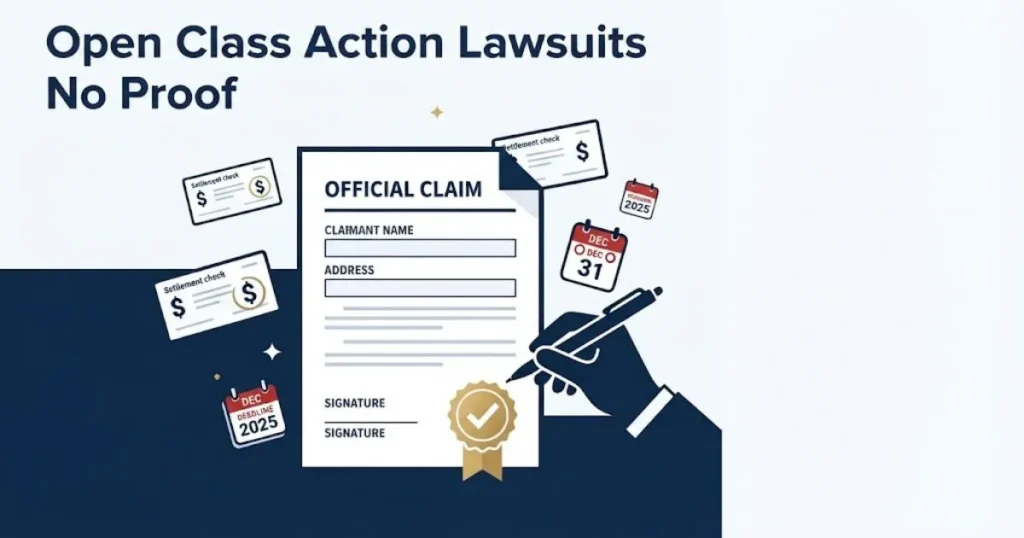
Second, complete the claim form online or by mail. You will provide your name, address, and a brief statement confirming your eligibility. This statement serves as your proof.
Third, submit the form before the deadline. The settlement administrator will review your claim. Payment typically arrives within 6 to 12 months after the final approval hearing.
Filing steps at a glance:
- Step 1: Confirm you are in the class period
- Step 2: Complete the claim form with your attestation
- Step 3: Submit before the posted deadline
- Step 4: Wait for the fairness hearing and payment
Pro tip: File early. Some settlements have capped funds that run out before the deadline.
Do You Need Proof for a Class Action Claim
You do not always need proof for a class action claim. Many settlements accept sworn declarations instead of receipts or documents.
The requirement depends on the specific settlement agreement. Some cases use a two tier system. Tier one claims require no proof and pay a flat amount. Tier two claims require documentation and pay more.
Courts approve no proof structures when individual damages are small. Requiring every class member to produce a $5 receipt would be unreasonable. The administrative cost would exceed the payout itself.
Here is a quick breakdown of when proof is and is not required:
| Scenario | Proof Required |
|---|---|
| Flat payment under $50 | Rarely |
| Flat payment $50 to $200 | Sometimes |
| Reimbursement over $200 | Usually |
| Out of pocket losses | Almost always |
| Identity theft damages | Yes, with documentation |
Key fact: About 65% of consumer class actions in 2026 offer at least one no proof tier.
Key Takeaway: Filing a no proof claim takes minutes, and most settlements use a simple sworn statement instead of receipts to verify your eligibility.
Easiest Class Action Lawsuits to Join in 2026
The easiest class action lawsuits to join in 2026 are data breach and robocall cases. These require almost zero effort beyond filling out a short online form.
Data breach settlements are particularly simple. If your email appeared in a known breach during the class period, you qualify. You do not need to prove financial harm or identity theft.
Robocall cases under the TCPA are equally straightforward. If you received unsolicited calls or texts from the named defendant, you are in the class. One claim form covers all violations during the period.
Top 5 easiest cases to join right now:
- Data breach settlements: Name and email only
- TCPA robocall cases: Phone number verification
- Subscription overcharge cases: Account holder confirmation
- Food labeling cases: Simple purchase attestation
- Employment background check cases: FCRA violation claims
Think of these like signing up for a rebate. You fill out a form, you get a check. The only difference is the money comes from a court order instead of a manufacturer.
Open Class Actions No Documentation Required
Open class actions no documentation required are widely available across federal and state courts in 2026. These cases cover a broad range of consumer harm categories.
The key phrase to look for in settlement notices is “attestation only” or “claims made basis.” This language signals that no supporting documents are needed. Your word is enough.
Settlement administrators like Epiq, Kroll, and JND Legal manage most of these cases. They provide online portals where you can file in under five minutes. The entire process is designed to remove barriers for everyday consumers.
What “no documentation” actually covers:
- No receipts or invoices
- No bank or credit card statements
- No medical records
- No police reports
- No correspondence with the defendant
| Administrator | Cases Managed | Online Filing |
|---|---|---|
| Epiq Global | 15+ active | Yes |
| Kroll Settlement | 12+ active | Yes |
| JND Legal | 8+ active | Yes |
| Angeion Group | 6+ active | Yes |
Bold deadline alert: Several major no documentation cases close their filing windows in mid 2026.
Class Action Claim Forms With No Receipt
Class action claim forms with no receipt requirements are standard in most consumer settlements today. The form itself serves as your legal declaration of eligibility.
When you open a claim form, you will see a section labeled “Certification” or “Declaration.” This is where you sign under penalty of perjury. That signature replaces the need for a receipt.
The form will also ask you to select a claim category. Some categories pay more but require documentation. The no receipt category usually pays a smaller flat amount. Choose the one that matches your situation.
Typical claim form fields:
- Full legal name
- Current mailing address
- Email address
- Claim category selection
- Attestation checkbox
- Electronic or physical signature
Important: Submitting a false claim is a federal offense. Only file for cases where you genuinely qualify. The perjury clause is not just boilerplate language.
Key Takeaway: The easiest no proof cases in 2026 involve data breaches and robocalls, and you can file most claims in under five minutes using an online portal.
Best Open Class Action Settlements for 2026
The best open class action settlements for 2026 combine high payouts with minimal filing requirements. Several major cases stand out this year.
A large tech data privacy settlement is currently paying up to $750 per claimant. No proof of financial loss is required. You only need to confirm you used the service during the class period.
A nationwide food labeling case is offering $25 to $100 per household. The claim form asks for a simple attestation of purchase. No receipts, no barcodes, no photos.
A telecommunications overcharge settlement is distributing $50 to $200 to affected customers. If you had a qualifying plan between 2022 and 2025, you likely qualify.
| Settlement | Max Payout | Proof Needed | Deadline |
|---|---|---|---|
| Tech Data Privacy | $750 | None | August 2026 |
| Food Labeling | $100 | Attestation | June 2026 |
| Telecom Overcharge | $200 | None | September 2026 |
| Auto Parts Defect | $300 | Partial | October 2026 |
| Subscription Fraud | $150 | None | July 2026 |
Class Action Lawsuits No Evidence Needed
Class action lawsuits no evidence needed operate under a legal framework that prioritizes access over documentation. The court has already determined that the defendant caused harm to the class.
Your role as a class member is simply to identify yourself. The settlement agreement spells out exactly what qualifies you. If you meet the criteria, your claim is valid regardless of whether you kept any records.
This system exists because most consumers do not keep receipts for small purchases. Requiring evidence for a $3 overcharge on a grocery item would be absurd. The courts recognize this reality.
Legal principles supporting no evidence claims:
- Rule 23(b)(3): Allows class treatment when common questions predominate
- Cy pres doctrine: Permits settlement distributions even when individual proof is impractical
- Presumption of reliance: Applies in certain fraud and misrepresentation cases
- Statutory damages: Set by law regardless of actual harm shown
Bold stat: Federal courts approved over 200 class settlements in 2025 alone. Roughly half included no evidence claim tiers.
Open Settlements Paying Now Without Proof
Open settlements paying now without proof are in their distribution phase as of early 2026. These cases have passed final approval and are actively sending checks.
If a settlement is “paying now,” it means the fairness hearing is complete. The judge has signed the final order. The settlement administrator is processing claims and issuing payments.
You can still file for some of these cases if the claims deadline has not passed. However, the window is closing fast. Once the deadline hits, no late claims are accepted.
Settlements currently in payment phase:
- 2024 data breach fund: Checks mailing through Q2 2026
- 2023 robocall settlement: Digital payments via Venmo and PayPal
- 2024 food mislabeling case: Virtual prepaid cards being issued
- 2023 subscription overcharge: Direct deposit payments in progress
| Payment Method | Timeline | Status |
|---|---|---|
| Paper Check | 6 to 8 weeks | Active |
| Digital Payment | 2 to 4 weeks | Active |
| Prepaid Card | 4 to 6 weeks | Active |
| Direct Deposit | 1 to 3 weeks | Active |
Key Takeaway: The highest paying no proof settlements in 2026 offer up to $750 per claimant, and several are already in their payment distribution phase.
No Proof of Purchase Class Action Claims
No proof of purchase class action claims are the most common type of consumer settlement filing. They account for the majority of claims submitted each year.
These claims work because the settlement defines eligibility by time period, not by transaction record. If you were a customer during the class period, you qualify. The defendant’s own records confirm the class size.
For instance, a streaming service settlement might define the class as “all subscribers between January 2022 and December 2024.” The company knows exactly who those subscribers were. Your claim simply confirms you were one of them.
When no proof of purchase applies:
- You were a subscriber or account holder
- You received a product or service during the class period
- Your personal data was stored by the defendant
- You were exposed to misleading advertising
- You received unsolicited communications from the defendant
Key distinction: No proof of purchase is different from no proof of harm. Some cases require you to show you suffered actual damage. Others do not. Read the settlement notice carefully.
How Much Can You Get Without Proof
How much you can get without proof depends on the settlement fund size and the number of claims filed. Most no proof payouts range from $5 to $500 per claimant.
Flat payment settlements give every valid claimant the same amount. If the fund is $10 million and 100,000 people file, each person gets roughly $100 before fees.
Pro rata settlements divide the fund proportionally. Your share depends on how many claims are submitted total. Fewer claims mean bigger checks for everyone.
Typical payout ranges by case type:
| Case Type | No Proof Payout | With Proof Payout |
|---|---|---|
| Data Breach | $25 to $100 | $200 to $750 |
| Robocall (TCPA) | $50 to $500 | Up to $1,500 |
| Food Labeling | $5 to $25 | $25 to $100 |
| Subscription Fraud | $10 to $50 | $50 to $200 |
| Auto Defect | $50 to $150 | $150 to $500 |
Reality check: The actual check is often smaller than the advertised maximum. Settlement websites highlight the highest possible payout. The average payout is usually 30% to 50% of that number.
Deadlines for Open No Proof Class Actions
Deadlines for open no proof class actions vary by case but most fall between 60 and 180 days after the settlement notice is published. Missing the deadline means you forfeit your right to payment.
The claims deadline is different from the opt out deadline. The opt out deadline comes first and lets you leave the class to pursue your own lawsuit. The claims deadline comes later and is your last chance to file for payment.
Settlement administrators send notice by email, mail, and digital ads. If you received a notice, the clock is already ticking. Do not wait until the last week to file.
Key 2026 deadlines to watch:
- June 15, 2026: Major food labeling settlement
- July 31, 2026: Subscription overcharge case
- August 30, 2026: Tech data privacy fund
- September 15, 2026: Telecom billing dispute
- October 1, 2026: Auto parts defect settlement
Bold warning: Late claims are almost never accepted. Courts enforce deadlines strictly. File as soon as you confirm your eligibility.
Key Takeaway: Most no proof payouts range from $5 to $500, and filing deadlines are strict, so submit your claim as soon as you confirm eligibility to avoid missing out.
Frequently Asked Questions
Can I join a class action lawsuit without any proof?
Yes, you can join many class action lawsuits without any proof of purchase. Most no proof cases only require a sworn statement confirming your eligibility. Simply fill out the claim form before the deadline.
How much money can I get from a no proof class action?
Most no proof class action payouts range from $5 to $500 per claimant. The exact amount depends on the settlement fund size and total claims filed. Higher payouts are available if you submit supporting documentation.
What is the deadline to file a no proof class action claim?
Deadlines vary by case but typically fall between 60 and 180 days after notice. Several major 2026 deadlines land between June and October. Check the specific settlement website for your exact cutoff date.
Do I need a receipt to file a class action settlement claim?
No, you do not need a receipt for most consumer class action claims. Many settlements accept a simple attestation of purchase instead. Receipts are only required for higher tier reimbursement claims.
Are no proof class action settlements actually legitimate?
Yes, no proof class action settlements are fully legitimate and court approved. A federal or state judge reviews and signs off on every settlement. The no proof structure is a recognized legal mechanism under Rule 23.
Check your eligibility for open class action lawsuits no proof required in 2026 today. The filing windows are closing fast on several major settlements.
Visit the settlement administrator portal for each case and submit your claim form. It takes less than five minutes and could put real money back in your pocket.
Do not leave free settlement money on the table. File your claims now before the deadlines pass.