A michigan court case search is your fastest path to public court records. The state handles over 2.3 million new filings every year. Most of those records are searchable online right now.
The MiCOURT system got a major overhaul in 2025. That update changed how searches work across all court levels. You need current information to find what you need.
This guide covers every search method available in 2026. We break down circuit, district, probate, and appeals courts. You will learn exactly where to look and what it costs.
County clerks still hold some older paper records. We will show you how to reach those too. Let’s get started.
Michigan Court Case Search
A michigan court case search lets you find public records from any state court. The system covers civil, criminal, traffic, family, and probate cases statewide.
Michigan operates over 150 individual courts. These include 57 circuit courts and 105 district courts. Each one feeds data into a central search system.
The primary tool is MiCOURT. It launched a significant platform update in late 2025. The 2026 version is faster and covers more counties than before.
You do not need a lawyer to use it. You do not need a paid subscription either. Basic case information is available to anyone with internet access.
Quick Facts:
- Total Michigan courts: Over 150
- Annual filings: 2.3 million plus
- Cost for basic search: Free
- System used: MiCOURT (updated 2025)
Think of it like a library card catalog. You type in what you know, and the system pulls matching files.
MiCOURT Case Search
MiCOURT case search is the official online portal for Michigan trial court records. It is run by the Michigan State Court Administrative Office.
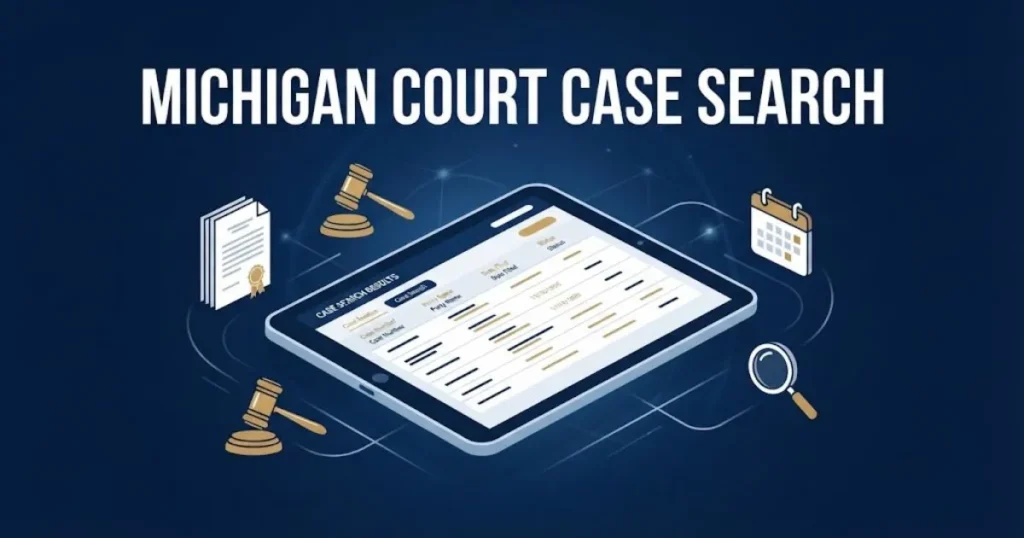
The portal covers most circuit and district courts in the state. As of 2026, over 80 counties feed data into MiCOURT. A few smaller counties still use separate systems.
You can search by party name, case number, or attorney name. The system returns matching cases with basic docket information. This includes filing dates, hearing schedules, and case types.
The 2025 update added improved filters. You can now narrow results by date range and case category. This makes it much easier to find specific records.
| Feature | Before 2025 | 2026 Version |
|---|---|---|
| Counties covered | 73 | 80 plus |
| Date range filters | Limited | Full range |
| Case category filters | None | Yes |
| Mobile responsive | Partial | Fully |
| Search speed | Slow | Much faster |
The portal is available 24 hours a day. Maintenance windows happen on Sunday mornings occasionally.
Key Takeaway: MiCOURT is your starting point for any Michigan trial court search, and the 2026 version covers more counties than ever before.
How to Look Up Court Cases in Michigan
To look up court cases in Michigan, start with the MiCOURT portal. Enter whatever details you have about the case. The system will return all matching results.
Here is the basic process for first-time users. Open the MiCOURT case search page. Choose your search type from the dropdown menu.
You have three main options. Search by party name if you know who is involved. Search by case number if you have the exact docket number. Search by attorney name if you know the lawyer.
Type your information into the search field. Click the search button and wait for results. Most queries return results in under five seconds.
Step-by-step summary:
- Open the MiCOURT search portal
- Select your search method (name, number, or attorney)
- Enter your search terms
- Review the matching case list
- Click on a case for docket details
If you get too many results, add a middle initial. You can also filter by county or filing year. This narrows the list quickly.
Michigan Court Records Online
Michigan court records online are available through multiple digital platforms. MiCOURT handles trial courts. The Michigan Supreme Court has its own separate database.
The state began digitizing records aggressively in 2020. By 2026, most cases filed after 2005 are fully searchable online. Older cases may require an in-person visit.
You can access records from any device with a browser. No software download is required. No account creation is needed for basic searches.
Some counties also maintain their own online portals. Wayne County and Oakland County have independent systems. These sometimes have records that MiCOURT has not yet indexed.
| Record Era | Online Availability |
|---|---|
| 2020 to 2026 | Fully digitized |
| 2005 to 2019 | Mostly digitized |
| 1990 to 2004 | Partially available |
| Before 1990 | In-person only |
The trend is clear. More records move online every quarter. By 2027, the state plans to digitize records back to 1995.
Michigan Court Case Lookup Free
A michigan court case lookup free of charge is available through MiCOURT. You pay nothing to search and view basic case information. This includes docket entries and hearing dates.
Free access covers party names, case types, and filing dates. You can see the current status of any active case. You can also view past case outcomes in most situations.
Some detailed documents require a small fee. Certified copies typically cost $10 to $15 per document. Standard copies run about $1 per page at most clerk offices.
Think of it like a restaurant menu. Reading the menu is free. Ordering the actual dish costs money. The search is free, but official copies are not.
What you get for free:
- Case search by name or number
- Basic docket information
- Hearing dates and outcomes
- Case type and filing date
- Party and attorney names
What costs money:
- Certified document copies
- Full case file printouts
- Sealed record access requests
Key Takeaway: Basic Michigan court record searches are completely free online, but you will pay small fees for certified copies or full file printouts.
Michigan Court Records by Name
Michigan court records by name searches are the most common method. You simply type a full or partial name into the search field. The system returns all matching cases.
This method works best when you have the full legal name. Include a middle initial if the name is common. A name like “John Smith” will return thousands of results.
The MiCOURT system uses partial matching by default. Typing “Sm” in the last name field catches Smith, Smythe, and Smalley. This is helpful when you are unsure of exact spelling.
You can search for plaintiffs, defendants, or both. The system labels each party’s role in the case. This helps you identify the right person quickly.
| Search Tip | Why It Helps |
|---|---|
| Use full legal name | Reduces false matches |
| Add middle initial | Narrows common names |
| Try alternate spellings | Catches clerical errors |
| Filter by county | Eliminates wrong jurisdiction |
| Add a date range | Focuses on relevant time period |
One warning about name searches. Maiden names and name changes can hide records. Try previous names if your first search comes up empty.
Michigan Court Case Number Search
A michigan court case number search is the most precise method available. Every case gets a unique number when it is filed. No two cases share the same number.
Michigan case numbers follow a standard format. They typically start with a year, followed by a case type code and a sequence number. An example looks like this: 24-001234-CZ.
The first two digits represent the filing year. The letter code indicates the case type. “CZ” means civil, “CR” means criminal, “FH” means family.
If you have the full case number, type it exactly as shown. Do not add spaces or extra characters. The system is sensitive to formatting.
Common Michigan case type codes:
- CZ: Civil case
- CR: Criminal felony
- CM: Criminal misdemeanor
- FH: Family/divorce
- PR: Probate
- TR: Traffic
A case number search returns one exact match. There is no guesswork involved. This is the gold standard for finding a specific case.
Key Takeaway: Searching by name is convenient, but a case number search gives you one exact result with zero ambiguity.
Michigan Circuit Court Case Search
A michigan circuit court case search covers the state’s main trial courts. Circuit courts handle felonies, major civil cases, and family law matters. There are 57 circuit courts across Michigan.
These courts handle cases involving more than $25,000 in damages. They also handle all felony criminal prosecutions. Divorce and custody cases start here too.
You search circuit court records through MiCOURT. Select “Circuit Court” from the court type dropdown. Then enter your search criteria as usual.
Some large counties have additional search tools. Wayne County Circuit Court has its own online portal. Oakland County offers a separate case access system.
| Circuit Court Fact | Detail |
|---|---|
| Number of circuits | 57 |
| Counties served | All 83 |
| Case types | Felony, civil, family |
| Minimum civil amount | $25,000 |
| Online access | MiCOURT plus county portals |
Circuit court records tend to be more detailed. Expect longer dockets with more filings per case. A single divorce case might have 50 or more docket entries.
Michigan District Court Case Search
A michigan district court case search covers the state’s busiest courts. District courts handle misdemeanors, small claims, and traffic violations. Michigan has 105 district court locations.
These courts process the highest volume of cases in the state. Traffic tickets alone account for over a million filings per year. Small claims cases under $7,000 also land here.
The search process is identical to circuit court. Use MiCOURT and select “District Court” from the menu. Enter the party name or case number.
District court records are often simpler. A typical traffic case has only three or four docket entries. A small claims case might have five or six.
Common district court case types:
- Traffic violations and parking tickets
- Misdemeanor criminal charges
- Small claims under $7,000
- Landlord-tenant disputes
- Civil cases under $25,000
One thing to remember. District court records move fast. Cases open and close within weeks sometimes. Check back frequently if you are monitoring an active case.
Michigan Probate Court Case Search
A michigan probate court case search covers wills, estates, and guardianships. Michigan has 78 probate courts, one in each county. Some smaller counties share a probate judge.
Probate records include estate administrations and trust disputes. They also cover guardianship and conservatorship cases. Mental health commitment hearings appear here too.
Not all probate records are fully public. Some estate files contain sensitive financial information. The court may restrict access to certain documents within a case.
You can search probate cases through MiCOURT. Select “Probate Court” from the court type filter. Use the decedent’s name for estate cases.
| Probate Record Type | Public Access Level |
|---|---|
| Will filings | Fully public |
| Estate inventories | Partially restricted |
| Guardianship petitions | Public with limits |
| Mental health records | Sealed |
| Trust disputes | Case by case |
Probate searches can be tricky. Estates may be filed under the decedent’s full legal name. Try variations if your first search fails.
Key Takeaway: Circuit, district, and probate courts all use MiCOURT, but each court level handles very different types of cases with different access rules.
Michigan Court of Appeals Case Search
A michigan court of appeals case search uses a different system entirely. The Court of Appeals maintains its own opinion database. It is separate from the MiCOURT trial court portal.
The Court of Appeals hears challenges to trial court decisions. It issues roughly 4,000 opinions per year. These are published and fully searchable online.
You can search by case name, docket number, or keyword. The database goes back several decades. Published opinions carry precedential weight in Michigan law.
Unpublished opinions are also searchable. These resolve the specific dispute but do not set binding precedent. They are still useful for understanding how the court rules on similar issues.
Search options for appeals cases:
- Party name or case name
- Appellate docket number
- Keyword within the opinion text
- Judge name
- Date range
The appeals database is completely free. No registration is required. You can read full opinion text directly in your browser.
Michigan Supreme Court Case Search
A michigan supreme court case search covers the highest court in the state. The Supreme Court hears a small number of cases each year. It issues about 100 to 150 opinions annually.
This court selects which cases it wants to hear. Most petitions for review are denied. The cases it does accept often involve major legal questions.
You search Supreme Court opinions through a dedicated database. It is hosted on the Michigan Courts website. The search tool covers opinions back to the 1800s.
These opinions shape Michigan law for decades. A single ruling can affect thousands of lower court cases. Lawyers and researchers use this database heavily.
| Court Level | Annual Opinions | Search System |
|---|---|---|
| Supreme Court | 100 to 150 | Dedicated database |
| Court of Appeals | 4,000 plus | Appellate database |
| Trial Courts | Millions of filings | MiCOURT |
Supreme Court opinions are the easiest to find. They are widely cited and indexed by many legal research platforms. The court’s own search tool is the most authoritative source.
Key Takeaway: Appellate and Supreme Court searches use separate databases from MiCOURT, but all are free and publicly accessible online.
Michigan Court Docket Search
A michigan court docket search shows you the full timeline of a case. The docket lists every filing, hearing, and order from start to finish. It is the chronological story of the case.
Each docket entry includes a date and a description. You will see entries like “complaint filed” or “motion for summary disposition.” Hearing results and judicial orders appear here too.
MiCOURT displays docket information on the case detail page. Click on any case from your search results to see the full docket. Entries are listed in reverse chronological order by default.
Some counties provide more detailed docket entries than others. Urban counties like Wayne and Oakland tend to have richer data. Rural counties may have shorter descriptions.
What a docket entry tells you:
- Date: When the action occurred
- Event type: Filing, hearing, or order
- Description: Brief summary of the action
- Filing party: Who submitted the document
Docket searches are especially useful for active cases. You can track upcoming hearing dates and recent filings. This helps you stay current without visiting the courthouse.
Michigan Court Case Status
Checking your michigan court case status is simple through MiCOURT. The system labels every case with a current status code. Common statuses include “open,” “closed,” and “pending.”
An “open” case is still active. Hearings may be scheduled or filings may be due. A “closed” case has reached a final resolution.
“Pending” means the court is waiting on something. This could be a response from a party or a scheduled hearing. The case is active but paused in some way.
You can find the status on the main case detail page. It appears near the top of the record. Look for a field labeled “Case Status” or “Disposition.”
| Status Code | Meaning |
|---|---|
| Open | Case is active |
| Closed | Case is resolved |
| Pending | Awaiting action |
| Dismissed | Case was dropped |
| Default | One party did not respond |
| Adjourned | Hearing postponed |
Status updates are not always instant. There can be a delay of 24 to 72 hours after a court action. Check back in a few days if the status seems outdated.
Michigan Court Records Public Access
Michigan court records public access is governed by Michigan Court Rule 8.119. This rule presumes that court records are open to the public. There are specific exceptions for sensitive cases.
Most civil and criminal records are fully public. Anyone can view them online or in person. You do not need to explain why you want the records.
Some records are sealed or restricted by law. Juvenile cases are almost always confidential. Mental health records and adoption files are also sealed.
The Michigan Freedom of Information Act also applies. It covers administrative court records and court budgets. It does not override the court rules on case file access.
Records that are typically public:
- Civil case filings and judgments
- Criminal charges and convictions
- Traffic citations and outcomes
- Divorce decrees and orders
- Property lien filings
Records that are typically sealed:
- Juvenile delinquency cases
- Adoption proceedings
- Mental health commitments
- Sealed plea agreements
- Expunged criminal records
Public access is a cornerstone of the Michigan justice system. The courts take transparency seriously. The 2025 MiCOURT update expanded digital access significantly.
Key Takeaway: Michigan law strongly favors public access to court records, with narrow exceptions for juvenile, mental health, and adoption cases.
Frequently Asked Questions
How do I search for a court case in Michigan for free?
Use the MiCOURT case search portal to search for free. Enter a party name, case number, or attorney name. Basic case information and docket entries are available at no cost.
What information do I need to look up a Michigan court case?
You need at least one piece of identifying information. A full name, case number, or attorney name will work. The more details you provide, the faster you will find the right case.
Can I search Michigan court records by someone’s name?
Yes, name searches are the most common method on MiCOURT. Type the full legal name into the party search field. Add a middle initial or county filter to narrow common names.
How long does it take for a new case to appear online?
Most new cases appear in MiCOURT within 24 to 72 hours. Some counties update their data once per business day. Weekend filings may not appear until Monday or Tuesday.
Are Michigan court records available to the general public?
Yes, most Michigan court records are public under Court Rule 8.119. Juvenile, adoption, and mental health records are exceptions. Anyone can search and view public records without special permission.
Your next step is simple. Open the MiCOURT portal and run your first search today. Start with a name or case number and see what comes up.
If you cannot find what you need online, contact the county clerk directly. Many older records still live in paper files at the courthouse. The clerk’s office can help you locate them.
Stay informed and check back regularly. Michigan’s court systems keep expanding their digital records. What is missing today might be online next month.