

The maxlend lawsuit is one of the biggest payday lending cases moving through courts in 2026. Thousands of borrowers allege they were charged illegal interest rates by the online lender.
MaxLend operates under BlueChip Financial. The company is tied to a tribal lending entity. This connection has made the legal battle unusually complex.
Borrowers in over 30 states say their loans carried APRs above 500 percent. Many claim they never received proper disclosures about total repayment costs.
This article breaks down everything you need to know. You will find eligibility rules, payout estimates, filing deadlines, and the latest case updates. One key fact: some borrowers may be owed over $2,000 in refunds.
MaxLend Lawsuit 2026
The maxlend lawsuit in 2026 is an active class action case targeting predatory lending practices. Plaintiffs argue MaxLend violated state and federal consumer protection laws.
The case has gained significant momentum this year. Court filings from early 2026 show the plaintiff class has grown past 45,000 members. Judges in multiple jurisdictions are now coordinating related claims.
The core allegation is straightforward. MaxLend allegedly charged interest rates that far exceed state legal caps. Many borrowers took out small loans and ended up owing many times the original amount.
| Detail | Info |
|---|---|
| Case Status | Active, in discovery phase |
| Plaintiff Class Size | Over 45,000 borrowers |
| Primary Allegation | Illegal interest rates and hidden fees |
| Jurisdictions | Federal and state courts in 30+ states |
The 2026 proceedings focus on class certification and damages calculations. A ruling on class scope is expected by mid-year.
What Is the MaxLend Class Action Lawsuit
The MaxLend class action lawsuit is a legal case filed on behalf of borrowers who used MaxLend short-term loans. It groups thousands of individual claims into one unified case.
BlueChip Financial operates the MaxLend platform. The company offers online payday and installment loans. It markets these products to consumers who need fast cash.
The lawsuit claims MaxLend structured loans to trap borrowers in debt cycles. Plaintiffs say the lender rolled over loans repeatedly. Each rollover added new fees and interest charges.
- Loan amounts typically ranged from $100 to $1,500
- Repayment terms were often two to four weeks
- Effective APRs allegedly exceeded 500 percent in many cases
- Rollover fees compounded the total debt rapidly
Think of it like a snowball rolling downhill. A small $300 loan could balloon to $1,800 within a few months. That is the pattern plaintiffs describe in court filings.
MaxLend Lawsuit Update
The latest maxlend lawsuit update for 2026 centers on settlement negotiations and class expansion. Attorneys for both sides met with a federal mediator in January 2026.
Those talks produced a preliminary framework for a potential settlement. No final dollar amount has been confirmed yet. However, sources close to the case suggest a fund between $15 million and $40 million.
The court also issued a key ruling in February 2026. The judge denied MaxLend’s motion to dismiss claims based on tribal sovereign immunity. This was a major win for plaintiffs.
| Event | Date | Outcome |
|---|---|---|
| Mediation session | January 2026 | Framework discussed |
| Motion to dismiss | February 2026 | Denied by federal judge |
| Class certification hearing | Scheduled May 2026 | Pending |
| Settlement deadline | TBD | Negotiations ongoing |
The May 2026 class certification hearing will be pivotal. If the judge approves the full class, the settlement pool could grow significantly.
Key Takeaway: The MaxLend lawsuit is active in 2026 with over 45,000 plaintiffs, and a federal judge has already rejected the lender’s attempt to dismiss the case.
MaxLend Lawsuit Eligibility
MaxLend lawsuit eligibility depends on whether you took out a loan through the MaxLend platform. The loan must fall within a specific date range to qualify.
Current eligibility criteria point to loans originated between January 2019 and December 2025. You must have been a resident of a state with usury caps below the rate MaxLend charged.
You do not need to have defaulted on the loan. Even borrowers who repaid in full may qualify. The claim is about the interest rate itself, not whether you paid.
- You borrowed money through MaxLend online
- Your loan APR exceeded your state’s legal limit
- You were charged rollover or renewal fees
- You received aggressive collection calls or letters
Residents of states like New York, Connecticut, and Arkansas have strong claims. These states enforce strict interest rate caps well below MaxLend’s typical rates.
Who Qualifies for the MaxLend Lawsuit
Who qualifies for the maxlend lawsuit comes down to three main factors. Your loan date, your state of residence, and the interest rate you were charged.
First, you must have an active or closed MaxLend loan from the covered period. Second, your state must have a usury law that MaxLend allegedly violated. Third, your effective APR must exceed that state cap.
| Qualification Factor | Requirement |
|---|---|
| Loan Provider | MaxLend or BlueChip Financial |
| Loan Date Range | January 2019 to December 2025 |
| State Usury Cap | Below the APR you were charged |
| Loan Type | Payday, installment, or short-term |
Even if you live in a state with higher caps, you may still qualify. Federal claims under the Truth in Lending Act apply nationwide. Check your loan agreement for the disclosed APR.
Key Takeaway: If you borrowed from MaxLend between 2019 and 2025 and your APR exceeded your state’s legal limit, you likely meet the basic eligibility requirements for the lawsuit.
MaxLend Lawsuit Filing Deadline
The maxlend lawsuit filing deadline has not been set as a final date yet. The court is still in the class certification phase as of early 2026.
However, legal experts expect the claims window to open by late summer 2026. Once the court approves the class, a formal notice period will begin. That window typically lasts 60 to 90 days.
Missing the deadline means losing your right to compensation. You will not receive a second chance to file. Courts enforce these cutoffs strictly in class action cases.
- Expected notice period: August to October 2026
- Expected claims deadline: November or December 2026
- Late filing policy: Generally not accepted
- Opt-out deadline: Separate from claims deadline
Set a calendar reminder now. When the official notice arrives, you will want to act quickly. Gathering your loan documents early will speed up the process.
MaxLend Lawsuit Payout
The maxlend lawsuit payout will depend on the final settlement amount and the number of valid claims. No checks have been issued yet as of early 2026.
Based on the preliminary settlement framework, estimates suggest individual payouts could range from $50 to $2,500. The exact amount will vary based on your specific loan history.
Borrowers with multiple loans or extremely high APRs will likely receive larger payments. Those with a single small loan may receive a smaller share of the settlement fund.
| Claim Tier | Estimated Payout |
|---|---|
| Single loan under $500 | $50 to $200 |
| Single loan over $500 | $200 to $750 |
| Multiple loans, moderate APR | $500 to $1,200 |
| Multiple loans, extreme APR | $1,000 to $2,500 |
These figures are projections based on similar payday lending settlements. The actual amounts will be finalized after the claims period closes.
Key Takeaway: Filing deadlines are expected to fall in late 2026, and estimated payouts range from $50 to $2,500 depending on your loan history and the interest rates you were charged.
How Much Can You Get From the MaxLend Lawsuit
How much can you get from the maxlend lawsuit depends on the total interest and fees you paid. The settlement formula will likely calculate your overpayment above the legal rate.
For example, if your state caps interest at 36 percent APR and you paid 600 percent, the difference is significant. The settlement would aim to refund that excess amount.
A borrower who paid $800 in interest on a $300 loan could see a substantial refund. The legal rate on that loan would have been roughly $108 in interest. The overpayment gap is nearly $700.
- Minimum expected recovery: $50 per eligible borrower
- Average expected recovery: $300 to $600
- Maximum expected recovery: $2,000 to $2,500
- Payment method: Check or direct deposit
Your loan statements are the most important documents. They prove exactly how much you paid in interest and fees. Start collecting those records now.
MaxLend Complaints and Violations
MaxLend complaints and violations form the factual backbone of the lawsuit. The allegations span multiple areas of consumer lending law.
The most common complaint involves undisclosed loan costs. Borrowers say the true cost of borrowing was buried in fine print. Many did not realize their APR exceeded 500 percent until months later.
Another major allegation involves automatic withdrawals. Plaintiffs claim MaxLend pulled funds from bank accounts without proper authorization. Some borrowers report overdraft fees triggered by these withdrawals.
| Violation Type | Description |
|---|---|
| Undisclosed APR | True interest rate hidden in loan terms |
| Unauthorized withdrawals | Bank debits without clear consent |
| Loan rollover traps | Repeated renewals that inflate debt |
| Misleading advertising | Promoted low rates that did not apply |
The Consumer Financial Protection Bureau has logged over 1,200 complaints against MaxLend since 2020. That volume places MaxLend among the most complained-about online lenders in the country.
MaxLend Interest Rates Lawsuit
The maxlend interest rates lawsuit targets the core of the lender’s business model. Plaintiffs argue the APRs charged violate state usury laws across the country.
Most states cap interest rates between 24 and 36 percent for consumer loans. MaxLend’s typical APR ranged from 400 to over 700 percent. That gap is the heart of the legal dispute.
Consider a real-world comparison. A credit card with a 25 percent APR is considered expensive. MaxLend borrowers were paying 20 to 30 times that rate on short-term loans.
- State usury caps: Typically 24 to 36 percent APR
- MaxLend average APR: 400 to 700 percent
- Excess interest per $500 loan: $500 to $1,500 annually
- States with strongest claims: NY, CT, AR, NJ, GA
The lender argues tribal sovereignty exempts it from state rate caps. Courts have increasingly rejected that argument in recent rulings. The 2026 case builds on those precedents.
Key Takeaway: MaxLend allegedly charged APRs of 400 to 700 percent, far exceeding state usury caps of 24 to 36 percent, and the core legal fight centers on whether tribal immunity shields those rates.
MaxLend Collection Practices Lawsuit
The maxlend collection practices lawsuit addresses how the company pursued borrowers who fell behind on payments. Plaintiffs describe aggressive and sometimes illegal tactics.
Many borrowers report receiving dozens of phone calls per day. Some calls came before 8 a.m. or after 9 p.m. Both timeframes violate the Fair Debt Collection Practices Act.
Others say MaxLend contacted their employers and family members. The FDCPA prohibits disclosing debt information to third parties. These contacts allegedly caused embarrassment and job-related problems.
| Practice | FDCPA Rule | Alleged Violation |
|---|---|---|
| Call frequency | No harassing calls | Up to 20 calls per day |
| Call timing | 8 a.m. to 9 p.m. only | Calls at 6 a.m. reported |
| Third-party contact | No disclosure to others | Employers and relatives called |
| Threats | No false legal threats | Threats of arrest reported |
These collection claims add a separate layer of potential damages. Borrowers who experienced harassment may qualify for additional compensation beyond the interest rate refund.
MaxLend Tribal Lending Lawsuit
The maxlend tribal lending lawsuit involves one of the most complex legal questions in the case. MaxLend operates through a tribal lending enterprise connected to the Mandan, Hidatsa, and Arikara Nation.
Tribal lenders often claim sovereign immunity from state laws. This doctrine shields tribal governments from certain lawsuits. MaxLend has used this defense to argue state usury caps do not apply.
However, courts have begun narrowing this protection. Recent rulings distinguish between genuine tribal enterprises and rent-a-tribe schemes. A rent-a-tribe arrangement uses tribal status as a legal shield for a non-tribal company.
- Tribal entity: Mandan, Hidatsa, and Arikara Nation
- Operating company: BlueChip Financial
- Legal defense: Tribal sovereign immunity
- Plaintiff counterargument: Rent-a-tribe structure
The February 2026 ruling rejecting MaxLend’s immunity claim was a turning point. The judge found that BlueChip Financial’s operational control undermined the immunity defense. This opens the door for state law claims to proceed.
MaxLend Consumer Protection Lawsuit
The maxlend consumer protection lawsuit extends beyond interest rates and collections. It encompasses broader violations of federal and state consumer protection statutes.
The Truth in Lending Act requires clear disclosure of loan costs. Plaintiffs say MaxLend failed to provide accurate APR information upfront. Many borrowers only discovered the true cost after signing.
State attorneys general in several states have also taken action. New York and Connecticut have issued cease-and-desist orders against MaxLend. These state actions support the federal class action claims.
| Law | Requirement | Alleged Violation |
|---|---|---|
| Truth in Lending Act | Clear APR disclosure | APR buried in fine print |
| Fair Debt Collection Act | No harassment | Excessive calls and threats |
| State usury laws | Interest rate caps | Rates 10 to 20 times the cap |
| State licensing laws | Proper lender licensing | Operated without state licenses |
The combination of federal and state claims strengthens the plaintiffs’ position. Even if one legal theory fails, others can still support the case.
Key Takeaway: The lawsuit alleges violations of the Truth in Lending Act, the Fair Debt Collection Practices Act, and multiple state consumer protection laws, giving plaintiffs several paths to recovery.
How to Join the MaxLend Lawsuit
How to join the maxlend lawsuit is simpler than most people expect. You do not need to hire your own attorney to participate in the class action.
Once the court certifies the class and approves a settlement, a claims administrator will be appointed. That administrator will set up a claims website and mailing process. You will receive a notice if you are in the class.
In the meantime, you can prepare by gathering your documents. Collect every loan agreement, bank statement, and payment receipt related to MaxLend. These records will speed up your claim.
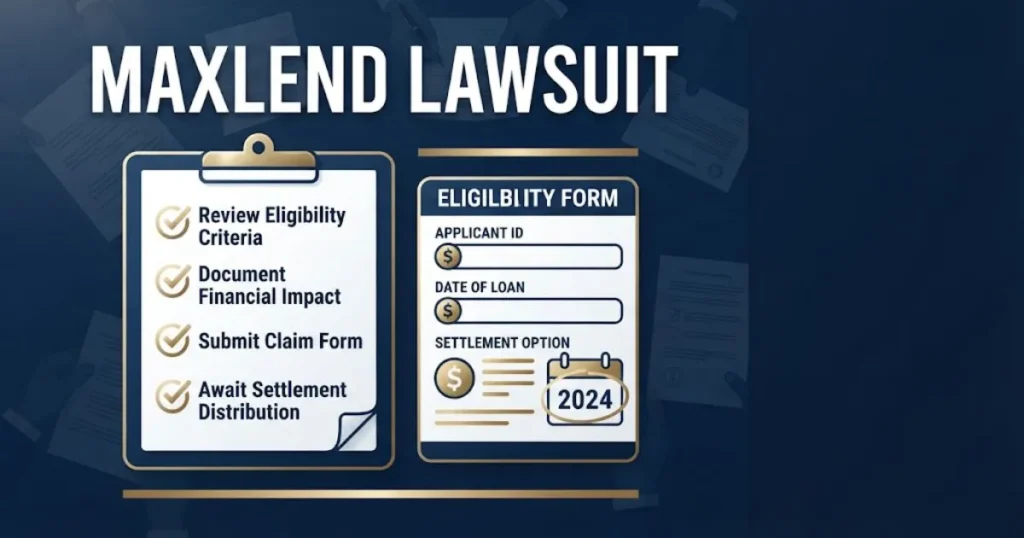
- Step 1: Confirm you borrowed from MaxLend between 2019 and 2025
- Step 2: Gather loan agreements and bank statements
- Step 3: Calculate the total interest and fees you paid
- Step 4: Watch for official class notice in mid-2026
- Step 5: Submit your claim form before the deadline
You will not need to appear in court. The class action attorneys handle all litigation. Your only job is to file your claim form on time.
MaxLend Lawsuit Settlement Timeline
The maxlend lawsuit settlement timeline stretches across most of 2026. Several key milestones will determine when borrowers receive payments.
The class certification hearing is scheduled for May 2026. If approved, the court will authorize notice to all potential class members. That notice period typically runs 60 to 90 days.
Settlement negotiations are running in parallel. If both sides reach an agreement, the court must still approve the deal. A fairness hearing would follow, likely in late 2026 or early 2027.
| Phase | Expected Date |
|---|---|
| Class certification hearing | May 2026 |
| Class notice period begins | June to July 2026 |
| Claims filing window | August to November 2026 |
| Settlement fairness hearing | Late 2026 or early 2027 |
| First payments issued | Mid-2027 (estimated) |
Patience is necessary in class action cases. The process moves slowly through the court system. But the 2026 timeline suggests real progress is happening.
MaxLend Lawsuit News and Developments
MaxLend lawsuit news in 2026 reflects a case gaining serious legal traction. Multiple developments in the first quarter have shifted momentum toward the plaintiffs.
The denial of the tribal immunity defense was the biggest headline. Legal analysts say this ruling could influence dozens of similar cases against tribal lenders. It sets a precedent that operational control matters more than tribal affiliation.
Consumer advocacy groups have also amplified the case. Organizations focused on predatory lending have published reports citing MaxLend as a primary example. Media coverage has increased borrower awareness significantly.
- January 2026: Federal mediation session held
- February 2026: Tribal immunity defense rejected
- March 2026: Plaintiff class surpasses 45,000 members
- April 2026: Additional state AG investigations announced
- May 2026: Class certification hearing scheduled
The pace of developments suggests a resolution is closer than many expected. Borrowers should stay alert for official notices throughout the year.
Key Takeaway: The 2026 timeline shows the case moving toward class certification and potential settlement, with first payments to borrowers estimated for mid-2027 if the current schedule holds.
Frequently Asked Questions
Is the MaxLend lawsuit real and still active in 2026?
Yes, the MaxLend lawsuit is a real and active class action case in 2026.
The case involves over 45,000 borrowers alleging illegal interest rates and abusive collection practices.
A federal judge rejected the lender’s motion to dismiss in February 2026.
How do I know if I am part of the MaxLend class action?
You are likely part of the class if you took out a MaxLend loan between 2019 and 2025.
Check your loan agreement for the disclosed APR and compare it to your state’s usury cap.
You will receive an official notice once the court certifies the class.
What is the deadline to file a MaxLend lawsuit claim?
The official claims deadline has not been set yet as of early 2026.
Legal experts expect the filing window to open around August 2026 and close by November or December 2026.
Missing the deadline will likely forfeit your right to any settlement payment.
How much money can I expect from the MaxLend settlement?
Most eligible borrowers can expect between $50 and $2,500 depending on their loan history.
The exact amount will be calculated based on the excess interest and fees you paid above legal limits.
Final payout amounts will be determined after the claims period closes.
Will filing a MaxLend claim affect my credit score?
No, filing a claim in the MaxLend class action will not affect your credit score.
The lawsuit targets the lender’s practices, not your borrowing behavior.
Your participation is confidential and is not reported to credit bureaus.
The MaxLend lawsuit represents a significant moment for payday lending accountability in 2026. If you borrowed from MaxLend, now is the time to gather your records and prepare.
Watch for the official class notice expected in mid-2026. File your claim as soon as the window opens to secure your share of any settlement.
Stay informed and act quickly when the deadline arrives. Your loan documents are your strongest asset in this process.







