The major AI lawsuit wave of 2026 is the largest tech litigation event in history. Over 40 active cases target companies like OpenAI, Meta, and Google for copyright theft, privacy violations, and worker discrimination.
If you created content, shared personal data, or lost a job to AI, you may have a claim. Settlement funds are already forming. Some deadlines are closing fast.
This article breaks down every active case in plain English. You will learn who qualifies, how much you could get, and when to act.
One striking fact: AI companies scraped over 100 billion web pages without permission. Courts are now deciding who pays for that.
Major AI Lawsuit
A major AI lawsuit is any large-scale legal action targeting artificial intelligence companies for harm caused by their technology. In 2026, these cases span copyright, privacy, employment, and consumer fraud.
The biggest cases involve generative AI tools like ChatGPT, Gemini, and LLaMA. Plaintiffs argue these tools were built on stolen data.
Federal courts in New York and California handle most of these cases. Judges are issuing rulings that could reshape the entire tech industry.
Think of it like the tobacco lawsuits of the 1990s. The legal theory is new, but the pattern is familiar. Big companies profited. Regular people paid the price.
Quick Facts:
- Active cases: Over 40 in federal court
- Main defendants: OpenAI, Meta, Google, Anthropic
- Total damages sought: Exceeding $100 billion
- Primary courts: SDNY, NDCA, D. Delaware
AI Copyright Lawsuit 2026
The AI copyright lawsuit surge in 2026 centers on one core question. Did tech companies illegally copy protected works to train their AI models?
The New York Times v. OpenAI case remains the flagship battle. The Times alleges ChatGPT was trained on millions of its articles without a license.
Authors Guild v. OpenAI is also advancing. Over 10,000 writers claim their books were fed into AI systems without consent or payment.
Courts are split on the fair use defense. Some judges say training on public data is transformative. Others say it is straight theft.
| Case | Plaintiff | Defendant | Status 2026 |
|---|---|---|---|
| NYT v. OpenAI | New York Times | OpenAI, Microsoft | Discovery phase |
| Authors Guild | 10,000+ writers | OpenAI | Class certification pending |
| Bartz v. Anthropic | Authors | Anthropic | Partial summary judgment |
| Concord v. Anthropic | Music publishers | Anthropic | Mediation ongoing |
Key Takeaway: The major AI lawsuit landscape in 2026 is dominated by copyright claims, and courts are beginning to side with creators on key fair use questions.
OpenAI Lawsuit Update
The OpenAI lawsuit update for 2026 shows the company facing legal pressure from every direction. Copyright, privacy, and consumer fraud claims are all active.
The NYT case is in full discovery. Both sides are exchanging millions of internal documents. OpenAI’s training data logs are a central focus.
A separate consumer fraud case alleges OpenAI misled users about ChatGPT’s accuracy. The FTC is also investigating the company’s data practices.
OpenAI has offered some licensing deals to publishers. Critics say the offers are too low. Most major newsrooms have rejected them so far.
Bold Stat: OpenAI faces over $20 billion in combined potential liability across all active cases as of early 2026.
AI Class Action Lawsuit
An AI class action lawsuit groups thousands of affected people into one legal case against a tech company. This is the most common path for everyday consumers.
Several AI class actions are now in the certification stage. Judges are deciding whether the plaintiffs share enough in common to proceed as a group.
The largest proposed class includes anyone whose data was scraped to train generative AI models. That could cover hundreds of millions of Americans.
Class actions are powerful because they pool resources. One person cannot afford to sue Google alone. A class of 50 million people can.
| Class Action Stage | What It Means | Typical Timeline |
|---|---|---|
| Filed | Complaint submitted to court | Day 1 |
| Certification | Judge approves the class | 6 to 18 months |
| Discovery | Evidence exchanged | 12 to 24 months |
| Settlement | Parties negotiate a deal | 18 to 36 months |
| Payout | Claims processed and paid | 24 to 48 months |
Key Takeaway: If your content, data, or likeness was used to train AI without permission, you may already be part of a pending AI class action lawsuit whether you know it or not.
AI Lawsuit Against Meta
The AI lawsuit against Meta targets the company’s LLaMA models and its massive data scraping operations. Multiple cases are active in California federal court.
Meta scraped public posts from Facebook and Instagram to train its AI. Users never gave explicit consent for this use of their personal content.
A separate case involves Meta’s use of pirated book datasets. Internal emails reportedly show executives knew the data sources were questionable.
Meta argues its AI training falls under fair use. The company says publicly available data is free to use for research and development.
Quick Facts:
- Models at issue: LLaMA, LLaMA 2, LLaMA 3
- Data sources: Facebook posts, Instagram images, BookCorpus
- Court: U.S. District Court, Northern District of California
- Lead judge: Judge Vince Chhabria
AI Lawsuit Against Google
The AI lawsuit against Google focuses on its Gemini models and the company’s long history of web scraping. Plaintiffs say Google crossed a legal line.
Google has scraped the web for decades to build its search index. Now it is using that same data to train generative AI. Creators say that is a different use entirely.
A group of photographers filed suit in 2025. They claim Google Images data was repurposed for AI image generation without licenses.
Google’s defense relies heavily on its terms of service. The company argues users agreed to broad data usage when they signed up.
| Claim Type | Plaintiff Group | Damages Sought |
|---|---|---|
| Web scraping | Website owners | $5 billion |
| Image generation | Photographers | $2 billion |
| Book training | Authors | $1.5 billion |
Key Takeaway: The AI lawsuits against Meta and Google could set the legal standard for how all tech companies use public data to build AI products.
AI Artist Lawsuit
The AI artist lawsuit movement began in 2023 and has grown into one of the most visible legal battles of the decade. Visual creators are fighting back.
Andersen v. Stability AI is the lead case. Three artists allege their work was used to train Stable Diffusion without permission or payment.
The court partially dismissed the original complaint in 2024. The artists amended their filing with stronger evidence of direct copying.
Midjourney and DeviantArt are also named defendants. Both companies built AI image generators trained on billions of artist portfolios.
Bold Stat: Over 200,000 artists have signed petitions supporting the AI artist lawsuits as of early 2026.
AI Training Data Lawsuit
An AI training data lawsuit challenges the raw materials used to build AI models. These cases argue that the data collection itself was illegal.
The core issue is consent. AI companies scraped websites, books, images, and code repositories without asking the creators.
A major 2026 case involves GitHub Copilot. Programmers allege their open-source code was used to train the AI coding assistant in violation of software licenses.
Training data lawsuits are technically complex. Plaintiffs must prove their specific work was included in the training set. That requires forensic data analysis.
Quick Facts:
- Estimated training datasets: Over 100 billion web pages
- Books scraped: Over 7 million titles
- Images used: Over 5 billion files
- Code repositories: Over 50 million GitHub repos
Key Takeaway: AI training data lawsuits strike at the foundation of the entire generative AI industry because the models literally cannot exist without the disputed data.
AI Data Privacy Lawsuit
The AI data privacy lawsuit wave targets how companies collect, store, and use personal information to power their AI systems. These cases affect nearly everyone.
ChatGPT conversations are a major concern. Users shared sensitive personal details thinking their chats were private. Some of that data was reportedly used for model improvement.
Illinois and Texas have filed state-level privacy actions. Both states have strong biometric data laws that AI companies may have violated.
A class action in California alleges AI chatbots collected data from minors without parental consent. That could trigger massive penalties under COPPA.
| Privacy Law | State | AI Violation Claim |
|---|---|---|
| BIPA | Illinois | Voice and face data scraping |
| CCPA | California | Unauthorized data collection |
| COPPA | Federal | Minor data without consent |
| GDPR | EU (affects US firms) | Cross-border data misuse |
AI Deepfake Lawsuit
The AI deepfake lawsuit category is the fastest-growing area of AI litigation in 2026. These cases involve AI-generated images, videos, and audio that mimic real people.
Several celebrities have filed suit over non-consensual deepfake pornography. The claims combine privacy violations with emotional distress damages.
A landmark case involves a political candidate whose voice was cloned for robocalls. The court ruled the AI-generated calls violated election law.
Ordinary citizens are also filing claims. Teachers, doctors, and small business owners have found their likenesses used in AI-generated scams.
Bold Stat: Deepfake fraud complaints to the FTC increased by 1,800 percent between 2023 and 2026.
Key Takeaway: AI deepfake lawsuits are expanding beyond celebrities to protect everyday people whose faces and voices are being cloned without consent.
AI Employment Discrimination Lawsuit
The AI employment discrimination lawsuit trend targets companies that use AI tools to hire, fire, or evaluate workers. These cases allege the algorithms are biased.
Several major employers now use AI resume screeners. Plaintiffs claim these tools systematically reject candidates based on race, age, or gender.
An EEOC investigation in 2025 found that one popular AI hiring tool rejected qualified Black applicants at twice the rate of white applicants.
New York City’s Local Law 144 requires AI hiring audits. Companies that skip the audits face fines. Multiple class actions cite violations of this law.
Quick Facts:
- Workers affected: Estimated 30 million job applicants per year
- AI tools at issue: Resume screeners, video interview analyzers, performance trackers
- Key law: NYC Local Law 144
- Agency involved: EEOC
Who Can File AI Lawsuit
You can file an AI lawsuit if a tech company used your creative work, personal data, or likeness without permission to train or operate AI systems.
Writers, artists, musicians, and photographers are the most common plaintiffs. But everyday internet users may also qualify.
If your social media posts, blog content, or photos were scraped for AI training, you likely have standing. The key is proving your data was actually used.
Workers who were fired or rejected by AI hiring tools can also file. You need evidence the AI decision was biased or unlawful.
| You May Qualify If | Evidence Needed |
|---|---|
| Your art was used to train AI | Portfolio match in AI outputs |
| Your writing appears in AI responses | Text similarity analysis |
| Your data was scraped without consent | Web scraping logs |
| AI rejected your job application | Hiring records and audit |
| Your likeness was deepfaked | AI-generated media samples |
How to Join AI Lawsuit
To join an AI lawsuit, you typically need to register as a class member through the lead law firm handling the case or through an official settlement website.
Most AI class actions do not require you to hire your own attorney. The lead counsel represents all class members on a contingency basis.
Start by identifying which case matches your situation. Copyright cases are separate from privacy cases. Each has its own enrollment process.
Fill out the claim form with your details. You will need to describe how your work or data was used. Attach samples if possible.
Quick Steps:
- Identify the active case that matches your claim type
- Find the official class action administrator
- Complete the claim form before the deadline
- Submit proof of your affected work or data
- Wait for court approval and settlement distribution
Key Takeaway: Joining an AI lawsuit is usually free and takes less than 30 minutes, but you must act before the filing deadline passes for your specific case.
AI Lawsuit Deadline 2026
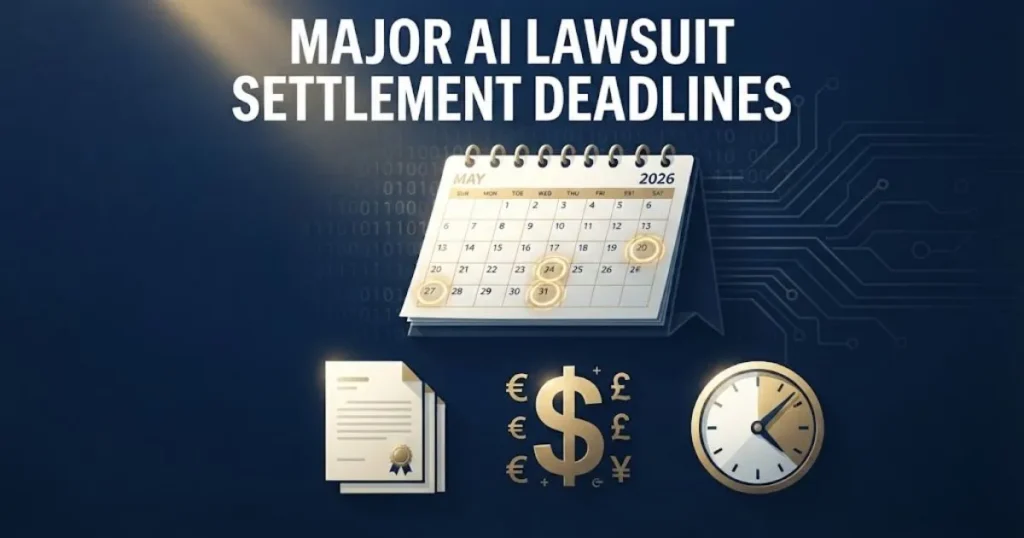
The AI lawsuit deadline in 2026 varies by case, but several critical cutoff dates are approaching within the next six months.
The Authors Guild v. OpenAI opt-in deadline is currently set for August 15, 2026. Writers who miss this date may lose their right to compensation.
The Andersen v. Stability AI class certification hearing is scheduled for June 2026. Artists must register their claims before the hearing.
Privacy class actions have rolling deadlines. Some close as early as April 2026. Check your specific case for the exact cutoff.
| Case | Deadline | Type |
|---|---|---|
| Authors Guild v. OpenAI | August 15, 2026 | Opt-in |
| Andersen v. Stability AI | June 30, 2026 | Registration |
| NYT v. OpenAI | TBD (discovery) | No action yet |
| Privacy class actions | April to September 2026 | Varies |
| Deepfake claims | Ongoing | Statute of limitations |
AI Lawsuit Settlement
An AI lawsuit settlement is a negotiated payment from the tech company to the affected class members. No major AI case has reached final settlement yet, but negotiations are active.
The Concord v. Anthropic case entered mediation in late 2025. Music publishers are seeking a per-song licensing fee for AI training use.
Industry analysts estimate the first major AI settlement could exceed $1 billion. That money would be divided among all qualifying class members.
Settlement structures will likely follow a tiered model. Creators with more affected works will receive larger payments. Casual users will get smaller amounts.
Bold Stat: Legal analysts project total AI lawsuit settlements could reach $15 billion to $30 billion by 2030.
Key Takeaway: While no final AI lawsuit settlement has been paid yet, the first major payouts are expected in late 2026 or early 2027 as the earliest cases resolve.
AI Lawsuit Compensation and Payout Amount
AI lawsuit compensation will depend on your claim type, the number of affected works, and the total settlement fund size. Exact amounts are not yet finalized.
For copyright claims, estimates range from $50 to $5,000 per affected work. Professional creators with large catalogs could receive significantly more.
Privacy claims are expected to pay less per person. Estimates range from $25 to $500 per class member depending on the severity of the data misuse.
Deepfake and likeness claims may yield the highest individual payouts. Victims of non-consensual AI-generated content could receive $1,000 to $50,000 per incident.
| Claim Type | Estimated Payout Range | Factors |
|---|---|---|
| Copyright (writers) | $50 to $5,000 per work | Number of works, revenue loss |
| Copyright (artists) | $100 to $10,000 per work | Portfolio size, AI output match |
| Data privacy | $25 to $500 per person | Data type, exposure level |
| Deepfake/likeliness | $1,000 to $50,000 | Severity, distribution reach |
| Employment AI bias | $500 to $25,000 | Lost wages, discrimination proof |
AI Lawsuit Timeline
The AI lawsuit timeline stretches from the first filings in 2022 through expected settlements in 2027 and beyond. Here is where things stand right now.
The earliest cases were filed in late 2022 by artists and programmers. Those cases are now in advanced discovery or mediation.
The big copyright cases from 2023 and 2024 are still in the evidence-gathering phase. Trials are not expected before late 2026 at the earliest.
Privacy and deepfake cases move faster because the harm is more direct. Some of these could settle by mid-2026.
| Year | Key Event |
|---|---|
| 2022 | First AI artist and coder lawsuits filed |
| 2023 | NYT and Authors Guild sue OpenAI |
| 2024 | Courts issue first fair use rulings |
| 2025 | Privacy and deepfake cases surge |
| 2026 | Class certifications and first settlements expected |
| 2027 | Major payouts likely begin |
Key Takeaway: The AI lawsuit timeline shows we are in the middle of the legal process, meaning now is the critical window to register your claim before settlements are finalized.
Frequently Asked Questions
What is the biggest AI lawsuit in 2026?
The New York Times v. OpenAI case is the largest active AI lawsuit in 2026. The Times seeks billions in damages for unauthorized use of its articles to train ChatGPT. The case is currently in the discovery phase in New York federal court.
How much money can I get from an AI lawsuit?
Most claimants can expect between $25 and $5,000 depending on the claim type. Copyright holders with large catalogs may receive more. Exact payout amounts will be determined when settlements are finalized.
Am I eligible to join an AI class action?
You are likely eligible if your creative work, personal data, or likeness was used to train AI without consent. Writers, artists, photographers, and social media users are the most common qualifying groups. Check the specific case requirements for your situation.
What is the deadline to file an AI lawsuit claim?
Deadlines vary by case but several key cutoffs fall between April and August 2026. The Authors Guild opt-in deadline is August 15, 2026. Act quickly because some privacy case deadlines are closing even sooner.
Do I need a lawyer to join an AI lawsuit?
No, you do not need your own lawyer to join most AI class actions. The lead attorneys handle the case on a contingency basis. You simply register your claim through the official class administrator before the deadline.
The major AI lawsuit wave of 2026 is your window to take action. Settlements are forming and deadlines are approaching fast.
Check which cases match your situation. Register your claim before the cutoff dates pass. The money will go to those who show up.
Stay informed and act now. The courts are moving, and the tech companies are paying attention.