Legal action for pressure sores holds care facilities accountable when patients suffer preventable skin injuries. Families filed over 15,000 bedsore neglect claims against nursing homes in 2025 alone.
Hospitals and home health agencies face rising lawsuit numbers too. The problem keeps getting worse across the country.
This 2026 guide covers settlement ranges, state filing deadlines, and who qualifies. You will learn the exact steps to take if your loved one was harmed.
Roughly 2.5 million Americans develop pressure ulcers each year. Research shows up to 95 percent are entirely preventable. That statistic drives thousands of lawsuits annually.
Related: Nursing Home Bed Sores Lawsuit: 2026 Settlement Guide
Legal Action for Pressure Sores
Legal action for pressure sores is a civil claim against a care facility. It targets nursing homes, hospitals, or agencies that failed to prevent skin breakdown.
Most cases fall under medical negligence or elder abuse laws. You must prove the facility owed a duty of care. Then you show they breached that duty.
These lawsuits argue that staff ignored basic prevention protocols. That includes failing to reposition patients every two hours. It also covers ignoring early signs of skin damage.
Families can seek compensation for medical bills, pain, and suffering. Wrongful death claims apply when a pressure sore proves fatal.
| Detail | Info |
|---|---|
| Claim Type | Personal injury or wrongful death |
| Legal Basis | Negligence or elder abuse |
| Common Defendants | Nursing homes, hospitals |
| Key Evidence | Staffing logs, wound photos |
The burden of proof rests on the plaintiff. You must show the facility knew about the risk. Medical records and care plans serve as primary evidence.
Pressure Sore Lawsuit
A pressure sore lawsuit is a legal claim filed when a patient develops preventable skin ulcers. These cases typically involve elderly or immobile patients in institutional care.
The lawsuit names the facility or its parent company as the defendant. Some cases also name individual nurses or doctors. That depends on the specific facts of the neglect.

Most pressure sore lawsuits settle before trial. Jury verdicts tend to be higher than settlements. A 2025 jury in Texas awarded $2.1 million for a Stage 4 bedsore death.
Quick Fact: The average time from filing to resolution is 18 to 24 months.
| Case Path | Timeline | Typical Outcome |
|---|---|---|
| Early Settlement | 6 to 12 months | Lower payout |
| Mediation | 12 to 18 months | Moderate payout |
| Jury Trial | 18 to 36 months | Highest payout |
Your attorney will evaluate which path makes sense. Most families prefer settlement to avoid lengthy court battles.
Can You Sue a Nursing Home for Bedsores
Yes, you can sue a nursing home for bedsores if neglect caused the injury. The key question is whether staff failed to follow standard prevention protocols.
Federal law requires nursing homes to prevent avoidable pressure sores. CMS regulations under 42 CFR 483.25 set clear care standards. Facilities must assess each resident’s risk using the Braden Scale.
You have grounds to sue if the facility ignored turning schedules. You also have a case if staff failed to document wound progression. Poor staffing ratios often serve as strong evidence of neglect.
Eligibility Checklist:
- Your loved one developed a Stage 2 or higher sore
- The facility had a documented care plan
- Staff failed to follow that care plan
- The sore worsened or failed to heal
- You have medical records showing the timeline
Think of it like a car accident claim. You need to prove the other driver broke the rules. Here, you prove the nursing home broke care standards.
Key Takeaway: Pressure sore lawsuits target facilities that ignored basic prevention duties, and most cases settle within 18 months of filing.
Bedsore Lawsuit Settlement Amounts
Bedsore lawsuit settlement amounts range from $25,000 to over $1 million. The payout depends heavily on the sore’s stage and the harm caused.
Stage 1 and Stage 2 cases typically settle for less. Stage 3 and Stage 4 cases command much higher amounts. Fatal cases involving sepsis or osteomyelitis reach the highest figures.
| Bedsore Stage | Average Settlement Range |
|---|---|
| Stage 1 | $10,000 to $50,000 |
| Stage 2 | $25,000 to $100,000 |
| Stage 3 | $75,000 to $350,000 |
| Stage 4 | $200,000 to $1,000,000+ |
| Wrongful Death | $500,000 to $2,500,000+ |
These numbers reflect national averages from 2024 and 2025 case data. Your actual settlement will depend on state laws and specific facts.
Jury verdicts often exceed settlement offers by 30 to 50 percent. However, trials carry risk and take much longer. Your attorney will weigh both options carefully.
How to Sue for Pressure Sores
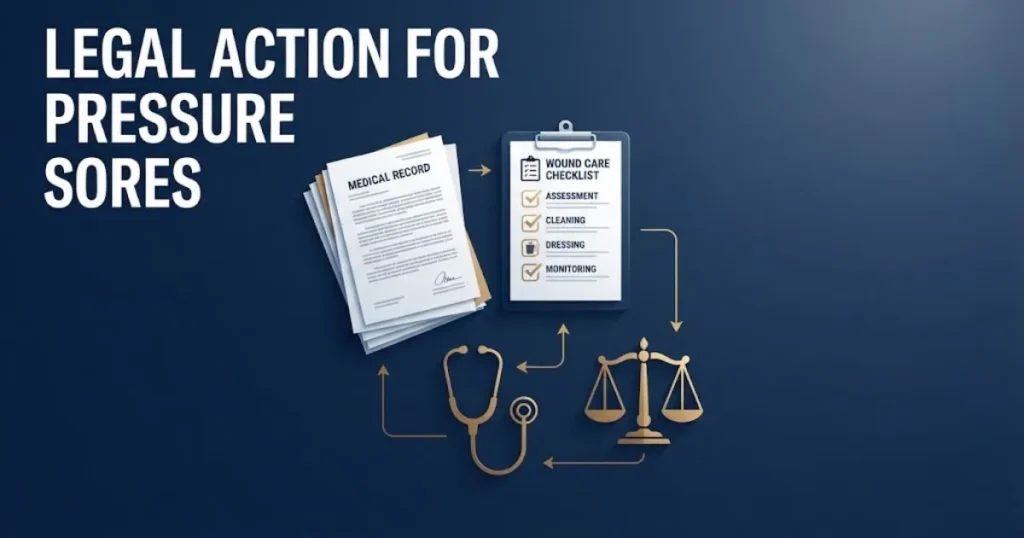
To sue for pressure sores, you first need to gather medical evidence. Request all wound care records from the facility immediately. These documents form the backbone of your case.
Next, contact an attorney who handles nursing home neglect cases. Most offer free initial consultations and work on contingency. That means you pay nothing unless you win.
Your lawyer will then send a preservation letter to the facility. This prevents them from destroying staffing records or care logs. Spoliation of evidence can lead to court sanctions.
Steps to Get Started:
- Collect all medical records and wound photos
- Document dates when the sore appeared and worsened
- Note any complaints you made to facility staff
- Contact a nursing home neglect attorney
- File your claim before the statute of limitations expires
The filing process itself takes a few weeks. Your attorney drafts the complaint and serves the defendant. The facility then has 30 to 60 days to respond.
Nursing Home Pressure Sore Lawsuit
A nursing home pressure sore lawsuit specifically targets long-term care facilities. These are the most common type of bedsore legal action.
Nursing homes have a legal duty to assess each resident’s skin risk. The Braden Scale is the industry standard tool. Scores below 18 indicate high risk for skin breakdown.
CMS inspection data from 2025 shows that 11 percent of nursing home residents develop pressure sores. Facilities with low staffing ratios have rates nearly three times higher.
| Facility Factor | Impact on Lawsuit |
|---|---|
| Low staffing ratios | Strong evidence of neglect |
| Missing turning logs | Suggests protocol violations |
| No Braden Scale assessment | Regulatory violation |
| Delayed wound treatment | Shows breach of duty |
Nursing home chains like Genesis HealthCare and Life Care Centers have faced multiple bedsore verdicts. Parent company liability is a growing trend in 2026 litigation.
Key Takeaway: Settlement amounts scale directly with bedsore severity, and nursing home cases dominate this area of law due to clear federal care standards.
Pressure Sore Lawsuit Settlement 2026
Pressure sore lawsuit settlement trends in 2026 show rising payouts across all stages. Inflation in medical costs and stronger CMS enforcement are driving numbers up.
The median settlement for a Stage 3 bedsore case is now around $175,000. That represents a 12 percent increase over 2024 figures. Stage 4 cases regularly exceed $500,000.
New CMS staffing minimums took effect in late 2025. Facilities that fail to comply face stronger liability exposure. Plaintiffs can now cite these rules as evidence of negligence.
2026 Settlement Trends:
- Average Stage 2 settlement: $65,000
- Average Stage 3 settlement: $175,000
- Average Stage 4 settlement: $420,000
- Average wrongful death settlement: $850,000
Insurance carriers are also raising policy limits for long-term care facilities. Higher coverage means larger potential payouts for plaintiffs. This trend is expected to continue through 2027.
Stage 4 Pressure Sore Lawsuit
A Stage 4 pressure sore lawsuit involves the most severe category of skin ulcer. These wounds penetrate through muscle to bone or tendon.
Stage 4 sores carry a high risk of life-threatening infection. Sepsis and osteomyelitis are common complications. Many Stage 4 cases end in wrongful death claims.
Jury verdicts in Stage 4 cases average over $1 million nationwide. A 2025 Florida jury awarded $3.4 million for a Stage 4 heel ulcer death. The facility had ignored wound care orders for 47 days.
Stage 4 Warning Signs:
- Exposed bone, tendon, or muscle
- Dark necrotic tissue in the wound bed
- Foul odor from the wound site
- Signs of systemic infection or fever
These cases are the strongest for plaintiffs. The severity makes it nearly impossible for the defense to argue the sore was unavoidable. Juries tend to react strongly to photographic evidence of Stage 4 wounds.
Pressure Sore Compensation
Pressure sore compensation covers several categories of damages. Economic damages include medical bills and future care costs. Non-economic damages cover pain and suffering.
Medical expenses in severe bedsore cases can exceed $100,000. Surgical debridement, skin grafts, and long-term wound care add up fast. Medicare and Medicaid may seek reimbursement from your settlement.
Punitive damages are possible in cases of extreme neglect. These punish the facility beyond actual harm. Courts award punitive damages when conduct is reckless or intentional.
| Damage Type | What It Covers | Typical Range |
|---|---|---|
| Economic | Medical bills, lost wages | $20,000 to $200,000 |
| Non-Economic | Pain, suffering, trauma | $50,000 to $500,000 |
| Punitive | Facility misconduct | $100,000 to $1,000,000+ |
Some states cap non-economic damages in medical cases. Texas limits them to $250,000 per defendant. California caps them at $350,000 for non-fatal cases.
Key Takeaway: Stage 4 pressure sore cases produce the highest verdicts, and compensation covers medical costs, pain and suffering, and sometimes punitive damages.
Pressure Sore Lawsuit Statute of Limitations
The pressure sore lawsuit statute of limitations varies by state. Most states give you one to three years from the date of injury. Missing this deadline kills your case permanently.
Some states use a discovery rule. That means the clock starts when you discover the harm. This matters if the facility hid the bedsore from your family.
| State | Time Limit | Discovery Rule |
|---|---|---|
| California | 2 years | Yes |
| Florida | 2 years | Yes |
| New York | 2.5 years | Limited |
| Texas | 2 years | Yes |
| Illinois | 2 years | Yes |
| Pennsylvania | 2 years | Yes |
Wrongful death claims may have a different deadline. In some states, the clock starts from the date of death. That can differ from the date the sore developed.
Act quickly even if your deadline seems far away. Evidence disappears over time. Staff members leave and memories fade.
Hospital Pressure Sore Lawsuit
A hospital pressure sore lawsuit targets acute care facilities for preventable skin injuries. These cases are less common than nursing home claims but growing fast.
Hospital-acquired pressure sores often develop during long surgeries or ICU stays. Patients on ventilators face the highest risk. Operating room teams must use pressure-relieving devices.
The legal standard in hospital cases is slightly different. You must prove the surgical or nursing team deviated from accepted protocols. Expert testimony from wound care specialists is usually required.
Common Hospital Bedsore Scenarios:
- Post-surgical heel sores from prolonged immobilization
- Sacral ulcers from ICU bed confinement
- Device-related sores from oxygen masks or tubing
- Operating table pressure injuries during long procedures
Hospital cases often involve larger insurance policies. That can mean higher settlement potential. However, hospital defense teams are typically more aggressive.
Pressure Ulcer Negligence Claim
A pressure ulcer negligence claim requires proving four legal elements. You must establish duty, breach, causation, and damages. All four must be present to win.
Duty means the facility had an obligation to care for the patient. Breach means they failed to meet the accepted standard. Causation links that failure directly to the sore.
Damages refer to the actual harm the patient suffered. This includes physical injury, medical costs, and emotional distress. Without measurable damages, you have no viable claim.
The Four Elements of Negligence:
- Duty: The facility accepted the patient for care
- Breach: Staff failed to follow prevention protocols
- Causation: The breach directly caused the pressure sore
- Damages: The patient suffered measurable harm
Expert witnesses play a big role in proving breach. A wound care nurse or geriatrician will testify about what proper care looks like. Their testimony helps the jury understand the standard.
Key Takeaway: Hospital bedsore cases are rising, and every negligence claim must prove duty, breach, causation, and damages to succeed.
Filing a Pressure Sore Claim
Filing a pressure sore claim begins with a formal demand letter. Your attorney sends this to the facility and its insurance carrier. The letter outlines the facts and demands compensation.
If the insurer rejects the demand, your attorney files a formal complaint. This initiates the lawsuit in civil court. The defendant then files an answer or a motion to dismiss.
Discovery follows the initial filings. Both sides exchange medical records, staffing logs, and depositions. This phase typically lasts six to twelve months.
| Filing Phase | Duration | Key Activity |
|---|---|---|
| Demand Letter | 1 to 2 months | Initial settlement offer |
| Complaint Filed | 1 to 2 weeks | Lawsuit officially begins |
| Discovery | 6 to 12 months | Evidence exchange |
| Mediation | 1 to 3 months | Settlement negotiation |
| Trial | 1 to 4 weeks | Jury verdict |
Most claims resolve during mediation. Only about 5 percent of bedsore cases reach a jury. Settlement is faster and less stressful for families.
Pressure Sore Wrongful Death Lawsuit
A pressure sore wrongful death lawsuit is filed when a bedsore contributes to a patient’s death. Sepsis from an infected pressure ulcer is the most common cause.
These claims are filed by the deceased patient’s estate or surviving family. Spouses, adult children, and legal guardians typically have standing. State law determines who can file.
Wrongful death damages include funeral costs, lost companionship, and pre-death suffering. Some states also allow punitive damages in fatal neglect cases.
Common Causes of Bedsore-Related Death:
- Sepsis from infected Stage 4 wounds
- Osteomyelitis spreading to the bloodstream
- Nutritional decline caused by chronic wounds
- Surgical complications from wound debridement
The average wrongful death settlement for a pressure sore case is $850,000 in 2026. Jury verdicts in fatal cases frequently exceed $2 million. These numbers reflect the severity of the harm.
Pressure Ulcer Malpractice
Pressure ulcer malpractice is a specific type of medical malpractice claim. It targets individual healthcare providers rather than just the facility.
Doctors, nurses, and wound care specialists can all face liability. A physician who fails to order proper wound treatment may be named. A nurse who skips turning schedules can also be held responsible.
Malpractice claims require a higher standard of proof than general negligence. You must show the provider deviated from accepted medical practice. This almost always requires expert medical testimony.
| Provider Type | Common Malpractice Allegation |
|---|---|
| Attending Physician | Failed to order wound care consult |
| Registered Nurse | Skipped repositioning schedule |
| Wound Care Specialist | Used improper treatment protocol |
| Nursing Assistant | Failed to report skin changes |
Malpractice insurance limits vary by provider. Individual nurse policies may cap at $1 million. Physician policies often reach $3 million or more.
Key Takeaway: Wrongful death claims produce the largest settlements, and malpractice claims can target individual providers beyond just the facility itself.
Frequently Asked Questions
How much is a pressure sore lawsuit worth in 2026?
Most pressure sore lawsuits settle between $50,000 and $500,000 in 2026.
The exact amount depends on the bedsore stage and the harm caused.
Stage 4 and wrongful death cases can exceed $1 million.
What is the time limit to sue for pressure sores?
Most states give you one to three years from the date of injury.
Some states extend the deadline if the facility concealed the wound.
File as soon as possible to preserve critical evidence.
Can you sue a hospital for bedsores?
Yes, you can sue a hospital if a bedsore developed during your stay.
Hospital cases often involve surgical or ICU-related pressure injuries.
These claims require expert testimony to prove protocol violations.
What evidence do you need for a pressure sore claim?
You need medical records, wound photographs, and facility care logs.
Staffing records and turning schedules are also powerful evidence.
Your attorney will request these documents during the discovery phase.
Do most bedsore lawsuits settle out of court?
Yes, roughly 95 percent of bedsore lawsuits settle before trial.
Mediation is the most common path to resolution.
Only about 5 percent of cases reach a jury verdict.
Pressure sores are preventable injuries that should never happen with proper care. If your loved one suffered harm, you have legal options available right now.
Gather your medical records and contact a nursing home neglect attorney this week. The statute of limitations is ticking, and early action preserves the strongest evidence.
Stay informed about 2026 CMS rule changes that may strengthen your case. Your family deserves answers and accountability.