
Looking for an Iowa court case search in 2026? You can access most state court records online for free right now. The Iowa Judicial Branch runs a public portal called Iowa Courts Online.
This database covers criminal, civil, and family cases across all 99 counties. You can search by name, case number, or citation number. Over 3 million active and closed case records are publicly available as of early 2026.
This guide walks you through every search method step by step. You will learn which records are free and which require a small fee. We also explain federal court options and county clerk alternatives for Iowa residents. Most searches take under five minutes once you know where to look.
Iowa Court Case Search
An Iowa court case search lets you find public court records statewide. The Iowa Judicial Branch maintains these records for all 99 counties. You can search criminal, civil, family, and small claims cases.
The search covers both active and closed cases from recent decades. Most records are available through a free online portal. Some older files may require a visit to the county courthouse.
Think of it like a library catalog for legal disputes. You enter a name or case number and get results. The system pulls matching records from a centralized state database.
As of 2026, the database holds over 3 million case files. New cases are added daily as courts process filings. Search results typically include party names, filing dates, and case status.
You do not need a lawyer to run these searches. The system is open to any member of the public. No special credentials or subscriptions are required for basic access.
| Detail | Info |
|---|---|
| Records Available | 3 million plus |
| Counties Covered | All 99 |
| Cost | Free for basic search |
| Update Frequency | Daily |
Iowa Courts Online Case Search
Iowa Courts Online (ICO) is the official state portal for case searches. The Iowa Judicial Branch built and maintains this tool. It is the single best starting point for any record lookup.
The ICO portal covers district court, appellate court, and supreme court cases. You access it through the Iowa Judicial Branch website. No account creation is needed for basic searches.
The search form lets you filter by party name, case type, or county. You can also narrow results by filing date range. Results load within seconds for most queries.
One big change hit the system in late 2024. The state began migrating to a new Electronic Document Management System called EDMS. This upgrade improved document viewing and download speeds significantly.
In 2026, both the legacy ICO interface and the new EDMS portal are active. The Judicial Branch plans to fully retire the old system by late 2026. Use whichever portal loads faster for your search.
Quick Fact: The ICO portal processes over 50,000 searches per week across Iowa.
Iowa Court Records Online
Iowa court records online include every publicly filed document in state courts. This covers complaints, motions, orders, judgments, and sentencing documents. Most are viewable as PDF files directly in your browser.
The online system stores records from all eight judicial districts in Iowa. Each district covers multiple counties and multiple courthouses. The centralized database pulls from all of them at once.
Records are typically uploaded within one to three business days of filing. Some rural counties may take slightly longer due to staffing. Larger counties like Polk and Linn update almost in real time.
You can view docket entries, hearing schedules, and final dispositions online. Full document downloads may require a small per-page fee in some cases. The first few pages of most documents are free to view.
Think of the online system as a digital filing cabinet. Every piece of paper submitted to the court gets scanned and stored. You are essentially browsing the same files a clerk would pull for you in person.
| Record Type | Available Online |
|---|---|
| Docket Entries | Yes |
| Hearing Dates | Yes |
| Final Judgments | Yes |
| Full PDFs | Partially (fees may apply) |
| Sealed Records | No |
Key Takeaway: The Iowa Courts Online portal and the new EDMS system together provide free access to over 3 million case records across all 99 Iowa counties.
Iowa Case Search Free
A free Iowa case search is available to anyone with an internet connection. The Iowa Judicial Branch does not charge for basic name or case number lookups. You pay nothing to see docket summaries and case status.
The free tier includes party names, case types, filing dates, and dispositions. You can see whether a case is open or closed. You can also view upcoming hearing dates at no cost.
Where fees kick in is full document downloads. The state charges a small per-page fee for certified copies. Uncertified PDF downloads are sometimes free and sometimes cost a few cents per page.
Third-party background check websites also offer Iowa case searches. These sites often charge monthly subscription fees of $20 to $50. The official state portal gives you the same data for free.
There is no catch and no hidden paywall on the state site. The Iowa Open Records Law guarantees public access to court filings. You are exercising a legal right when you search these records.
Bold Stat: You can save $200 to $600 per year by using the free state portal instead of paid background check services.
Iowa Court Docket Search
An Iowa court docket search shows you the chronological timeline of a case. The docket lists every filing, motion, hearing, and order from start to finish. It is the most detailed view of case activity available.
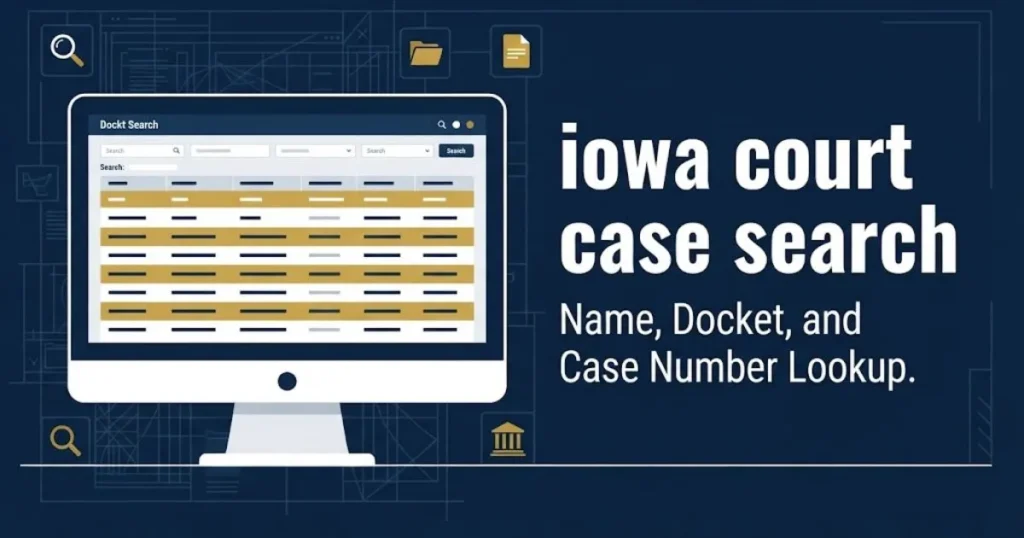
You run a docket search the same way you run a case search. Enter the party name or case number in the ICO portal. Click on the case to expand the full docket sheet.
Each docket entry includes a date stamp and a brief description. You will see entries like “Motion to Dismiss Filed” or “Order Granting Summary Judgment.” The entries are listed in reverse chronological order.
Docket searches are especially useful for tracking active litigation. You can see exactly what happened at the last hearing. You can also check whether a response deadline has passed.
For federal cases in Iowa, you will need to use PACER instead. The federal docket system charges $0.10 per page viewed. Quarterly fees under $15 are waived automatically.
| Search Type | Portal | Cost |
|---|---|---|
| State Docket | Iowa Courts Online | Free |
| Federal Docket | PACER | $0.10 per page |
| Appellate Docket | ICO or EDMS | Free |
Iowa Court Records by Name
Searching Iowa court records by name is the most common method. You simply type the full legal name of a party into the search bar. The system returns all matching cases across the state.
Use the person’s full legal name for the best results. Nicknames and abbreviations may miss records. If you know the middle initial, include it to narrow the results.
The search returns cases where the person is a plaintiff, defendant, or other party. You will see both current and historical cases listed together. Filter by county or date range to reduce clutter.
Common name searches can return hundreds of results. A search for “John Smith” in Iowa may pull over 200 cases. Use additional filters like birth year or county to find the right person.
Name searches work for businesses and organizations too. Enter the full company name to find lawsuits involving that entity. This is useful for landlords, employers, and contractors doing due diligence.
Quick Tip: Try alternate spellings if your first search comes up empty. Court clerks sometimes misspell names during data entry.
Key Takeaway: Free name-based and docket searches on the state portal give you the same core data that paid third-party services charge $20 to $50 per month to access.
Iowa Court Case Number Search
An Iowa court case number search is the fastest way to find a specific case. The case number is a unique identifier assigned when the case is first filed. No two cases share the same number.
Iowa case numbers follow a standard format. They typically start with a county code, followed by the year and a sequential number. An example might look like “LACV012345.”
If you have the case number, enter it directly into the ICO search bar. The system will pull up the exact case immediately. There is no need to filter through name matches.
Case numbers appear on every official court document you receive. Check any summons, complaint, or order you have been served with. The case number is usually printed in the top right corner.
If you do not have the case number, you can request it from the county clerk. Call the clerk’s office in the county where the case was filed. Provide the party name and approximate filing date.
| Case Number Part | Meaning |
|---|---|
| First Letters | County code |
| Middle Letters | Case type (CV, CR, SM) |
| Year Digits | Filing year |
| Final Digits | Sequential case number |
Iowa District Court Records
Iowa district court records cover the trial-level courts in the state. Iowa has eight judicial districts that span all 99 counties. Every criminal, civil, and family case starts at this level.
District courts handle the vast majority of Iowa legal disputes. This includes felony trials, divorce proceedings, and small claims cases. If a case happened in Iowa, it almost certainly passed through a district court.
You access district court records through the same ICO portal. Select the county or judicial district from the dropdown menu. The system filters results to show only trial-level cases.
Some rural district courts still maintain paper-only records for older cases. Cases filed before 2005 may not appear in the online system. You will need to contact the county clerk directly for those files.
Larger districts like Polk County (District 5) and Linn County (District 6) have fully digitized records going back to the early 2000s. These are the easiest counties to search online.
Bold Stat: Iowa’s eight judicial districts process over 400,000 new case filings every year.
Iowa Criminal Case Search
An Iowa criminal case search reveals arrests, charges, convictions, and sentencing records. These records are public under Iowa Code Chapter 22. Anyone can search them without a special reason or court order.
Criminal records include misdemeanors, felonies, traffic offenses, and OWI charges. The search results show the original charge and the final disposition. You can see whether the case ended in conviction, dismissal, or acquittal.
Run the search through the ICO portal using the defendant’s full name. Filter the case type to “Criminal” to exclude civil and family cases. This narrows results significantly.
Some criminal records may be sealed or expunged under Iowa law. Expunged cases will not appear in any public search. Iowa expanded its expungement eligibility in 2023, so more records are now hidden from public view.
Juvenile criminal records are also restricted. Cases involving defendants under 18 are generally not accessible online. You would need a court order to view most juvenile case files.
| Record Type | Public Access |
|---|---|
| Felony Convictions | Yes |
| Misdemeanor Convictions | Yes |
| Dismissed Charges | Yes |
| Expunged Cases | No |
| Juvenile Records | Restricted |
Key Takeaway: District court records cover all trial-level cases in Iowa, and criminal case searches reveal convictions, charges, and dispositions unless the record has been legally expunged or sealed.
Iowa Civil Court Records
Iowa civil court records cover lawsuits between private parties and organizations. This includes personal injury claims, contract disputes, property cases, and debt collection actions. These records are fully public.
Civil cases make up roughly 60 percent of all Iowa court filings. The ICO portal lets you filter specifically for civil case types. Look for the “CV” designation in case numbers.
You will find complaints, answers, discovery motions, and final judgments in civil records. Settlement agreements are sometimes filed publicly and sometimes kept confidential. It depends on the terms the parties negotiated.
Small claims cases are a subset of civil court records. Iowa small claims courts handle disputes under $6,500 as of 2026. These records are searchable through the same ICO portal.
Civil records are popular among landlords screening tenants and businesses vetting partners. A quick search can reveal whether someone has a history of unpaid debts or broken contracts. Think of it as a financial background check through public data.
Quick Fact: The average Iowa civil case takes 8 to 14 months from filing to final disposition.
Iowa Supreme Court Case Search
An Iowa Supreme Court case search covers the highest court in the state. The Iowa Supreme Court hears appeals from lower courts and issues binding legal opinions. Its records are fully public and free to access.
You can search Supreme Court opinions through the ICO portal or the EDMS system. Filter by court level to see only appellate decisions. Results include the full written opinion and any dissents.
The Iowa Court of Appeals is the intermediate appellate court. Its decisions are also searchable through the same portal. Many cases are resolved at this level before reaching the Supreme Court.
Supreme Court opinions are valuable for legal research. They establish precedent that lower courts must follow. Law students, attorneys, and journalists use these records frequently.
Opinions are typically published within 30 to 90 days of oral arguments. The court releases new opinions on Friday mornings during its term. You can check the Iowa Judicial Branch website for the latest releases.
| Court Level | Cases Per Year | Online Access |
|---|---|---|
| Supreme Court | 100 to 150 | Full opinions |
| Court of Appeals | 800 to 1,000 | Full opinions |
| District Courts | 400,000 plus | Docket summaries |
Iowa Public Court Records
Iowa public court records are protected under Iowa Code Chapter 22. This law guarantees that government records, including court filings, are open to inspection. You do not need to state a reason for your search.
The law covers all records created or maintained by Iowa courts. This includes filings, orders, judgments, and docket entries. Both paper and electronic records fall under the open records mandate.
Certain records are exempt from public disclosure. Sealed cases, adoption records, and mental health commitment files are restricted. Juvenile proceedings are also generally closed to the public.
Iowa updated its public records rules in 2024 to address digital access. Courts must now make electronically filed documents available online within a reasonable time. The standard is typically one to three business days.
If a court clerk denies your records request, you can appeal. File a complaint with the Iowa Public Information Board. The board has authority to investigate and enforce open records compliance.
Bold Stat: Iowa Code Chapter 22 has been in effect since 1967, making it one of the oldest open records laws in the country.
Key Takeaway: Iowa civil and Supreme Court records are fully searchable online for free, and Iowa Code Chapter 22 guarantees your right to access nearly all court filings without stating a reason.
Iowa Court Case Lookup
An Iowa court case lookup is a broader term for any method of finding court records. This includes online searches, phone calls to clerk offices, and in-person visits to courthouses. The method you choose depends on what you need.
Online lookups through the ICO portal are the fastest option. You get instant results for most cases filed after 2005. This covers the vast majority of active and recently closed cases.
Phone lookups work well when you need specific details not shown online. Call the county clerk’s office during business hours. Have the party name and approximate filing date ready.
In-person lookups are necessary for older records and certified copies. Visit the courthouse in the county where the case was filed. Bring a valid photo ID and be prepared to pay copy fees.
Some counties offer email or fax request options for record retrieval. Check the specific county clerk’s website for available methods. Processing times for remote requests range from 3 to 10 business days.
| Lookup Method | Speed | Best For |
|---|---|---|
| Online (ICO) | Instant | Recent cases |
| Phone | Same day | Specific details |
| In Person | 1 to 3 days | Old records, certified copies |
| Email or Fax | 3 to 10 days | Remote requests |
Iowa Court Filing Search
An Iowa court filing search focuses on specific documents submitted to the court. This includes complaints, motions, briefs, affidavits, and proposed orders. You search for the document itself rather than the overall case.
The EDMS system makes filing searches easier than ever in 2026. You can search by document type, filing date, and case number. The system indexes every electronically filed document by keyword.
Filing searches are useful for attorneys tracking opposing counsel’s motions. They are also helpful for journalists covering high-profile litigation. You can see exactly what was filed and when.
Not all filings are available as full-text downloads. Some documents are viewable only as docket entries with a brief description. Full PDF access may require a per-page fee depending on the county.
The state requires electronic filing for most case types as of 2025. This means nearly all new filings are immediately available in the digital system. Paper filings are becoming increasingly rare.
Quick Tip: Use the “Document Type” filter in EDMS to find specific filings like “Motion for Summary Judgment” without scrolling through the entire docket.
How to Search Iowa Court Cases
Here is how to search Iowa court cases step by step in 2026. The process takes about five minutes for most people. No legal training is required.
Step 1: Go to the Iowa Judicial Branch website. Look for the “Iowa Courts Online” or “EDMS” link on the homepage. Both portals are free and require no account.
Step 2: Choose your search type. Select “Party Name” if you know the person involved. Select “Case Number” if you have the exact identifier.
Step 3: Enter your search terms. Use the full legal name for best results. Add the county or date range if you get too many matches.
Step 4: Review the results. Click on any case to see the full docket. Check the filing date, case type, and current status.
Step 5: Download or print what you need. Some documents are free to view. Others may charge a small per-page fee for PDF downloads.
| Step | Action | Time |
|---|---|---|
| 1 | Open ICO or EDMS portal | 30 seconds |
| 2 | Choose search type | 15 seconds |
| 3 | Enter name or case number | 30 seconds |
| 4 | Review results | 1 to 3 minutes |
| 5 | Download documents | 1 to 2 minutes |
Key Takeaway: You can complete a full Iowa court case lookup in under five minutes using the free ICO or EDMS portal, and electronic filing mandates now ensure nearly all new documents are searchable online within days.
Frequently Asked Questions
Is the Iowa court case search really free?
Yes, the basic Iowa court case search is completely free through the state portal. You can view docket summaries, case status, and hearing dates at no cost. Fees only apply if you download full PDF documents or request certified copies.
Can I search Iowa court records by someone else’s name?
Yes, you can search Iowa court records by any person’s full legal name. Iowa Code Chapter 22 guarantees public access to court filings. You do not need permission from the person you are searching.
How far back do Iowa court records go online?
Most Iowa court records are available online from 2005 to the present. Cases filed before 2005 may require an in-person visit to the county courthouse. Some larger counties have digitized records going back to the early 2000s.
Are Iowa criminal cases included in the online search?
Yes, Iowa criminal cases are included in the online search results. You can filter by case type to view only criminal records. Expunged and juvenile cases are excluded from public access.
What should I do if my Iowa court case does not show up?
Contact the county clerk’s office where the case was filed. The record may not yet be digitized or may contain a data entry error. Provide the case number and filing date to help the clerk locate it.
Your Iowa court case search starts and ends with the state’s free online portals. Use Iowa Courts Online or the new EDMS system to find criminal, civil, and appellate records in minutes. If a record is missing, call the county clerk directly and request a manual lookup. Stay updated on the EDMS migration timeline so you always know which portal to use.