

An invasion of privacy lawsuit lets you sue when someone violates your personal rights. These cases are exploding in 2026 as AI surveillance and data harvesting spread everywhere.
You can recover real money if your privacy was breached. Settlements range from a few thousand dollars to well over a million in serious cases. The legal system is finally catching up.
This guide covers every type of claim you can bring. You will learn about payouts, deadlines, and filing steps. We look at employers, landlords, hospitals, and tech giants.
Over 4,000 privacy lawsuits hit federal courts last year alone. That number keeps climbing as new tech creates new violations daily.
What Is an Invasion of Privacy Lawsuit
An invasion of privacy lawsuit is a civil claim for unauthorized personal intrusion. It protects your right to keep your private life truly private.
The legal concept dates back to an 1890 Harvard Law Review article. Samuel Warren and Louis Brandeis first defined the “right to be let alone.”
Today the law recognizes four distinct categories of privacy violations. Each one covers a different type of harm.
You do not need to suffer physical injury to file. Emotional distress and reputational harm both count.
Quick Facts:
- Legal basis: Restatement (Second) of Torts, Section 652
- Claim type: Civil tort, not criminal
- Proof needed: Reasonable expectation of privacy was violated
- Burden of proof: Preponderance of the evidence
Types of Invasion of Privacy Lawsuits
The law recognizes four specific types of invasion of privacy lawsuits. Each type targets a different kind of wrongful behavior.
Intrusion upon seclusion covers unwanted prying into your private affairs. Think hidden cameras or unauthorized access to your medical records.
Public disclosure of private facts involves spreading true but deeply personal information. The disclosed facts must be offensive to a reasonable person.
False light means portraying you in a misleading way publicly. It is similar to defamation but focuses on implication rather than direct lies.
Appropriation of likeness happens when someone uses your name or image for profit. This is common in advertising and social media cases.
| Privacy Tort | What It Covers | Common Example |
|---|---|---|
| Intrusion on Seclusion | Prying into private matters | Hidden cameras in bathrooms |
| Public Disclosure | Sharing private facts publicly | Posting medical records online |
| False Light | Misleading public portrayal | Doctored photos with false captions |
| Appropriation | Using your identity for profit | Your face in an ad without consent |
Key Takeaway: The law recognizes four distinct privacy torts, and each one requires different evidence and covers different types of harm.
Invasion of Privacy Lawsuit Examples in 2026
Real invasion of privacy lawsuit examples in 2026 show how broad these claims have become. Technology has created entirely new categories of violations.
Clearview AI faced massive litigation for scraping billions of facial images without consent. The company settled multiple state-level cases for over $50 million combined.
A major hospital system in Texas paid $18 million after employees accessed patient records without authorization. Over 24,000 patients were affected in that single breach.
Meta Platforms agreed to a $725 million settlement in a long-running data tracking case. The suit alleged unauthorized collection of user activity across third-party websites.
- Biometric scanning: Facial recognition lawsuits surged under Illinois BIPA law
- Smart home devices: Ring camera data sharing triggered new class actions
- Workplace AI monitoring: Employee keystroke tracking sparked multiple suits
- Data broker sales: Personal information sold without consent drew FTC scrutiny
Invasion of Privacy Lawsuit Settlement Amounts
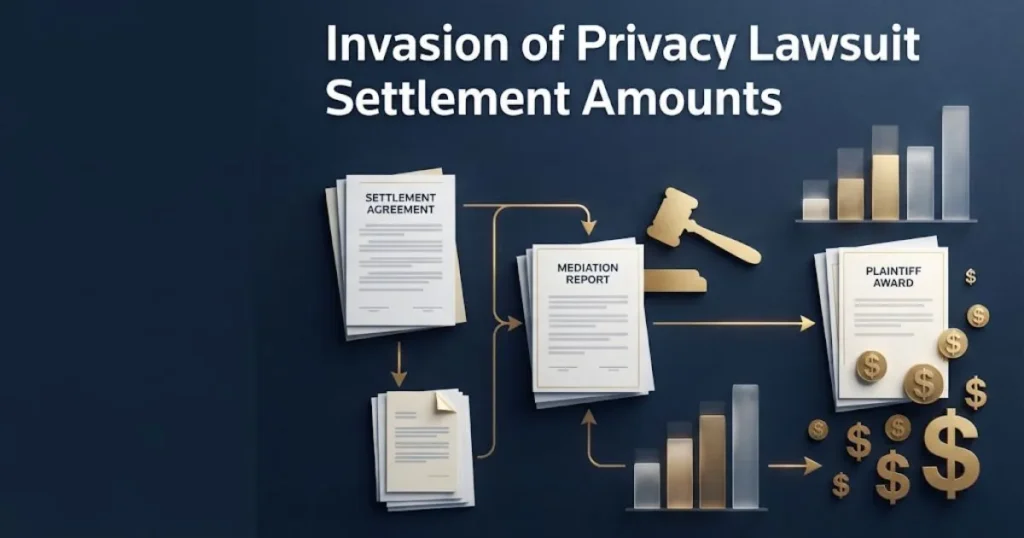
Invasion of privacy lawsuit settlement amounts vary wildly depending on the claim type. There is no single number that applies to every case.
Minor intrusion cases typically settle between $1,000 and $10,000. These involve limited exposure and minimal emotional harm.
Moderate cases with clear evidence often reach $10,000 to $100,000. Medical record breaches and employer surveillance fall in this range.
Major class actions and severe individual cases can exceed $1 million. The largest privacy settlements in recent years have topped $700 million.
| Case Severity | Typical Settlement Range | Example Scenario |
|---|---|---|
| Minor | $1,000 to $10,000 | Neighbor peeping through windows |
| Moderate | $10,000 to $100,000 | Employer reading personal emails |
| Severe | $100,000 to $1,000,000 | Hospital leaking HIV status |
| Class Action | $1 million to $725 million | Tech company mass data harvesting |
Key Takeaway: Settlement amounts depend heavily on the severity of the violation, the number of victims, and the financial resources of the defendant.
How to File an Invasion of Privacy Lawsuit
You file an invasion of privacy lawsuit by submitting a civil complaint in your state court. The process starts with documenting every detail of the violation.
First, gather all evidence of the intrusion. Save screenshots, emails, photos, and witness statements.
Second, identify which of the four privacy torts applies to your situation. This determines the legal theory in your complaint.
Third, file your complaint before the statute of limitations expires. Missing this deadline kills your case permanently.
Filing Steps at a Glance:
- Document the violation with dates, times, and proof
- Identify the correct privacy tort for your claim
- Calculate your damages including emotional distress
- File a civil complaint in the appropriate court
- Serve the defendant with official legal notice
- Enter the discovery phase to exchange evidence
Most privacy claims are filed in state civil court. Federal court applies if the defendant is a large corporation from another state.
Invasion of Privacy Lawsuit Damages You Can Recover
Invasion of privacy lawsuit damages fall into three main categories. You can recover money for economic loss, emotional harm, and punishment.
Compensatory damages cover your actual financial losses. This includes therapy bills, lost wages, and identity theft costs.
Emotional distress damages compensate for anxiety, humiliation, and sleep disruption. Courts take these seriously in privacy cases.
Punitive damages punish the defendant for especially reckless behavior. These can multiply your total award by several times.
| Damage Type | What It Covers | Typical Range |
|---|---|---|
| Compensatory | Medical bills, lost income | $5,000 to $200,000 |
| Emotional Distress | Anxiety, humiliation, trauma | $10,000 to $500,000 |
| Punitive | Punishment for willful acts | $50,000 to $5,000,000 |
| Statutory | Fixed amounts set by law | $1,000 to $5,000 per violation |
Key Takeaway: You can recover compensatory, emotional distress, and punitive damages in a privacy lawsuit, and statutory damages may apply under specific state laws like BIPA.
Invasion of Privacy Lawsuit Statute of Limitations
The invasion of privacy lawsuit statute of limitations varies by state. Most states give you between one and four years to file.
California allows two years from the date of the violation. Texas gives you two years as well.
New York is stricter with just one year for most privacy torts. Illinois allows five years under its biometric privacy law.
The clock typically starts when you discover the violation. This is called the “discovery rule” in legal terms.
| State | Time Limit | Discovery Rule Applies |
|---|---|---|
| California | 2 years | Yes |
| Texas | 2 years | Yes |
| New York | 1 year | Limited |
| Illinois | 5 years (BIPA) | Yes |
| Florida | 4 years | Yes |
Do not wait to act. Evidence disappears and memories fade quickly. File as soon as you confirm the violation occurred.
Invasion of Privacy Lawsuit Compensation Breakdown
Invasion of privacy lawsuit compensation depends on several key factors. The type of violation matters most.
Appropriation of likeness cases tend to pay the highest individual awards. Your face has commercial value, and courts recognize that.
Public disclosure cases vary based on how widely the information spread. A viral social media post causes more damage than a private conversation.
Intrusion cases often yield moderate compensation unless the intrusion was extreme. Hidden cameras in bedrooms produce the largest intrusion awards.
Compensation Factors:
- Severity of the violation: More intrusive means higher payouts
- Duration of exposure: Longer violations increase damages
- Number of people affected: Mass violations trigger class actions
- Defendant’s financial resources: Deep pockets mean bigger settlements
- State law differences: Some states cap damages while others do not
Key Takeaway: Your compensation depends on the violation type, the extent of harm, and the defendant’s ability to pay, with biometric and likeness cases paying the most.
Invasion of Privacy Lawsuit Against Your Employer
An invasion of privacy lawsuit against your employer is one of the most common claims filed today. Workplace surveillance has reached unprecedented levels in 2026.
Employers cannot monitor your personal phone calls on your own device. They cannot read personal emails sent from private accounts during breaks.
However, employers do have the right to monitor company equipment. Your work laptop and company email are generally fair game.
The line blurs with remote work monitoring software. Keystroke loggers and webcam snapshots have triggered dozens of new lawsuits.
| Employer Action | Legal or Illegal |
|---|---|
| Monitoring company email | Generally legal |
| Reading personal phone texts | Illegal |
| GPS tracking company vehicles | Usually legal with notice |
| Hidden cameras in restrooms | Always illegal |
| Keystroke logging on personal devices | Illegal |
| Social media password requests | Illegal in most states |
Bold stat: Over 60% of large employers now use some form of AI-driven employee monitoring. That number doubled since 2023.
Invasion of Privacy Lawsuit Against Social Media Companies
An invasion of privacy lawsuit against social media companies dominates headlines in 2026. Tech giants face unprecedented legal pressure over data collection.
Meta, TikTok, and Google have all paid massive settlements recently. The allegations center on tracking users without meaningful consent.
Children’s privacy violations carry the heaviest penalties. The FTC has imposed fines exceeding $500 million for COPPA violations alone.
Facial recognition features on social platforms triggered a wave of BIPA lawsuits. Illinois residents have received payouts of $200 to $400 per violation.
Major Social Media Privacy Cases:
- Meta: $725 million settlement for third-party data sharing
- TikTok: $92 million settlement for biometric data collection
- Google: $391.5 million settlement for location tracking deception
- Snapchat: Ongoing litigation over location data exposure
Key Takeaway: Social media companies face the largest privacy settlements in history, and individual users may be eligible for payouts from active class actions.
Invasion of Privacy Lawsuit Against a Landlord
An invasion of privacy lawsuit against a landlord typically involves illegal entry or surveillance. Tenants have a legal right to quiet enjoyment of their homes.
Your landlord cannot enter your unit without proper notice. Most states require at least 24 to 48 hours written notice.
Hidden cameras in common areas may be legal in some states. Cameras pointed at your front door or inside your unit are not.
Landlords also cannot share your personal information with third parties. Your rental application and payment history are confidential.
| Landlord Action | Legal Status |
|---|---|
| Entering without 24-hour notice | Illegal in most states |
| Installing cameras inside your unit | Always illegal |
| Sharing your SSN with marketers | Illegal |
| Inspecting with proper notice | Legal |
| Cameras in outdoor common areas | Usually legal |
| Reading your mail | Federal crime |
Bold stat: Tenant privacy complaints increased by 35% in 2025 according to HUD data. Smart home devices in rentals are the fastest-growing source of disputes.
Invasion of Privacy Lawsuit Against a Hospital
An invasion of privacy lawsuit against a hospital usually involves unauthorized access to medical records. HIPAA sets the federal standard for patient privacy.
Hospital employees cannot look at your records out of curiosity. Every access must have a legitimate treatment or billing purpose.
Celebrity medical record breaches draw the largest settlements. A single unauthorized look at a VIP chart can cost a hospital millions.
Mental health and HIV records receive the strongest legal protection. Disclosure of these conditions triggers the highest damage awards.
Common Hospital Privacy Violations:
- Staff accessing records of coworkers or neighbors
- Accidental release of records to the wrong patient
- Posting patient photos on social media
- Discussing patient conditions in public areas
- Selling patient data to pharmaceutical companies
Key Takeaway: Hospital privacy violations involving sensitive conditions like mental health or HIV status produce the highest individual damage awards in privacy law.
Invasion of Privacy Lawsuit Cost to File
The invasion of privacy lawsuit cost to file depends on your approach. You have several options at different price points.
Filing fees alone typically range from $150 to $400 depending on your court. Small claims court costs less than superior court.
Attorney fees for privacy cases usually run on contingency. That means you pay nothing upfront and the lawyer takes 33% to 40% of your recovery.
Hourly rates for privacy attorneys range from $200 to $600 per hour. Complex cases against tech companies cost more than simple neighbor disputes.
| Cost Category | Typical Range |
|---|---|
| Court filing fees | $150 to $400 |
| Contingency attorney fee | 33% to 40% of recovery |
| Hourly attorney rate | $200 to $600 per hour |
| Expert witness fees | $2,000 to $10,000 |
| Discovery and deposition costs | $1,000 to $15,000 |
Many privacy lawyers offer free initial consultations. Shop around before committing to a firm.
Invasion of Privacy Lawsuit Against Police Departments
An invasion of privacy lawsuit against police departments involves Fourth Amendment violations. Unlawful searches and surveillance are the most common claims.
Police cannot search your phone without a warrant. The Supreme Court confirmed this in Riley v. California.
Body camera footage release has become a major privacy battleground. Victims of police encounters are suing to keep footage private.
Drone surveillance by law enforcement is a growing concern in 2026. Several states have passed new laws restricting aerial monitoring.
Common Police Privacy Violations:
- Warrantless phone searches during traffic stops
- Unauthorized use of facial recognition on bystanders
- Releasing body cam footage of medical emergencies
- GPS tracking without a court order
- Social media monitoring without probable cause
Bold stat: The ACLU reported a 45% increase in police surveillance lawsuits between 2023 and 2025. Facial recognition misuse is the leading cause.
Key Takeaway: Police privacy lawsuits center on Fourth Amendment protections, and recent Supreme Court rulings have strengthened your rights against warrantless digital searches.
Invasion of Privacy Lawsuit Trends for 2026
Invasion of privacy lawsuit trends for 2026 point to a massive expansion of claims. Technology is outpacing the law, and courts are scrambling to catch up.
AI-generated deepfakes are the fastest-growing category of privacy suits. Victims are suing creators for false light and appropriation claims.
Biometric data collection lawsuits continue to dominate. Illinois BIPA remains the most powerful state privacy law in the country.
Children’s data privacy is getting aggressive enforcement. New federal proposals would expand COPPA protections to teens under 17.
2026 Privacy Lawsuit Predictions:
- Deepfake litigation: Expected to triple by year-end
- Biometric claims: BIPA payouts projected to exceed $2 billion total
- AI workplace monitoring: New class actions filing every quarter
- Smart home data: Ring and Nest data sharing suits expanding
- Health app privacy: Fitness and period tracker data sales under fire
Bold stat: Privacy lawsuit filings increased by 28% in 2025 compared to 2024. Analysts expect another 20% jump in 2026.
Frequently Asked Questions
How much is an invasion of privacy lawsuit worth?
Most individual claims settle between $1,000 and $100,000 depending on severity.
Severe cases involving medical records or biometric data can exceed $1 million.
Class action payouts vary based on the total settlement fund and number of claimants.
How long do you have to file an invasion of privacy lawsuit?
Most states give you between one and four years from the date of the violation.
California and Texas allow two years, while Illinois allows five years for biometric claims.
The clock may start when you discover the violation rather than when it occurred.
Can you sue for invasion of privacy without physical harm?
Yes, you can sue without any physical injury at all.
Emotional distress, reputational damage, and financial loss all qualify as valid harm.
Courts recognize that privacy violations cause real psychological injury.
What are the four types of invasion of privacy claims?
The four types are intrusion on seclusion, public disclosure, false light, and appropriation.
Each type covers a different form of wrongful conduct against your personal privacy.
Your specific situation determines which type of claim you should file.
Is invasion of privacy a criminal charge or a civil case?
Invasion of privacy is primarily a civil lawsuit where you sue for money damages.
Some related acts like wiretapping or voyeurism can also carry criminal charges.
You can pursue both a civil suit and support criminal prosecution simultaneously.
Your privacy rights are stronger now than at any point in recent history. The law is evolving fast to match the technology that threatens your personal life.
Check your eligibility for any active class action settlements. Document any violations immediately and preserve all evidence.
Do not let the statute of limitations expire on your claim. Take action now while the evidence is fresh and the deadlines are still open.







